Question 13 Marks
A cuboidal tin box opened at the top has dimensions $20cm \times 16cm \times 14cm$. What is the total area of metal sheet required to make $10$ such boxes?
AnswerDimensions of cuboidal tin box are $20cm \times 16cm \times 14cm,$
$\therefore$ Area of metal sheet for 1 box = Surface area of cuboid
$= 2(lb + bh + hl)$
$= 2(20 \times 16 + 16 \times 14 + 14 \times 20)$
$= 2(320 + 224 + 280)$
$= 2(824)$
$= 1648cm^2$
$\therefore$ Area of metal sheet required to make $10$ such boxes $= 10 \times 1648 = 164600m^2$.
View full question & answer→Question 23 Marks
Find the area of the shaded portion in the following figures.
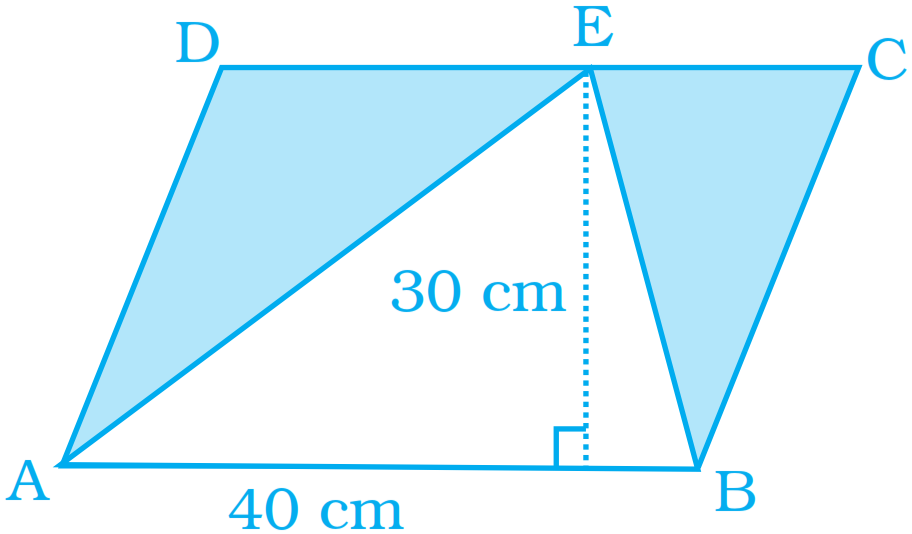
AnswerArea of the shaded region = Area of the parallelogram $ABCD$ - Area of $\triangle\text{ABE}$
$\because$ Area of parallelogram = Side $\times$ Height
$\therefore$ Area of parallelogram $ABCD = 40 \times 30 = 1200cm^2$
Area of $\triangle\text{AEB}=\frac{1}{2}\times\text{AB}\times\text{EF}=\frac{1}{2}\times40\times30=600\text{cm}^2$
$\therefore$ Area of shaded region $= 1200 - 600 = 600cm^2$
View full question & answer→Question 33 Marks
A running track has $2$ semicircular ends of radius 63m and two straight lengths. The perimeter of the track is $1000\ m$. Find each straight length.
AnswerRadius of semi-circular track $= 63\ m$
perimeter of $2$ semi-circals = Perimeter of $1$ circle
perimeter of a circular track $=2\pi\text{r}$
perimeter of circular track $=2\times\frac{22}{7}\times63$
$=2\times22\times9$
$=44\times9$
$=396\text{m}$
$\because$ The perimeter of the total track is 1000m.
$\therefore$ Length of two straight lengths track
$=100-396$
$=604\text{m}$
Length of $1$ straight longth track $=\frac{604}{2}=302\text{m}$
View full question & answer→Question 43 Marks
The ratio between the curved surface area and the total surface area of a right circular cylinder is $1 : 2$. Find the ratio between the height and radius of the cylinder.
AnswerCurved surface area of a cylinder $=2\pi\text{rh}$
Total surface area of a cylinder $=2\pi\text{r}(\text{r + h})$
The ratio between the curved surface area and the total surface area of a cylinder is $1 : 2,$
$\therefore\frac{1}2{}=\frac{2\pi\text{rh}}{2\pi\text{r(r + h)}}$
$\Rightarrow\frac{1}{2}=\frac{\text{h}}{(\text{r + h})}$
$\Rightarrow2\text{h}=(\text{r + h})$
$\Rightarrow2\text{h}-\text{h = r}\Rightarrow\text{h = r}$
$\therefore$ Ratio of height and radius $= 1 : 1.$
View full question & answer→Question 53 Marks
A bicycle wheel makes $500$ revolutions in moving $1\ km$. Find the diameter of the wheel.
AnswerA bicycle wheel makes $500$ revolutions in moving $1\ km$.
In $1$ revolution, the bicycle wheel covers
$=\frac{1}{500}\text{km}=\frac{1000}{500}\text{m}=2\text{m}$
$1$ revolution distance $=\frac{\text{Circumference}}{\text{Perimeter of the wheel }}$
$\Rightarrow2\pi\text{r}=2$
$\Rightarrow2\times\frac{22}{7}\times\text{r}=2$
$\Rightarrow\text{r}=\frac{2\times7}{2\times22}=\frac{7}{22}$ [$\because$ Circumference of a circle $=2\pi\text{r}$]
$\therefore\text{Diameter (d)}=2\text{r}=\frac{7}{22}\times2=\frac{7}{11}=0.636\text{m}$
View full question & answer→Question 63 Marks
If the length of each edge of a cube is tripled, what will be the change in its volume?
AnswerLet the edge of a cube be a.
If edge of the cube became tripled i.e. $a = 3 \times a = 3a$
$\because$ Volume of the cube $= a^3$
$\therefore$ Volume of the cube with edge tripled $= (3a)^3= 27a^3$
Hence, volume is $27$ times of the original volume.
View full question & answer→Question 73 Marks
The circumference of the front wheel of a cart is $3\ m$ long and that of the back wheel is $4\ m$ long. What is the distance travelled by the cart, when the front wheel makes five more revolutions than the rear wheel?
AnswerGiven, circumference of front wheel $= 3\ m$
Now, distance covered by front wheel of the cart in $1$ revolution = Circumference of front wheel.
$\therefore$ Distance covered by front wheel in $5$ revolutions $= 3 \times 5 = 15\ m$
Hence, the distance covered by the cart is $15\ m.$
View full question & answer→Question 83 Marks
What will happen to the volume of the cube, if its edge is:
$a.$ Tripled.
$b.$ Reduced to one$-$fourth?
AnswerLet each side of the cubo be a, then its volume $= a^3 [\because$ volume of a cube $= (\text{side})^3]$
$a.$ If side became triple, then volume will be $= (3a)^3= 27a^3$
Hence, new volume of the cube will $27$ times of original volume of the cube.
$b.$ If side reduced to one fourth $=\text{a}\times\frac{1}{4}=\frac{\text{a}}{4}$
Now, its volume $=\Big(\frac{\text{a}}{4}\Big)^3=\frac{\text{a}^3}{64}$
Hence, new volume $\frac{1}{64}$ times of original volume.
View full question & answer→Question 93 Marks
Water flows from a tank with a rectangular base measuring $80\ cm$ by $70\ cm$ into another tank with a square base of side $60\ cm$. If the water in the first tank is $45\ cm$ deep, how deep will it be in the second tank?
AnswerDimensions of rectangular base tank are $80\ cm \times 70\ cm.$
Height of rectangle base tank $= 45\ cm$
Each side of square base tank $= 60\ cm$
Let h be the height of square base tank
Volume of rectangular tank = Volume of square tank
$\Rightarrow80\times70\times45=60\times60\times\text{h}$ [$\because$ volume of cuboidal $= l \times b \times h]$
$\Rightarrow\frac{80\times70\times45}{60\times60}=\text{h}$
$\therefore\text{h}=70\text{cm}$
Hence, water in second tank will be $70\ cm$ deep.
View full question & answer→Question 103 Marks
Three cubes each of side $10\ cm$ are joined end to end. Find the surface area of the resultant figure.
AnswerIf three cubes each of side $10\ cm$ are joined, then a cuboid will be formed of dimensions $30cm \times 10cm \times 10cm.$
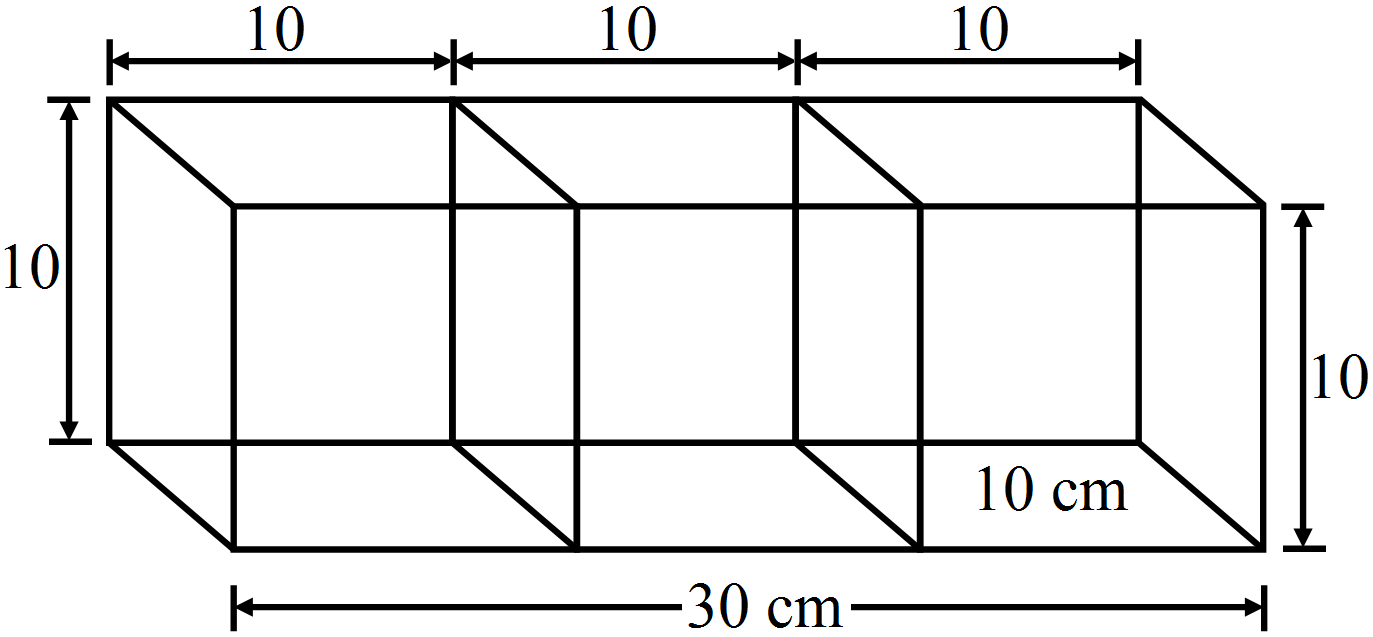
$\therefore$ Surface area of the cuboid $= 2[lb + bh+ hl]$
$= 2[30 \times 10 + 10 \times 10 + 30 \times 10]$
$= 2[300 + 100 + 300] = 2[700] = 1400cm^2$ View full question & answer→Question 113 Marks
Find the perimeter of the given figure.
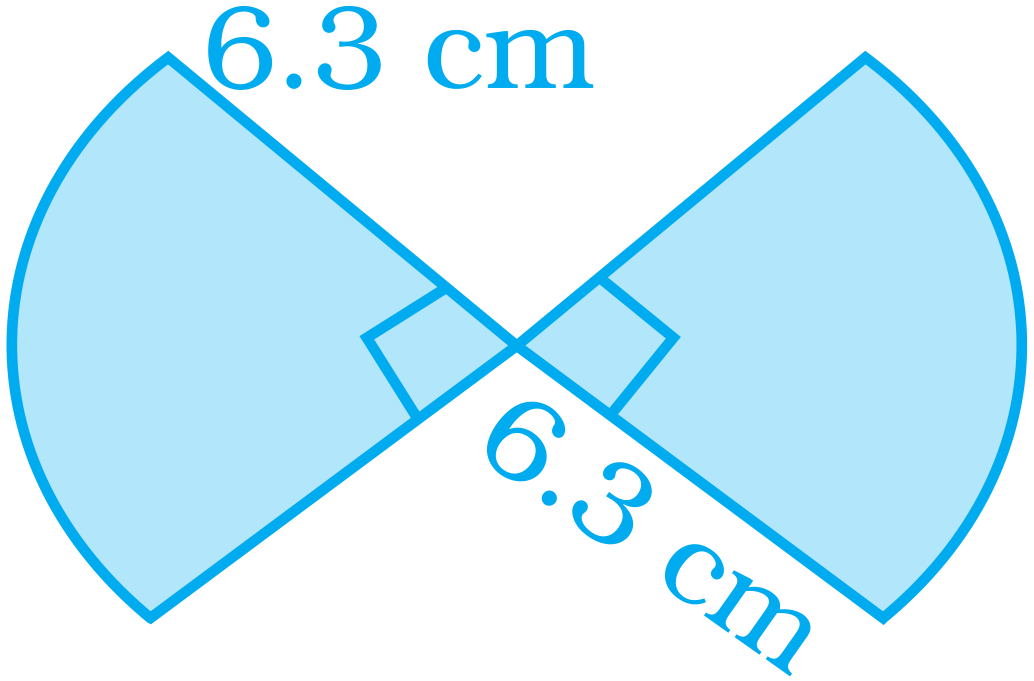
AnswerRadius of the given figure $= 6.3\ m$
Two sections in figure from a semi-circle.
Perimeter of semi-circular figure $=\frac{2\pi\text{r}}{2}+2\text{r}=\pi\text{r}+2\text{r}$
$=\frac{22}{7}\times6.3+2\times6.3$
$=22\times0.9+2\times6.3$
$=19.8+12.6=32.4\text{m}$
View full question & answer→Question 123 Marks
Find the area of the shaded portion in the following figures.
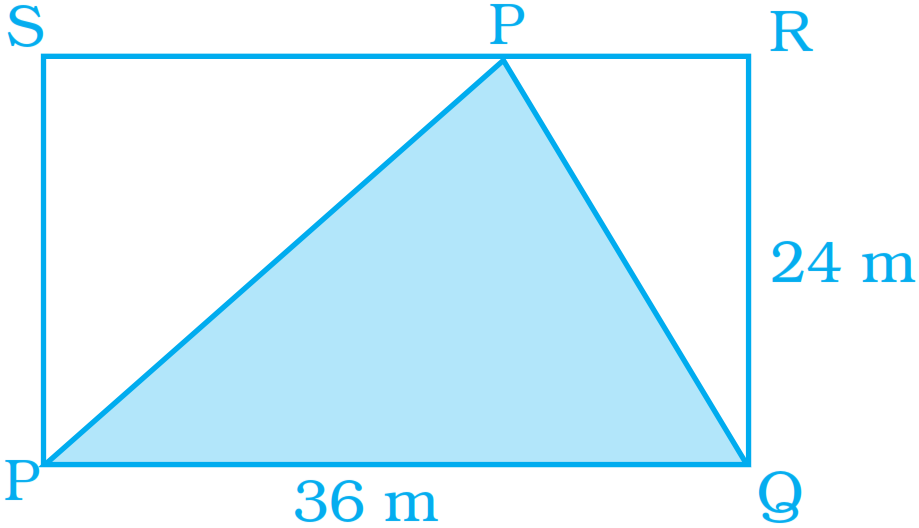
AnswerArea of the shaded portion = Area of $\triangle\text{PTQ}$
$\because$ Area of a triangle $=\frac{1}{2}\times\text{Base}\times\text{ Height}$
So, in $\triangle\text{PTQ},$ RQ = Height
$\therefore$ Area of $\triangle\text{PTQ}=\frac{1}{2}\times36\times24$
$=18\times24=432\text{m}^2$
View full question & answer→Question 133 Marks
A truck carrying $7.8m^3$ concrete arrives at a job site. A platform of width $5\ m$ and height $2\ m$ is being contructed at the site. Find the length of the platform, constructed from the amount of concrete on the truck?
AnswerTotal volume of concrete $= 7.8m^3$
Width of the platform $= 5m$
Height of the platform $= 2m$
Let the length of the platform $= xm$
According to the question,
Volume of concrete = Volume used to make platform
$\therefore 7.8 = 5 \times 2 \times x$
$\Rightarrow 7.8 = 10x$ [$\because$ volume = length \times breadth $\times$ height]
$\Rightarrow 10x = 7.8$
$\Rightarrow x = 0.78m$
Hence, the length of the platform is $0.78m.$
View full question & answer→Question 143 Marks
Find the area of the shaded portion in the following figures.
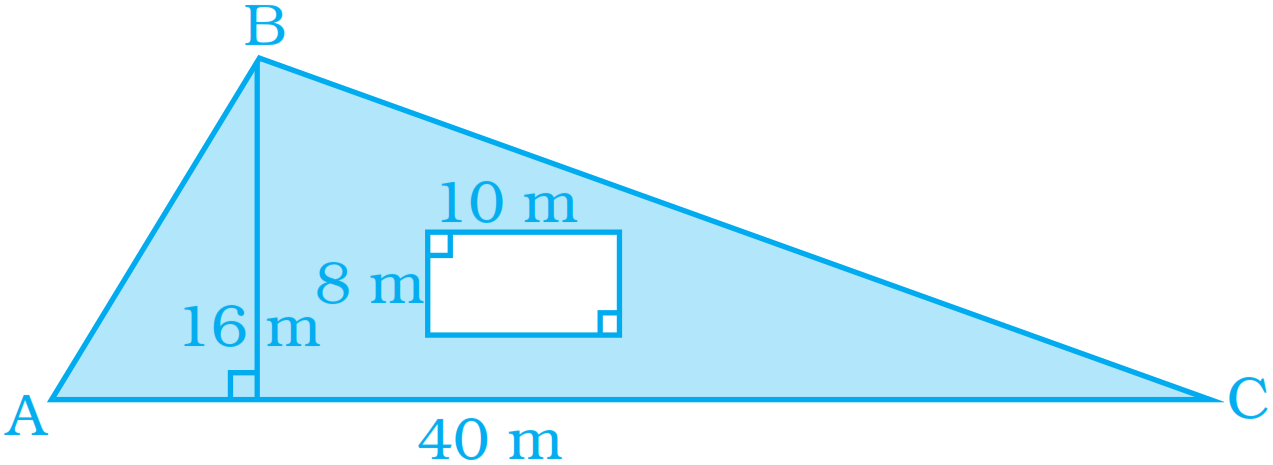
AnswerArea of the shaded region = Area of $\triangle\text{ABC}$ - Area of rectangle $PQRS$
$\therefore$ Area of a triangle $=\frac{1}{2}\times\text{Base}\times\text{ Height}$
$\therefore$ Area of $\triangle\text{ABC}=\frac{1}{2}\times\text{AC}\times\text{BD}=\frac{1}2{}\times40\times16\text{m}^2$
$=20\times16=320\text{m}^2$
$\because$ Area of rectangle = Length \times Breadth
$\therefore$ Area of rectangle $= 10 \times 8 = 80m^2$
Area of shaded region $= 320 - 80 - 240m^2$
View full question & answer→Question 153 Marks
Work out the surface area of following shape (use $\pi = 3.14).$
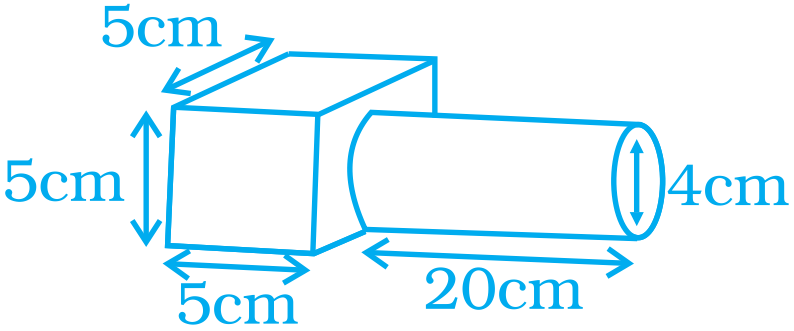
AnswerIn the given figure, there is a cube of side $5\ cm$ and a cylinder of hight $20\ cm$ and radius is $2\ cm.$
So, total surface area = Surface area of cube + Curved surface area of cylinder
$=6(5)^2+2\pi(2)\times20 [\because\text{}$ surface area of cube $= 6a^2]$ $ [\therefore$ surface area of cylinder $=2\pi\text{rh}]$
$=150+80\pi$
Total surface aera $= 150 + 251.2 = 401.2cm^2$
Note: In this question assume that cylinder is at end open.
View full question & answer→Question 163 Marks
A cube of side 5cm is cut into as many $1\ cm$ cubes as possible. What is the ratio of the surface area of the original cube to that of the sum of the surface areas of the smaller cubes?
AnswerSurface area of a cube $= 6a^2$, where a is side of a cube.
$\therefore$ Side of cube $= 5cm$
$\therefore$ Surface area of the cube $= 6 \times (5)^2- 6 \times 25$
$= 150cm^2$
Now, surface area of the cube with side $1cm = 6 \times (1)^2= 6cm^2$
$\therefore$ Surface area of 5 cubes with side $1cm = 5 \times 6 = 30cm^3$
Ratio of the surface area of the original cube to that of the sum of the surface area of the smaller cubes $=\frac{30}{150}=\frac{3}{15}=1:5$
View full question & answer→Question 173 Marks
A carpenter makes a box which has a volume of $13,400cm^3$. The base has an area of $670cm^2$. What is the height of the box?
AnswerLet the height of the box be h.
Volume of the $= 13400cm^2$
Area of base of the box $= 670cm^2$
$\because$ Volume of a box = Area of base × Height
$\therefore13400=670\times\text{h}$
$\Rightarrow\text{h}=\frac{13400}{670}$
$\Rightarrow\text{h}=\frac{1340}{67}=20\text{cm}$
Hence, the height of the box is $20\ cm.$
View full question & answer→Question 183 Marks
The radius and height of a cylinder are in the ratio $3 : 2$ and its volume is $19,404cm^3$. Find its radius and height.
AnswerThe radius and height of a cylinder are in the ratio $3 : 2.$
Let the radius be 3x and height be $2x$. Then,
Volume of cylinder $= 19404cm^3$
$\because$ Volume of a cylinder $=\pi\text{r}^2\text{h}$
$\therefore19404=\frac{22}{7}\times(3\text{x})^2\times(2\text{x})$
$\Rightarrow19404=\frac{22}{7}\times9\text{x}^2\times2\text{x}=\frac{22\times18\text{x}^3}{7}$
$\Rightarrow19404=\frac{396\text{x}^3}{7}$
$\Rightarrow\text{x}^3=343\Rightarrow\text{x}^3=(7)^3$
$\therefore\text{x}=7\text{cm}$
Hence, radius of the cylinder $\text{= 3 \times 7 = 21cm}$
and height of the cylinder $\text{= 2 \times 7 = 14cm}$
View full question & answer→Question 193 Marks
A rectangular examination hall having seats for $500$ candidates has to be built so as to allow $4$ cubic metres of air and $0.5$ square metres of floor area per candidate. If the length of hall be $25\ m$, find the height and breadth of the hall.
AnswerTotal number of seats in rectangular examination hall $= 500$
Length of the hall $= 25m$
Cubic metres of air for per candidate $= 4m^3$
Square metres of floor area for per candidate $= 0.5m^2$
$\therefore$ Height of the hall $=\frac{\text{Volume of air per candidate}}{\text{Square metre of floor area for one candidate}}$
$=\frac{4}{0.5}=\frac{40}{5}=8\text{m}$
Total capacity of the hall $=500\times4=2000\text{m}^3$
$\therefore$ Breadth of the hall $=\frac{2000}{25\times8}=\frac{80}{8}=10\text{m}$
View full question & answer→Question 203 Marks
Find the area of the shaded portion in the following figures.
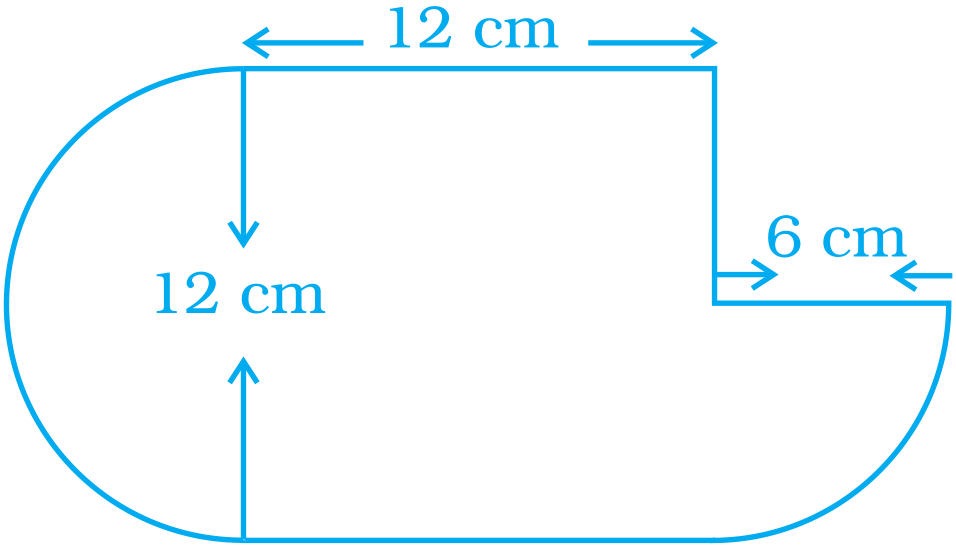
AnswerArea of the given figure = Area of section with $6\ cm +$ Area of square with side measure $12\ cm +$ Area of semi-circle with radius 6cm
$=\frac{22\times6\times6}{7\times4}+(12)^2+\frac{22\times6\times6}{7\times2}=\frac{11\times18}{7}+144+\frac{11\times36}{7}$
$=\frac{198}{7}+144+\frac{396}{7}$
$=\frac{198+1008+396}{7}=\frac{1602}{7}=228.85\text{cm}^2$
Hence, area of the given figure is $225.85cm^2$.
View full question & answer→Question 213 Marks
A wooden box (including the lid) has external dimensions $40\ cm$ by $34\ cm$ by $30\ cm$. If the wood is $1\ cm$ thick, how many $cm^3$ of wood is used in it?
AnswerExternal dimensions of wooden box are $40\ cm × 34\ cm × 30\ cm$
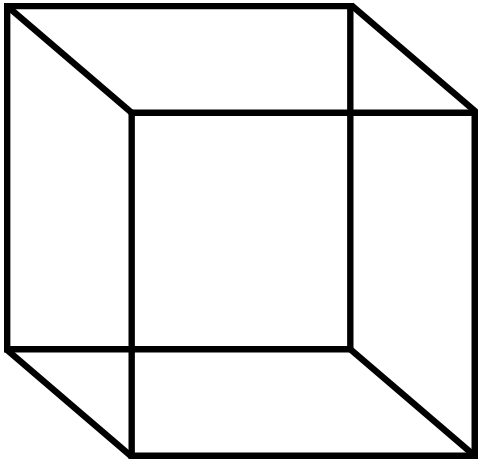
Since, the wood is $1\ cm$ thick, it means the internal dimensions will be
$(40 - 2)\ cm × (34 - 2)\ cm × (30 - 2)\ cm = 38\ cm × 32\ cm × 28\ cm$
$\therefore$ Wood used foe the box
$=$ Volume of the wooden box with external dimensions - Volume of the wooden box with internal dimensions
$= 40 × 34 × 30 - 38 × 32 × 28$
$= 40800 - 34048$
$= 6752\ cm^3$ View full question & answer→Question 223 Marks
A boy is cycling such that the wheels of the cycle are making $140$ revolutions per hour. If the diameter of the wheel is $60\ cm$, calculate the speed in km/h with which the boy is cycling.
AnswerThe cycle are making $140$ revolutions per hour.
Diameter of the wheel $= 60\ cm$
Radius of the wheel $= 30\ cm$
Circumference of a circle $=2\pi\text{r}$
$=2\times\frac{22}{7}\times30$
$=\frac{44\times30}{7}$
$=188.57\text{cm}$
Distance cover in $140$ revolutions
$=140\times188.57$
$=26400\text{cm}$
$\therefore\text{Speed}=\frac{26400}{100000}\text{km/h}$
$=0.264\text{km/h}$
View full question & answer→Question 233 Marks
A river $2\ m$ deep and $45\ m$ wide is flowing at the rate of $3\ km$ per hour. Find the amount of water in cubic metres that runs into the sea per minute.
AnswerDepth of the river $= 2\ m$
Width of the river $= 45\ m$
Flowing rate of the water $= 3km/h$
$=3\times\frac{1000}{60}=\frac{3000}{60} [\because 1km = 1000\ m$ and $1h = 60min]$
$=\frac{300}{6}=50\text{m/min}$
The amount of water into sea per minute
$=$ Depth $\times $ Width $\times $ Length of water of 1min
$= 2 \times 45 \times 50$
$= 4500m^3/min$
View full question & answer→Question 243 Marks
How many cubic metres of earth must be dug to construct a well $7\ m$ deep and of diameter $2.8\ m?$
AnswerA well is in the form of cylinderical form.
Earth must be dug to construct a well $7\ m$ deep and diameter $2.8\ m$ is equal to the volume of a cylinder with $7\ m$ height and diameter $2.8\ m.$
Volume of a cylinder $=\pi\text{r}^2\text{h}$
$=\frac{22}{7}\times\frac{2.8}{2}\times\frac{2.8}{2}\times7=11\times2.8\times1.4=43.12\text{m}^3$
View full question & answer→Question 253 Marks
Find the area of the shaded portion in the following figures.
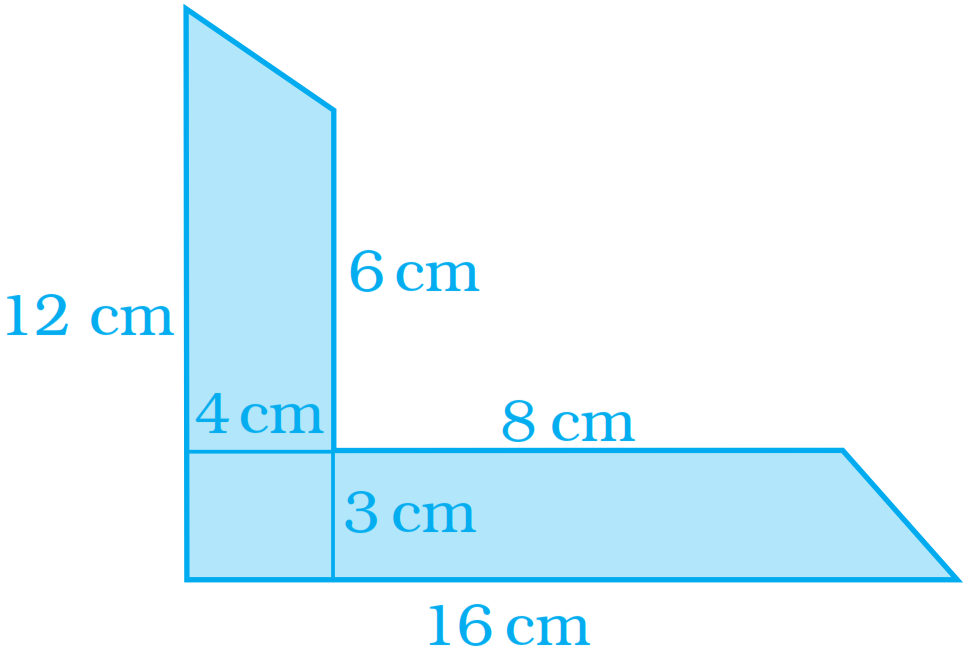
Answer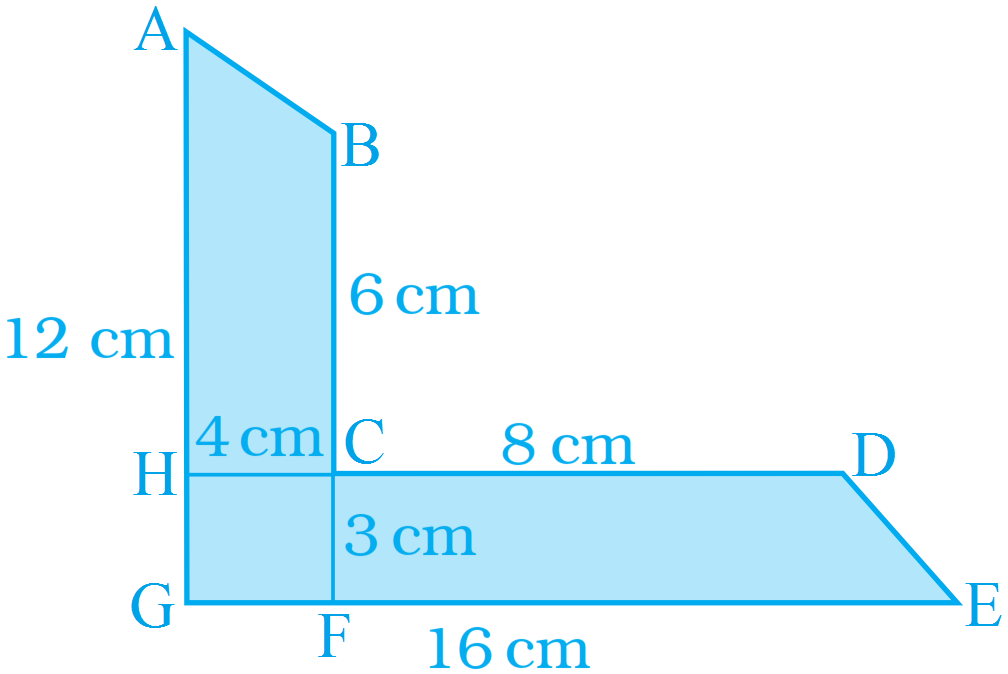
Area of shaded portion = Area of trapezium $ABCH +$ Area of trapezium $CDEF$
Area of trapezium $=\frac{1}{2}\times(\text{Sum of parallel sides})\times\text{(Height)}$
$\therefore$ Area of trapezium $ABCH$
$=\frac{1}{2}\times(12+6)\times4=\frac{1}2{}\times18\times4=18\times2=36\text{cm}^2$
$\therefore$ Area of trapezium $CDEF =\frac{1}2{}\times(8+16)\times3$
$=\frac{24\times3}{2}=36\text{cm}^2$
Area of shaded portin $=36+36=72\text{cm}^2$ View full question & answer→Question 263 Marks
Find the area to be painted in the following block with a cylindrical hole. Given that length is $15\ cm$, width $12\ cm$, height $20\ cm$ and radius of the hole $2.8cm.$
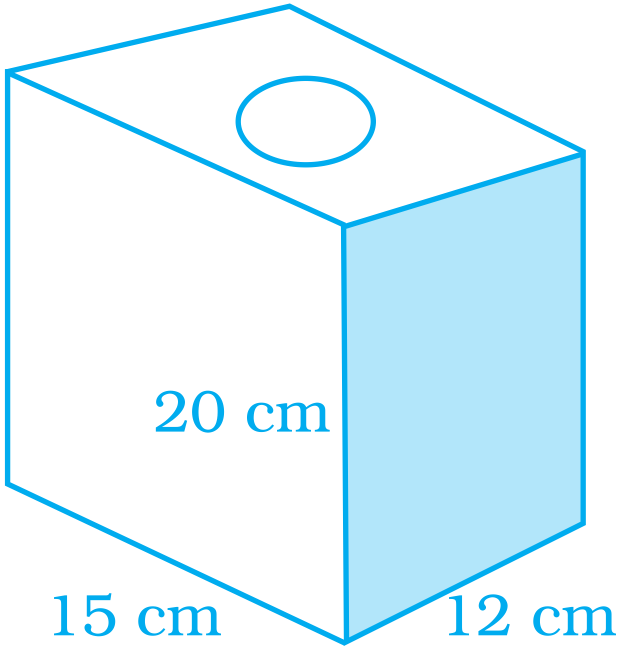
AnswerLenght of the given figure $= 15\ cm$
width of the given figure $= 12\ cm$
Height of the given figure $= 20\ cm$
Radius of the hole $= 2.8\ cm$
$\therefore$ The area to be painted = Surface area of the figure $- 2 \times $ Area of the circular hole
$=2(\text{lb + bh + lh})-2\pi\text{r}^2$
$=2(15\times12+12\times20+15\times20)-2\times\frac{22}{7}\times2.8\times2.8$
$=2(180+240+300)-\frac{44\times2.8\times2.8}{7}$
$=2\times720-49.28$
$=1440-49.28$
$=1390.72\text{cm}^2$
View full question & answer→Question 273 Marks
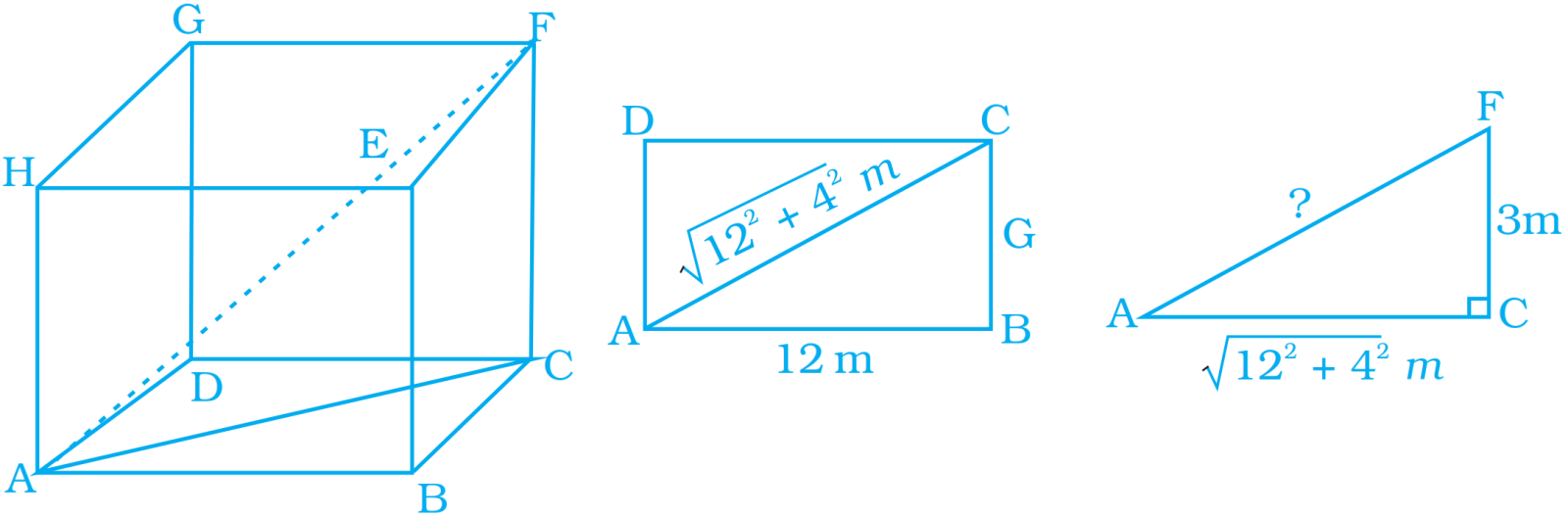
Find the length of the largest pole that can be placed in a room of dimensions 12m × 4m × 3m.
Answer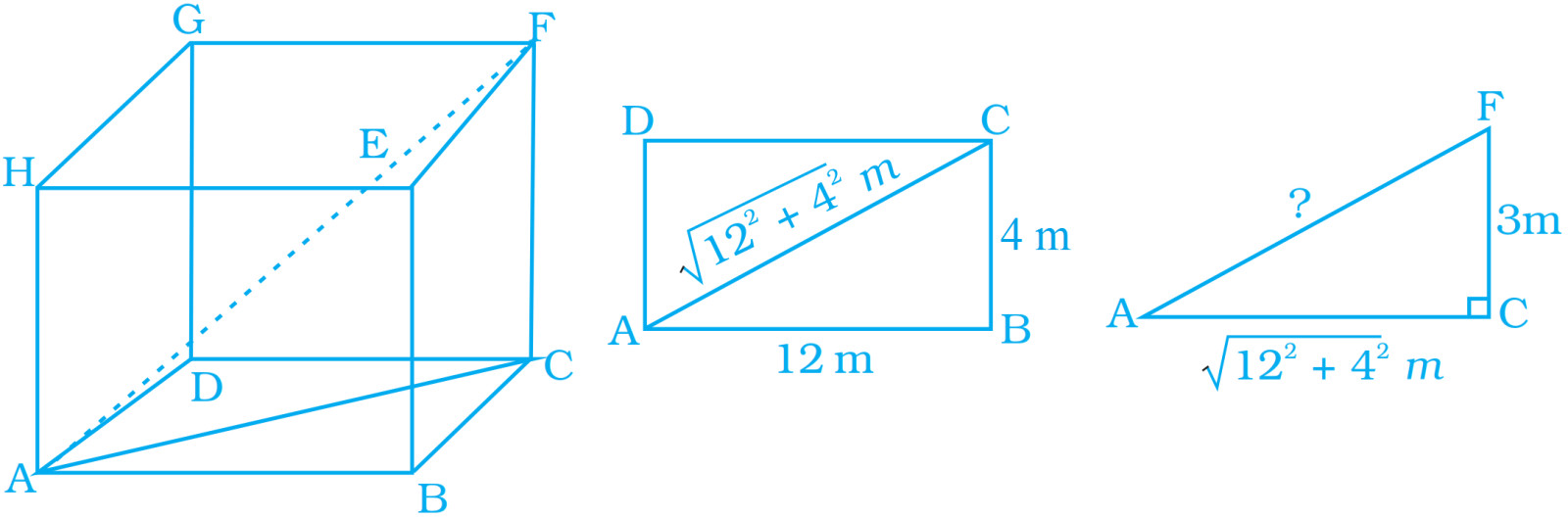
We have, $\triangle\text{ACF,}$ in which $\angle\text{C}=90^{\circ},$ CF = 3m and $\text{AC}=\sqrt{(12)^2+(4)^4}\text{m}$
The length of the largest pole = Length of diagonal of cuboid (in shape of room)
$\Rightarrow(\text{AF})^2=\text{(AC)}^2+\text{(CF)}^2$
$\Rightarrow\text{(AF})^2=(12)^2+(4)^2+(3)^2$
$\Rightarrow\text{AF}=\sqrt{144+16+9}$
$=\sqrt{169}$
$=13\text{m}$ View full question & answer→Question 283 Marks
A square sheet of paper is converted into a cylinder by rolling it along its side. What is the ratio of the base radius to the side of the square?
AnswerLet the sides of a square paper be a.
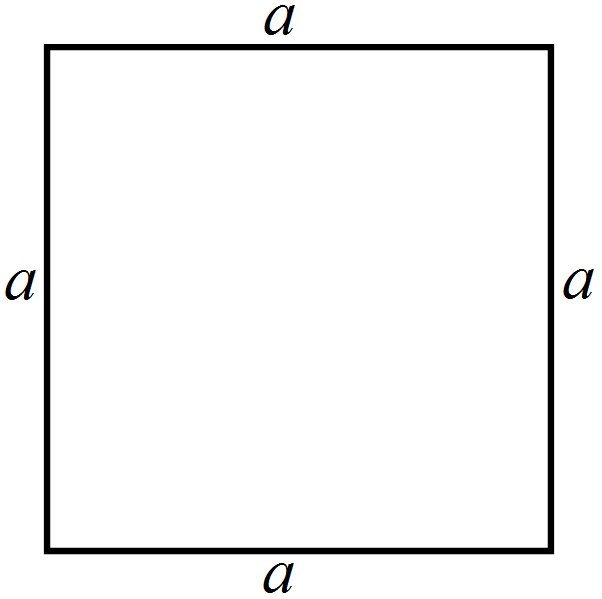
A cylinder is formed by rolling the paper along its side.
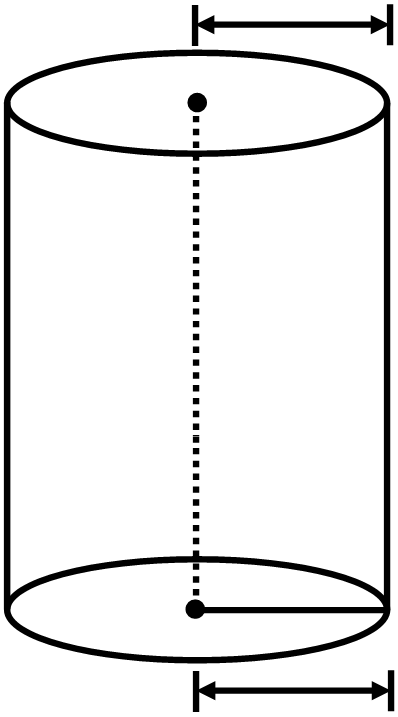
$\therefore$ Base of the cylinder is circle, so the circumference of the circle is equal to the length of each side of the square sheet.
$\Rightarrow2\pi\text{r}=\text{a}$ [$\because$ circumference of circle $=2\pi\text{r}$]
$\therefore\text{r}=\frac{\text{a}}{2\pi}$
$\therefore$ Ratio $=\frac{\text{a}}{2\pi}:\text{a}=\frac{1}{2\pi}:1=1:2\pi$
Hence, the ratio of the base radius to the side of the square is $1:2\pi.$ View full question & answer→Question 293 Marks
The areas of two circles are in the ratio $49 : 64.$ Find the ratio of their circumferences.
AnswerGiven, the area of two circles are in the ratio $49 : 64$
Area of a circle $=\pi\text{r}^2$
Let area of the first circle $=\pi\text{r}^2_1$
and area of the second circle $=\pi\text{r}^2_2$
According to the question, $\frac{49}{64}=\frac{\pi\text{r}^2_1}{\pi\text{r}^2_2}$
$\Rightarrow\frac{49}{64}=\frac{\text{r}^2_1}{\text{r}^2_2}$
$\Rightarrow\frac{(7)^2}{(8)^2}=\frac{\text{r}^2_1}{\text{r}^2_2}$
$\Rightarrow\Big(\frac{7}{8}\Big)^2=\Big(\frac{\text{r}_1}{\text{r}_2}\Big)^2$
$\therefore$ $r_1= 7$ and $r_2= 8$
The ratio of circumferences of these two circles
$=\frac{2\pi\text{r}_1}{2\pi\text{r}_2}=\frac{\text{r}_1}{\text{r}_2}=\frac{7}{8}$ $[\because\text{circumference of circle}=2\pi\text{r}]$
Hence, required ratio is $7 : 8.$
View full question & answer→Question 303 Marks
Mukesh walks around a circular track of radius $14\ m$ with a speed of $4\ km/hr$. If he takes $20$ rounds of the track, for how long does he walk?
AnswerRadius of the circular track $= 14\ m$
Circumference of the circular track $=2\pi\text{r}=2\times\frac{22}{7}\times14$
$=44\times2=88\text{m}$
Total distance cover in $20$ rounds $= 88 \times 20 = 1760m$
Speed of Mukesh on the circular track $= 4km/h$
$=\frac{4\times1000}{60}=\frac{2\times100}{3}=\frac{200}{3}\text{m/min}$
Time taken by Mukesh $=\frac{1760}{\frac{200}{3}}=\frac{1760\times3}{200}=\frac{176\times3}{20}=26.4\text{min}$
$26.4min = 26min$ and $24s.$
View full question & answer→Question 313 Marks
Below are the drawings of cross sections of two different pipes used to fill swimming pools. Figure $A$ is a combination of $2$ pipes each having a radius of $8\ cm$. Figure $B$ is a pipe having a radius of $15\ cm$. If the force of the flow of water coming out of the pipes is the same in both the cases, which will fill the swimming pool faster?
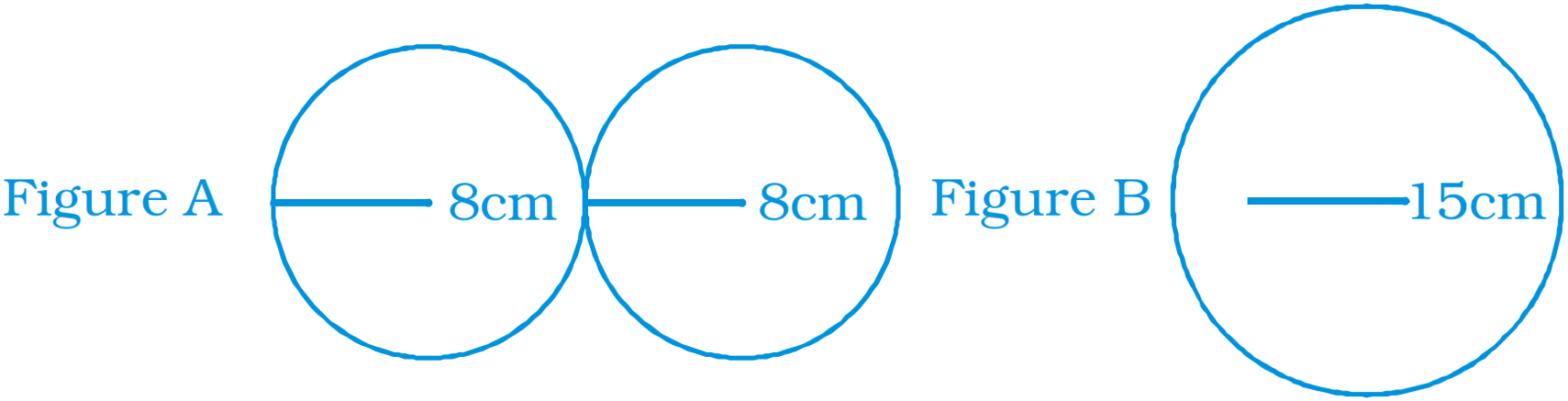
AnswerIn figure $A, 2$ pipes each having a radius of $8\ cm$.
$\because$ Area of a circle $=\pi\text{r}^2$
$\therefore$ Area of one pipe $=\frac{22}{7}\times8\times8$
$=\frac{22\times8\times8}{7}=\frac{22\times64}{7}\text{cm}^2$
Area of $2$ pipes $=\frac{2\times1408}{7}=\frac{2816}{7}\text{cm}^2=402.28\text{cm}^2$ In figure B, a pipe having radius of 15cm. $\therefore$ Area of the pipe $=\pi\text{r}^2$
$=\frac{22}{7}\times15\times15=\frac{22}{7}=\times225$
$=\frac{4950}{7}=707.14\text{cm}^2$Clearly, the surface area of pipe $B$ is greater.
So, pipe $B$ till the swimming pool faster.
View full question & answer→Question 323 Marks
Find the volume of each of the given figure if volume $=$ base area $\times $ height.
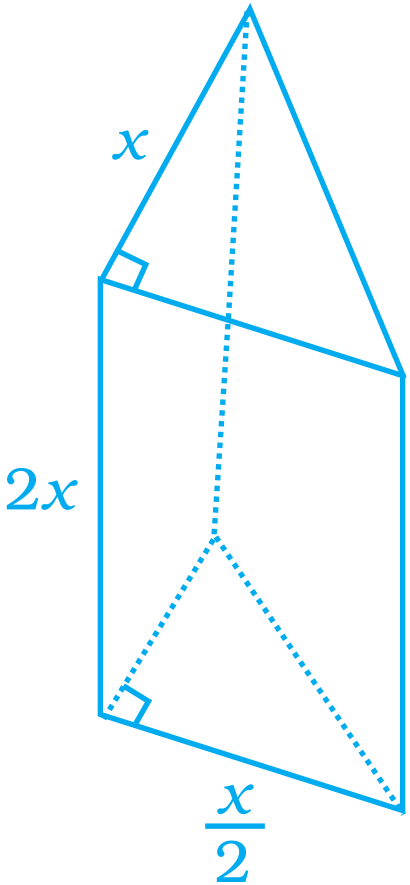
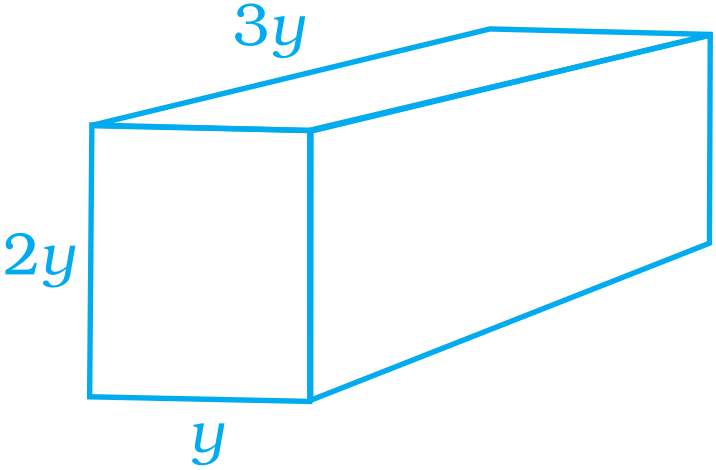
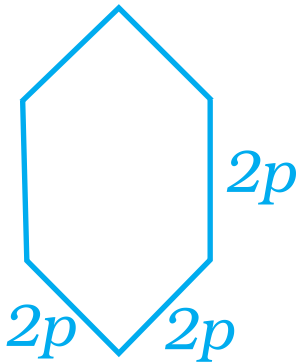
Answer$\because$ Volume of each of the given figure = Base area $\times $ Height
In Fig. $(a)$, base is rectangle.
So, area of rectangle $=2\text{x}\times\frac{\text{x}}{2}=\text{x}^2$
$\therefore\text{Height}=\frac{\text{x}}{2}$
$\therefore$ Volume of the figure $=\text{x}^2\times\frac{\text{x}}{2}=\frac{\text{x}^3}{2}$
In Fig. $(b),$ base is rectangle.
So, area of rectangle $= y \times 3y = 3y^2$
Height $= 2y$
$\therefore$ Volume of the figure $= 3y^2\times 2y = 6y^3$
In Fig. $(c)$, base is rectangle.
So, area of rectangle $= 2p \times 2p = 4p^2$
Height $= 2p$
Volume of the figure $= 4p^2\times 2p = 8p^3$
View full question & answer→Question 333 Marks
A housing society consisting of $5,500$ people needs $100L$ of water per person per day. The cylindrical supply tank is $7\ m$ high and has a diameter $10\ m$. For how many days will the water in the tank last for the society?
AnswerTotal number of peoples $= 5500$
Water required per person per day $= 100L$
Total requirement of water by $5500$ peoples
$= 100 \times 5500 = 550000L$
Height of the cylindrical tank $= 7m$
Diameter of the cylindrical tank $= 10m$
$\therefore$ Radius $= 5m\Big[\because\frac{\text{diameter}}{2}=\text{radius}\Big]$
$\therefore$ Volume of cylinder $=\pi\text{r}^2\text{h}=\frac{22}{7}\times5\times5\times7$
$=22\times25=550\text{m}^3$
$=550\times1000=550000\text{L} [\because 1m^3= 100L]$
Hence, for $1$ day the water in the tank lost for the society and in one day society needs $550000L$ of water.
View full question & answer→Question 343 Marks
The walls and ceiling of a room are to be plastered. The length, breadth and height of the room are $4.5\ m, 3\ m$, and $350\ cm$ respectively. Find the cost of plastering at the rate of Rs $8$ per $m^2$.
AnswerGiven, length of the room $(l) = 4.5m$
Breadth of the room $(b) = 3m$
Height of the room $(h) = 350cm= 3.5m [\because 100cm = 1m]$
and the cost of plastering $= ₹ 8$ per $m^2$
$\therefore$ Area of the walls $= 2h (l + b)$
$= 2 \times 3.5(4.5 + 3)$
$= 7 \times (7.5) = 52.5m^2$
Area of the ceiling $= lb = 4.5 \times 3 = 13.5m^2$
Area of the room $= 52.5 + 13.5 = 66m^2$
Hence, the cost of plastering $= 66 \times 8 = ₹ 528$
View full question & answer→Question 353 Marks
Find the area of the shaded portion in the following figures.
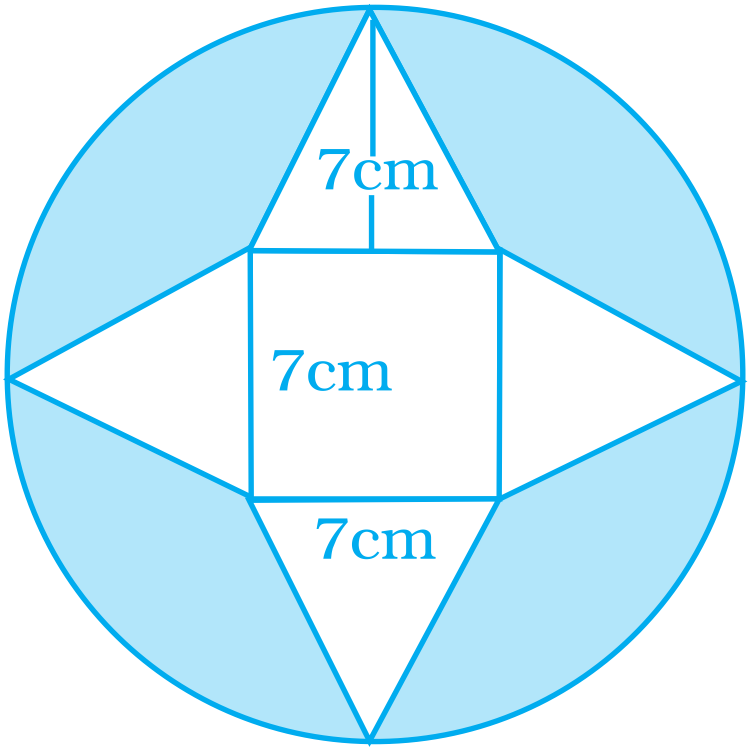
AnswerAroa of shaded region = Area of the circle - Area of four triangles - Area of a square
Area of four triangles $=4\times\frac{1}2{}\times\text{Base}\times\text{Height}$
$=4\times\frac{1}{2}\times7\times7=\frac{4\times49}{2}=2\times49=98\text{cm}^2$
Area of a square $=\text{(side)}^2=(7)^2=49\text{cm}^2$
Area of a circle $=\pi\text{r}^2=\frac{22}{7}\times\frac{21}{2}\times\frac{21}{2}=\frac{11\times3\times21}{2}=\frac{693}{2}$
$=346.5\text{cm}^2$
Area of shaded region $= (346.5 - 98 - 49) $
$=199.5\text{cm}^2$
View full question & answer→Question 363 Marks
A hollow garden roller of $42\ cm$ diameter and length $152\ cm$ is made of cast iron $2\ cm$ thick. Find the volume of iron used in the roller.
AnswerDiameter of the hollow garden roller $= 42\ cm$
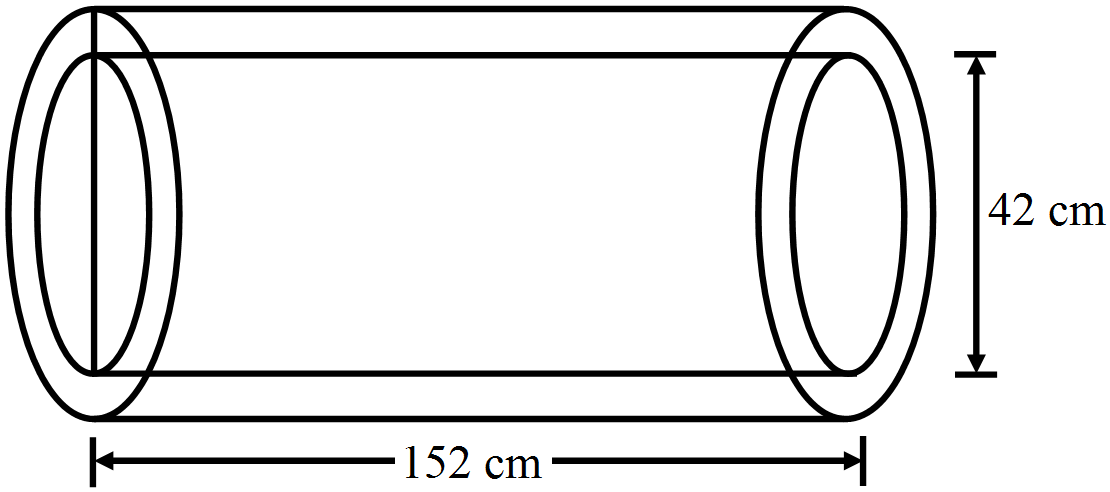
$\therefore$ Inner raduse $=\frac{42}{2}=21\text{cm}$
$\because$ Thicness of cast iron $= 2\ cm$
$\therefore$ Outer radius $= 21 + 2 = 23\ cm$
Volume of hollow cylinder $=\pi(\text{R}^2-\text{r}^2)\times\text{h}$ [where, $R$ is outer-radius and $r$ is inner-radius]
$=\frac{22}{7}\times[(23)^2-(21)^2]\times152$
$=\frac{22}{7}\times(529-441)\times152$
$=\frac{22}{7}\times88\times152=\frac{22\times88\times152}{7}=\frac{294272}{7}$
$=42038.85\text{cm}^3$ View full question & answer→Question 373 Marks
How many bricks of size $22\ cm \times 10\ cm \times 7\ cm$ are required to construct a wall $11\ m$ long, $3.5\ m$ high and $40\ cm$ thick, if the cement and sand used in the construction occupy $\Big(\frac{1}{10}\Big)\text{th}$ part of the wall?
AnswerVolume of wall $= 11 \times 3.5 \times 0.4m^3= 15.4m^3$
Since $\frac{1}{10}\text{th}$ part off the wall is occupied by cement and sand so the part occupied by the brics is $\frac{15.4}{10}\text{m}^3=1.54\text{m}^3$
now volume of $1$ brick $= 0.22 \times 0.10 \times 0.07 = 0.00154m^3$
so required number of bricks $=\frac{1.54}{0.00154}=1000$
View full question & answer→Question 383 Marks
A swimming pool is $200\ m$ by $50\ m$ and has an average depth of $2\ m$. By the end of a summer day, the water level drops by $2\ cm$. How many cubic metres of water is lost on the day?
AnswerDimensions of swimming pool are $200m \times 50m.$
Average depth of the swimming pool $= 2m$
At the end of summer day the water level drops by $2cm.$
$\therefore$ Volume of water in swimming pool = Length \times Breadth \times depth
$= 200 \times 50 \times 2 = 20000m^3$
If water level drope by 2cm, it means new level of water
$=\Big(2-\frac{2}{100}\Big)\text{m}=1.98\text{m}$
$\Big[\because1\text{cm}=\frac{1}{100}\text{m}\Big]$
Volume of water after summer day $=200\times50\times1.98$
$=19800\text{m}^3$
So, water in cubic metres was lost on that day
= lnitial volume - Volume after summer day
$= 20000 - 19800 = 200m^3$
View full question & answer→Question 393 Marks
Four times the area of the curved surface of a cylinder is equal to $6$ times the sum of the areas of its bases. If its height is $12\ cm$, find its curved surface area.
AnswerLet the radius and height of the cylinder be $r$ and $h$, respectively.
Curved surface area of cylinder $=2\pi\text{rh}$
Area of base $=\pi\text{r}^2$
Sum of areas of bases $=2\pi\text{r}^2$
According to the question,
$4 \times $ Curved surface area $= 6 \times $ Sum of areas of bases
$4\times2\pi\text{rh}=6\times2\pi\text{r}^2$
$\Rightarrow8\pi\text{rh}=12\pi\text{r}^2$
$\Rightarrow2\text{h}=3\text{r}$
$\Rightarrow\text{r}=\frac{2}{3}\text{h}$
$\therefore\text{r}=\frac{2}{3}\times12=8\text{cm}$ [$\because h = 12\ cm$, given]
$\therefore$ Curved surface area of the cylinder $=2\pi\text{rh}$
$=2\times\frac{22}{7}\times8\times12=\frac{44\times8\times12}{7}$
$=603.428\text{cm}^2$
View full question & answer→Question 403 Marks
The capacity of a closed cylindrical vessel of height 1m is $15.4L$. How many square metres of metal sheet would be needed to make it?
AnswerHeight of cylindrical vessel $= 1m$
Capacity of the cylindrical vessel $= 15.4L$
In metre cube $=\frac{15.4}{1000}=.0154\text{m}^3 [\because 1m^3= 1000L]$
Volume of a cylinder $=\pi\text{r}^2\text{h}$
$\Rightarrow\frac{22}{7}\times\text{r}^2\times1=0.0154$
$\Rightarrow\text{r}^2=\frac{0.0154}{3.14}=0.0049$
$\Rightarrow\text{r}=\sqrt{0.0049}=0.07\text{m}$
$\therefore$ Metal of sheet required $=2\pi\text{rh}=2\times\frac{22}{7}\times0.07\times1=0.4396=0.44\text{m}^2$
View full question & answer→Question 413 Marks
Metallic discs of radius $0.75cm$ and thickness $0.2\ cm$ are melted to obtain $508.68cm^3$ of metal. Find the number of discs melted $($use $\pi = 3.14).$
AnswerRadius of metallic disc $= 0.75cm$
Thickness of disc $= 0.2cm$
Total volume of material which will be used in forming/ melting of disc $= 508.68cm^3$
$\therefore$ Material required for one disc = Volume of cylinder
$=\pi\text{r}^2\text{h}=\frac{22}{7}\times0.75\times0.75\times0.2$ [$\because$ shape of a disc is a cylinder]
$=3.14\times0.75\times0.75\times0.2$
$=0.35325\text{cm}^2$
Number of discs can be melted $=\frac{\text{Total volume of metal obtained after melting}}{\text{Volume of one disc}}$
$=\frac{508.68}{0.35325}=1440\text{ discs}$
View full question & answer→Question 423 Marks
Find the area of the shaded portion in the following figures.
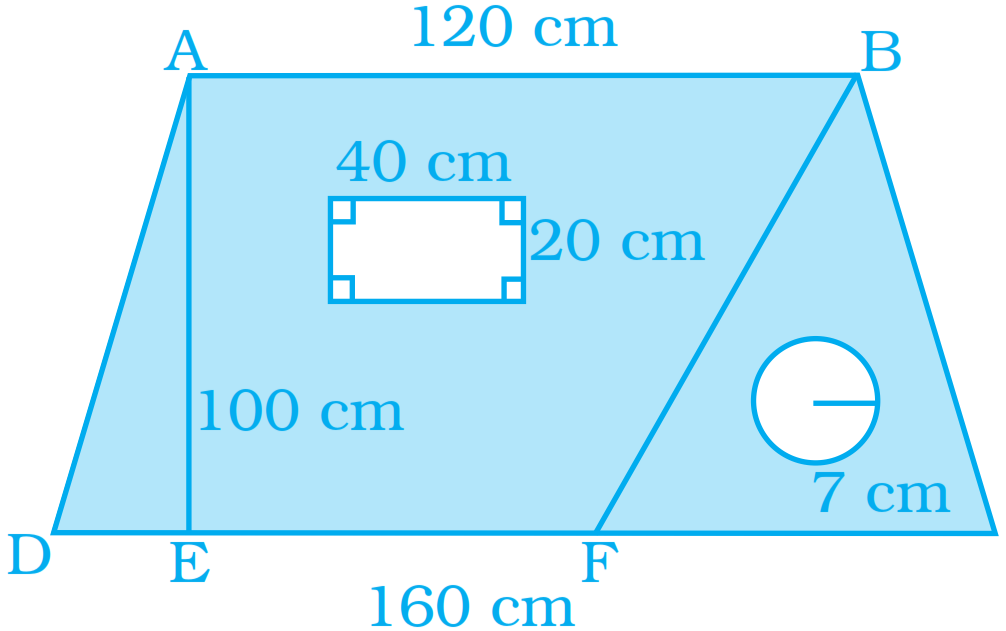
AnswerArea of shaded portion = Area of trapezium - Area of rectangle - Area of circle
Area of trapezium $=\frac{1}{2}\times[\text{Sum of parallel sides}]\times\text{Height}$
$=\frac{1}{2}\times(120+160)\times100$
$=\frac{1}{2}\times280\times100$
$=\frac{28000}{2}=14000\text{cm}^2$
Area of rectangle = Length × Breath $= 40 \times 20 = 800\text{cm}^2$
Area of circle $=\pi\text{r}^2=\frac{22}{7}\times7\times7$
$=154\text{cm}^2$
$\therefore$ Area of shaded porton $=14000-800-154$
$=13046\text{cm}^2$
View full question & answer→Question 433 Marks
There is a circular pond and a footpath runs along its boundary. A person walks around it, exactly once keeping close to the edge. If his step is $66\ cm$ long and he takes exactly $400$ steps to go around the pond, find the diameter of the pond.
AnswerLet the radius of the pond ber. Then, diameter of the pond $d = 2 \times r [\because$ diameter $= 2 \times $ radius]
Since, a person takes exactly $400$ steps with 66cm long each step to go round the pond.
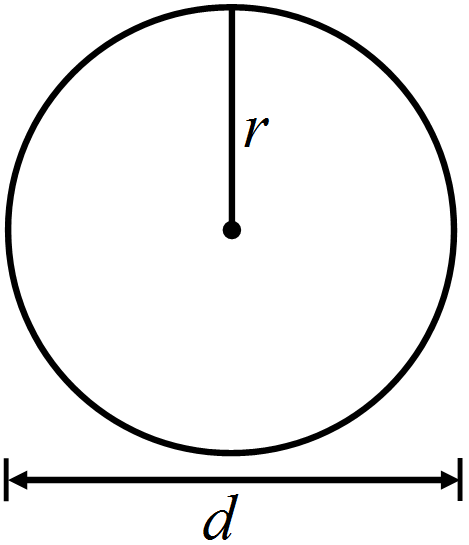
Hence, the circumference of the pond $= 66 \times 400$
$= 26400cm$
$=\frac{26400}{100}\text{m}=264\text{m}$ [$\because 100cm = 1m]$
We know that, circumference of a circle is $2\pi\text{r}.$
$\therefore2\pi\text{r}=264$
$\Rightarrow\text{r}=\frac{264}{2}\times\frac{7}{22}=\frac{264\times7}{44}=42\text{m}$
Hence, radius of the pond $= 42m$
So, diameter of the pond $= 2 \times 42 = 84m$ View full question & answer→