Questions

5 Marks Questions

Take a timed test

17 questions · self-marked practice — reveal the answer and mark yourself.

Question 15 Marks
The thickness of a hollow metallic cylinder is $2\ cm$. It is $70\ cm$ long with outer radius of $14\ cm$. Find the volume of the metal used in making the cylinder, assuming that it is open at both the ends. Also find its weight if the metal weighs $8g$ per $cm^3$.
Answer
The thickness of the hollow metallic cylinder is $2\ cm.$
Heign of the cylinder $= 70\ cm$
Outer radius of the cylinder $= 14\ cm$
Inner radius of the cylinder $= 14 - 2 = 12\ cm$
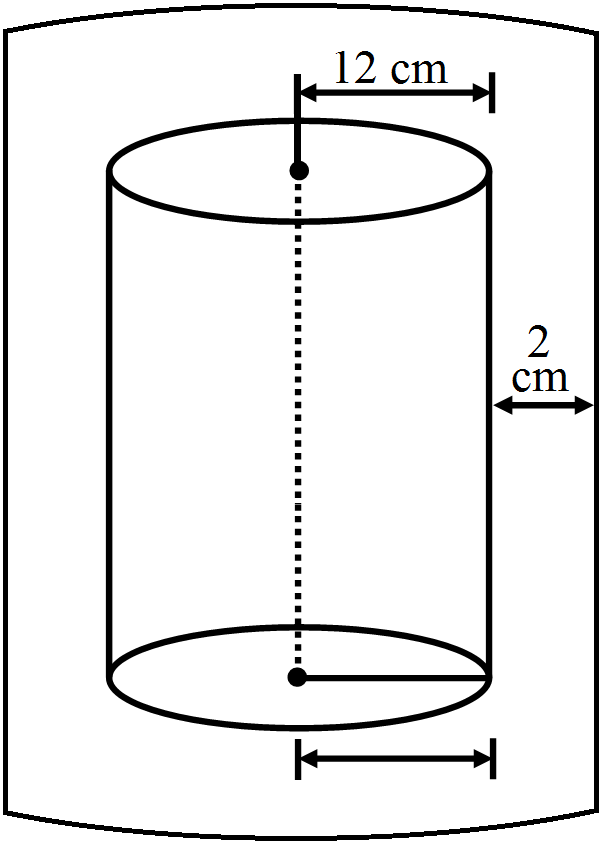
Volume of the metal used in making the cylinder = Volume of the hollow cylinder
$=\pi(\text{R}^2-\text{r}^2)\times\text{h}$
$=\frac{22}{7}\times[(14)^2-(21)^2]\times70$
$=22\times[196-144]\times10$
$=22\times52\times10=11440\text{cm}^3$
Weight of $11440cm^3,$ if metal is $8\ g$ per $cm^3$
$= 11440\times8=91520\text{g}$
View full question & answer
Question 25 Marks
A cylindrical tank has a radius of $154\ cm$. It is filled with water to a height of $3\ m$. If water to a height of $4.5\ m$ is poured into it, what will be the increase in the volume of water in kl?
Answer
Radius of cylindrical tank $= 154\ cm$
Initial height of water tank $= 3\ m = 3 \times 100\ cm [\because 1\ m = 100\ cm]$
$\therefore$ Volume of water $=\pi\text{r}^2\text{h}=\frac{22}7{}\times154\times154\times3\times100$
$=22360800\text{cm}^3$
If height of water $4.5\ m$ is poured into it, then volume of water
$=\frac{22}{7}\times154\times154\times4.5\times100$
$=33541200\text{cm}^3$
Increase in volume $= 33541200 - 22360800 $
$=11180400\text{cm}^3$
$=11180.4\text{L} [1000\ cm^3= 1L]$
$=11.1804\text{kL}[1kL = 1000L]$
View full question & answer
Question 35 Marks
From a pipe of inner radius $0.75\ cm$, water flows at the rate of $7\ m$ per second. Find the volume in litres of water delivered by the pipe in $1$ hour.
Answer
Radius of pipe $= 0.75\ cm = 0.0075\ m$
The rate of water flow $= 7\ m/s$
$\therefore$ Length of water in $1$ sec $= 7\ m$
$\therefore$ Volume of water flow in $1$ hour $=60\times60\times\frac{22}{7}\times0.0075\times0.0075\times7$
$=3600\times3.14\times0.00005625\times7$
$=11304\times7\times0.00005625$
$=79128\times0.00005625$
$=4.45095\text{m}^3$
$\simeq4.45000\text{m}^3$
$\simeq4450000\text{cm}^3\simeq4450\text{L}$ [$\because100cm^3= 1L]$
View full question & answer
Question 45 Marks
The length, breadth and height of a cuboidal reservoir is $7\ m, 6\ m$ and $15\ m$ respectively. $8400\ L$ of water is pumped out from the reservoir. Find the fall in the water level in the reservoir.
Answer
Length of a cuboidal reservoir $= 7\ m$
Breadth of a cuboidal reservoir $= 6\ m$
Height of a cuboidal reservoir $= 15\ m$
Capacity of cuboidal reservoir $= l \times b \times h = 7 \times 6 \times 15 = 630m^3$
If $8400\ L$ of water is pumped out.
In meter cubic $=\frac{8400}{1000}=8.4\text{m}^3$
Fall in water level $= 630 - 8.4 = 621.6\ m^3$
$= 621.6 \times 1000 [\because 1m^3= 1000L]$
$= 621600\ L$
View full question & answer
Question 55 Marks
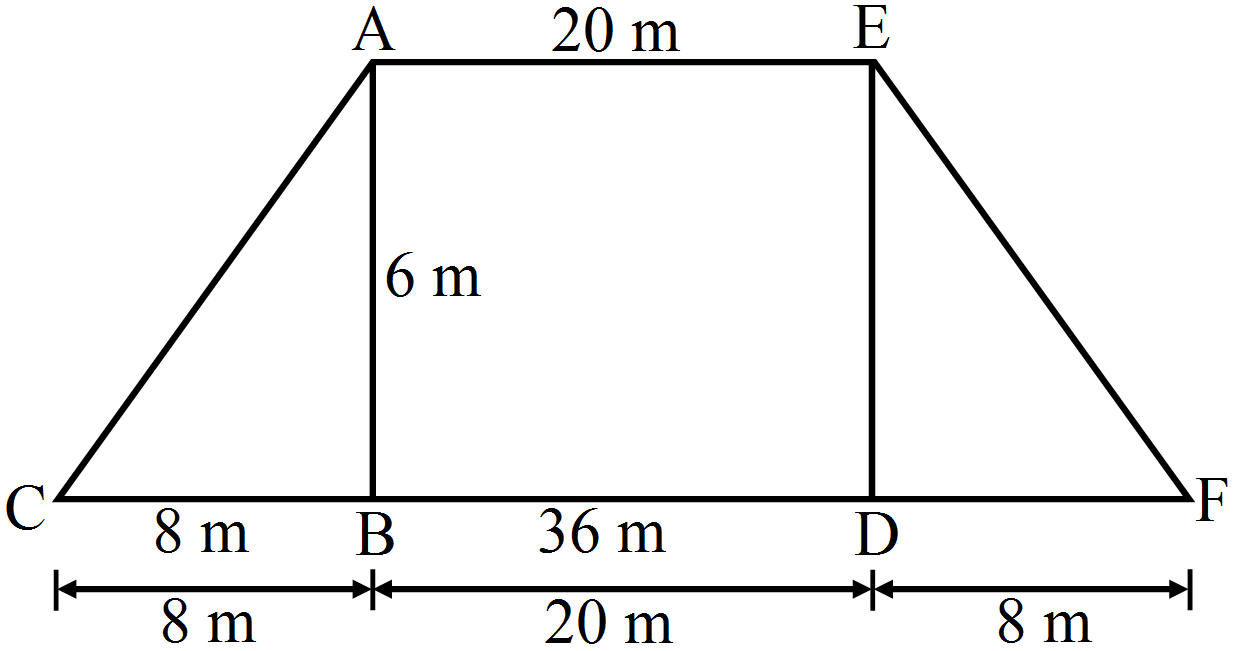
The area of a trapezium with equal non-parallel sides is $168m^2$. If the lengths of the parallel sides are $36\ m$ and $20\ m$, find the length of the non-parallel sides.
Answer
Length of the parallel sides are $36\ m$ and $20\ m$.
Area of a trapezium $= 168m^2$
$\because$ Area of a trapezium $=\frac{1}{2}$ $\times$ [Sum of parallel sides] $\times$ Height
$\therefore168=\frac{1}{2}\times[36+20]\times\text{Height}$
$\Rightarrow\text{Height}=\frac{168\times2}{56}=\frac{336}{56}=6\text{m}$

In $\triangle\text{ACB} ,$ using Pythagoras theorem,
$ (A B)^2=(B C)^2+(A C)^2 $
$ \Rightarrow(A B)^2=(8)^2+(6)^2 $
$ \Rightarrow(A B)^2=64+36 $
$ \Rightarrow(A B)^2=100 $
$\therefore\text{AB}=\sqrt{100}=10\text{m}$
Hence, length of the non-parallel side is $10\ m.$
View full question & answer
Question 65 Marks
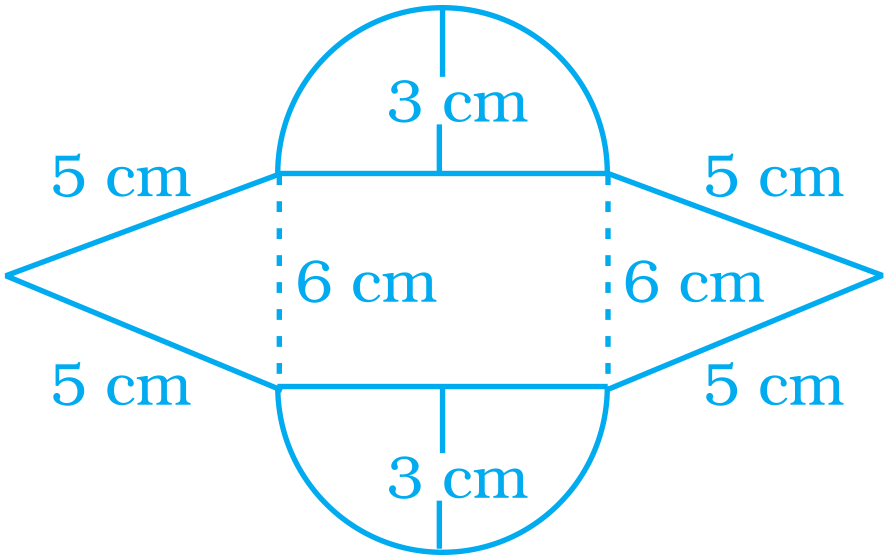
Find the area of the shaded portion in the following figures.
Answer
Area of the given figure = Area of two semi-circles + Area of two triangles + Area of a square
$\therefore$ Area of triangle $=\sqrt{\text{s(s}-\text{a})(\text{s}-\text{b})(\text{s}-\text{c})}$ [$\because$ $a = 5\ cm, b = 5\ cm$ and $c = 6\ cm$, given]
where, $\text{s}=\frac{\text{a + b + c}}{2}=\frac{5 + 5 + 6}{2}$
$=\frac{16}{2}=8\text{cm}$
$\therefore$ Area of a triangle $=\sqrt{8(8-5)(8-5)(8-6)}$
$=\sqrt{8\times3\times3\times2}=\sqrt{144}=12\text{cm}^2$
$\therefore$ Area of $2$ triangle $=2\times12=24\text{cm}^2$
$\therefore$ Area of $2$ semi-circles = Area of $1$ circle
Area of circle $=\pi\text{r}^2=\frac{22}{7}\times3\times3=\frac{9\times22}{7}=\frac{198}{7}=28.28\text{cm}^2$
$\therefore$ Area of square $=6\times6=36\text{cm}^2$
Area of the given figure $=(24+28.28+36)=88.28\text{cm}^2$
View full question & answer
Question 75 Marks
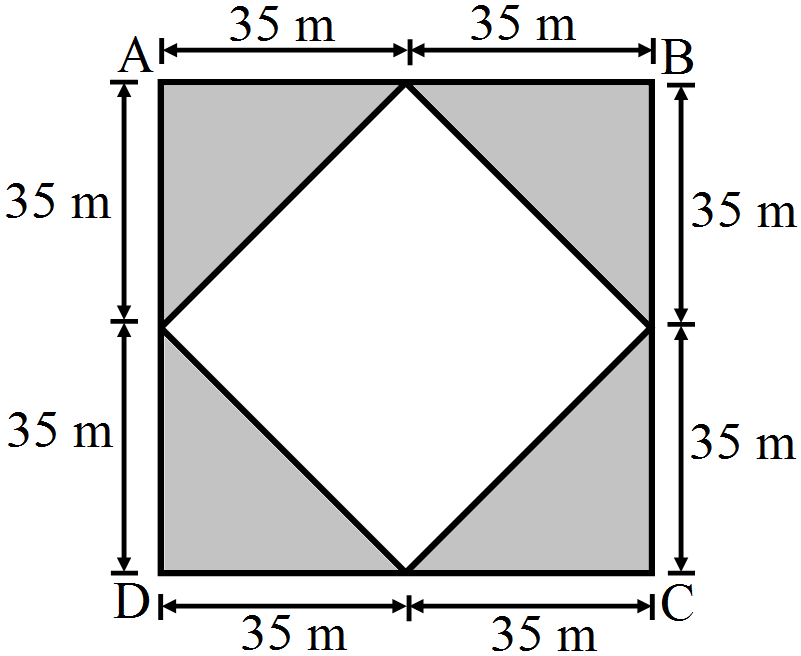
Four horses are tethered with equal ropes at $4$ corners of a square field of side $70$ metres so that they just can reach one another. Find the area left ungrazed by the horses.
Answer
Given, side of a square $= 70\ m$
Also, four horses are tethered with equal ropes at $4$ corners of the square field.
Hence, each horse can graze upto $35\ m$ of distance along the side.

$\therefore$ Area of the square field = Side $\times$ Side
$= 70 \times 70$
$= 4900m^2$
The grazed area is making a complete circle by taking all the four grazed parts.
So, area of grazed part $=\pi\text{r}^2$
$=\frac{22}{7}\times35\times35$
$=22\times5\times35$
$=3850\text{m}^2$
Area left ungrazed by the harses = Area of square field - Area of grazed part
$= 4900 - 3850$
$= 1050m^2$
View full question & answer
Question 85 Marks
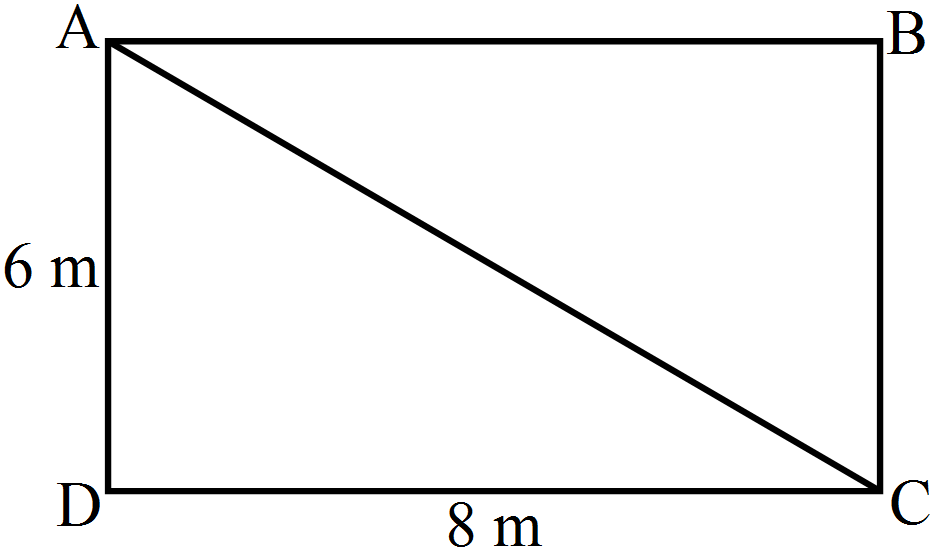
The area of a rectangular field is $48m^2$ and one of its sides is $6\ m$. How long will a lady take to cross the field diagonally at the rate of $20$m/minute?
Answer


Given the area of a rectangular field is $48m^2$ and one side of the rectangle is $= 6\ m$.
$\therefore$ Area of a rectangular = Length $\times $ Breadth
$\Rightarrow 48 = 6 \times $ Breadth
$\Rightarrow $ Breadth $= 8\ m.$
In $\triangle\text{ACD},\angle\text{D}=90^{\circ}$ [$\because$ in a rectangle, all angles are of $90^\circ $]
So, it is a right-angled triangle.
By using Pythagoras theorem, we have
$ (A C)^2=(A D)^2+(D C)^2 $
$ \Rightarrow(A C)^2=(6)^2+(8)^2 $
$ \Rightarrow(A C)^2=36+64 $
$\Rightarrow\text{AC}=\sqrt{100}$
$\therefore$ $AC = 10\ m$
Time taken by lady to cross the field diagonally at rate of $20$m/min $=\frac{\text{Distance}}{\text{Speed}}$
$=\frac{10}{20}=\frac{1}{2}$ min or $30\ s$.
View full question & answer
Question 95 Marks
The ratio of the radius and height of a cylinder is $2 : 3$. If its volume is $12,936\ cm^3$, find the total surface area of the cylinder.
Answer
The ratio of the radius and height of a cylinder $= 2 : 3$
Let the radius of the cylinder be $2x$ and the height of the cylinder be $3x$.
Volume of the cylinder $= 12936\ cm^3$
$\because$ Volume of a cylinder $=\pi\text{r}^2\text{h}$
$\therefore12936=\frac{22}{7}\times(2\text{x})^2\times3\text{x}$
$\Rightarrow12936=\frac{22}7{}\times4\text{x}^2\times3\text{x}$
$\Rightarrow12936=\frac{264}{7}\text{x}^3$
$\Rightarrow\text{x}^3=\frac{12936\times7}{264}=49\times7$
$\Rightarrow\text{x}^3=7\times7\times7=(7)^3$
$\Rightarrow\text{x}^3=(7)^3$
$\therefore\text{x}=7$
So, radius $= 2x = 2 \times 7 = 14\ cm$ and height $= 3x = 3 \times 7 = 21\ cm$
The total surface area of the cylinder $=2\pi\text{r(r + h)}$
$=2\times\frac{22}7{}\times14(14+21)$
$=\frac{44\times14}{7}\times35=44\times14\times5=3080\text{cm}^2$
View full question & answer
Question 105 Marks
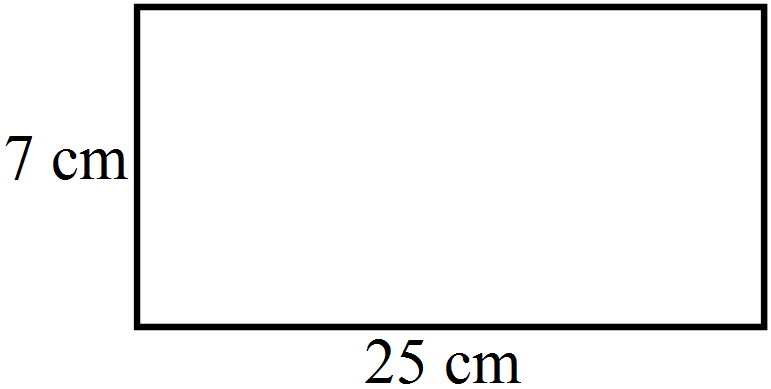
A rectangular sheet of dimensions $25\ cm \times 7\ cm$ is rotated about its longer side. Find the volume and the whole surface area of the solid thus generated.
Answer
A rectangular sheet of demensions $25\ cm \times 7\ cm$ is rotated about its longer side which makes a cylinder with base $25\ cm$ and height $7\ cm$.

Surface area of a base $=2\pi\text{r}$
$\therefore2\pi\text{r}=25\text{cm}$
$\Rightarrow\text{r}=\frac{25\times7}{2\times22}=\frac{175}{44}\text{cm}$

Volume of a cylinder $=\pi\text{r}^2\text{h}$ $=\frac{22}{7}\times\frac{175}{44}\times\frac{175}{44}\times7$
$=\frac{175\times175}{2\times44}=\frac{30625}{88}$
$=348.011\text{cm}^3$
Surface area $=2\pi\text{rh}=2\times\frac{22}{7}\times\frac{175}{44}\times7$
$=\frac{44}{44}\times175$ $=175\text{cm}^2$
View full question & answer
Question 115 Marks
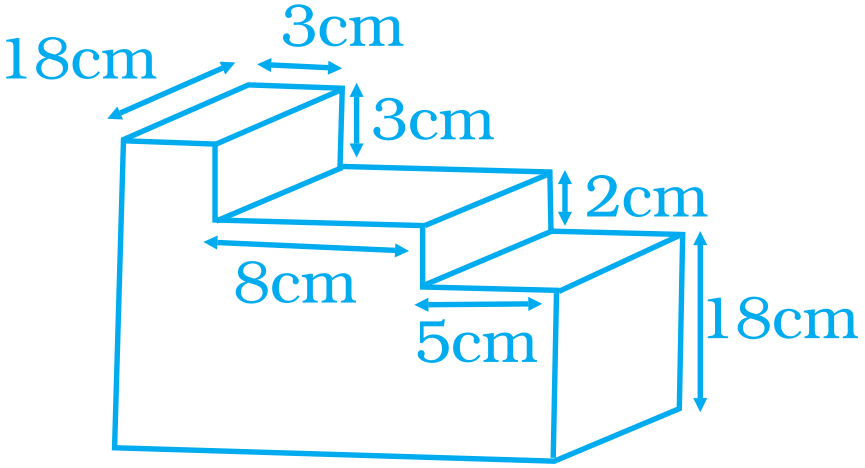
Work out the surface area of following shape (use $\pi$ $= 3.14$).
Answer
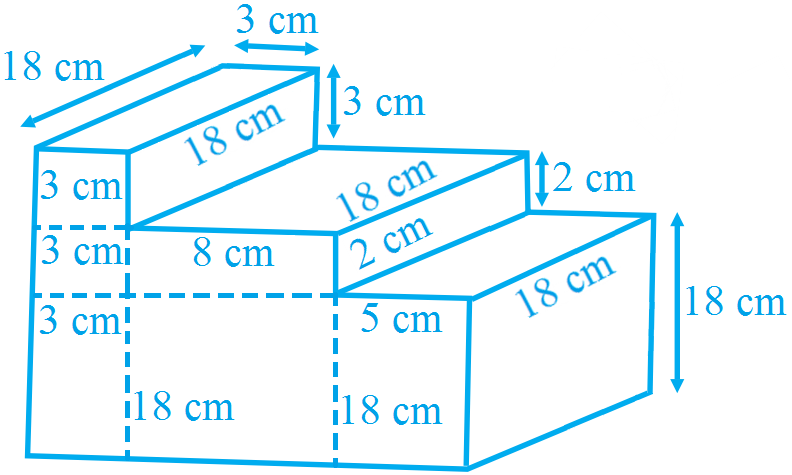
To find the total surface area, we draw the figure as given below.

$\therefore$ Upper surface area
$= 18 \times 3 + 8 \times 18 + 5 \times 18$
$= 54 + 144 + 90$
$= 288\ cm ^2$
$\therefore$ Lower surface area $= 288\ cm ^2$
$\therefore$ Surface area of thosse faces which are flat from right
$= 18 \times 18 + 2 \times 18 + 3 \times 18$
$= 324 + 36 + 54$
$= 414\ cm ^2$
Also, surface area of that face which are flat from left
$= 414\ cm ^2$
Surface area of from face
$= 18 \times 5 + 2 \times 8 + 8 \times 18 + 3 \times 2 + 3 \times 18 + 3 \times 3$
$= 90 + 16 + 144 + 6 + 54 + 9$
$= 319\ cm ^2$
Surface area of the bace face $= 319\ cm ^2$
$\therefore$ Total surface area
$= 288 + 288 + 414 + 414 + 319 + 319$
$= 288 + 1754$
$= 2042\ cm ^2$
View full question & answer
Question 125 Marks
External dimensions of a closed wooden box are in the ratio $5 : 4 : 3$. If the cost of painting its outer surface at the rate of $Rs\ 5$ per $dm^2$ is $Rs\ 11,750$, find the dimensions of the box.
Answer
External dimensions of a closed wooden box are in the ratio $5 : 4 : 3$.
Let the external dimensions of the closed wooden box be $5x, 4x$ and $3x$.
The cost of painting $= ₹ 5$ per $dm^2$
Total cost of painting $= ₹ 11750$
$\therefore\text{Total surface area}=\frac{\text{Total cost of painting}}{\text{Cost of painting per dm}^2}$
$=\frac{11750}{5}$
$=2350\text{dm}^2$
Total surface area of a cuboid
$=2(\text{lb + bh + hl})$
$=2(5\text{x}\times4\text{x}+4\text{x}\times3\text{x}+3\text{x}\times5\text{x})$
$=2(20\text{x}^2+12\text{x}^2+15\text{x}^2)$
$=2\times47\text{x}^2=94\text{x}^2$
Since, total surface area $=2350\text{dm}^2$
$\Rightarrow94\text{x}^2=2350$
$\Rightarrow\text{x}^2=\frac{2350}{94}=25$
$\therefore\text{x}=5$
Hence, dimensions of the box are $5x \times 5 = 25\ dm$, $4x \times 5 = 20\ dm$ and $3x \times 5 = 15\ dm$.
View full question & answer
Question 135 Marks
Radius of a cylinder is $r$ and the height is $h$. Find the change in the volume if the:
$a.$ Height is doubled.
$b.$ Height is doubled and the radius is halved.
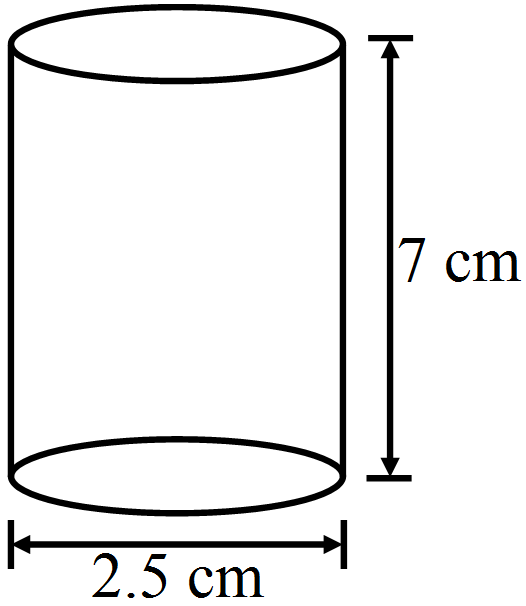
$c.$ Height remains same and the radius is halved.
Answer
$\because$ Volume of a cylinder $=\pi\text{r}^2\text{h}$
where, $h$ is height and $r$ is radius of base of the cylinder.
$i.$ If height is double i.e. $h = 2 \times h = 2h$
Then, its volume $=\pi\text{r}^2\times2\text{h}$
$=2\pi\text{r}^2\text{h}$
Hence, volume became double of original volume.
$ii.$ If height is doubled and the radius is halved,
i.e. $h = 2\ h$ and $\text{r}=\frac{\text{r}}{2}$
$\therefore$ Volume $=\pi\times\Big(\frac{\text{r}}{2}\Big)\times\Big(\frac{\text{r}}{2}\Big)\times2\text{h}$
$=\pi\times\frac{\text{r}^2}{4}\times2\text{h}=\frac{\pi\text{r}^2\text{h}}{2}$
Hence, volume became half of the original volume.
$iii.$ If height is remains same and the radius is halved,
i.e. $h = h$ and $\text{r}=\frac{\text{r}}{2}$
$\therefore$ Volume $=\pi\times\frac{\text{r}}{2}\times\frac{\text{r}}{2}\times\text{h}=\pi\times\frac{\text{r}^2}{4}\times\text{h}$
Hence, volume became $\frac{1}{4}^{th}$ of the original volume.
View full question & answer
Question 145 Marks
A rectangular sheet of paper is rolled in two different ways to form two different cylinders. Find the volume of cylinders in each case if the sheet measures $44\ cm \times 33\ cm$.
Answer
We have, length of the sheet $= 44\ cm$
breadth of the sheet $= 33\ cm$
Case $1$: When it is roled along its length.
Now, circumference of base of cylinder formed = length of sheet
$\Rightarrow2\pi\text{r}=44$ (where, $r$= radius of base)
$\Rightarrow2\times\frac{22}{7}\times\text{r}= 44$
$\Rightarrow\text{r}=7\text{cm}$
Now, height of the cylinder = breadth of the sheet
$\Rightarrow\text{h}=33\text{cm}$
Now, volume of cylinder $=\pi\text{r}^2\text{h}=\frac{22}{7}\times49\times33=5082\text{cm}^3$
Case $2$: When it is roled along its breadth.
Now, circumference of base of cylinder formed = breadth of sheet
$\Rightarrow2\pi\text{r}=33$ (where, $r$ = radius of base)
$\Rightarrow2\times\frac{22}{7}\times\text{r}=33$
$\Rightarrow\text{r}=\frac{21}{4}\text{cm}$
Now, height of the cylinder = length of the sheet
$\Rightarrow\text{h}=44\text{cm}$
Now, volume of cylinder $=\pi\text{r}^2\text{h}=\frac{22}{7}\times\frac{21}{4}\times\frac{21}4{}\times44=3811.5\text{cm}^3$
View full question & answer
Question 155 Marks
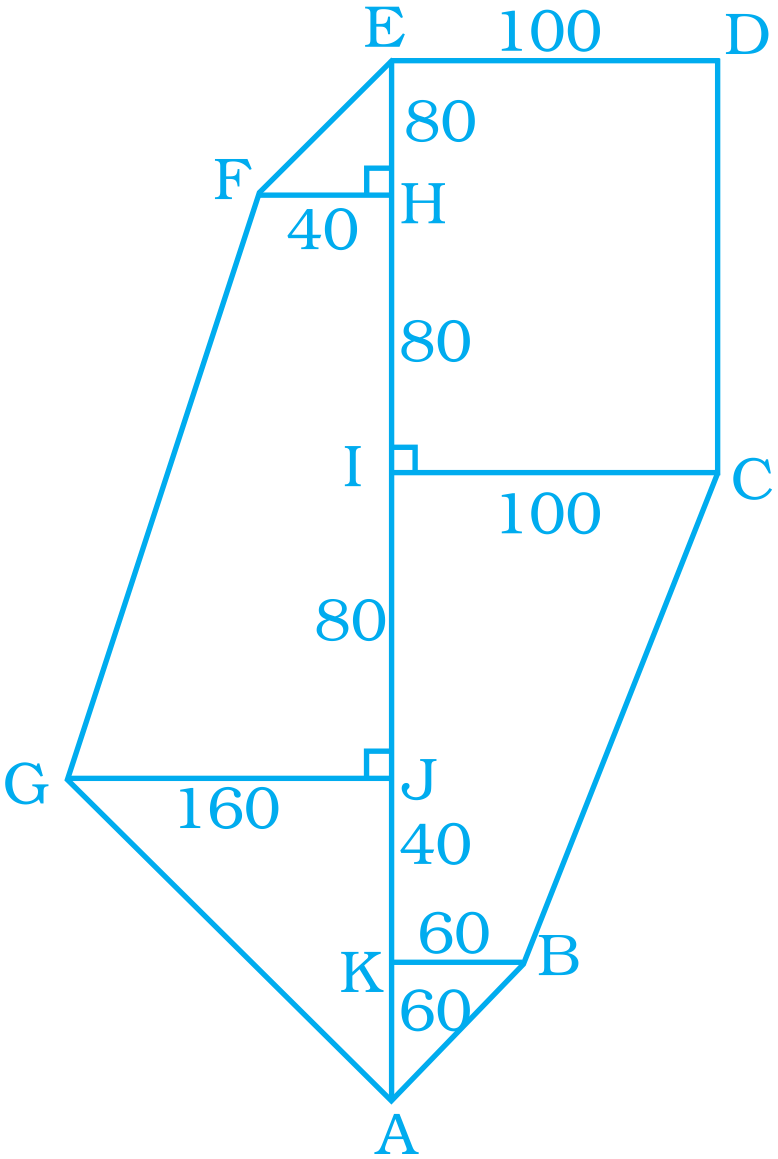
Find the area of the following fields. All dimensions are in metres.
Answer
Area of the given figure = Area of $\triangle\text{EFH}$ + Area of rectangle $EDCI$ + Area of trapezium $FHJG$ + Area of trapezium $ICBK$ + Area of $\triangle\text{GJA}$ + Area of $\triangle\text{KBA}$
Area of $\triangle\text{EFH}=\frac{1}{2}\times\text{Base}\times\text{Height}$
$=\frac{1}{2}\times40\times80=40\times40=1600\text{m}^2$
Area of rectangle $EDCI$ = Length $\times $ Breadth $= 100\times160-16000\text{m}^2$
Area of trapezium $FHJG$ $=\frac{1}{2}\times[\text{Sum of parallel sides}]\times\text{Height}$
$=\frac{1}{2}\times[40+160]\times160$
$=\frac{200}{2}\times160=100\times160$
$=16000\text{m}^2$
Area of trapezium $ICBK$ $=\frac{1}{2}\times[\text{Sum of parallel sides}]\times\text{Height}$
$=\frac{1}{2}\times[60+100]\times120$
$=\frac{1}{2}\times160\times120$
$=80\times120=9600\text{m}^2$
Area of $\triangle\text{AJG}=\frac{1}{2}\times\text{Base}\times\text{Height}=\frac{1}{2}\times160\times100$
$=80\times100=8000\text{m}^2$
Area of $\triangle\text{KBA}=\frac{1}{2}\times\text{Base}\times\text{Height}$
$=\frac{1}{2}\times60\times60=60\times30=1800\text{m}^2$
Thus, the area of the complete figure
$= 1600 + 16000 + 16000 + 9600 + 8000 + 1800 $
$=53000\text{m}^2$
View full question & answer
Question 165 Marks
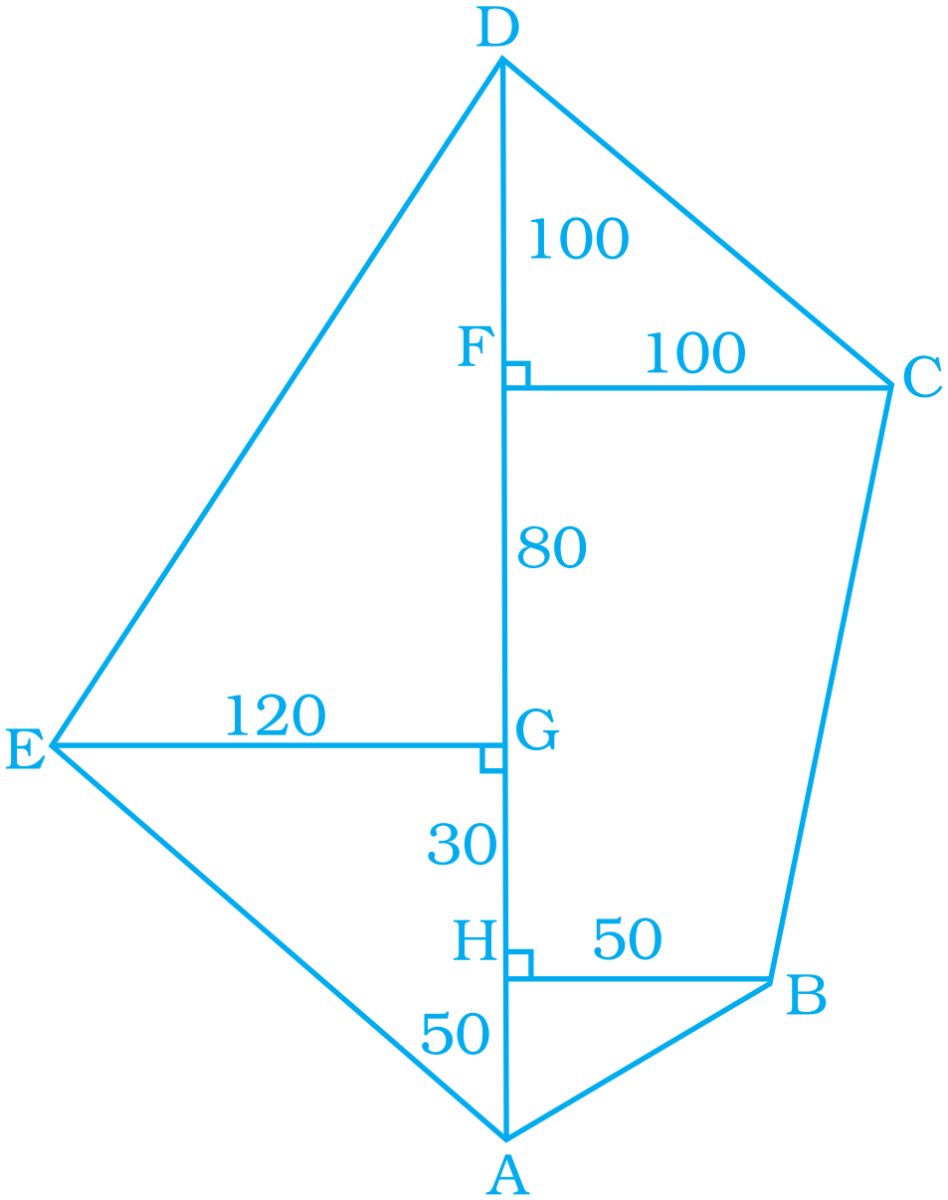
Find the area of the following fields. All dimensions are in metres.
Answer
Area of the given figure - Area of $\triangle\text{DCF}$ + Area of $\triangle\text{EGD}$ + Area of trapezium $FCBH$ + Area of $\triangle\text{EGA}$ + Area of $\triangle\text{AHB}$
$\therefore$ Area of $\triangle\text{DCF}=\frac{1}{2}\times\text{Base}\times\text{Height}$
$=\frac{1}{2}\times100\times100$
$=\frac{10000}{2}=5000\text{m}^2$
Area of $\triangle\text{EGD}=\frac{1}{2}\times\text{Base}\times\text{Height}$
$=\frac{1}{2}\times120\times180$
$=60\times180=10800\text{m}^2$
Area of trapezium$=\frac{1}{2}\text{[Sum of parallel sides]}\times\text{ Height}$
$=\frac{1}{2}\times[100+50]\times110=\frac{1}{2}\times150\times110$
$=75\times110=8250\text{m}^2$
Area of $\triangle\text{EGA}=\frac{1}{2}\times\text{Base}\times\text{Height}$
$=\frac{1}{2}\times120\times80$
$=60\times80=4800\text{m}^2$
Area of $\triangle\text{AHB}=\frac{1}{2}\times\text{Base}\times\text{Height}$
$=\frac{1}{2}\times50\times50$
$=25\times50$
$=1250\text{m}^2$
Thus, the area of the complete figure $= 5000 + 10800 + 8250 + 4800+ 1250 $
$=30100\text{m}^2$
View full question & answer
Question 175 Marks
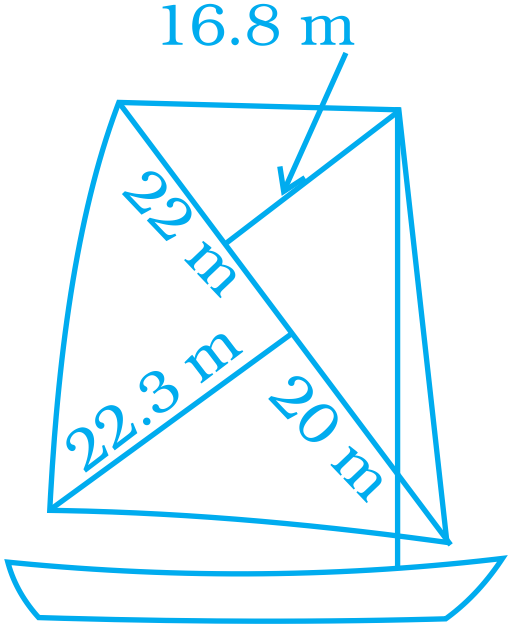
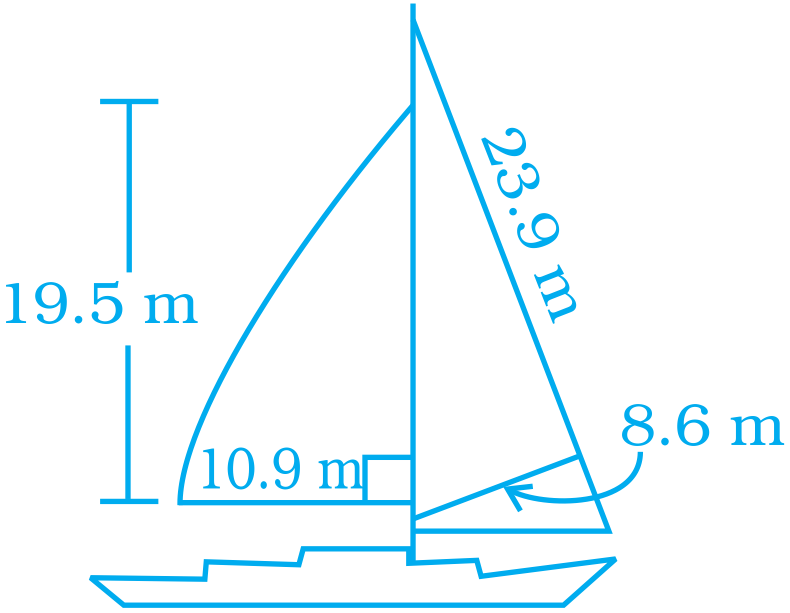
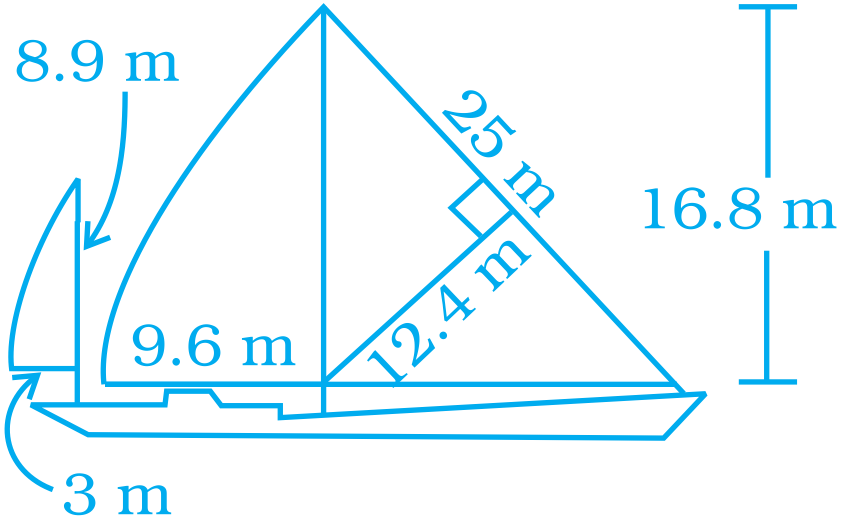
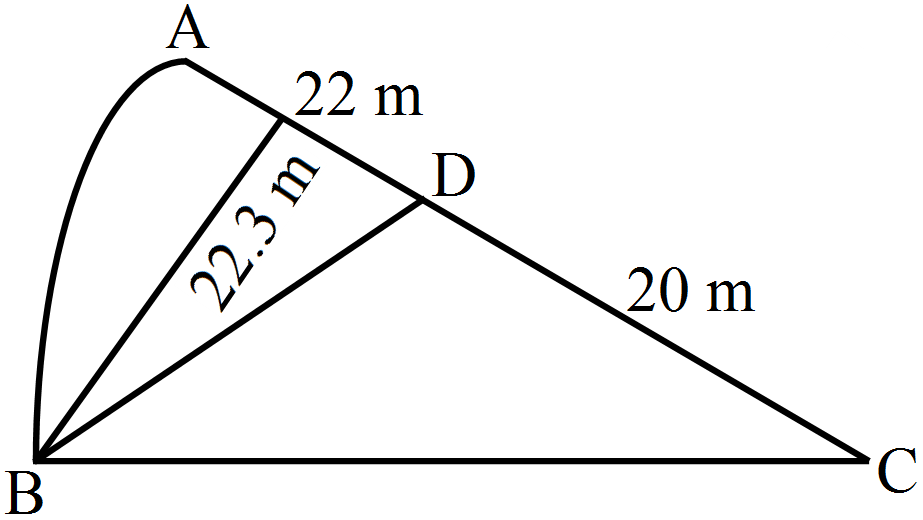
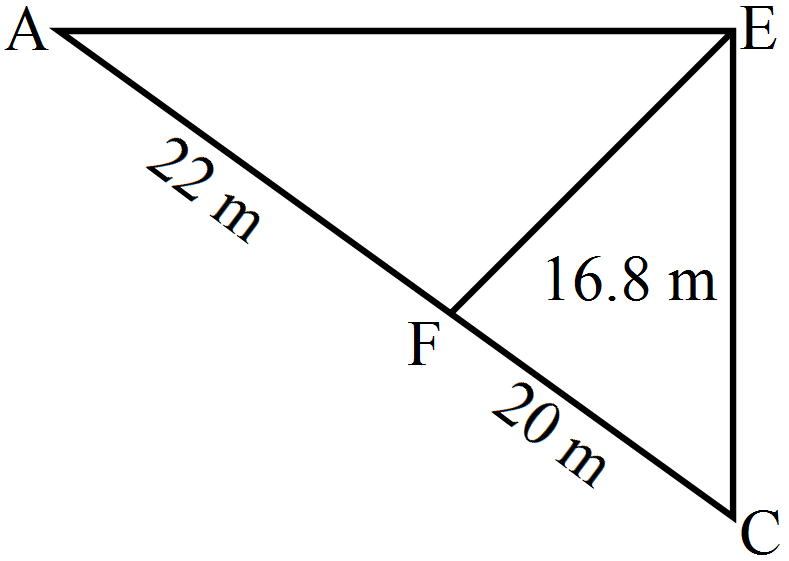
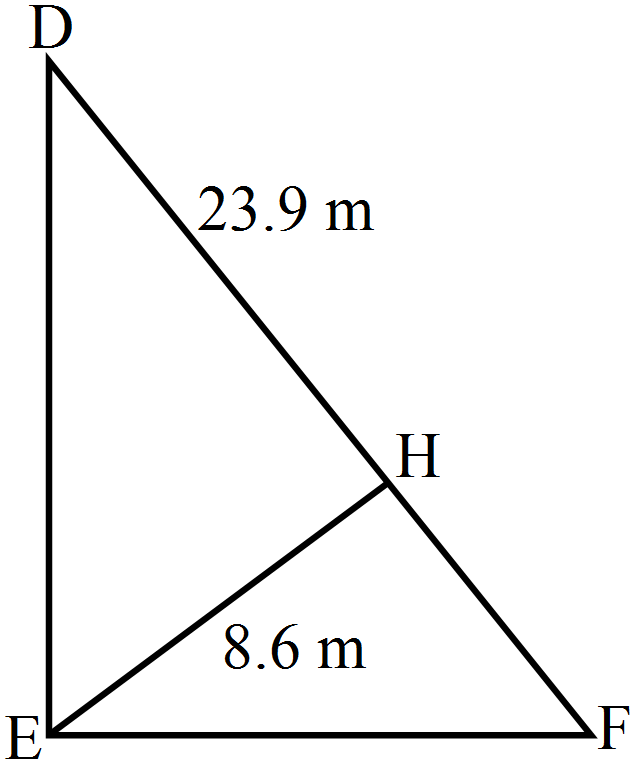
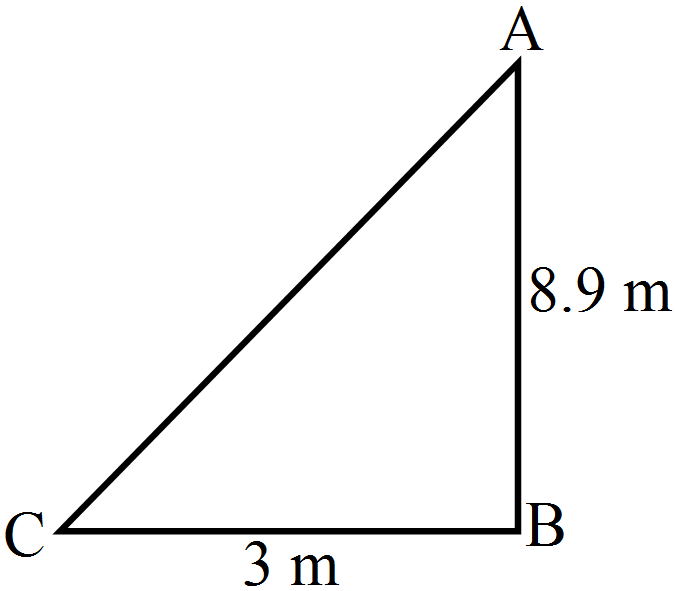
Most of the sailboats have two sails, the jib and the mainsail. Assume that the sails are triangles. Find the total area of each sail of the sail boats to the nearest tenth.


Answer
In the sailboat $(i)$,
Area of a triangle $=\frac{1}{2}\times\text{Base}\times\text{Height}$
In $\triangle\text{ABC},$ $AC =$ Base $= 22 + 20 = 42\ m$
$BD =$ Height $= 22.3\ m$

$\therefore$ Area of $\triangle\text{ABC}=\frac{1}{2}\times42\times22.3=\frac{936.6}{2}=468.3\text{m}^2$

In another triangular part,
In $\triangle\text{ACE},$ $EF =$ Height $= 16.8\ m$
$AC $= Base $= 22 + 20 = 42\ m$
$\therefore$ Area of $\triangle\text{ACE}=\frac{1}{2}\times42\times16.8$
$=\frac{705.6}{2}=352.8\text{m}^2$
$\therefore$ Area of sailboat $(i) = 468.3 + 352.8 = 821.1m^2$
In sailboat $(ii)$,
Area of a triangle $=\frac{1}{2}\times\text{Base}\times\text{Height}$

In $\triangle\text{ABC},\angle\text{B}=90^{\circ},$ base $(BC) = 10.9\ m$ and height $(AB) = 19.5\ m$
Area of $\triangle\text{ABC}=\frac{1}{2}\times10.9\times19.5=\frac{212.55}{2}=106.275\text{m}^2$
In another triangular part,
Area of $\triangle\text{DEF}=\frac{1}{2}\times\text{DF}\times\text{EH}$
$=\frac{1}{2}\times23.9\times8.6$
$=\frac{205.54}{2}=102.77\text{m}^2$
Area of sailboat $(ii)$ $=106.275+102.77=209.045\text{m}^2$
In sailboat $(iii)$,
Area of triangle $=\frac{1}{2}\times\text{Base}\times\text{Height}$

In $\triangle\text{ABC}$ $AB = 8.9\ m$ and $BC = 3\ m.$
Area of $\triangle\text{ABC}=\frac{1}2{}\times\text{BC}\times\text{AB}$
$=\frac{1}{2}\times8.9\times3$
$=\frac{26.7}{2}=13.35\text{m}^2$

In another triangular part,
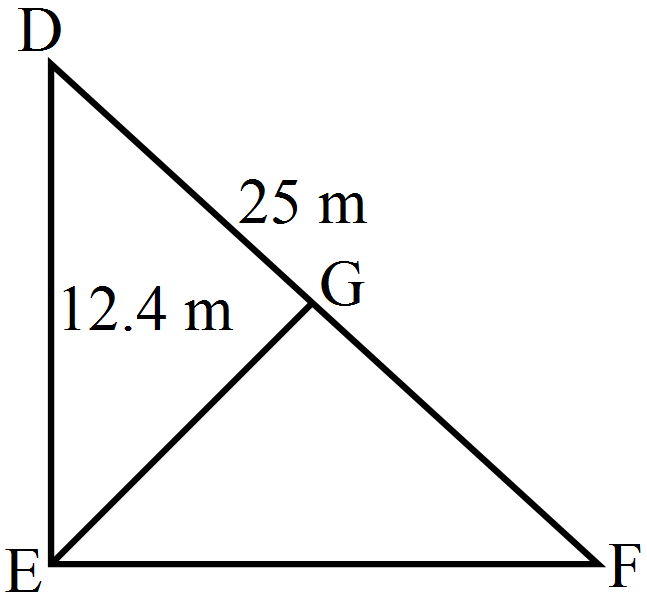
Area of $\triangle\text{DEF}=\frac{1}{2}\times\text{DF}\times\text{EG}$
$=\frac{1}2{}\times25\times12.4$
$=155\text{m}^2$

In another triangular part,
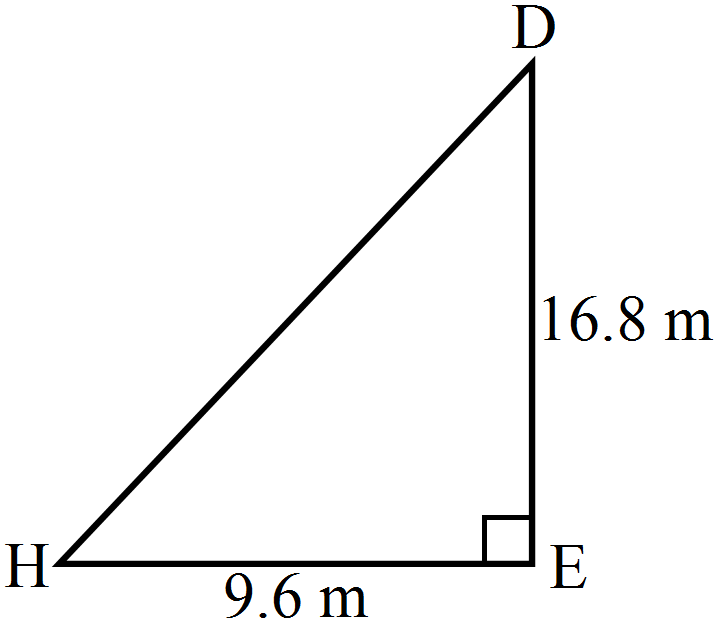
Area of $\triangle\text{DEH}=\frac{1}{2}\times\text{DE}\times\text{EH}$
$=\frac{1}{2}\times9.6\times16.8$
$=80.64\text{m}^2$
$\therefore$ Area of sailboat $(iii) = 155 + 80.64$
$= 235.64\ m^2$
View full question & answer