Question 15 Marks
A society collected $Rs.\ 92.16$. Each member collected as many paise as there were members. How many members were there and how much did each contribute?
AnswerLet $M$ be the number of members.
Let $r$ be the amount in paise donated by each member.
The total contribution can be expressed as follows,
$M x r = Rs. 92.16 = 9216$ paise
Since the amount received as donation is the same as the number of members,
$r = M$
Substituting this in the first equation, we get,
$M \times M = 9216$
$M^2= 2 \times 2 \times 2 \times 2 \times 2 \times 2 \times 2 \times 2 \times 2 \times 2 \times 3 \times 3$
$M^2= (2 \times 2) \times (2 \times 2) \times (2 \times 2) \times (2 \times 2) \times (2 \times 2) \times (3 \times 3)$
$M = 2 \times 2 \times 2 \times 2 \times 2 \times 3 = 96$
To find $r$, we can use the relation $r = M$.
Let $M$ be the number of members.
Let $r$ be the amount in paise donated by each member.
The total contribution can be expressed as follows:
$M \times r = Rs\ 92.16 = 9216$ paise
Since the amount received as donation is the same as the number of members,
$r = 96$
So, there are $96$ members and each paid $96$ paise.
View full question & answer→Question 25 Marks
Which of the following numbers are squares of even numbers?
$121, 225, 256, 324, 1296, 6561, 5476, 4489, 373758$
AnswerThe numbers whose last digit is odd can never be the square of even numbers.
So, we have to leave out $121, 225, 6561$ and $4489$, leaving only $256, 324, 1296, 5476$ and $373758$.
For each number, use prime factorisation method and make pairs of equal factors.
$i. 256 = 2 \times 2 \times 2 \times 2 \times 2 \times 2 \times 2 \times 2$
$= (2 \times 2) \times (2 \times 2) \times (2 \times 2) \times (2 \times 2)$
There are no factors that are not paired.
Hence, $256$ is a perfect square.
The square of an even number is always even.
Hence, $256$ is the square of an even number.
$ii. 324 = 2 \times 2 \times 3 \times 3 \times 3 \times 3$
$= (2 \times 2) \times (3 \times 3) \times (3 \times 3)$
There are no factors that are not paired.
Hence, $324$ is a perfect square.
The square of an even number is always even.
Hence, $324$ is the square of an even number.
$iii. 1296 = 2 \times 2 \times 2 \times 2 \times 3 \times 3 \times 3 \times 3$
$= (2 \times 2) \times (2 \times 2) \times (3 \times 3) \times (3 \times 3)$
There are no factors that are not paired. Hence, $1296$ is a perfect square.
The square of an even number is always even.
Hence, $1296$ is the square of an even number.
$iv. 5476 = 2 \times 2 \times 37 \times 37$
$= (2 \times 2) \times (37 \times 37)$
There are no factors that are not paired.
Hence, $5476$ is a perfect square.
The square of an even number is always even.
Hence, $5476$ is the square of an even number.
$v. 373758 = 2 \times 3 \times 7 \times 11 \times 809$
Here, each factor appears only once,
so grouping them into pairs of equal factors is not possible.
It means that $373758$ is not the square of an even number.
Hence, the numbers that are the squares of even numbers are $256, 324, 1296$ and $5476$.
View full question & answer→Question 35 Marks
Observe the following pattern, $1=\frac{1}{2}\{1\times(1+1)\}$ $1+2=\frac{1}{2}\{2\times(2+1)\}$ $1+2+3=\frac{1}{2}\{3\times(3+1)\}$ $1+2+3+4=\frac{1}{2}\{4\times(4+1)\}$ and find the values of each of the following:
$i. 1+2+3+4+5+\ .....\ +50$
$ii. 31+32+\ ...\ +50$
AnswerObserving the three numbers for right hand side of the equalities:
The first equality, whose biggest number on the $\text{L.H.S}$ is $1$, has $1, 1$ and $1$ as the three numbers.
The second equality, whose biggest number on the $\text{L.H.S}$ is $2$, has $2, 2$ and $1$ as the three numbers.
The third equality, whose biggest number on the $\text{L.H.S}$ is $3$, has $3, 3$ and $1$ as the three numbers.
The fourth equality, whose biggest number on the $\text{L.H.S}$ is $4$, has $4, 4$ and $1$ as the three numbers.
Hence, if the biggest number on the $\text{L.H.S}$ is $n$, the three numbers on the $\text{R.H.S}$ will be $n, n$ and $1$. Using this property, we can calculate the sums for $(i)$ and $(ii)$ as follows:
$i. 1+2+3+\ .....\ +50$
$=\frac{1}{2}\times50\times(50+1)=1275$
$ii.$ The sum can be expressed as the difference of the two sums as follows,
$31 + 32 + ...... + 50 = (1 + 2 + 3 + ...... + 50) - (1 + 2 + 3 + ..... + 30)$
The result of the first bracket is exactly the same as in part $(i)$
$1 + 2 + ...... + 50 = 1275$
Then, the second bracket,
$1+2+\ ....\ +30=\frac{1}{2}(30\times(30+1))=465$
Finally, we have,
$31 + 32 + ..... + 50 = 1275 - 465 = 810$
View full question & answer→Question 45 Marks
Observe the following pattern,
$ 2^2-1^2=2+1 $
$ 3^2-2^2=3+2 $
$ 4^2-3^2=4+3 $
$ 5^2-4^2=5+4 $
and find the value of,
$i. 100^2- 99^2$
$ii. 111^2- 109^2$
$iii. 99^2- 96^2$ AnswerFrom the pattern, we can say that the difference between the squares of two consecutive numbers is the sum of the numbers itself. In a formula, $(n + 1)^2- (n)^2= (n + 1) + n$ Using this formula, we get,
$i. 100^2-99^2$
$=(99+1)+99$
$ =199$
$ii. 111^2-109^2$
$=111^2-110^2+110^2-109^2 $
$ =(111+110)+(110+109)$
$ =440$
$iii. 99^2-96^2$
$=99^2-98^2+98^2-97^2+97^2-96^2 $
$=99+98+98+97+97+96 $
$=585$
View full question & answer→Question 55 Marks
The area of a square field is $5184cm^2$. A rectangular field, whose length is twice its breadth has its perimeter equal to the perimeter of the square field. Find the area of the rectangular field.
AnswerFirst, we have to find the perimeter of the square.
The area of the square is $r^2$, where r is the side of the square.
Then, we have the equation as follows,
$r^2= 5184 = (2 \times 2) \times (2 \times 2) \times (2 \times 2) \times (3 \times 3) \times (3 \times 3)$
Taking the square root, we get $r = 2 \times 2 \times 2 \times 3 \times 3 = 72$
Hence the perimeter of the square is $4 \times r = 288m$
Now let L be the length of the rectangular field.
Let W be the width of the rectangular field.
The perimeter is equal to the perimeter of square. Hence, we have,
$2(L + W) = 288$
Moreover, since the length is twice the width,
$L = 2 \times W.$
Substituting this in the previous equation, we get,
$2 \times (2 \times W + W) = 288$
$3 \times W = 144 W$
$= 48$
To find L,
$L = 2 \times W = 2 \times 48 = 96$
Area of the rectangular field $= L \times W = 96 \times 48 = 4608m^2$
View full question & answer→Question 65 Marks
Find the square roots of $121$ and $169$ by the method of repeated subtraction.
AnswerTo find the square root of $121, 121 - 1 = 120 120 - 3 = 117 117 - 5 = 112 112 - 7 = 105 105 - 9 = 96 96 - 11 = 85 85 - 13 = 72 72 - 15 = 57 57 - 17 = 40 40 - 19 = 21 21 - 21 = 0$ In total, there are $11$ numbers to subtract from $121$.
Hence, the square root of $121$ is $11$. To find the square are $11$ numbers to subtract from $121$.
Hence, the square root of $121$ is $11$. To find the square root of $169$.
$169 - 1 = 168 168 - 3 = 165 165 - 5 = 160 160 - 7 = 153 153 - 9 = 144 144 - 11 = 133 133 - 13 = 120 120 - 15 = 105 105 - 17 = 88 88 - 19 = 69 69 - 21 = 48 48 - 23 = 25 25 - 25 = 0$ In total, there are $13$ numbers to subtract from $169$.
Hence, the square root of $169$ is $13$.
View full question & answer→Question 75 Marks
Which of the following numbers are perfect squares?
$i. 484$
$ii. 625$
$iii. 576$
$iv. 941$
$v. 961$
$vi. 2500$
Answer$i. 484 = 22^2$
$ii. 625 = 25^2$
$iii. 576 = 24^2$
$iv.$ Perfect squares closest to $941$ are $900$ $(30^2)$ and $961 (31^2)$.
Since $30$ and $31$ are consecutive numbers,
there are no perfect squares between $900$ and $961$.
Hence, $941$ is not a perfect square.
$v. 961 = 31^2$
$vi. 2500 = 50^2$
Hence, all numbers except that in $(iv)$, i.e. $941$ are perfect squares.
View full question & answer→Question 85 Marks
Find the square root in decimal form: $3600.720036$
Answer
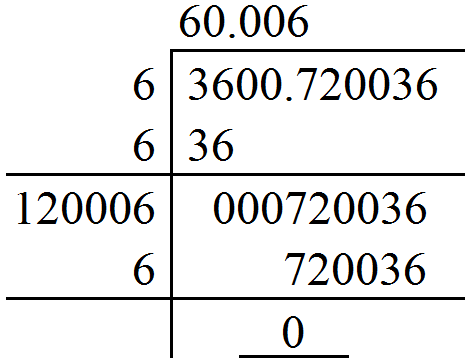
Hence, the square root of $3600.720036$ is $60.006$. View full question & answer→Question 95 Marks
Observe the following pattern,
$1^2=\frac{1}{6}\big[1\times(1+1)\times(2\times1+1)\big]$
$1^2+2^2=\frac{1}{6}\big[2\times(2+1)\times(2\times2+1)\big]$
$1^2+2^2+3^2=\frac{1}{6}\big[3\times(3+1)\times(2\times3+1)\big]$
$1^2+2^2+3^2+4^2=\frac{1}{6}\big[4\times(4+1)\times(2\times4+1)\big]$
and find the values of each of the following:
$i. 1^2+2^2+3^2+4^2+\ .....\ +10^2$
$ii. 5^2+6^2+7^2+8^2+9^2+10^2+11^2+12^2$
AnswerObserving the six numbers on the $\text{R.H.S}$ of the equalities,
$-$The first equality, whose biggest number on the $\text{L.H.S}$ is $1$, has $1, 1, 1, 2, 1$ and $1$ as the six numbers.
$-$The second equality, whose biggest number on the $\text{L.H.S}$ is $2$, has $2, 2, 1, 2, 2$ and $1$ as the six numbers.
$-$The third equality, whose biggest number on the $\text{L.H.S}$ is $3$, has $3, 3, 1, 2, 3$ and $1$ as the six numbers.
$-$The fourth equality, whose biggest number on the $\text{L.H.S}$ is $4$, has numbers $4, 4, 1, 2, 4$ and $1$ as the six numbers.
Note that the fourth number on the $\text{R.H.S}$ is always $2$ and the sixth number is always $1$. The remaining numbers are equal to the biggest number on the $\text{L.H.S}$ Hence, if the biggest number on the $\text{L.H.S}$ is $n$, the six numbers on the $\text{R.H.S}$ would be $n, n, 1, 2, n$ and $1$. Using this property, we can calculate the sums for $(i)$ and $(ii)$ as follows,
$i. 1^2+2^2+\ ....\ +10^2$
$=\frac{1}{6}\times\big[10\times(10+1)\times(2\times10+1)\big]$
$=\frac{1}{6}\times\big[10\times11\times12\big]$
$=385$
$ii. $The sum can be expressed as the difference of the two sums as follows,
$5^2+6^2+\ ....\ +12^2$
$=(1^2+2^2+\ ....\ 12^2)-(1^2+2^2+\ ....\ +4^2)$
The sum of the first bracket on the $\text{R.H.S}$
$1^2+2^2+\ .....\ +12^2$
$=\frac{1}{6}\big[12\times(12+1)\times(12\times12+1)\big]$
$=650$
The second bracket is,
$1^2+2^2+\ .....\ +4^2$
$=\frac{1}{6}\times[4\times(4+1)\times(2\times4+1)\big]$
$=\frac{1}{6}\times4\times5\times9=30$
Finally, the wanted sum is,
$5^2+6^2+\ .....\ +12^2$
$=(1^2+2^2+\ ....\ +12^2)-(1^2+2^2+\ .....\ +12^2)$
$=650-30=620$
View full question & answer→Question 105 Marks
Which of the following numbers are perfect squares? $11, 12, 16, 32, 36, 50, 64, 79, 81, 111, 121.$
Answer$11$: The perfect squares closest to $11$ are $9 (9 = 3^2)$ and $16 (16 = 4^2)$.
Since $3$ and $4$ are consecutive numbers, there are no perfect squares between $9$ and $16$, which means that $11$ is not a perfect square.
$12$: The perfect squares closest to $12$ are $9 (9 = 3^2)$ and $16 (16 = 4^2)$.
Since $3$ and $4$ are consecutive numbers, there are no perfect squares between $9$ and $16$, which means that $12$ is not a perfect square.
$16 = 4^2$
$32$: The perfect squares closest to $32$ are $25 (25 = 5^2)$ and $36 (36 = 6^2).$
Since $5$ and $6$ are consecutive numbers, there are no perfect squares between $25$ and $36$, which means that $32$ is not a perfect square.
$36 = 6^2$
$50$: The perfect squares closest to $50$ are $49 (49 = 7^2)$ and $64 (64 = 8^2).$
Since $7$ and $8$ are consecutive numbers, there are no perfect squares between $49$ and $64$, which means that $50$ is not a perfect square.
$64 = 8^2$
$79$: The perfect squares closest to $79$ are $64 (64 = 8^2)$ and $81 (81 = 9^2).$
Since $8$ and $9$ are consecutive numbers, there are no perfect squares between $64$ and $81$, which means that $79$ is not a perfect square.
$81 = 9^2$
$111$: The perfect squares closest to $111$ are $100 (100 = 10^2)$ and $121 (121 = 11^2).$
Since $10$ and $11$ are consecutive numbers, there are no perfect squares between $100$ and $121$, which means that $111$ is not a perfect square.
$121 = 11^2$
Hence, the perfect squares are $16, 36, 64, 81$ and $121.$
View full question & answer→Question 115 Marks
The square of which of the following numbers would be an odd number?
$i. 731$
$ii. 3456$
$iii. 5559$
$iv. 42008$
AnswerThe square of an odd number is always odd.
$i. 731$ is an odd number. Hence, its square will be an odd number.
$ii. 3456$ is an even number. Hence, its square will not be an odd number.
$iii. 5559$ is an odd number. Hence, its square will not be an odd number.
$iv. 42008$ is an even number. Hence, its square will not be an odd number.
Hence, only the squares of $731$ and $5559$ will be odd numbers.
View full question & answer→Question 125 Marks
By what number should the following numbers be multiplied to get a perfect square in each case? Also, find the number whose square is the new number. $3468$
AnswerFactorising number.
$3468 = 2 \times 2 \times 3 \times 17 \times 17$
$\begin{array}{c|c} 2& 3468 \\ \hline 2 & 1734 \\\hline 3&864 \\\hline 17&289 \\\hline 17&17\\\hline &1 \end{array}$
Grouping them into pairs of equal factors, $3468 = (2 \times 2) \times (17 \times 17) \times 3$
The factor $3$ is not paired. For a number to be a perfect square, each prime factor has to be paired.
Hence, $3468$ must be multiplied by $3$ for it to be a perfect square.
The new number would be $(2 \times 2) \times (17 \times 17) \times (3 \times 3)$
Furthermore, we have, $(2 \times 2) \times (17 \times 17) \times (3 \times 3) = (2 \times 3 \times 17) \times (2 \times 3 \times 17)$
Hence, the number whose square is the new number is, $2 \times 3 \times 17 = 102$
View full question & answer→Question 135 Marks
By what number should the following numbers be multiplied to get a perfect square in each case? Also, find the number whose square is the new number. $2880$
AnswerFactorising number.
$2880 = 2 \times 2 \times 2 \times 2 \times 2 \times 2 \times 3 \times 3 \times 5$
$\begin{array}{c|c} 2& 2880 \\ \hline 2 & 1440 \\\hline 2&720 \\\hline 2&360 \\\hline 2&180 \\\hline 2&90 \\\hline 3&45 \\\hline 3&15 \\\hline 5&5 \\\hline &1 \end{array}$
Grouping them into pairs of equal factors, $2880 = (2 \times 2) \times (2 \times 2) \times (2 \times 2) \times (3 \times 3) \times 5$
There is a $5$ as the leftover. For a number to be a perfect square, each prime factor has to be paired.
Hence, $2880$ must be multiplied by $5$ to be a perfect square.
The new number would be $(2 \times 2) \times (2 \times 2) \times (2 \times 2) \times (3 \times 3) \times (5 \times 5)$ Furthermore,
we have,$ (2 \times 2) \times (2 \times 2) \times (2 \times 2) \times (3 \times 3) \times (5 \times 5) = (2 \times 2 \times 2 \times 3 \times 5) \times (2 \times 2 \times 2 \times 3 \times 5)$
Hence, the number whose square is the new number is,$ 2 \times 2 \times 2 \times 3 \times 5 = 120$
View full question & answer→Question 145 Marks
By what numbers should the following be divided to get a perfect square in case? Also, find the number whose square is the new number. $5103$
AnswerFactorising number.
$5103 = 3 \times 3 \times 3 \times 3 \times 3 \times 3 \times 7$
$\begin{array}{c|c} 3& 5103 \\ \hline 3 & 1701 \\\hline 3&567 \\\hline 3 &189 \\\hline 3&63 \\\hline 3&21 \\\hline 7&7\\\hline&1 \end{array}$
Grouping them into pairs of equal factors, $5103 = (3 \times 3) \times (3 \times 3) \times (3 \times 3) \times 7$ The factor, $7$ is not paired.
For a number to be a perfect square, each prime factor has to be paired.
Hence, $5103$ must be divided by $7$ for it to be a perfect square.
The new number would be $(3 \times 3) \times (3 \times 3) \times (3 \times 3)$ Furthermore,
we have, $(3 \times 3) \times (3 \times 3) \times (3 \times 3) = (3 \times 3 \times 3) \times (3 \times 3 \times 3)$
Hence, the number whose square is the new number is $3 \times 3 \times 3 = 27$
View full question & answer→Question 155 Marks
The product of two numbers is $1296$. If one number is $16$ times the other, find the numbers.
AnswerLet the two numbers be $a$ and $b$.
From the first statement, we have $a \times b = 1296$
If one number is $196$ times the other, then we have $b = 16 \times a$
Substituting this value in the first equation,
we get $a \times (16 \times a) = 1296$ By simplifying both sides,
we get $\text{a}^2=\frac{1296}{16}=81$
Hence, $a$ is the square root of $81$, which is $9$ To find $b$,
use equartion $b = 16 \times a$ Since $a = 9 b = 16 \times 9 = 144$
So, the two numbers satisfying the question are $9$ and $144$
View full question & answer→Question 165 Marks
By what number should the following numbers be multiplied to get a perfect square in each case? Also, find the number whose square is the new number. $3675$
AnswerFactorising number. $3675 = 3 \times 5 \times 5 \times 7 \times 7$
$\begin{array}{c|c} 3& 3675 \\ \hline 5 & 1225 \\\hline 5&245 \\\hline 7&49 \\\hline 7 &7 \\\hline &1 \end{array}$
Grouping them into pairs of equal factors, $3675 = (5 \times 5) \times (7 \times 7) \times 3$ The factor, $3$ is not paired.
For a number to be a perfect square, each prime factor has to be paired.
Hence, $3675$ must be multiplied by $3$ for it to be a perfect square.
The new number would be ($5 \times 5) \times (7 \times 7) \times (3 \times 3)$ Furthermore,
we have, $(5 \times 5) \times (7 \times 7) \times (3 \times 3) = (3 \times 5 \times 7) \times (3 \times 5 \times 7)$
Hence, the number whose square is the new number is, $3 \times 5 \times 7 = 105$
View full question & answer→Question 175 Marks
By what numbers should the following be divided to get a perfect square in case? Also, find the number whose square is the new number.$1575$
AnswerFactorising number.
$1575 = 3 \times 3 \times 5 \times 5 \times 7$
$\begin{array}{c|c} 3& 1575 \\ \hline 3 & 525 \\\hline 5&175 \\\hline 5 &35\\\hline7&7\\\hline&1 \end{array}$
Grouping them into pairs of equal factors,
$1575 = (3 \times 3) \times (5 \times 5) \times 7$
The factor, $7$ is not paired. For a number to be a perfect square, each prime factor has to be paired.
Hence, $1575$ must be divided by $7$ for it to be a perfect square.
The new number would be $(3 \times 3) \times (5 \times 5)$
Furthermore, we have,
$(3 \times 3) \times (5 \times 5) = (3 \times 5) \times (3 \times 5)$
Hence, the number whose square is the new number is $3 \times 5 = 15$
View full question & answer→Question 185 Marks
Show that the following numbers are not perfect squares:
$i. 9327$
$ii. 4058$
$iii. 22453$
$iv. 743522$
AnswerA number ending with $2, 3, 7$ or $8$ cannot be a perfect square.
$i.$ Its last digit is $7$. Hence, $9327$ is not a perfect square.
$ii.$ Its last digit is $8$. Hence, $4058$ is not a perfect square.
$iii.$ Its last digit is $3$. Hence, $22453$ is not a perfect square.
$iv.$ Its last digit is $2$. Hence, $743522$ is not a perfect square.
View full question & answer→Question 195 Marks
By what numbers should the following be divided to get a perfect square in case? Also, find the number whose square is the new number. $3698$
AnswerFactorising number. $3698 = 2 \times 43 \times 43$
$\begin{array}{c|c} 2& 3698 \\ \hline 43 & 1849 \\\hline 43&43 \\\hline &1 \end{array}$
Grouping them into pairs of equal factors, $3698 = 2 \times (43 \times 43)$ The factor, $2$ is not paired.
For a number to be a perfect square, each prime factor has to be paired.
Hence, $3698$ must be divided by $2$ for it to be a perfect square.
The new number would be $(43 \times 43).$
Hence, the number whose square is the new number is $43$.
Hence, the number whose square is the new number is $43$.
View full question & answer→Question 205 Marks
By what numbers should the following be divided to get a perfect square in case? Also, find the number whose square is the new number.$3174$
AnswerFactorising number.
$3174 = 2 \times 3 \times 23 \times 23$
$\begin{array}{c|c} 2& 3174 \\ \hline 3 & 1587 \\\hline 23&529 \\\hline 23 &23\\\hline&1 \end{array}$
Grouping them into pairs of equal factors, $3174 = 2 \times 3 \times (23 \times 23)$ The factore, $2$ and $3$ are not paired.
For a number to be perfect square, each prime factor has to be paired.
Hence, $3174$ must be divided by $6 (2 \times 3)$ for it to be a perfect square.
The new number would be $(23 \times 23)$
Hence, the number whose square is the new number is $23$
View full question & answer→Question 215 Marks
Find the least number of six digits which is a perfect square.
AnswerThe least number with six digits is $100000$.
To find the least square number with six digits,
we must find the smallest number that must be added to $100000$ in order to make a perfect square.
For that, we have to find the square root of $100000$ by the long division method as follows:
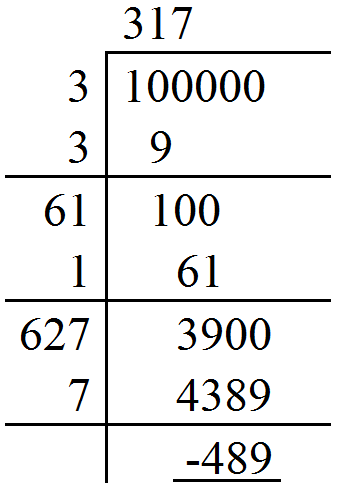
$100000$ is $489 (4389 - 3900)$ less than $317^2$.
Hence, to be a perfect square, $489$ should be added to $100000$.
$100000 + 489 = 100489$ Hence, the least number of six digits that is a perfect square is $100489$. View full question & answer→Question 225 Marks
Find the smallest number by which $1152$ must be divided so that it becomes a perfect square. Also, find the number whose square is the resulting number.
AnswerPrime factorisation of $1152$
$1152 = 2 \times 2 \times 2 \times 2 \times 2 \times 2 \times 2 \times 3 \times 3$
$\begin{array}{c|c} 2& 1152 \\ \hline 2 & 576 \\\hline 2&288 \\\hline 2 &144\\\hline2&72\\\hline2&36\\\hline2&18\\\hline3&9\\\hline3&3\\\hline&1 \end{array}$
Grouping them into pairs of equal factors,
$1152 = (2 \times 2) \times (2 \times 2) \times (2 \times 2) \times (3 \times 3) \times 2$
The factor, $2$ at the end is not paired. For a number to be a perfect square, each prime factor has to be paired.
Hence, $1152$ must be divided by $2$ for it to be a perfect square.
The resulting number would be $(2 \times 2) \times (2 \times 2) \times (2 \times 2) \times (3 \times 3)$
Furthermore, we have,
$(2 \times 2) \times (2 \times 2) \times (2 \times 2) \times (2 \times 2) \times (3 \times 3) = (2 \times 2 \times 2 \times 3) \times (2 \times 2 \times 2 \times 3)$
Hence, the number whose square is the resulting number is,
$2 \times 2 \times 2 \times 3 = 24$
View full question & answer→Question 235 Marks
By what number should the following numbers be multiplied to get a perfect square in each case? Also, find the number whose square is the new number.
$8820$
AnswerFactorising number.
$8820 = 2 \times 2 \times 3 \times 3 \times 5 \times 7 \times 7$
$\begin{array}{c|c} 2& 8820 \\ \hline 2 & 4410 \\\hline 3&2205 \\\hline 3&735 \\\hline 5 &245 \\\hline 7&49 \\\hline 7&7 \\\hline &1 \end{array}$
Grouping them into pairs of equal factors,
$8820 = (2 \times 2) \times (3 \times 3) \times (7 \times 7) \times 5$
The factor, $5$ is not paired. For a number to be a perfect square, each prime factor has to be paired.
Hence, $8820$ must be multiplied by $5$ for it to be a perfect square.
The new number would be $(2 \times 2) x (3 \times 3) x (7 \times 7) x (5 \times 5)$
Furthermore, we have,
$(2 \times 2) \times (3 \times 3) \times (7 \times 7) \times (5 \times 5) = (2 \times 3 \times 5 \times 7) \times (2 \times 3 \times 5 \times 7)$
Hence, the number whose square is the new number is, $2 \times 3 \times 5 \times 7 = 210$
View full question & answer→Question 245 Marks
By what number should the following numbers be multiplied to get a perfect square in each case? Also, find the number whose square is the new number. $4056$
AnswerFactorising number. $4056 = 2 \times 2 \times 2 \times 3 \times 13 \times 13$
$\begin{array}{c|c} 2& 4056 \\ \hline 2 & 2028 \\\hline 2&1014 \\\hline 3&507 \\\hline 13&169 \\\hline 13&13 \\\hline &1 \end{array}$
Grouping them into pairs of equal factors, $4056 = (2 \times 2) \times (13 \times 13) \times 2 \times 3$
The factors at the end, $2$ and $3$ are not paired.
For a number to be a perfect square, each prime factor has to be paired.
Hence, $4056$ must be multiplied by $6 (2 \times 3)$ for it to be a perfect square.
The new number would be $(2 \times 2) \times (2 \times 2) \times (3 \times 3) \times (13 \times 13)$ Furthermore,
we have, $(2 \times 2) \times (2 \times 2) \times (3 \times 3) \times (13 \times 13) = (2 \times 2 \times 3 \times 13) \times (2 \times 2 \times 3 \times 13)$
Hence, the number whose square is the new number is, $2 \times 2 \times 3 \times 13 = 156$
View full question & answer→Question 255 Marks
The area of a square field is $60025m^2. $ A man cycles along its boundary at 18km/hr. In how much time will he return at the starting point?
AnswerArea of the square field $= 60025m^2$ The length of the square field would be the square root of $60025$.
Using the long division method,
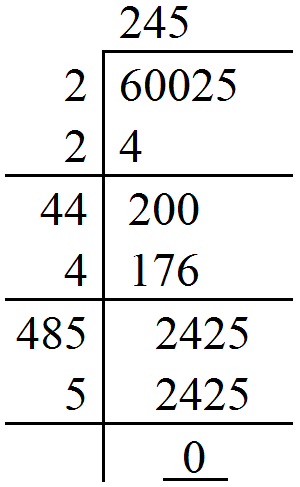
Hence, the length of the square field is $245\ m$.
The square has four sides, so the number of boundaries of the field is 4.
The distance s covered by the man $= 245m \times 4 = 980\ m = 0.98\ km$
If the velocity $v$ is $18$km/hr, the required time t can be calculated using the following formula,
$\text{t}=\frac{\text{s}}{\text{v}}$
$\text{t}=\frac{0.98}{18}=0.054\text{hr}$
$\text{t}=3\text{ minutes},16\text{ seconds}$
So, the man will return to the starting point after $3$ minutes and $16$ seconds. View full question & answer→Question 265 Marks
Using square root table, find the square root, $\frac{101}{169}$
Answer$\sqrt{\frac{101}{169}}=\frac{\sqrt{101}}{\sqrt{169}}$ The square root of $101$ is not listed in the table.
This is because the table lists the square roots of all the numbers below $100$.
Hence, we have to manipulate the number such that we get the square root of a number less than $100$.
This can be done in the following manner, $\sqrt{101}=\sqrt{1.01\times100}=\sqrt{1.01}\times10$
Now, we have to find the square root of $1.01$ We have, $\sqrt{1}=1$ and $\sqrt{2}=1.414$
Their difference of $1\ (2 - 1)$, the difference in the values of the square roots is $0.414$ For the difference of $0.01$,
the difference in the values of the square roots is, $0.01\times0.414=0.00414$
$\therefore\sqrt{1.01}=1+0.00414=1.00414$
$\sqrt{101}=\sqrt{1.01}\times10=1.00414\times10=10.0414$
Finally, $\sqrt{\frac{101}{169}}=\frac{\sqrt{101}}{1313}=\frac{10.0414}{13}=0.772$
This value is really close to the one from the key answer.
View full question & answer→Question 275 Marks
By what numbers should the following be divided to get a perfect square in case? Also, find the number whose square is the new number.
$16562$
AnswerFactorising number.
$16562 = 2 \times 7 \times 7 \times 13 \times 13$
$\begin{array}{c|c} 2& 16562 \\ \hline 7 & 8281 \\\hline 7&1183 \\\hline 13 &169 \\\hline 13&13 \\\hline &1 \end{array}$
Grouping them into pairs of equal factors,
$16562 = 2 \times (7 \times 7) \times (13 \times 13)$
The factor, $2$ is not paired. For a number to be a perfect square, each prime factor has to be paired.
Hence, $16562$ must be divided by $2$ for it to be a perfect square.
The new number would be $(7 \times 7) \times (13 \times 13)$
Furthermore, we have,
$(7 \times 7) \times (13 \times 13) = (7 \times 13) \times (7 \times 13)$
Hence, the number whose square is the new number is, $7 \times 13 = 91$
View full question & answer→Question 285 Marks
By what number should the following numbers be multiplied to get a perfect square in each case? Also, find the number whose square is the new number.
$7776$
AnswerFactorising number.
$7776 = 2 \times 2 \times 2 \times 2 \times 2 \times 3 \times 3 \times 3 \times 3 \times 3$
$\begin{array}{c|c} 2& 7776 \\ \hline 2 & 3888 \\\hline 2&1944 \\\hline 2&972 \\\hline 2&486 \\\hline 3&243 \\\hline 3&81 \\\hline 3&27 \\\hline 3&9 \\\hline 3&3 \\\hline &1 \end{array}$
Grouping them into pairs of equal factors,
$7776 = (2 \times 2) \times (2 \times 2) \times (3 \times 3) \times (3 \times 3) \times 2 \times 3$
The factors, $2$ and $3$ at the end are not paired.
For a number to be a perfect square, each prime factor has to be paired.
Hence, $7776$ must be multiplied by $6\ (2 \times 3)$ for it to be a perfect square.
The new number would be $(2 \times 2) \times (2 \times 2) \times (2 \times 2) \times (3 \times 3) x (3 \times 3) \times (3 \times 3)$
Furthermore, we have,
$(2 \times 2) \times (2 \times 2) \times (2 \times 2) \times (3 \times 3) \times (3 \times 3) \times (3 \times 3) = (2 \times 2 \times 2 \times 3 \times 3 \times 3) \times (2 \times 2 \times 2 \times 3 \times 3 \times 3)$
Hence, the number whose square is the new number is, $2 \times 2 \times 2 \times 3 \times 3 \times 3 = 216$
View full question & answer→Question 295 Marks
Using square root table, find the square root, $4955$
AnswerOn prime factorisation, $4955$ is equal to $5 \times 991$, which means that $\sqrt{4955}=\sqrt{5}\times\sqrt{11}$
The square root of $991$ is not listed in the table, it lists the square roots of all the numbers below $100$
Hence, we have to manipulate the number such that we get the square root of a number less than $100$.
This can be done in the following manner.
$\sqrt{4955}=\sqrt{49.55\times100}=\sqrt{49.55}\times10$
Now, we have to find the square root of $49.55$ We have, $\sqrt{49}=7$ and $\sqrt{50}=7.071$
Their difference is $0.071$ Thus, for the difference of $1\ (50 - 49)$, the difference in the values of the square roots is $0.071$ For the difference of $0.55$, the difference in the values of the square is, $0.55\times0.0701=0.03905$
$\therefore\sqrt{49.55}=7+0.3905=7.03905$
Finally, we have $\sqrt{4955}=\sqrt{49.55}\times10$
$=7.03905\times10=70.3905$
View full question & answer→Question 305 Marks
By what number should the following numbers be multiplied to get a perfect square in each case? Also, find the number whose square is the new number. $605$
AnswerFactorising number.
$605 = 5 \times 11 \times 11$
$\begin{array}{c|c} 5& 605 \\ \hline 11 & 121 \\\hline 11&11 \\\hline &1 \end{array}$
Grouping them into pairs of equal factors, $605 = 5 \times (11 \times 11)$
The factor, $5$ is not paired. For a number to be a perfect square, each prime factor has to be paired.
Hence, $605$ must be multiplied by $5$ for it to be a perfect square.
The new number would be $(5 \times 5) \times (11 \times 11)$ Furthermore,
we have, $(5 \times 5) \times (11 \times 11) = (5 \times 11) \times (5 \times 11)$
Hence, the number whose square is the new number is, $5 \times 11 = 55$
View full question & answer→Question 315 Marks
Observe the following pattern, $(1\times2)+(2\times3)=\frac{2\ \times\ 3\ \times\ 4}{3}$ $(1\times2)+(2\times3)+(3\times4)=\frac{3\ \times\ 4\ \times\ 5}{3}$ $(1\times2)+(2\times3)+(3\times4)+(4\times5)=\frac{4\ \times\ 5\ \times\ 6}{3}$ and find the value of, $(1\times2)+(2\times3)+(3\times4)+(4\times5)$
AnswerThe $RHS$ of the three equalities is a fraction whose numerator is the multiplication of three consecutive numbers and whose denominator is $3$.
If the biggest number (factor) on the $L.H.S$ is $3$, the multiplication of the three numbers on the $R.H.S$ begins with $2$.
If the biggest number (factor) on the $L.H.S$ is $4$, the multiplication of the three numbers on the $R.H.S$ begins with $3$.
If the biggest number (factor) on the $L.H.S$ is $5$, the multiplication of the three numbers on the $R.H.S$ begins with $4$.
Using this pattern, $(1 \times 2) + (2 \times 3) + (3 \times 4) + (4 \times 5) + (5 \times 6)$ has $6$ as the biggest number.
Hence, the multiplication of the three numbers on the $R.H.S$ will begin with $5$.
Finally, we have, $1\times2\times+2\times3+3\times4+4\times5+5\times6$
$=\frac{5\ \times\ 6\ \times\ 7}{3}=70$
View full question & answer→