Question 13 Marks
Find the smallest number by which $2925$ must be divided to obtain a perfect square. Also, find the square root of the perfect square so obtained.
AnswerBy prime factorisation, we get $2925 = 3 \times 3 \times 5 \times 5 \times 13$
So, the given number should be multiplied by $13$ to make the product a perfect square.
New number $= 2925 ÷ 13 = 225$
$\therefore 225 = 3 \times 3 \times 5 \times 5$
$\sqrt{225}=3\times5=15$
View full question & answer→Question 23 Marks
Evaluate $\sqrt{0.9}$ correct up to two places of decimal.
Answer $\begin{array}{c|c} &0.948 \\ \hline 9 & 0.\overline{90}\ \overline{00}\ \overline{00}\ \overline{00}\\& -81\ \ \ \ \ \ \ \ \ \ \ \ \ \ \\ \hline184 &\ \ 900\ \ \ \ \ \ \\ &-736\ \ \ \ \ \ \ \\ \hline1888 &\ 16400 \\ &-15104\ \ \\ \hline &\ \ \ \ 1296 \end{array}$
$\therefore\sqrt{0.9}=0.948=0.95$
(Correct up to two places of decimal)
View full question & answer→Question 33 Marks
Find the least number which must be added to $8400$ to obtain a perfect square. Find this perfect square and its square root.
AnswerFinding the square root of $8400$ by long division method, we find that $64$ is to be added to $8400$
We, get $8400 + 64 = 8464$
$\begin{array}{c|c} &92 \\ \hline 9 & \overline{84}\ \overline{00}\\& 81 \ \ \ \ \ \\ \hline182 &\ \ 300\\ &-364\\ \hline &\ \ \ \ \ 64 \end{array}$
Least number to be added $= 64$
Perfect square $= 8464$
Square root $= 92$
View full question & answer→Question 43 Marks
Find the greatest number of five digits which is a perfect square. What is the square root of this number$?$
AnswerThe greatest 5 digit number is $99999.$
$\begin{array}{c|c}&316\\\hline3&\bar{9}\ \overline{99}\ \overline{99}\\3&9\ \ \ \ \ \ \ \ \ \ \\\hline61&99\\\ \ \ 1&\ \ \ \ 61\ \ \ \ \\\hline626&\ \ \ \ \ 3899\\\ \ \ \ 6&\ \ \ \ \ \ \ \ \ 3756\ \ \ \ \\\hline&\ \ \ \ \ \ \ 143\\\end{array}$ $316<\sqrt{99999}<317$ $316^2=99856$
Thus, this is the greatest $5$ digit number.
View full question & answer→Question 53 Marks
Find the least square number which is exactly divisible by each of the numbers $8, 12, 15$ and $20.$
AnswerThe least number divisible by each one of $8, 12, 15$ and $20$ is their $LCM.$
Now, $LCM$ of $8, 12, 15$ and $20 = (2 × 2 × 3 × 5 × 2) = 120$
By prime factorization, we get
$120 = 2 × 2 × 2 × 3 × 5$
To make it perfect square it must be multiplied by $(2 × 3 × 5)$ i.e., $30$
Hence, required number $= (120 × 30) = 3600$
View full question & answer→Question 63 Marks
Evaluate $\sqrt{3}$ correct up to two places of decimal.
Answer$\begin{array}{c|c}&1.732\\\hline1&\bar{3}\ \overline{00}\ \overline{00}\ 00\\1&1\ \ \ \ \ \ \ \ \ \ \ \ \ \ \ \ \\\hline27& 200\ \ \ \ \ \ \ \ \ \ \ \\\ 7&189\ \ \ \ \ \ \ \ \ \ \\\hline343\ \ \ & \ \ \ \ \ \ \ \ 1100\ \ \ \ \ \ \ \ \ \ \ \ \\\ 3&1029\ \ \ \\\hline3462\ \ \ \ \ & \ \ \ \ \ \ \ \ \ \ \ \ \ \ \ \ \ \ 7100\ \ \ \ \ \ \ \ \ \ \ \ \ \\\ 2&\ \ \ \ \ 6924 \\\hline&\ \ \ \ \ \ 176\\\end{array}$ $\sqrt{3}=1.732$
Therefore, the value of $\sqrt{3}$ up to two places of decimal is $1.73.$
View full question & answer→Question 73 Marks
Evaluate:
$\sqrt{3\frac{13}{36}}$
Answer $\sqrt{3\frac{13}{36}}$
$=\sqrt{\frac{3\times36+13}{36}}$
$=\sqrt{\frac{108+13}{36}}$
$=\sqrt{\frac{121}{36}}$
$=\sqrt{\frac{11\times11}{6\times6}}$
$=\frac{11}{6}$
View full question & answer→Question 83 Marks
Evaluate: $\sqrt{3\frac{33}{289}}$
Answer$\sqrt{3\frac{33}{289}}$
$=\sqrt{\frac{3\times289+33}{289}}$
$=\sqrt{\frac{867+33}{289}}$
$=\sqrt{\frac{900}{289}}$
$\begin{array}{c|c}2&900\\\hline2&450\\\hline3&225\\\hline3&75\\\hline5&25\\\hline5&5\\\hline&1\end{array}$
$\begin{array}{c|c}17&289\\\hline17&17\\\hline&1\end{array}$
$=\sqrt{\frac{\overline{2\times2}\times\overline{3\times3}\times\overline{5\times5}}{17\times17}}$
$=\frac{2\times3\times5}{17}$
$=\frac{30}{17}$
$=1\frac{13}{17}$
View full question & answer→Question 93 Marks
Evaluate $\sqrt{11236}$
AnswerUsing long division method: $\begin{array}{c|c}&106\\\hline1&\bar{1}\ \overline{12}\ \overline{36}\\1&1\ \ \ \ \ \ \ \ \ \ \\\hline206&\ \ \ 1236\\\ \ \ \ 6&\ \ \ \ 1236\\\hline&\ \ \ \ \ \ \times\\\end{array}$ $\therefore\sqrt{11236}=106$
View full question & answer→Question 103 Marks
Find the least number which must be added to $6203$ to obtain a perfect square. Find this perfect square and its square root.
AnswerFinding the square root of $6203$ by division method,
we find that $38$ is to be added to get a perfect square
$i.$ Least number to be added $= 38$
$ii.$ Perfect square $= 6241$
$iii.$ Square root $= 79$
$\begin{array}{c|c} &79 \\ \hline 7 & \overline{62}\ \overline{03}\\& 49 \ \ \ \ \ \\ \hline149 &\ \ \ \ 1303\\ &-1341\\ \hline &\ \ \ \ -38 \end{array}$
View full question & answer→Question 113 Marks
Find the value of using the diagonal method: $(86)^2$
Answer
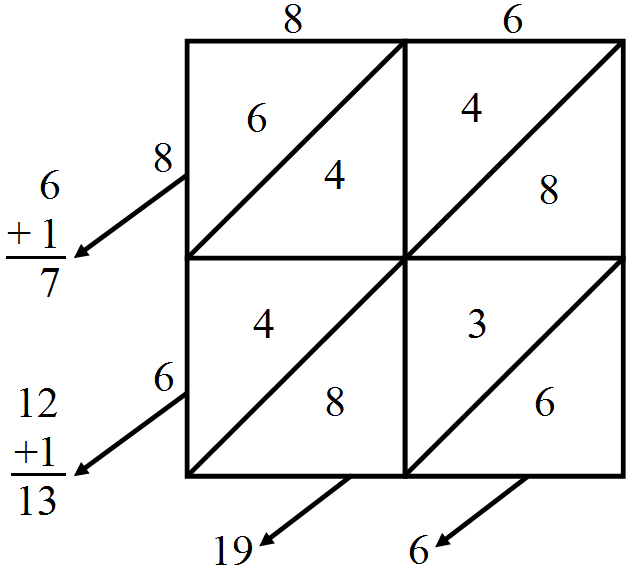
$\therefore$ $(86)^2 = 7396$ View full question & answer→Question 123 Marks
Evaluate: $\sqrt{\frac{625}{729}}$
Answer$\sqrt{\frac{625}{729}}$ $\begin{array}{c|c}5&625\\\hline5&125\\\hline5&25\\\hline5&5\\\hline&1\end{array}$ $\begin{array}{c|c}3&729\\\hline3&243\\\hline3&81\\\hline3&27\\\hline3&9\\\hline3&3\\\hline&1\end{array}$ $=\sqrt{\frac{\overline{5\times5}\times\overline{5\times5}}{\overline{3\times3}\times\overline{3\times3}\times\overline{3\times3}}}$ $=\frac{5\times5}{3\times3\times3}$ $=\frac{25}{27}$
View full question & answer→Question 133 Marks
Find the least number which must be subtracted from $7581$ to obtain a perfect square. Find this perfect square and its square root.
AnswerFinding the square root of $7581$ by division method, we find that $12$ is left as remainder $12$ must be subtracted from $7587$ to get a perfect square
i.e., $7581 - 12 = 7569$
$\begin{array}{c|c} &87 \\ \hline 8 & \overline{75}\ \overline{81}\\& 64 \ \ \ \ \ \\ \hline167 &\ \ \ \ 1181\\ &\ \ \ \ 1169\\ \hline &\ \ \ \ \ \ \ 12 \end{array}$
$i.$ The least number to be subtracted $= 12$
$ii.$ Perfect square $= 7569$
$iii.$ square root $= 87$
View full question & answer→Question 143 Marks
Find the least square number which is exactly divisible by each of the numbers $6, 9, 15$ and $20.$
AnswerThe least number divisible by each one of $6, 9, 15$ and $20$ is their $LCM.$
Now, $LCM$ of $6, 9, 15$ and $20 = (2 \times 3 \times 5 \times 3 \times 2) = 180$
By prime factorization, we get
$180 = 2 \times 2 \times 3 \times 3 \times 5$
To make it perfect square it must be multiplied by $5$
Hence, required number $= (180 \times 5) = 900$
View full question & answer→Question 153 Marks
Find the least number of four digits which is a perfect square. Also find the square root of the number so obtained.
AnswerLeast four digit number $= 1000$
$\begin{array}{c|c} &32 \\ \hline 3 & \overline{10}\ \overline{00}\\& \ \ 9 \ \ \ \ \ \\ \hline62 &\ \ 100\\ &-124\\ \hline &\ -24 \end{array}$
Finding the square root of $1000$ by division method, we find that $24$ must be added to get a perfect square of $4$ digits.
Perfect square $= 1000 + 24 = 1024$
Square root of $1024 = 32$
$\begin{array}{c|c} &32 \\ \hline 3 & \overline{10}\ \overline{24}\\&\ 9 \ \ \ \ \ \\ \hline62 &\ 124\\ &-124\\ \hline &\ \ \ \times \end{array}$
View full question & answer→Question 163 Marks
Find the smallest number by which $252$ must be multiplied to get a perfect square. Also, find the square root of the perfect square so obtained.
AnswerBy prime factorisation, we get $252 = 2 \times 2 \times 3 \times 3 \times 7$
So, the given number should be multiplied by $7$ to make the product a perfect square.
New number $= 252 \times 7 = 1764$
$\therefore 1764 = 2 \times 2 \times 3 \times 3 \times 7 \times 7$
$\sqrt{1764}=2\times3\times7=42$
View full question & answer→Question 173 Marks
Evaluate $\sqrt{0.2809 }$
AnswerThe least number of $4$ digit is $1000.$
$\begin{array}{c|c}&0.53\\\hline5&\bar0.\overline{28}\ \overline{09}\\5&25\\\hline103&\ \ \ \ \ \ \ \ 3\ 09\\3&\ \ \ \ \ \ \ \ 3\ 09\\\hline&\ \ \ \ \ \ \ 0\end{array}$
$\therefore\sqrt{0.2809 }=0.53$
View full question & answer→Question 183 Marks
Evaluate: $\sqrt{4\frac{73}{324}}$
Answer$\sqrt{4\frac{73}{324}}$ $=\sqrt{\frac{4\times324+73}{324}}$ $=\sqrt{\frac{1296+73}{324}}$ $=\sqrt{\frac{1369}{324}}$ $\begin{array}{c|c}37&1369\\\hline37&37\\\hline&1\end{array}$ $\begin{array}{c|c}2&324\\\hline2&162\\\hline3&81\\\hline3&27\\\hline3&9\\\hline3&3\\\hline&1\end{array}$ $=\sqrt{\frac{37\times37}{2\times2\times3\times3\times3\times3}}$ $=\frac{37}{2\times3\times3}$ $=\frac{37}{18}$ $=2\frac{1}{18}$
View full question & answer→Question 193 Marks
Find the least number of four digits which is a perfect square. What is the square root of this number$?$
AnswerThe least number of $4$ digit is $1000.$
$\begin{array}{c|c}&31\\\hline1&\overline{10}\ \overline{00}\\1&\ \ \ \ \ \ 9\ \ \ \ \ \ \ \ \ \ \\\hline61&\ \ \ 100\ \ \ \ \\\ 1&\ 61\\\hline&\ 39\\\end{array}$
$31<\sqrt{100}<32$
$32^2=1024$
$1024$ is the least four digit perfect square and its square root is $32.$
View full question & answer→Question 203 Marks
Find the value of using the diagonal method: $(256)^2$
Answer
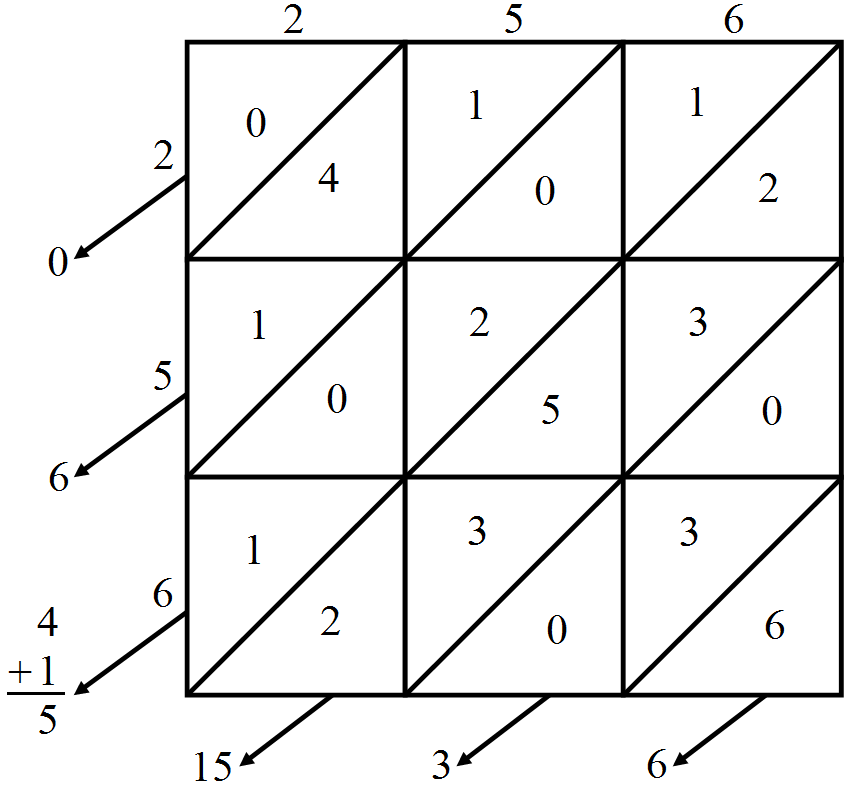
$\therefore (256)^2 = 65536$ View full question & answer→Question 213 Marks
Find the greatest number of five digits which is a perfect square. Also find the square root of the number so obtained.
AnswerGreatest number of five digits $= 99999$
Finding the square root of $99999$
We get remainder $= 143$
$\begin{array}{c|c} &316 \\ \hline 3 & \bar{9}\ \overline{99}\ \overline{99}\\& 9 \ \ \ \ \ \ \ \ \ \ \\ \hline61 &99\ \ \ \\ &61\ \ \ \\ \hline626 &\ 3899\\ &\ 3756\\\hline &\ \ \ \ 143 \end{array}$
Required perfect square $= 99999 - 143 = 99856$
and square root $= 316$
View full question & answer→Question 223 Marks
Evaluate $\frac{\sqrt{48}}{\sqrt{243}}$
Answer$\frac{\sqrt{48}}{\sqrt{243}}$ $=\sqrt{\frac{48}{243}}$ $=\sqrt{\frac{2\times2\times2\times2\times3}{3\times3\times3\times3\times3}}$ $=\frac{\sqrt{2\times2\times2\times2}}{\sqrt{3\times3\times3\times3}}$ $=\frac{2\times2}{3\times3}$ $=\frac{4}{9}$
View full question & answer→Question 233 Marks
Find the value of using the diagonal method:
$(67)^2$
Answer
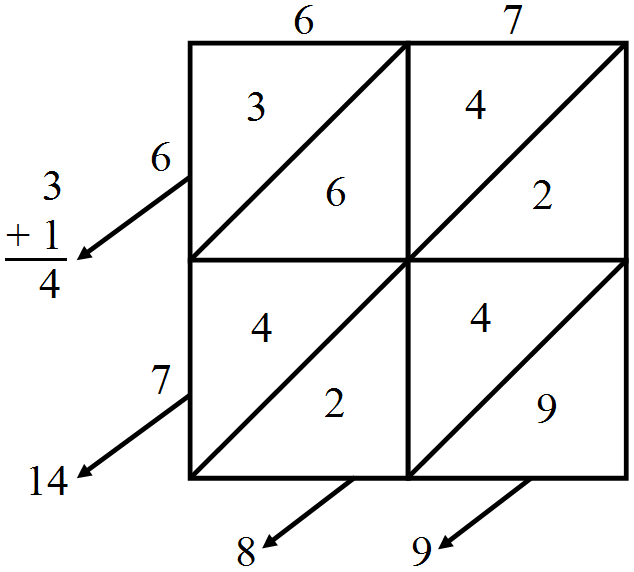
$\therefore (67)^2 = 4489$ View full question & answer→Question 243 Marks
Evaluate: $\sqrt{98}\times\sqrt{162}$
Answer$\sqrt{98}\times\sqrt{162}$
$=\sqrt{98\times162}$
$=\sqrt{2\times7\times7\times2\times3\times3\times3\times3}$
$=\sqrt{\overline{2\times2}\times\overline{7\times7}\times\overline{3\times3}\times\overline{3\times3}}$
$=2\times7\times3\times3$
$=126$
$\begin{array}{c|c}2&98\\\hline7&29\\\hline7&7\\\hline&1\end{array}$
$\begin{array}{c|c}2&162\\\hline3&81\\\hline3&27\\\hline3&9\\\hline3&3\\\hline&1\end{array}$
View full question & answer→Question 253 Marks
The area of a square field is $60025\ m^2$. A man cycles along its boundary at $18\ km/ h.$ In how much time will he return to the starting point?
AnswerArea of a square field = $60025\ m^2$
Let its side $= a$
$\therefore\text{a}^2=60025$
$\Rightarrow\text{a}=\sqrt{60025}$
$\Rightarrow\text{a}=245\text{m}$
$\begin{array}{c|c} &245 \\ \hline 2 & \bar{6}\ \overline{00}\ \overline{25}\\& 4 \ \ \ \ \ \ \ \ \ \ \\ \hline44 &200\ \ \ \ \ \\ &176\ \ \ \ \ \\ \hline485 &\ \ 2425\\ &\ \ 2425\\\hline &\ \ \ \times \end{array}$
Perimeter $= 4a$
$= 4 × 245 = 980m$
Speed of cycling $= 18\ km/ h$
$\therefore$ Time taken to complete its boundary $=\frac{980}{1000}\times\frac{60}{18}=\frac{49}{15}\ \text{minutes}$
$=3\frac{4}{15}\ \text{minutes}$
$=3\ \text{minutes}\ 16\ \text{seconds}$
View full question & answer→Question 263 Marks
Evaluate $\sqrt{2.8}$ correct up to two places of decimal.
Answer$\begin{array}{c|c} &1.673 \\ \hline 1 &2. \overline{80}\ \overline{00}\ \overline{00}\\& -1\ \ \ \ \ \ \ \ \ \ \ \ \ \ \ \ \ \ \\ \hline26 &180\ \ \ \ \ \ \ \ \ \ \ \\ &-156\ \ \ \ \ \ \ \ \ \ \ \ \ \ \\ \hline327 &\ 2400\ \ \ \ \ \ \\ &-2289\ \ \ \ \ \ \ \ \\ \hline \hline3343 &\ \ \ \ \ \ \ 11100\ \ \ \ \ \ \\ &\ \ \ \ -10029\ \ \ \ \ \ \ \ \\ \hline&\ \ \ \ \ \ \ \ \ \times\ \ \ \ \ \ \ \ \end{array}$ $\therefore\sqrt{2.8}=1.673=1.67$ (Correct up to two places of decimal)
View full question & answer→Question 273 Marks
Find the value of using the diagonal method: $(137)^2$
Answer
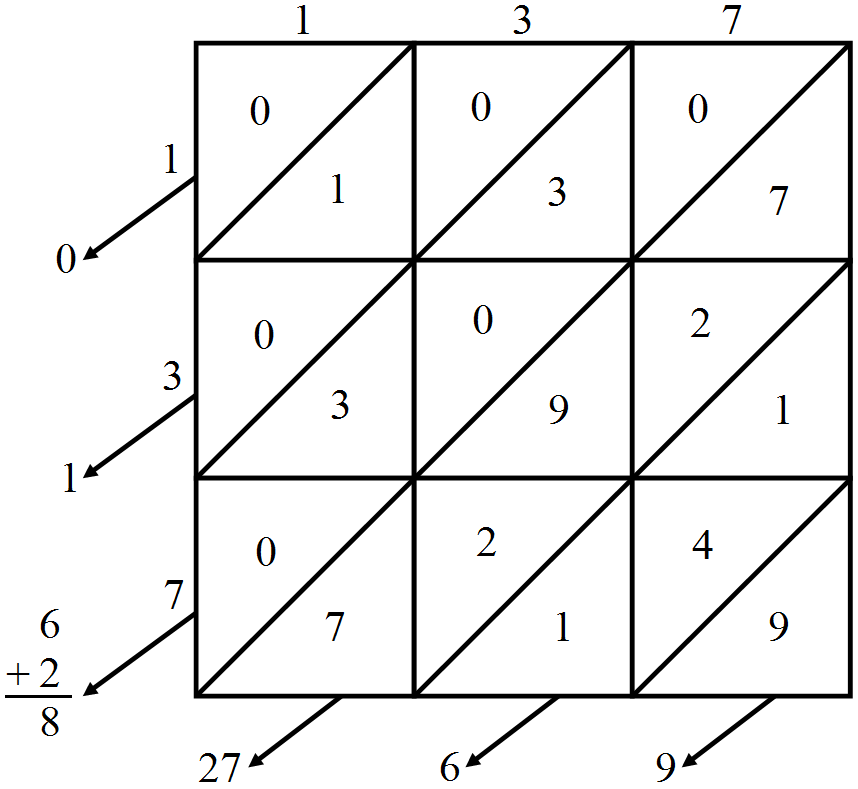
$\therefore$ $(137)^2= 18769$ View full question & answer→