Questions

1 Marks Question

Take a timed test

82 questions · self-marked practice — reveal the answer and mark yourself.
Question 11 Mark
Every rectangle is a trapezium.
Answer
True. Solution: As a rectangle satisfies all the properties of a trapezium. So, we can say that, every rectangle is a trapezium but vice-versa is not true.
View full question & answer
Question 21 Mark
Three angles of a quadrilateral are equal. Fourth angle is of measure $120^\circ .$ What is the measure of equal angles$?$
Answer
Let the measures of angles be $x^\circ $ each.
Then, by the angle sum property of a quadrilateral,
$x^\circ + x^\circ + x^\circ + 120^\circ = 360^\circ $
$\Rightarrow 3x^\circ + 120^\circ = 360^\circ $
$\Rightarrow 3x^\circ = 360^\circ - 120^\circ $
$\Rightarrow\frac{240^\circ}{3}=80^\circ$
View full question & answer
Question 31 Mark
Adjacent angles of a parallelogram are _____.
Answer
Adjacent angles of a parallelogram are supplementary. Solution: By property of a parallelogram, we know that, the adjacent angles of a parallelogram are supplementary.
View full question & answer
Question 41 Mark
Diagonals of a rhombus are equal and perpendicular to each other.
Answer
False. Solution: As diagonals of a rhombus are perpendicular to each other but not equal.
View full question & answer
Question 51 Mark
If all sides of a quadrilateral are equal, it is a _____.
Answer
If all sides of a quadrilateral are equal, it is a rhombus or square.
Solution:
As in both the quadrilaterals all sides are of equal length.
View full question & answer
Question 61 Mark
If the sum of interior angles is double the sum of exterior angles taken in an order of a polygon, then it is a hexagon.
Answer
True. Solution: Since the sum of exterior angles of a hexagon is $360^\circ$ and the sum of interior angles of a hexagon is $720^\circ$ ,  i.e. double the sum of exterior angles.
View full question & answer
Question 71 Mark
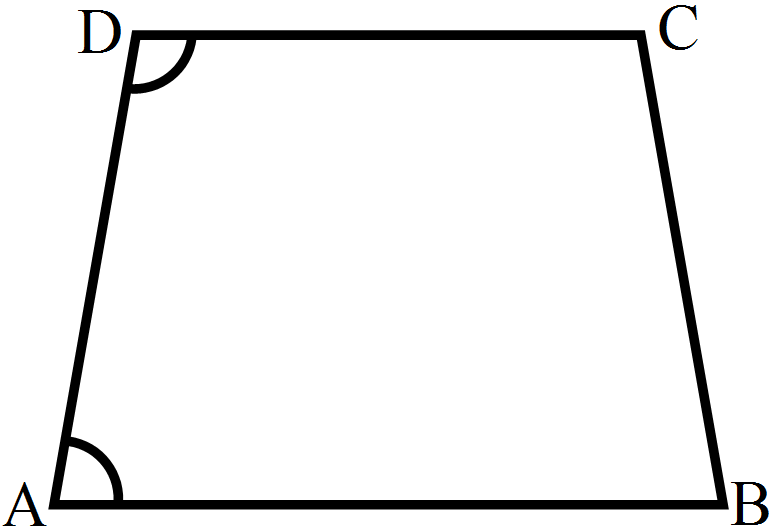
In trapezium $ABCD$ with $AB || CD,$ if $\angle\text{A}=100^\circ, \text{then}\ \angle\text{D}=$ _____.
Answer
In trapezium $ABCD$ with $AB || CD,$
 if $\angle\text{A}=100^\circ, \text{then}\ \angle\text{D}= 80^\circ .$
Solution: In trapezium, we know that, the angles on either sides of the base are supplementary.
So, in trapezium $ABCD,$ given $?? || ??$
 $\therefore\angle\text{A}+\angle\text{D}=180^\circ$
$\Rightarrow100^\circ+\angle\text{D}\ 180^\circ$
$\Rightarrow\angle\text{D}=180^\circ-100^\circ$
$\Rightarrow\angle\text{D}=80^\circ$
View full question & answer
Question 81 Mark
A nonagon has _____ sides.
Answer
A nonagon has $9$ sides. Solution: Nonagon is a polygon which has $9$ sides.
View full question & answer
Question 91 Mark
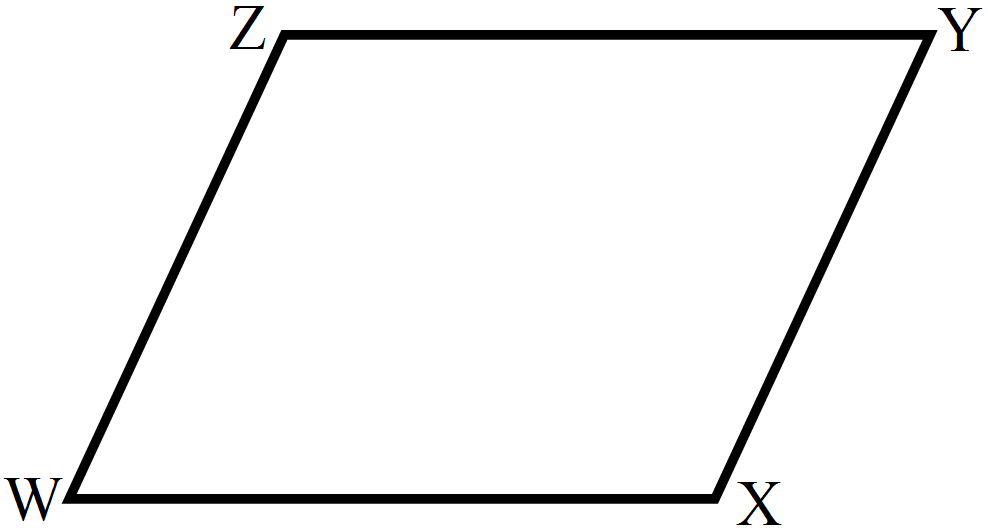
In quadrilateral $WXYZ,$ the pairs of opposite angles are _____.
Answer
In quadrilateral $WXYZ,$ the pairs of opposite angles are $\angle\text{w}, \angle\text{y}; \angle\text{x}, \angle\text{z}.$
Solution:

The pairs of opposite angles are.
View full question & answer
Question 101 Mark
Every square is a trapezium.
Answer
True. Solution: As a square has all the properties of a trapezium. So, we can say that, every square is a trapezium but vice-versa is not true.
View full question & answer
Question 111 Mark
A rectangle whose adjacent sides are equal becomes a _____.
Answer
A rectangle whose adjacent sides are equal becomes a square. Solution: If in a rectangle, adjacent sides are equal, then it is called a square.
View full question & answer
Question 121 Mark
If diagonals of a quadrilateral bisect each other, it must be a parallelogram.
Answer
True. Solution: It is the property of a parallelogram.
View full question & answer
Question 131 Mark
The measure of _____ angle of concave quadrilateral is more than $180^\circ .$
Answer
The measure of one angle of concave quadrilateral is more than $180^\circ$.
Solution:
Concave polygon is a polygon in which at least one interior angle is more than $180^\circ$.
View full question & answer
Question 141 Mark
A rhombus can be constructed uniquely if both diagonals are given.
Answer
True. Solution: A rhombus can be constructed uniquely, if both diagonals are given.
View full question & answer
Question 151 Mark
A polygon is a simple closed curve made up of only _____.
Answer
A polygon is a simple closed curve made up of only line segments. Solution: since a simple closed curve made up of only line segments is called a polygon.
View full question & answer
Question 161 Mark
A quadrilateral can be drawn if only measures of four sides are given.
Answer
False. Solution: As we require at least five measurements to determine a quadrilateral uniquely.
View full question & answer
Question 171 Mark
quadrilateral has two diagonals.
Answer
As the sum of interior angles of a triangle is $180^\circ $ and the sum of exterior angles is $360^\circ ,$ i.e. double the sum.
View full question & answer
Question 181 Mark
The sum of all _____ of a quadrilateral is $360^\circ $
Answer
The sum of all angles of a quadrilateral is $360^\circ$
Solution:
We know that, the sum of all angles of a quadrilateral is $360^\circ$.
View full question & answer
Question 191 Mark
_____ measurements can determine a quadrilateral uniquely.
Answer
$5$ measurements can determine a quadrilateral uniquely.
Solution: To construct a unique quadrilateral, we require $5$ measurements,
i.e. four sides and one angle or three sides and two included angles or two adjacent sides and three angles are given.
View full question & answer
Question 201 Mark
Sum of the angles of a hexagon is _____.
Answer
Sum of the angles of a hexagon is $720^\circ .$
Solution:
Since, the sum of angles of an $n-$gon $= (n − 2) \times 180^\circ$
$\therefore $ Sum of the angles of a hexagon $= (6 − 2) \times 180^\circ = 4 \times 180^\circ =720^\circ$
View full question & answer
Question 211 Mark
The number of diagonals in a hexagon is _____.
Answer
The number of diagonals in a hexagon is equilateral triangle. Solution: as polygon is regular, i.e. length of each side is same.
View full question & answer
Question 221 Mark
_____is a regular quadrilateral.
Answer
Square is a regular quadrilateral. Solution: Since in square, all the sides are of equal length and all angles are equal.
View full question & answer
Question 241 Mark
The sum of all exterior angles of a polygon is _____.
Answer
The sum of all exterior angles of a polygon is $360^\circ .$
Solution: As the sum of all exterior angles of a polygon is $360^\circ .$
View full question & answer
Question 261 Mark
Sum of all the angles of a quadrilateral is $180^\circ .$
Answer
False. Solution: Since sum of all the angles of a quadrilateral is $360^\circ .$
View full question & answer
Question 281 Mark
A polygon having $10$ sides is known as _____.
Answer
A polygon having $10$ sides is known as $5.$
Solution: We know that, the sum of exterior angles of any polygon is $360^\circ .$
View full question & answer
Question 291 Mark
Diagonals of a rectangle are _____.
Answer
Diagonals of a rectangle are equal. Solution: We know that, in a rectangle, both the diagonals are of equal length.
View full question & answer
Question 301 Mark
The measure of each exterior angle of a regular pentagon is _____.
Answer
The measure of each exterior angle of a regular pentagon is $78^\circ .$
Solution: Measures of exterior angle $=\frac{360^\circ}{\text{Number of sides}}=\frac{360^\circ}{5}=72^\circ.$
View full question & answer
Question 311 Mark
In a rhombus diagonals intersect at _____ angles.
Answer
In a rhombus diagonals intersect at right angles.solution:
The diagonals of a rhombus intersect at right angles.
View full question & answer
Question 321 Mark
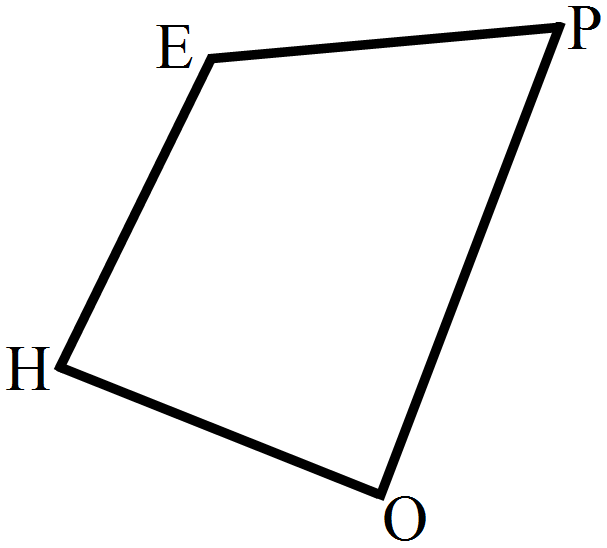
In quadrilateral $HOPE,$ the pairs of opposite sides are _____.
Answer
In quadrilateral $HOPE,$ the pairs of opposite sides are $EH, PO$ and $HO, EP.$
Solution:

are pairs of opposite sides.
View full question & answer
Question 331 Mark
A quadrilateral can be drawn if three sides and two diagonals are given.
Answer
True. Solution: A quadrilateral can be drawn, if three sides and two diagonals are given.
View full question & answer
Question 341 Mark
Every rhombus is a trapezium.
Answer
True.
Solution:
Since a rhombus satisfies all the properties of a trapezium. So, we can say that, every rhombus is a trapezium but vice-versa is not true.
View full question & answer
Question 351 Mark
The measure of each exterior angle of a regular polygon of $18$ sides is _____.
Answer
The measure of each exterior angle of a regular polygon of $18$ sides is $20^\circ .$​​​​​​​
Solution: We know that, measure of each exterior angle $=\frac{360^\circ}{\text{Number of sides}}=\frac{360^\circ}{18}=20^\circ.$
View full question & answer
Question 361 Mark
A quadrilateral in which a pair of opposite sides is parallel is_____.
Answer
A quadrilateral in which a pair of opposite sides is parallel is trapezium.
Solution:
We know that, in a trapezium, one pair of sides is parallel.
View full question & answer
Question 371 Mark
A parallelogram can be constructed uniquely if both diagonals and the angle between them is given.
Answer
True. Solution: We can draw a unique parallelogram, if both diagonals and the angle between them is given.
View full question & answer
Question 381 Mark
If only one diagonal of a quadrilateral bisects the other, then the quadrilateral is known as _____.
Answer
If only one diagonal of a quadrilateral bisects the other, then the quadrilateral is known as kite.
Solution:
This is a property of kite, i.e., only one diagonal bisects the other.
View full question & answer
Question 401 Mark
The number of sides of a regular polygon, where each exterior angle has a measure of $36^\circ$, is _____.
Answer
The number of sides of a regular polygon, where each exterior angle has a measure of $36^\circ ,$ is $10^\circ .$
Solution: The sum of exterior angles of a regular polygon is $360^\circ$ Further, since each exterior angle is of $36^\circ ,$ therefore, number of sides $=\frac{360^\circ}{\text{Exterior angle}}=\frac{360^\circ}{36^\circ}=10^\circ.$
View full question & answer
Question 411 Mark
Every kite is a parallelogram.
Answer
False. Solution: Kite is not a parallelogram as its opposite sides are not equal and parallel.
View full question & answer
Question 421 Mark
If opposite angles of a quadrilateral are equal, it must be a parallelogram.
Answer
True. Solution: If opposite angles are equal, it has to be a parallelogram.
View full question & answer
Question 431 Mark
The polygon in which sum of all exterior angles is equal to the sum of interior angles is called _____.
Answer
The polygon in which sum of all exterior angles is equal to the sum of interior angles is called quadrilateral.
Solution:
We know that, the sum of exterior angles of a polygon is $360^\circ $ and in a quadrilateral, sum of interior angles is also $360^\circ .$ Therefore, a quadrilateral is a polygon in which the sum of both interior and exterior angles are equal.
View full question & answer
Question 441 Mark
A regular polygon is a polygon whose all sides are equal and all _____are equal.
Answer
A regular polygon is a polygon whose all sides are equal and all angles In a regular polygon, are equal. Solution: all sides are equal and all angles are equal.
View full question & answer
Question 451 Mark
The adjacent sides of a parallelogram are $5\ cm$ and $9\ cm.$ Its perimeter is _____.
Answer
The adjacent sides of a parallelogram are $5\ cm$ and $9\ cm.$ Its perimeter is $28\ cm.$
Solution: Perimeter of a parallelogram $= 2 ($Sum of lengths of adjacent sides$) = 2(5 + 9) = 2 \times 14 = 28\ cm$
View full question & answer
Question 461 Mark
Every trapezium is a parallelogram.
Answer
False. Solution: Since in a trapezium, only one pair of sides is parallel.
View full question & answer
Question 471 Mark
A quadrilateral can be drawn when all the four angles and one side is given.
Answer
False.
Solution:
We cannot draw a unique-quadrilateral, if four angles and one side is known.
View full question & answer
Question 481 Mark
All rhombuses are squares.
Answer
False.
Solution:
As in a rhombus, each angle is not a right angle, so rhombuses are not squares.
View full question & answer
Question 491 Mark
A quadrilateral can have all four angles as obtuse.
Answer
False. Solution: If all angles will be obtuse, then their sum will exceed $360^\circ .$ This is not possible in case of a quadrilateral.
View full question & answer
Question 501 Mark
The name of three-sided regular polygon is _____.
Answer
The name of three-sided regular polygon is equilateral triangle. Solution: as polygon is regular, i.e. length of each side is same.
View full question & answer
Question 511 Mark
Every square is a parallelogram.
Answer
True.
Solution:
Every square is also a parallelogram as it has all the properties of a parallelogram but vice-versa is not true.
View full question & answer
Question 521 Mark
If diagonals of a quadrilateral are equal, it must be a rectangle.
Answer
True. Solution: If diagonals are equal, then it is definitely a rectangle.
View full question & answer
Question 531 Mark

is a polygon.
Answer
False.
Solution:
Because it is not a simple closed curve as it intersects with itself more than once.
View full question & answer
Question 541 Mark
Diagonals of rectangle bisect each other at right angles.
Answer
False. Solution: Diagonals of a rectangle does not bisect each other.
View full question & answer
Question 551 Mark
The measure of each angle of a regular pentagon is _____.
Answer
The measure of each angle of a regular pentagon is $108^\circ .$
Solution: We know that, the sum of interior angles of a polygon
​​​​​​​ $= (n − 2) \times 180^\circ .$
$= (5 − 2) \times 180^\circ $
$= 540^\circ $
Since, it is a regular pentagon.
​​​​​​​$\therefore$ Measure of each interior angle $=\frac{\text{sum of interior angles}}{\text{Number of sides}}=\frac{540^\circ}{5}=180^\circ.$
View full question & answer
Question 561 Mark
Every parallelogram is a rectangle.
Answer
False. Solution: As in a parallelogram, all angles are not right angles, while in a rectangle, all angles are equal and are right angles.
View full question & answer
Question 571 Mark
A rhombus is a parallelogram in which _____ sides are equal.
Answer
A rhombus is a parallelogram in which all sides are equal. Solution: As length of each side is same in a rhombus.
View full question & answer
Question 581 Mark

is a closed curve entirely made up of line segments. The another name for this shape is _____.

Answer


is a closed curve entirely made up of line segments. The another name for this shape is concave polygon.
Solution:
As one interior angle is of greater than $180^\circ .$
View full question & answer
Question 591 Mark
A polygon is regular if all of its sides are equal.
Answer
False.
Solution:
By definition of a regular polygon, we know that, a polygon is regular, if all sides and all angles are equal.
View full question & answer
Question 601 Mark
The sum of interior angles of a polygon of n sides is _____ right angles.
Answer
The sum of interior angles of a polygon of $n$ sides is $(2n − 4)$ right angles.
Solution: By the formula, sum of interior angles of a polygon of $?$ sides $= (n − 2) × 180^\circ= (2n − 2) × 90^\circ$.
View full question & answer
Question 611 Mark
Every square is a rhombus.
Answer
True.
Solution:
As a square possesses all the properties of a rhombus. So, we can say that, every square is a rhombus but vice-versa is not true.
View full question & answer
Question 621 Mark
The point of intersection of diagonals of a quadrilateral divides one diagonal in the ratio $1 : 2.$ Can it be a parallelogram? Why or why not?
Answer
No, it can never be a parallelogram, as the diagonals of a parallelogram intersect each other in the ratio $1 : 1.$
View full question & answer
Question 631 Mark
The number of sides in a regular polygon having measure of an exterior angle as $72^\circ $ is ______.
Answer
The number of sides in a regular polygon having measure of an exterior angle as $72^\circ $ is $5.$
Solution:
We know that, the sum of exterior angles of any polygon is $360^\circ$
View full question & answer
Question 641 Mark
The sum of interior angles and the sum of exterior angles taken in an order are equal in case of quadrilaterals only.
Answer
True.
Solution:
Since the sum of interior angles as well as of exterior angles of a quadrilateral are $360^\circ $
View full question & answer
Question 651 Mark
A quadrilateral can be drawn if all four sides and one angle is known.
Answer
True. Solution: A quadrilateral can be drawn, if all four sides and one angle is known.
View full question & answer
Question 661 Mark
A diagonal of a quadrilateral is a line segment that joins two _____ vertices of the quadrilateral.
Answer
A diagonal of a quadrilateral is a line segment that joins two opposite vertices of the quadrilateral. Solution: Since the line segment connecting two opposite vertices is called diagonal.
View full question & answer
Question 671 Mark
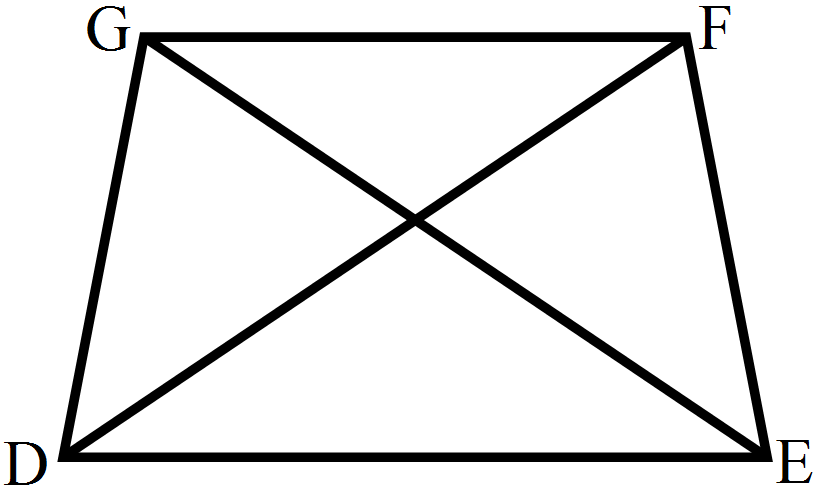
The diagonals of the quadrilateral $DEFG$ are _____ and _____.
Answer
The diagonals of the quadrilateral $DEFG$ are $GE$ and $FD.$
Solution:

The diagonals are.
View full question & answer
Question 681 Mark
A kite is not a convex quadrilateral.
Answer
False Solution: A kite is a convex quadrilateral as the line segment joining any two opposite vertices inside it, lies completely inside it.
View full question & answer
Question 691 Mark
All kites are squares.
Answer
False. Solution: As kites do not satisfy all the properties of a square. e.g. In square, all the angles are of $90^\circ $ but in kite, it is not the case.
View full question & answer
Question 701 Mark
Every trapezium is a rectangle.
Answer
False. Solution: Since in a rectangle, opposite sides are equal and parallel but in a trapezium, it is not so.
View full question & answer
Question 711 Mark
If one diagonal of a rectangle is 6cm long, length of the other diagonal is _____
Answer
If one diagonal of a rectangle is 6cm long, length of the other diagonal is square. Solution: If in a rectangle, adjacent sides are equal, then it is called a square.
View full question & answer
Question 721 Mark
All rectangles are parallelograms.
Answer
True. Solution: Since rectangles satisfy all “the” “properties” of parallelograms. Therefore, we can say that, all rectangles are parallelograms but vice-versa is not true.
View full question & answer
Question 731 Mark
The interior angles of a triangle are in the ratio $1 : 2 : 3,$ then the ratio of its exterior angles is $3 : 2 : 1.$
Answer
Given, ratio of interior angles $= 1 : 2 : 3$ Let the interior angles be $x, 2x$ and $3x$
So, $x + 2x + 3x= 180^\circ $
$6x=180^\circ $
$\text{x}=\frac{180^\circ}{6}=30^\circ$
$\therefore$The interior angles are $30^\circ , 60^\circ , 90^\circ $
Now, the exterior angles will be $(180^\circ - 30^\circ ), (180^\circ - 60^\circ )$ and $(180^\circ - 90^\circ )$
i.e., $150^\circ , 120^\circ $ and $90^\circ $ The ratio of exterior angles $= 150^\circ : 120^\circ : 90^\circ = 15 : 12 : 9 = 5 : 4 : 3.$
View full question & answer
Question 741 Mark
A quadrilateral can be constructed uniquely if its three sides and _____ angles are given.
Answer
A quadrilateral can be constructed uniquely if its three sides and two included angles are given. Solution: We cap determine a quadrilateral uniquely, if three sides and two included angles are given.
View full question & answer
Question 751 Mark
A quadrilateral can be constructed uniquely if three angles and any two sides are given.
Answer
True. Solution: We can construct a unique quadrilateral with given three angles given and two included sides.
View full question & answer
Question 761 Mark
A photo frame is in the shape of a quadrilateral. With one diagonal longer than the other. Is it a rectangle? Why or why not?
Answer
No, it cannot be a rectangle, as in rectangle, both the diagonals are of equal lengths.
View full question & answer
Question 771 Mark
All squares are rectangles.
Answer
True. Solution: Since squares possess all the properties of rectangles. Therefore, we can say that, all squares are rectangles but vice-versa is not true.
View full question & answer
Question 781 Mark
A quadrilateral can be drawn if all four sides and one diagonal is known.
Answer
True.
Solution:
A quadrilateral can be constructed uniquely, if four sides and one diagonal is known.
View full question & answer
Question 791 Mark
A quadrilateral that is not a parallelogram but has exactly two opposite angles of equal measure is _____.
Answer
A quadrilateral that is not a parallelogram but has exactly two opposite angles of equal measure is kite. Solution: By the property of a kite, we know that, it has two opposite angles of equal measure.
View full question & answer
Question 801 Mark
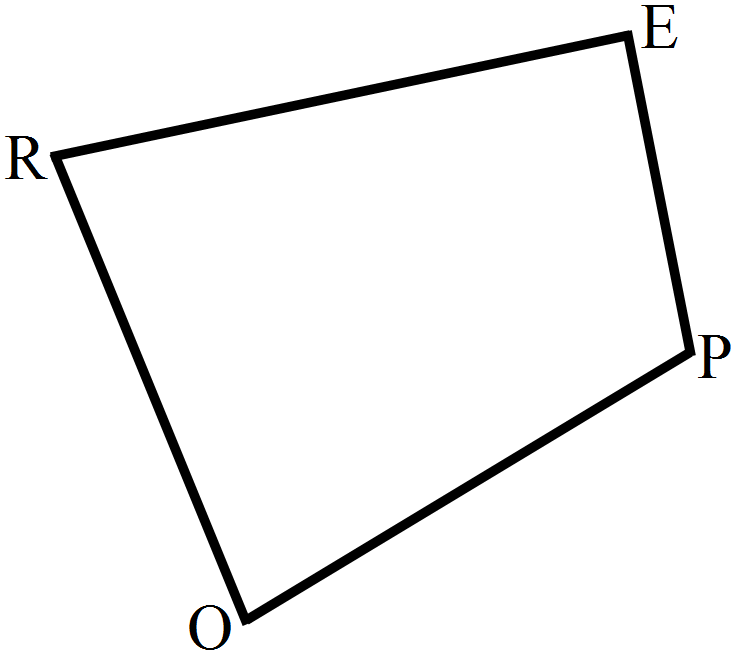
In quadrilateral $ROPE,$ the pairs of adjacent angles are _____.
Answer
In quadrilateral $ROPE,$ the pairs of adjacent angles are $\angle\text{R}, \angle\text{O}, \angle\text{O}, \angle\text{P}, \angle\text{E}, \angle\text{E}, \angle\text{R}.$ Solution:

The pairs of adjacent angles are.
View full question & answer
Question 811 Mark
If the diagonals of a quadrilateral bisect each other, it is a _____.
Answer
If the diagonals of a quadrilateral bisect each other, it is a parallelogram. Solution: Since in a parallelogram, the diagonals bisect each other.
View full question & answer
Question 821 Mark
A line $l$ is parallel to line m and a transversal $p$ interesects them at $X, Y$ respectively. Bisectors of interior angles at $X$ and $Y$ interesct at $P$ and $Q.$ Is $PXQY$ a rectangle$?$ Given reason.
Answer
False.
Solution:
As it has $6$ sides, therefore it is a concave hexagon.
View full question & answer