Questions

2 Marks Questions

Take a timed test

44 questions · self-marked practice — reveal the answer and mark yourself.

Question 12 Marks
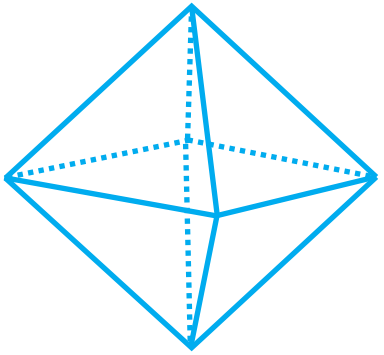
How many faces, edges and vertices does a pyramid have with n sided polygon as its base?
Answer
In a pyramid, the number of vertices is $1$ more than the number of sides of the polygon base, i.e. vertices $= n + 1$.
Also, the number of faces is $1$ more than the number of sides of the polygonal base, i.e. faces $= n + 1$
But the number of edges is $2$ times the number of sides of the polygonal base, i.e. edges $= 2n$.
View full question & answer
Question 22 Marks
Look at the shapes given below and state these are polyhedra using Euler’s formula.
Answer
In the give figure, we have.Faces $(F) = 10$, verties $(v) = 16$ and edges $(E) = 24$
On putting these values in Euler's formula, we get.
$F + V - E = 2$
$\Rightarrow 10 + 16 - 24 = 2$
$\Rightarrow 26 - 24 = 2$
$\Rightarrow 2 = 2$
Hence, these valus do not satisfy the Euler's formula. So, it is a polyhedra.
View full question & answer
Question 32 Marks
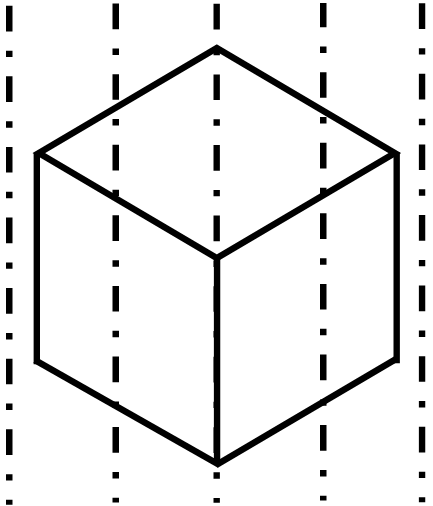
Use isometric dot paper to draw each figure.A rectangular prism with length $4$ units, width $2$ units and height $2$ units.
Answer
The followingrectangular prism with length $4$ units, width $2$ units and height $2$ units is made by using isometric dott paper.
View full question & answer
Question 42 Marks
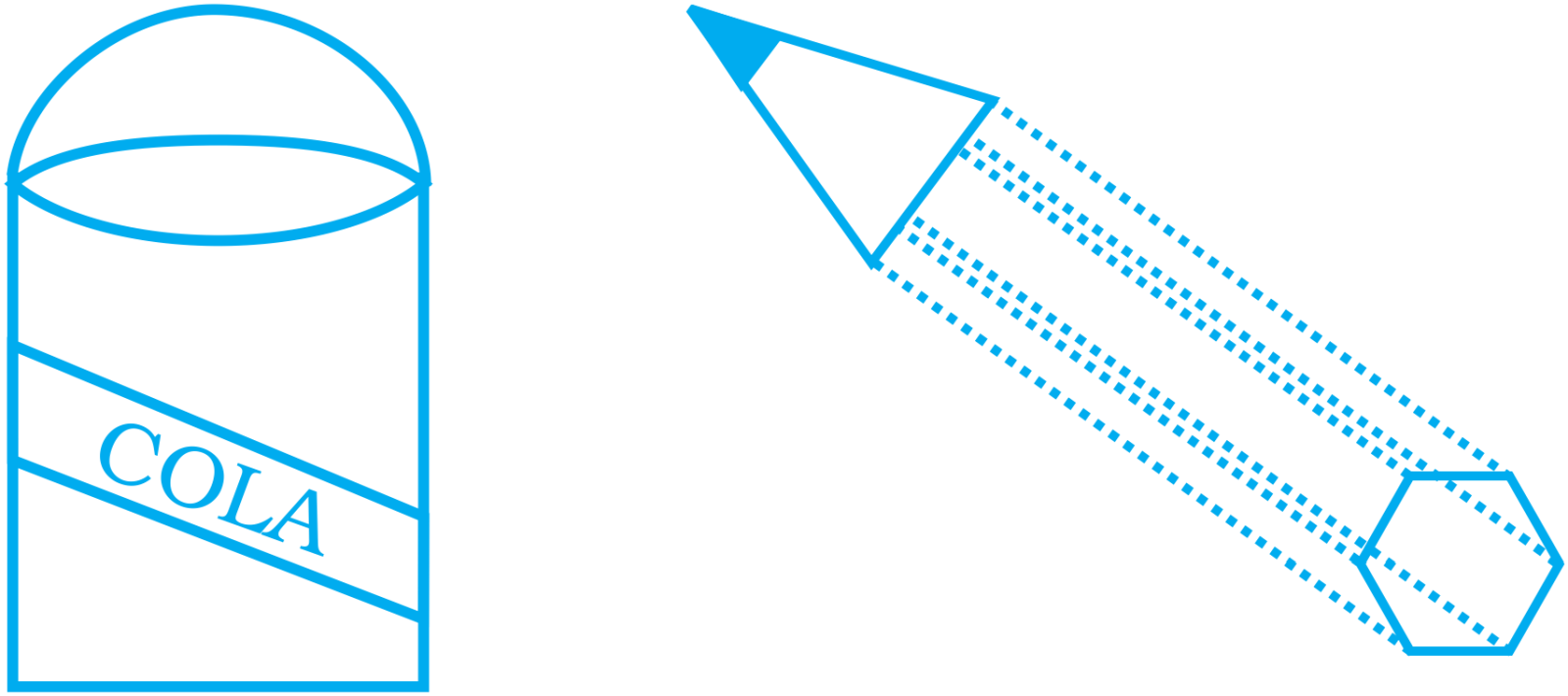
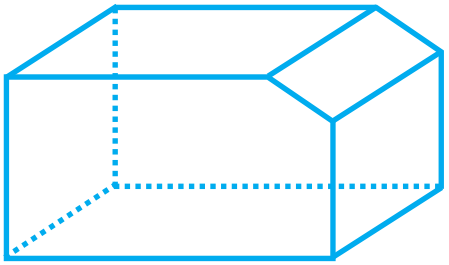
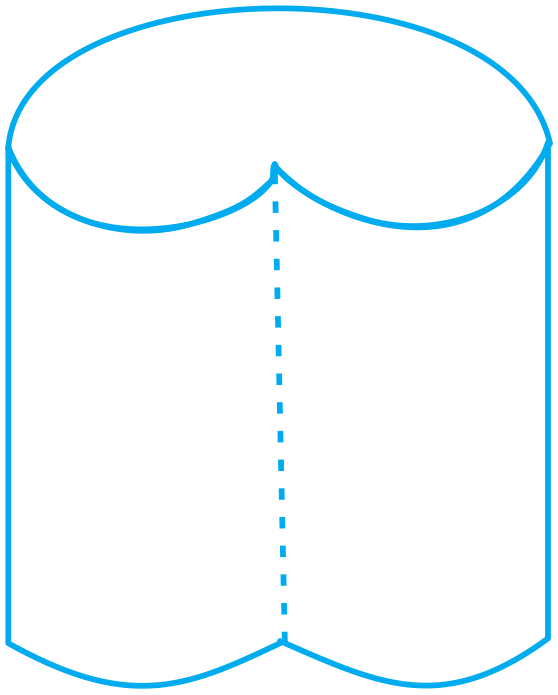
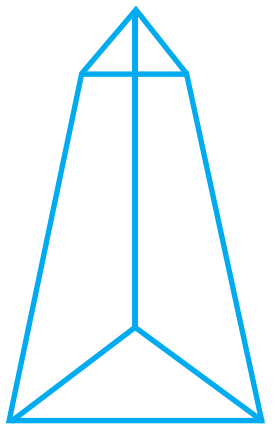
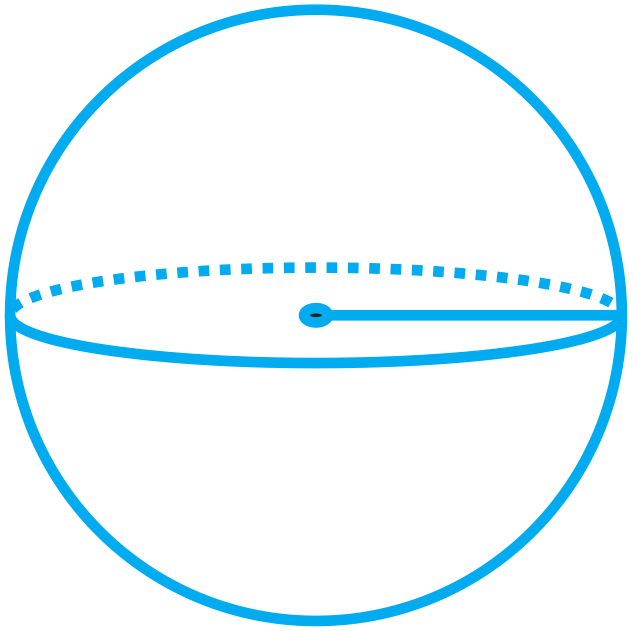
In the given figures, identify the different shapes involved.
Answer
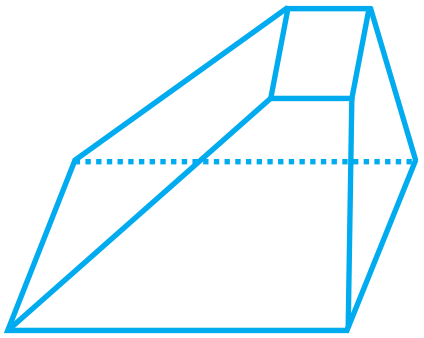
First figure is made by using a hemisphere and cylinder. In this figure, cylinder is mounted by hemisphere. The second figure is made by using.aoone and hexagonal prism. In this figure, hexagonal prism is mounted by a cone.
View full question & answer
Question 52 Marks
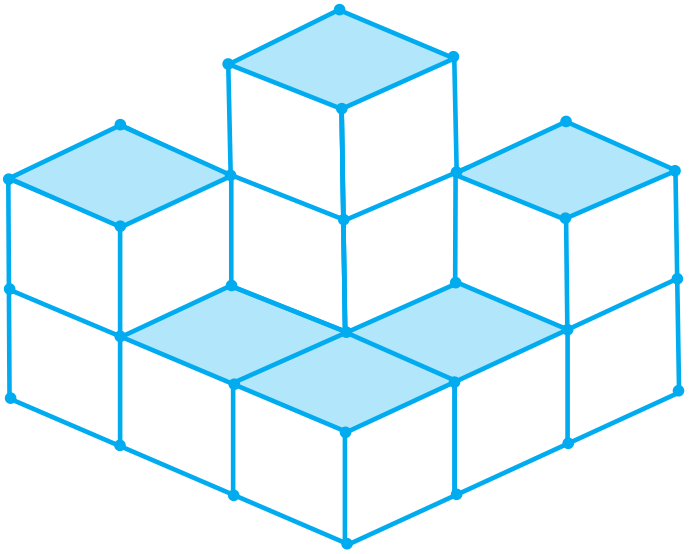
In the above figure, if only the shaded cubes are visible from the top, draw the base layer.
Answer
The top view of the figure is shown below:

Note: If we see the given figure from top, we will only see upper layer not base layer.
View full question & answer
Question 62 Marks
Using Euler’s formula. Find the value of unknown $x, y, z, p, q$ andr in the following table.
Faces $p$
Vertices $6$
Edges $12$
Answer
By using Euler's formula for polyhedron $V = 6, E = 12$ and $F = p$
So,$F + V - E = 2 $
$\Rightarrow P + 6 - 12 = 2$
$ \Rightarrow P - 6 = 2 $
$\Rightarrow P = 2 + 6 $
$\Rightarrow P = 8$
View full question & answer
Question 72 Marks
Using Euler’s formula. Find the value of unknown $x, y, z, p, q$ andr in the following table.
Faces $8$
Vertices $11$
Edges $r$
Answer
By using Euler's formula for polyhedron
$F = 8, V = 11$ and $E = r$
So, $F + V - E = 2$
$\Rightarrow 8 + 11 - r = 2$
$\Rightarrow 19 - r = 2$
$\Rightarrow r = 19 - 2$
$\Rightarrow r = 17$
View full question & answer
Question 82 Marks
Find the scale. Actual size $45$ feet. Drawing size $5$ inches.
Answer
By using, $\text{Scale}=\frac{\text{size drawn}}{\text{Actual size}}=\frac{5\text{inches}}{45\text{feet}}$
$=\frac{1 \text{ inch}}{9\text{ feet}}=1\text{ inch}:9\text{ feet}$
Hence, scale = $1$ inch : $9$ feet
View full question & answer
Question 92 Marks
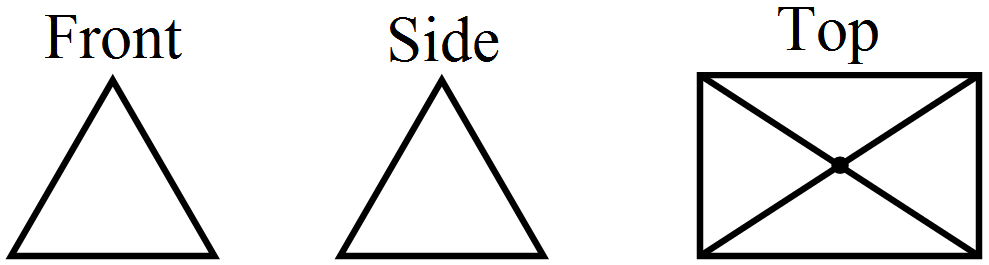
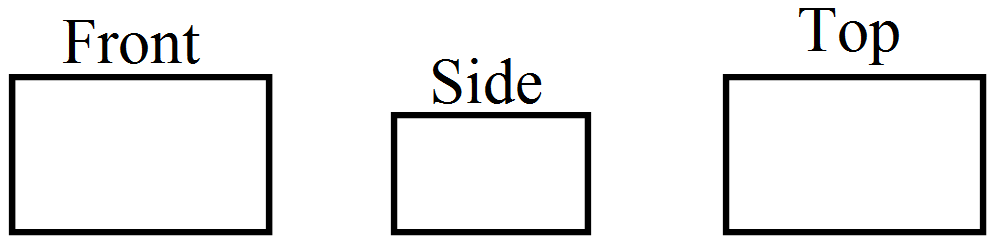
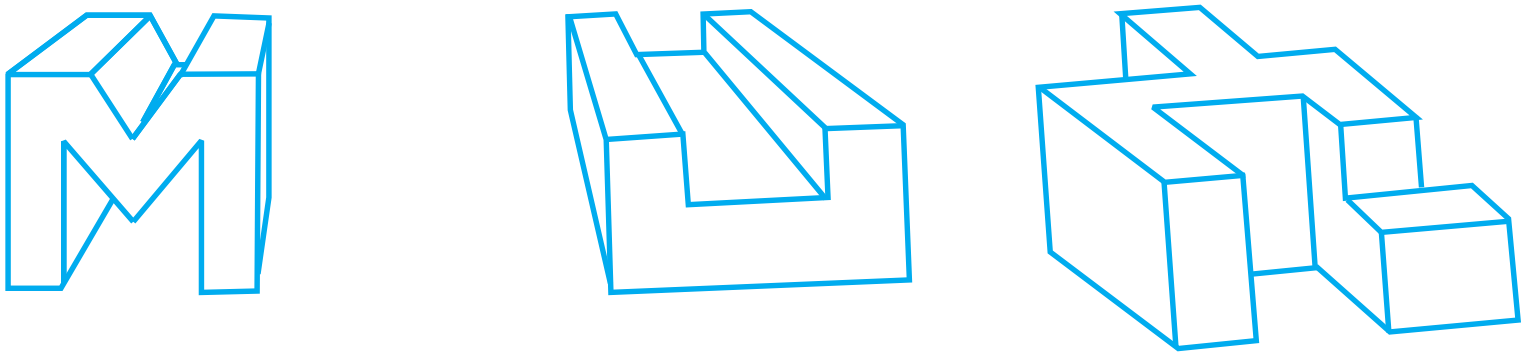
Draw the front, side and top view of the given shapes.

Answer
On the basis of properties and features of front view, top view and side view, we can draw all the three views of the given figures as:

View full question & answer
Question 102 Marks
The distance between school and house of a girl is given by $5\ cm$ in a picture, using the scale $1\ cm : 5\ km$. Find the actual distance between the two places?
Answer
Given scale $= 1\ cm : 5\ km,$ i.e. $1\ cm$ in picture $= 5\ km$ of actual distance
$\therefore$ 5cm in picture $= 5 \times 5 = 25\ km$ of actual distance
Hence, the actual distance between the two places is 25km.
So, 5cm represent $= 5 \times 5 = 25\ km$ distance
View full question & answer
Question 122 Marks
Look at the shapes given below and state these are polyhedra using Euler’s formula.
Answer
In the give figure, we have.Faces $(F) = 7$, verties $(v) = 10$ and edges $(E) = 15$
On putting these values in Euler's formula, we get.
$F + V - E = 2$
$\Rightarrow 17 + 10 - 15 = 2$
$\Rightarrow 17 - 15 = 2$
$\Rightarrow 2 = 2$
Hence, these valus satisfie the Euerl's fomula. So, it is a polyhedra
View full question & answer
Question 132 Marks
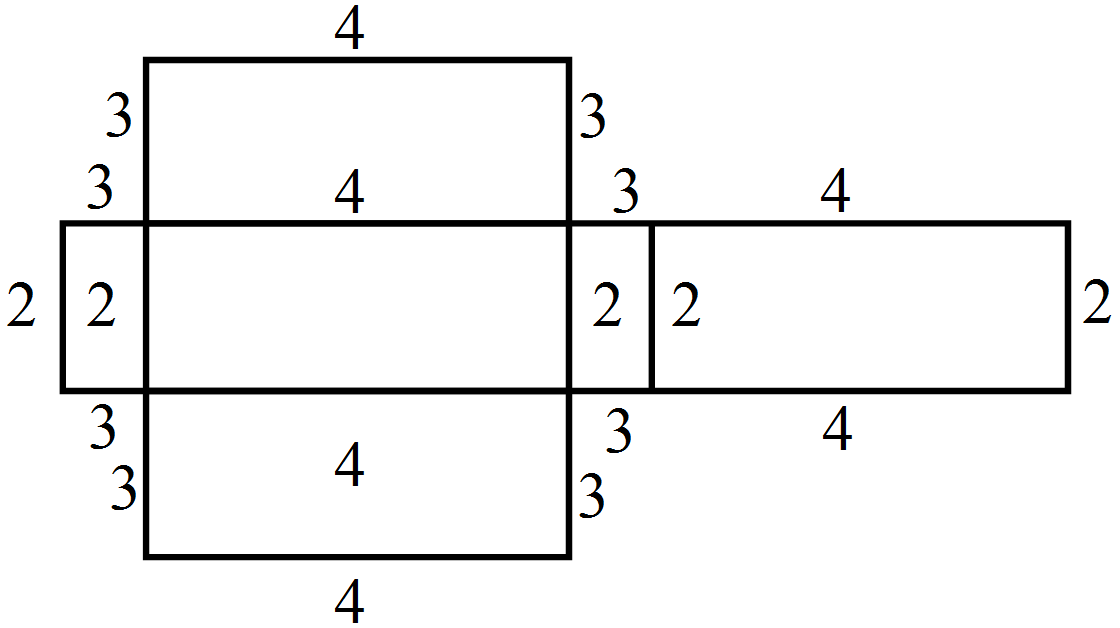
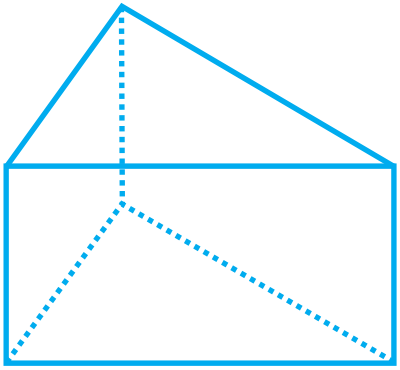
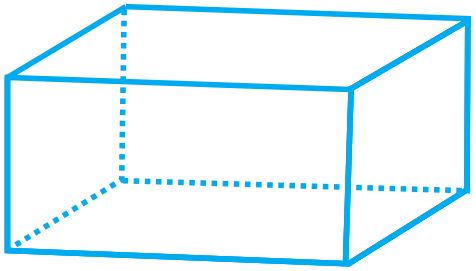
Draw the net of the following shape.
Answer
The net of the given shape is shown below:
Note: if we open this shape from dotted line, we will find above net.
View full question & answer
Question 142 Marks
Look at the shapes given below and state these are polyhedra using Euler’s formula.
Answer
In the give figure, we have. Faces $(F) = 2$, verties $(v) = 1$ and edges $(E) = 0$.
On putting these values in Euler's formula,
we get. $F + V - E = 2 \Rightarrow 2 + 1 - 0 = 2$ $\Rightarrow 3\neq2$
Hence, these valus do not satisfy the Euler's formula. So, it is not a polyhedra.
View full question & answer
Question 152 Marks
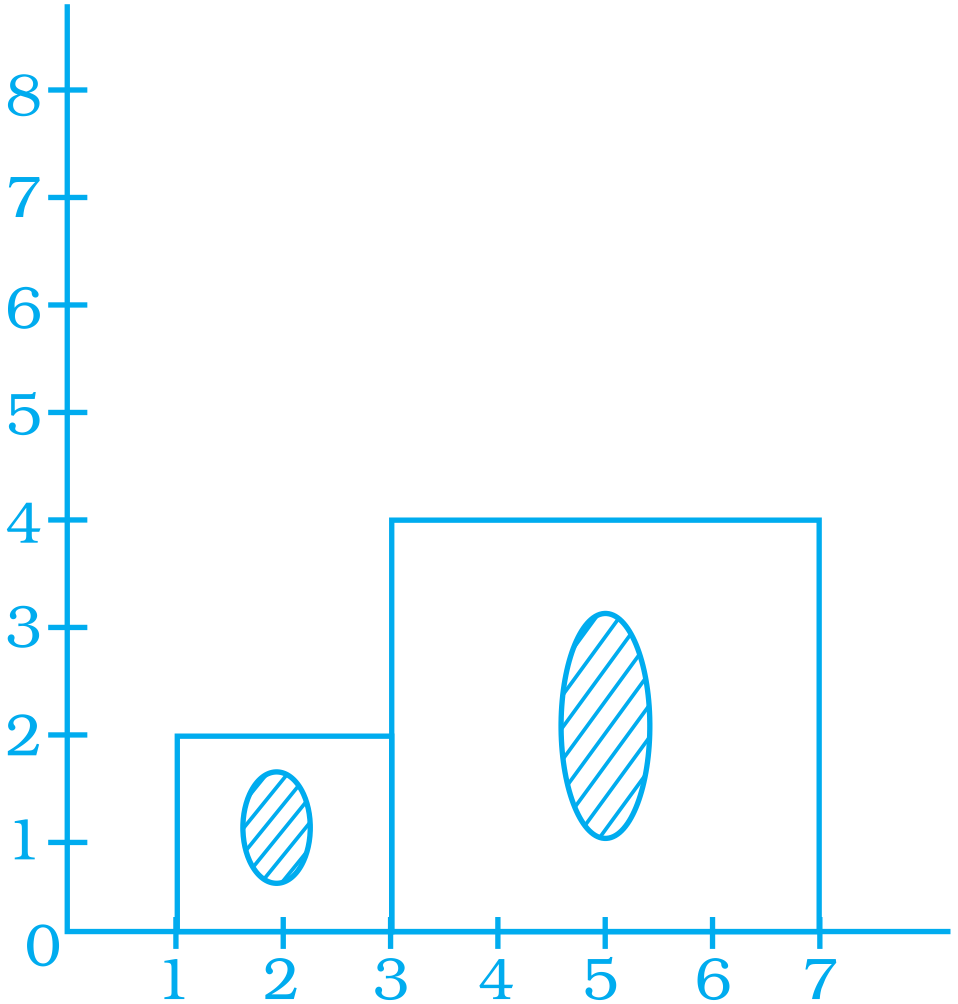
A photographer uses a computer program to enlarge a photograph. What is the scale according to which the width has enlarged?
Answer
By the given graph, we have width before editing $= 2$ units Width after editing $= 4$ units
We know that, $\text {Scale}=\frac{\text{Size berfore editing}}{\text{Size after editing}}$
$\therefore \text{Scale}=\frac{2}{4}=\frac{1}{2}=1:2$
Hence, scale used to enlarge the photograph is $1:2$
View full question & answer
Question 162 Marks
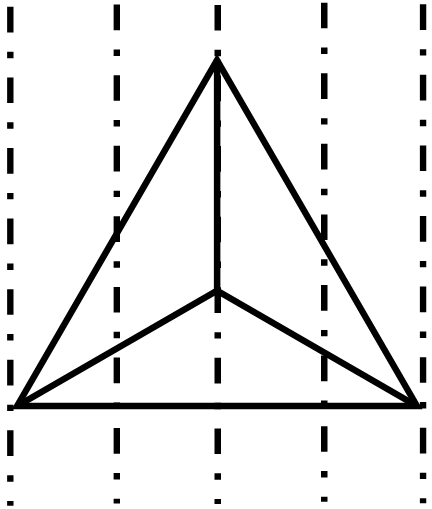
Use isometric dot paper to draw each figure. A tetrahedron.
Answer
The following tetrahedron figure is made by using isometric dot paper.
View full question & answer
Question 172 Marks
Look at the shapes given below and state these are polyhedra using Euler’s formula.
Answer
In the give figure, we have.Faces $(F) = 5$, verties $(v) = 6$ and edges $(E) = 9$
On putting these values in Euler's formula, we get.
$F + V - E = 2$
$\Rightarrow 5 + 6 - 9 = 2$
$\Rightarrow 11 - 9 = 2$
$\Rightarrow 2 = 2$
Hence, these valus do not satisfy the Euler's formula. So, it is a polyhedra.
View full question & answer
Question 182 Marks
Look at the shapes given below and state these are polyhedra using Euler’s formula.
Answer
In the give figure, we have.Faces $(F) = 6$, verties $(v) = 8$ and edges $(E) = 12$
On putting these values in Euler's formula, we get.
$F + V - E = 2$
$\Rightarrow 6 + 8 - 12 = 2$
$\Rightarrow 14 - 12 = 2$
$\Rightarrow 2 = 2$
Hence, these valus satisfie the Euerl's fomula. So, it is a polyhedra
View full question & answer
Question 192 Marks
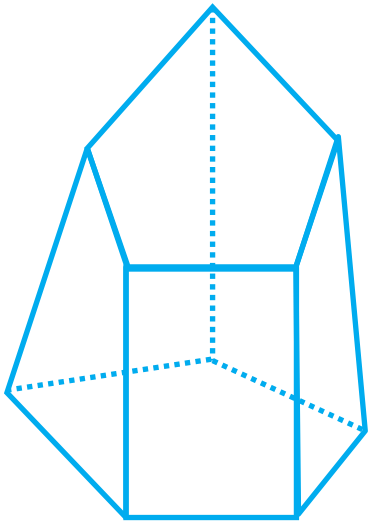
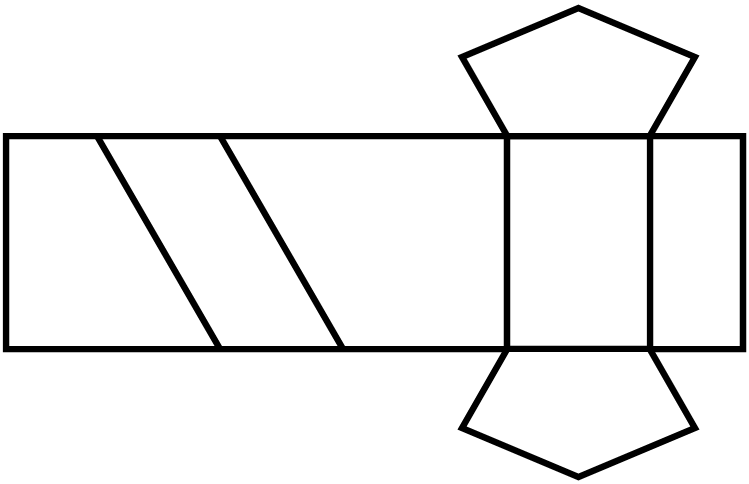
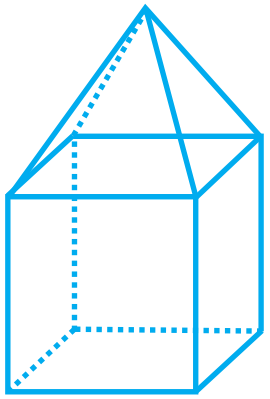
Draw the net of the following solid. (Hint: Pentagons are not congruent.)
Answer
The net of the given solid is shown below: Note: If we open this solid shape, we will find above net.
View full question & answer
Question 202 Marks
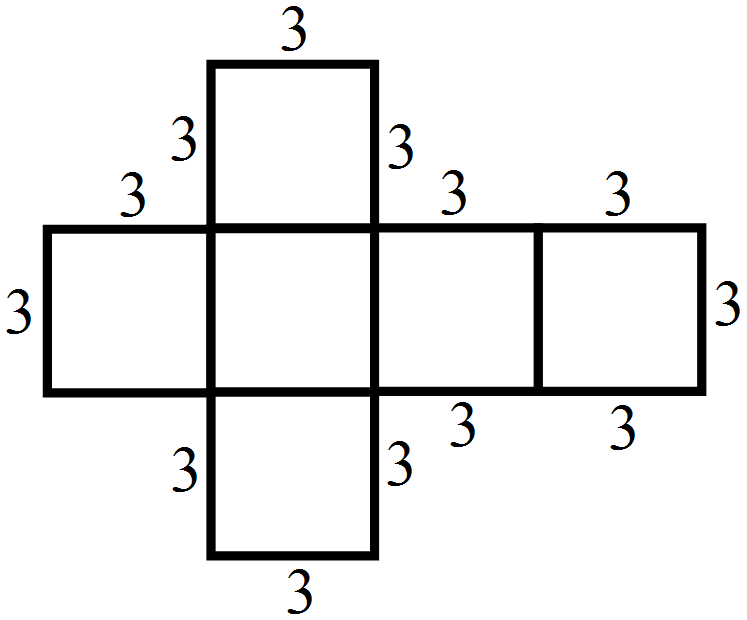
Draw the net of a regular hexahedron with side $3\ cm$.(Hint: Regular hexahedron - cube)
Answer
The net of a regular hexahedron with side $3\ cm$ is given below:
View full question & answer
Question 212 Marks
Find the scale.
Actual size $12\ m$.
Drawing size $3\ cm$.
Answer
By using,
$\text{Scale}=\frac{\text{Size drawn}}{\text{Actual size}}$
$=\frac{3\text{cm}}{12\text{cm}}$
$=\frac{1\text{cm}}{4\text{m}}=1\text{cm}:4\text{m}$
Hence, scale $= 1\ cm : 4\ cm$
View full question & answer
Question 222 Marks
Look at the shapes given below and state these are polyhedra using Euler’s formula.
Answer
In the give figure, we have.Faces $(F) = 9$, verties $(v) = 9$ and edges $(E) = 16$
On putting these values in Euler's formula, we get.
$F + V - E = 2$
$\Rightarrow 9 + 9 - 16 = 2$
$\Rightarrow 18 - 16 = 2$
$\Rightarrow 2 = 2$
Hence, these valus do not satisfy the Euler's formula. So, it is a polyhedra.
View full question & answer
Question 232 Marks
A polyhedron has $20$ faces and $12$ vertices. Find the edges of the polyhedron.
Answer
By using Euler's formula for polyhedron,$F + V - E = 2$
[where, $F$ = faces, $V$ = vertices, $E$ = edges]
Given, faces$(F) = 20$, vertices$(V) = 12$
$\Rightarrow 20 + 12 - E = 2$
$\Rightarrow 32 - E = 2$
$\Rightarrow E = 32 - 2$
$\Rightarrow E = 30$
Hence, the edges of the polyhedron are $30$.
View full question & answer
Question 242 Marks
Look at the shapes given below and state these are polyhedra using Euler’s formula.
Answer
In the give figure, we have.Faces $(F) = 8$, verties $(v) = 12$ and edges $(E) = 18$
On putting these values in Euler's formula, we get.
$F + V - E = 2$
$\Rightarrow 8 + 12 - 18 = 2$
$\Rightarrow 20 - 18 = 2$
$\Rightarrow 2 = 2$
Hence, these valus do not satisfy the Euler's formula. So, it is a polyhedra.
View full question & answer
Question 252 Marks
Look at the shapes given below and state which of these are polyhedra using Euler’s formula.
Answer
In the give figure, we have.
Faces $(F) = 5$, verties $(v) = 6$ and edges $(E) = 9$ On putting these values in Euler's formula,we get. 
 $F + V - E = 2 $
$\Rightarrow 5 + 6 - 9 = 2$
$ \Rightarrow 11 - 9 = 2 $
$\Rightarrow 2 = 2$
Hence, these valus satisfie the Euerl's fomula.
​​​​​​​So, it is a polyhedra
View full question & answer
Question 262 Marks
Look at the shapes given below and state these are polyhedra using Euler’s formula.
Answer
In the give figure, we have.
Faces $(F) = 1$, verties $(v) = 0$ and edges $(E) = 1$
On putting these values in Euler's formula, we get.
$F + V - E = 2$
$\Rightarrow 1 + 0 - 1 = 2$
$\Rightarrow0\neq2$
Hence, these valus do not satisfy the Euler's formula. So, it is not a polyhedra.
View full question & answer
Question 272 Marks
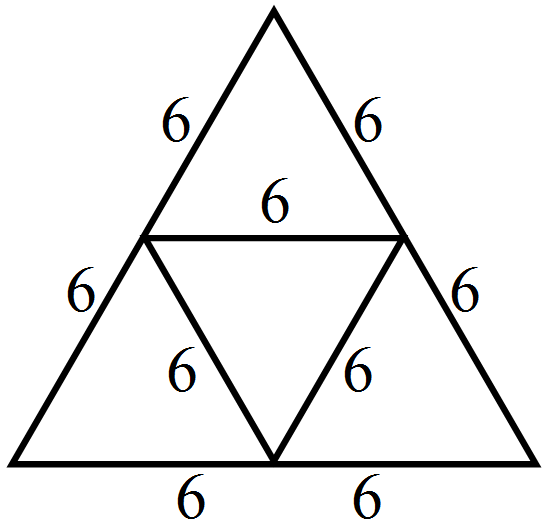
Draw the net of a regular tetrahedron with side $6\ cm$.
Answer
The net of a regular tetrahedron with side $6\ cm$ is given below:
View full question & answer
Question 282 Marks
Look at the shapes given below and state these are polyhedra using Euler’s formula.
Answer
In the give figure, we have.Faces $(F) = 11$, verties $(v) = 11$ and edges $(E) = 20$
On putting these values in Euler's formula, we get.
$F + V - E = 2$
$\Rightarrow 11 + 11 - 20 = 2$
$\Rightarrow 22 - 20 = 2$
$\Rightarrow 2 = 2$
Hence, these valus do not satisfy the Euler's formula. So, it is a polyhedra.
View full question & answer
Question 292 Marks
Look at the shapes given below and state these are polyhedra using Euler’s formula.
Answer
In the give figure, we have.Faces $(F) = 3$, verties $(v) = 0$ and edges $(E) = 2$
On putting these values in Euler's formula, we get.
$F + V - E = 2$
$\Rightarrow 3 + 0 - 2 = 2$
$\Rightarrow1\neq2$
Hence, these valus do not satisfy the Euler's formula. So, it is not a polyhedra.
View full question & answer
Question 302 Marks
Using Euler’s formula. Find the value of unknown $x, y, z, p, q$ andr in the following table.
Faces $6$
Vertices $q$
Edges $12$
Answer
By using Euler's formula for polyhedron $F = 6, E = 12$ and $V = q$
So, $F + V - E = 2$
$\Rightarrow 6 + q - 12 = 2$
$\Rightarrow q - 6 = 2$
$\Rightarrow q = 2 + 6 = 8$
View full question & answer
Question 312 Marks
Match the following:
Figure Name
Hexahedron
Hexagonal Prism
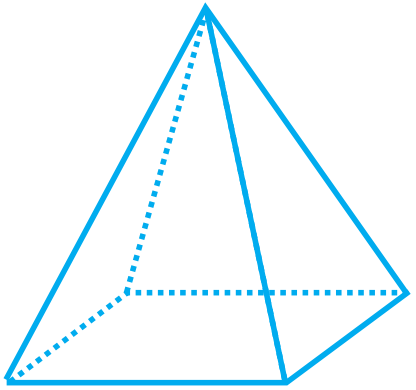
Square Pyramid
Cone
Answer
Figure Name
Hexagonal prism
Cone
Square pyramind
Hexahedron
$i.$ The base and top both are the hexagonal polygons.
So, it is a hexagonal prism.
$ii.$ Only one vertexes available.
So, it is a cone.
$iii.$ The base is square and rest four faces are equilateral triangles.
So, it is a square pyramid.
$iv.$ The base is square and it has $6$ faces and $8$ vertices.
So, it is a hexahedron $($cube$). [$Note Cube is also known as Hexahedron.$]$
View full question & answer
Question 322 Marks
In a town, an ice cream parlour has displayed an ice cream sculpture of height $360\ cm$. The parlour claims that these ice creams and the sculpture are in the scale $1:30$.What is the height of the ice creams served?
Answer
Given, height of ice - cream sculpture $= 360\ cm$
Scal used for ice - cream and sulpture $= 1 : 30$
The heiight of the ice - cream served = Scale $\times $ Actual size
$\Big[\therefore\text{Scale}=\frac{\text{size drawn}}{\text{actual size}}\Big]$
$=\frac{1\times360}{30}=12\text{cm.}$
Hence, the height of the ice - cream served ie $12\ cm$.
View full question & answer
Question 332 Marks
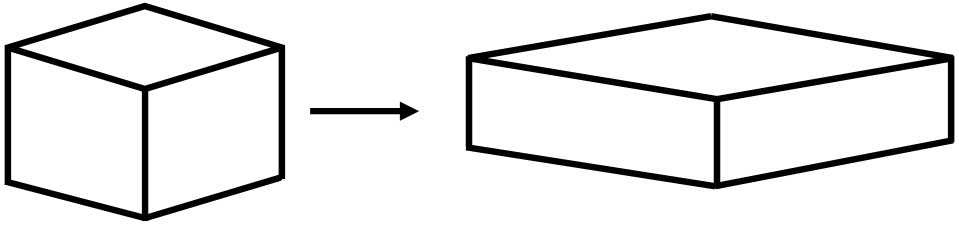
What figure is formed if only the height of a cube is increased or decreased?
Answer
If we only increase on decrease the height of a cube, the obtained figure is cuboid.

When the height is increased

When the height is decreased

View full question & answer
Question 342 Marks
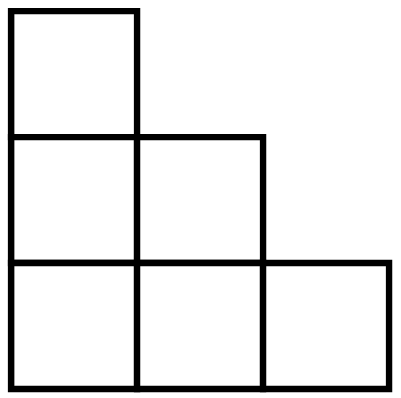
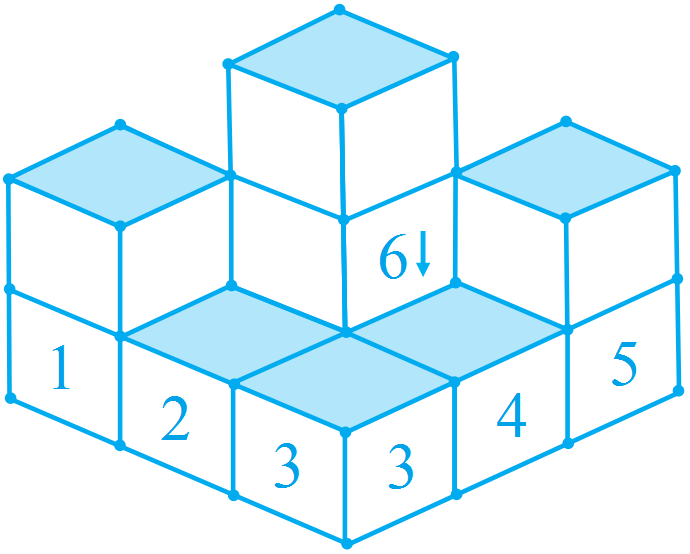
Find the number of cubes in the base layer of the following figure.

Answer
The number of cubes in the the base layer of the given figure is 6.

View full question & answer
Question 352 Marks
Draw the front, side and top view of the given shapes.
Answer
On the basis of properties and features of front view, top view and side view, we can draw all the three views of the given figures as:
View full question & answer
Question 362 Marks
The side of a square board is $50\ cm$. A student has to draw its image in her notebook. If the drawing of the square board in the notebook has perimeter of $40\ cm$, then by which scale the figure has been drawn?
Answer
Given, the side of a square board is $50\ cm$.So, perimeter of the square board $= 4 \times $ Side $= 4 \times 50 = 200\ cm$
On drawing in the notebook, the perimeter of square board $= 40\ cm$
$\therefore \text{Scale}=\frac{\text{Size of actual square board}}{\text{Size in notebook}}$
$=\frac{200}{40}=5:1$
Hence, the used scale is $5 : 1$
View full question & answer
Question 372 Marks
Look at the shapes given below and state these are polyhedra using Euler’s formula.
Answer
In the give figure, we have.Faces $(F) = 3$, verties $(v) = 0$ and edges $(E) = 2$
On putting these values in Euler's formula, we get.
$F + V - E = 2$
$\Rightarrow 3 + 0 - 2 = 2$
$\Rightarrow1\neq2$
Hence, these valus do not satisfy the Euler's formula. So, it is not a polyhedra.
View full question & answer
Question 382 Marks
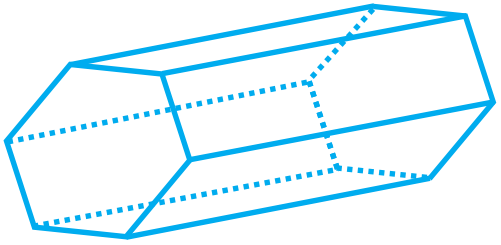
Find the number of faces in the given shapes:
Answer
In the first figure, the number of faces are equal to $14$. In the second figure, the number of faces are equal to $10$. In the third figure, the number of faces are equal to 16.
View full question & answer
Question 392 Marks
A polyhedron has $60$ edges and $40$ vertices. Find the number of its faces.
Answer
By using Euler's formula for polyhedron,[where, $F$ = faces, $V$ = vertices, $E$ = edge]
[$\therefore$ $E = 60$ and $V = 40$, given]
$\Rightarrow F + V - E = 2$
$\Rightarrow F + 40 - 60 = 2$
$\Rightarrow F - 20 = 2$
$\Rightarrow F = 2 + 20$
$\Rightarrow F = 22$
Hence, the number of faces are $22$.
View full question & answer
Question 402 Marks
Look at the shapes given below and state these are polyhedra using Euler’s formula.
Answer
In the give figure, we have.
Faces $(F) = 8$, verties $(v) = 6$ and edges $(E) = 12$
On putting these values in Euler's formula, we get.
$F + V - E = 2$
$\Rightarrow 8 + 6 - 12 = 2$
$\Rightarrow 14 - 12 = 2$
$\Rightarrow 2 = 2$
Hence, these valus do not satisfy the Euler's formula. So, it is a polyhedra.
View full question & answer
Question 412 Marks
A solid has forty faces and, sixty edges. Find the number of vertices of the solid.
Answer
By using Euler's formula for polyhedron $F + V - E = 2$
Given, faces $(F) = 40$, edges$(E) = 60.$
$\Rightarrow 40 + V - 60 = 2$
$\Rightarrow V - 20 = 2$
$\Rightarrow V = 2 + 20 = 22$
Hence, the vertices of the soild are $22$.
View full question & answer
Question 422 Marks
The actual length of a painting was $2m$. What is its length in the photograph if the scale used is $1\ mm : 20\ cm$.
Answer
The actual of the painting was $2m$ or $2 \times 100 = 200cm$$[\therefore 1\text{m} = 100\text{cm}]$
Scale used in the painting $= 1\ mm : 20\ cm$
$\Big[\therefore\text{Scale}=\frac{\text{Size drawn}}{\text{actial size}}\Big]$
Hence, length of painting in photograph = Scale $\times $ Actual size
$\frac{1}{20}\times200 = 10\text{mm}$
View full question & answer
Question 432 Marks
Check whether a polyhedron can have $V = 12, E = 6$ and $F = 8$.
Answer
By using Euler's formula for polyhedron,$F + V - E = 2$
[where, $F =$ faces, $V =$ vertices, $E =$ edges]
$\Rightarrow 8 + 12 - 6 = 2$
$\Rightarrow 20 - 6 = 2$
$\Rightarrow14\neq2$
$\therefore$ Given values do not satisfy the Euler's formula. Its mean this type of polyhedron cannot be possible.
View full question & answer
Question 442 Marks
Draw a figure that represents your mathematics textbook. What is the name of this figure? Is it a prism?
Answer
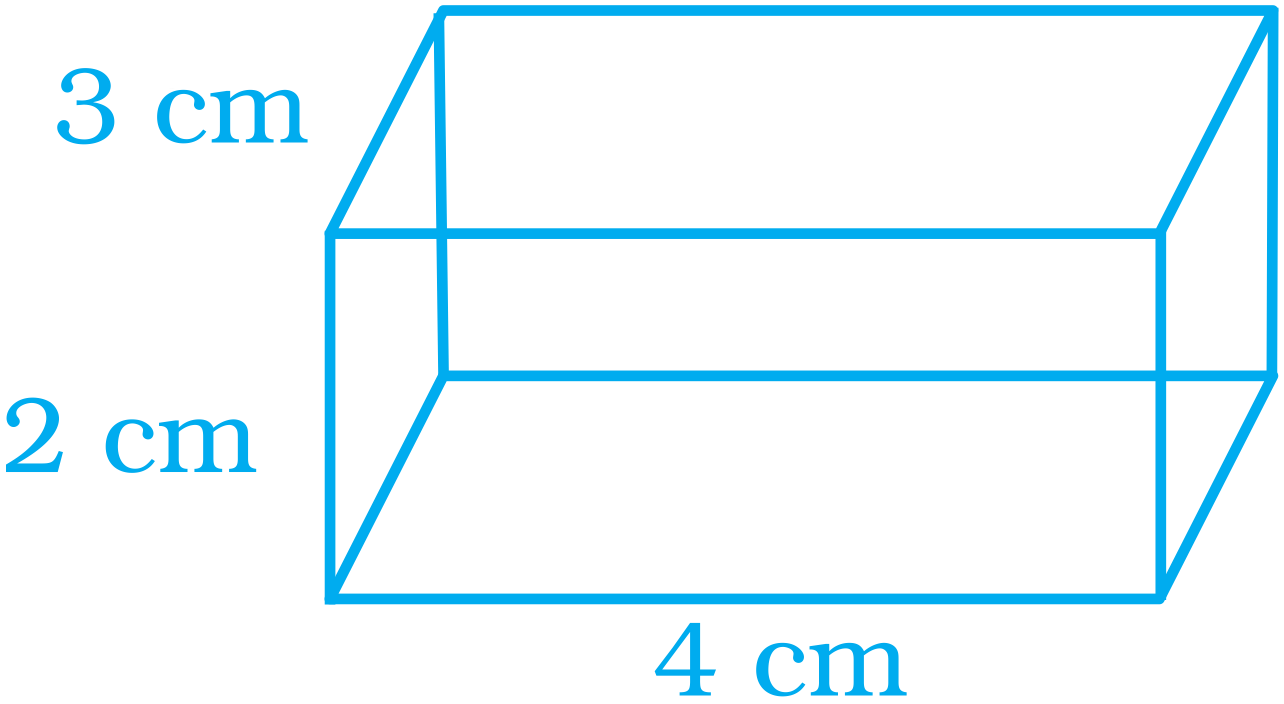
The figure of our mathematics textbook is cuboid which is shown below. Also, we know that the another name of cuboid is a rectangular prism.
View full question & answer