Question types

Chemical Effects of Electric Current question types

407 questions across 10 question groups — pick any mix to generate a Science paper with step-by-step answer keys.

407
Questions
10
Question groups
5
Question types
Sample Questions

Chemical Effects of Electric Current questions

One sample from each question group in this chapter. Select any group above to see the full set with answer keys.

Which of the following is correct?
  • A
    Water can be used for extinguishing fires caused due to electrical faults.
  • B
    Carbon is a non$-$metal so it cannot be used in electrolytic cell.
  • A liquid conducts electricity because of the presence of ions.
  • D
    Pure water forms ions to conduct electricity.

Answer: C.

View full solution
Which of the following is not an application of the chemical effect of electric current?
  • A
    Electroplating of metals.
  • B
    Purification of metals.
  • Decomposition of elements.
  • D
    Decomposition of compounds.

Answer: C.

View full solution
Which of the following are the characteristics of an electrolyte?
  • A
    It has a positive charge.
  • B
    It has a negative charge.
  • C
    It conducts charge without dissociating.
  • It forms positive and negative ions.

Answer: D.

View full solution
Fill in the following blanks with suitable words: If you pass current through copper sulphate solution, copper gets deposited on the plate connected to the $............$ terminal of the battery.
View full solution
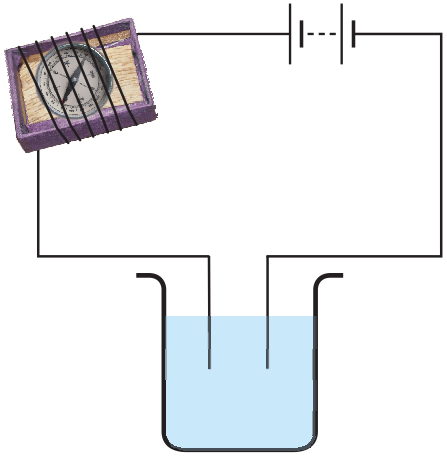
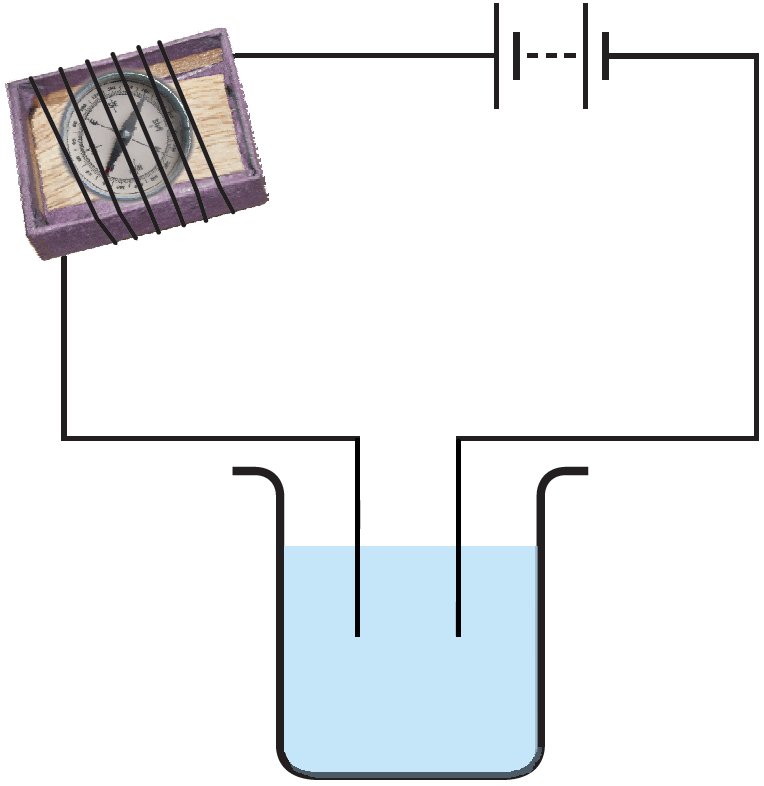
A child staying in a coastal region tests the drinking water and also the seawater with his tester. He finds that the compass needle deflects more in the case of seawater. Can you explain the reason?
View full solution
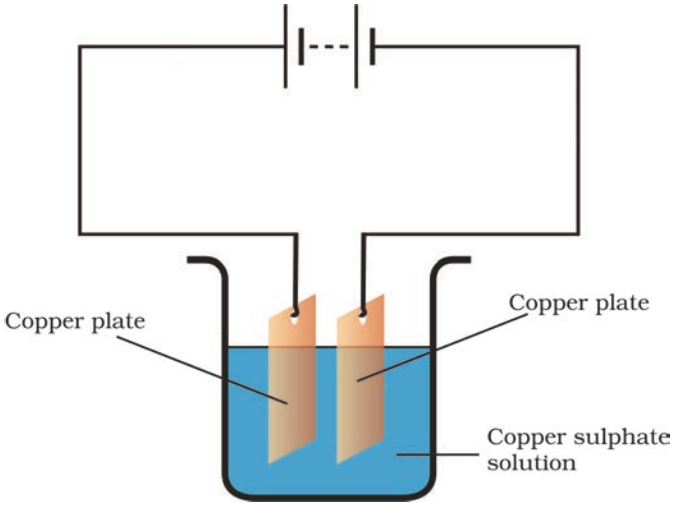
The process that you saw in Activity $14.7$ is used for purification of copper. A thin plate of pure copper and a thick rod of impure copper are used as electrodes. Copper from impure rod is sought to be transferred to the thin copper plate. Which electrode should be attached to the positive terminal of the battery and why?
View full solution
In the circuit given as Figure, Boojho observed that copper is deposited on the electrode connected to the negative terminal of the battery. Paheli tried to repeat the same experiment. But she could find only one copper plate. Therefore she took a carbon rod as negative electrode. Will copper be still deposited on the carbon rod? Explain your answer.

View full solution
Yor are provided with a magnetic compass, an empty match box, a battery of two cells and connecting wires. Using these objects how will you make a tester for testing an electric circuit? Draw the necessary circuit diagram and explain.
View full solution
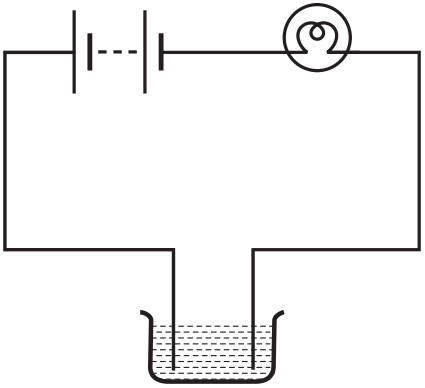
$A$ tester is used to check the conduction of electricity through two liquids, labelled $A$ and $B$. It is found that the bulb of the tester glows brightly for liquid $A$ while it glows very dimly for liquid $B$. You would conclude that.
$i.$ liquid $A$ is a better conductor than liquid $B$.
$ii.$ liquid $B$ is a better conductor than liquid $A$.
$iii.$ both liquids are equally conducting.
$iv.$ conducting properties of liquid cannot be compared in this manner.
View full solution
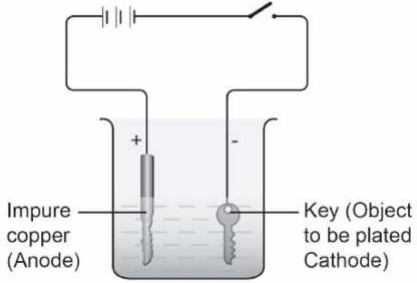
Electroplating is the process of adding a surface layer of metal on another metal.Image
$7.$ Which of these is true about electroplating?
Circle ‘Yes’ or ‘No’ for the correct response.
Is the statement true? Yes or No
The solution used contains ions of two metals. Yes/No
Metal gets deposited on the electrode connected to the negative terminal. Yes/No
A non-metal is used as the electrode connected to the positive terminal. Yes/No
$8.$ Which of these is an example of electroplating?
$A.$ Colouring of jeans
$B.$ Painting of a wall
$C.$ Lamination of a photograph
$D.$ Gold plating of imitation jewelleries
$9. $ Sumit replaced all the bulbs in his home with $LEDs.$
After a month, he noticed that the electricity bill had decreased.
What was the most likely reason for the decrease in electricity bill?
$10.$ Distilled water is a bad conductor of electricity.
Why does rainwater conduct electricity?
View full solution
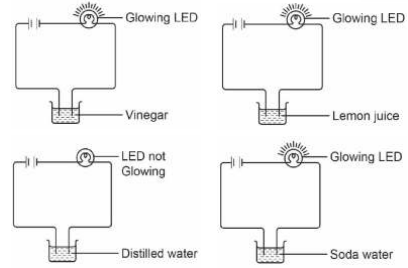
Rashmi made separate electric circuits with four different solutions.
The pictures show what she found.
Image

$4.$ What can be concluded from her activity$?$
$A. LED$ glows only in solutions
$B.$ All four solutions are insulators of electricity
$C.$ All four solutions are good conductors of electricity
$D.$ Acids and bases are good conductors of electricity
$5.$ Which safety precaution must Rashmi follow while doing this activity$?$
$A.$ Wear boots
$B.$ Wear goggles
$C.$ Wear headphones
$D.$ Wear rubber gloves
$6.$ Will an electric device work if we place the positive terminal of a battery towards the negative point of the device? Explain your answer.
View full solution
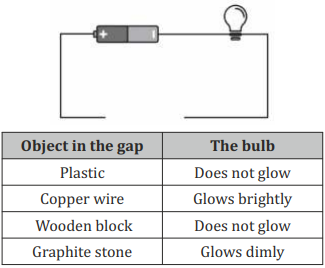
Tia used four different objects to ill the gap in an electric circuit, separately.
The table shows what she found.
Image
$1.$ Which of these best conducts electricity$?$
$A.$ Wood
$B.$ Plastic
$C.$ Copper
$D.$ Graphite
$2$. Which of these is a chemical effect of electric current$?$
$A.$ Glowing of bulb
$B.$ Heating of water
$C.$ Ringing of mobile phone
$D.$ Chromium plating on iron
$3.$ Which of these is a correct pair of an insulator and a conductor$?$
  Insulator Conductor
$A.$ Aluminium Cotton
$B.$ Thermocol Rubber
$C.$ Copper Iron
$D.$ Wax Aluminium
View full solution

Generate a Chemical Effects of Electric Current paper free

Pick question groups from the list above, set marks and difficulty, and export a branded PDF with step-by-step answer keys. First 3 chapters free — no signup.

Download App