Questions

case /data -based (4 Marks)

Take a timed test

6 questions · self-marked practice — reveal the answer and mark yourself.

Question 14 Marks
The picture shows the size of the pupil under two different conditions.Image
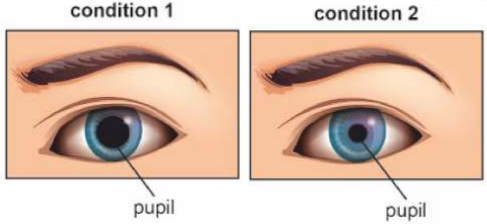
10. What makes the pupil change size between conditions $1$ and $2?$
Answer
$10.$ Mentions intensity of light or brightness of light.
View full question & answer
Question 24 Marks
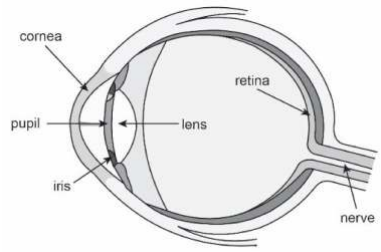
The diagram shows the basic parts of the human eye.
Image
$9.$ Which part protects the human eye from injury$?$
$A.$ Iris
$B.$ Lens
$C.$ Retina
$D.$ Cornea
Answer
$9. D.$ Cornea
View full question & answer
Question 34 Marks
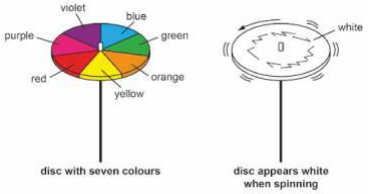
Reema has a multi-coloured disc.
She inds that the disc appears white when she spins it rapidly.
Image
$7.$ What can be concluded from the picture$?$
$A.$ All discs are multi-coloured
$B.$ All spinning objects appear white
$C.$ Objects lose its colour on spinning
$D.$ White is a mixture of seven different colours
$8. $ Which of these objects relects light$?$
$A.$ The Sun
$B. $The Moon
$C.$ A glowing bulb
$D.$ Burning wood
Answer
$7. D.$ White is a mixture of seven different colours
$8. B.$ The Moon
View full question & answer
Question 44 Marks
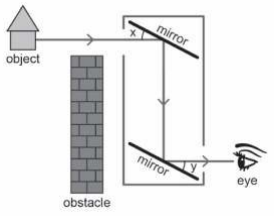
The diagram shows how an object is seen through a periscope.
$x$ and $y$ are two angles on the path of the light ray.
Image
$5$. Which condition is required for the periscope to work properly$?$
Circle ‘Yes’ or ‘No’ for the correct response.
Is the statement true? Yes or No
Angle $x$ should be equal to angle $y.$ Yes/No
Object to be viewed should be within $5\ m$ of the periscope. Yes/No
Top of the periscope should be higher than the top of the obstacle. Yes/No
$6.$ How many times is a light ray is relected in the periscope$?$
$A.$ Once
$B.$ Twice
$C.$ Thrice
$D.$ Four times
Answer
$5.$ Yes
No
Yes
$6. B.$ Twice
View full question & answer
Question 54 Marks
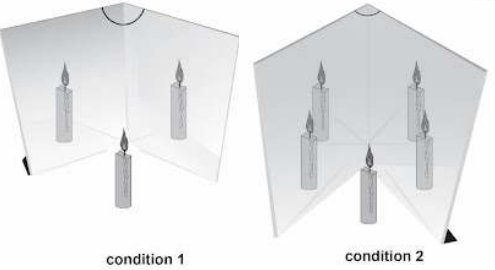
The picture shows a candle in front of two plane mirrors joined at their sides.

Image
$4.$ What will increase the number of images formed on the mirrors$?$
$A.$ Decrease in the size of the object
$B.$ Increase in the size of the mirrors
$C.$ Decrease in the angle between the two mirrors
$D.$ Increase in the distance between the object and the mirrors
Answer
$4. C.$ Decrease in the angle between the two mirrors
View full question & answer
Question 64 Marks
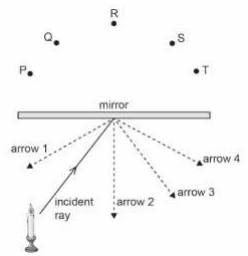
The picture shows a light ray from a candle falling on a mirror.
$P, Q, R, S$ and $T$ are ive points behind the mirror
Image
$1.$ Which arrow represents the light ray relected by the mirror$?$
$A.$ Arrow $1$
$B.$ Arrow $2$
$C.$ Arrow $3$
$D.$ Arrow $4$
$2.$ At which point will the image of the candle form$?$
Will the image be erect or inverted$?$
$3.$ Which of these statements is true for relection of light rays$?$
Circle ‘Yes’ or ‘No’ for the correct response.
Is the statement true? Yes or No
Light rays are relected by plane surfaces only. Yes/No
Angle of incidence is equal to the angle of relection. Yes/No
Incident ray and relected ray meet at the same point. Yes/No
Answer
$1. C.$ Arrow $3$
$2.$ Mentions that the image of the candle will be formed at $Q$ and the image will be erect. For example,
● At point $Q.$ The image will be erect.
$3.$ No
Yes
Yes
View full question & answer