Question types

Reproduction in Animals question types

457 questions across 11 question groups — pick any mix to generate a Science paper with step-by-step answer keys.

457
Questions
11
Question groups
5
Question types
Sample Questions

Reproduction in Animals questions

One sample from each question group in this chapter. Select any group above to see the full set with answer keys.

Choose the most appropriate answer.
Internal fertilisation occurs:
  • In female body.
  • B
    Outside female body.
  • C
    On male body.
  • D
    Outside male body.

Answer: A.

View full solution
Which of the following statements is true about asexual reproduction?
  • New individuals are produced without the fusion of gametes.
  • B
    New individuals involves the fusion of male and female gametes.
  • C
    It is a mode of reproduction which occurs only in plants.
  • D
    New individuals are produced by the fusion of dissimilar gametes.

Answer: A.

View full solution
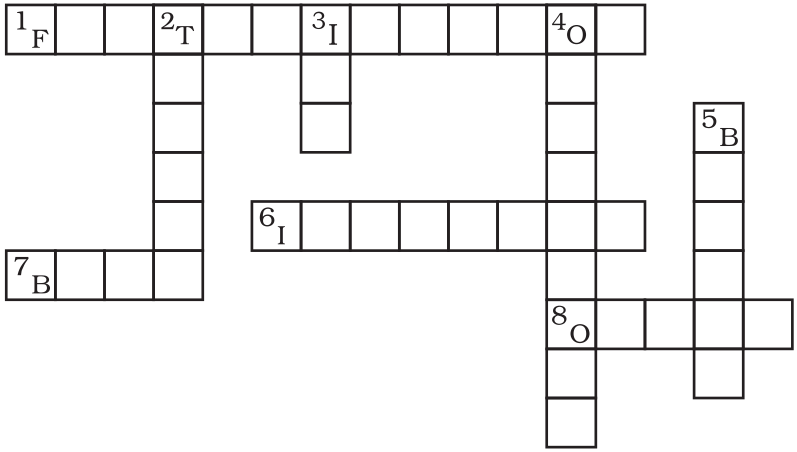
Complete the crossword puzzle using the hints given below.
Across:
$1.$ The process of the fusion of the gametes.
$6.$ The type of fertilisation in hen.
$7.$ The term used for bulges observed on the sides of the body of hydra.
$8.$ Eggs are produced here.
Down:
$2.$ Sperms are produced in these male reproductive organs.
$3.$ Another term for in vitro fertilisation.
$4.$ These animals lay eggs.
$5.$ A type of fission in amoeba.
​​​​​​​
View full solution
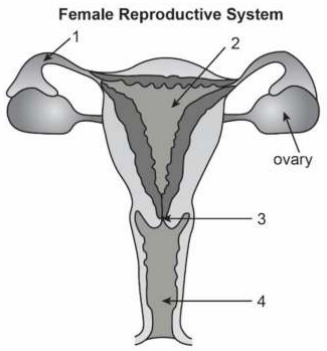
Draw a labeled diagram of the human female reproductive system.
$1.$ Where in the human body does an egg $($or ovum$)$ get fertilized?
$2.$ Where does a fertilized egg $($or zygote$)$ develop into a baby in the human body?
View full solution
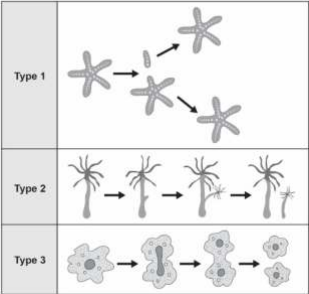
The pictures show three types of reproduction in animals.
Image
$10.$ Which of these statements is true$?$
$A.$ Type $1$ reproduction is called binary ission.
$B.$ Type $2$ reproduction produces two non-identical offspring.
$C.$ Type $3$ reproduction involves unequal distribution of genetic materials.
$D.$ Types $1, 2$ and $3$ methods of reproduction involve single parent only
View full solution
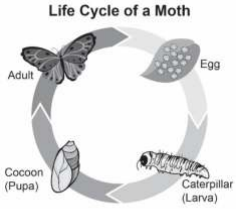
The picture shows the life cycle of a moth.
Image

$9.$ What can be concluded from the picture$?$
Circle ‘Yes’ or ‘No’ for the correct response.
Can this be concluded from the picture? Yes or No
Moth is an oviparous animal. Yes/No
A moth looks different in each stage of its life cycle. Yes/No
There are two different stages in the life cycle of a moth. Yes/No
View full solution
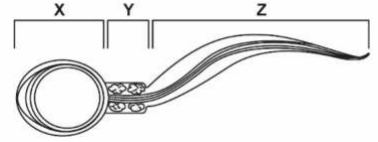
The picture shows the basic parts of a salmon ish sperm.

Image
$7.$ Which part of the sperm helps it to swim in water and reach the egg$?$
$8.$ Which of these animals reproduce by external fertilization?
$A.$ Snake
$B.$ Frog
$C.$ Horse
$D.$ Elephant
View full solution
The table shows the processes of external fertilisation and internal fertilisation.
External fertilisation Internal fertilisation
The female releases the eggs (ova) outside its body. The male releases the sperms on the eggs. Fertilisation takes place outside the female body. The male releases the sperms inside the body of the female. Fertilisation takes place inside the female body.
$6.$ Which of these is true about external fertilization and internal fertilization$?$
  External fertilization Internal fertilization
$A.$ Both parents are necessary Both parents are necessary
$B.$ Embryo is not formed Embryo is formed
$C.$ Involves development of eggshell Involves development of eggshell
$D.$ Takes place among invertebrates Takes place among vertebrates
View full solution
The picture shows the relative size of different types of cells between $100\ nm$ and $100\ mm.$
Image
$1$. A mature egg and a sperm unite to form a zygote.
In which part of the female reproductive system does a zygote form$?$
$A. 1$
$B. 2$
$C. 3$
$D. 4$
$2.$ How many eggs are usually released each month by the ovary of a woman$?$
$A.$ One
$B.$ Two
$C.$ Fourteen
$D.$ Twenty-four
$3.$ In which part of the female reproductive system does an embryo implant$?$
$A. 1$
$B. 2$
$C. 3$
$D. 4$
$4.$ Which of these statements is true about a foetus$?$
Circle ‘Yes’ or ‘No’ for the correct response.
Is this statement true about a foetus? Yes or No
All body parts can be identiied properly Yes/No
It is covered by a hard shell of protective layers. Yes/No
It resembles a large ball made of millions of cells. Yes/No
$5.$ Where does the fertilisation of egg occur in the process of In Vitro Fertilisation $(IVF)?$
$A.$ Ovary
$B.$ Water
$C.$ Uterus
$D.$ Petri dish
View full solution

Generate a Reproduction in Animals paper free

Pick question groups from the list above, set marks and difficulty, and export a branded PDF with step-by-step answer keys. First 3 chapters free — no signup.

Download App