Question types

Synthetic Fibres and Plastics question types

377 questions across 7 question groups — pick any mix to generate a Science paper with step-by-step answer keys.

377
Questions
7
Question groups
5
Question types
Sample Questions

Synthetic Fibres and Plastics questions

One sample from each question group in this chapter. Select any group above to see the full set with answer keys.

Rayon is different from truly synthetic fibres because:
  • A
    It has a silk like appearance.
  • It is obtained from wood pulp.
  • C
    Its fibres can be woven like those of natural fibres.
  • D
    It can be dyed in wide variety of colors.

Answer: B.

View full solution
Consider the following statement and choose the incorrect one:
  • A
    Chemical name of natural polymer of cotton is cellulose.
  • B
    Rayon is often regarded as artificial silk.
  • C
    Terycot is made by mixing terylene and cotton.
  • None of the above.

Answer: D.

View full solution
Which of the following properties of nylon are most convenient for its use?
  • A
    It is soft, strong and heavy.
  • It is strong, elastic and light.
  • C
    It is soft, inexpensive and strong.
  • D
    It is expensive, soft and light.

Answer: B.

View full solution
$PVC$ (polyvinyl chloride) is a thermoplastic and is used for making toys, chappals, etc. Bakelite is a thermosetting plastic and is used for making electrical switches, handles of various utensils, etc. Can you write the major difference between these two types of plastics?
View full solution
Match the terms of column $A$ correctly with the phrases given in column $B.$
  Column I   Column II
$(i)$ Polyester $(a)$ Prepared by using wood pulp
$(ii)$ Teflon $(b)$ Used for making parachutes and stockings
$(iii)$ Rayon $(c)$ Used to make non-stick cookwares
$(iv)$ Nylon $(d)$ Fabrics do not wrinkle easily
View full solution
The $5\ R$ principle is about environment - friendly practices.
The key components of the principle are as follows.
● Reuse
● Refuse
● Reduce
● Recycle
● Recover
$10.$ The government advises people to stop using plastic bags for grocery shopping.
Which component of the $5\ R$ principle is this advice related to$?$

 
View full solution
Erik dumped four types of domestic waste in separate land pits.
He covered the pits and left them undisturbed for a year.
The table below shows what he observed after a year.
Waste $1$ Waste $2$ Waste $3$ Waste $4$
Fully decomposed Not decomposed at all Fully decomposed Not decomposed at all
$9.$ Which type of waste(s) is most likely to cause soil pollution$?$
View full solution
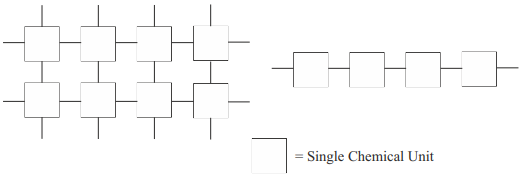
The pictures show the arrangement of chemical units in two types of plastics.Image
$7.$ What terms are used to describe the arrangement in Type $1$ and Type $2$ plastics$?$
$8.$ Which of these features is/are essential to classify a plastic as thermoplastic$?$
Circle ‘Yes’ or ‘No’ to mark your response.
Is this feature essential for classifying a plastic as thermoplastic? Yes or No
It bends easily on heating. Yes/No
It does not react with air and water Yes/No
It is a good conductor of heat. Yes/No
View full solution
Sujoy had four different fabrics.
He lit each fabric on ire and observed what happened.
Fabric $1$ Fabric $2$ Fabric $3$ Fabric $4$
Burned completely,some ash left behind Melted into a sticky substance Burned completely, some ash left behind Melted into a sticky substance
$5.$ What is Sujoy trying to ind out$?$
$A.$ Which fabric is a polymer$?$
$B.$ Which fabric is the strongest$?$
$C.$ Which fabric is natural and which fabric is synthetic$?$
$D.$ Which fabric is most comfortable to wear in summers$?$
$6.$ Which of the following activities is dangerous while wearing a shirt made of fabric $2?$
$A.$ Riding a bicycle
$B.$ Cooking on a gas stove
$C.$ Watering plants in a garden
$D.$ Painting with water colours
View full solution
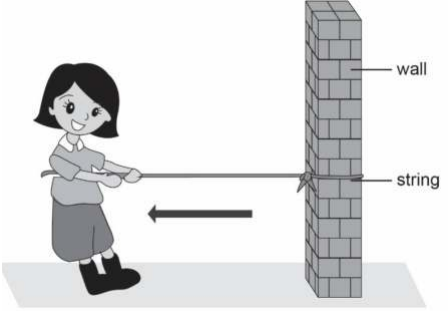
Ameeta ties four strings made of different materials to a wall.
She then pulls each string until it breaks.
The arrow shows the direction of the force.
Image

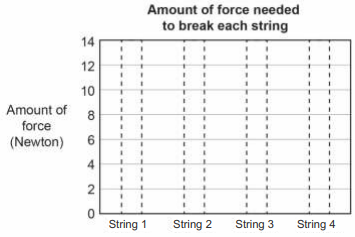
The table shows the amount of force needed to break each string.
String Amount of force needed to break the string (Newton)
String $1$ $10$
String $2$ $2$
String $3$ $14$
String $4$ $4$
$1.$ Draw the bars in the graph below to show the observations of Ameeta’s activity.
Fill in the dotted columns to show the correct values along the $Y- $axis.
Image
$2.$ Which string is made of the strongest ibre$?$
$A.$ String $1$
$B.$ String $2$
$C.$ String $3$
$D.$ String $4$
$3.$ What must Ameeta keep the same in her activity$?$
$A.$ Colour of the strings
$B.$ Length of the strings
$C.$ Thickness of the strings
$D.$ Height of the strings from ground
$4.$ Which of the following statements is/are true about polymers$?$
Circle ‘Yes’ or ‘No’ to mark your response.
Is the statement correct? Yes or No
All synthetic ibres are polymers. Yes/No
Some natural ibres are polymers. Yes/No
Polymers are made of multiple small chemical units. Yes/No
View full solution

Generate a Synthetic Fibres and Plastics paper free

Pick question groups from the list above, set marks and difficulty, and export a branded PDF with step-by-step answer keys. First 3 chapters free — no signup.

Download App