Questions

3 Marks Question

Take a timed test

10 questions · self-marked practice — reveal the answer and mark yourself.

Question 13 Marks
If two non - parallel sides of a trapezium are equal, prove that it is cyclic.
Answer
Given: Non parallel sides $AD$ and $BC$ of a trapeziumare equal.
To prove : $ABCD$ is a cyclic trapezium.
Construction: Draw $DK \perp AB$ and $CP \perp AB$
Proof: In it $\Delta ADK$ and $\Delta BCP$
$AD=BC$
$DK=CP$ [Distance between || sides]
$DKA=CBP$ [ each $90{}^\circ$ ]
By RHS criteria of congruency,
$\triangle DKA  \cong \triangle CPB$
$\angle A=\angle B $
$\angle ADK=\angle BCP\\ \angle ADK+90{}^\circ =\angle BCP+90{}^\circ $
$\angle ADC=\angle BCD$
$\angle D=\angle C ................(ii)$
$\angle A+\angle B+\angle C+\angle D=360{}^\circ [\angle A= \angle B , \angle C= \angle D]$
$\angle B+\angle B+\angle D+\angle D=360{}^\circ \\ \angle B+\angle D=180{}^\circ $
Hence, $ABCD$ is a cyclic trapezium.
View full question & answer
Question 23 Marks
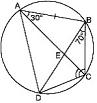
$A B C D$ is a cyclic quadrilateral whose diagonals intersect at a point $E$ . If $\angle D B C=70^{\circ}, \angle BAC$ is $30^{\circ} \quad$, find $\angle BCD$ . Further, if $A B=B C$, find $\angle BCD$. If $A B=B C$, find $\angle ECD$.
Answer
$\angle CDB =\angle BAC \mid$ Angles in the same segment of a circle are equal
$= 30 ^o ....... (1)$
$\angle DBC = 70^o ...... (2)$
In $\triangle BCD$

$\angle B C D+\angle D B C+\angle C D B=180^{\circ}\left[\text { Sum of all the angles of a triangle is } 180^{\circ}\right]$
$\Rightarrow \angle B C D+70^{\circ}+30^{\circ}=180^{\circ}[\text { Using (1) and (2)] }$
$\Rightarrow \angle B C D+1000=180^{\circ}$
$\Rightarrow \angle B C D=1800-100^{\circ}$
$\Rightarrow \angle B C D=800 \ldots \ldots \ldots$
$\text { In } \triangle A B C$
$A B=B C$
$\therefore \angle B C D=\angle B A C$ [ Angles opposite to equal sides of a triangle are equal]
$=30^{\circ} \ldots \ldots . .(4)[\because \angle BAC=30 \text { (given) }]$
$\text { Now } \angle BCD=80^{\circ} \text { |From (3) }$
$\Rightarrow \angle BCA+\angle ECD=80^{\circ}$
$\Rightarrow 30^{\circ}+\angle ECD=80^{\circ}$
$\Rightarrow \angle ECD=80^{\circ}-30^{\circ}$
$\Rightarrow \angle ECD=50^{\circ}$
View full question & answer
Question 33 Marks
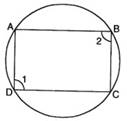
Prove that a cyclic parallelogram is a rectangle.
Answer
Given: $A B C D$ is a cyclic parallelogram.
To prove: $A B C D$ is a rectangle.

Proof: $\because  ABCD$ is a cyclic quadrilateral
$\therefore \angle 1+\angle 2=180^{\circ}---- (1)$
[ $\because$ Opposite angles of a cyclic quadrilateral are supplementary]
$\therefore A B C D$ is a parallelogram
$\therefore \angle 1=\angle 2$
From $(1)$ and $(2),$
$\angle 1=\angle 2=90^{\circ}$
$\therefore \| \mathrm{~gm} ~A B C D$ is a rectangle.
View full question & answer
Question 43 Marks
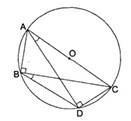
$ABC$ and $ADC$ are two right triangles with common hypotenuse $AC$. Prove that $\angle C A D = \angle C B D.$
Answer
Given: ABC and ADC are two right triangles with common hypotenuse $AC.$
To prove: $\angle C A D = \angle C B D$

Proof : AC is the common hypotenuse and $ABC$ and $ADC$ are two right triangles.
$\therefore \angle A B C = 90 ^ { \circ } = \angle A D C$
$\Rightarrow$ Both the triangles are in the same semi-circle
$\therefore$ Points $A, B, D$ and $C$ are concyclic
$\therefore DC$ is a chord
$\therefore \angle C A D = \angle C B D$ |$\because$ Angles in the same segment are equal.
View full question & answer
Question 53 Marks
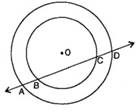
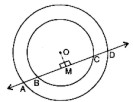
If a line intersects two concentric circles (circles with the same centre) with centre $O$ at $A, B, C$ and $D$, prove that $AB = CD.$
Answer
Given: A line intersects two concentric circles (circles with the same centre) with centre $O$ at $A, B, C$ and $D.$
To prove : $AB = CD$
Construction : Draw $O M \perp B C$

Proof: $\because$ The perpendicular drawn from the centre of a circle to a chord bisects the chord.
$\therefore AM = DM$
and $BM = CM$
Subtracting $(2)$ from $(1)$, we get
$AM - BM = DM - CM$
$\Rightarrow AB = CD$
View full question & answer
Question 63 Marks
Recall that two circles are congruent if they have a same radii. Prove that equal chords of congruent circles subtend equal angles at their centres.
Answer
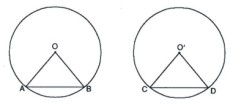
Given: $AB$ and $CD$ are two equal chords of congruent circles with centres $O$ and $O'$ respectively.
To Prove: $\angle A O B=\angle C O^{\prime} D$
Proof: In $\triangle O A B$ and $\Delta O^{\prime} C D$
$OA=O'C$ |Radii of congruent circles
$OB = O'D$ [Radii of congruent circles]

$AB = CD$ |Given
$\therefore \triangle \mathrm{OAB} \cong \triangle \mathrm{O}^{\prime} \mathrm{CD}$ [$SSS$ Rule]
$\therefore$ $\angle AOB =  \angle CO'D$ [c.p.c.t]
View full question & answer
Question 73 Marks
Prove that the quadrilateral formed (if possible) by the internal angle bisectors of any quadrilateral is cyclic.
 
Answer

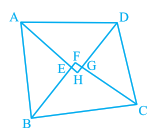
In Figure, $A B C D$ is a quadrilateral in which the angle bisectors $A H, B F, C F$ and $D H$ of internal angles $A, B, C$ and $D$ respectively form a quadrilateral EFGH .
Now, $\angle F E H=\angle A E B=180^{\circ}-\angle E A B-\angle E B A$
$=180^{\circ}-\frac{1}{2}(\angle A+\angle B)$
and $\angle F G H=\angle C G D=180^{\circ}-\angle G C D-\angle G D C$
$=180^{\circ}-\frac{1}{2}(\angle C+\angle D)$
Therefore, $\angle F E H+\angle F G H=180^{\circ}-\frac{1}{2}(\angle A+\angle B)+180^{\circ}-\frac{1}{2}(\angle C+\angle D)$
$=360^{\circ}-\frac{1}{2}(\angle A+\angle B+\angle C+\angle D)=360^{\circ}-\frac{1}{2} \times 360^{\circ}$
$=360^{\circ}-180^{\circ}=180^{\circ}$
Therefore, by Theorem If the sum of a pair of opposite angles of a quadrilateral is $180^{\circ}$, the quadrilateral is cyclic., the quadrilateral $E F G H$ is cyclic.
View full question & answer
Question 83 Marks
Equal chords of a circle (or of congruent circles) are equidistant from the centre (or centres)
Answer
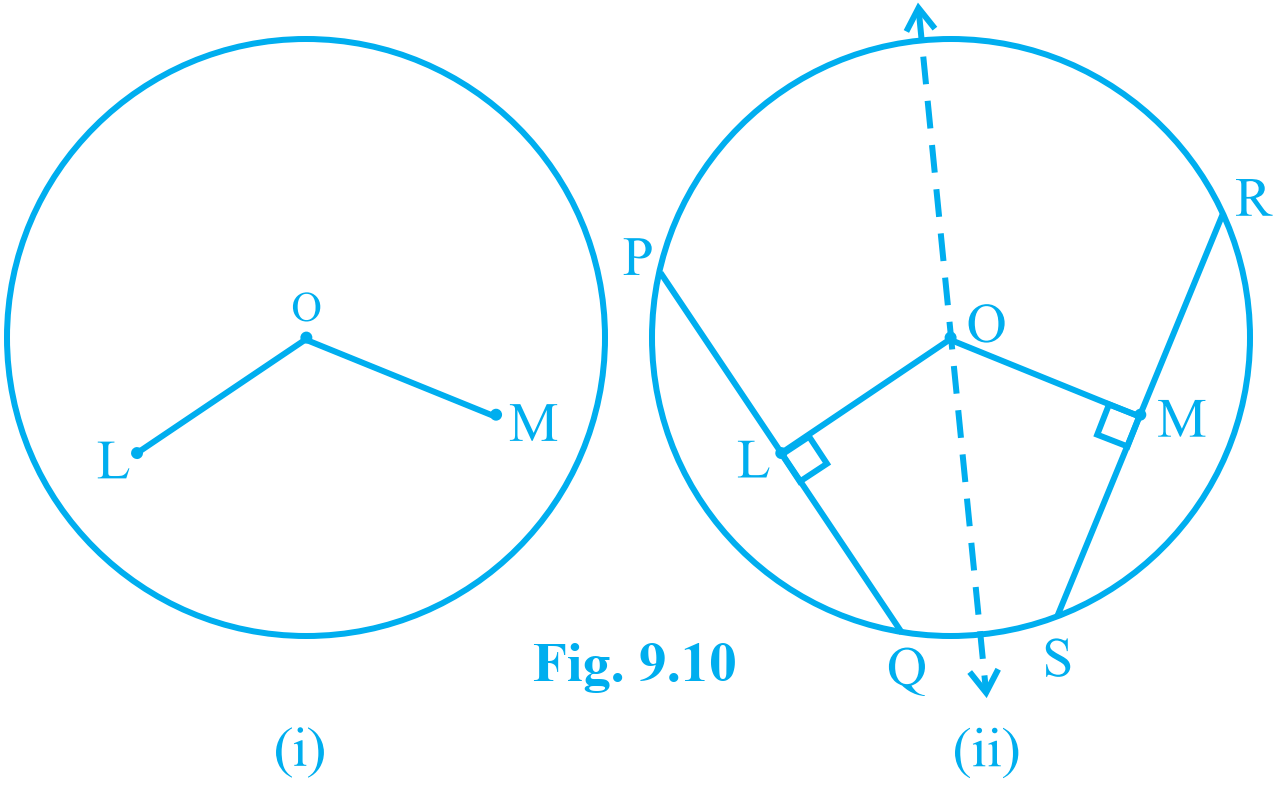
Next, it will be seen whether the converse of this theorem is true or not. For this, draw a circle with centre O. From the centre O, draw two line segments OL and OM of equal length and lying inside the circle [see Fig. 9.10(i)]. Then draw chords PQ and RS of the circle perpendicular to OL and OM respectively [see Fig 9.10(ii)]. Measure the lengths of PQ and RS. Are these different? No, both are equal. Repeat the activity for more equal line segments and drawing the chords perpendicular to them. This verifies the converse of the Theorem 9.5 which is stated as follows:
Image
View full question & answer
Question 93 Marks
The line drawn through the centre of a circle to bisect a chord is perpendicular to the chord
Answer
Is this true? Try it for few cases and see. You will see that it is true for these cases. See if it is true, in general, by doing the following exercise. We will write the stages and you give the reasons.
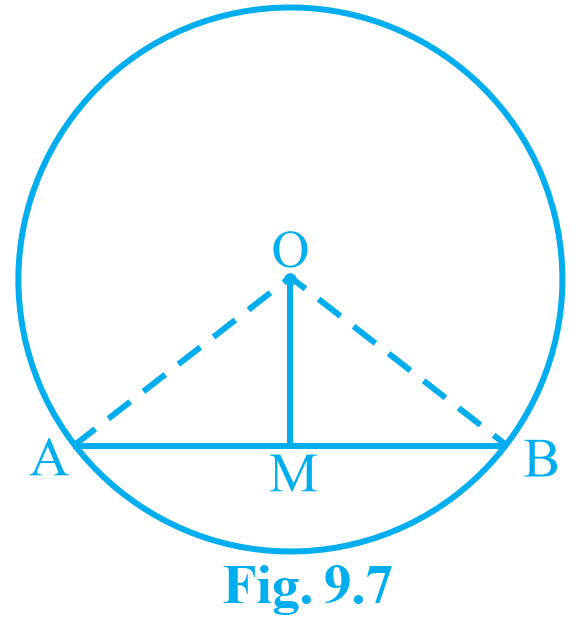
Let $A B$ be a chord of a circle with centre $O$ and $O$ is joined to the mid-point $M$ of $A B$. You have to prove that $O M \perp A B$. Join $O A$ and $O B$ (see Fig. 9.7). In triangles OAM and OBM,
$\mathrm{OA}$ $=\mathrm{OB}$ (Why?)
$\mathrm{AM}$ $=\mathrm{BM}$ (Why?) 
$\mathrm{OM}$ $=\mathrm{OM}$ (Common) 
Therefore, $\triangle \mathrm{OAM}$ $\cong \Delta \mathrm{OBM}$ (How?)
This gives $\angle \mathrm{OMA}$ $=\angle \mathrm{OMB}=90^{\circ}$ (Why?)
Image
View full question & answer
Question 103 Marks
Equal chords of a circle subtend equal angles at the centre.
Answer
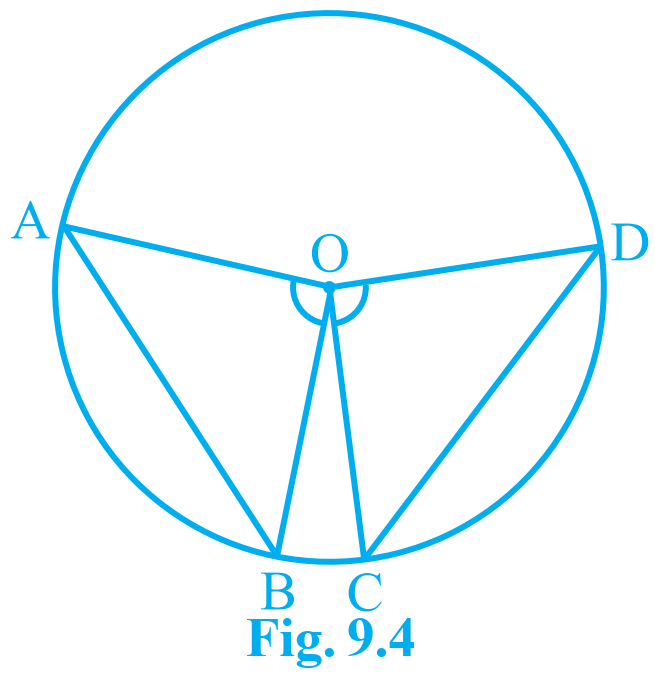
Proof : You are given two equal chords $A B$ and $C D$ of a circle with centre O (see Fig.9.4). You want to prove that $\angle \mathrm{AOB}=\angle \mathrm{COD}$.
In triangles $A O B$ and $C O D$,
$\mathrm{OA}$ $=\mathrm{OC}$ (Radii of a circle)
$\mathrm{OB}$ $=\mathrm{OD}$ (Radii of a circle)
$\mathrm{AB}$ $=\mathrm{CD}$ (Given)
Therefore, $\quad \triangle \mathrm{AOB}$ $\cong \Delta \mathrm{COD}$ (SSS rule)
This gives $\quad \angle \mathrm{AOB}$ $=\angle \mathrm{COD}$
(Corresponding parts of congruent triangles)
Image
View full question & answer