Sample QuestionsCircles questions
One sample from each question group in this chapter. Select any group above to see the full set with answer keys.
Two point on a circle makes the:
Answer: B.
View full solution →Circle having same centre are said to be:
Answer: B.
View full solution →In the given figure, $CD$ is the diameter of a circle with centre $O$ and $CD$ is perpendicular to chord $AB.$ If $AB = 12\ cm$ and $CE = 3\ cm,$ then radius of the circles is:
- A
$6\ cm$
- B
$9\ cm$
- ✓
$7.5\ cm$
- D
$8\ cm$
Answer: C.
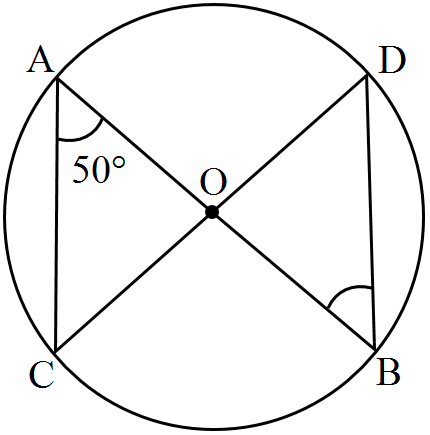
View full solution →In the given figure, $O$ is the centre of a circle. If $\angle\text{OAC}=50^\circ,$ then $\angle\text{ODB}=?$
- A
$40^\circ $
- ✓
$50^\circ$
- C
$75^\circ$
- D
$60^\circ$
Answer: B.
View full solution →If the length of a chord of a circle is $16\ cm$ and is at a distance of $15\ cm$ from the centre of the circle, then the radius of the circle is:
- A
$15\ cm.$
- B
$16\ cm.$
- ✓
$17\ cm.$
- D
$34\ cm.$
Answer: C.
View full solution →Directions: In the following questions, the Assertions $(A)$ and Reason(s) $(R)$ have been put forward. Read both the statements carefully and choose the correct alternative from the following:
Assertion: $x^2+y^2+4 x-8 y-84=0$ the equation of the circle concentric with the circle $x^2+y^2+4 x-8 y-6=0$, having the radius double of its radius.
Reason: The equation of the circle is $x^3+y^3+2 g x+2 f y+c=0$.
- A
Both Assertion and Reason are correct and Reason is the correct explanation for Assertion.
- B
Both Assertion and Reason are correct and Reason is not the correct explanation for Assertion.
- ✓
Assertion is true but the reason is false.
- D
Both assertion and reason are false.
Answer: C.
View full solution →Directions: In the following questions, the Assertions $(A)$ and Reason(s) $(R)$ have been put forward. Read both the statements carefully and choose the correct alternative from the following:
Assertion: The circumference of a circle must be a positive real number.
Reason: If $r(> 0)$ is the radius of the circle, then its circumference $2\pi\text{r}$ is a positive real number.
- ✓
Both assertion and reason are true and reason is the correct enatixplaon of assertion.
- B
Both assertion and reason are true but reason is not the correct explanation of assertion.
- C
Assertion is true but reason is false.
- D
Assertion is false but reason is true.
Answer: A.
View full solution →Directions: In the following questions, the Assertions $(A)$ and Reason(s) $(R)$ have been put forward. Read both the statements carefully and choose the correct alternative from the following:
Assertion: A chord of a circle, which is twice as long as its radius, is a diameter of the circle.
Reason: As we know that any chord whose length is twice as long as the radius of the circle always passes through the centre of the circle.
- ✓
Both Assertion and Reason are correct and Reason is the correct explanation for Assertion.
- B
Both Assertion and Reason are correct and Reason is not the correct explanation for Assertion.
- C
Assertion is true but the reason is false.
- D
Both assertion and reason are false.
Answer: A.
View full solution →Directions: In the following questions, the Assertions $(A)$ and Reason(s) $(R)$ have been put forward. Read both the statements carefully and choose the correct alternative from the following:
Assertion: Circle has a diameter $142.8\ mm.$ Then its radius is $71.4\ mm.$
Reason: $\text{Radius}=\big(\frac{1}{2}\big)\times\text{diameter}.$
- ✓
Both Assertion and Reason are correct and Reason is the correct explanation for Assertion.
- B
Both Assertion and Reason are correct and Reason is not the correct explanation for Assertion.
- C
Assertion is true but the reason is false.
- D
Both assertion and reason are false.
Answer: A.
View full solution →Directions: In the following questions, the Assertions $(A)$ and Reason(s) $(R)$ have been put forward. Read both the statements carefully and choose the correct alternative from the following:
Assertion: Sector is a region of a circle between the arc and the two radii of the circle.
Reason: Sector is the region between the chord and its corresponding arc.
- A
Both Assertion and Reason are correct and Reason is the correct explanation for Assertion.
- B
Both Assertion and Reason are correct and Reason is not the correct explanation for Assertion.
- ✓
Assertion is true but the reason is false.
- D
Both assertion and reason are false.
Answer: C.
View full solution →$ABCD$ is a cyclic quadrilateral such that $\angle\text{A}=90^\circ,\angle\text{B}=70^\circ,\angle\text{C}=95^\circ$ and $\angle\text{D}=105^\circ.$
View full solution →If $AOB$ is a diameter of a circle and $C$ is a point on the circle, then $\mathrm{AC}^2+\mathrm{BC}^2=A B^2$.
View full solution →Two congruent circles with centres $O$ and $O′$ intersect at two points $A$ and $B.$ Then $\angle\text{AOB}=\angle\text{AO'B}.$
View full solution →Two chords $AB$ and $AC$ of a circle with centre $O$ are on the opposite sides of $OA.$ Then $\angle\text{OAB}=\angle\text{OAC}.$
View full solution →A circle of radius $3\ cm$ can be drawn through two points $A, B$ such that $AB = 6\ cm$
View full solution → A circle divides the plane, on which it lies, in _________ parts.
An arc is a __________ when its ends are the ends of a diameter.
A point whose distance from the center of a circle is greater than its radius lies in __________ of the circle.
A continuous piece of a circle is _________ of the circle.
An arc is a _______________ when its ends are the ends of a diameter.
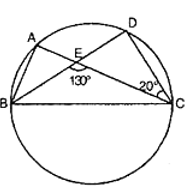
In figure, $A, B, C, D$ are four points on the circle. $AC$ and $BD$ intersect at a point $E$ such that $\angle BEC = 130^\circ $ and $\angle ECD = 20^\circ $ Find $\angle BAC.$
View full solution →In the given figure, two circles intersect at two points $A$ and $B. AD$ and $AC$ are diameters to the circles. Prove that $B$ lies on the line segment $DC.$
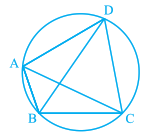
View full solution →In Fig., $ABCD$ is a cyclic quadrilateral in which $AC$ and $BD$ are its diagonals. If $\angle DBC = 55^\circ $ and $\angle BAC = 45^\circ ,$ find $\angle BCD.$
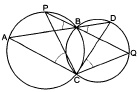
View full solution →In given figure, two circles intersect at two points $B$ and $C$. Through $B$, two line segments $A B D$ and $P B Q$ are drawn to intersect the circles at $A, D$ and $P, Q$ respectively. Prove that $\angle A C P=\angle Q C D$.
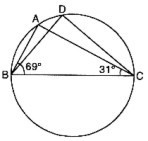
View full solution →In given figure, $\angle A B C=69^{\circ}, \angle A C B=31^{\circ}$, find $\angle B D C$.
View full solution →A chord of a circle is equal to the radius of the circle. Find the angle subtended by the chord at a point on the minor arc and also at a point on the major arc.
If circles are drawn taking two sides of a triangle as diameters, prove the point of intersection of these circles lie on the third side.
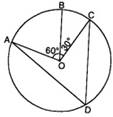
In figure, $A, B, C$ are three points on a circle with centre $O$ such that $\angle B O C=30^{\circ}, \angle A O B=60^{\circ}$. If $D$ is a point on the circle other than the arc $A B C$, find $\angle A D C$.
View full solution →If two non - parallel sides of a trapezium are equal, prove that it is cyclic.
$A B C D$ is a cyclic quadrilateral whose diagonals intersect at a point $E$ . If $\angle D B C=70^{\circ}, \angle BAC$ is $30^{\circ} \quad$, find $\angle BCD$ . Further, if $A B=B C$, find $\angle BCD$. If $A B=B C$, find $\angle ECD$.
View full solution →Prove that a cyclic parallelogram is a rectangle.
$ABC$ and $ADC$ are two right triangles with common hypotenuse $AC$. Prove that $\angle C A D = \angle C B D.$
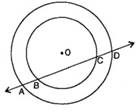
View full solution →If a line intersects two concentric circles (circles with the same centre) with centre $O$ at $A, B, C$ and $D$, prove that $AB = CD.$
View full solution → If diagonals of a cyclic quadrilateral are diameters of the circle through the vertices of the quadrilateral, prove that it is a rectangle.
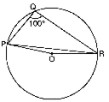
In figure, $\angle \mathrm { PQR } = 100 ^ { \circ }$, where$ P, Q $and $R$ are points on a circle with centre $O$. Find $\angle O P R$
View full solution →The circular park of radius $20\ m$ is situated in a colony. Three boys Ankur, Syed and David are sitting at equal distance on its boundary each having a toy telephone in his hands to talk each other. Find the length of the string of each phone.
View full solution →Three girls Reshma, Salma and Mandip are playing a game by standing on a circle of radius $5 \ m$ drawn in a park. Reshma throws a ball to Salma. Salma to Mandip, Mandip to Reshma. If the distance between Reshma and Salma and between Salma and Mandip is $6 \ m$ each, what is the distance between Reshma and Mandip?
View full solution →If two equal chords of a circle intersect within a circle, prove that the segments of one chord are equal to corresponding segments of the other chord.
Two new roads, Road $E$ and Road $F$ were constructed between society $4$ and $1$ and society $1$ and $2.$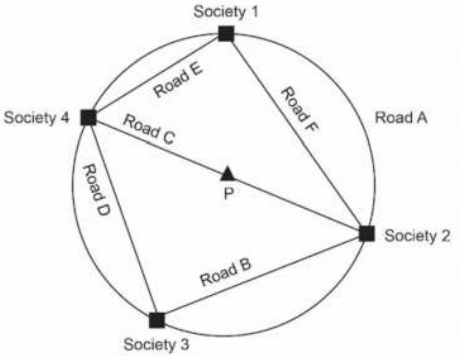
$5.$ What would be the measure of the sum of angles formed by the straight roads at society $1$ and society $3?$
$A. 60^\circ $
$B. 90^\circ $
$C. 180^\circ $
$D. 360^\circ $
$6.$ Krish says, “The distance to go from society $4$ to society $2$ using Road $D$ will be longer that the distance using Road $E”$
Is Krish correct$?$ Justify your answer with examples.
$7.$ Road $G,$ perpendicular to Road $F$ was constructed to connect the park and Road $F.$
Which of the following is true for Road $G$ and Road $F?$
$A.$ Road $G$ and road $F$ are of same length.
$B$. Road $F$ divides Road $G$ into two equal parts.
$C.$ Road $G$ divides Road $F$ into two equal parts.
$D.$ The length of road $G$ is one-fourth of the length of Road $F.$
$8.$ Priya said, “Minor arc corresponding to Road $B$ is congruent to minor arc corresponding to Road $D.”$
Do you agree with Priya$?$ Give reason to support your answer. View full solution →Given below is the map giving the position of four housing societies in a township connected by a circular road $A.$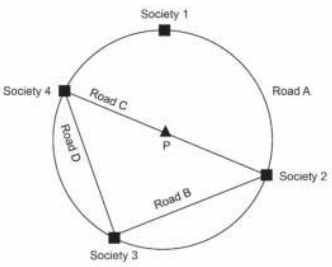
Society $2$ and $3$ are connected by straight road $B,$ society $4$ and $2$ are connected by straight road $C$ and society $ 4$ and 3 are connected by road $D.$ Point $P$ denotes the position of a park. The park is equidistant to all four societies.
Rubina claims that it is not possible to construct another circular road connecting all four societies.
$1.$ Which of the following options justiies Rubina’s claim?
$A.$ Equal chords of congruent circles subtend equal angles at the centre.
$B.$ The perpendicular from the centre of a circle to a chord bisects the chord.
$C.$ There is a unique circle passing through three non-collinear points.
$D.$ Points equidistant from a given point will lie on a circle.
$2$ What is the position of the park P with respect to road $A?$
$A.$ Chord
$B.$ Centre
$C.$ Sector
$D.$ Segment
$3.$ The length of Road $B$ is equal to the length of Road $D.$
Which of the following options can be true for the roads in the township$?$
$A.$ Road $B$ bisects Road $D.$
$B.$ Road $B$ and Road make an acute angle.
$C.$ Road $B,$ Road $C$ and Road $D$ are of equal length.
$D. $ Road $B$ and Road $D$ subtend equal angles at society $1.$
$4.$ Alex says, “The angle made by road $B$ on road $D$ is a right angle.”
Jai and Angad give different justiications to support Alex’s claim.
Jai says, “Angles in the same segment of a circle are equal.”
Angad says, “The angle in a semicircle is a right angle.”
Who has given the correct justiication$?$ View full solution →Read the Source/ Text given below and answer these questions:
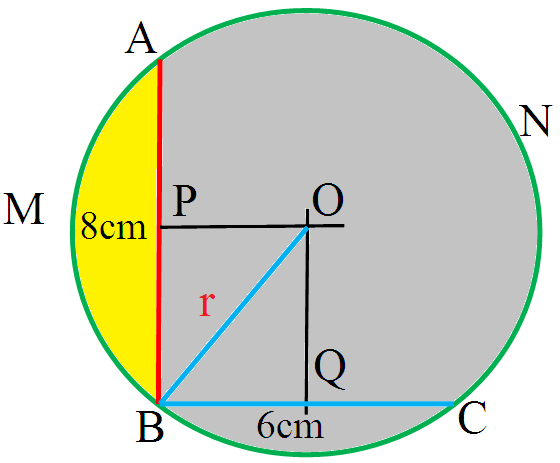
As Class $IX\ C'$ s teacher Mrs.Rashmi entered in the class, She told students to do some practice on circle chapter. She Draws two-line $AB$ and $BC$ so that $AB = 8\ cm$ and $BC = 6\ cm.$ She told all students To make this shape in their notebook and draw a circle passing through the three points $A, B$ and $C.$
$i.$ Dileep drew $AB$ and $BC$ as per the figure
$ii.$ He drew perpendicular bisectors $OP$ and $OQ$ of the line $AB$ and $BC.$
$ii. OP$ and $OQ$ intersect at $O$
$iv.$ Now taking $O$ as centre and $OB$ as radius he drew The circle which passes through $A, B$ and $C.$
$v.$ He noticed that $A, O$ and $C$ are collinear.
Answer the following questions:
$i.$ What you will call the line $\text{AOC}?$
$a.$ Arc
$b.$ Diameter
$c.$ Radius
$d.$ Chord
$ii.$ What is the measure of $\angle\text{ABC}?$
$a. 60^\circ $
$b. 90^\circ $
$c. 45^\circ $
$d. 75^\circ $
$iii.$ What you will call the yellow color shaded area $\text{AMB}?$
$a.$ Arc.
$b.$ Sector.
$c.$ Major segment.
$d.$ Minor Segment.
$iv.$ What you will call the grey colour shaded area $\text{BCNA}?$
$a.$ Arc.
$b.$ Sector.
$c.$ Major segment.
$d.$ Minor Segment.
$v.$ What is the radius of the circle$?$
$a. 4\ cm$
$b. 3\ cm$
$c. 7\ cm$
$d. 5\ cm$ View full solution →Read the Source/ Text given below and answer any four questions: Rohan and Suraj were close friends, One day they were riding horses from Delhi to Faridabad. The names of their horses were Saku and Fareed respectively. The day was very sunny. On the way, they stopped for resting in a park. They tied their horses to a tree in the park. The length of ropes of Rohans's horse is $14m$ and that of the horse of Suraj is $7m$ as shown in the figures. Both the friends slept in the park under a green tree for some time. During this period both the horses took $10$ rounds along with the tree they were tied.
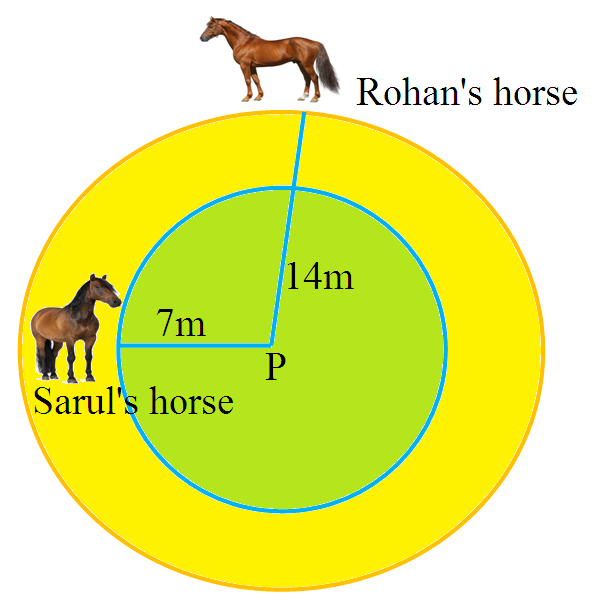
Answer the following questions
$i.$ The ratio of distance walked in $10$ rounds by the horses of Rohan and Suraj is:
$a. 2 : 1$
$b. 1 : 2$
$c. 3 : 1$
$d. 1 : 3$
$ii.$ The ratio of area of the grass the horses of Rohan and Suraj could graze:
$a. 2 : 1$
$b. 1 : 2$
$c. 4 : 1$
$d. 1 : 4$
$iii.$ What is the distance walked by Rohan's horse in $5$ rounds:
$a. 220\ m$
$b. 100\ m$
$c. 440\ m$
$d. 110\ m$
$iv.$ What we call the the length of rope in terms of circle$?$
$a.$ Diameter
$b.$ Radius
$c.$ Chord
$d.$ Tangent
$v.$ What we call the the distance walked by a horse in one round$?$
$a.$ Area
$b.$ Radius
$c.$ Circumference
$d.$ diameter View full solution →Read the Source/ Text given below and answer these questions:
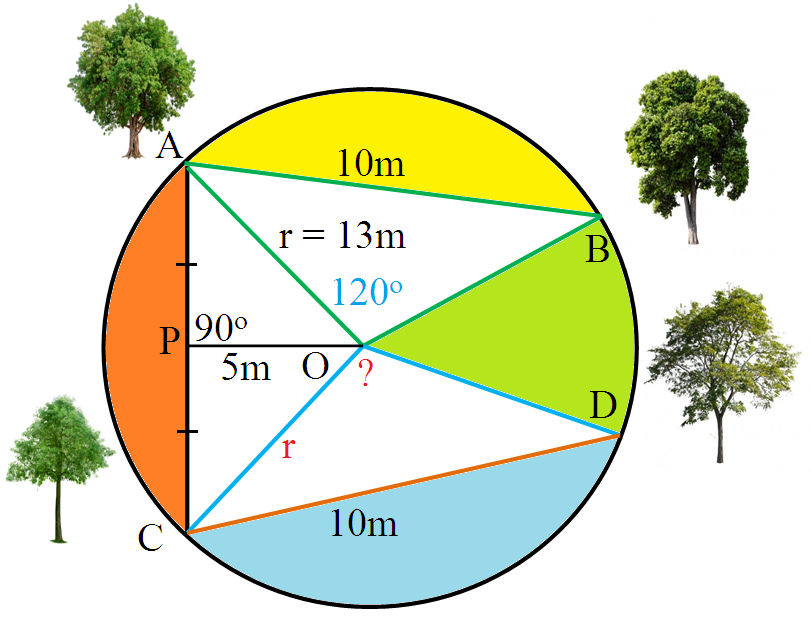
A farmer has a circular garden as shown in the picture above. He has a different type of trees, plants and flower plants in his garden. In the garden, there are two mango trees $A$ and $B$ at a distance of $AB = 10m.$ Similarly, he has two Ashoka trees at the same distance of $10\ m$ as shown at $C$ and $D.\ AB$ subtends $\angle\text{AOB}=120^\circ$ at the center $O,$ The perpendicular distance of $AC$ from center is $5m$. The radius of the circle is $13\ m$. Now answer the following questions:
$i.$ What is the value of $\angle\text{COD}?$
$a. 60^\circ $
$b. 120^\circ $
$c. 100^\circ $
$d. 80^\circ $
$ii.$ What is the distance between mango tree $A$ and Ashok tree $C?$
$a. 12\ m$
$b. 24\ m$
$c. 13\ m$
$d. 15\ m$
$iii.$ What is the value of $\angle\text{OAB}?$
$a. 60^\circ $
$b. 120^\circ $
$c. 30^\circ $
$d. 90^\circ $
$iv.$ What is the value of $\angle\text{OCD?}$
$a. 30^\circ $
$b. 120^\circ $
$c. 60^\circ $
$d. 90^\circ $
$v.$ What is the value of $\angle\text{ODC}?$
$a. 90^\circ $
$b. 120^\circ $
$c. 60^\circ $
$d. 30^\circ $ View full solution →