Questions

3 Marks Question

Take a timed test

7 questions · self-marked practice — reveal the answer and mark yourself.

Question 13 Marks
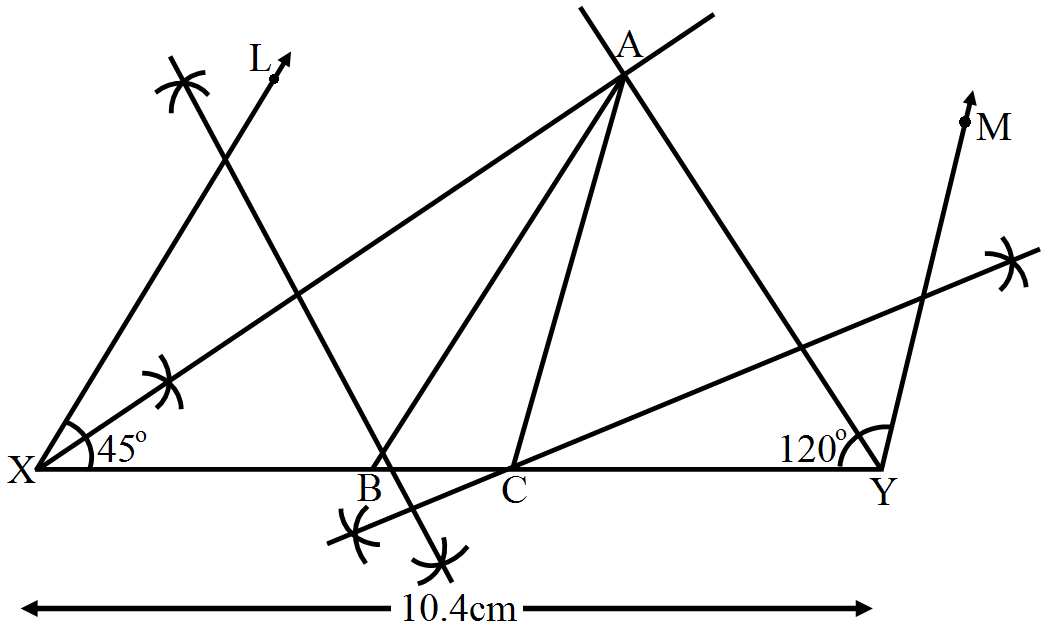
Construct the following and give justification: A triangle if its perimeter is $10.4\ cm$ and two angles are $45^\circ $ and $120^\circ $
Answer
Steps of construction,

$1.$ Draw $XY = 10.4\ cm$
$2.$ Draw $\angle\text{LXY}=45^\circ$ and $\angle\text{MYX}=120^\circ$ with the help of protractor.
$3.$ Draw angle bisector $\angle\text{LXY}.$
$4.$ Draw angles bisector of $\angle\text{MYX}$ such that it meets the angle bisector of $\angle\text{LXY}$ at point $A.$
$5.$ Draw the perpendicular bisector of $AX$ such that it meets $XY$ at $B.$
$6.$ Draw the perpendicular bisector of $AY$ such that it meets $XY $at $C$.
$7.$ Join $AB$ and $AC$.
Thus $\text{ABC}$ is the required triangle.
View full question & answer
Question 23 Marks
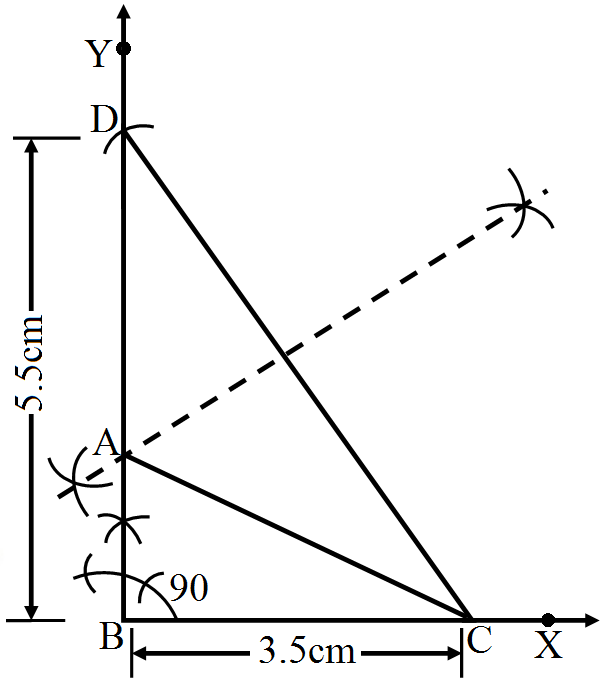
Construct the following and give justification: A right triangle when one side is $3.5\ cm$ and sum of other sides and the hypotenuse is 5$.5\ cm.$
Answer
In $\triangle ABC$, base $BC =3.5 cm$, the sum of other side and hypotenuse i.e., $AB + AC =5.5 cm$ and $\angle ABC =90^{\circ}$ To construct, An $\triangle ABC$. Steps of construction,
1. Draw a ray $B X$ and cut off a line segment $B C=3.5 cm$ from it.
2. Construct $\angle XBY =90^{\circ}$ with the help of a ruler and compass.
3. From by cut off a line segment $B D=5.5 cm$.

4. Join $CD.$
5. Draw the perpendicular bisector of $C D$ intersecting $B D$ at $A$.
6. Join $A C$. Then, $A B C$ is the required triangle.
View full question & answer
Question 33 Marks
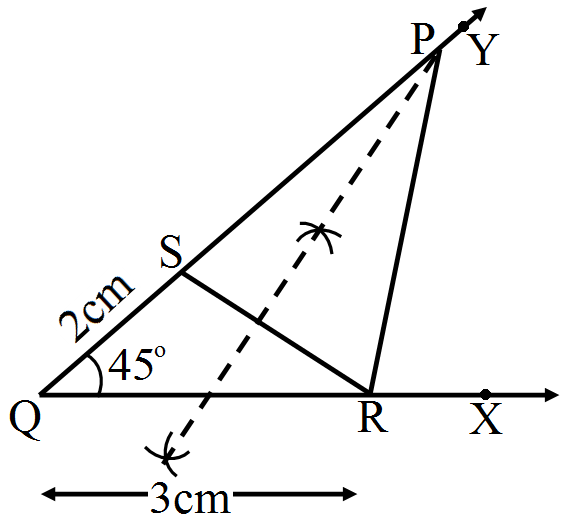
Construct the following and give justification: A triangle $PQR$ given that $QR = 3cm, \angle\text{PQR}=45^\circ$ and $QP - PR = 2cm.$
Answer
Steps of construction,
1. Draw a ray $O X$ and cut off a line segment $Q R=3 cm$.
2. $AT Q$, construction $\angle YQR =45^{\circ}$ with help of protractor.
3. On QY, cut off $QS =2 cm$.

4. Join $RS.$
5. Draw perpendicular bisector of $R S$ to meet $Q Y$ at $P$.
6. Join $PR$. Then $PQR$ is the required triangle.
View full question & answer
Question 43 Marks
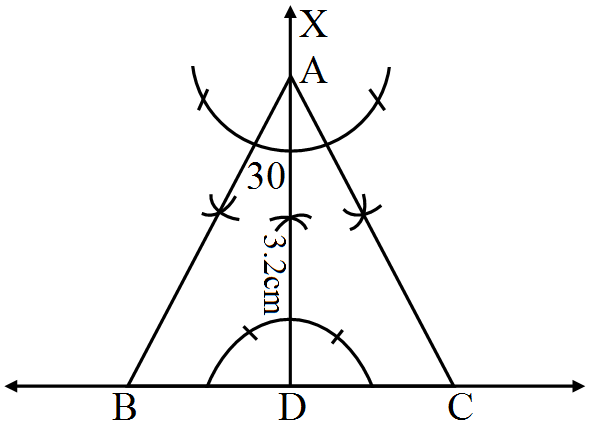
Construct the following and give justification: An equilateral triangle if its altitude is $3.2\ cm.$
Answer
Steps of Construction,
$1.$ Draw a line $l.$
$2.$ Mark any point $D$ on the line $l.$

$3.$ At point $D$, draw $\overline{\text{DX}}\perp\text{l}$ with the help of ruler and compass and cut $DA = 3.2\ cm$ on $\overline{\text{DX}}.$
$4.$ At the point $A$, construct $AB$ and $AC$ which meets the $l$ as points $B$ and $C$ respectively such that $\angle\text{DAB}=30^\circ$ and $\angle\text{DAC}=30^\circ$
Then $\triangle\text{ABC}=30^\circ$ is the required equilateral triangle because,
$\angle\text{ABC}=180^\circ-(90^\circ+30^\circ)=60^\circ$
$\angle\text{ACB}=180^\circ-(90^\circ+30^\circ)=60^\circ$
And $\angle\text{BAC}=30^\circ+30^\circ=60^\circ$
View full question & answer
Question 53 Marks
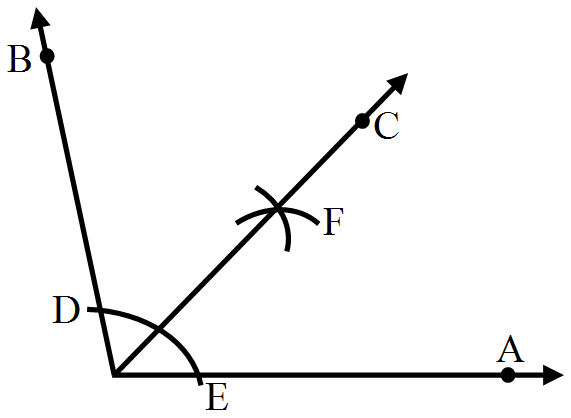
Draw an angle of $110^\circ $ with the help of a protractor and bisect it. Measure each angle.
Answer
Draw $\angle\text{BXA}=110^\circ$ with the help of a protractor.
Now, we use the following steps for required construction.

Taking $X$ as centre and any radius daw an arc to Intersect the rays $X A$ and $X B$, say at $E$ and $D$, respectively. Taking $D$ and $E$ as centres and with the radius more than $\frac{1}{2} DE$, draw arcs to intersect each other, say at $F . $ Draw the ray $XF$ . Thus, ray $XF$ is the required bisector of the angle BXA. On measuring each angle. we get, $\angle BXC =\angle AXC =55^{\circ}$ $\left[\therefore \angle BXC =\angle AXC =\frac{1}{2} \angle BXA =\frac{1}{2} \times 110^{\circ}=55^{\circ}\right]$
View full question & answer
Question 63 Marks
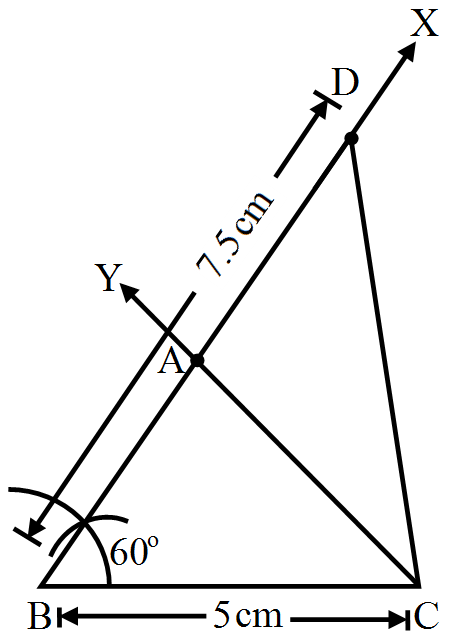
Construct a $\triangle ABC$ in which $BC = 5\ cm$, $\angle\text{B}=60^\circ$ and $AC + AB = 7.5\ cm.$
Answer
$1.$ Draw the base $BC = 5\ cm.$
$2.$ At the point $B$ make an $\angle\text{XBC}=60^\circ$
$3.$ Cut a line segment $BD$ equal to $AB + AC = 7.5\ cm$ from the ray $BX.$

$4.$ Join $DC.$
$5.$ Make an $\angle\text{DCY}=\angle\text{BDC}$
$6.$ Let $CY$ intersect $BX$ at $A.$
Then, $\triangle\text{ABC}$ is the required triangle.
View full question & answer
Question 73 Marks
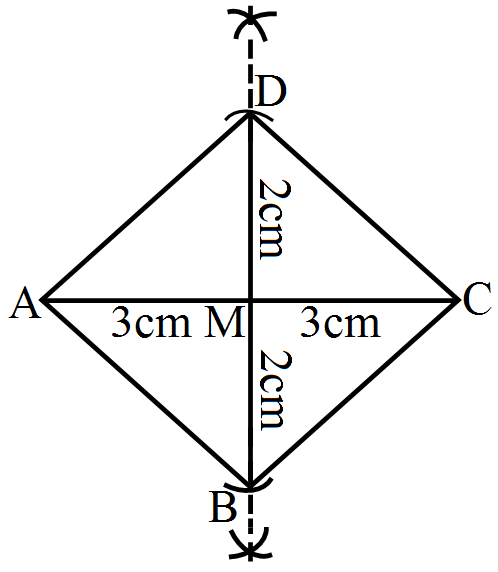
Construct the following and give justification: A rhombus whose diagonals are $4\ cm$ and $6\ cm$ in lengths.
Answer
To construct, A rhombus $\text{ABCD}$. Step of constuction,
$1.$Take $AC = 6\ cm.$
$2.$ Draw $BD$ the right bisectors of $AC.$

$3.$ Cut off $MB = 2\ cm.$
$4.$ Join $AB, BC, Cd$ and $DA.$
Hence, $\text{ABCD}$ is the required rhombus.
View full question & answer