Questions

4 Marks Questions

Take a timed test

6 questions · self-marked practice — reveal the answer and mark yourself.

Question 14 Marks
Construct a triangle whose sides are $3.6\ cm, 3.0\ cm$ and $4.8\ cm$. Bisect the smallest angle and measure each part.
Answer
To construct a triangle $A B C$ in which $A B=3.6 \ cm, A C=3.0 \ cm$ and $B C=4.8 \ cm$, use the following steps.
1. Draw a line segment $B C$ of length $4.8 cm .$
2. From $B$, point $A$ is at a distance of $3.6 \ cm$ . So, having $B$ as centre, draw an arc of radius $3.6 \ cm . $
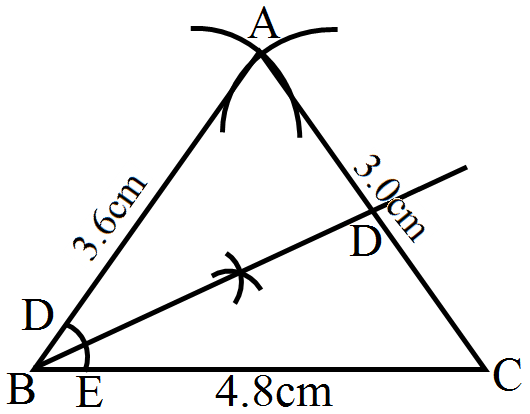
3. From $C$, point $A$ is at a distance of $3 \ cm$ . So, having $C$ as centre, draw an arc of radius $3 \ cm$ which intersect previous arc at $A$.
4. Join $A B$ and $A C$. Thus, $\triangle A B C$ is the required triangle.
Here, angle $B$ is smallest, as $A C$ is the smallest side. To direct angle $B$, we use the following steps.
1. Taking $B$ as centre, we draw an are intersecting $A B$ and $B C$ at $D$ and $E$, respectively.
2. Taking $D$ and $E$ as centres we draw arcs intersecting at $P$.
3. Joining $B P$, we obtain angle bisector of $\angle B$
4. Here, $\angle ABC =39^{\circ}$
Thus, $\angle ABD =\angle= DBC =\frac{1}{2} \times 139^{\circ}=19.5^{\circ}$
View full question & answer
Question 24 Marks
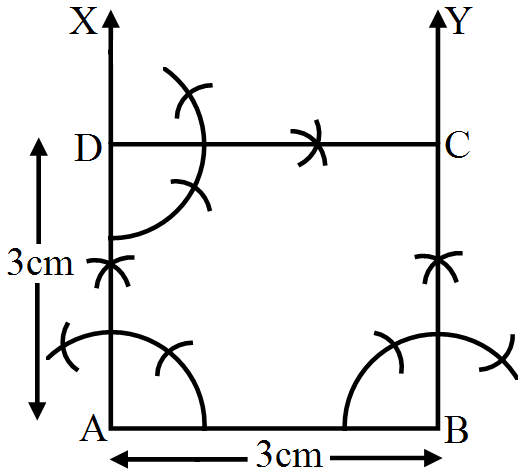
Construct a square of side $3\ cm.$
Answer
We know that, each angle of a square is right angle (i.e., $90^{\circ}$ ). To construct a square of side $3 cm $, use the following steps.
1. Draw a line segment $A S$ of length $3 cm .$
2. Now, generate an angle of $90^{\circ}$ at points $A$ and $B$ of the line segment and plot the parallel lines $A X$ and $B Y$ at these points.
3. Cut $A D$ and $S C$ of length $3 cm$ from $A X$ and $B Y$, respectively.
4. Draw an angle of $90^{\circ}$ at any one of the point $C$ or $D$ and join both points by a line segment $C D$ of length $3 cm .$ Thus, $A B C D$ is the required square of side, $3 cm .$
View full question & answer
Question 34 Marks
Draw an angle of $80^\circ$ with the help of a protractor. Then construct angles of :
$i. 40^\circ$
$ii. 160^\circ$
$iii. 120^\circ$
Answer
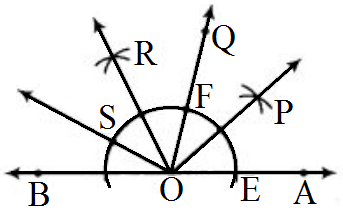
First, draw an angle of $80^\circ $ say $\angle\text{QOA}=180^\circ $ with the help of protractor.
Now, use the the following steps to construct angles of,

Taking $O$ as centre and any radius draw an arc which intersect $OA$ at $E$ and $OQ$ at $F.$
Taking $E$ and $F$ as centres and radius more than $\frac{1}{2}\text{EF}$ draw arcs which intersect each other at $P.$
Join $OP$ Thus, $\angle\text{POA}=40^\circ$
$\big[\therefore\ 40^\circ=\frac{1}{2}\times 80^\circ\big]$
Now, taking $F$ as centre and radius equal to $EF$ draw an arc which intersect previous arc obtained in step ii at $S.$
Join $OS$. Thus, $\angle\text{SOA}=160^\circ$
$\big[\therefore\ 160^\circ=2\times80^\circ\big] $
Taking $S$ and $F$ as centre and radius more than $\frac{1}{2}\text{SF}$ draw arcs which intersect each other at $R.$ Join $OR.$
Thus, $\angle\text{ROA}=\angle=\text{ROQ}=40^\circ+80^\circ=120^\circ$
View full question & answer
Question 44 Marks
Construct a rhombus whose side is of length $3.4\ cm$ and one of its angles is $45^\circ $
Answer
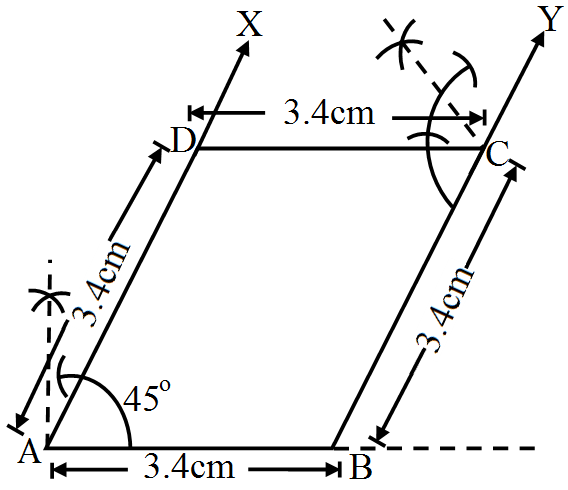
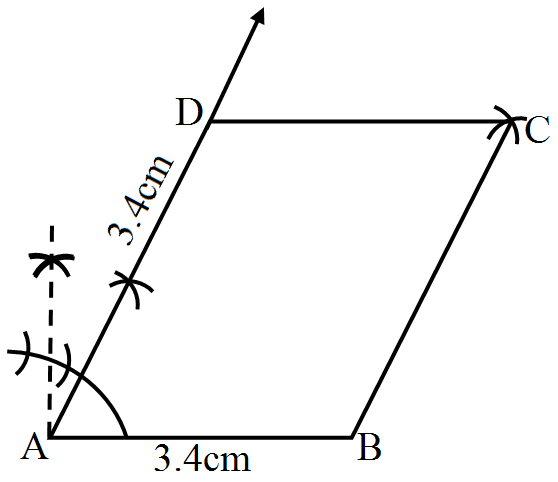
1.Draw a line segment $AS$ of length $3.4cm.$

2. Now, generate an angle $45^{\circ}$ at both ends $A$ and $B$ of line segment $A B$ and plot the parallel lines $A X$ and $B Y$.
3. Cut $A D$ and $S C$ of length $3.4 \ cm$ from $A X$ and $B Y$, respectively.
4. Draw an angle of $45^{\circ}$ at one of the point $D$ or $C$ and join both points by a line segment $D C$ of length $3.4 \ cm$ and parallel to $A B$. Thus, $A B C D$ is the required rhombus whose side is of length $3.4 \ cm$ and one of its angle is $45^{\circ}$
View full question & answer
Question 54 Marks
Construct a rectangle whose adjacent sides are of lengths $5\ cm$ and $3.5\ cm.$
Answer
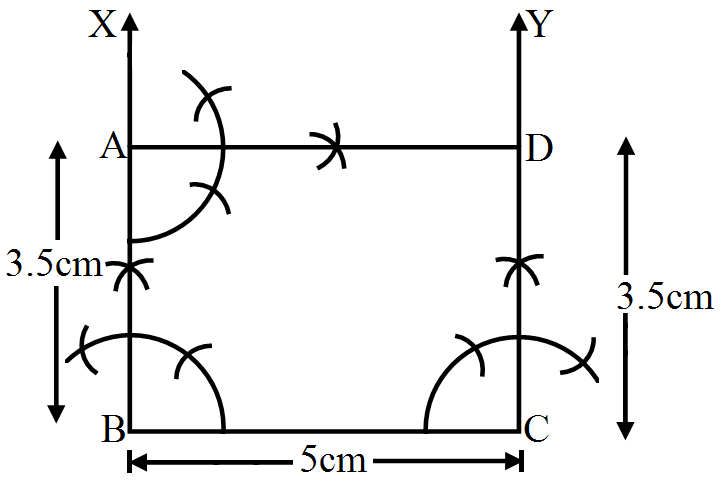
We know that, each angle of a rectangle is right angle (i.e., $90^{\circ}$ ) and its opposite sides are equal and parallel. To construct a rectangle whose adjacent sides are of lengths $5 cm$ and $3.5 cm$ , use the $1$ following steps.
1. Draw a line segment $B C$ of length $5 cm .$
2. Now, generate an angle of $90^{\circ}$ at points $B$ and $C$ of the line segment $B C$ and plot the parallel lines $B X$ and $C Y$ at these points. .

3. Cut $A B$ and $C D$ of length $3.5 \ cm$ from $B X$ and $C Y$, respectively.
4. Draw an angle $90^{\circ}$ at one of the point $A$ or $D$ and join both points by a line segment $A D$ of length $5 \ cm$ . Thus, $A B C D$ is the required rectangle with adjacent sides of length $5 \ cm$ and $3.5 \ cm$ .
View full question & answer
Question 64 Marks
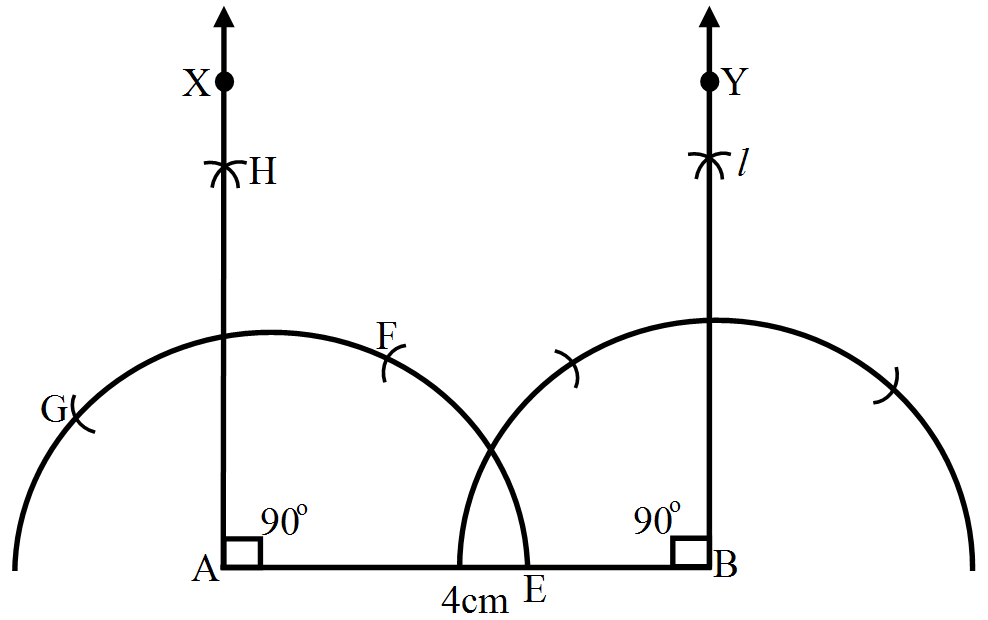
Draw a line segment $AB$ of $4\ cm$ in length. Draw a line perpendicular to $AB$ through $A$ and $B$, respectively. Are these lines parallel?
Answer
$1.$ Draw a line segment $AB = 4\ cm.$
$2.$ Taking $4$ as centre and radius more than $\frac{1}{2}\text{AB} ($i.e., $2\ cm)$ draw an arc say it intersect $AB$ at $E.$
$3.$ Taking $E$ as centre and with same radius as above draw an arc which intersect previous arc at $F.$
$4.$ Again, taking $F$ as centre and with same radius as above draw an arc which intersect previous arc $($obtained in step $ii)$ at $G.$

$5.$ Taking $G$ and $F$ are centres, draw arcs which intersect each other at $H.$
$6.$ Join $AH$ .
Thus, $AX$ is perpendicular to $AB$ at $A$.
Similarly, draw $\text{BY}\perp\text{AB}$ at $B.$
Now, we know that if two lines are parallel, then the angle between them will be $0^\circ $ or $180^\circ $
Here, $\angle\text{XAB}=90^\circ\ \big[\therefore\ \text{XA}\perp\text{AB}\big]$
and $\angle\text{YBA}=90^\circ\ \big[\therefore\ \text{YB}\perp\text{AB}\big]$
$\angle\text{XAB}+\angle\text{YBA}=90^\circ+90^\circ=180^\circ$
So, the lines $XA$ and $YS$ are parallel.
$[$since, it sum of interior angle on same side of transversal is $180^\circ $, then the two lines are parallel$]$
View full question & answer