Questions

1 Marks Question

Take a timed test

15 questions · self-marked practice — reveal the answer and mark yourself.

Question 11 Mark
Why is Axiom $5,$ in the list of Euclid's axioms, considered a 'universal truth'$?$
Answer
Euclid's Axiom $5$ states that "The whole is greater than the part. Since this is true for anything in any part of the world. So, this is a universal truth.
View full question & answer
Question 21 Mark
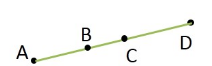
In fig., if $AC = BD,$ then prove that $AB = CD$
Answer
$AC = BD . . . . [$Given$] . . . (1)$
$AC = AB + BC . . . . [$Point $B$ lies between $A$ and $C] . . . . (2)$
$BD = BC + CD . . . . [$Point $C$ lies between $B$ and $D] . . . . (3)$
Substituting $(2)$ and $(3)$ in $(1),$ we get
$AB + BC = BC + CD$
$\Rightarrow AB = CD . . . . [$Subtracting equals from equals$]$
View full question & answer
Question 31 Mark
Point $C$ is called a mid point of line segment $AB,$ prove that every line segment has one and only one mid-point.
Answer


Let a line $AB$ have two mid-points, say, $C$ and $D.$ Then
$AB = AC + CB = 2AC . . . . (i) . . . [$As $C$ is the mid-point of $AB]$
and $AB = AD + DB = 2AD . . . . (ii) [$As $D$ is the mid-point of $AB]$
From equation $(i)$ and $(ii)$
$AC = AD$ and $CB = DB$
But this will possible only when $D$ lies on point $C$. So every line segment has one and only one mid-point.
View full question & answer
Question 41 Mark
If a point $'C'$ lies between two points $A$ and $B$ such that $AC = BC,$ then prove that $AC =\frac{1}{2}AB$. Explain by drawing the figure.
Answer


Given, $AC = BC$
$AC + AC = BC + AC . . . . [AC$ are added to both the side$]$
$2AC = AB . . . . [BC + AC$ coincides with $AB]$
$\therefore AC = \frac{1}{2}AB$
View full question & answer
Question 51 Mark
There exist at least three points that are not on the same line. Does the postulate contain any undefined term? Is this postulate consistent? Does this follow from Euclid’s postulates? Explain.
Answer
Yes, this postulate contains undefined terms, which are point and angle.
Point $C$ does not lie on the line segment joining $A$ and $B.$

No, they don't follow from Euclid's postulates. This follow an axiom, stated as given two distinct points; there is a unique line that passes through them.
View full question & answer
Question 61 Mark
Given any two distinct points $A$ and $B,$ there exists a third point $C$ which is in between $A$ and $B.$
Answer
Point $C$ is lying in between and on the line segment joining $A$ and $B$ as shown in below fig
View full question & answer
Question 71 Mark
Define : Square
Answer
A quadrilateral with all the four sides equal and all the four angles of measure $90^{\circ}$ each is called a square.
View full question & answer
Question 81 Mark
Define : radius of a circle
Answer
The length of the line-segment joining the centre of a circle to any point on its circumference is called the raduis of the circle.
View full question & answer
Question 91 Mark
Define : line segment
Answer
A line segment is a part of a line with two end points and it cannot be extended further. It has a definite length or breadth.
View full question & answer
Question 101 Mark
Define : Perpendicular lines
Answer
Two lines which are at a right angles to each other are called perpendicular lines.
View full question & answer
Question 121 Mark
Consider the statement: There exists a pair of straight lines that are everywhere equidistant from one another. Is this statement a direct consequence of Euclid’s fifth postulate? Explain.
 
Answer
Take any line $l$ and a point $P$ not on $l.$ Therefore, by Playfair’s axiom, which is equivalent to the fifth postulate, which states that there is a unique line m through $P$ which is parallel to $l.$
Now, the distance of a point from a line is the length of the perpendicular from the point to the line. This distance will be the same for any point on $m$ from $l$ and any point on $l$ from $m.$ Therefore, these two lines are everywhere equidistant from one another.
View full question & answer
Question 131 Mark
Prove that an equilateral triangle can be constructed on any given line segment.
Answer
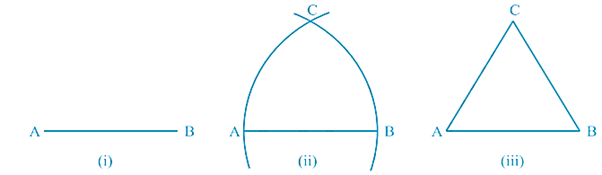
In the statement above, a line segment of any length is given, say $AB [$see Fig. $(i)].$

Here, we need to do some construction. Using Euclid’s Postulate 3, we can draw a circle with point $A$ as the centre and $AB$ as the radius $[$see Fig. $(ii)].$ Similarly, draw another circle with point $B$ as the centre and $BA$ as the radius. The two circles meet at a point, say $C$. Then, draw the line segments $AC$ and $BC$ to form $\triangle ABC [$see Fig. $(iii)].$
Therefore, we have to prove that this triangle is equilateral, i.e., $AB = AC = BC.$
Now, $AB = AC,$ because they are the radii of the same circle $...(1)$
Similarly, $AB = BC ($Radii of the same circle$) ...(2)$
From these two facts, and Euclid’s axiom that things which are equal to the same thing are equal to one another, we can conclude that $AB = BC = AC.$ Therefore, $\triangle$ ABC is an equilateral triangle.
Hence,proved.
View full question & answer
Question 141 Mark
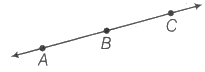
In the given figure, if $A, B$ and $C$ are three points on a line and $B$ lies between $A$ and $C,$ then prove that $AB + BC = AC.$
Answer

In the given figure, $AC$ coincides with $AB + BC.$
Also, Euclid’s axiom $4$ says that things which coincide with one another, are equal to one another. So, it can be deduced that
$AB + BC = AC$
View full question & answer
Question 151 Mark
Two distinct lines cannot have more than one point in common.
Answer
Proof : Here we are given two lines l and m. We need to prove that they have only one point in common.
For the time being, let us suppose that the two lines intersect in two distinct points,
say P and Q. So, you have two lines passing through two distinct points P and Q. But
this assumption clashes with the axiom that only one line can pass through two distinct
points. So, the assumption that we started with, that two lines can pass through two
distinct points is wrong.
From this, what can we conclude? We are forced to conclude that two distinct
lines cannot have more than one point in common.
View full question & answer