Questions

2 Marks Questions

Take a timed test

8 questions · self-marked practice — reveal the answer and mark yourself.

Question 12 Marks
The linear equation that converts Fahrenheit $(F)$ to Celsius $(C)$ is given by the relation, $\text{C}=\frac{5\text{F}-160}{9}$ What is the numerical value of the temperature which is same in both the scales?
Answer
$\text{C}=\frac{5\text{F}-160}{9}$ putting $C = F,$ in the given relation,
we get $\text{F}=\frac{5\text{F}-160}{9}$
​​​​​​​$\Rightarrow9\text{F}=5\text{F}-160$
$\Rightarrow4\text{F}=160$
$\therefore\text{F}=\frac{-160}{4}=-40^\circ$
Hence, the numarical value of the temperature which is same in both the scales is $-40.$
View full question & answer
Question 22 Marks
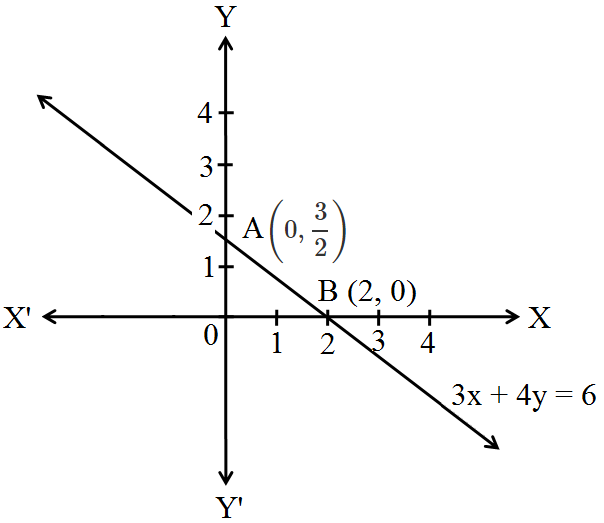
Draw the graph of the linear equation $3x + 4y = 6$. At what points, the graph cuts $X$ and $K-$axes?
Answer
The given eqution is $3x + 4y = 6$.
To draw the graph of this eqution. we need atleast two points lying on the graph of $4\text{y}=6-3\text{x}$ $\Rightarrow\text{y}=\frac{6-3\text{x}}{4}$
When $x = 2$, then $\text{y}=\frac{6-3\times2}{4}=\frac{6-6}{4}=0$
When $x = 0$, then $\text{y}=\frac{6-3\times0}{4}=\frac{6}{4}=\frac{3}{2}$
$x$ $2$ $0$
$y$ $0$ $\frac{3}{2}$
Here, we find two points $\text{A}\Big(0,\frac{3}{2}\Big)$ and $B(2, 0)$ and join then, to get the line $AB$. Line $AB$ is the required graph. You can see that the graph (line $AB$) cuts the $X-$axis at the point $(2, 0)$ and the $Y-$axis at the point $\Big(0,\frac{3}{2}\Big).$
View full question & answer
Question 32 Marks
For what value of $c$, the linear equation $2x + cy = 8$ has equal values of $x$ and $y$ for its solution.
Answer
The value of c for which the liner eqution $2x + cy = 8$ has equal values of x and $y$ i.e., $x = y$ for solution is, $2\text{x}+\text{cy}=8$
$\Rightarrow2\text{x}+\text{cx}=8\ [\because\text{y}=\text{x}]$
$\Rightarrow\text{cx}=8-2\text{x}$
$\therefore\text{c}=\frac{8-2\text{x}}{\text{x}},\text{x}\neq0$
View full question & answer
Question 42 Marks
The linear equation that converts Fahrenheit $(F)$ to Celsius $(C)$ is given by the relation,
$\text{c}=\frac{5\text{F}-160}{9}$
If the temperature is $86^\circ F$, what is the temperature in Celsius?
Answer
$\text{c}=\frac{5\text{F}-160}{9}$
putting $F = 86^\circ ,$
we get $\text{C}=\frac{5(86)-160}{9}=\frac{430-160}{9}=\frac{270}{9}=30^\circ$
Hence, the temperature in Celsius is $30^\circ C.$
View full question & answer
Question 52 Marks
The linear equation that converts Fahrenheit $(F)$ to Celsius $(C)$ is given by the relation, $\text{c}=\frac{5\text{F}-160}{9}$ If the temperature is $35^\circ C$, what is the temperature in Fahrenheit?
Answer
$\text{c}=\frac{5\text{F}-160}{9}$ putting $C = 35^\circ $,
we get $35^\circ=\frac{5\text{(F)}-160}{9}\Rightarrow315^\circ=5\text{F}-160$
$\Rightarrow5\text{F}=315+160=475$
$\therefore\text{F}=\frac{475}{5}=95^\circ$
Hence, the temperature in Fahrenheit is $95^\circ F.$
View full question & answer
Question 62 Marks
The linear equation that converts Fahrenheit $(F)$ to Celsius $(C)$ is given by the relation,
$\text{c}=\frac{5\text{F}-160}{9}$
If the temperature is $0^\circ C$, what is the temperature in Fahrenheit and if the temperature is $0^\circ F$, what is the temperature in Celsius?
Answer
$\text{c}=\frac{5\text{F}-160}{9}$
putting $C = 0^\circ $, we get
$0=\frac{5\text{F}-160}{9}\Rightarrow0=5\text{F}-160$
$\Rightarrow5\text{F}=160$
$\therefore\text{F}=\frac{160}{5}=32^\circ$
Now, putting $F = 0^\circ $,
we get $\text{C}=\frac{5\text{F}-160}{9}\Rightarrow\text{C}=\frac{5(0)-160}{9}=\Big(-\frac{160}{9}\Big)^\circ$
If the temperature in Fahrenheit is $32^\circ $ and if the temperature is $0^\circ F$, then the temperature in Celsius is $\Big(-\frac{160}{9}\Big)^\circ\text{C.}$
View full question & answer
Question 72 Marks
Let $y$ varies directly as $x.$ If $y = 12$ when $x = 4$, then write a linear equation. What is the value of $y$ when $x = 5?$
Answer
$y$ varies of directly as x. $\Rightarrow\text{y}\propto\text{x},$
$\therefore\text{y}=\text{kx}$ Substituting $y = 12$ when $x = 4,$
we get, $12=\text{k}\times4\Rightarrow\text{k}=12\div4=3$
Hence, the required eqution is $y = 3x.$
The value of $y$ when $x = 5$ is $y = 3 \times 5 = 15.$
View full question & answer
Question 82 Marks
Find the solution of the linear equation $x+2y = 8$ which represents a point on:
$i. x-$axis
$ii. y-$axis
Answer
We have, $x + 2y = 8 ...(i)$
$i.$ When the point is on the $X-$axis, then put $y = 0$ in Eq. $(i)$, we get
$x + 2(0) = 8$
$\Rightarrow x = 8 $
Hence, the required point is $(8, 0).$​​​​​​​
$ii.$ When the point is on the $Y-$axis, then put $x = 0$ in Eq. $(i)$, we get
$0 + 2y = 8$
$\Rightarrow \text{y}=\frac{8}{2}= 4$
Hence, the required point is $(0, 4).$
View full question & answer