Questions

3 Marks Question

Take a timed test

28 questions · self-marked practice — reveal the answer and mark yourself.

Question 13 Marks
If a wheel has six spokes equally spaced, then find the measure of the angle between two adjacent spokes.
Answer
It is given that the six spokes are equally spaced, thus, two adjacent spokes subtend equal angle at the centre of the wheel.
Let that angle measures $x^\circ$ .
Also, The six spokes form a complete angle, that is $360^\circ$ .
Therefore, $x + x + x + x + x + x = 360^\circ$ $6x = 360^\circ$ $\text{x}=\frac{360^\circ}{6}$ $x = 60^\circ$
Hence, the measure of the angle between two adjacent spokes measures $60^\circ$ .
View full question & answer
Question 23 Marks
Prove that the straight lines perpendicular to the same straight line are parallel to one another.
Answer
Let $AB$ and $CD$ be drawn perpendicular to the Line $MN$ $\angle\text{ABD}=90^\circ$ $... (i)$
$[AB$ is perpendicular to $MN]$
$\angle\text{CON}=90^\circ$ $... (ii) [CD$ is perpendicular to $MN ]$
Now, $\angle\text{ABD}=\angle\text{CDN}=90^\circ$$[$From $(i)$ and $(ii)]$
Therefore,$ AB\ ||\ CD$, Since corresponding angles are equal.
View full question & answer
Question 33 Marks
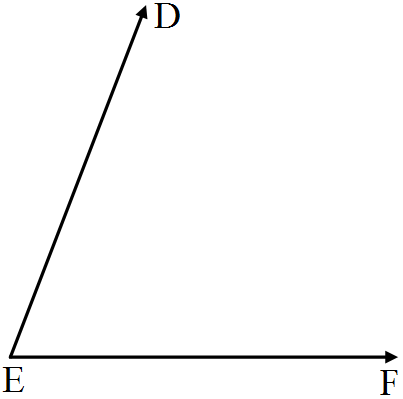
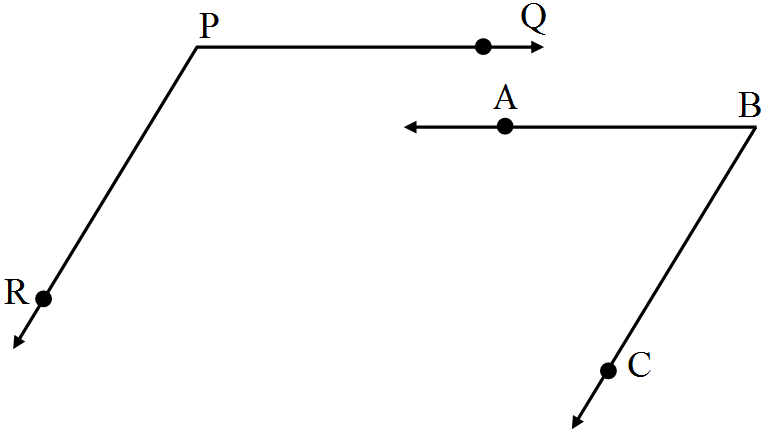
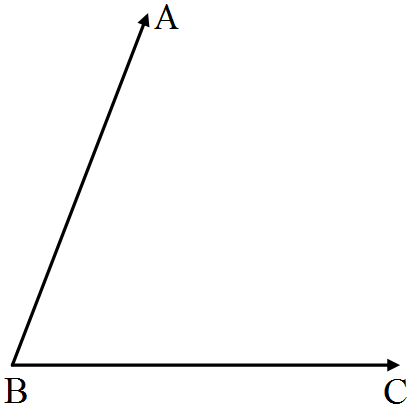
In figure, arms $BA$ and $BC$ of $\angle\text{ABC}$ are respectively parallel to arms $ED$ and $EF$ of $\angle\text{DEF}.$ Prove that $\angle\text{ABC}=\angle\text{DEF}.$
Answer
Given $AB\ ||\ DE$ and $BC\ ||\ EF$
To Prove: $\angle\text{ABC}=\angle\text{DEF}$
 Construction: Produce $BC$ to $x$ such that it intersects $DE$ at $M$.
Proof: Since $AB\ ||\ DE$ and $BX$ is the transversal $ABC = DMX ...(1)$ [Corresponding angle]
Also, $BX\ ||\ EF$ and $DE$ is the transversal $DMX = DEF ...(2)$ [Corresponding angles] From $(1)$ and $(2)$ $\angle\text{ABC}=\angle\text{DEF}$
View full question & answer
Question 43 Marks
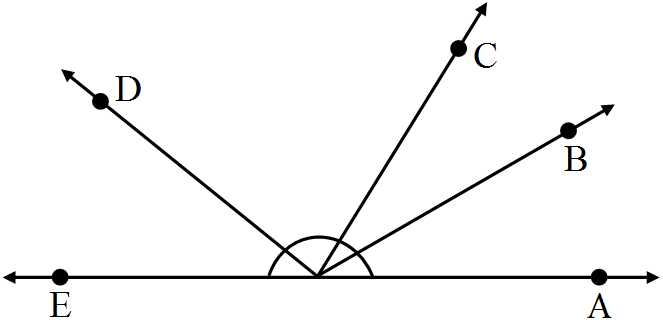
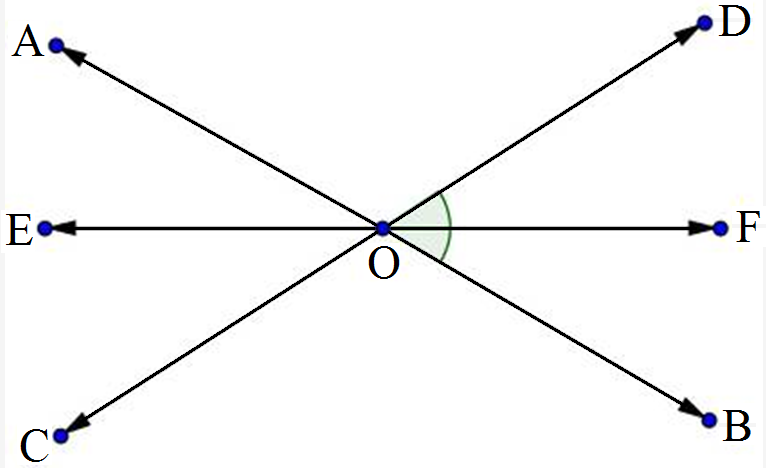
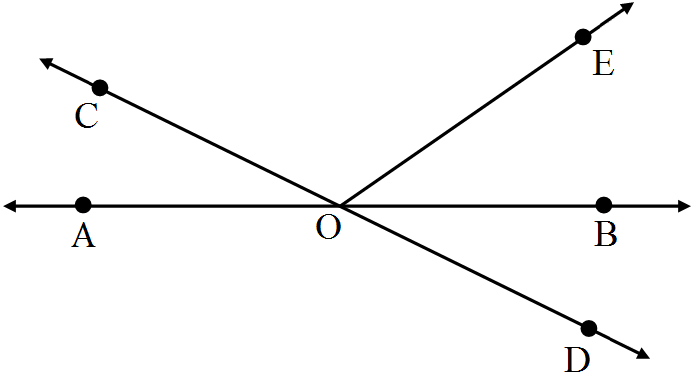
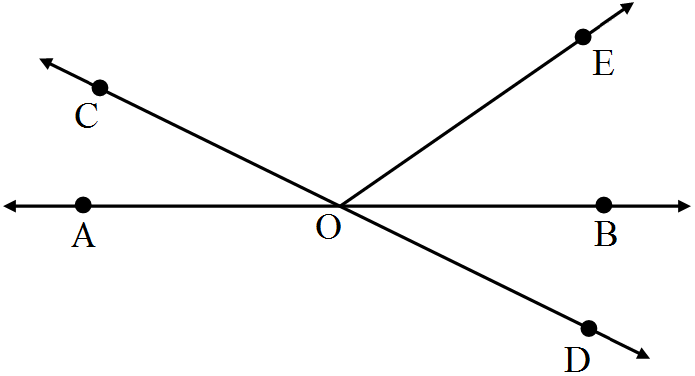
How many pairs of adjacent angles, in all, can you name in figure $10.36$.
Answer
Pairs of adjacent angles are:
$\angle\text{EOC},\angle\text{DOC}$
$\angle\text{EOD},\angle\text{DOB}$
$\angle\text{DOC},\angle\text{COB}$
$\angle\text{EOD},\angle\text{DOA}$
$\angle\text{DOC},\angle\text{COA}$
$\angle\text{BOC},\angle\text{BOA}$
$\angle\text{BOA},\angle\text{BOD}$
$\angle\text{BOA},\angle\text{BOE}$
$\angle\text{EOC},\angle\text{COA}$
$\angle\text{EOC},\angle\text{COB}$
 Hence, $10$ pair of adjacent angles.
View full question & answer
Question 53 Marks
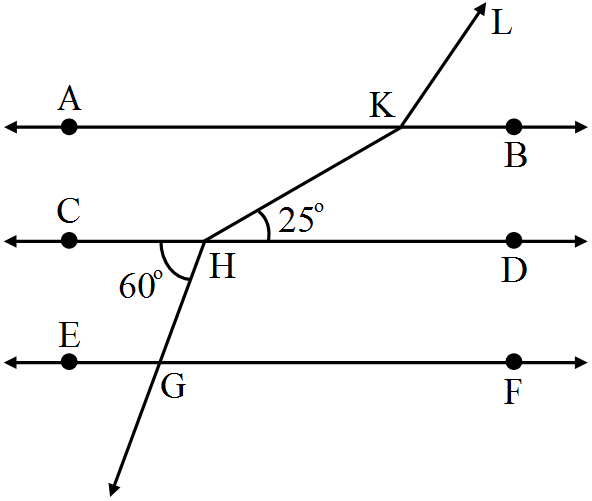
In figure, $AB\ ||\ CD\ ||\ EF$ and $GH\ ||\ KL$. Find $\angle\text{HKL}.$
Answer
Produce $LK$ to meet $GF$ at $N$.
Now, alternative angles are equal $\angle\text{CHG}=\angle\text{HGN}=60^\circ$
$\angle\text{HGN}=\angle\text{KNF}=60^\circ$ [Corresponding angles]
Hence, $\angle\text{KNG}=180-60=120$
$\Rightarrow\ \angle\text{GNK}=\angle\text{AKL}=120^\circ$ [Corresponding angles]
$\angle\text{AKH}=\angle\text{KHD}=25^\circ$ [alternative angles]
Therefore, $\angle\text{HKL}=\angle\text{AKH}+\angle\text{AKL}=25+120=145^\circ.$
View full question & answer
Question 63 Marks
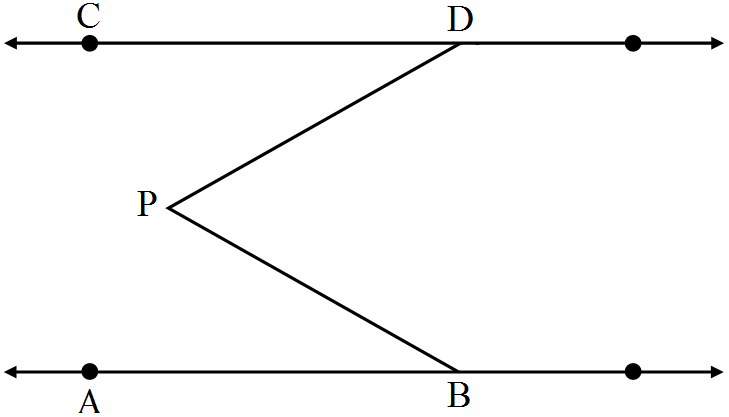
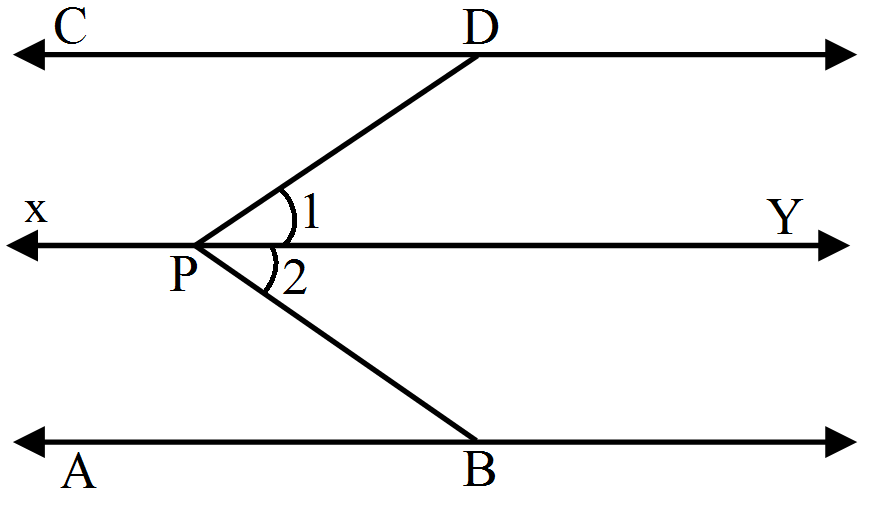
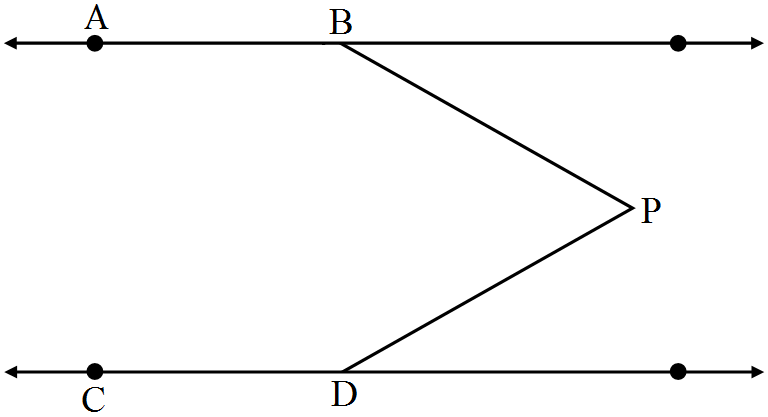
In figure, lines $AB$ and $CD$ are parallel and $P$ is any point as shown in the figure. Show that $\angle\text{ABP}+\angle\text{CDP}=\angle\text{DPB}.$
Answer
Given that $AB\ ||\ CD$ Let $EF$ be the parallel line to $AB$ and $CD$ which passes through $P$.
It can be seen from the figure. Alternative angles are equal $\angle\text{ABP}=\angle\text{BPF}$ Alternative angles are equal $\angle\text{CDP}=\angle\text{DPF}$ $\angle\text{ABP}+\angle\text{CDP}=\angle\text{BPF}+\angle\text{DPF}$ $\angle\text{ABP}+\angle\text{CDP}=\angle\text{DPB}$
Hence proved $AB$ parallel to $CD, P$ is any point
To prove: $\angle\text{ABP}+\angle\text{BPD}+\angle\text{CDP}=360^\circ$
Construction: Draw $EF\ ||\ AB$ passing through $P$.

Proof: Since $AB\ ||\ EF$ and $AB\ ||\ CD$, Therefore $EF\ ||\ CD$ [Lines parallel to the same line are parallel to each other] $\angle\text{ABP}+\angle\text{EPB}=180^\circ$[Sum of co-interior angles is $180$]
$\angle\text{EPD}+\angle\text{COP}=180^\circ\dots(1)$ [Sum of co-interior angles is $180$]
$\angle\text{EPD}+\angle\text{CDP}=180^\circ\dots(2)$ By adding $(1)$ end $(2)$
$\angle\text{ABP}+\angle\text{EPB}+\angle\text{EPD}+\angle\text{CDP}=(180+180)^\circ$
$\angle\text{ABP}+\angle\text{EPB}+\angle\text{COP}=360^\circ$
View full question & answer
Question 73 Marks
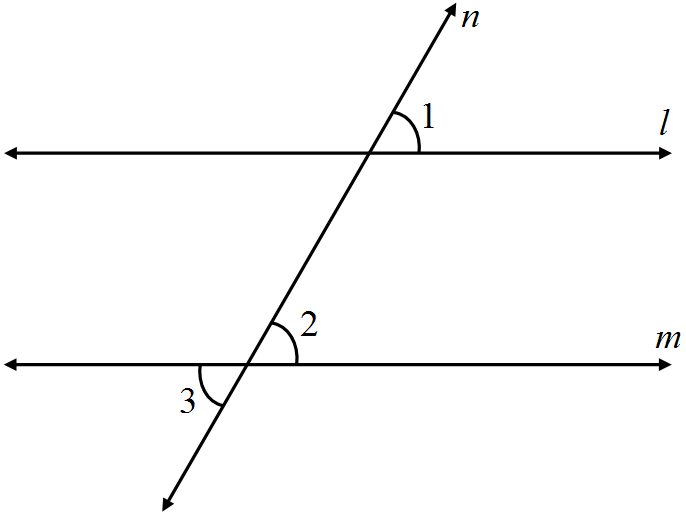
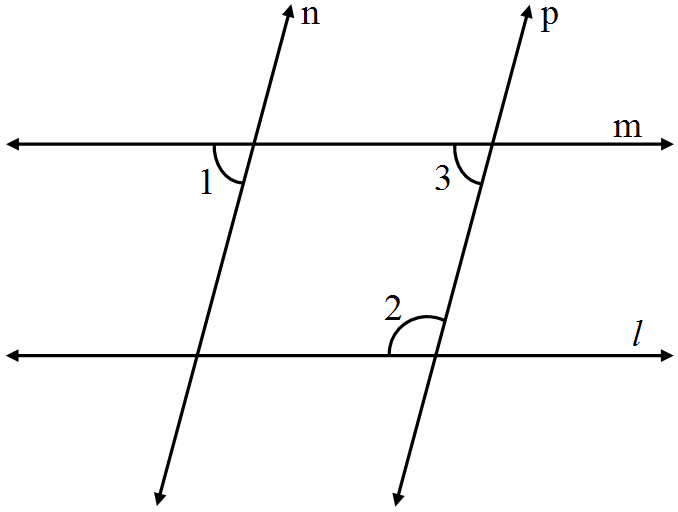
In figure, $\angle{1}=60^\circ$ and $\angle{2}=\Big(\frac{2}{3}\Big)^\text{rd}$ of a right angle. Prove that l∥m.
Answer
Given: $\angle{1}=60^\circ$ and $\angle{2}=\Big(\frac{2}{3}\Big)^\text{rd}$ of a right angle
To Prove: Parallel Drawn to m Proof: $\angle{1}=60^\circ$ $\angle{2}=\Big(\frac{2}{3}\Big)\times90=60$
Since $\angle{1}=\angle{1}=60^\circ$
Therefore, Parallel to m as pair of corresponding angles are equal.
View full question & answer
Question 83 Marks
Define supplementary angles.
Answer
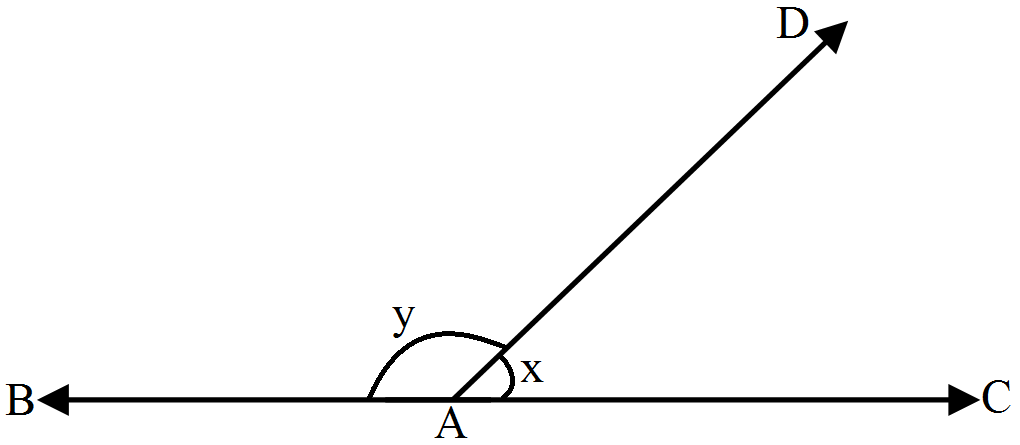
supplementary Angles: Two angles, the sum of whose measures is $180^\circ $, are called suppplementary angles.
Thus,
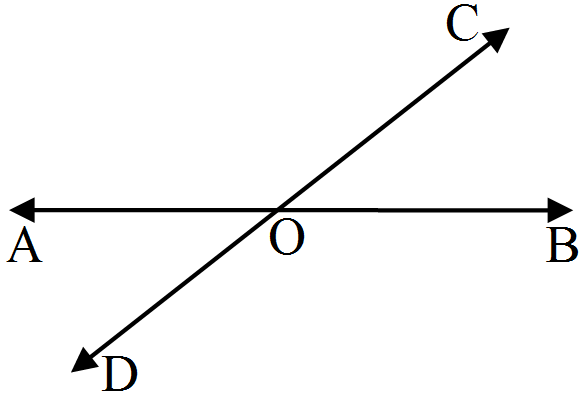
angles $\angle\text{BAC}$ and $\angle\text{DAC}$ are aupplementary angles.
If $x + y = 180^\circ $.

Example $1$: Angles of measure $50^\circ$ and $130^\circ $ are supplementary angles, because
$50^\circ + 130^\circ = 180^\circ $
Example $2$: Angles of measure $60^\circ$ and $120^\circ $ are supplementary angles, because
$60^\circ + 120^\circ = 180^\circ $
View full question & answer
Question 93 Marks
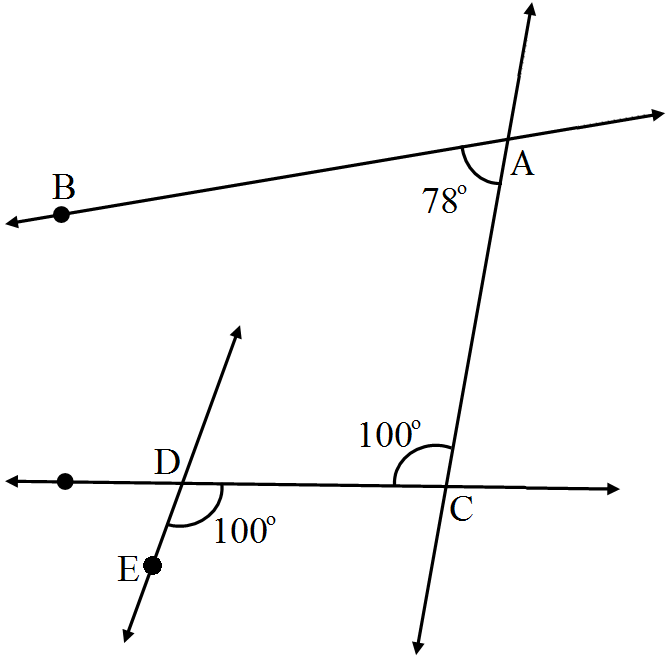
In figure, state Which lines are parallel and why.
Answer
Vertically opposite angles are equal
$\Rightarrow\ \angle\text{EOC}=\angle\text{DOK}=100^\circ$
$\Rightarrow\ \angle\text{DOK}=\angle\text{ACO}=100^\circ$
Here two lines $EK$ and $CA$ cut by a third line and the corresponding angles to it are equal Therefore, $EK\ ||\  AC$.
View full question & answer
Question 103 Marks
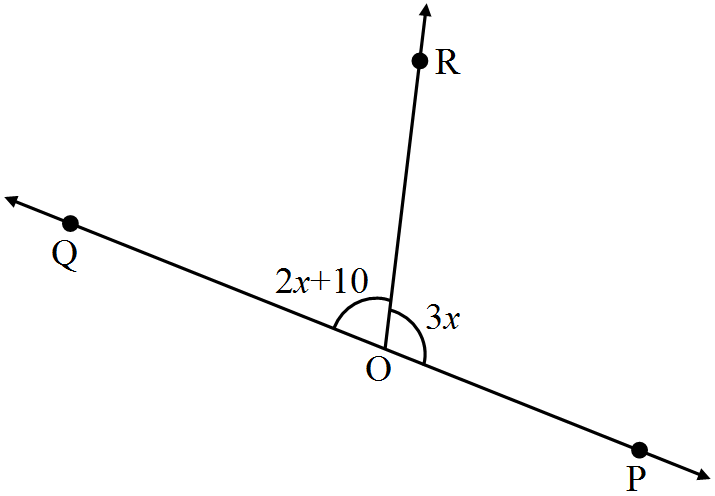
Given $\angle\text{POR}=3\text{x}$ and $\angle\text{QOR}=2\text{x}+10,$ Find the value of $x$ for which $POQ$ will be a line. (Figure $10.41$).
Answer
For the case that $POR$ is a line $\angle\text{POR}$ and $\angle\text{QOR}$ are linear parts $\angle\text{POR}+\angle\text{QOR}=180^\circ$
Also, given that, $\angle\text{POR}=3\text{x}$ and $\angle\text{QOR}=2\text{x}+10$
 $2x + 10 + 3x = 180$
$5x + 10 = 180 $
$5x = 180 - 10 $
$5x = 170 x $
$​​​​​​​= 34$
Hence the value of $x$ is $34^\circ $
View full question & answer
Question 113 Marks
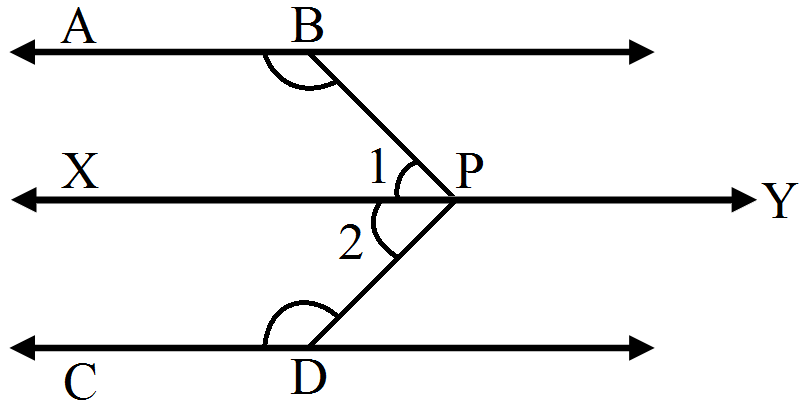
In figure, $AB\ ||\ CD$ and $P$ is any point shown in the figure. Prove that: $\angle\text{ABP}+\angle\text{BPD}+\angle\text{CDP}=360^\circ$
Answer
The given figure is as follows:

It is give that $AB || CD$ Let us draw a line $XY$ passing through point $P$ and parallel to $AB$ and $CD$.
We have $XY\ ||\ CD$, thus, $\angle\text{CDP}$ and $\angle{2}$ are consecutive interior angles.
Therefore, $\angle{2}+\angle\text{CDP}=180^\circ\dots(\text{i})$
Similarly, we have $XY\ ||\ AB$, thus, $\angle\text{ABP}$ and $\angle{1}$ are consecutive interior angles.
​​​​​​​Therefore, $\angle{1}+\angle\text{ABP}=180^\circ\dots(\text{ii})$ On adding equation $(i)$ and $(ii)$, we get: $\angle{2}+\angle\text{CDP}+\angle{1}+\angle\text{ABP}=180^\circ+180^\circ$ $(\angle{2}+\angle{1})+\angle\text{CDP}+\angle\text{ABP}=360^\circ$ $\angle\text{ABP}+\angle\text{BPD}+\angle\text{CDP}=360^\circ$ Hence proved.
View full question & answer
Question 123 Marks
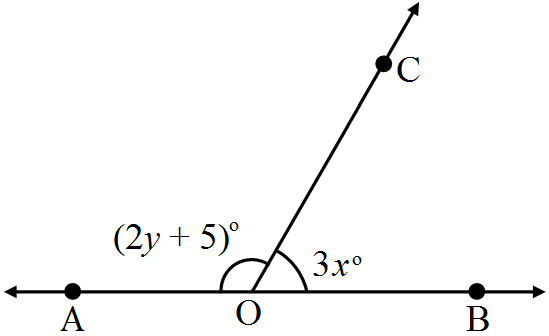
In figure, $OA$ and $OB$ are opposite rays: If $x = 25^\circ $, what is the value of $y$?
Answer
Given that, $x = 25$ Since $\angle\text{AOC}$ and $\angle\text{BOC}$ form a linear pair $\angle\text{AOC}+\angle\text{BOC}=180^\circ$
Given that $\angle\text{AOC}=2\text{y}+5$ and $\angle\text{BOC}=3\text{x}$
$\angle\text{AOC}+\angle\text{BOC}=180^\circ$
$(2y + 5) + 3x $
$= 180 (2y + 5) + 3(25) $
$= 180 2y + 5 + 75$
$ = 180 2y + 80$
$ = 180 2y $
$= 180 - 80 $
$= 100$
$\text{y}=\frac{100}{2}$ $y = 50$
View full question & answer
Question 133 Marks
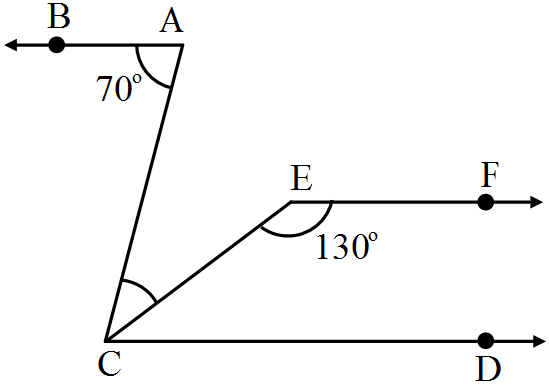
If figure, if $AB\ ||\ CD$ and $CD\ ||\ EF$, find $\angle\text{ACE}.$
Answer
Since $EF\ ||\ CD$
Therefore, $EFC + ECD = 180$ [Co-interior angles are supplementary]
$\Rightarrow ECD = 180 - 130 = 50$
Also $BA\ ||\ CD$
$\Rightarrow BAC = ACD = 70$ [alternative angles] But,
$ACE + ECD = 70 $
$\Rightarrow ACE = 70 - 50 = 20$
View full question & answer
Question 143 Marks
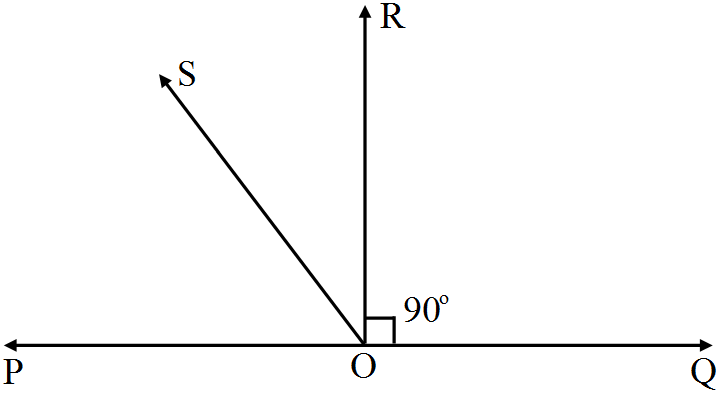
In figure $POQ$ is a line. Ray $OR$ is perpendicular to line $PQ$. $OS$ is another ray lying between rays $OP$ and $OR$. Prove that $\angle\text{ROS}=\frac{1}{2}(\angle\text{QOS}-\angle\text{POS}).$
Answer
Given that OR perpendicular $\therefore\angle\text{POR}=90^\circ$
$\angle\text{POS}+\angle\text{SOR}=90$
$[\therefore\angle\text{POR}=\angle\text{POS}+\angle\text{SOR}]$
$\angle\text{ROS}=90^\circ-\angle\text{POS}\dots(1)$
$\angle\text{QOR}=90$
$(\because\text{OR}\perp\text{PQ})$
 $\angle\text{QOS}-\angle\text{ROS}=90^\circ$
$\angle\text{ROS}=\angle\text{QOS}-90^\circ\dots(2)$ By adding $(1)$ and $(2)$ equations,
we get: $\therefore\ \angle\text{ROS}=\angle\text{QOS}-\angle\text{POS}$
$\angle\text{ROS}=\frac{1}{2}(\angle\text{QOS}-\angle\text{POS})$
View full question & answer
Question 153 Marks
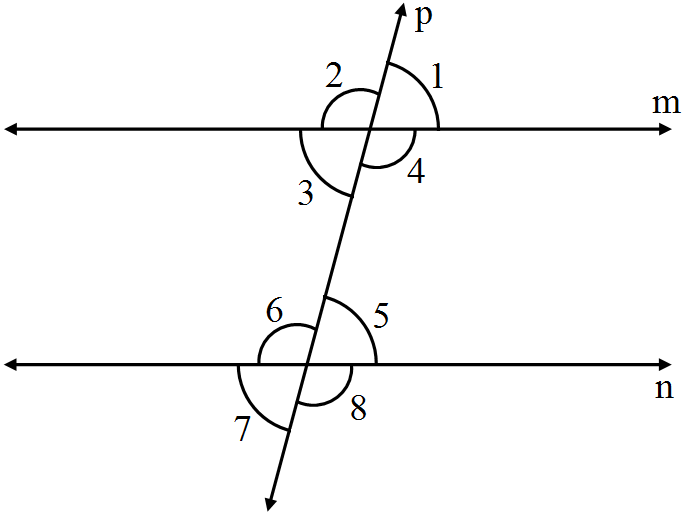
In figure, $p$ is a transversal to lines $m$ and $n$, $\angle{2}=120^\circ$and $\angle{5}=60^\circ.$Prove that $m\ ||\ n$.
Answer
Given that
$\angle{2}=120^\circ$ and $\angle{5}=60^\circ.$
To prove,
$\angle{2}+\angle{1}=180^\circ$ [Linear pair]
$120+\angle{1}=180^\circ$
$\angle{1}=180-120$
$\angle{1}=60^\circ$
Since $\angle{1}=\angle{5}=60^\circ$
Therefore, $m\ ||\ n$. [As pair of corresponding angles are equal]
View full question & answer
Question 163 Marks
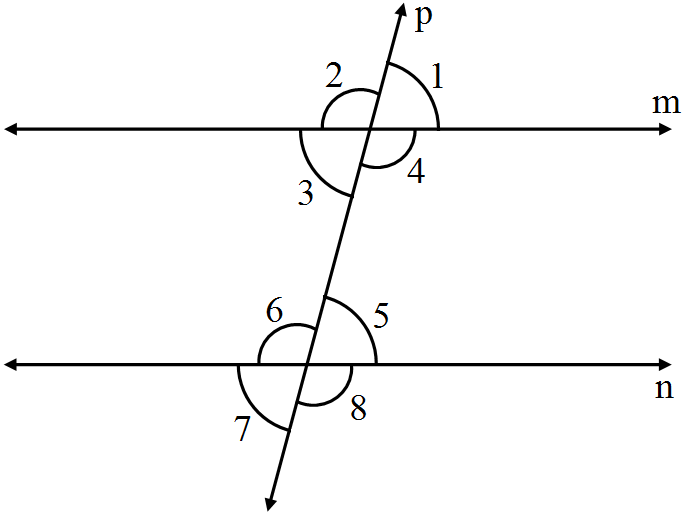
In figure transversal $l$ intersects two lines $m$ and $n$, $\angle{4}=110^\circ$ and $\angle{7}=65^\circ.$ Is $m\ ||\ n$?
Answer
Given: $\angle{4}=110^\circ$and $\angle{7}=65^\circ.$
To find: is $m\ ||\ n$ Here, $\angle{7}=\angle{5}=65^\circ$ [Vertically opposite angle]
Now, $\angle{4}+\angle{5}=110+65=175^\circ$
Therefore, $m$ is not parallel to $n$ as the pair of co interior angles is not supplementary.
View full question & answer
Question 173 Marks
If the complement of an angle is equal to the supplement of the thrice of it. Find the measure of the angle.
Answer
Let the measure of the angle be $x^\circ $.
Its complement will be $(90^\circ - x^\circ )$ and its supplement will be $(180^\circ - x^\circ )$.
Supplement of thrice of the angle $= (180^\circ - 3x^\circ )$
According to the given information:
$(90^\circ - x^\circ ) = (180^\circ - 3x^\circ )$
$3x - x = 180 - 90$
$2x = 90$
$x = 45$
Thus, the measure of the angle is $45^\circ $.
The measure of the angle is $45^\circ $.
View full question & answer
Question 183 Marks
In figure, $PQ\ ||\ AB$ and $PR\ ||\ BC$. If $\angle\text{QPR}=102^\circ,$ determine $\angle\text{ABC}.$ Give reasons.
Answer
$AB$ is produce to meet $PR$ at $K$ Since $PQ\ ||\ AB$
$\angle\text{QPR}=\angle\text{BKR}=102^\circ$[corresponding angles]
Since $PR\ ∥\ BC$ $\angle\text{RKB}+\angle\text{CBK}=180^\circ$[Since Corresponding angles are supplementary]
$\angle\text{CKB}=180-102=78$
$\therefore\ \angle\text{CKB}=78^\circ$
View full question & answer
Question 193 Marks
$AB, CD$ and $EF$ are three concurrent lines passing throught the point $O$ such that $OF$ bisects $\angle\text{BOD}.$ If $\angle\text{BOF}=35^\circ,$ find $\angle\text{BOC}$ and $\angle\text{AOD}.$
Answer

$\angle\text{BOF}=35^\circ$ $\therefore\angle\text{BOD}=2\angle\text{BOF}=70^\circ$
$[\because$ $OF$ bisects $\angle\text{BOD}]$
$\angle\text{BOD}=\angle\text{AOC}=70^\circ$ [vertically opposite angles]
Now, $\angle\text{BOC}+\angle\text{AOC}=180^\circ$ [linear pair]
$\Rightarrow\ \angle\text{BOC}+70^\circ=180^\circ$
$\Rightarrow\ \angle\text{BOC}=110^\circ$
$\therefore\ \angle\text{AOD}=\angle\text{BOC}=110^\circ$ [vertically opposite angles]
View full question & answer
Question 203 Marks
In figure if $l\ ||\ m, n∥p$ and $\angle\text{1}=85^\circ,$ find $\angle{2}.$
Answer
Corresponding angles are equal
$\Rightarrow\ \angle{1}=\angle{3}=85^\circ$
By using the property of co-interior angles are supplementary
$\angle{2}+\angle{3}=180^\circ$
$\angle{2}+55=180^\circ$
$\angle{2}=180-85$
$\angle{2}=95^\circ$
View full question & answer
Question 213 Marks
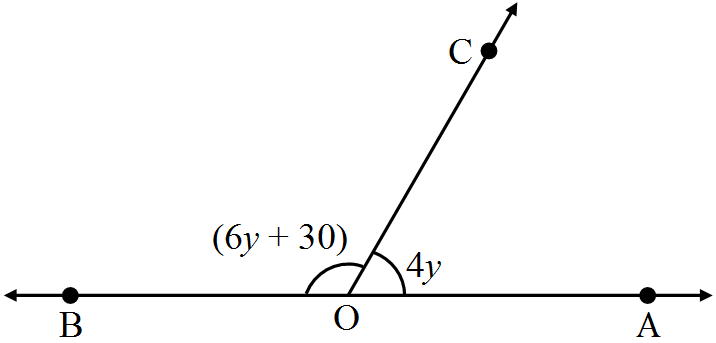
What value of $y$ would make $AOB$ a line in the below figure, If $\angle\text{AOC}=4\text{y}$ and $\angle\text{BOC}=(6\text{y}+30)?$
Answer
Since, $\angle\text{AOC}$ and $\angle\text{BOC}$ are linear pairs $\angle\text{AOC}+\angle\text{BOC}=180^\circ$
$6y + 30 + 4y = 180\ 10y + 30 = 180\ 10y = 180 - 30\ 10y = 150$ $\text{y}=\frac{150}{10}$ y = 15
Hence value of $y$ that will make $AOB$ a line is $15^\circ$ .
View full question & answer
Question 223 Marks
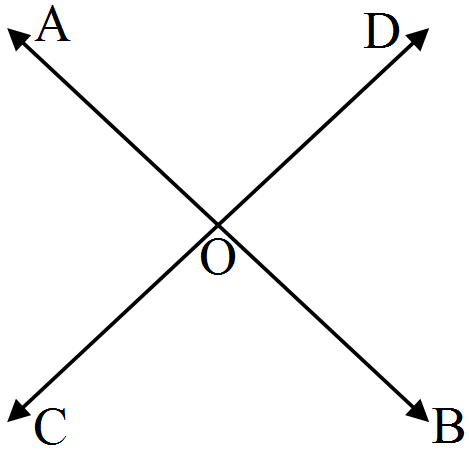
How many pairs of adjacent angles are formed when two lines intersect in a point?
Answer
Let us draw the following diagram showing two lines $AB$ and $CD$ intersecting at a point $O$.

We have the following pair of adjacent angles,
so formed: $\angle\text{AOC}$ and $\angle\text{BOC}$
$\angle\text{AOC}$ and $\angle\text{AOD}$
$\angle\text{BOD}$ and $\angle\text{BOC}$
$\angle\text{BOD}$ and $\angle\text{AOD}$
Hence, in total four pair of adjacent angles are formed.
View full question & answer
Question 233 Marks
An angle is equal to five times its complement. Determine its measure.
Answer
Let the complement of the required angle measures $x^\circ$ .
Therefore, the required angle becomes $5x^\circ $.
Since, the angles are complementary.
Thus, their sum must be equal to $90^\circ $.
Or we can say that : $x + 5x = 90^\circ 6x = 90^\circ $ $\text{x}=\frac{90^\circ}{6}$ $x = 15^\circ $
Hence, the required angle becomes: $5x = 5(15^\circ ) = 75^\circ $.
View full question & answer
Question 243 Marks
An angle is equal to its supplement. Determine its measure.
Answer
Let the supplement of the angle be $x^\circ$ .
According the given statement, the required angle is equal to its supplement, therefore, the required angle becomes $x^\circ$ .
 Sine both the angles are supplementary, therefore, their sum must be equal to $180^\circ$ .
Or we can say that: $x + x = 180^\circ$ $2x = 180^\circ$ $\text{x}=\frac{180^\circ}{2}$$ x = 90^\circ$
Hence, the required angle measures $90^\circ$ .
View full question & answer
Question 253 Marks
Two lines $AB$ and $CD$ intersect at $O$. If $\angle\text{AOC}+\angle\text{COB}+\angle\text{BOD}=270^\circ,$ find the measure of $\angle\text{AOC},\angle\text{COB},\angle\text{BOD}$ and $\angle\text{DOA}.$
Answer

Given: $\angle\text{AOC}+\angle\text{COB}+\angle\text{BOD}=270^\circ$
To find: $\angle\text{AOC},\angle\text{COB},\angle\text{BOD},\angle\text{DOA}$
Here, $\angle\text{AOC},\angle\text{COB},\angle\text{BOD}=270^\circ$[Complete angle]
$\Rightarrow 270 + AOD = 360 $
$\Rightarrow AOD = 360 - 270$
$ \Rightarrow AOD = 90$
Now, $AOD + BOD = 180$ [Linear pair]
$90 + BOD = 180 $
$\Rightarrow BOD = 180 - 90$
$ \Rightarrow BOD = 90 AOD = BOC = 90$ [Vertically opposite angles]
$BOD = AOC = 90$ [Vertically opposite angles]
View full question & answer
Question 263 Marks
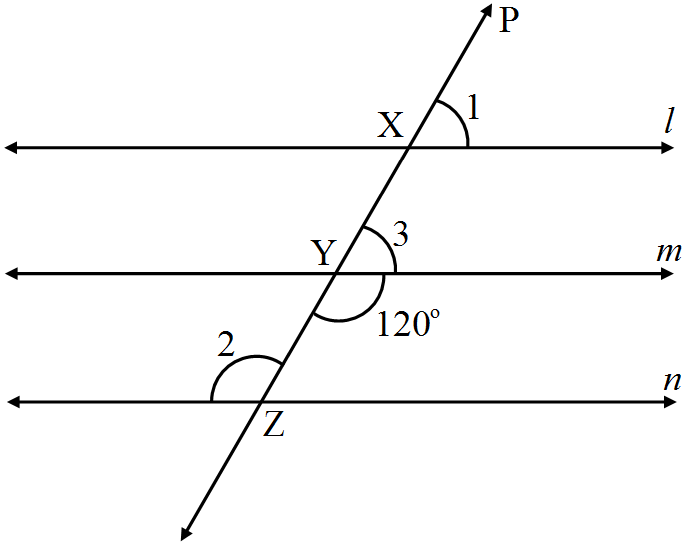
In figure, $l, m$ and $n$ are parallel lines intersected by transversal $p$ at $X. Y$ and $Z$ respectively. Find $\angle\text{1},\angle\text{2}$ and $\angle\text{3}.$
Answer
From the given figure:
$\angle\text{3}+\angle\text{myz}=180^\circ$ [Linear pair]
$\Rightarrow\ \angle{3}=180-120$
$\Rightarrow\ \angle3=60^\circ$
Now line $I$ parallel to $m$
$\angle{1}=\angle{3}$ [Corresponding angles]
$\angle{1}=60^\circ$
Also $m$ parallel to $n$
$\Rightarrow\ \angle{2}=120^\circ$ [Alternative interior angle]
Hence,
$\angle{1}=\angle{3}=60^\circ$
$\angle{2}=120^\circ$
View full question & answer
Question 273 Marks
In figure, lines $AB$ and $CD$ intersect at $O$. If $\angle\text{AOC}+\angle\text{BOE}=70^\circ$ and $\angle\text{BOD}=40^\circ,$ find $\angle\text{BOE}$ and reflex $\angle\text{COE}.$
Answer
In the figure, $\angle\text{AOC},\angle\text{BOE}$ and $\angle\text{COE} $ from a linear pair.
Thus,
$\angle\text{AOC}+\angle\text{BOE}+\angle\text{COE}=180^\circ$
It is given that $\angle\text{AOC}+\angle\text{BOE}=70^\circ,$
on substituting this value, we get:
$70^\circ+\angle\text{COE}=180^\circ$
$\angle\text{COE}=180^\circ-70^\circ$
$\angle\text{COE}=110^\circ$
Thus, reflex $\angle\text{COE}=360^\circ-110^\circ$
Therefore, reflex $\angle\text{COE}=250^\circ.$
View full question & answer
Question 283 Marks
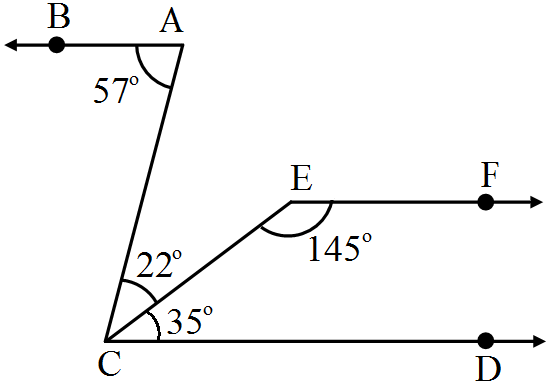
In figure, show that $AB\ ||\ EF$.
Answer
Produce $EF$ to intersect $AC$ at $K$.
Now, $\angle\text{DCE}+\angle\text{CEF}=35+145=180^\circ$
Therefore, $EF\ ||\ CD ... (1)$ [Since Sum of Co-interior angles is $180$]
Now, $\angle\text{BAC}=\angle\text{ACD}=57^\circ$ $\Rightarrow BA\ ||\ EF ... (2)$ [Alternative angles are equal]
From $(1)$ and $(2)$ $AB\ ||\ EF$ [Since, Lines parallel to the same line are parallel to each other] Hence proved.
View full question & answer