Questions

2 Marks Questions

Take a timed test

8 questions · self-marked practice — reveal the answer and mark yourself.

Question 12 Marks
In a parallelogram ABCD, if $\angle\text{D} = 115^\circ,$ then write the measure of $\angle\text{A.}$
Answer
In Parallelogram $ABCD , \angle A$ and $\angle D$ are Adjacent angles. We know that in a parallelogram, adjacent angles are supplementary. Now, $\angle A +\angle D =180^{\circ} \Rightarrow \angle A +115^{\circ}=180^{\circ} \Rightarrow \angle A =180^{\circ}-115^{\circ} \Rightarrow \angle A =65^{\circ}$ So, measure of $\angle A$ is $65^{\circ}$.
View full question & answer
Question 22 Marks
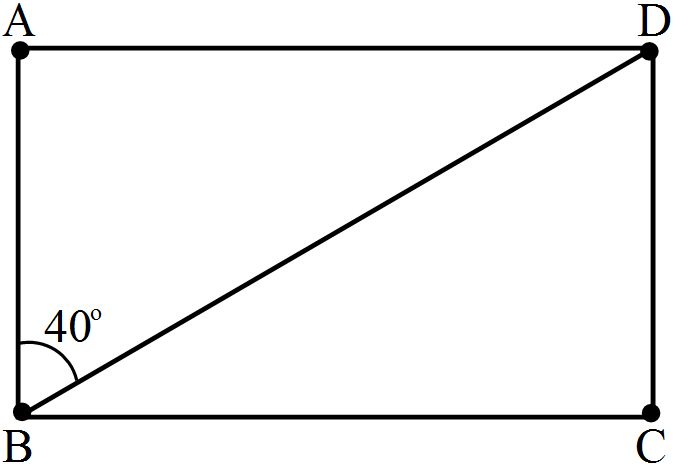
ABCD is a rectangle with $\angle\text{ABD}=40^\circ$. Determine $\angle\text{DBC}$.
Answer
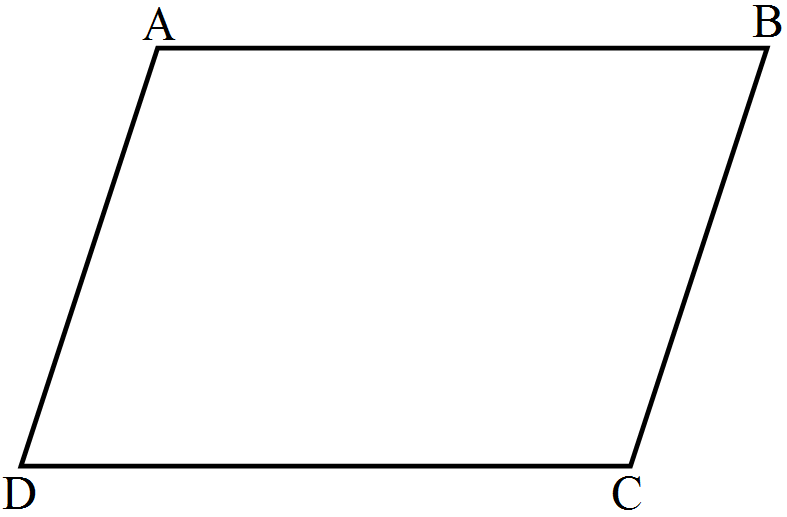
$\angle\text{ABC}=90^\circ$ $\Rightarrow\angle\text{ABD}+\angle\text{DBC}=90^\circ$ $\Rightarrow40^\circ+\angle\text{DBC}=90^\circ$ $\Rightarrow\angle\text{DBC}=50^\circ$
View full question & answer
Question 32 Marks
In a parallelogram $ABCD$, write the sum of angles $A$ and $B.$
Answer
In Parallelogram ABCD, $\angle\text{A}$ and $\angle\text{B}$ are adjacent angles. Thus, $AB \| DC$. Then, we have $\angle\text{A}$ and $\angle\text{B}$ as consecutive interior angles which must be supplementary. $\angle\text{A}+\angle\text{B}=180^\circ$ Hence, the sum of $\angle\text{A}$ and $\angle\text{B}$ is $180^\circ $.
View full question & answer
Question 42 Marks
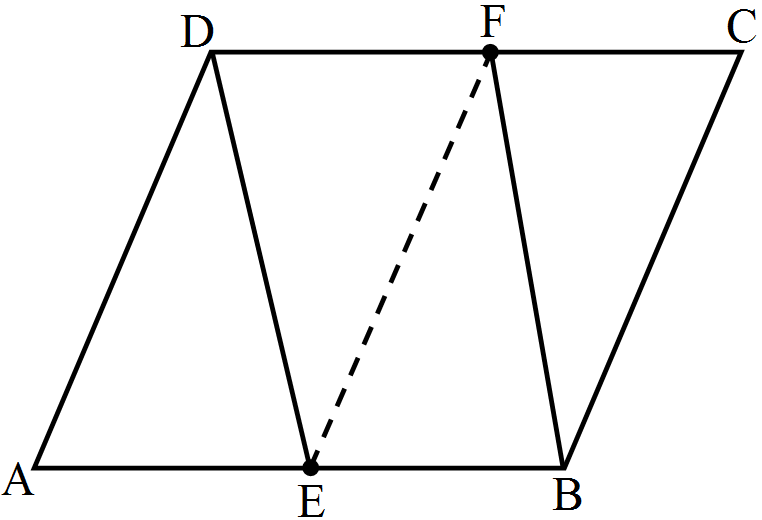
The sides $AB$ and $CD$ of a parallelogram $ABCD$ are bisected at $E$ and $F$. prove that $EBFD$ is a parellelogram.
Answer

Since is a parallelogram. therefore,
$AB \| DC$ and $AB = DC$
$\Rightarrow EB || DF$ and $\frac{1}{2}\text{AB}=\frac{1}{2}\text{DC}$
$\Rightarrow EB || DF$ and $EB = DF$
$\Rightarrow EBFB$ is a parallelogram.
View full question & answer
Question 52 Marks
In a parallelogram $ABCD$, determine the sum of angles $\angle\text{C}$ and $\angle\text{D}$.
Answer

$\angle\text{C}$ and $\angle\text{D}$ are cosecutive interior angles on the same side of the transversal $CD$. Therefore, $\angle\text{C}+\angle\text{D}=180^\circ$
View full question & answer
Question 62 Marks
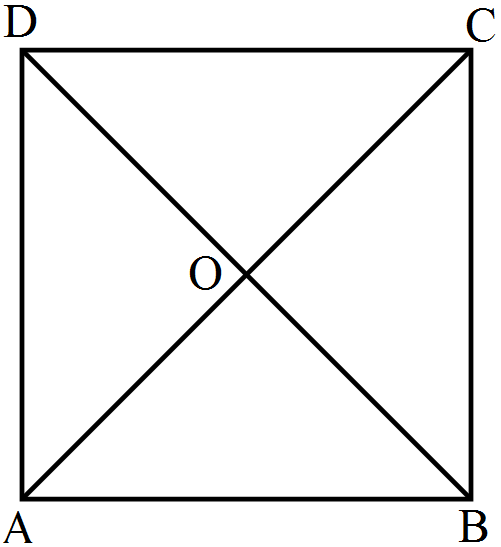
$A B C D$ is a square. $A C$ and $B D$ intersect at $O$. state the measure of $\angle A O B$.
Answer

Since, diagonals of a square bisect each other at right angle. Therefore, $\angle\text{AOB}=90^\circ$
View full question & answer
Question 72 Marks
In a parallelogram $ABCD$, if $\angle\text{B}=135^\circ,$ determine the measure of its other angles.
Answer
We have, $\angle \text{B}=135^\circ$
Since $ABCD$ is a parallelogram
$\therefore\angle\text{A}=\angle\text{C},\angle\text{B}=\angle\text{D}$ and $\angle\text{A}+\angle\text{B}=180^\circ$
$\Rightarrow\angle\text{A}+135^\circ=180^\circ$
$\Rightarrow\angle\text{A}=45^\circ$
$\Rightarrow\angle\text{A}=\angle\text{C}=45^\circ$ and $\angle\text{B}=\angle\text{D}=135^\circ$
View full question & answer
Question 82 Marks
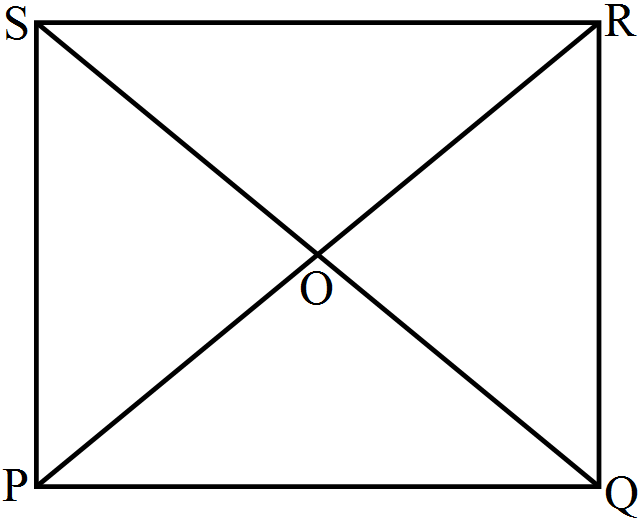
$PQRS$ is a square such that $PR$ and $SQ$ intersect at $O$. State the measure of $\angle\text{POQ.}$
Answer
$PQRS$ is a square given as:

Since the diagonals of a square intersect at right angle.
Therefore, the measure of $\angle\text{POQ}$ is $90^\circ .$
View full question & answer