Sample QuestionsQuadrilaterals questions
One sample from each question group in this chapter. Select any group above to see the full set with answer keys.
$ABCD$ is a parallelogram and $E$ is the mid-point of $BC$. $DE$ and $AB$ when produced meet at $F$. Then, $AF$ =
- A
$\frac{3}{2}\text{AB}$
- ✓
$2\text{AB}$
- C
$3\text{AB}$
- D
$\frac{5}{4}\text{AB}$
Answer: B.
View full solution →In a parallelogram $ABCD$, if $\angle\text{DAB}=75^\circ$ and $\angle\text{DBC}=60^\circ,$ then $\angle\text{BDC}=$
- A
$75^\circ $
- B
$60^\circ$
- ✓
$45^\circ$
- D
$55^\circ$
Answer: C.
View full solution →The figure formed by joining the mid-points of the adjacent sides of a quadrilateral is a:
Answer: A.
View full solution →In a rhombus $ABCD$, if $\angle\text{ACB}=40^\circ,$ then $\angle\text{ADB}=$
- A
$70^\circ$
- B
$45^\circ$
- ✓
$50^\circ$
- D
$60^\circ$
Answer: C.
View full solution →If an angle of a parallelogram is two-third of its adjacent angle, the smallest angle of the parallelogram is:
- A
$108^\circ$
- B
$54^\circ$
- ✓
$72^\circ$
- D
$81^\circ$
Answer: C.
View full solution →Which of the following statements are true $(T)$ and which are false $(F)?$ If all the angles of a quadrilateral are equal, it is a parallelogram.
View full solution →Which of the following statements are true $(T)$ and which are false $(F)?$ In a parallelogram, the diagonals intersect each other at right angles.
View full solution →Which of the following statements are true $(T)$ and which are false $(F)?$ In any quadrilateral, if a pair of opposite sides is equal, it is a parallelogram.
View full solution →Which of the following statements are true $(T)$ and which are false $(F)?$ In a parallelogram, the diagonals are equal.
View full solution →Which of the following statements are true $(T)$ and which are false $(F)?$ If three sides of a quadrilateral are equal, it is a parallelogram.
View full solution →Complete the following statements by means of one of those given in brackets against each: If one pair of opposite sides are equal and parallel, then the figure is _____________. (parallelogram, rectangle, trapezium).
Complete the following statements by means of one of those given in brackets against each: If in a quadrilateral only one pair of opposite sides are parallel, the quadrilateral is $........... ($square, rectangle, trapezium$).$
View full solution →Fill in the blanks to make the following statements correct: The figure formed by joining the mid-points of consecutive sides of a quadrilateral is $...........$
View full solution →Fill in the blanks to make the following statements correct: The triangle formed by joining the mid-points of the sides of an isosceles triangle is $...........$
View full solution →Complete the following statements by means of one of those given in brackets against each: If both pairs of opposite sides of a quadrilateral are equal, then it is necessarily a _________. (rectangle, parallelogram, rhombus).
In a parallelogram ABCD, if $\angle\text{D} = 115^\circ,$ then write the measure of $\angle\text{A.}$
View full solution →ABCD is a rectangle with $\angle\text{ABD}=40^\circ$. Determine $\angle\text{DBC}$.
View full solution →In a parallelogram $ABCD$, write the sum of angles $A$ and $B.$
View full solution →The sides $AB$ and $CD$ of a parallelogram $ABCD$ are bisected at $E$ and $F$. prove that $EBFD$ is a parellelogram.
View full solution →In a parallelogram $ABCD$, determine the sum of angles $\angle\text{C}$ and $\angle\text{D}$.
View full solution →In a parallelogram $ABCD$, $\angle \text{D}=135^\circ$. Determine the measures of $\angle\text{A}$ and $\angle\text{B}$.
View full solution →If the angles of a quadrilateral are in the ratio $3 : 5 : 9 : 13$, then find the measure of the smallest angle.
View full solution →Find the measure of all the angles of a parallelogram, if one angle is $24^\circ$ less than twice the smallest angle.
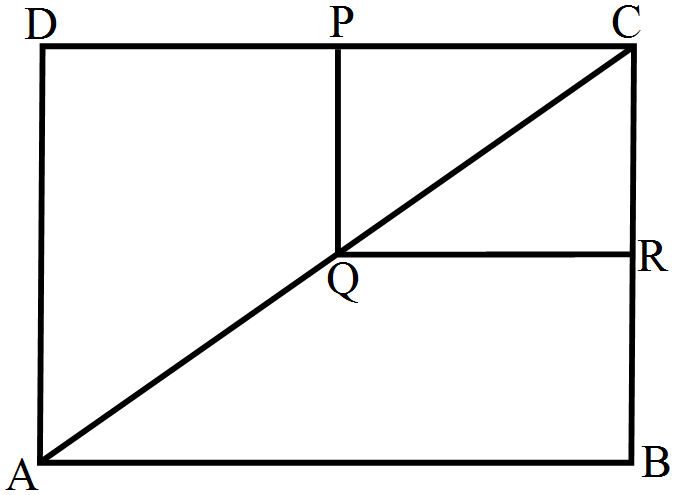
View full solution →In figure, $\text{ABCD}$ and $\text{PQRC}$ are rectangles and $Q$ is the mid$-$point of $AC$. Prove that
$i. DP = PC$
$ii. \text{PR}=\Big(\frac{1}{2}\Big)\text{AC}$
View full solution →Three angles of a quadrilateral are respectively equal to $110^\circ , 50^\circ $ and $40^\circ $. Find its fourth angle.
View full solution →In the given figure, $ABCD$ and $AEFG$ are two parallelograms. If $\angle\text{C}= 58^\circ,$ find $\angle\text{F}.$ 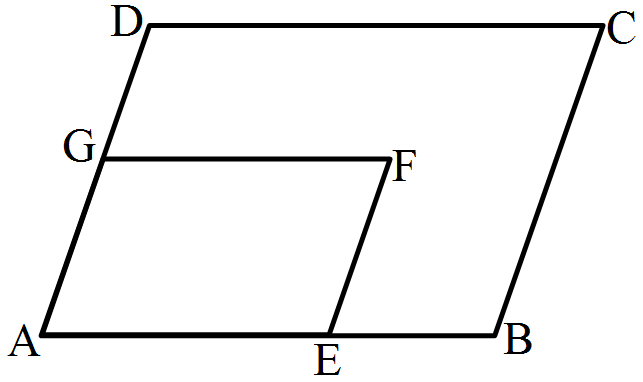
View full solution →In a $\triangle\text{ABC},$ $BM$ and $CN$ are perpendiculars from $B$ and $C$ respectively on any line passing through $A$. If $L$ is the mid-point of $BC$, prove that $ML = NL$.
View full solution →$ABCD$ is a kite having $AB = AD$ and $BC = CD$. Prove that the figure found by joining the mid points of the sides, in order, is a rectangle.
View full solution →In a triangle, $P, Q$ and $R$ are the mid points of sides $BC, CA$ and $AB$ respectively. If $AC = 21\ cm, BC = 29\ cm$ and $AB = 30\ cm$, find the perimeter of the quadrilateral $ARPQ$.
View full solution →If an angle of a parallelogram is two-third of its adjacent angle, find the angles of the parallelogram.