Questions

3 Marks Question

Take a timed test

15 questions · self-marked practice — reveal the answer and mark yourself.

Question 13 Marks
In a parallelogram $ABCD$, $\angle \text{D}=135^\circ$. Determine the measures of $\angle\text{A}$ and $\angle\text{B}$.
Answer
In a parallelogram $ABCD$ Adjacent angles are supplementary So,
$\angle\text{D}+\angle\text{C}=180^\circ$
$\angle\text{C}=180^\circ-135^\circ$
$\angle\text{C}=45^\circ$ In a parallelogram opposite sides are equal.
$\angle\text{A}=\angle\text{C}=45^\circ$
$\angle\text{B}=\angle\text{D}=135^\circ$
View full question & answer
Question 23 Marks
If the angles of a quadrilateral are in the ratio $3 : 5 : 9 : 13$, then find the measure of the smallest angle.
Answer
We have, $\angle\text{A}:\angle\text{B}:\angle\text{C}:\angle\text{D}=3:5:9:13.$
So, let $\angle\text{A}=3\text{x},$
$\angle\text{B}=5\text{x},$
$\angle\text{C}=9\text{x},$ and $\angle\text{D}=13\text{x},$
By angle sum property of a quadrilateral,
we get: $\angle\text{A}+\angle\text{B}+\angle\text{C}+\angle\text{D}=360$
$3x + 5x + 9x + 13x = 360\ 30x = 360$
$\text{x}=\frac{360}{3}$
$x = 12$smallest angle is: $\angle\text{A}=3\text{x},$
$\angle\text{A}=3(12^\circ)$
$\angle\text{A}=36^\circ$
Hence, the smallest angle measures $36^\circ$ .
View full question & answer
Question 33 Marks
Find the measure of all the angles of a parallelogram, if one angle is $24^\circ$ less than twice the smallest angle.
Answer
$x + 2x - 24 = 180^\circ $
$\Rightarrow 3x - 24 = 180^\circ $
$\Rightarrow 3x = 108^\circ + 24^\circ $
$\Rightarrow 3x = 204^\circ $
$\Rightarrow\text{x}=\frac{204}{3}=68^\circ$
$\Rightarrow x = 68^\circ $
$\Rightarrow 2x - 24^\circ = 2 \times 68^\circ - 24^\circ = 112^\circ $
Hence, four angles are $68^\circ , 112^\circ , 68^\circ , 112^\circ $.
View full question & answer
Question 43 Marks
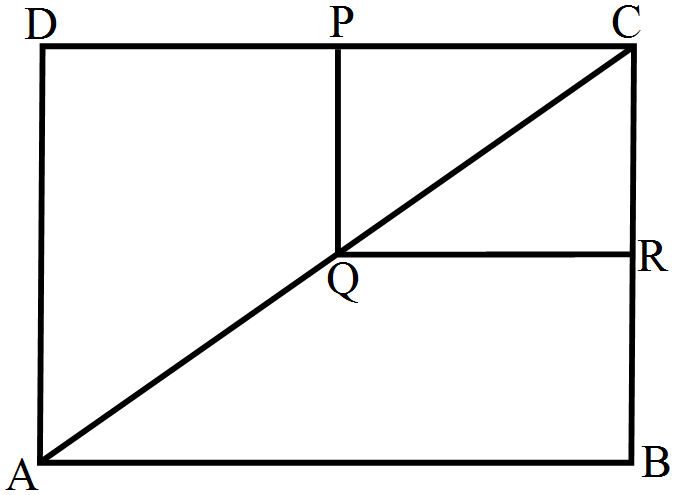
In figure, $\text{ABCD}$ and $\text{PQRC}$ are rectangles and $Q$ is the mid$-$point of $AC$. Prove that
$i. DP = PC$
$ii. \text{PR}=\Big(\frac{1}{2}\Big)\text{AC}$
Answer
$i.$ In $\triangle\text{ADC},$ $Q$ is the mid$-$point of $AC$ such that $PQ \| AD$
Therefore, $P$ is the mid$-$point of $DC$.
$\Rightarrow DP = DC [$Using mid$-$point theorem$]$
$ii.$ Similarly, $R$ is the mid$-$point of $BC$
$\therefore\text{PQ}=\Big(\frac{1}{2}\Big)\text{BD}$
$\text{PR}=\Big(\frac{1}{2}\Big)\text{AC} [$Diagonal of rectangle are equal, $BD = AC]$
View full question & answer
Question 53 Marks
Three angles of a quadrilateral are respectively equal to $110^\circ , 50^\circ $ and $40^\circ $. Find its fourth angle.
Answer
Given, Three angles are $110^\circ , 50^\circ $ and $40^\circ $
Let the fourth angle be $'x'$ We have,
Sum of all angles of a quadrilateral
$= 360^\circ 110^\circ + 50^\circ + 40^\circ = 360°$
$\Rightarrow x = 360^\circ - 200^\circ $
$ \Rightarrow x = 160^\circ $
 Therefore, the required fourth angle is $160^\circ$.
View full question & answer
Question 63 Marks
The angles of a quadrilateral are in the ratio $3 : 5 : 9 : 13$. Find all the angles of the quadrilateral.
Answer
Let the common ratio between the angles is $'t'$
So the angles will be $3t, 5t, 9t$ and $13t$ respectively.
Since the sum of all interior angles of a quadrilateral is $360^\circ$
Therefore, $3t + 5t + 9t + 13t = 360^\circ $
$\Rightarrow 30t = 360^\circ $
$\Rightarrow t = 12^\circ $
Hence, the angles are
$3t = 3 \times 12 = 36^\circ $
$5t = 5 \times 12 = 60^\circ $
$9t = 9 \times 12 = 108^\circ $
$13t = 13 \times 12 = 156^\circ $
View full question & answer
Question 73 Marks
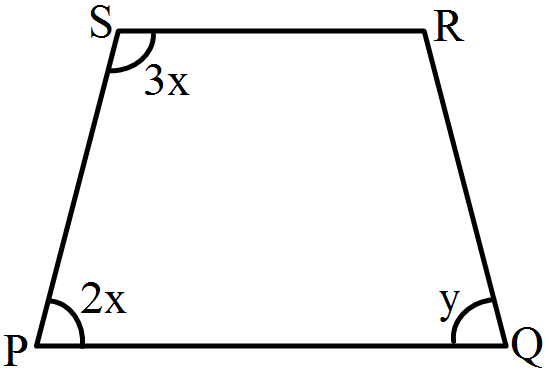
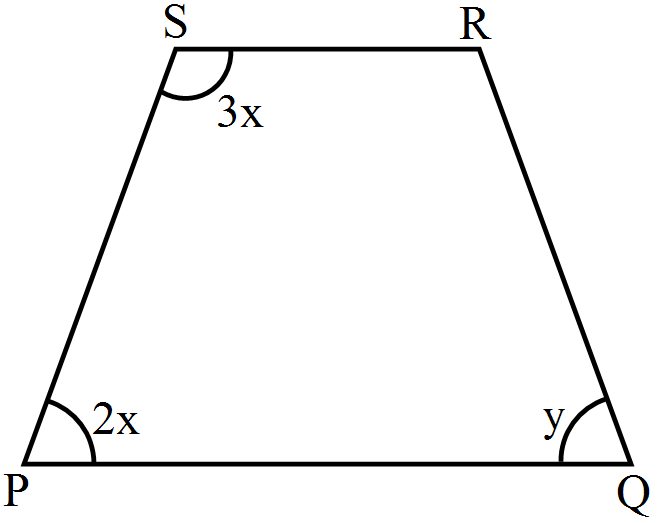
In the given figure, $PQRS$ is an isosceles trapezium. Find $x$ and $y$.
Answer
Trapezium is given as follows:

We know that $PQRS$ is a trapezium with $SR\ ||\ PQ$
Therefore, $\angle\text{P}+\angle\text{S}=180^\circ$
$2\text{x}+3\text{x}=108^\circ$
$5\text{x}=180^\circ$ $\text{x}=\frac{180^\circ}{5}$
$\text{x}=36^\circ$
Hence, the required value for $x$ is $36^\circ $.
View full question & answer
Question 83 Marks
The perimeter of a parallelogram is $22\ cm$. If the longer side measures $6.5\ cm$, what is the measure of shorter side?
Answer
Let the shorter side of the parallelogram be $x\ cm$.
The longer side is given as $6.5\ cm$.
Perimeter of the parallelogram is given as $22\ cm$ Therefore,
$2[x + 6.5] = 22 x + 6.5 $
$= 11 x = 11 - 65 x$
$= 4.5$
Hence, the measure of the shorter side is $4.5\ cm$.
View full question & answer
Question 93 Marks
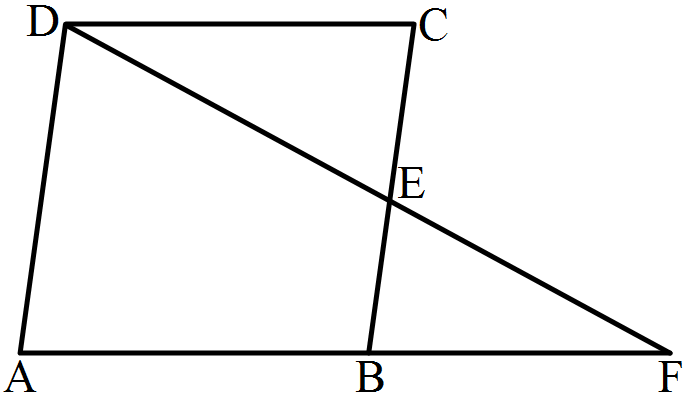
In figure, $ABCD$ is a parallelogram and $E$ is the mid-point of side $BC$. If $DE$ and $AB$ when produced meet at $F$, prove that $AF = 2AB$.
Answer
In $\triangle\text{BEF}$ and $\triangle\text{CED}$
$\angle\text{BEF}=\angle\text{CED}$ [Verified opposite angle]
$BE = CE$ [Since, $E$ is the mid-point of $BC$]
$\angle\text{EBF}=\angle\text{ECD}$ [Since, Alternate interior angles are equal]
$\therefore\triangle\text{BEF}\cong\triangle\text{CED}$ [ASA congruence]
$\therefore\text{BF}=\text{CD}\ [\text{CPCT}]$
$​​​​​​​AF = AB + AF AF = AB + AB AF = 2AB$. Hence proved.
View full question & answer
Question 103 Marks
$ABCD$ is a parallelogram in which $\angle\text{A}=70^\circ$ Compute $\angle\text{B},\angle\text{C}$ and $\angle\text{D}$.
Answer
In a parallelogram $ABCD$ $\angle\text{A}=70^\circ$
$\angle\text{A}+\angle\text{B}=180^\circ$ [Since, adjacent angles are supplementary]
$70^\circ+\angle\text{B}=180^\circ$
$[\because\angle\text{A}=70^\circ]$
$\angle\text{B}=1800-70^\circ$
$\angle\text{B}=110^\circ$ In a parallelogram opposite sides are equal.
$\angle\text{A}=\angle\text{C}=70^\circ$
$\angle\text{B}=\angle\text{D}=110^\circ$
View full question & answer
Question 113 Marks
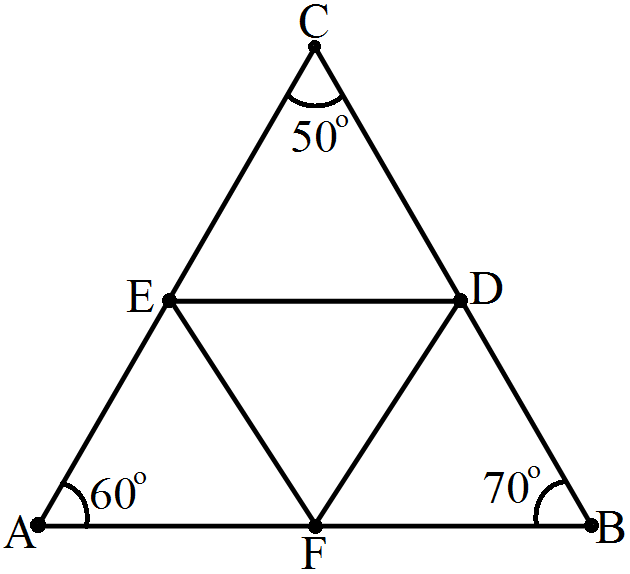
In a triangle $\angle\text{ABC},$ $\angle\text{A}=50^\circ,$ $\angle\text{B}=60^\circ$ andFind the measures of the angles of the triangle formed by joining the mid-points of the sides of this triangle.
Answer
In $\triangle\text{ABC},$

$D$ and $E$ are mid points of $AB$ and $BC$.
By Mid point theorem, $\text{DE}||\text{AC},\ \text{DE}=\frac{1}{2}\text{AC}$ $F$ is the midpoint of $AC$ Then,
 $\text{DE}=\Big(\frac{1}{2}\Big)\text{AC}=\text{CF}$ In a Quadrilateral $DECF$
$\text{DE}||\text{AC},\ \text{DE}=\text{CF}$
 Hence $DECF$ is a parallelogram.
$\therefore\angle\text{C}=\angle\text{D}=70^\circ$ [Opposite sides of a parallelogram]
Similarly $BEFD$ is a parallelogram, $\angle\text{B}=\angle\text{F}=60^\circ$ $ADEF$ is a parallelogram,
$\angle\text{A}=\angle\text{E}=50^\circ$
$\therefore$ Angles of $\triangle\text{DEP}$ are: $\angle\text{D}=70^\circ,\angle\text{E}=50^\circ,\angle\text{F}=60^\circ$
View full question & answer
Question 123 Marks
In a quadrilateral $ABCD$, the angles $A, B, C$ and $D$ are in the ratio of $1 : 2 : 4 : 5.$ Find the measure of each angles of the quadrilateral.
Answer
Let the angles of the quadrilaterals be $A=x, B=2 x, C=4 x$ and $D=5 x$
Then, $A + B + C + D = 360^\circ$
$\Rightarrow x + 2x + 4x + 5x = 360^\circ$
$\Rightarrow 12x = 360^\circ$
$\Rightarrow\text{x} = \frac{360^\circ}{12}$
$\Rightarrow x = 30^\circ​​​​​​​$​​​​​​​
Therefore, $A=x=30^{\circ} B=2 x=60^{\circ} C =4 x=120^{\circ} D =5 x =150^{\circ}$
View full question & answer
Question 133 Marks
The perimeter of a parallelogram is $22\ cm$.If the longer side measures $6.5\ cm$ what is the measure of the shorter side?
Answer
Let the shorter side be $'x'$.
 Therefore, perimeter $= x + 6.5 + 6.5 + x$ [Sum of all sides]
$22 = 2(x + 6.5) 11 = x + 6.5 $
$\Rightarrow x = 11 - 6.5 = 4.5\ cm$
Therefore, shorter side $= 4.5\ cm$
View full question & answer
Question 143 Marks
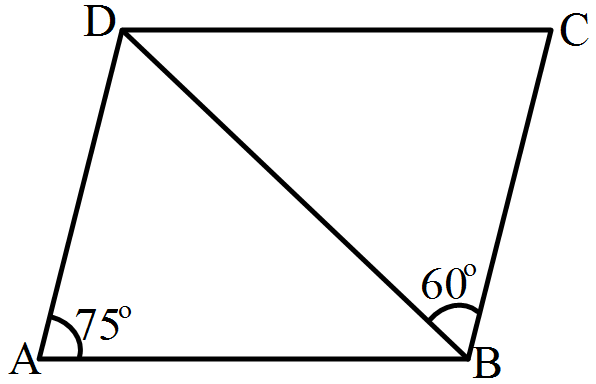
In figure, $ABCD$ is a parallelogram in which $\angle\text{DAB}=75^\circ$ and $\angle\text{DBC}=60^\circ$.
Compute $\angle\text{CDB},$ and $\angle\text{ADB}$.
Answer
To find $\angle\text{CDB}$ and $\angle\text{ADB}$
$\angle\text{CBD}=\angle\text{ABD}=60^\circ$ [Alternate interior angle. $AD∥ BC$ and $BD$ is the transversal] in $\angle\text{BDC}$
$\angle\text{CBD}+\angle\text{C}+\angle\text{CDB}=180^\circ$ [Angle sum property]
$\Rightarrow60^\circ+75^\circ+\angle\text{CDB}=180^\circ$
$\Rightarrow\angle=180^\circ-(60^\circ+75^\circ)$
$\Rightarrow\angle\text{CDB}=45^\circ$
Hence, $\angle\text{CDB}=45^\circ,\angle\text{ADB}=60^\circ$
View full question & answer
Question 153 Marks
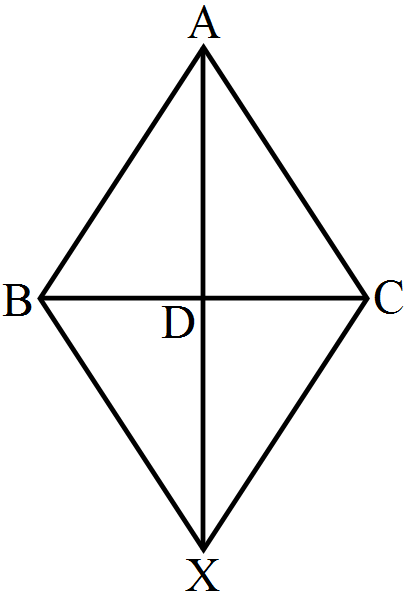
In a $\triangle\text{ABC}$ median $AD$ is produced to $x$ such that $AD = DX$. Prove that $ABXC$ is a parallelogram.
Answer

In a quadrilateral $ABXC$, we have $AD = DX$ [Given] $BD = DC$ [Given]
So, diagonals $AX$ and $BC$ bisect each other.
Therefore, $ABXC$ is a parallelogram.
View full question & answer
3 Marks Question - Maths STD 9 Questions - Vidyadip