Questions

3 Marks Question

Take a timed test

4 questions · self-marked practice — reveal the answer and mark yourself.

Question 13 Marks
$ABCD$ is a parallelogram in which $AB = 9.5\ cm$ and its perimeter is $30\ cm.$ Find the length of each side of the parallelogram.
Answer
Perimeter of a parallelogram $ABCD$
$= AB + BC + CD + DA$
$= 9.5 + BC + 9.5 + BC$
$[\therefore ABCD$ is a parrallelogram and its opposite sides are equal i.e. $AB = CD$ and $BC = DA]$
$30 = 19 + 2BC [$Perimeter $=30\ cm ($given$)]$
$⇒ 2BC = 30 - 19 = 11$
$⇒ BC =\frac{11}{2} = 5.5\ cm$
$\therefore AB = 9.5\ cm, BC = 5.5\ cm, CD = 9.5\ cm, DA = 5.5\ cm.$
View full question & answer
Question 23 Marks
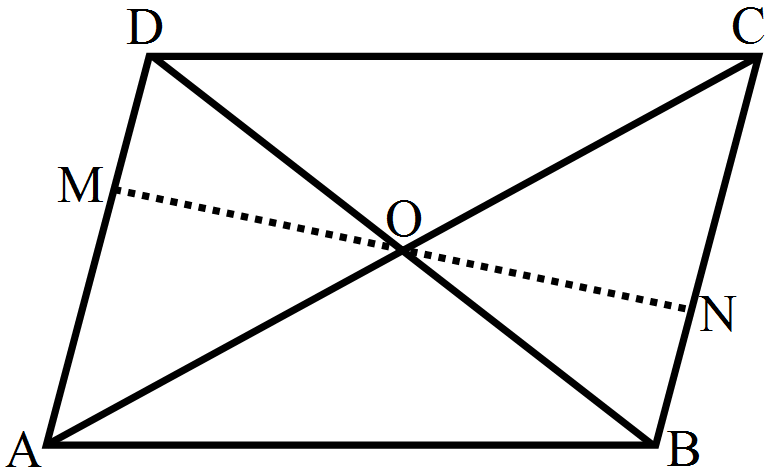
$M$ and $N$ are points on opposite sides $AD$ and $BC$ of a parallelogram $ABCD$ such that $MN$ passes through the point of intersection $O$ of its diagonals $AC$ and $BD.$ Show that $MN$ is bisected at $O.$
Answer


In $\triangle\text{AOM}$ and $\triangle\text{CON}$
$\angle\text{MAO}=\angle\text{OCN} ($Alternate angles$)$
$\text{AO = OC} ($Diagonals of a parallelogram bisect each other$)$
$\angle\text{AOM}=\angle\text{CON} ($Vertically opposite angles$)$
$\therefore\triangle\text{AOM}\cong\triangle\text{CON} ($by $ASA$ congruence criterion$)$
$\Rightarrow\text{MO = NO} (C.P.C.T.)$
Thus, $MN$ is bisected at point $O.$
View full question & answer
Question 33 Marks
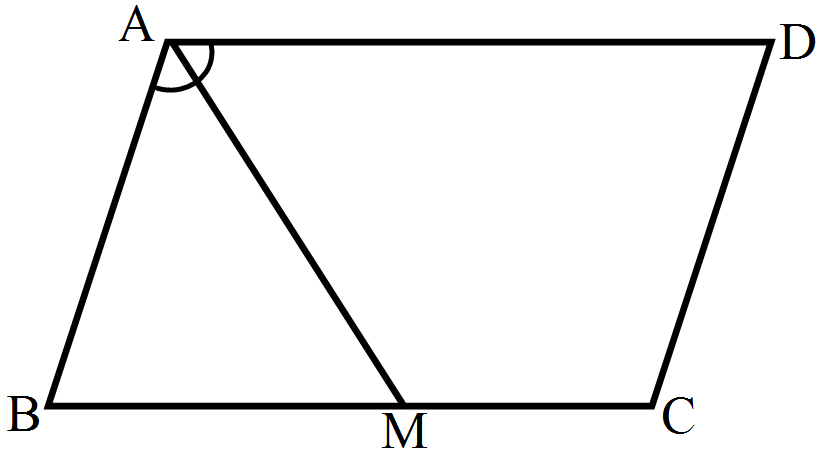
In the adjoining figure, $M$ is the midpoint of side $BC$ of a parallelogram $ABCD$ such that $\angle\text{BAM}=\angle\text{DAM}.$ Prove that $AD = 2CD.$
Answer
$ABCD$ is a parallelogram. Hence, $AD || BC.$
​​$\Rightarrow\angle\text{DAM}=\angle\text{AMB} ($alternate angles$)$
$\Rightarrow\angle\text{BAM}=\angle\text{AMB}$
$(\text{since }\angle\text{BAM} = \angle\text{DAM})$
$\Rightarrow\text{BM = AB} ($sides opposite to equal sides are equal$)$
But, $\text{AB = CD}$ Opposite sides of a parallelogram$)$
$\Rightarrow\text{BM = AB = CD}...(\text{i})$
Now, $\text{BM =}\frac{1}{2}\text{BC} (M$ is the mid-point of $BC)$
$\Rightarrow\text{BM}=\frac{1}{2}\text{AD}$
$\Rightarrow\text{CD}=\frac{1}{2}\text{AD} [$from $(i)]$
$\Rightarrow\text{AD}=2\text{CD}$
View full question & answer
Question 43 Marks
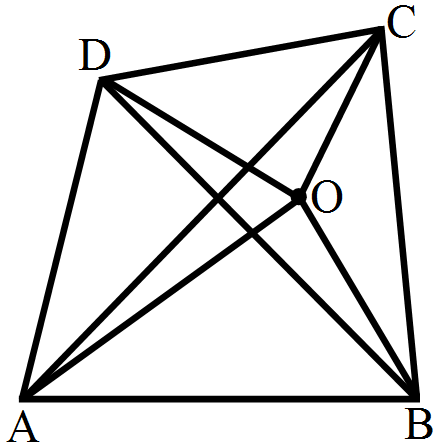
If $O$ is a point within a quadrilateral $ABCD,$ show that $OA + OB + OC + OD > AC + BD.$
Answer


Let $ABCD$ be a quadrilateral whose diagonals are $AC$ and $BD$ and $O$ is any point within the quadrilateral.
Join $O$ with $A, B, C,$ and $D.$
We know that the sum of any two sides of a triangle is greater than the third side.
So, in $\triangle\text{AOC,} OA + OC > AC$
Also, in $\triangle\text{BOD,}OB + OD > BD$
Adding these inequalities, we get:
$(OA + OC) + (OB + OD) > (AC + BD)$
$\Rightarrow OA + OB + OC + OD > AC + BD$
View full question & answer