Question 15 Marks
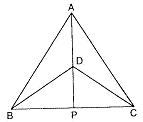
$\triangle ABC$ and $\triangle DBC$ are two isosceles triangles on the same base $BC$ and vertices $A$ and $D$ are on the same side of $BC$ . If $A D$ is extended to intersect $B C$ at $P$, show that :
$1. \triangle ABD \cong \triangle ACD$
$2. \triangle ABP \cong \triangle ACP$
$3. AP$ bisects $\angle A$ as well as $\angle D$
$4. AP$ is the perpendicular bisector of $BC.$
$1. \triangle ABD \cong \triangle ACD$
$2. \triangle ABP \cong \triangle ACP$
$3. AP$ bisects $\angle A$ as well as $\angle D$
$4. AP$ is the perpendicular bisector of $BC.$
Answer
View full question & answer→It is given in the question that:
$\triangle ABC$ and $\triangle DBC$ are two isosceles triangles
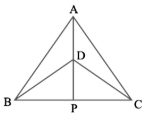
$i. \triangle ABC$ and $\triangle DBC$
$AD = AD ($Common$)$
$A B=A C ($Triangle $\text{ABC}$ is isosceles$)$
$B D=C D ($Triangle $\text{DBC}$ is isosceles$)$
By $\text{SSS}$ axiom,
$\triangle A B D \cong \triangle A C D$
$ii.$ In $\triangle A B P$ and $\triangle A C P$,
$AP = AP ($Common$)$
$\angle PAB =\angle PAC ($By $\text{c.p.c.t})$
$AB = AC ($Triangle $\text{DBC}$ is isoceles$)$
By $\text{SAS}$ axiom,
$\triangle A B P \cong \triangle A C P$
$iii. \angle PAB =\angle PAC (\text{c.p.c.t })$
$AP$ bisects $\angle A (i)$
Also,
In $\triangle B P D$ and $\triangle C P D$,
$PE = PD ($Common$)$
$B D=C D ($Triangle $\text{DBC}$ is isosceles$)$
$BP = CP (\triangle A B P \cong \triangle A C P$ so by $\text{c.p.c.t})$
By $\text{SSS}$ axiom,
$\triangle B P D \cong \triangle C P D$
Thus,
$\angle BDP=\angle CDP(\text { c.p.c.t })\text{(ii)}$
By $(i)$ and $(ii)$, we can say that $\angle A P$ bisects $\angle A$ as well as $D$
$iv. \angle BPD =\angle CPD ($ By $\text{c.p.c.t})$
And,
$B P=C P(i)$
Also, $\angle BPD =\angle CPD =180^{\circ}( BC$ is a straight line$)$
$2 \angle BPD=180^{\circ}$
$\angle B P D=90^{\circ} \text { (ii) }$
From $(i)$ and $(ii),$ we get
$A P$ is the perpendicular bisector of $B C$
$\triangle ABC$ and $\triangle DBC$ are two isosceles triangles
$i. \triangle ABC$ and $\triangle DBC$
$AD = AD ($Common$)$
$A B=A C ($Triangle $\text{ABC}$ is isosceles$)$
$B D=C D ($Triangle $\text{DBC}$ is isosceles$)$
By $\text{SSS}$ axiom,
$\triangle A B D \cong \triangle A C D$
$ii.$ In $\triangle A B P$ and $\triangle A C P$,
$AP = AP ($Common$)$
$\angle PAB =\angle PAC ($By $\text{c.p.c.t})$
$AB = AC ($Triangle $\text{DBC}$ is isoceles$)$
By $\text{SAS}$ axiom,
$\triangle A B P \cong \triangle A C P$
$iii. \angle PAB =\angle PAC (\text{c.p.c.t })$
$AP$ bisects $\angle A (i)$
Also,
In $\triangle B P D$ and $\triangle C P D$,
$PE = PD ($Common$)$
$B D=C D ($Triangle $\text{DBC}$ is isosceles$)$
$BP = CP (\triangle A B P \cong \triangle A C P$ so by $\text{c.p.c.t})$
By $\text{SSS}$ axiom,
$\triangle B P D \cong \triangle C P D$
Thus,
$\angle BDP=\angle CDP(\text { c.p.c.t })\text{(ii)}$
By $(i)$ and $(ii)$, we can say that $\angle A P$ bisects $\angle A$ as well as $D$
$iv. \angle BPD =\angle CPD ($ By $\text{c.p.c.t})$
And,
$B P=C P(i)$
Also, $\angle BPD =\angle CPD =180^{\circ}( BC$ is a straight line$)$
$2 \angle BPD=180^{\circ}$
$\angle B P D=90^{\circ} \text { (ii) }$
From $(i)$ and $(ii),$ we get
$A P$ is the perpendicular bisector of $B C$