Questions

3 Marks Question

Take a timed test

12 questions · self-marked practice — reveal the answer and mark yourself.

Question 13 Marks
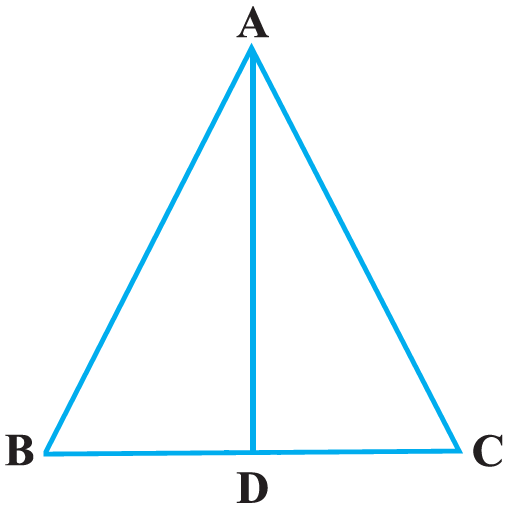
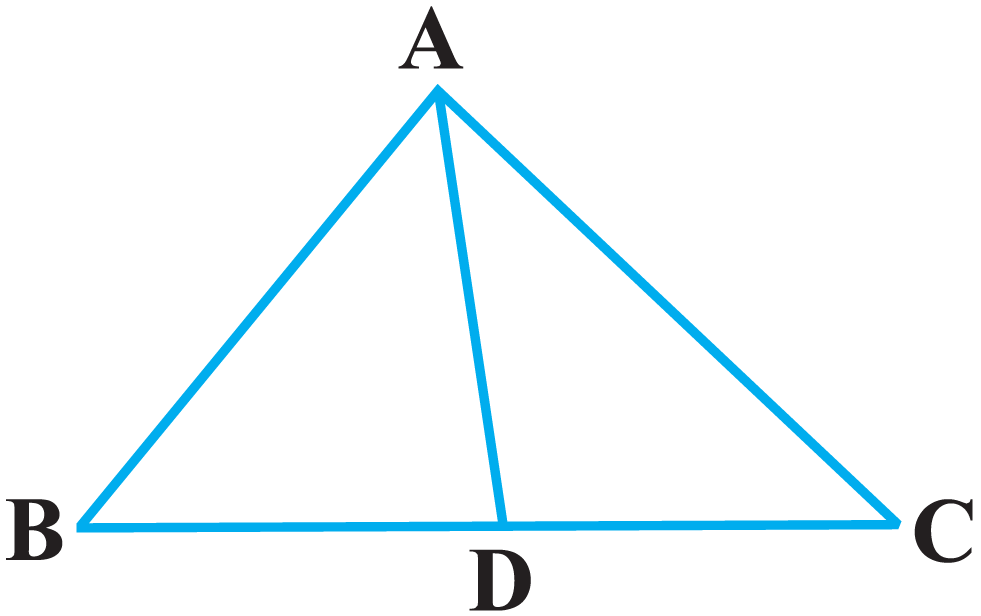
In following figure if $AD$ is the bisector of $\angle\text{BAC},$ then prove that $AB > BD.$
Answer
Given $ABC$ is a triangle such that $AD$ is the bisector of $\angle\text{BAC},$ To prove $AB > BD$ Since, $AD$ is the bisector of $\angle\text{BAC}.$ But $\angle\text{BAD}=\angle\text{CAD}\ ...(\text{i})$ $\therefore\angle\text{ADB} >\angle\text{CAD}$ A triangle is greater than of the opposite angle. $\text{AB}>\text{BD}$
View full question & answer
Question 23 Marks
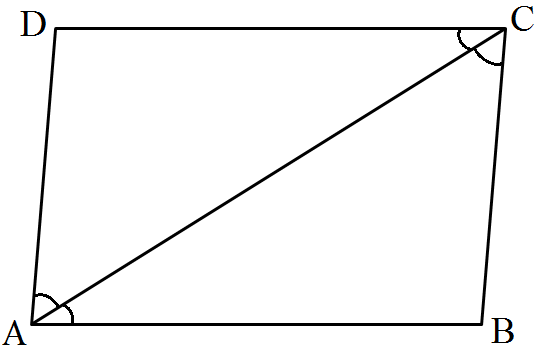
$ABCD$ is a quadrilateral such that diagonal $AC$ bisects the angles $A$ and $C$. Prove that $AB = AD$ and $CB = CD$.
Answer
Given in a quadrilateral $ABCD$, diagonal $AC$ bisects the angles $A$ and $C.$
​​​​​​​
To prove $\text{AB}=\text{CD}\ \text{ and }\text{CB}=\text{CD}$ Proof in $\triangle\ \text{ADC}\ \text{and}\ \triangle\ \text{ABC},$
$\angle\ \text{DAC}=\angle\ \text{BAC}$
$\big[\because$ AC is the bisector of $\angle\ \text{A}\ \text{and}\ \angle\ \text{C}\big]$
$\angle\ \text{DCA}=\angle\ \text{BCA}$
$\big[\because$ AC is the bisector of $\angle\ \text{A}\ \text{and}\ \angle\text{C}\big]$
$\text{and}\ \text{AC}=\text{AC}$ [common side]
$\therefore\ \triangle\text{ADC}\cong\triangle\text{ABC}$ [by$ASA$ congruence rule]
$\text{AD}=\text{AB}$ [by CPCT] $\text{and}\ \text{CD}=\text{CB}$ [by $CPCT$] Hence proved.
View full question & answer
Question 33 Marks
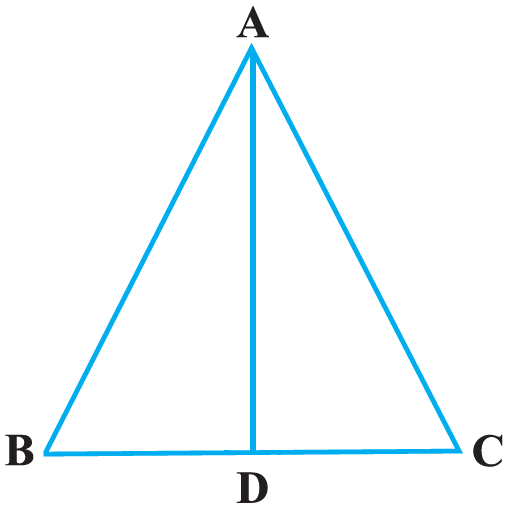
ABC is an isosceles triangle with $AB = AC$ and $D$ is a point on $BC$ such that $\text{AD}\perp\text{BC}$ (see figure). To prove that $\angle\text{BAD} = \angle\text{CAD},$ a student proceeded as follows:

In $\triangle\text{ABD}$ and $\triangle\text{ACD},$
$\text{AB}=\text{AC}$
$\angle\text{B}=\angle\text{C}$
$\angle\text{ADM}=\angle\text{ADC}$
$\therefore\triangle\text{ABD}\cong\triangle\text{ADC}$
$\angle\text{BAD}=\angle\text{CAD}$
What is the defect in the above arguments?
Answer
In $\triangle\text{ABC,}$
$\text{AB}=\text{AC}$
$\Rightarrow \angle\text{ACB}=\angle\text{ABC}$In $\triangle\text{ABD}$ and $\triangle\text{ACD},$
$\text{AB}=\text{AC}$
$\angle\text{ADB}=\angle\text{ACD}$
$\triangle\text{ABD}\cong\triangle\text{ACB}$
So, the defect in the given argument is that firstiy prove $\triangle\text{ABD}\cong\triangle\text{ACB}.$
View full question & answer
Question 43 Marks
Is it possible to construct a triangle with lengths of its sides as $4\ cm, 3\ cm$ and $7\ cm$? Give reason for your answer.
Answer
No, it is not possible to construct a triangle with lengths of its sides as $4\ cm, 3\ cm$ and $7\ cm$ because here we see that sum of the lengths of two sides is equal to third side i.e.,$ 4 + 3 = 7$ As we know that, the sum of any two sides of a triangle is greater than its third side, so given statement is not correct.
View full question & answer
Question 53 Marks
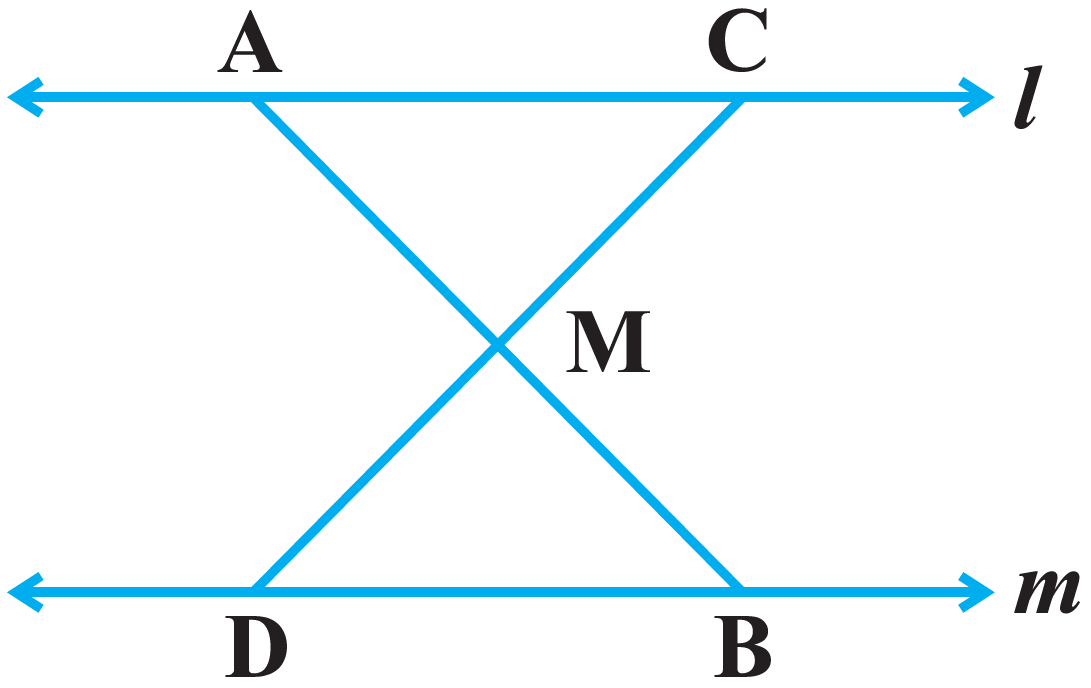
In given $\text{l}\ ||\ \text{m}$ and $M$ is the mid-point of a line segment $AB$. Show that $M$ is also the mid-point of any line segment $CD$, having its end points on $l$ and $m$, respectively.
Answer
Given in the $\text{l}\ ||\ \text{m}$ and $M$ is the mid-point of a line segment $AB. AM = BM. MC = MD$ $\text{l}\ ||\ \text{m}$ $\angle\text{BAC}=\angle\text{ABD}$ $\angle\text{AMC}=\angle\text{BMD}$ In $\triangle\text{AMC}$ and $\triangle\text{BMD,}$$\angle\text{BAC}=\angle\text{ABD}$
$\text{AM}=\text{BM}$ $\angle\text{AMC}=\angle\text{BMD}$ $\text{MC}=\text{MD}$
View full question & answer
Question 63 Marks
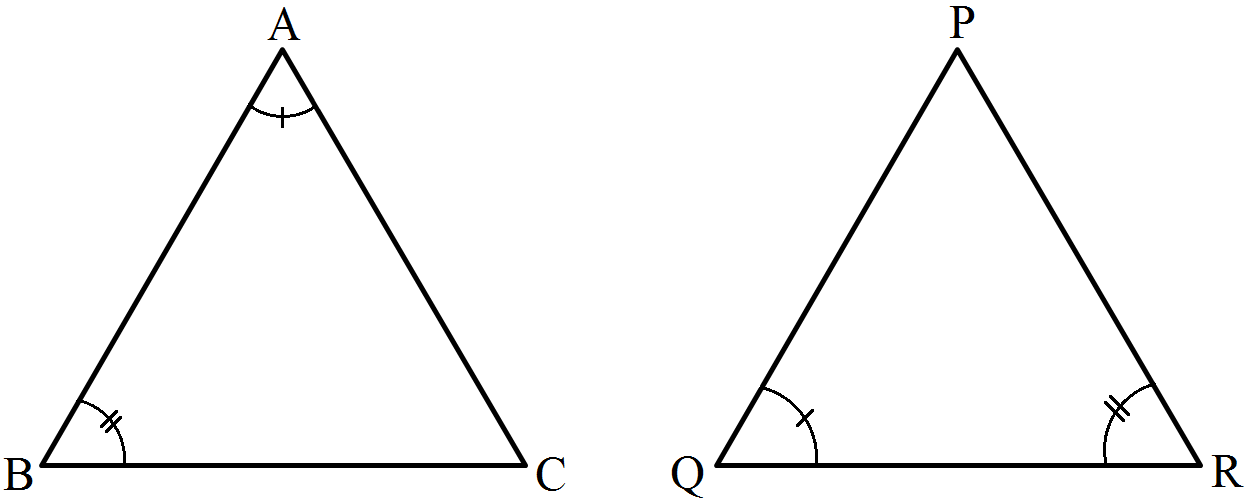
In $\triangle\text{PQR},\angle\text{A}=\angle\text{Q}$ and $\angle\text{B}=\angle\text{R}.$ Which side of should be equal to side AB of so, that the two triangles are congruent? Give reason for your answer.
Answer

In triangle $ABC$ and $PQR$, we have
$\angle\text{A}=\angle\text{Q}$
$\angle\text{B}=\angle\text{R}$
For the triangle to be congruent, we must $AB = QR$. They will be congruent by $ASA$ rule.
View full question & answer
Question 73 Marks
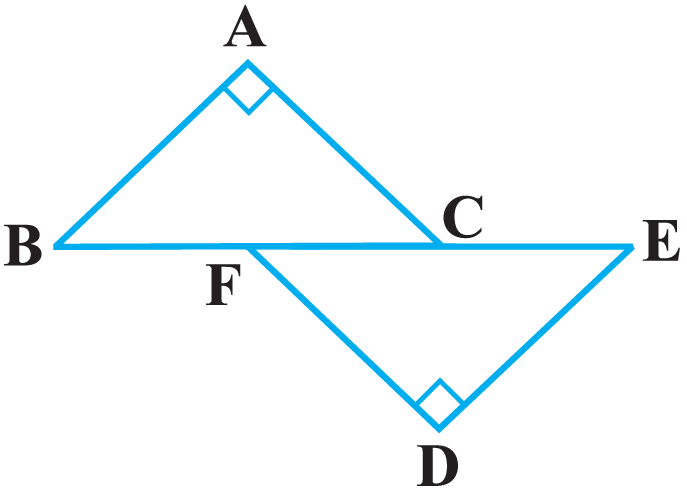
In $\text{BA}\perp\text{AC},\text{DE}\perp\text{DF}$ such that $BA = DE$ and $BF = EC$. Show that $\triangle\text{ABC}\cong\triangle\text{DEF.}$
Answer
Given, $\text{BA}\perp\text{AC},\text{DE}\perp\text{DF}$ such that $BA = DE and BF = EC$.$\triangle\text{ABC}\cong\triangle\text{DEF}$
$\text{BF}=\text{EC}$
On adding CF both sides, we have
$\text{BF}+\text{CF}=\text{EC}+\text{CF}$
$\text{BC}=\text{EF}$
In $\triangle\text{ABC}$ and $\triangle\text{DEF},$
$\angle\text{A}=\angle\text{D}=90^{\circ}$
$\text{BA}=\text{DE}$
$\triangle\text{ABC}\cong\triangle\text{DEF}$
View full question & answer
Question 83 Marks
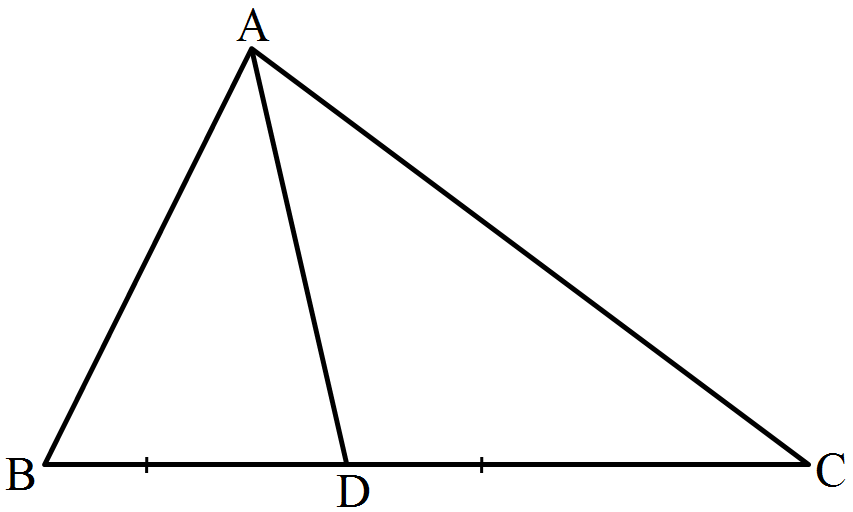
$AD$ is a median of the $\triangle\text{ABC}.$ Is it true that $AB + BC + CA > 2AD?$ Give reason for your answer.
Answer

In $\triangle\text{ABD,}$ we have $\text{AB}+\text{BD}>\text{AD}\ ....(\text{i})$ In $\triangle\text{ACD,}$
we have $\text{AC}+\text{CD}>\text{AD}\ ...(\text{ii})$ On adding eq.$(i)$ and $(ii),$
$\Rightarrow(\text{AB}+\text{BD}+\text{AC}+\text{CD})>2\text{AD}$
$\Rightarrow(\text{AB}+\text{BD}+\text{CD}+\text{AC})>2\text{AD}$
$\Rightarrow\text{AB}+\text{BC}+\text{AC}>2\text{AD}$
View full question & answer
Question 93 Marks
Find all the angles of an equilateral troiangle.
Answer
In $\triangle\text{ABC},$ we have $\text{AB}=\text{AC}$
$\Rightarrow \angle\text{C}=\angle\text{B}\ ...(\text{i})$
$\text{BC}=\text{AC}$
$\angle\text{A}=\angle\text{B}\ ...(\text{ii})$
Now, $\angle\text{A}+\angle\text{B}+\angle\text{C}=180^{\circ}$
$\Rightarrow \angle\text{A}+\angle\text{A}+\angle\text{A}=180^{\circ}$
$\Rightarrow 3\angle\text{A}=180^{\circ}$
$\Rightarrow \angle\text{A}=\frac{180^{\circ}}{3}=60^{\circ}$
$\therefore \angle\text{A}=\angle\text{B}=\angle\text{C}=60^{\circ}$
View full question & answer
Question 103 Marks
$D$ is any point on side $AC$ of a $\triangle\text{ABC}$ with $AB = AC$. Show that $CD > BD.$
Answer
In $\triangle\text{ABC},$
we have $\text{AB}=\text{AC}$
$\therefore\angle\text{ABC}=\angle\text{ACB}$
Now, $\angle\text{DBC}=\angle\text{ABC}$
$\therefore \angle\text{DBC}<\angle\text{DCB}$
Hence, $\text{CD}>\text{BD}$
View full question & answer
Question 113 Marks
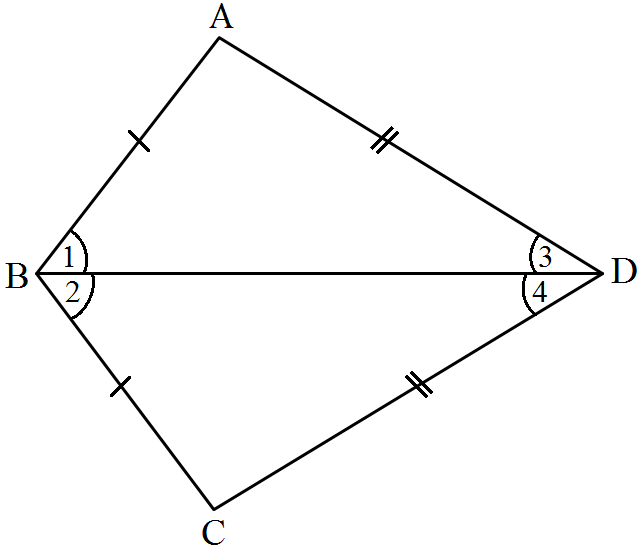
$ABCD$ is a quadrilaeter in which $AB = BC$ and $AD = CD$. Show that $BD$ bisects both the angles $ABC$ and $ADC.$
Answer
In $\triangle\text{ABC}$ and $\triangle\text{CBD},$ we have

$\text{AB}=\text{BC}$ $\text{AD}=\text{CD}$ $\text{BD}=\text{BD}$ $\therefore\text{ABC}\cong\triangle\text{CBD}$ $\Rightarrow\angle\text{1}=\angle\text{2}$ $\angle3=\angle4$ Hence, $BD$ bises both the angle $ABC$ and $ADC.$
View full question & answer
Question 123 Marks
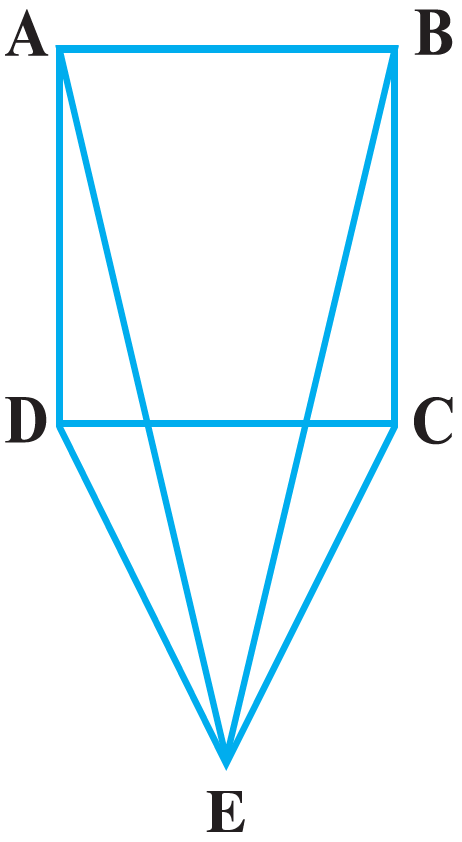
In the given figure $\triangle\text{CDE}$ is an equilateral triangle formed on a side $CD$ of a square $ABCD$. Show that $\triangle\text{ADE}\cong\triangle\text{BCE}.$
Answer
Given, $\triangle\text{CDE}$ is an equilateral triangle formes on a side $CD$ of a $ABCD.$ $\triangle\text{ADE}\cong\triangle\text{BCE}$ In $\triangle\text{ADE}$ and $\triangle\text{BCE},$ $\text{DE}=\text{CE}$ $\angle\text{ADE}=\angle\text{BCE}$ $\text{AD}=\text{BC}$ $\triangle\text{ADE}\cong\triangle\text{BCE}$
View full question & answer