MCQ 11 Mark
You have to push with $15\ N$ of force to move it $10$ meters. How much work do you do?
- A
$15$ Joules
- ✓
$150$ Joules
- C
$1.5$ Joules
- D
$67$ Joules
AnswerCorrect option: B. $150$ Joules
View full question & answer→MCQ 21 Mark
Potential energy increases:
- ✓
- B
- C
As the velocity increases
- D
AnswerPotential energy of an object of mass m at height h, $P.E = mgh$
$\Rightarrow P.E \ \alpha\ h$
Therefore, potential energy increases as the height increases.
View full question & answer→MCQ 31 Mark
Ne megawatt is equivalent to:
- A
$10^2 \mathrm{~W}$
- ✓
$10^6 \mathrm{~W}$
- C
$10^4 \mathrm{~W}$
- D
$10^8 \mathrm{~W}$
AnswerCorrect option: B. $10^6 \mathrm{~W}$
Prefix Mega means $10^6$.
So, $1$ Megawatt = $1 \times 10^6 \mathrm{~W}$
View full question & answer→MCQ 41 Mark
You lift a suitcase from the floor and keep it on the table. The work done by you on the suitcase depends on:
- A
The path taken by the suitcase
- B
- ✓
The weight of the suitcase
- D
The time taken by you in doing so
AnswerCorrect option: C. The weight of the suitcase
The work done by a person in lifting an object is stored as its potential energy mgh.
Hence, work done depends on the weight of the object mg.
View full question & answer→MCQ 51 Mark
Does the Law of Conservation of energy apply to machines?
- ✓
No, as machines require a constant input of energy in order to work
- B
Yes, the energy required to maintain motion is balanced by the energy lost to friction
- C
Yes, but only to perpetual motion machines
- D
No, as the law would apply to only perpetual motion machines
AnswerCorrect option: A. No, as machines require a constant input of energy in order to work
Machines require input work to be done on them, which increases the potential, or kinetic energy, or both, of the system.
However this work is done on the machines by external systems that utilize their energies to convert them to work.
So even though Law of Conservation of Energy holds for the entire system as a whole, it does not stand for the machines alone.
View full question & answer→MCQ 61 Mark
Identify the best definition of energy?
- A
Anything that has mass and takes up space
- B
Distance moved in a period of time
- ✓
- D
AnswerEnergy is defined as the ability to do work and its $SI$ unit is Joule.
View full question & answer→MCQ 71 Mark
The device which converts mechanical energy into energy which runs our microwave oven is:
AnswerAlternator is the device that converts mechanical energy into energy, which runs in microwave oven.
View full question & answer→MCQ 81 Mark
A rocket rises up in the air due to the force generated by the fuel. The work done by the:
- A
Fuel is negative work and that of force of gravity is positive work.
- ✓
Fuel is positive work and that of force of gravity is negative work.
- C
Both fuel and force of gravity do positive work.
- D
Both fuel and force of gravity do negative work.
AnswerCorrect option: B. Fuel is positive work and that of force of gravity is negative work.
View full question & answer→MCQ 91 Mark
The work done on an object does not depend on the:
- A
- B
Angle between force and displacement.
- C
- ✓
Initial velocity of the object.
AnswerCorrect option: D. Initial velocity of the object.
The work done on an object does not depend upon the initial velocity of the moving object.
View full question & answer→MCQ 101 Mark
- ✓
Negative, positive or zero
- B
- C
- D
AnswerCorrect option: A. Negative, positive or zero
View full question & answer→MCQ 111 Mark
Which of the following is not an example of potential energy?
- A
A vibrating pendulum at its maximum displacement from the mean position
- B
A body at rest at some height from the ground
- C
- ✓
A vibrating pendulum when it is just passing through the mean position
AnswerCorrect option: D. A vibrating pendulum when it is just passing through the mean position
Whenever a body is at some height from the mean $($base$)$ position or at a state of extension $($or contraction$),$ the body will have some potential energy. But when the pendulum is passing the mean position, the height from the base is $0.$ Hence a vibrating pendulum at the mean position has no potential energy.
View full question & answer→MCQ 121 Mark
Which mathematical relation of energy of a stone of mass $m$ falling freely from height $h$ remains conserved at every point in its downward motion?
AnswerCorrect option: C. $\text{E}=\text{mgh}+\frac{1}{2}\text{mv}^2$
$\text{E}=\text{mgh}+\frac{1}{2}\text{mv}^2$ mathematical relation of energy of a stone of mass $m$ falling freely from height $h$ remains conserved at every point in its downward motion.
View full question & answer→MCQ 131 Mark
Which one of the following possesses potential energy?
- A
Moving vehicle on the road
- B
- C
- ✓
AnswerMoving vehicle on the road possesses kinetic energy.
A running athlete possesses kinetic energy.
Stone on the road possesses kinetic energy.
A stretched rubber band possesses potential energy.
View full question & answer→MCQ 141 Mark
How much work they do in just holding it?
- A
$250J$
- B
$2500J$
- ✓
$0J$
- D
$625J$
AnswerThe work done by a constant force of magnitude F on a point that moves a displacement (not distance) s in the direction of the force is given by:
$W = F × s$
As the men are just holding the box the value of s is $0.$
View full question & answer→MCQ 151 Mark
Kinetic Energy is defined as:
- A
Energy stored due to its location.
- ✓
- C
Energy stored in the bonds of molecules.
- D
View full question & answer→MCQ 161 Mark
In the $SI$ system, the unit of potential energy is:
View full question & answer→MCQ 171 Mark
The unit for energy and work is:
MCQ 181 Mark
Kinetic energy of a body depends on its:
Answer$\text{K.E.}=\frac{1}{2}\text{mv}^2 $
So the kinetic energy of a body depends upon its mass and velocity.
View full question & answer→MCQ 191 Mark
A girl is carrying a school bag of $3\ kg$ mass on her back and moves $200\ m$ on a levelled road. If the value of g be $10\ m/s^2$, the work done by the girl against the gravitational force will be:
- A
$6000\ J$
- B
$0.6\ J$
- ✓
$0\ J$
- D
$6\ J$
AnswerCorrect option: C. $0\ J$
The girl is moving with the bag on a levelled road. Her direction of motion is perpendicular to the direction of gravitational force. So, work done by the girl against gravity is zero.
View full question & answer→MCQ 201 Mark
The linear momentum of a body of mass $2\ kg$ is 16kgms$−1$. What is its $K. E?$
- ✓
$64\ J$
- B
$70\ J$
- C
$60\ J$
- D
AnswerCorrect option: A. $64\ J$
$64\ J$
View full question & answer→MCQ 211 Mark
A boy is pushing hard on a wall. Is he doing work?
AnswerWork = Force $\times $ Displacement
Here, the wall is not moving although the boy is pushing hard.
$\therefore$ Displacement $= 0$
$\therefore$ Work $= 0$
View full question & answer→MCQ 221 Mark
A stone weighing $1\ kg$ is dropped from rest from a height of $4$ metres above the ground. When it has free-fallen $1$ metre its total energy with respect to the ground is:
- A
$15\ J$
- ✓
$40\ J$
- C
$20\ J$
- D
$30\ J$
AnswerCorrect option: B. $40\ J$
$40\ J$
View full question & answer→MCQ 231 Mark
Work done upon a body is:
AnswerWork done due to displacement caused by a force is a scalar quantity, since it has only magnitude and no direction.
View full question & answer→MCQ 241 Mark
A body is falling a height $h$. After it has fallen a height $\frac{\text{h}}{2}$. it will possess
- A
- B
- ✓
Half potential energy and half kinetic energy
- D
More kinetic and less potential energy
AnswerCorrect option: C. Half potential energy and half kinetic energy
When the body is height $h$; its potential energy is at maximum and kinetic energy is zero. When the body hits the ground, its potential energy becomes zero and kinetic energy is at maximum. At mid$-$way i.e., half the height; its potential energy becomes half of the maximum potential energy and same happens to the kinetic energy.
View full question & answer→MCQ 251 Mark
Potential energy and kinetic energy are types of:
MCQ 261 Mark
A fruit hanging from the top branch of a tree possesses:
- ✓
Gravitational potential energy
- B
- C
- D
AnswerCorrect option: A. Gravitational potential energy
A fruit, hanging from the top branch of a tree, is at rest at a certain height from the earth"s surface.
So, it possesses gravitational potential energy.
View full question & answer→MCQ 271 Mark
According to the law of conservation of energy, total energy is:
AnswerThe law of conservation of energy states that the total energy is constant in any process. Energy may change in form or be transferred from one system to another, but the total remains the same.
View full question & answer→MCQ 281 Mark
View full question & answer→MCQ 291 Mark
Which one of the following is not the unit of energy?
AnswerWe know that, joule, newton metre and kilowatt hour are the units of energy and the kilowatt is the unit of power.
View full question & answer→MCQ 301 Mark
A ball rolling on the ground possesses:
AnswerA moving car possesses mechanical energy due to its motion $($kinetic energy$)$. A moving baseball possesses mechanical energy due to both its high speed $($kinetic energy$)$ and its vertical position above the ground $($gravitational potential energy$)$.
View full question & answer→MCQ 311 Mark
A car is accelerated on a levelled road and acquires a velocity $4$ times of its initial velocity. During this process, the potential energy of the car:
AnswerPotential energy of an object depends only on its position above the ground and mass. So, the potential energy of a car traveling on a leveled road does not change.
View full question & answer→MCQ 321 Mark
A wristwatch works on the basis of energy possessed by:
- A
- B
- C
- ✓
Can be $(b)$ or $(c).$
AnswerCorrect option: D. Can be $(b)$ or $(c).$
A battery sends an electric current to a tiny, tuning-fork-shaped piece of quartz, causing it to oscillate at $32,768$ vibrations per second. (This is why mechanical watches, whose springs steadily release tension, have smoother second-hand movement than quartz watches).
View full question & answer→MCQ 331 Mark
Which of the following is an example of an object with Kinetic energy?
- ✓
- B
- C
- D
Water stored in a reservoir
Answerkinetic energy is energy possessed by body due to virtue of its motion.
only boy in option $A$ is in motion so only he has some kinetic energy.
rest option have things at rest so no kinetic energy.
View full question & answer→MCQ 341 Mark
What are the two types of Mechanical Energy$? (ME)$
- ✓
Kinetic and Potential Energy.
- B
Kinetic and Nuclear Energy.
- C
Potential and Chemical Energy.
- D
Thermal and Kinetic Energy.
AnswerCorrect option: A. Kinetic and Potential Energy.
Kinetic and Potential Energy.
View full question & answer→MCQ 351 Mark
A man carries a heavy box on his head on a horizontal plane from one place to another. In this case, he does:
AnswerA man carrying a box on his head:
In this case, the force acting on the man is the weight of the box, which is acting downwards.
The displacement of the man is along the horizontal direction.
Therefore, the force and the displacement are perpendicular to each other. So there is no work involved in this process.
View full question & answer→MCQ 361 Mark
A girl weighing $400N$ climbs a vertical ladder. If the value of g be $10\ ms^2$, the work done by her after climbing $2m$ will be:
- A
$200J$
- ✓
$800J$
- C
$8000J$
- D
$2000J$
AnswerCorrect option: B. $800J$
Weight of the girl $(W) = 400N$
Vertical height $(h) = 2m$
Acceleration due to gravity $(g) = 10m/s^2$
We can calculate the work done against gravity in moving a body of mass $(m)$ by a height $(h)$ as,
Work done in lifting a body $= ($Weight of body$)($Vertical distance$)$
So,
$W = (m)(g)(h)$
So,
Work done in lifting a body
$= (400)(2)J$
$= 800J$
View full question & answer→MCQ 371 Mark
Two masses $m$ and $2m$ are dropped from certain height $‘h’.$ Then on reaching the ground:
- A
$K.E.$ of them will be equal.
- B
$K.E.$ of the heavier is $4$ times the $K.E.$ of the lighter.
- C
$K.E.$ of the lighter is $4$ times the $K.E.$ of the heavier.
- ✓
$K.E.$ of the heavier is more than that of the lighter.
AnswerCorrect option: D. $K.E.$ of the heavier is more than that of the lighter.
$K.E.$ of the heavier is more than that of the lighter.
View full question & answer→MCQ 381 Mark
Unit used in selling electrical energy to consumer is:
Answer The commercial unit of electrical energy is Kilowatt $−$ hour (kWh).
$1\ kWh$ is equal to $1$ unit of energy.
View full question & answer→MCQ 391 Mark
You drop a $5\ kg$ ball from a height of $2\ m.$ Just before it reaches the ground, what type of energy does it have$?$
View full question & answer→MCQ 401 Mark
The law of conservation of energy implies that the:
- A
Total mechanical energy is conserved
- B
Total kinetic energy is conserved
- C
Total potential energy is conserved
- ✓
Sum of all kinds of energies is conserved
AnswerCorrect option: D. Sum of all kinds of energies is conserved
Law of conservation of energy implies that energy can neither be created nor destroyed, but can merely be transfered from one form to other. These forms are varied. Thus, when considering all forms of energy,$($including workdone$)$ the total sum never changes.
View full question & answer→MCQ 411 Mark
What is potential energy?
- ✓
Energy of an object due to its position or arrangement in a system
- B
Energy of an object due to its nature or arrangement in a system
- C
Energy of an object due to its shape or arrangement in a system
- D
AnswerCorrect option: A. Energy of an object due to its position or arrangement in a system
The potential energy is the stored energy of an object due to its position.
some examples of potential energies are gravitational potential energy, Electrostatic potential energy and elastic energy etc.
A body placed at ground will have less gravitational potential energy than a body placed at some height. therefore, potential energy changes by changing the position of object.
View full question & answer→MCQ 421 Mark
All types of energy that exist in the nature can be categorized as either kinetic or potential. Choose correct statement regarding the validity of above sentence:
- A
This statement is true for thermal and and mechanical, but not elastic
- B
This statement is true for all different types of energy
- ✓
This statement is false, except in the case of mechanical energy
- D
This statement is never true
AnswerCorrect option: C. This statement is false, except in the case of mechanical energy
There exists other types of energies such as light energy, sound energy, nuclear energy etc. which are neither kinetic nor potential.
Energies in the form of mechanical energy are categorized as either kinetic or potential energy.
View full question & answer→MCQ 431 Mark
A stone rubbed on a rough floor and placed on the skin will show heating sensation, because:
- ✓
- B
Heat flows from the skin to stone.
- C
Heat flows from stone to the skin.
- D
AnswerWhen a fire stone is rubbed on a hard and rough surface we get fire. This is due to friction.
View full question & answer→MCQ 441 Mark
When heated, molecules absorb $......$ and their capacity to do $......$ increases:
AnswerWhen heated, molecules absorb the energy, and their capacity to do work increases.
View full question & answer→MCQ 451 Mark
Work done by the gravitational force of earth on a satellite along a circular path is:
MCQ 461 Mark
On listening to his friend, Amit said “Moon does not work as it goes round our earth”, because:
A: Moon displaces perpendicular to direction of force.
B: No force acts on the moon.
C: Momentum change is non-zero.
Which of the combination is/ are correct$?$
- ✓
$A $ and $C$ only.
- B
$A$ and $B$ only.
- C
$A, B$ and $C.$
- D
$B$ and $C$ only.
AnswerCorrect option: A. $A $ and $C$ only.
As the moon orbits the Earth, the force of gravity acting upon the moon provides the centripetal force required for circular motion.
This would mean that the force is always directed perpendicular to the direction that the object is being displaced.
View full question & answer→MCQ 471 Mark
Which of the following physical quantities is different from others$?$
Answer Kinetic energy is the energy possessed by the body by virtue of its motion and potential energy is the energy possessed by the virtue of its position and shape. Energy is required to do work.
Hence work, kinetic energy, potential energy all can be measured using same unit, i.e joule.
So, force is the physical quantity here which is different from others as given by product of mass and acceleration. $S.I$ unit of force is $N ($newton$).$
View full question & answer→MCQ 481 Mark
When a body falls freely towards the earth, then its total energy:
- A
- B
- C
First increases and then decreases
- ✓
View full question & answer→MCQ 491 Mark
Find the correct statement:
AnswerCorrect option: C. Both $a$ and $b$
Both $a$ and $b$
View full question & answer→MCQ 501 Mark
The commercial unit of energy is:
- A
- B
Watt$-$hour.
- ✓
Kilowatt$-$hour.
- D
AnswerCorrect option: C. Kilowatt$-$hour.
Kilowatt$-$hour is the commercial unit of electricity.
View full question & answer→MCQ 511 Mark
- ✓
- B
- C
Can not be changed into another form of energy.
- D
View full question & answer→MCQ 521 Mark
In case of negative work, the angle between the force and displacement is:
- A
$0$
- B
$45^{\circ}$
- C
$90^{\circ}$
- ✓
$180^{\circ}$
AnswerCorrect option: D. $180^{\circ}$
In this case, the force of gravity is acting in the downward direction. But, the displacement of the body is in the upward direction. Since the angle between the force and displacement is $180^{\circ}$, the work done by the gravitational force on the body is negative.
View full question & answer→MCQ 531 Mark
View full question & answer→MCQ 541 Mark
gravitational potential energy is defined as:
- ✓
The energy an object has due to its height above the ground.
- B
The energy an object has due to its motion.
- C
The energy a spring has due to its stretch.
- D
The chemical energy stored in the molecules of atoms.
AnswerCorrect option: A. The energy an object has due to its height above the ground.
View full question & answer→MCQ 551 Mark
Flowing water has the capacity to do work:
AnswerFlowing water possess kinetic energy which is used to do work.
View full question & answer→MCQ 561 Mark
Which one of the following energies cannot be possessed by a body at rest?
AnswerKinetic energy is possessed by a body by virtue of its state of motion. So, a body at rest cannot possess kinetic energy. A body at rest will possess potential energy. Thermal and magnetic energies are irrespective of state of rest or of motion of a body.
View full question & answer→MCQ 571 Mark
A block of mass $10\ kg$ is dropped from a height of $10\ m$ from the earth's surface and it falls onto a vertical heli spring of stiffness $5000\ N/ m$ and length $50\ cm$ as shown in the figure. The compression of the springs is $($Take, $g = 10m/ s)$
- A
$0.1\ m$
- B
$0.2\ m$
- ✓
$\sqrt{0.4}\text{ m}$
- D
$0.3\ m$
AnswerCorrect option: C. $\sqrt{0.4}\text{ m}$
View full question & answer→MCQ 581 Mark
What is an example of Electric Energy
MCQ 591 Mark
Which one of the following possesses kinetic energy?
- ✓
- B
- C
Water stored in the reservoir of a dam
- D
A car parked in the garage
AnswerAny moving object must have kinetic energy because of its velocity. So, a moving car possesses kinetic energy.
View full question & answer→MCQ 601 Mark
In order to prove the law of conservation of energy in a freely falling object, Nakul followed the steps: A: Found $P.E.$ at the height $‘h’$ B: Used $v^2 = u^2 + 2as$ and $(h - s)$ to find total energy after a fall of $'s'$ metre. C: Found $K.E.$ just at the time of landing. The sequence of steps are:
- A
$B - C - A$
- B
$A - B - C$
- ✓
$C - A - B$
- D
AnswerCorrect option: C. $C - A - B$
Law of conservation of energy states that the energy can neither be created nor destroyed but can be transformed from one form to another. Let us now prove that the above law holds good in the case of a freely falling body. Total energy at $A =$ Potential energy $+$ Kinetic energy.
View full question & answer→MCQ 611 Mark
$P.E$ of a spring increases when it is in the state of:
- A
- B
Neither $a$ nor $b$
- C
- ✓
Both $a$ and $b$
AnswerCorrect option: D. Both $a$ and $b$
Both $a$ and $b$
View full question & answer→MCQ 621 Mark
A body at maximum height possesses:
AnswerPotential energy is an energy that an object possesses because of its position. So at the highest position, its potential energy is maximum.
View full question & answer→MCQ 631 Mark
The capacity of a body to do work is called ______:
AnswerEnergy is the capacity of a physical system to perform work. Energy exists in several forms such as heat energy, kinetic or mechanical energy, light energy, potential energy, electrical energy, or other forms. According to the law of conservation of energy the total energy of a system remains constant, though energy may transform into another form.
The SI unit of energy is the joule $(J)$ or newton-meter $(N-m).$ Joule is also the SI unit of work.
View full question & answer→MCQ 641 Mark
Potential energy of a body depends on its:
AnswerWe know that potential energy is the energy possesd by the virtue of its position.
So, $F =$ mgh
Where, $m =$ mass
So, From above equation we can deduce that potential energy depends on the mass of the substance.
View full question & answer→MCQ 651 Mark
Work done by a fielder in catching a ball is:
AnswerTo catch a ball, the fielder has to stop the ball. This means, force is applied against the motion of the ball. So, the fielder applied the force on the ball and the ball moves in the direction opposite to the direction of force till the ball comes to rest. Thus work is negative.
View full question & answer→MCQ 661 Mark
When a body moves with a constant speed along a circle, then which of the following is correct :
- A
- B
Its velocity remains constant
- ✓
- D
No acceleration is produced in it
AnswerIf the speed is constant then no force is acting in tangential direction. Only force acting is perpendicular to direction of velocity. Hence, work done will be zero.
View full question & answer→MCQ 671 Mark
What is practical unit of power$?$
AnswerPractical unit of power is horse power $(hp).$
$1\ hp = 746W ,$ where $W$ is Watt $($the $SI$ unit of power$).$
View full question & answer→MCQ 681 Mark
AnswerThe watt - hour $(Wh)$ is a unit of electric energy equivalent to one watt $(1\ W)$ of power expended for one hour $(1\ h)$ of time. Watt-hour is commonly used in electrical applications.
$1\ Wh = 1 × 60 × 60 = 3600J$
View full question & answer→MCQ 691 Mark
An elevator with load, weighing $500\ kg$ is moving up with a velocity of $0.2\ ms.$ The power of the motor in horse power is $(1\ H.P. = 746$ watt$):$
Answer$\text{P}=\frac{\text{w}}{\text{t}}$
$=\frac{\text{F}\times\text{d}}{\text{t}}=\text{m}\times\text{a}\times\text{v}$
$=500\times9.8\times0.2$
$=980\text{ Watt}$
$1\ H.P. = 746$ watt
$1.3$ horse power
View full question & answer→MCQ 701 Mark
- A
- B
- C
Both momentum and kinetic Energy
- ✓
Answer A body at rest can have potential energy because $PE$ is due to position of object but it does not have kinetic energy because $KE$ is due to motion but object is at rest so no $KE$ will be present.Momentum is also not present because momentum is due to velocity and velocity is zero in this case.
For example an object at a roof at rest have no $KE$ but it has gravitational potential energy due to it's height above ground given by mgh.
View full question & answer→MCQ 711 Mark
Newtons are the unit for _____________.
MCQ 721 Mark
What is work done in holding a body of mass $20\ kg$ at a height of $2 m$ above the ground$? (g = 10\ m/s^2$)
Answer A body of mass $20\ kg$ is held at a height of $2m$ above the ground means there is no displacement because of which there is no change in its potential energy. Hence work done is zero.
View full question & answer→MCQ 731 Mark
A student sitting at the top of a tree has ...... than the student who is sitting on the ground:
- A
- ✓
- C
- D
More gravitational energy
AnswerPotential energy =$ mgh$
$m →$ mass
$g →$ acceleration due to gravity
$h →$ height from ground
$P.E.$ is directly proportional to the height from the ground.
Hence a student sitting at the top of a tree has more potential energy than the student who is sitting on the ground.
View full question & answer→MCQ 741 Mark
A coconut fruit hanging high in a palm tree has $.........$ owing to its location:
AnswerThe potential energy possessed by the object is the energy present in it by virtue of its position or configuration. So, the hanging coconut has potential energy due to its location $($height$)$.
View full question & answer→MCQ 751 Mark
How much energy does a $100W$ electric bulb transfer in $1$ minute$?$
- A
$100J$
- B
$600J$
- C
$3600J$
- ✓
$6000J$
AnswerCorrect option: D. $6000J$
Power, $(P) = 100W$
Time duration, $(t) = 60s$
Now, we can calculate the electrical energy consumed as,
Energy consumed $= ($Power$)($Time$)$
So,
Energy consumed
$= (100)(60)J$
$= 6000J$
So, the energy consumed is $6000 J.$
View full question & answer→MCQ 761 Mark
What is the commercial unit of energy?
AnswerCorrect option: C. $KW/ h$
View full question & answer→MCQ 771 Mark
Water falls from a height of $60m$ at the rate of $15\ kg$ is operate a turbine. The soosses due to frictional forces are $10\%$ of energy. How much power is generated by the turbine$? ($Take, $g = 10m/ s^2)$
- ✓
$8.1kW$
- B
$10.2kW$
- C
$12.3kW$
- D
$7.9kW$
AnswerCorrect option: A. $8.1kW$
$90\%$ the of the energy is used to turn the turbine.
$\Rightarrow $ So the power generated in the turbine is $= 0.9 \times ($change in $PE$ of the water per second$)$
$\Rightarrow 0.9 \times 15 \times 10 \times 60$
$= 8100$ watt.
View full question & answer→MCQ 781 Mark
What is needed to calculate work?
- A
- B
- ✓
- D
Acceleration and velocity.
View full question & answer→MCQ 791 Mark
AnswerThe work done is equal to the change in the kinetic energy of an object.
View full question & answer→MCQ 801 Mark
A nuclear power plant operated at $100\ kW.$ How much mass is converted into energy per day$?$
- ✓
$9.6\ kg$
- B
$7.6\ kg$
- C
$7.8\ kg$
- D
$8.6\ kg$
AnswerCorrect option: A. $9.6\ kg$
Given,
Power $= 10^7 \mathrm{KW}$
$=\frac{\text{Energy}}{\text{Time}}$
Energy = $\left(10^7 \times 10^3\right) \times(24 \times 3600)$
$= 864 \times 10^{12}$ Joule
$E = \mathrm{mc}^2$
Have, $c =$ Speed og light
$=3 \times 10^8 \mathrm{~m} / \mathrm{s}$
$\text{m}=\frac{864\times10^{12}}{9\times10^{16}}$
$\text{m}=96\times10^{-4}$
$\text{m}=96\times10^{-3}\text{kg}$
$=9.6\text{gm}$
View full question & answer→MCQ 811 Mark
An iron sphere of mass $10\ kg$ has the same diameter as an aluminium sphere of mass $3.5\ kg.$ Both the spheres are dropped simultaneously from a tower. When they are $10\ m$ above the ground, they have the same:
Answer Momentum, potential energy and kinetic energy depend on the mass of the body. So, the answer is acceleration as it is independent of mass.
View full question & answer→MCQ 821 Mark
A force of $5\ N$ acts on a $1.5\ kg$ body initially at rest. The work done by the force during the first second of motion of the body is:
- A
$51$
- ✓
$\frac{5}{6}\text{J}$
- C
$6J$
- D
$75J$
AnswerCorrect option: B. $\frac{5}{6}\text{J}$
$\xrightarrow{5\text{N}}15\text{kg}$
$\text{a}=\frac{5\text{N}}{15\text{kg}}=\frac{1}{3}\text{m/ s}^2$
$\text{S}=\text{vt}+\frac{1}{2}\text{at}^2\ [\text{t}=1\text{sec}]$
$\text{S}=\frac{1}{2}\times\frac{1}{3}\times(1)^2$
$=\frac{1}{6}$
$\text{W}=\text{F}\times\text{S}$
$\frac{5}{6}\text{J}$
View full question & answer→MCQ 831 Mark
Which is Potential Energy?
MCQ 841 Mark
Kilowatt is the unit of electrical _______ but kilowatt-hour is the unit of electrical _______:
- ✓
- B
Power, Electric potential
- C
- D
Answer In $SI$ system, unit of power is Watt $(W).$ Kilowatt is equal to one thousand $(10^3) $ watts. The kilowatt-hour is a unit of energy and is equal to $1,000$ watt-hours. If the energy is being transmitted or used at a constant rate (power) over a period of time, the total energy in kilowatt-hours is the product of the power in kilowatts and the time in hours.
View full question & answer→MCQ 851 Mark
The energy possessed by wind is:
AnswerKinetic energy is the energy possessed by an object due to its motion. The energy possessed by the wind is kinetic energy due to the motion of air.
View full question & answer→MCQ 861 Mark
The energy absorbed by a solar panal is used to charge a battery. During the day, the battery stores $1.6J$ of energy each second. At night the battery is used to light a $1.2W$ lamp for $18000s.$ What is the minimum time for which the battery must be charged within the day$?$
- A
$13505s$
- ✓
$13500s$
- C
$15300s$
- D
$13050s$
AnswerCorrect option: B. $13500s$
$\text{power}=\frac{\text{energy}}{\text{time}}$
$1.2=\frac{\text{energy}}{18000}$
energy required $= 21600J$
Total time required for $21600J$ is $\frac{21600}{1.6}=13500$
View full question & answer→MCQ 871 Mark
The $CGS$ unit of energy is:
Answer$CGS$ unit of energy is Dyne−cm which is also known as erg.
View full question & answer→MCQ 881 Mark
When a body falls freely towards the earth, then its total energy:
- A
- B
- ✓
- D
First increases and then decreases.
AnswerWhen a body falls freely towards the earth, its potential energy and kinetic energy will be same, it obeys the law of conservation of energy. Due to this, its total energy remains constant.
View full question & answer→MCQ 891 Mark
What is the unit of measurement for work?
MCQ 901 Mark
In SI system, the unit of $P.E.$ is:
AnswerIn $SI$ unit energy is measured in Joules.
Therefore, $S.I$ unit of potential energy is Joule$(J).$
View full question & answer→MCQ 911 Mark
If work is done at a faster rate, then:
- ✓
- B
No power is required to do work
- C
- D
Infinite power is required
View full question & answer→MCQ 921 Mark
A lorry and a car moving with the same $KE$ are brought to rest by applying the same retarding force, then:
- A
Lorry will come to rest in a shorter distance.
- B
Car will come to rest in a shorter distance.
- ✓
Both come to rest in a same distance.
- D
AnswerCorrect option: C. Both come to rest in a same distance.
Work done by brakes $(F × d)$ transfers their $KE.$
$(\text{F}\times\text{d})=\frac{1}{2}\text{mv}^2$
Since both have same $KE$ and both subject to same force $(F).$
then distances $(d)$ are equal.
View full question & answer→MCQ 931 Mark
Which of the following possesses kinetic energy?
AnswerKinetic energy is the energy possessed by an object due to its motion.
View full question & answer→MCQ 941 Mark
On tripling the speed of motion of a body, the change in $K.E.$ is:
- ✓
$9$ times
- B
$8$ times
- C
$4$ times
- D
$2$ times
AnswerCorrect option: A. $9$ times
$9$ times
View full question & answer→MCQ 951 Mark
What is one unit of household electrical energy in $J?$
AnswerCorrect option: D. $3.6 \times 10^6 \mathbf{J}$
One unit of household is $1\ kwh$
kwh $=$ kilo watt hour
$1$ unit $= 1\ kWh$
$⇒ 1$ unit $= 10^3 \mathrm{~W} \times 3600 \mathrm{~s}$
$⇒ 1$ unit $= 3.6 \times 10^6 \mathrm{~J}$
View full question & answer→MCQ 961 Mark
In which form, the energy is stored in a fuel?
AnswerChemical energy is energy stored in the bonds of atoms and molecules. Batteries, biomass, petroleum, natural gas, and coal are examples of chemical energy. Chemical energy is converted to thermal energy when people burn wood in a fireplace or burn gasoline in a car's engine.
View full question & answer→MCQ 971 Mark
AnswerThe body at rest may have energy.
For example$:$ A body put on height at rest has potential energy $= \text{mgh}.$
View full question & answer→MCQ 981 Mark
A raised hammer possesses:
AnswerCorrect option: B. $P.E.$
A raised hammer possesses $P.E$ Energy possessed by a body by virtue of its position is called as potential energy. Similarly is the case when a hammer is raised. A raised hammer possesses potential energy by virtue of its height above ground level.
View full question & answer→MCQ 991 Mark
A force is applied by an engine of a train of mass $2.05 × 10^6\ kg$ changes its velocity from $5\ m/ s$ to $25\ m/ s$ min. The power of engine is:
- A
$1.025\ MW$
- ✓
$2.05\ MW$
- C
$5\ MW$
- D
$6\ MW$
AnswerCorrect option: B. $2.05\ MW$
$\text{Power}=\frac{\text{Work done}}{\text{time}}$
$=\frac{\frac{1}{2}\text{m}(\text{v}^2-\text{u}^2)}{\text{t}}$
$\text{P}=\frac{1}{2}\times\frac{2.05\times10^6\times\big[(25)^2-(5^2)\big]}{\text{t}}$
$\text{P}=2.05\times{10^6}\text{W}$
$=2.05\text{MW}$
View full question & answer→MCQ 1001 Mark
Which among the following is the commercial unit of electrical energy$?$
AnswerThe kilowatt-hour is a unit of energy equal to $1,000$ watt-hours, or $3.6$ mega-joules. If the energy is being transmitted or used at a constant rate (power) over a period of time, the total energy in kilowatt-hours is the product of the power in kilowatts and the time in hours. The kilowatt-hour is commonly used as a billing unit for energy delivered to consumers by electric utilities.
View full question & answer→MCQ 1011 Mark
An electric lamp of $100w$ is used for $5$ hours per day calculate the units of energy consumed by lamp in one day:
- A
$1$ unit
- ✓
$0.5$ unit
- C
$1.5$ units
- D
AnswerCorrect option: B. $0.5$ unit
$0.5$ unit
View full question & answer→MCQ 1021 Mark
A car is accelerated on a levelled road and attains a speed of $4$ times its initial speed. In this process, the kinetic energy of the car:
- A
- B
Becomes $4$ times that of initial kinetic energy.
- C
Becomes $8$ times that of initial kinetic energy.
- ✓
Becomes $16$ times that of initial kinetic energy.
AnswerCorrect option: D. Becomes $16$ times that of initial kinetic energy.
Kinetic energy of a body is directly proportional to the square of the velocity. So, the kinetic energy will become $16$ times its initial value if the velocity is increased $4$ times.
View full question & answer→MCQ 1031 Mark
Two bodies of equal weight are kept at heights of $h$ and $1.5\ A,$ respectively. The ratio of their $PE$ is:
- A
$3 : 2$
- ✓
$2 : 3$
- C
$1 : 1$
- D
$4 : 3$
AnswerCorrect option: B. $2 : 3$
$2 : 3$
View full question & answer→MCQ 1041 Mark
When a stone falls freely towards the earth, its total energy $?$
- A
First decreases and then becomes zero
- ✓
- C
- D
AnswerSince the ball is in free-fall, the only force acting on it is gravity. Therefore, we can use the principle of conservation of mechanical energy - initially the ball has potential energy and no kinetic energy. As it falls, its total energy (the sum of the $KE$ and the $PE)$ remains constant and equal to its initial $PE.$ when reaches the ground there is no $PE$ only $KE\ I.E.,$ Equal to initial $PE$
View full question & answer→MCQ 1051 Mark
A car is accelerated on a leveled road and attains a velocity $4$ times of its initial velocity. In this process the potential energy of the car:
AnswerPotential energy is the energy possessed by a body by the virtue of its height from the ground and in the given case, the car only increases its velocity $4$ times but its height from the ground remains constant. Thus, the potential energy does not change.
View full question & answer→MCQ 1061 Mark
In winters, rubbing of hands together for some time, causes a sensation of warmth mainly because of:
- ✓
Heat caused by the force of friction.
- B
Heat caused by the momentum.
- C
Heat caused by the motion.
- D
Heat flows from the blood to skin.
AnswerCorrect option: A. Heat caused by the force of friction.
View full question & answer→MCQ 1071 Mark
A heavy object has $.......$ potential energy than a lighter one:
Answer$P.E = \text{mgh}$
The amount of potential energy an object possesses depends on its height and mass.
The heavier the object and the higher from the ground, the more potential energy it holds.
View full question & answer→MCQ 1081 Mark
The energy possessed by an oscillating pendulum of a clock is:
MCQ 1091 Mark
When a force retards the motion of a body, the work done is:
- A
- ✓
- C
- D
Positive or negative depending upon the magnitude of force and displacement
AnswerWhen the force retards the motion of a body, the work done is negative.
View full question & answer→MCQ 1101 Mark
In which of the following cases work is said to be done?
- ✓
A man pushing a roller and displacing it
- B
- C
- D
AnswerCorrect option: A. A man pushing a roller and displacing it
In the first case, the man is pushing a roller and it is moving so work is said to be done
and in the other two both are sitting they are not moving so no work is said to be done.
work = force $\times$ displacement
View full question & answer→MCQ 1111 Mark
If an object remains stationary even when force is applied then:
- A
- ✓
- C
- D
Work cannot act on that body
AnswerWork = Force $\times $ Displacement
Work is said to be done only when the body is displaced from its original position by an applied force on it.
If the body does not displace then no work is being done even if the force is acting on the body.
View full question & answer→MCQ 1121 Mark
......... is said to be done only when the force applied on a body makes the body to move:
AnswerWork is said to be done when the force applied to a body makes the body move.
By definition 'Work = Force $x$ Displacement.
View full question & answer→MCQ 1131 Mark
An electric motor raises a load of $0.2\ kg$, at a constant speed, through a vertical distance of $3.0\ m$ in $2\ s$. If the acceleration power stations and thermal power stations, alternators produce electricity.
AnswerMass of the load ($m$$_1$) $= 0.2\ kg$
Height $(h) = 3\ m$
Acceleration due to gravity $(g) = 10\ m/s$$^2$
Time taken $(t) = 2\ s$
We can calculate the work done against gravity as,
Work done by the car = (Weight of body)(Vertical distance)
$= (0.2)(10)(3)J$
$= 6J$
Now, we can calculate the power of the boy as,
$\text{Power}=\frac{\text{Work done}}{\text{Time}}$
So,
$\text{Power}=\frac{6}{2}\text{W}$
$=3\text{W}$
So, the power is $3W$.
View full question & answer→MCQ 1141 Mark
The $S.I.$ unit of energy is
AnswerEnergy is capacity of doing work. The unit of energy is same as that of work. So, $S.I.$ unit of energy is joule$(J)$.
View full question & answer→MCQ 1151 Mark
A ball is thrown vertically upwards. Its velocity keeps on decreasing. What happens to its kinetic energy when its reaches the maximum height?
- A
Kinetic energy is double.
- ✓
- C
Kinetic energy is maximum at maximum height.
- D
Kinetic energy is half of initial value.
View full question & answer→MCQ 1161 Mark
Which of the following is unit of power?
AnswerThe dimension of power is energy divided by time. The $SI$ unit of power is the watt$(W)$, which is equal to one joule per second.
View full question & answer→MCQ 1171 Mark
While running you possess certain kind of energy due to motion .What kind of energy do you possess?
AnswerThe energy possessed by the virtue of motion of any object is called kinetic energy.
Hence while running the energy possessed by the person is kinetic energy.
View full question & answer→MCQ 1181 Mark
Which of the following statements is incorrect?
- A
No work is done if the displacement is perpendicular to the direction of the applied force
- B
If the angle between the force and displacement vectors is obtuse, then the work done is negative
- C
Frictional force is a non-conservative
- ✓
All the central forces are non-conservativ
AnswerCorrect option: D. All the central forces are non-conservativ
Non-conservative force such as friction depends on other factors, such as velocity and dissipative and no potential energy can be defined for them.
View full question & answer→MCQ 1191 Mark
Which one of the following is not the unit of energy?
AnswerKilowatt is the unit of power.
View full question & answer→MCQ 1201 Mark
The form of energy present in a wound spring is:
AnswerPotential energy is stored in a wound spring. Potential energy is a type of mechanical energy. Hence, energy present in a wound spring is mechanical energy.
View full question & answer→MCQ 1211 Mark
The work done on an object does not depend upon the:
- A
- B
- C
Angle between force and displacement.
- ✓
Initial velocity of the object.
AnswerCorrect option: D. Initial velocity of the object.
$\text{W}=\text{F}\times\text{d}\cos\theta$
Here, $F$ = force applied on the object
$d$ = displacement
$\theta$ = angle between force and displacement
So, the work done on an object does not depend upon the initial velocity of the object.
The correct option is $D$.
View full question & answer→MCQ 1221 Mark
A weight lifter lifts a weight off the ground and holds it up then:
- A
Work is done in lifting as well as holding the weight
- B
No work is done in both lifting and holding the weight
- ✓
Work is done in lifting the weight but no work is required to hold it up
- D
No work is done in lifting the weight but work is required to be done in holding it up
AnswerCorrect option: C. Work is done in lifting the weight but no work is required to hold it up
Work is done by the lifter in lifting the weight (displacement of weight upwards in the direction of force).
There is no displacement of weight when he holds it. Hence, no work is done.
View full question & answer→MCQ 1231 Mark
Potential energy is directly proportional to:
- A
- B
- ✓
Height of the body from the surface
- D
AnswerCorrect option: C. Height of the body from the surface
Gravitational potential energy = Mgh
therefore it is directly proportional to the height of the body from the surface.
View full question & answer→MCQ 1241 Mark
The $SI$ unit of energy is:
AnswerAs energy is defined via work so,the SI unit for energy is the same as the unit of work that is joule $(J)$
View full question & answer→MCQ 1251 Mark
Smallest commercial unit of energy is:
AnswerSmallest commercial unit of energy is called Watt hour (Wh). One watt hour is the energy consumed when $1$ watt of power is used for $1$ hour.
View full question & answer→MCQ 1261 Mark
Complete the following sentence: The potential energy of a body is the energy by virtue of its _______:
AnswerThe potential energy of a body is the energy by virtue of its position or configuration. For example, the heavy ball of a demolition machine is storing energy when it is held at an elevated position. This stored energy due to its position is referred to as potential energy. Similarly, a drawn bow is able to store energy as the result of its change of shape or configuration.
View full question & answer→MCQ 1271 Mark
Which of the following is an example of zero work even when the body suffers a displacement from its initial position?
- ✓
A coolie carrying a load on his head and moving forward on a horizontal road
- B
A fielder catching a ball
- C
- D
A child pulling a toy car
AnswerCorrect option: A. A coolie carrying a load on his head and moving forward on a horizontal road
When a coolie carries a load on his head, he applies a force upwards against the weight of the load, i.e., against the gravitational force. And the displacement is forward horizontally. So, the angle between the force and the displacement is $90^\circ$
and the work done is zero.
To catch a ball, work done is negative as the ball moves in the opposite direction of force before coming to rest.
A child pushing a wall is an example of zero work as the wall suffers zero displacements.
View full question & answer→MCQ 1281 Mark
The product of force and displacement equals:
AnswerWork is defined as the dot product of force and displacememt.$(F.S)$
Power is defined as work done per unit time.$(j/s)$
Momentum is defined as mass into velocity$(mv)$.
View full question & answer→MCQ 1291 Mark
According to the law of conservation of energy:
- A
Energy can’t be destroyed.
- B
- C
Energy can be transformed from one from to another.
- ✓
View full question & answer→MCQ 1301 Mark
In case of negative work the angle between the force and displacement is:
- A
$0^\circ$
- B
$45^\circ$
- C
$90^\circ $
- ✓
$180^\circ$
AnswerCorrect option: D. $180^\circ$
- Work done $W = F.d \cos\theta$
$\therefore$ Work done at $\theta=0^\circ,\ \text{W}=\text{F.d}\ \cos0^\circ(\therefore\cos0^\circ=1)$
$\Rightarrow W = F.d$
For $\angle \theta=0^\circ,$
Work done Is positive, so it is not true.
- We know that work done, $W = F.d \cos\theta$
$\text{W}=\text{F.d}\ \cos45^\circ\Big(\because\cos45^\circ=\frac{1}{\sqrt{2}}\Big)$
$\text{W}=\frac{\text{F.d}}{\sqrt{2}}$
For angle $0=45^\circ,$
work done is positive, so it is not true.
- We know that work done, $W = d \cos\theta$
Work done at $\theta=90^\circ, W = F.d \cos90^\circ(\therefore\cos90^\circ=0)$
$W = 0$
So, it in not true.
- Work done at $\theta=180^\circ,\ \text{W}=\text{F.d}\ \cos\theta\ (\therefore\cos180^\circ=-1)$
$W = -F.d$
For negative work, the angle between the force and displacement should be $180^\circ$.
$($i.e, force and displacement are anti parallel to each other$)$ So, it is true. View full question & answer→MCQ 1311 Mark
A body is falling from a height h. After it has fallen a height $\frac{\text{h}}{2},$ it will possess:
- A
- B
- ✓
Half potential and half kinetic energy.
- D
More kinetic and less potential energy
AnswerCorrect option: C. Half potential and half kinetic energy.
When the body is at height h; its potential energy is at maximum and kinetic energy is zero. When the body hits the ground, its potential energy becomes zero and kinetic energy is at maximum. At mid-way, i.e. half the height; its potential energy becomes half of the maximum potential energy and same happens to the kinetic energy.
View full question & answer→MCQ 1321 Mark
A horse is running on a playground and comes to a skidding stop. The force applied on the horse due to playground is $500\ N$. Which is directly opposed to the motion of the horse. How much work does the horse do on the playground?
AnswerZero
The stopping force and the displacement make an angle of $180^\circ(\pi\text{ rad})$ with each other.
Thus, work done by the road,
$\text{W}_\text{r}=\text{Fd}\cos\theta$
$=500\times0\times\cos\pi$
$=0$
View full question & answer→MCQ 1331 Mark
Water stored in a dam possesses:
AnswerWater stored in a dam possess $POTENTIAL\ ENERGY$ or mechanical energy. And when the water is flowing or falling in the dam that energy is known as $KINETIC\ ENERGY$.
View full question & answer→MCQ 1341 Mark
As an object falls, its $......$ energy changes into $......$ energy:
AnswerThis work is converted to a form of potential energy called potential energy. When the item falls towards Earth like an apple from a tree, potential energy is converted into kinetic energy.
View full question & answer→MCQ 1351 Mark
One megawatt is ..... times that of one kilowatt:
- ✓
$1000$
- B
$19600$
- C
$100000$
- D
$0.001$
AnswerCorrect option: A. $1000$
A. $1000$
Explanation:
One megawatt $= 10^6$ Watt
One Kilowatt $= 10^3$ Watt
$\Rightarrow$ one megawatt $= 1000$ kilowatt
View full question & answer→MCQ 1361 Mark
- A
Oranges contain Elastic Energy.
- ✓
Food contains Chemical Energy.
- C
Phone on the table doesn't contain Gravitational Energy.
- D
Radiator contains Nuclear Energy.
AnswerCorrect option: B. Food contains Chemical Energy.
View full question & answer→MCQ 1371 Mark
The velocity of a ball goes on decreasing when it is thrown vertically upwards. When its velocity becomes zero, its potential energy becomes:
AnswerAccording to the law of conservation of energy its kinetic energy is getting converted in to potential energy because of gain in height. So, if the velocity of a ball goes on decreasing when it is thrown vertically upwards. When its velocity becomes zero, its potential energy becomes maximum.
View full question & answer→MCQ 1381 Mark
The momentum of a bullet of mass $20g$ fired from a gun is $10\ kg\ m/s$. The kinetic energy of this bullet in kJ will be:
AnswerMass of the bullet, $(m), = 0.02\ gm$
Momentum of the bullet, $(P) = 10\ kg.m/s$
The relation between momentum, mass and kinetic energy is as follows:
$\text{K.E.}=\frac{1}{2}\Big(\frac{\text{p}^2}{\text{m}}\Big)$
So,
$\text{K.E.}=\frac{1}{2}\Big(\frac{(10)^2}{0.02}\Big)\text{J}$
$=\frac{100}{0.04}\text{J}$
$=2500\text{J}$
$2.5\text{KJ}$
View full question & answer→MCQ 1391 Mark
A ball is thrown vertically up-wards from the ground. Regarding the work done by air resistance, which of the following is correct?
- A
- ✓
- C
- D
Work done may be positive or negative
AnswerAir resistance offers retarding force opposite to the direction of instantaneous velocity. As the force acts opposite to the displacement of the body, the work done by it is negative.
View full question & answer→MCQ 1401 Mark
Work done is said to be positive when a force causes displacement:
- ✓
- B
In the direction opposite to the applied force.
- C
In the direction at right angles to the direction of applied force.
- D
View full question & answer→MCQ 1411 Mark
Name the type of energy $($kinetic energy $K $ or potential energy $U)$ possessed in a compressed spring:
- ✓
$U$
- B
$K$
- C
Both $U$ and $K$
- D
AnswerWhen you compress a spring, it possess potential energy. The force of compression is proportional to the compression, according to Hooke's Law. Releasing the spring turns the potential energy into kinetic energy. The spring can be then used to propel some object.
View full question & answer→MCQ 1421 Mark
A stone is tied to a string and whirled in a circular path. The work done by the stone is:
MCQ 1431 Mark
When the time taken to complete a given amount of work increases, then:
- A
Power generated increases
- ✓
Power generated decreases
- C
- D
AnswerCorrect option: B. Power generated decreases
Power is the rate of energy generation $($or absorption$).$
The relation between time and power is ${ P} = \frac{E}{t}.$
So power and time are inversely proportional to each other. Hence when the time to complete a given amount of work increases then the power generated decreases.
View full question & answer→MCQ 1441 Mark
Work done by centripetal force is:
MCQ 1451 Mark
A boy holds a mass on his stretched hand. Then
- A
Work done against gravity is zero.
- B
- ✓
Both $(a)$ and $(b).$
- D
Neither $(a)$ nor $(b).$
AnswerCorrect option: C. Both $(a)$ and $(b).$
Both $(a)$ and $(b).$
View full question & answer→MCQ 1461 Mark
Energy can be defined as:
- ✓
- B
- C
- D
Attraction between two oppositely charged particles
AnswerEnergy is the capacity of a system to perform work. The various forms of energy include potential energy, kinetic energy, heat energy, chemical energy, electrical energy and light energy.
View full question & answer→MCQ 1471 Mark
The ratio of the total work done or total energy consumed to the total time taken is called:
AnswerThe average power is the average amount of work done or energy transferred per total time.
Paverage $=\frac{\text{total work done}}{\text{total time taken}} $
View full question & answer→MCQ 1481 Mark
When an object falls freely towards the earth, then its total energy:
- A
- B
- ✓
- D
First increases and then decreases.
AnswerTotal energy of a freely falling object remains conserved.
View full question & answer→MCQ 1491 Mark
Natural length of a spring is $60\ cm$ and its spring constant is $4000\ N/ m.$ A mass of $20\ kg$ is hung from it. in The extension produced in the spring is the $($Take, $g = 9.8\ m/ s)$
- ✓
$4.9\ cm$
- B
$0.49\ cm$
- C
$9.4\ cm$
- D
$0.94\ cm$
AnswerCorrect option: A. $4.9\ cm$
$\text{F}=\text{kx}\ þ\ \text{x}$
$=\frac{\text{F}}{\text{k}}=\frac{\text{mg}}{\text{k}}$
$=\frac{20\times9.8}{4000}$
$=4.9\text{cm}$
View full question & answer→MCQ 1501 Mark
Scientifically, work is said to be done in which of the following cases:
- ✓
Manish pulls the trolley for a certain distance.
- B
Mira studies for her exam.
- C
Manoj pushes the wall with no change in the position of wall.
- D
Mira pulls the wall with no change in the position of wall.
AnswerCorrect option: A. Manish pulls the trolley for a certain distance.
View full question & answer→MCQ 1511 Mark
Water stored in a dam possesses:
AnswerThe potential energy possessed by the object is the energy present in it by virtue of its position or configuration. Water stored in a dam , when allowed to flow, has kinetic energy which was earlier stored as potential energy.
View full question & answer→MCQ 1521 Mark
In which case work is not done:
- A
A girl swimming in a pond.
- B
A windmill lifting water from a well.
- ✓
A standing man holding a suit case in his hand.
- D
A sail boat moving in the direction of wind.
AnswerCorrect option: C. A standing man holding a suit case in his hand.
View full question & answer→MCQ 1531 Mark
Two weights of $5\ kg$ and $10\ kg$ are placed on a horizontal table of height $1.5\ m.$ Which will have more potential energy$?$
- A
$5\ kg$
- ✓
$10\ kg$
- C
Both will have equal energy
- D
AnswerCorrect option: B. $10\ kg$
We know that , $P.E =$ mgh So, It is directly proportional to height and mass.
Since both the weights are at the same height, so the weight with a larger mass will have more potential energy.
Since 10kg object has a larger mass than a $5\ kg,$ so, the potential energy of a $10\ kg$ mass will be greater.
View full question & answer→MCQ 1541 Mark
- Falling coconut$:$ Kinetic energy
- Stone on tower$: …………………$
AnswerA child drops a stone of $1\ kg$ from the top of a tower, Kinetic energy of the stone is given by $1250J.$
View full question & answer→MCQ 1551 Mark
The total energy at the start of the free$-$fall of an object is?
AnswerThe kinetic energy of an object at the start of the free $-$ fall is zero because its velocity is zero. The total energy of the object is thus its potential energy which is $mgh,$
View full question & answer→MCQ 1561 Mark
Work done by the gravitational force on a body of mass m moving on a smooth horizontal surface through a distance s is: $($Given acceleration due to gravity $=g):$
- A
$Mgs$
- B
$−Mgs$
- ✓
$0$
- D
$2\ mgs$
AnswerWork is done only when the displacement is in the direction of force.
Work done is zero when force is perpendicular to displacement.
As the gravitational force is perpendicular to the distance moved by body, the work done by gravity will be zero.
View full question & answer→MCQ 1571 Mark
Energy can neither be created nor be destroyed, but it can be changed from one form to another. This law is known as:
AnswerThe law of conservation of energy states that the total energy of an isolated system remains constant, it is said to be conserved over time. This law means that energy can neither be created nor destroyed; rather, it can only be transformed from one form to another.
For instance, chemical energy is converted to kinetic energy when a stick of dynamite explodes. If one adds up all the forms of energy that were released in the explosion, such as the kinetic energy of the pieces, as well as heat and sound, one will get the exact decrease of chemical energy in the combustion of the dynamite.
View full question & answer→MCQ 1581 Mark
Each of the following statement describes a force acting. Which force is causing work to be done?
- A
The weight of a book at rest on a table.
- ✓
The pull of a moving railway engine on its coaches.
- C
The tension in an elastic band wrapped around a parcel.
- D
The push of a person's feet when standing on the floor.
AnswerCorrect option: B. The pull of a moving railway engine on its coaches.
- The weight of a book at rest on a table cannot do any work as the book is at rest. So, the work done by this force is zero.
- The pulling force applied by the railway engine on its coaches is doing work, as the force applied by the engine results in the motion of the coaches.
- The tension force in an elastic band wrapped around a parcel cannot do any work, as there is no motion of the parcel because of the tension force of the rubber band.
- The push of a person’s feet on a floor when he is standing cannot do any work because there is no motion involved due to the applied force.
View full question & answer→MCQ 1591 Mark
A stone is thrown upwards as shown in the diagram. When it reaches $P,$ which of the following has the greatest value for the stone?
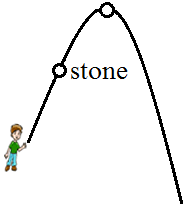
Answer
When a stone is thrown vertically upwards, the following conclusions can be done for point $P:$
- The acceleration for the entire journey of the stone is constant, as acceleration due to gravity near the surface of the earth is constant.
- The velocity of the stone at $P$ will be the least. Hence, kinetic energy at this point will be the least.
- The stone is at a maximum height at point $P.$ Hence, the potential energy is the maximum at $P.$
- Weight of the stone will remain nearly constant, as acceleration due to gravity near the surface of the earth is constant.
View full question & answer→MCQ 1601 Mark
An iron sphere of mass $10\ kg$ has the same diameter as an aluminium sphere of mass is $3.5\ kg.$ Both spheres are dropped simultaneously from a tower. When they are $10m$ above the ground, they have the same:
AnswerMomentum, potential energy and kinetic energy depend on the mass of the object; as well as on some other factors. But acceleration, in this case, is the acceleration due to gravity; which does not depend on mass or velocity. So, options $(a)$ is correct.
View full question & answer→MCQ 1611 Mark
- A
Electrical energy into sound energy in ordinary telephone.
- B
Microwave energy into sound energy in a mobile phone.
- C
Sound energy into mechanical energy in a stereo system.
- ✓
Sound energy into electrical energy in public address system.
AnswerCorrect option: D. Sound energy into electrical energy in public address system.
A microphone converts sound energy into electrical energy in public address systems.
View full question & answer→MCQ 1621 Mark
What is the unit of energy in food$?$
AnswerThe energy stored in food is measured in kilo calories. This is the unit of energy in food.
Where $1$ kilo calorie $= 4184$ Joules
View full question & answer→MCQ 1631 Mark
When we pay for our electricity bill, we are paying for the:
AnswerElectricity bill is measured in units where $1$ unit is equal to kWh which is the unit of energy. Hence, when we pay for our electricity bill, we pay for the amount of electrical energy consumed by us.
View full question & answer→MCQ 1641 Mark
A body rolling down a hill has:
AnswerCorrect option: D. Both $K.E.$ and $P.E$
A ball rolling down a hill has both Kinetic and potential energy. Kinetic energy is due to motion. So if the ball is rolling down it has kinetic energy. Potential energy is the stored energy which is waiting to be used. If the ball is at a greater height it will have more potential energy. So when the body starts rolling the stored potential energy gets converted into kinetic energy which causes its motion. Hence a body rolling down a hill has both $K.E$ and $P.E$
View full question & answer→MCQ 1651 Mark
The commercial unit of electric energy is kilowatt−hour (kWh), commonly known as:
AnswerA. Unit
Explanation:
The commercial unit of electrical energy is kilowatt−hour (kWh), commonly known as unit. $1$ kWh $= \ 1$ unit $= 3.6 \times 10^6\ J.$ Electricity bills are calculated in the units of energy consumed.
View full question & answer→MCQ 1661 Mark
Which of the following statements is incorrect?
AnswerCorrect option: D. All the central forces are non$-$conservative
Non$-$conservative force such as friction depends on other factors, such as velocity and dissipative and no potential energy can be defined for them.
Hence central forces are non$-$conservative.
View full question & answer→MCQ 1671 Mark
Which of the following energy change involves frictional force?
- A
Chemical energy to heat energy.
- ✓
Kinetic energy to heat energy.
- C
Potential energy to sound energy.
- D
Chemical energy to kinetic energy.
AnswerCorrect option: B. Kinetic energy to heat energy.
Frictional force is responsible for heating up of the tires of a moving vehicle. In such a situation, kinetic energy is converted into heat energy due to the frictional force.
View full question & answer→MCQ 1681 Mark
From the following statements find the one that is $\text{NOT}$ correct :
- A
A flying bird has both potential and kinetic energy
- ✓
A ball rolling on the ground has kinetic energy but no mechanical energy
- C
A stretched rubber band has potential energy.
- D
Chemical energy can be converted into electrical energy
AnswerCorrect option: B. A ball rolling on the ground has kinetic energy but no mechanical energy
The energy of an object by virtue of its motion is known as potential energy.
The energy possessed by a body due to its change in position or shape is called potential energy. For example, A stretched rubber band.
The sum of kinetic energy and potential energy of an object is its total mechanical energy.
View full question & answer→MCQ 1691 Mark
Work is expressed by the formula as:
- ✓
Work $=$ Force $(N)\ ×$ Distance $(m)$
- B
Work $=$ Force $(g)\ ×$ Distance $(m)$
- C
Work $=$ Force $(mg)\ ×$ Distance $(m)$
- D
Work $=$ Force $(kg)\ ×$ Distance $(cm)$
AnswerCorrect option: A. Work $=$ Force $(N)\ ×$ Distance $(m)$
Unit of force is Newton $(N).$
View full question & answer→MCQ 1701 Mark
An object is falling freely from a height $x.$ After it has fallen a height, it will possess:
- A
- B
- ✓
Half potential and half kinetic energy.
- D
Less potential and more kinetic energy.
AnswerCorrect option: C. Half potential and half kinetic energy.
During the free fall, potential energy is gradually converted into kinetic energy. At half of the maximum height, energy is equally distributed in the form of potential and kinetic energy.
View full question & answer→MCQ 1711 Mark
As the fall of the object continues, the potential energy would $.......$ while the kinetic energy would $......$
AnswerAs the fall of the object continues, the potential energy would decrease while the kinetic energy would increase.
View full question & answer→MCQ 1721 Mark
Which of the following does not have potential energy ?
AnswerPotential energy is the energy that is stored in an object due to its position above the ground surface and when the object is in motion then it has kinetic energy. Water in a flowing river has kinetic energy.
View full question & answer→MCQ 1731 Mark
A body is moved through a distance of $3m$ in the following different ways. In which case is the maximum work done$?$
- A
When pushed over an inclined plane.
- ✓
When lifted vertically upward.
- C
When pushed over smooth rollers.
- D
When pushed on a plain horizontal surface.
AnswerCorrect option: B. When lifted vertically upward.
View full question & answer→MCQ 1741 Mark
Which of the following does has kinetic energy?
AnswerAn object which has velocity with respect to the observer has Kinetic Energy.
View full question & answer→MCQ 1751 Mark
AnswerPractical unit of power is horsepower $(hp).$
One horsepower is equal to $746$ watts.
whereas Watt is the SI unit of power.
View full question & answer→MCQ 1761 Mark
The rate of doing work is called $.....:$
Answerpower is the rate of doing work. It is equivalent to an amount of energy consumed per unit time. In the $SI$ system, the unit of power is the joule per second $(J/s).$
View full question & answer→MCQ 1771 Mark
- ✓
Potential energy possessed by stored water is converted into electricity
- B
Kinetic energy possessed by stored water is converted into potential energy
- C
Water is heated to produce electricity
- D
Water is converted into steam to produce electricity
AnswerCorrect option: A. Potential energy possessed by stored water is converted into electricity
Hydro power plant uses the potential energy stored in water. When water flows down the dam, potential energy is converted into kinetic energy which is used to rotate the turbine which produce electricity.
View full question & answer→MCQ 1781 Mark
A car is accelerated on a levelled road and attains a velocity $4$ times of its initial velocity. In this process the potential energy of the car:
AnswerPotential energy depends on the height at which the object is situated. Where potential energy is measured by the product of the mass of the object, gravity, and height. In this case, there is no change in height of the object. Hence, there is no change in its potential energy.
View full question & answer→MCQ 1791 Mark
A freely falling object eventually stops on reaching ground. What happens to its potential and kinetic energy while falling?
- ✓
Potential energy decreases and Kinetic energy increases
- B
Potential energy increases and Kinetic energy increases
- C
Potential energy increases and Kinetic energy decreases
- D
AnswerCorrect option: A. Potential energy decreases and Kinetic energy increases
When an object release from a certain height then it starts to move toward the earth. During its motion, work is done by gravity along the direction of motion. Hence kinetic energy of the object started to increase.
Also, Potential energy is a function of height, so when the height of an object decreases, its potential also decreases.
View full question & answer→MCQ 1801 Mark
$1\ W. S = \_\_\_\_\_\_\_\_?$
- A
$10$ joule
- ✓
$1$ joule
- C
$3.6 × 10⁶$ joule
- D
$2$ joule
AnswerCorrect option: B. $1$ joule
$1$ joule
View full question & answer→MCQ 1811 Mark
Which of the following does not possess the ability to do work not because motion?
- A
A sparrow flying in the sky.
- B
A sparrow moving slowly on the ground.
- ✓
A sparrow in the nest on a tree.
- D
A squiral going up a tree.
AnswerCorrect option: C. A sparrow in the nest on a tree.
We will justify all statements one by one as:
- A sparrow flying in the sky possesses kinetic energy, which can be transformed into work.
- A sparrow moving slowly on the ground possesses kinetic energy, which can be transformed into work.
- A sparrow in the nest does not possess any kinetic energy as it is at rest. It does not possess the ability to do work in terms of motion of the body.
- A squirrel going up a tree possesses kinetic energy, which can be transformed into work.
View full question & answer→MCQ 1821 Mark
A girl is carrying a school bag of $3\ kg$ mass on her back and moves $200m$ on a lavelled road. The work done against the gravitational force will be $(g = 10 \mathrm{~ms}^{-2})$
AnswerCorrect option: A. $6 \times 10^3 \mathrm{~J}$
First find out force
force $=$ mass $×$ acceleration
force $= 3 × 10$
force $= 30N$
work $=$ force $×$ displacement
work $= 30 × 200$
work $= 6000$ Joule
$= 6 \times 10^3 \mathrm{~J}$
View full question & answer→MCQ 1831 Mark
$9800$ joule of energy was spent to raise a mass of $50\ kg,$ the mass was raised to a height of:
View full question & answer→MCQ 1841 Mark
When speed of the moving object is doubled its
AnswerCorrect option: C. $K\ E.$ is increased to four times
$K\ E.$ is increased to four times
View full question & answer→MCQ 1851 Mark
Which one of the following statements about power stations is not true?
- A
Hydroelectric power stations use water to drive turbines.
- B
In a power station, turbines drive generators.
- ✓
Electricity from thermal power stations differs from that produced in hydroelectric power stations.
- D
In hydroelectric power stations and thermal power stations, alternators produce electricity.
AnswerCorrect option: C. Electricity from thermal power stations differs from that produced in hydroelectric power stations.
Electricity produced in a hydroelectric power station is similar to electricity produced in thermal power plants.
View full question & answer→MCQ 1861 Mark
A rigid body of mass m kg is lifted uniformly by a man to a height of one metre in $30$ sec. Another man lifts the same mass to the same height in $60$ sec. The work done on the body against gravitation in both the cases are in ratio:
- A
$1 : 2$
- ✓
$1 : 1$
- C
$2 : 1$
- D
$4 : 1$
AnswerCorrect option: B. $1 : 1$
$W = F.S$
As work done is independent of time. So, both the man does same work.
Hence, the work done on the body against gravitation are in ratio $1 : 1.$
View full question & answer→