MCQ 11 Mark
In the given figure, $\text{QR}$ is a common tangent to the given circles touching externally at the point $T.$ The tangent at $T$ meets $\text{QR}$ at $P.$ If $\text{PT} = 3.8\ cm,$ then the length of $\text{QR} ($ in $cm)$ is:
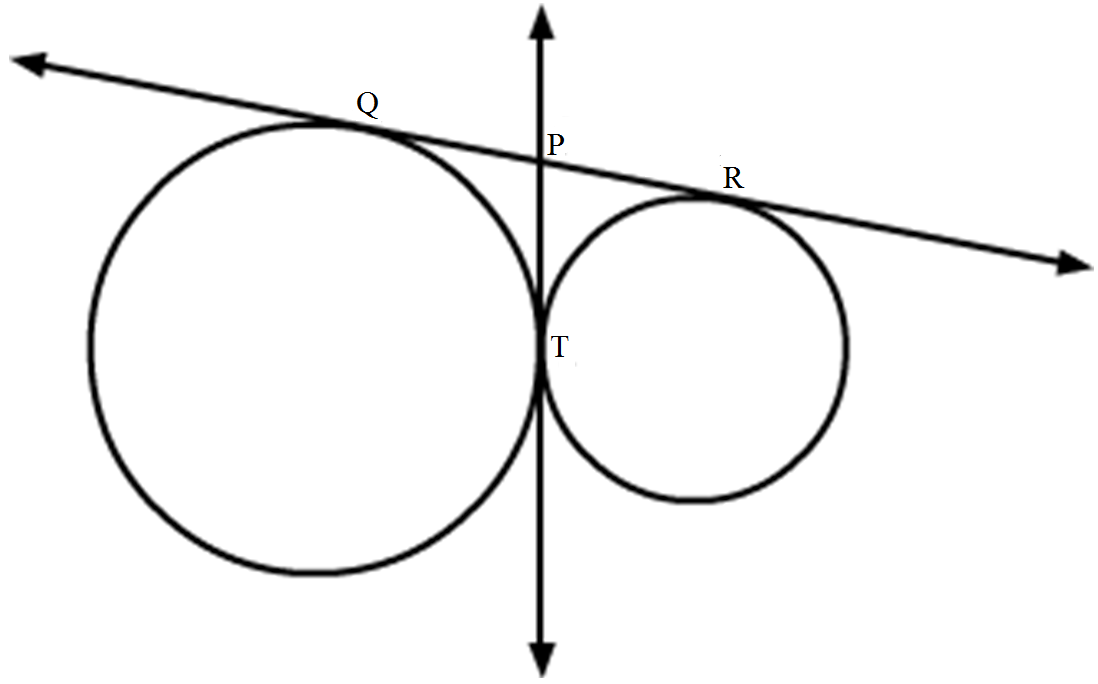
AnswerIt is given that $\text{QR}$ is a common tangent to the given circles touching externally at the point $T.$
Also, the tangent at $T$ meets $\text{QR}$ at $P$ such that $\text{PT} = 3.8\ cm.$
Now, $\text{PQ}$ and $\text{PT}$ are tangents drawn to the same circle from an external point.
$\therefore \text{PQ = PT} = 3.8\ cm ($Lengths of tangents drawn from an external point to a circle are equal$)$
$\text{PR}$ and $\text{PT}$ are tangents drawn to the same circle from an external point $T.$
$\therefore \text{PR = PT} = 3.8\ cm ($Lengths of tangents drawn from an external point to a circle are equal$)$
Now,
$\text{QR = PQ + PR} = 3.8\ cm + 3.8\ cm = 7.6\ cm$
Thus, the length of $\text{QR}$ is $7.6\ cm.$
View full question & answer→MCQ 21 Mark
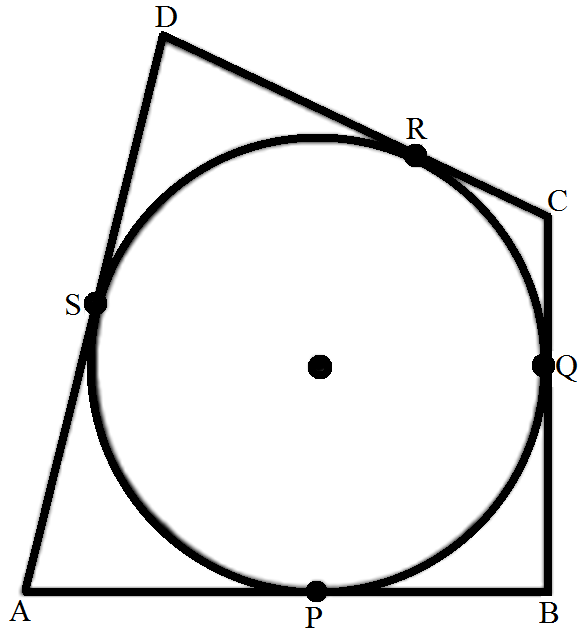
In the figure, a quadrilateral $\text{ABCD}$ is drawn to circumscribe a circle such that its sides $\text{AB, BC, CD}$ and $\text{AD}$ touch the circle at $\text{P, Q, R}$ and $S$ respectively. If $\text{AB} = x \ cm,$
$\text{BC}= 7\ cm, \text{CR} = 3\ cm$ and $\text{AS} = 5\ cm,$ then $x =$
AnswerIn the given figure,
$\text{ABCD}$ is a quadrilateral circumscribe a circle and its sides $\text{AB, BC, CD}$ and $\text{DA}$ touch the circle at $\text{P, Q, R}$ and $\text{S}$ respectively.
$\ce{AB = x \ cm, BC = 7\ cm, CR = 3\ cm, AS = 5\ cm}$
$\text{CR}$ and $\text{CQ}$ are tangents to the circle from $\text{C}$
$\ce{CR = CQ = 3\ cm}$
$\ce{BQ = BC – CQ = 7 – 3 = 4\ cm}$
$\text{BQ =}$ and $\text{BP}$ are tangents from $\text{B}$
$\ce{BP = BQ = 4\ cm}$
$\text{AS}$ and $\text{AP}$ are tangents from $\text{A}$
$\ce{AP = AS = 5\ cm}$
$\ce{AB = AP + BP = 5 + 4 = 9\ cm}$
$\ce{x = 9\ cm}$
View full question & answer→MCQ 31 Mark
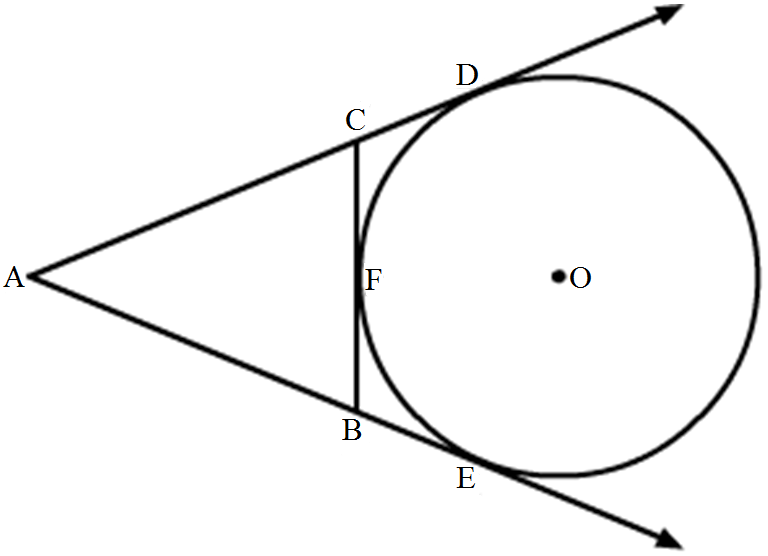
In the given figure, if $\text{AD, AE}$ and $\text{BC}$ are tangents to the circle at $\text{D, E}$ and $\text{F}$ respectively, Then:
- A
$\ce{AD = AB + BC + CA}$
- ✓
$\ce{2AD = AB + BC + CA}$
- C
$\ce{3AD = AB + BC + CA}$
- D
$\ce{4AD = AB + BC + CA}$
AnswerCorrect option: B. $\ce{2AD = AB + BC + CA}$
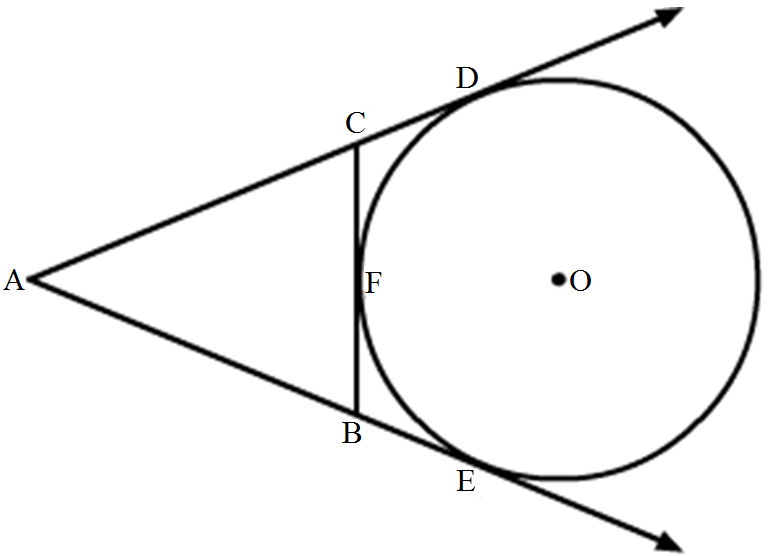
By the property of tangent
$\ce{AC = AB} ($tangent from $A)...(i)$
$\ce{CD = CF} ($tangent from $C)...(ii)$
$\ce{BF = BE} ($tangent from $B)...(iii)$
Now taking $\ce{RHS},$
$\ce{AB + BC + CA = AB + BF + FC + CA}$
$\ce{AB + BC + CA = AB + BE + CD + CA [ from (ii) (iii) ]}$
$\ce{AB + BC + CA = AE + AD}$
$\ce{AB + BC + CA = 2AD}$ View full question & answer→MCQ 41 Mark
The length of the tangent from a point $A$ at a circle, of radius $3\ cm$, is $4\ cm$. The distance of $A$ from the centre of the circle is:
- A
$\sqrt{7}\text{cm}$
- B
$7\ cm$
- ✓
$5\ cm$
- D
$25 \ cm$
AnswerCorrect option: C. $5\ cm$
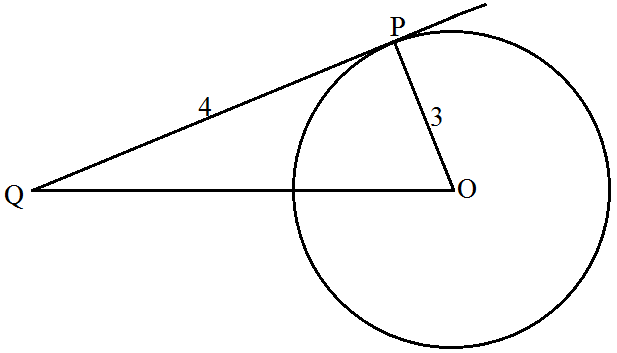
We know, radius always perpendicular to tangent so we say $\triangle\text{OPA}$ is right angle triangle then $\angle\text{OPA}=90^{\circ}$
Now, we have to find $OA$
$\Rightarrow OA^2 = AP^2 + OP^2$
$\Rightarrow OA^2 = 4^2 + 3^2$
$\Rightarrow OA^2 = 16 + 9$
$\Rightarrow OA$= $\sqrt{25}$
$\Rightarrow OA = 5$
Hence, correct choice is $(c)$ View full question & answer→MCQ 51 Mark
If $\ce{PT}$ is tahgent drawn froth a point $P$ to a circle touching it at $T$ and $O$ is the centre of the circle, then $\ce{\angle OPT + \angle POT =}$
- A
$30^\circ$
- B
$60^\circ$
- ✓
$90^\circ$
- D
$180^\circ$
AnswerCorrect option: C. $90^\circ$
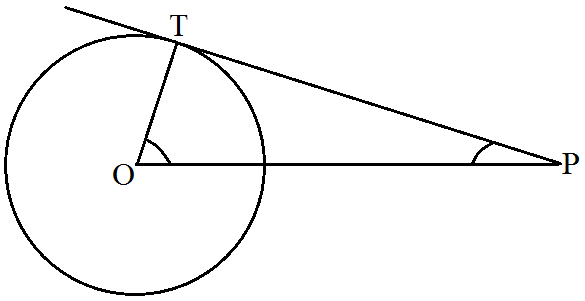
In the figure, $\text{PT}$ is the tangent to the circle with centre $O.$
$\text{OP}$ and $\text{OT}$ are joined
$\text{PT}$ is tangent and $\text{OT}$ is the radius
$\ce{OT \perp PT}$
Now in right $\triangle\text{OTP}$
$\angle\text{OTP}=90^{\circ}$
$\angle\text{OPT}+\angle\text{POT}$
$=180^{\circ}-90^{\circ}$
$=90^{\circ}$ View full question & answer→MCQ 61 Mark
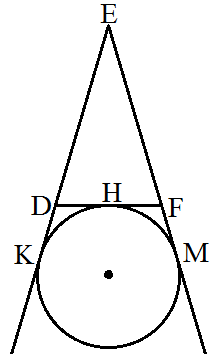
In the figure, a circle touches the side $\text{DF}$ of $\triangle\text{EDF}$ at $H$ and touches $\text{ED}$ and $\text{EF}$ produced at $K$ and $M$ respectively. If $\text{EK} = 9\ cm,$ then the perimeter $\triangle\text{EDF}$ of is:
- ✓
$18\ cm$
- B
$13.5\ cm$
- C
$12\ cm$
- D
$9\ cm$
AnswerCorrect option: A. $18\ cm$
In $\triangle\text{DEF, DF}$ touches the circle at $H$ and circle touches $\text{ED}$ and $\text{EF}$ Produced at $K$ and $M$ respectively.
$\text{EK} = 9\ cm$
$\text{EK}$ and $\text{EM}$ are the tangents to the circle.
$\text{EM = EK}= 9\ cm$
Similarly $\text{DH}$ and $\text{DK}$ are the tangent.
$\text{DH = DK}$ and $\text{FH}$ and $\text{FM}$ are tangents.
$\text{FH = FM}$
Now, perimeter of $\triangle\text{DEF}$
$\text{= ED + DF + EF}$
$\text{= ED + DH + FH + EF}$
$\text{= ED + DK + EM + EF}$
$\text{= EK + EM}$
$= 9 + 9$
$= 18\ cm.$
View full question & answer→MCQ 71 Mark
In the given figure, there are two concentric circles with centre $\text{O. PR}$ and $\text{PQS}$ are tangents to the inner circle from point plying on the outer circle. If $\text{PR} = 7.5\ cm,$ then $\text{PS}$ is equal to:
- A
$10\ cm$
- B
$12\ cm$
- ✓
$15\ cm$
- D
$18\ cm$
AnswerCorrect option: C. $15\ cm$
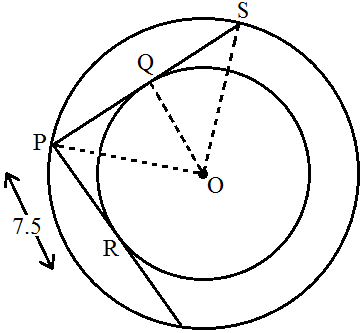
Here, $\ce{PO = OS}($radius$)$
then $\triangle\text{POS}$ called isosceles triangle.
We know, In isosceles triangle line drawn from vertex to base,
then line bisects the base in equal parts.
so we say,
$\ce{PQ = QS ...(i)}$
From the property of tangent
$\ce{PR = PQ = 7.5\ cm [}$ tangent from point $\ce{P] ...(ii)}$
Now we have to find $\ce{PS,}$
$\ce{PS = PQ + QS}$
$\Rightarrow \ce{PS = PQ + PQ [from eq.(i)]}$
$\Rightarrow \ce{PS = 7.5 + 7.5 [fromeq.(ii)]}$
$\Rightarrow \ce{PS =15\ cm}$ View full question & answer→MCQ 81 Mark
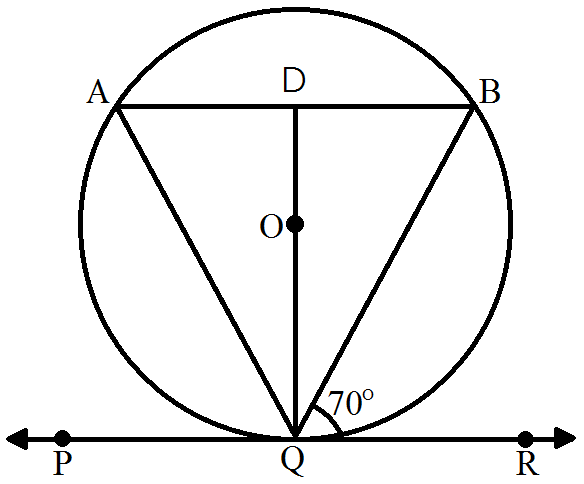
In the figure, if $\text{PQR}$ is the tangent to a circle at $\text{Q}$ whose centre is $\text{O, AB}$ is a chord parallel to $\text{PR}$ and $\angle\text{BQR}=70^\circ$ then $\angle\text{AQB}$ is equal to:
- A
$20^\circ$
- ✓
$40^\circ$
- C
$35^\circ$
- D
$45^\circ$
AnswerCorrect option: B. $40^\circ$
Given, $\ce{AB \| PR}$
$\angle\text{ABQ}=\angle\text{BQR}=70^\circ [$alternate angles$]$
Also $\text{QD}$ is perpendicular to $\text{AB}$ and $\text{QD}$ bisects $\text{AB.}$
In $\triangle\text{QDA}$ and $\triangle\text{QDB}$
$\angle\text{QDA}= \angle\text{QDB} [$each $90^\circ ]$
$\text{AD = BD}$
$\text{QD = QD}[$common side$]$
$\triangle\text{ADQ}=\angle\text{BDQ} [$by $\text{SAS}$ similarity criterion$]$
Then, $\angle\text{QAD}=\angle\text{QDA}\ ....(\text{i) [c.p.c.t.]}$
Also, $\angle\text{ABQ}=\angle\text{BQR} [$alternate interior angle$]$
$\angle\text{ABQ}=70^\circ$
$[\angle\text{BQR}=70^\circ]$
Hence, $\angle\text{QAB}=70^\circ [$ from Eq. $(i)]$
Now, In $\triangle\text{ABQ},$
$\angle\text{A}+\angle\text{B}+\angle\text{Q}=180^\circ$
$\Rightarrow\angle\text{Q}=180^\circ-(70^\circ+70^\circ)=40^\circ$
View full question & answer→MCQ 91 Mark
If radii of two concentric circles are $4\ cm$ and $5\ cm,$ then the length of each chord of one circle which is tangent to the other circle is:
- A
$3\ cm$
- ✓
$6] cm$
- C
$9\ cm$
- D
$1] cm$
AnswerCorrect option: B. $6] cm$
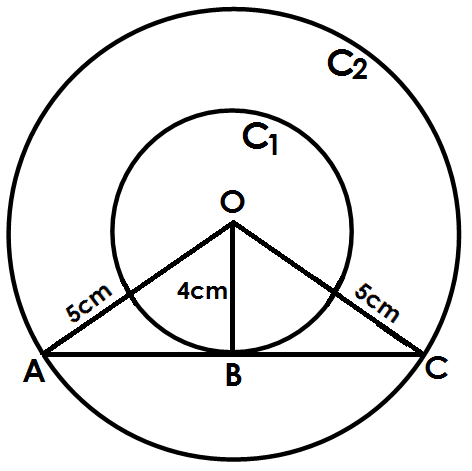
Let $O$ be the centre of two concentric circles $C_1$ and $C_2$, whose radii are $r_1 = 4\ cm$ and $r_2 = 5\ cm.$
Now, we draw a chord $AC$ of circle $C_2$, which touches the circle $C_1$ at $B$.
Also, join $OB$, which is perpendicular to $AC. [$Tangent at any point of circle is perpendicular to radius throughly the point of contact$]$
Now, in right angled $\triangle\text{OBC},$ by using Pythagoras theorem,
$\Rightarrow OC^2 = BC^2 + BO^2 [($hypotenuse$)^2 = ($base$)^2 + ($perpendicular$)^2]$
$\Rightarrow 5^2 = BC^2 + 4^2$
$\Rightarrow BC^2 = 25 – 16 = 9$
$\Rightarrow BC = 3\ cm$
Length of chord $AC = 2 BC = 2 \times 3 = 6\ cm.$
View full question & answer→MCQ 101 Mark
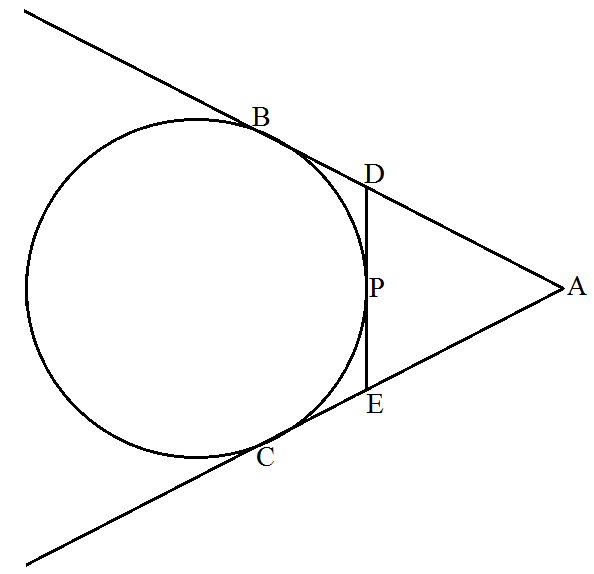
In the given figure, if $\text{AB} = 8\ cm$ and $\text{PE} = 3\ cm,$ then $\text{AE} =$
- A
$11\ cm$
- B
$7\ cm$
- ✓
$5\ cm$
- D
$3\ cm$
AnswerCorrect option: C. $5\ cm$
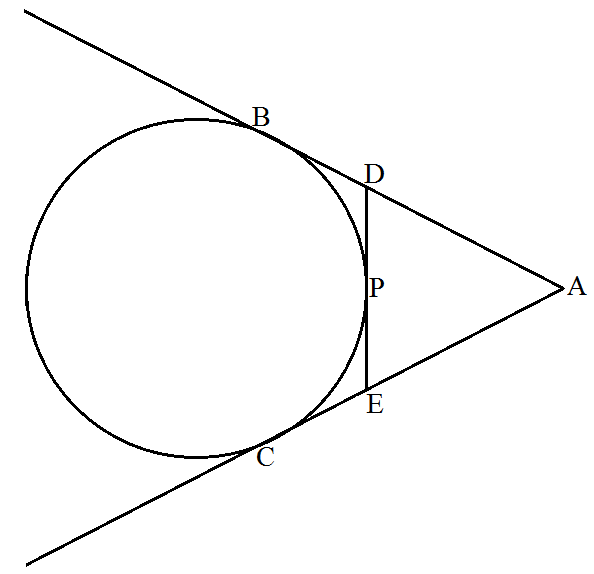
We know that tangents drawn from the same external point will be equal in length.
Therefore,
$\ce{AB = AC}$
It is given that,
$\ce{AB = 8\ cm}$
Hence,
$\ce{AC = 8\ cm}…… (1)$
Similarly,
$\ce{PE = CE}$
It is given that,
$\ce{PE = 3\ cm}$
Therefore,
$\ce{CE = 3\ cm……(2)}$
Subtracting equations $(1)$ and $(2),$ we get,
$\ce{AC − CE = 8 − 3}$
From the figure we can see that,
$\ce{AC − CE = AE}$
Therefore,
$\ce{AE = 8 − 3}$
$\ce{AE = 5\ cm}$ View full question & answer→MCQ 111 Mark
In the given figure, $RQ$ is a tangent to the circle with centre $O$. If $SQ = 6\ cm$ and $QR = 4\ cm$, then $OR =$
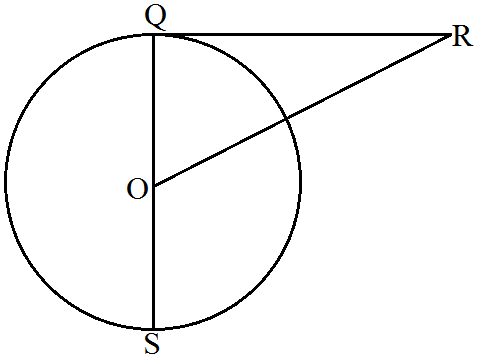
- A
$8\ cm$
- ✓
$3\ cm$
- C
$2.5\ cm$
- D
$5\ cm$
AnswerCorrect option: B. $3\ cm$
In the figure, $0$ is the centre of the circle $QR$ is tangent to the circle and $QOS$ is a diameter $SQ = 6\ cm, QR = 4\ cm$
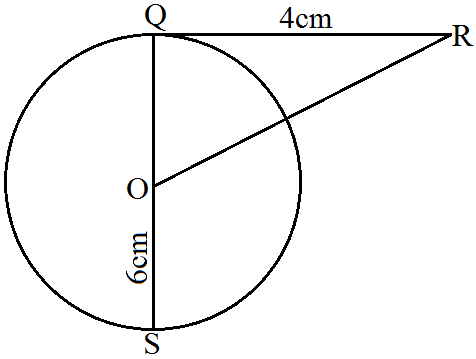
$\text{OQ}=\ \frac{1}{2}\ \text{QS}=\frac{1}{2}\times6=3\ \text{cm}$
$OQ$ is radius
$OQ ⊥ QR$
Now in right $\triangle\text{OQR}$
$OR^2 = QR^2 + QO^2 $
$= (3)^2+ (4)^2 $
$= 9 + 16 $
$= 25 $
$= (5)^2$
$OR = 5\ cm$
View full question & answer→MCQ 121 Mark
If two tangents inclined at a angle of $60^\circ$ are drawn to a circle of radius $3\ cm,$ then length of each tangent is equal to:
AnswerCorrect option: D. $3\sqrt{3}\text{cm}$
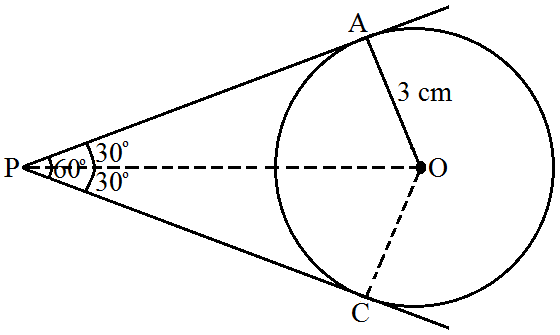
Let $P$ be an external point and a pair of tangents is drawn from point $P$ and angle between these two tangents is $60^\circ$.
Join $\text{OA}$ and $\text{OP.}$
Also, $\text{OP}$ is a bisector of line.
$\angle\text{APO}=\angle\text{CPO}=30^\circ$
Also, $\ce{OA \perp AP}$
Tangent at any point of a circle is perpendicular to the radius through the point of contact.
In right angled $\triangle\text{OAP},\tan30^\circ=\frac{\text{OA}}{\text{AP}}=\frac{3}{\text{AP}}$
$\Rightarrow\frac{1}{\sqrt{3}}=\frac{3}{\text{AP}}$
$\Rightarrow\text{AP}=3\sqrt{3}\text{cm}$
Hence, the length of each tangent is $3\sqrt{3}\text{cm}$ View full question & answer→MCQ 131 Mark
If angle between two radii of a circle is $130^\circ ,$ the angle between the tangent at the ends of radii is:
- A
$90^\circ$
- ✓
$50^\circ$
- C
$70^\circ$
- D
$40^\circ$
AnswerCorrect option: B. $50^\circ$
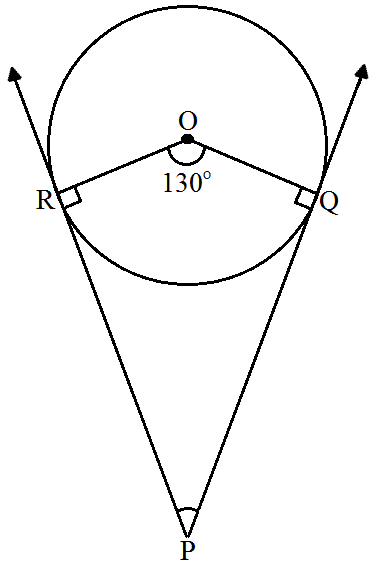
Let $\ce{PQ}$ and $\ce{RP}$ be the radii of the circle with the centre $O.$
$\angle\text{ROQ}=130^\circ$
$\text{RP}\bot\text{OR}$ and $\text{PQ}\bot\text{OQ} ($Radii are perpendicular to the tangent$)$
In quadilateral $\ce{ROQP,}$
$\angle\text{ORP}+\angle\text{RPQ}+\angle\text{PQO}+\angle\text{QOR}=360^\circ$
$\Rightarrow90^\circ+\angle\text{RPQ}+90^\circ+130^\circ=360^\circ$
$\Rightarrow\angle\text{RPQ}=50^\circ$
View full question & answer→MCQ 141 Mark
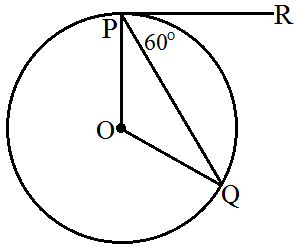
In the figure, if $\text{PR}$ is tangent to the circle at $P$ and $Q$ is the centre of the circle, then $\angle \text{POQ =}$
- A
$110^\circ$
- B
$100^\circ$
- ✓
$120^\circ$
- D
$90^\circ$
AnswerCorrect option: C. $120^\circ$
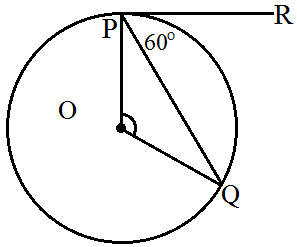
We know, radius $\text{OP}\bot$ to tangent $\text{PR}$ then $\angle\text{OPR}=90^{\circ}$
Now,
$\angle\text{OPQ}=\angle\text{OPR}-\angle\text{QPR}$
$\angle\text{OPQ}=90^{\circ}-60^{\circ}$
$\angle\text{OPQ}=30^{\circ}$
In $\triangle\text{OPQ},$
$\text{OP = OQ} ($radius of circle$)$
$\angle\text{OPQ}=\angle\text{OQP}=30^{\circ}($opposite angle of same side$)$
we also know that sum of all angle of triangle is $180^\circ$,
then $\angle\text{OPQ}+\angle\text{OQP}+\angle\text{POQ}=180^{\circ}$
$\Rightarrow30^{\circ}+30^{\circ}+\angle\text{POQ}=180^{\circ}$
$\Rightarrow\angle\text{POQ}=120^{\circ}$ View full question & answer→MCQ 151 Mark
From a point $Q$, the length of the tangent to a circle is $24\ cm$ and the distance of $Q$ from the centre is $25\ cm$. The radius of the circle is:
- ✓
$7\ cm$
- B
$12\ cm$
- C
$15\ cm$
- D
$24.5\ cm$
AnswerCorrect option: A. $7\ cm$
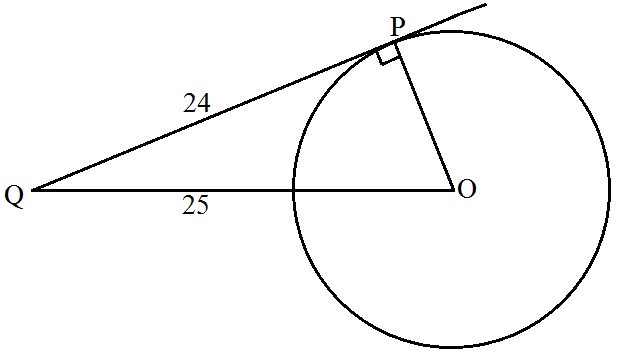
We know, radius always perpendicular to tangent so we say $\triangle\text{OPQ}$ is right angle triangle then $\angle\text{OPQ}=90^{\circ}$
Now, we have to find $OP$
$\Rightarrow OP^2 = OQ^2 - PQ^2$
$\Rightarrow OP^2 = 25^2 - 24^2$
$\Rightarrow OP^2 = 625 - 576$
$\Rightarrow\text{OP}=\sqrt{49}$
$\Rightarrow OP = 7\ cm$
Hence, correct choice is $(A)$ View full question & answer→MCQ 161 Mark
From a point $P$ which is at a distance $13\ cm$ from the centre $O$ of a circle of radius $5\ cm$, the pair of tangent $PQ$ and $PR$ to the circle are drawn. Then the area of the quadrilateral $\text{PQOR}$ is:
- ✓
$60\ cm^2$
- B
$65\ cm^2$
- C
$30\ cm^2$
- D
$32.5\ cm^2$
AnswerCorrect option: A. $60\ cm^2$
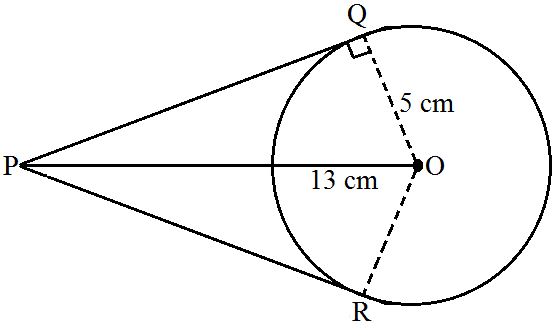
Firstly, draw a circle of radius $5\ cm$ having centre $O.$
$P$ is a point at a distance of $13\ cm$ from $O.$
A pair of tangents $PQ$ and $PR$ are drawn.
Thus, quadrilateral $\text{PQOR}$ is formed.
$OQ ⊥ QP [$since, $AP$ is a tangent line$]$
In right angled $\triangle\text{POQ}$
$\Rightarrow OP^2 = OQ^2 + QP^2$
$\Rightarrow 13^2 = 5^2 + QP^2$
$\Rightarrow QP^2 = 169 – 25 = 144 = 12^2$
$\Rightarrow QP = 12\ cm$
Now, $\text{area}\ \text{of}\triangle\text{OQP}=\frac{1}{2}\times\text{QP}\times\text{QO}=\frac{1}{2}\times12\times5=30\text{cm}^2$
Area of quadilateral $\text{QORP} = 2\triangle\text{OQP}=2\times30=60\text{cm}^2$ View full question & answer→MCQ 171 Mark
If $\text{TP}$ and $\text{TQ}$ are two tangents to a circle with centre $O$ so that $\angle\text{POQ}=110^{\circ},$ then, $\angle\text{PTQ}$ is equal to:
- A
$60^\circ$
- ✓
$70^\circ$
- C
$80^\circ$
- D
$90^\circ$
AnswerCorrect option: B. $70^\circ$
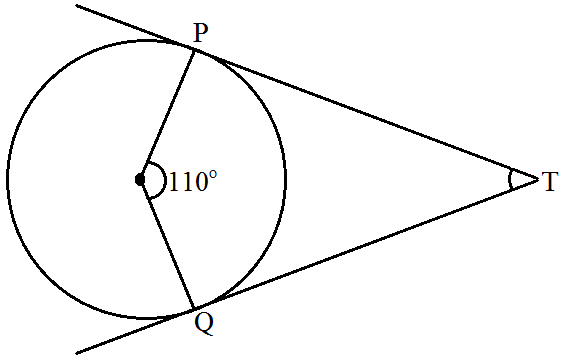
$\text{TP}$ and $\text{TQ}$ are the tangents from $T$ to the circle with centre $\text{O}$ and $\text{OP, OQ}$ are joined and $\angle\text{POQ}=110^{\circ},$
But $\angle\text{POQ}+\angle\text{PTQ}=180^{\circ}$
$\Rightarrow110^{\circ}+\angle\text{PTQ}=180^{\circ}$
$\Rightarrow\angle\text{PTQ}=180^{\circ}-110^{\circ}=70^{\circ}$ View full question & answer→MCQ 181 Mark
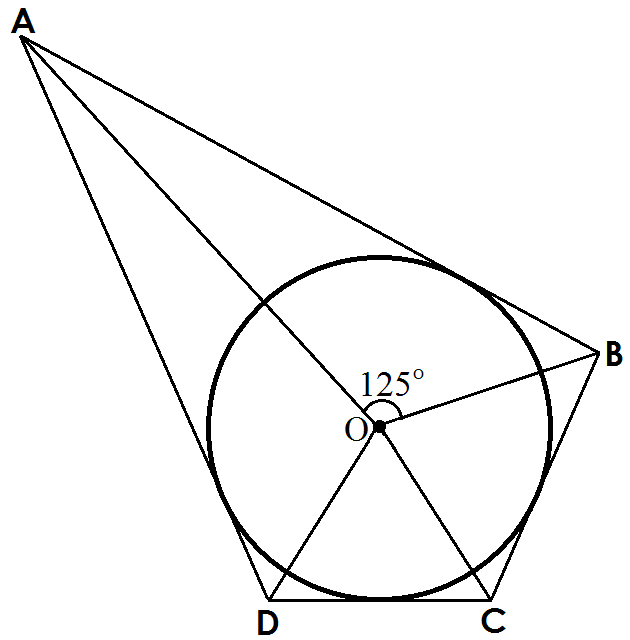
In the figure, if $\angle\text{AOB}=125^\circ$ then $\angle\text{COD}$ is equal to:
- A
$45^\circ$
- B
$35^\circ$
- ✓
$55^\circ$
- D
$62\frac{1}{2}^\circ$
AnswerCorrect option: C. $55^\circ$
We know that, the opposite sides of a quadrilateral circumscribing a circle subtend supplementary angles at the centre of the circle
$\angle\text{AOB}+\angle\text{COD}=180^\circ$
$\Rightarrow\angle\text{COD}=180^\circ-\angle\text{AOB}$
$=180^\circ-125^\circ$
$=55^\circ$
View full question & answer→MCQ 191 Mark
If tangents $\text{PA}$ and $\text{PB}$ from a point $P$ to a circle with centre $O$ are inclined to each other at
- ✓
$50^\circ$
- B
$60^\circ$
- C
$70^\circ$
- D
$80^\circ$
AnswerCorrect option: A. $50^\circ$
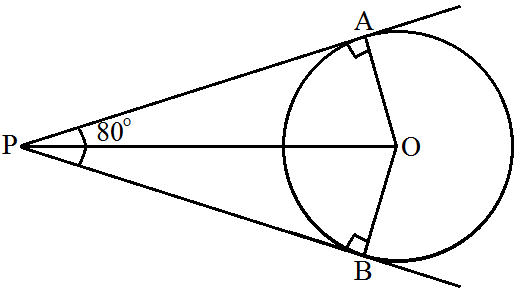
We know, radius is always perpendicular to tangent
then,
$\angle\text{OAP}=90^{\circ}(\text{OA}\bot\text{PA})$
$\angle\text{OBP}=90^{\circ}(\text{OB}\bot\text{PB})$
$\angle\text{APB}=80^{\circ}(\text{given})$
We also know that sum of all angles of a quadilateral is $360^\circ$ then,
$\angle\text{OAP}+\angle\text{OBP}+\angle\text{APB}+\angle\text{AOB}=360^{\circ}$
$\Rightarrow90^{\circ}+90^{\circ}+80^{\circ}+\angle\text{AOB}=360^{\circ}$
$\Rightarrow260^{\circ}+\angle\text{AOB}=360^{\circ}$
$\Rightarrow\angle\text{AOB}=100^{\circ}...(\text{i})$
Now, consider $\triangle\text{POA}\ \text{and}\ \triangle\text{POB},$
$\text{OA = OB} ($Radius of circle$)$
$\text{PA = PB} ($tangent grom external point $P)$
$\text{OP = OP} ($commom$)$
So, By using $\text{SSS}$ congurancy,
$\triangle\text{POA}\cong\triangle\text{POB}$
then $\angle\text{POA}=\triangle\text{POB}...(\text{ii})$
By eq. $(i)$ and $(ii)$
$\Rightarrow\angle\text{AOB}=100^{\circ}$
$\Rightarrow\angle\text{POA}+\angle\text{POB}=100^{\circ}$
$\Rightarrow2\angle\text{POA}=100^{\circ}$
$\Rightarrow\angle\text{POA}=50^{\circ}$
Hence, correct choice is $(A)$ View full question & answer→MCQ 201 Mark
The length of the tangent drawn from a point $8\ cm$ away from the centre of a circle of radius $6\ cm$ is:
- A
$\sqrt{7}\ \text{cm}$
- ✓
$2\sqrt{7}\ \text{cm}$
- C
$10\ \text{cm}$
- D
$5\ \text{cm}$
AnswerCorrect option: B. $2\sqrt{7}\ \text{cm}$
Let us first put the given data in the form of a diagram.
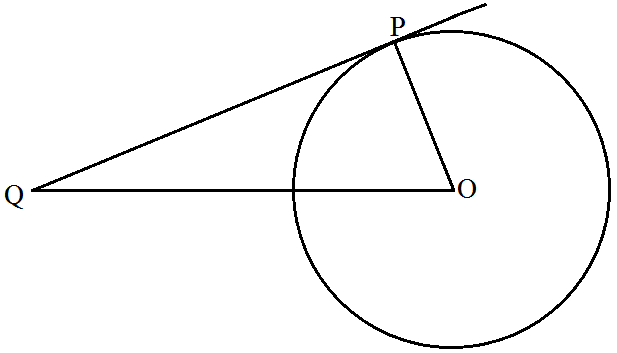
We know that the radius of a circle will always be perpendicular to the tangent at the point of contact.
Therefore, $OP$ is perpendicular to $QP$.
We can now use Pythagoras theorem to find the length of $QP.$
$QP^2 = OQ^2 - OP^2$
$QP^2 = 8^2 - 6^2$
$QP^2 = 64 - 36$
$QP^2 = 28$
$QP =\sqrt{28}$
$QP =2\sqrt{7}$ View full question & answer→MCQ 211 Mark
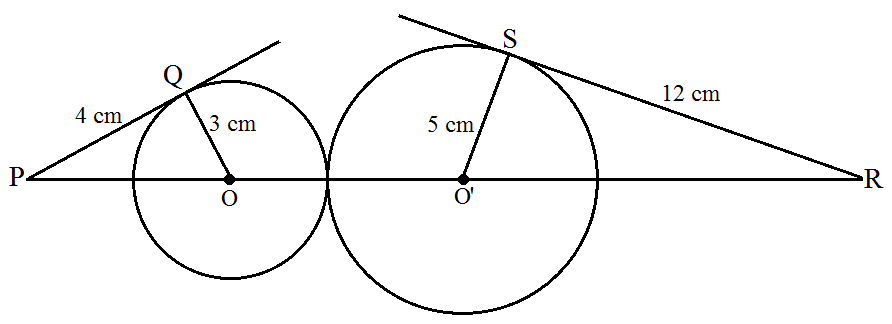
In the figure, PR =
- A
$20\ cm$
- ✓
$26\ cm$
- C
$24\ cm$
- D
$28\ cm$
AnswerCorrect option: B. $26\ cm$
$26\ cm$
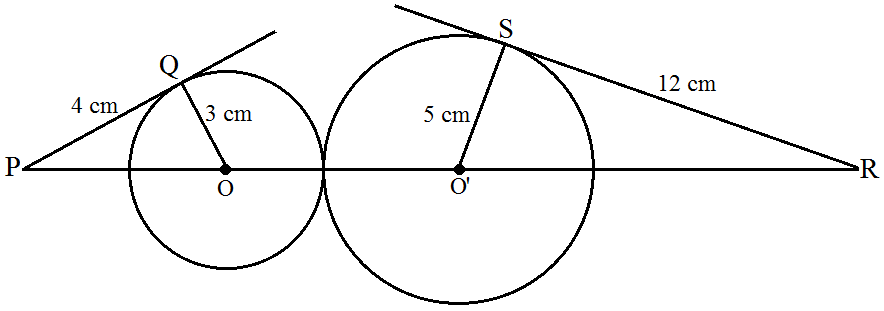
In the figure, two circles with centre $O$ and $O$’ touch each other externally $PQ$ and $RS$ are the tangents drawn to the circles.
$OQ$ and $O’S$ are the radii of these circles and $OQ = 3\ cm, PQ = 4\ cm O’S = 5\ cm$ and $SR = 12\ cm.$
Now in right $\triangle\text{OQP}$
$OP^2 = (OQ)^2 + PQ^2 = (3)^2 + (4)^2 = 9 + 16 = 25 = (5)^2$
$OP = 5cm$
Similarly in right $\triangle\text{RSO}$
$(O’R)^2 = (RS)^2 + (O’S)^2 = (12)^2 + (5)^2 = 144 + 25 = 169 = (13)^2$
$O’R = 13\ cm$
Now $PR = OP + OO’ + O’R = 5 + (3 + 5) + 13 = 26\ cm.$
View full question & answer→MCQ 221 Mark
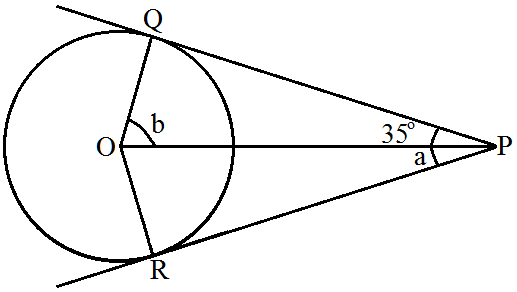
In the given figure, $\text{PQ}$ and $\text{PR}$ are tangents drawn from $P$ to a circle with centre $O$. If $\angle\text{OPQ}=35^\circ$, then:
- A
$a= 30^\circ , b= 60^\circ$
- ✓
$a= 35^\circ , b = 55^\circ$
- C
$a= 40^\circ , b = 50^\circ$
- D
$a= 45^\circ , b = 45^\circ$
AnswerCorrect option: B. $a= 35^\circ , b = 55^\circ$
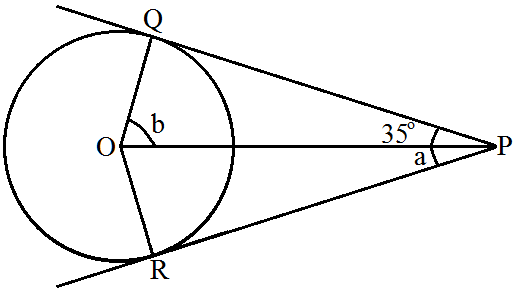
We know, radius always $\bot \text{TP}$ tangent
$\text{OQ}\bot\text{QP}$
$\text{OR}\bot\text{RP}$
From above eq. $\triangle\text{OQP}$ and $\triangle\text{ORP}$ is right angle triangle then,
$\angle\text{OQP}=\angle\text{ORP}=90^\circ$
$\triangle\text{OQP}\sim\triangle\text{ORP}$
then $\angle\text{QPO}=\angle\text{RPO}=35^\circ=\angle\text{a}$
sum of all angles in $\triangle\text{OQP}$ is $180^\circ$
$\angle\text{OQP}+\angle\text{QPO}+\angle\text{QOP}=180^\circ$
$\Rightarrow90^\circ+35^\circ+\angle\text{b}=180^\circ$
$\Rightarrow\angle\text{b}=55^\circ$ View full question & answer→MCQ 231 Mark
Two circles touch each other externally at $\text{P. AB}$ is a common tangent to the circle touching them at $A$ and $B.$ The value of $\angle\text{APB}$ is:
- A
$30^\circ$
- B
$45^\circ$
- C
$60^\circ$
- ✓
$90^\circ$
AnswerCorrect option: D. $90^\circ$
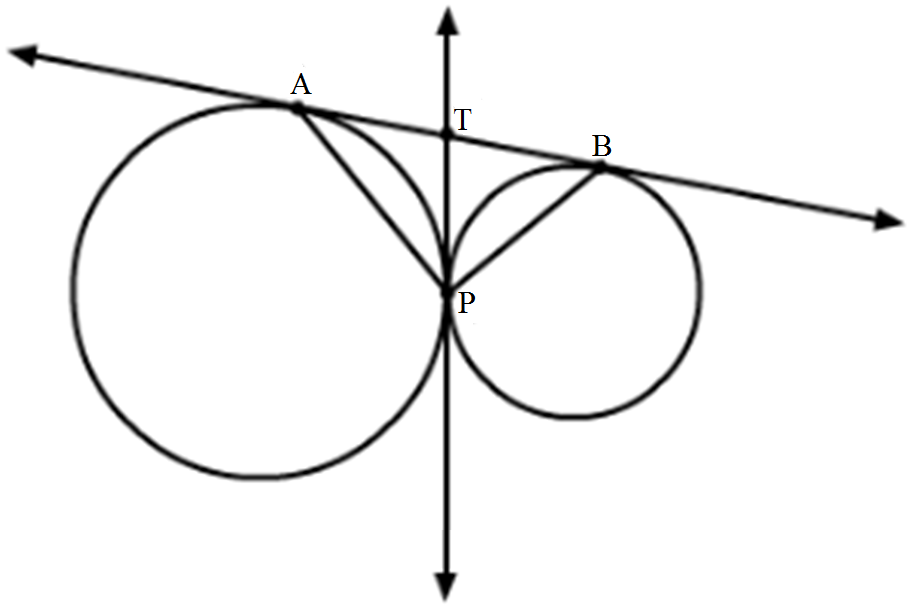
It is given that two circles touch each other externally at $\text{P. AB}$ is a common tangent to the circle touching them at $A$ and $B$.
Draw a tangent to the circle at $P,$ intersecting $\text{AB}$ at $T.$
Now, $\text{TA}$ and $\text{TP}$ are tangent drawn to the same circle from an external point $T.$
$\therefore \text{TA = TP} ($Length of tangents drawn from an external point to a circle are equal$)$
$\text{TB}$ and $\text{TP}$ are tangent drawn to the same circle from an external point $T.$
$\therefore \text{TB = TP} ($Length of tangents drawn from an external point to a circle are equal$)$
In $\triangle\text{ATP}$
$\text{TA = TP}$
$\therefore\angle\text{APT}=\angle\text{PAT}...(1)($In a triangle, equal sides have equal angles opposite to them$)$
In $\triangle\text{BTP},$
$\text{TB = TP}$
$\therefore\angle\text{BPT}=\angle\text{PBT}...(2)($In a triangle, equal sides have equal angles opposite to them$)$
Now, in $\triangle\text{APB},$
$\Rightarrow\angle\text{APB}+\angle\text{PAB}+\angle\text{PBA}=180^\circ($Angle sum property$)$
$\Rightarrow\angle\text{APB}+\angle\text{APT}+\angle\text{BPT}=180^\circ[$From $(1)$ and $(2)]$
$\Rightarrow\angle\text{APB}+\angle\text{APB}=180^\circ$
$\Rightarrow2\angle\text{APB}=180^\circ$
$\Rightarrow\angle\text{APB}=90^\circ$
Thus, the value of $\angle\text{APB}$ is $90^\circ$ View full question & answer→MCQ 241 Mark
The pair of tangents $\text{AP}$ and $\text{AQ}$ drawn from an external point to a circle with centre $O$ are perpendicular to each other and length of each tangent is $5\ cm.$ The radius of
the circle is:
- A
$10\ cm$
- B
$7.5\ cm$
- ✓
$5\ cm$
- D
$2.5\ cm$
AnswerCorrect option: C. $5\ cm$
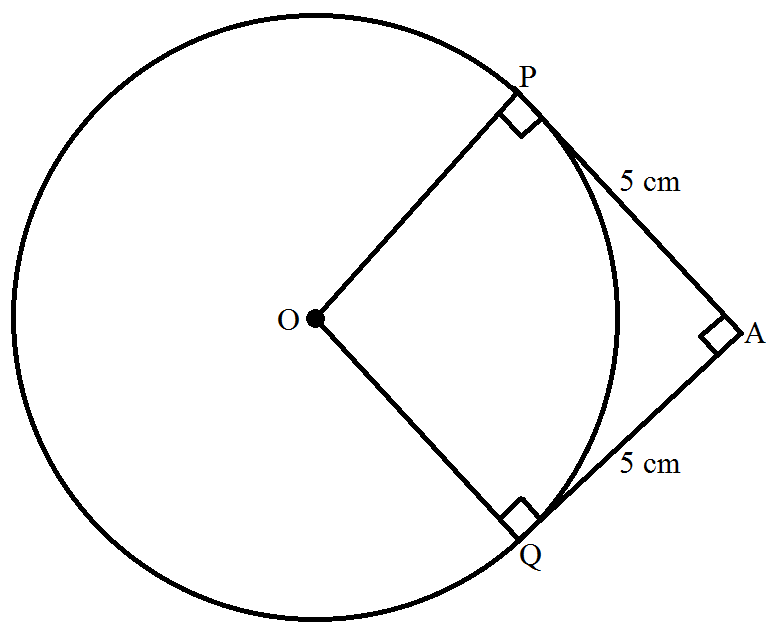
Given: $\text{AP}$ and $\text{AQ}$ are tangents to the ciecle with centre $\ce{O, AP \bot AQ}$ and $\text{AP = AQ} = 5\ cm$
We know that radius of a circle is perpendicular to the tangent at the point of contact.
$\Rightarrow\text{OP}\bot\text{AP}$ and $\text{OQ}\bot\text{AQ}$
Also sum of all angles of a quadilateral is $360^\circ$
$\Rightarrow\angle\text{O}+\angle\text{P}+\angle\text{A}+\angle\text{Q}=360^\circ$
$\Rightarrow\angle\text{O}+90^\circ+90^\circ=360^\circ$
$\Rightarrow\angle\text{O}=360^\circ-270^\circ=90^\circ$
Thus$\angle\text{O}=\angle\text{P}=\angle\text{A}=\angle\text{Q}=90^\circ$
$\Rightarrow \text{OPAQ}$ is a rectangle.
Since adjacent sides of $\text{OPAQ}$
i.e. $\text{AP}$ and $\text{AQ}$ are equal.
Thus $\text{OPAQ}$ is a square radius $\text{= OP = OQ = AP = AQ} = 5\ cm$ View full question & answer→MCQ 251 Mark
If $\text{PA}$ and $\text{PB}$ are tangents to the circle with centre $O$ such that $\angle\text{APB}=50^\circ$ then $\angle\text{OAB}$ is equal to:
- ✓
$25^\circ$
- B
$30^\circ$
- C
$40^\circ$
- D
$50^\circ$
AnswerCorrect option: A. $25^\circ$
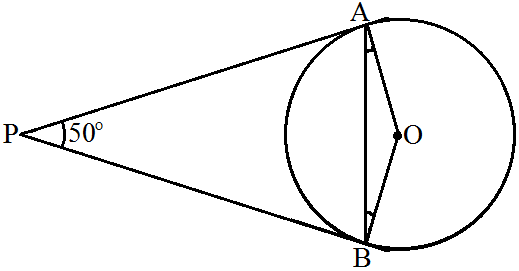
Given, $\text{PA}$ and $\text{PB}$ are tangent lines.
$\text{PA = PB} [$ Since, the length of tangents drawn from an$\angle\text{PAB}=\angle\text{PBA}=\theta ($say$)]$
In $\triangle\text{PAB},$
$\angle\text{P}+\angle\text{A}+\angle\text{B}=180^\circ [$since, sum of angles of a triangle $= 180^\circ]$
$50^\circ+\theta+\theta=180^\circ$
$2\theta=180^\circ-50^\circ=130^\circ$
$\theta=65^\circ$
Also, $\ce{OA \perp PA}[$ Since, tangent at any point of a circle is perpendicular to the radius through the point of contact.$]$
$\angle\text{PAO}=90^\circ$
$\Rightarrow\angle\text{PAB}+\angle\text{BAO}=90^\circ$
$\Rightarrow65^\circ+\angle\text{BAO}=90^\circ$
$\Rightarrow\angle\text{BAO}=90^\circ-65=25^\circ$
View full question & answer→MCQ 261 Mark
In the given figure, a circle with centre $O$ is inscribed in a quadrilateral $\text{ABCD}$ such that, it touches sides $\text{BC, AB, AD}$ and $\text{CD}$ at points $\text{P, Q, R}$ and $\text{S}$ respectively. If $\ce{AB
= 29\ cm, AD = 23\ cm, \angle\text{B}=90^\circ}$ and $\ce{DS = 5\ cm,}$ then the radius of the circle $($in $cm)$ is:
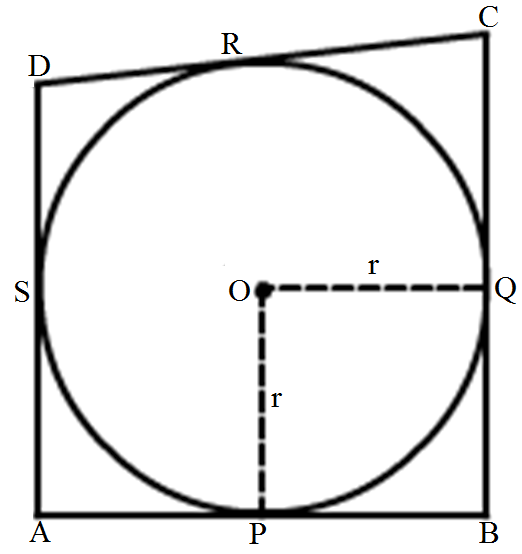
AnswerIn the figure, a circle touches the sides of a quadrilateral $\text{ABCD.}$
$\ce{\angle\text{B}=90^\circ, OP = OQ = r}$
$\ce{AB = 29\ cm, AD = 23\ cm, DS = 5\ cm}$
$\angle\text{B}=90^\circ,$
$\text{BA}$ is tangent and $\text{OQ}$ is radius
$\angle\text{QPB}=90^\circ$
Similarly $\text{OP}$ is radius and $\text{BC}$ is tangents.
$\angle\text{OPB}=90^\circ$
But $\angle\text{B}=90^\circ, ($given$)$
$\text{PBQO}$ is a square.
$\ce{DS = 5\ cm}$
But $\text{DS}$ and $\text{DR}$ are tangents to the circles.
$\ce{DR = 5\ cm}$
But $\ce{AD = 23\ cm}$
$\ce{AR = 23 – 5= 18\ cm}$
$\ce{AR = AQ} ($ tangents to the circle from $A.)$
$\ce{AQ = 18\ cm}$
But $\ce{AB = 29 \ cm}$
$\ce{BQ = 29 – 18 = 11\ cm}$
$\ce{OPBQ}$ is a square.
$\ce{OQ = BQ = 11\ cm}$
Radius of the circle $= 11\ cm.$
View full question & answer→MCQ 271 Mark
If four sides of a quadrilateral $\text{ABCD}$ are tangential to a circle, then:
- A
$\text{AC + AD = BD + CD}$
- ✓
$\text{AB + CD = BC + AD}$
- C
$\text{AB + CD = AC + BC}$
- D
$\text{AC + AD = BC + DB}$
AnswerCorrect option: B. $\text{AB + CD = BC + AD}$
A circle is inscribed in a quadrilateral $\text{ABCD}$ which touches the sides $\text{AB, BC, CD}$ and $\text{DA}$ at $\text{P, Q, R}$ and $\text{S}$ respectively then the sum of two opposite sides is equal
to the sum of other two opposite sides
$\text{AB + CD = BC + AD}$
View full question & answer→MCQ 281 Mark
Two equal circles touch each other externally at $C$ and $\text{AB}$ is a common tangent to the circles. Then, $\angle\text{ACB}=$
- A
$60^\circ$
- B
$45^\circ$
- C
$30^\circ$
- ✓
$90^\circ$
AnswerCorrect option: D. $90^\circ$
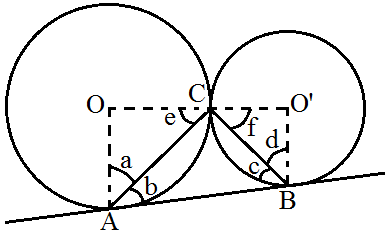
we know, radius always $\bot$ to tangent then,
$\angle\text{OAB}=\angle\text{a}+\angle\text{b}=90^{\circ}[\because\text{OA}\bot\text{AB}]$
$\Rightarrow\angle\text{a}=90^{\circ}=\angle\text{b}...(\text{i})$
$\angle\text{O'BA}=\angle\text{C}+\angle\text{d}=90^{\circ}$
$\Rightarrow\angle\text{d}=90^{\circ}-\angle\text{c}...(\text{ii})$
Here, redius are equal.
$\angle\text{a}=\angle\text{e} ($opposite angle of same side$)$
$\angle\text{d}=\angle\text{f} ($opposite angle of same side$)$
Now,
$\Rightarrow\angle\text{ACB}=\angle\text{OCO'}-\angle\text{e}-\angle\text{f}$
$\Rightarrow\angle\text{ACB}=180^{\circ}-\angle\text{a}-\angle\text{d}$
Put the value from eq. $(i)$ and $(ii)$
$\Rightarrow\angle\text{ACB}=180^{\circ}-(90-\angle\text{b})-(90-\angle\text{c})$
$\Rightarrow\angle\text{ACB}=180^{\circ}-90-\angle\text{b}-90-\angle\text{c}$
$\Rightarrow\angle\text{ACB}=\angle\text{b}+\angle\text{c}...(\text{iii})$
Now In $\triangle\text{ACB}$
$\angle\text{b}+\angle\text{c}+\angle\text{ACB}=180^{\circ}$
from eq$....(iii)$
$\Rightarrow\angle\text{ACB}+\angle\text{ACB}=180^{\circ}$
$\Rightarrow2\angle\text{ACB}=180^{\circ}$
$\Rightarrow\angle\text{ACB}=90^{\circ}$ View full question & answer→MCQ 291 Mark
In the figure, if $AP = 10\ cm$, then $BP =$
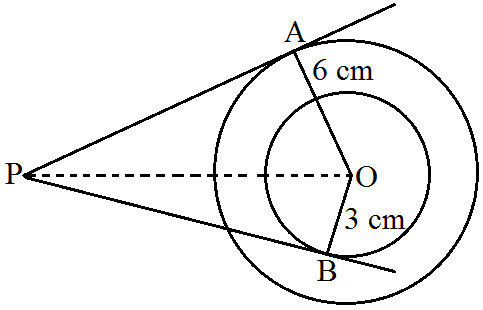
- A
$\sqrt{91}\ \text{cm}$
- ✓
$\sqrt{127}\ \text{cm}$
- C
$\sqrt{119}\ \text{cm}$
- D
$\sqrt{109}\ \text{cm}$
AnswerCorrect option: B. $\sqrt{127}\ \text{cm}$
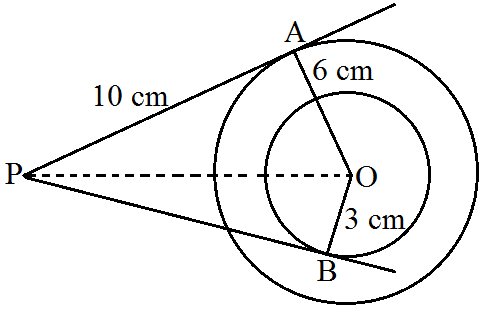
In the figure,
$OA = 6\ cm, OB = 3\ cm$ and $AP = 10\ cm$
$OA$ is radius and $AP$ is the tangent
$OA \perp AP$
Now in right $\triangle\text{OAP}$
$OP^2 = AP^2 + OA^2 $
$= (10)^2 + (6)^2 $
$= 100 + 36 $
$= 136$
Similarly $BP$ is tangent and $OB$ is radius
$OP^2 = OB^2 + BP^2$
$136 = (3)^2 + BP^2$
$136 = 9 + BP^2$
$\Rightarrow BP^2 $
$= 136 – 9 $
$= 127$
$BP =\sqrt{127}\ \text{cm}$ View full question & answer→MCQ 301 Mark
In the figure, if tangents $PA$ and $PB$ are drawn to a circle such that $\angle\text{APB}=30^\circ$ and chord $AC$ is drawn parallel to the tangent $PB,$ then $\angle\text{ABC} =$
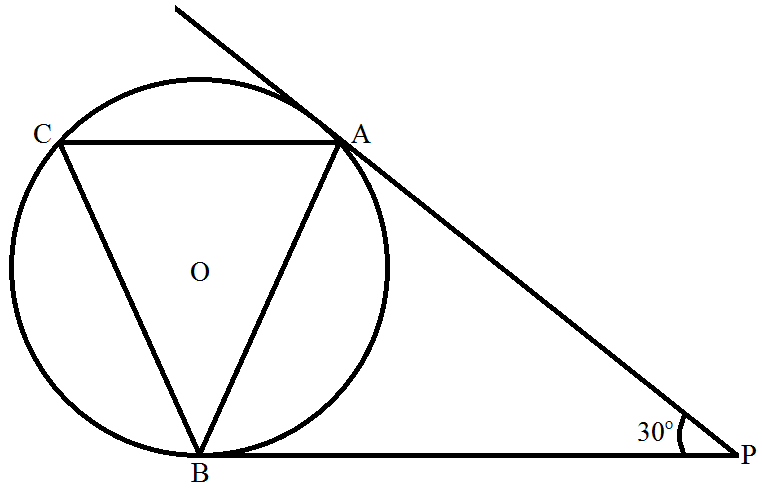
- A
$60^\circ$
- B
$90^\circ$
- ✓
$30^\circ$
- D
AnswerCorrect option: C. $30^\circ$
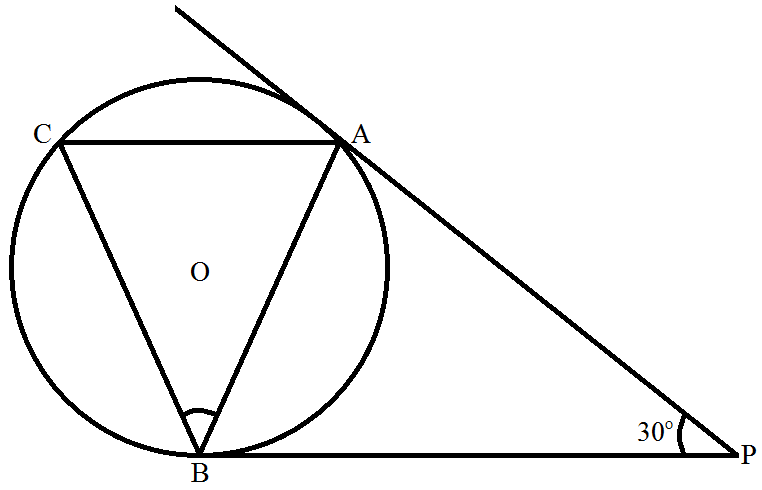
By property of tangent $\text{PA = PB} ($ tangent from $P)$
then, In $\triangle\text{ABP}$
$\text{PA = PB}$ and $\angle\text{PAB}=\angle\text{ABP}$
Sum of all angles of triangle $\text{APB}$ is $180^\circ$
$\angle\text{PAB}+\angle\text{ABP}+\angle\text{APB}=180^\circ$
$\Rightarrow\angle\text{ABP}+\angle\text{ABP}+30^\circ=180^\circ$
$\Rightarrow2\angle\text{ABP}=150^\circ$
$\Rightarrow\angle\text{ABP}=75^\circ$
$\angle\text{ABP}=\angle\text{BAC}=75^\circ($Alternate algles$)$
$\angle\text{ABP}=\angle\text{ACB}=75^\circ($Alternate segment theorem$)$
Now, sum of all angles of $\triangle\text{ABC}=180^\circ$
$\Rightarrow\angle\text{BAC}+\angle\text{ACB}+\angle\text{ABC}=180^\circ$
$\Rightarrow75^\circ+75^\circ+\angle\text{ABC}=180^\circ$
$\Rightarrow\angle\text{ABC}=30^\circ$ View full question & answer→MCQ 311 Mark
In the given figure, if quadrilateral $\text{PQRS}$ circumscribes a circle, then $\text{PD + QB} =$ 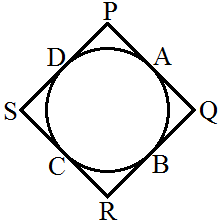
- ✓
$\text{PQ}$
- B
$\text{QR}$
- C
$\text{PR}$
- D
$\text{PS}$
AnswerCorrect option: A. $\text{PQ}$
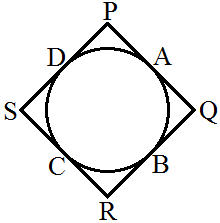
We know that tangents drawn to a circle from the same external point will be equal in length.
Therefore,
$\text{PD = PA …… (1)}$
$\text{QB = QA …… (2)}$
Adding equations $(1)$ and $(2)$, we get,
$\text{PD + QB = PA + QA}$
By looking at the figure we can say,
$\text{PD + QB = PQ.}$ View full question & answer→MCQ 321 Mark
In a right triangle $ABC$, right angled at $B$, $BC = 12\ cm$ and $AB = 5\ cm$. The radius of the circle inscribed in the triangle (in cm) is:
Answer$2$
Solution:
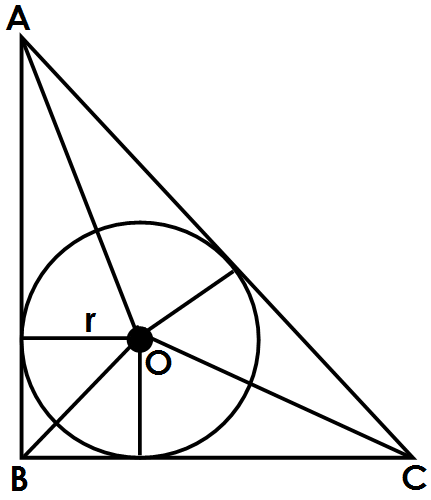
$\Rightarrow AC^2 = AB^2 + (BC)^2$ [Pythagoras theorem]
$\Rightarrow AC^2 = 25 + 144 = 169$
$\Rightarrow AC = 13\ cm$
$\text{ar}.\ \text{of}\ \triangle\text{ABC}$ $=\text{ar}.\ \text{of}\ \triangle\text{AOB}$ $+\text{ar}.\ \text{of}\ \triangle\text{BOC}$ $+\text{ar}.\ \text{of}\ \triangle\text{AOC}$
$\frac{5\times12}{2}=\frac{\text{AB}\times\text{r}}{2}+\frac{\text{BC}\times\text{r}}{2}+\frac{\text{AC}\times\text{r}}{2}$
$60=\text{r}(\text{AB}+\text{BC}+\text{AC})$ $[\because\text{Area}\ \text{of}\ \triangle=\frac{\text{Base}\times\text{Corr.alt}}{2}]$
$60=\text{r}(5+12+13)$
$60=30\text{r}\Rightarrow\text{r}=2\text{cm}$ View full question & answer→MCQ 331 Mark
$AB$ and $CD$ are two common tangents to circles which touch each other at $C.$ If $D$ lies on $AB$ such that $CD = 4\ cm,$ then $AB$ is equal to:
- A
$4\ cm$
- B
$6\ cm$
- ✓
$8\ cm$
- D
$12\ cm$
AnswerCorrect option: C. $8\ cm$
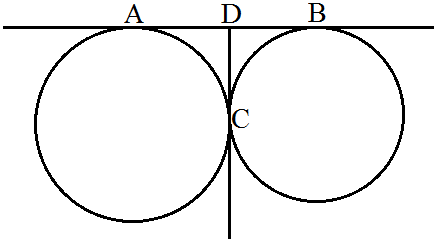
By property of tangent,
$\text{AD = DC} ($ tangent from $D)$
$\text{DB = DC} ($ tangent from $D)$
Given, $\text{DC} = 4\ cm$
Now, we have to find $AB$
$\text{AB = AD + DB}$
$\Rightarrow \text{AB = DC + DC}$
$\Rightarrow \text{AB = 2DC}$
$\Rightarrow \text{AB} = 2 \times 4$
$\Rightarrow \text{AB} = 8\ cm$ View full question & answer→MCQ 341 Mark
Two concentric circles of radii $3\ cm$ and $5\ cm$ are given. Then length of chord BC which touches the inner circle at P is equal to:
- A
$4\ cm$
- B
$6\ cm$
- ✓
$8\ cm$
- D
$10\ cm$
AnswerCorrect option: C. $8\ cm$
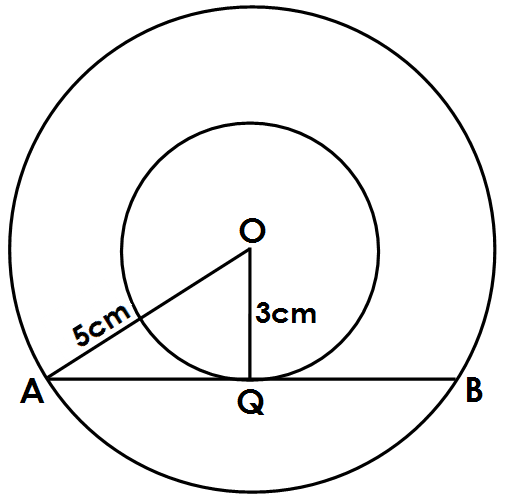
Here, radius $OQ$ $\bot$ to tangent $AB$ then we say,
$\angle\text{OQA}=\angle\text{OQB}=90^\circ$
and $\triangle\text{OQA}$ is right angle triangle then,
$AQ^2 = OA^2 - OQ^2$
$^\Rightarrow AQ2 = 5^2 - 3^2$
$^\Rightarrow AQ^2 = 25 - 9$
$\Rightarrow\text{AQ}^2=\sqrt{16}$
$^\Rightarrow AQ = 4cm$
By property of tangent.
$BQ = BP($tangent from point $B)$
$\because$ $OQ$ bisects $AB$ then $AQ = QB = 4\ cm$
$OP$ bisects $AB$ then $BP = PC = 4\ cm$
Now, we have to find $BC,$
$BC = BP + PC$
$\Rightarrow BC = 4 + 4$
$\Rightarrow BC = 8\ cm.$ View full question & answer→MCQ 351 Mark
At one end of a diameter $PQ$ of a circle of radius $5\ cm$, tangent $XPY$ is drawn to the circle. The length of chord $AB$ parallel to $XY$ and at distance of $8\ cm$ from $P$ is:
- A
$5\ cm$
- B
$6\ cm$
- C
$7\ cm$
- ✓
$8\ cm$
AnswerCorrect option: D. $8\ cm$
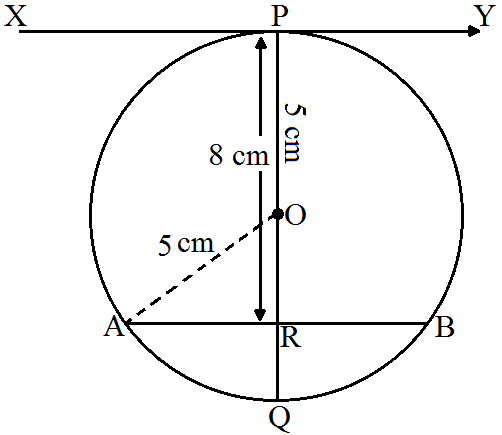
In the figure, $PQ$ is diameter $XPY$ is tangent to the circle with centre $O$ and radius $5\ cm$ From $P$, at a distance of $8\ cm$ $AB$ is a chord drawn parallel to $XY.$
To find the length of $AB$ Join $OA$
$XY$ is tangent and $OP$ is the radius.
$OP ⊥ XY$ or $PQ ⊥ XY$
$AB || XY$
$OQ is ⊥ AB$ which meets $AB$ at $R$
Now in right $\triangle\text{OAR}$
$OA^2 = OR^2 + AR^2$
$(5)^2 = (3)^2 + AR^2$
$25 = 9 + AR^2$
$\Rightarrow AR^2 = 25 – 9 = 16 = (4)^2$
$AR = 4\ cm$
But $R$ is mid-point of $AB$
$AB = 2 AR = 2\times 4 = 8\ cm$
View full question & answer→MCQ 361 Mark
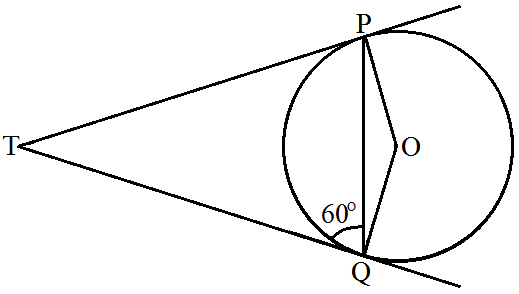
In the figure, if $TP$ and $TQ$ are tangents drawn from an external point $T$ to a circle with centre $O$ such that$\angle\text{TQP}=60^\circ,$ then:
- A
$25^\circ$
- ✓
$30^\circ$
- C
$40^\circ$
- D
$60^\circ$
AnswerCorrect option: B. $30^\circ$
In the figure, $\text{TP}$ and $\text{TQ}$ are the tangents drawn from $T$ to the circle with centre $\text{O. OP, OQ}$ and $\text{PQ}$ are joined.$\angle\text{TQP}=60^\circ$
$\text{TP = TQ} ($Tangents from $T$ to the circle$)$
$\angle\text{TPQ}=\angle\text{TQP}=60^\circ$
$\angle\text{PTQ}=180^\circ-(60^\circ+60^\circ)=180^\circ-120^\circ=60^\circ$
and $\angle\text{PTQ}=180^\circ-(60^\circ+60^\circ)=180^\circ-120^\circ=60^\circ$
But $\text{OP = OQ} ($radii of the same circle.$)$
$\angle\text{OPQ}=\angle\text{OQP}$
But $\angle\text{OPQ}+\angle\text{OQP}=180^\circ-120^\circ=60^\circ$
But $\angle\text{OQP}=30^\circ$
View full question & answer→MCQ 371 Mark
In the given figure, $\text{DE}$ and $\text{DF}$ are tangents from an external point $D$ to a circle with centre $A.$ If $\text{DE} = 5\ cm$ and $\ce{DE \perp DF,}$ then the radius of the circle is:
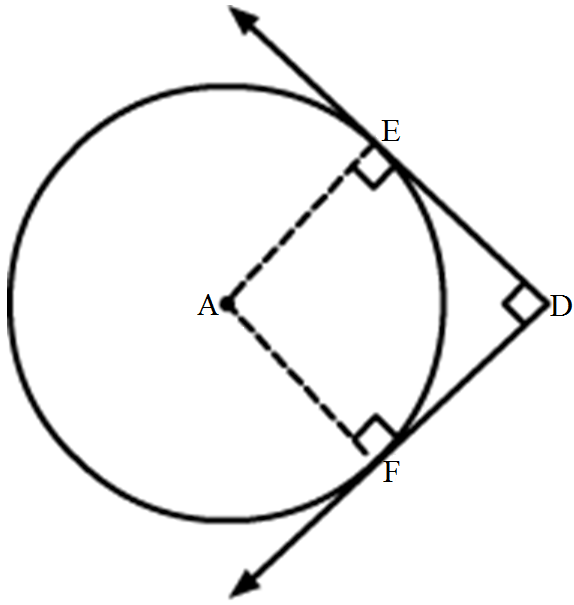
- A
$3\ cm$
- ✓
$5\ cm$
- C
$4\ cm$
- D
$6\ cm$
AnswerCorrect option: B. $5\ cm$
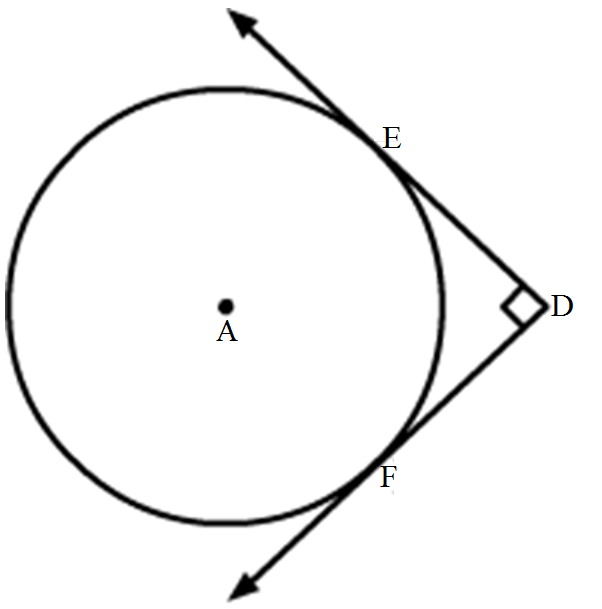
join $\text{AE}$ and $\text{AF.}$
Now, $\text{DE}$ is a tangent at $\text{E}$ and $\text{AE}$ is the radius through the point of contact $E.$
$\therefore\angle\text{AED}=90^\circ($Tangent at any point of a circle is perpendicular to the radius through the point of contact$)$
Also, $\text{DF}$ is a tangent at $\text{F}$ and $\text{AF}$ is the radius through the point of contct $F.)$
$\therefore\angle\text{AFD}=90^\circ($Tangent at any point of a circle is perpendicular to the radius through the point of contact$)$
$\therefore\angle\text{EDF}=90^\circ\ (\text{DE}\bot\text{DF})$
Also, $\text{DF = DE} ($ length of tangents drawn from an external point to a circle are equal$)$
so, $\text{AEDF}$ is a square.
$\therefore \text{AE = AF = DE} = 5\ cm ($sides if square are equal$)$
Thus, the radius of the circle is $5\ cm.$ View full question & answer→MCQ 381 Mark
A tangent $PQ$ at a point $P$ of a circle of radius 5cm meets a line through the centre $O$ at a point $Q$ such that $OQ = 12\ cm$. Length $PQ$ is:
- A
$12\ cm$
- B
$13\ cm$
- C
$8.5\ cm$
- ✓
$\sqrt{119}\text{cm}$
AnswerCorrect option: D. $\sqrt{119}\text{cm}$
Let us first put the given data in the form of a diagram.
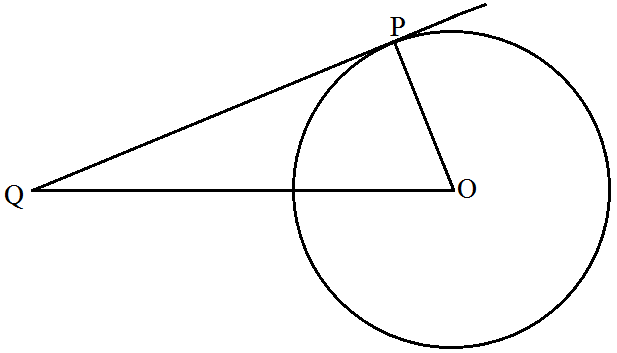
Given data is as follows:
$OQ = 12\ cm$
$OP = 5\ cm$
We have to find the length of $QP$.
We know that the radius of a circle will always be perpendicular to the tangent at the point of contact. Therefore, $OP$ is perpendicular to $QP$. We can now use Pythagoras theorem to find the length of $QP.$
$QP^2 = OQ^2 - OP^2$
$QP^2= 12^2 - 5^2$
$QP^2 = 144 - 25$
$QP^2 = 119$
$\text{QP}\sqrt{119}$
Therefore the correct answer is choice $(d).$ View full question & answer→MCQ 391 Mark
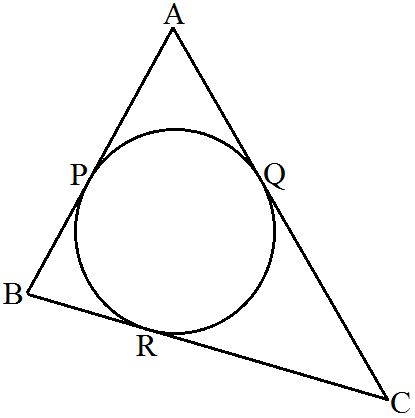
In the figure, if $\text{AP = PB}$, then:
- A
$\text{AC = AB}$
- ✓
$\text{AC = BC}$
- C
$\text{AQ = QC}$
- D
$\text{AB = BC}$
AnswerCorrect option: B. $\text{AC = BC}$
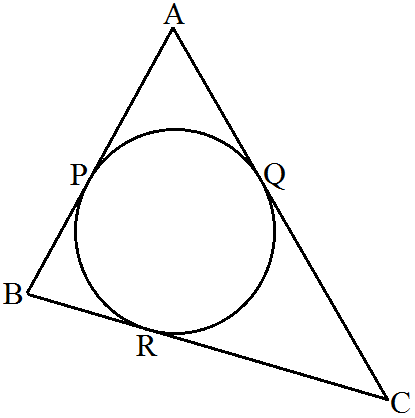
In the figure, $\text{AP = PB}$
But $\text{AP}$ and $\text{AQ}$ are the tangent from $A$ to the circle.
$\text{AP = AQ}$ Similarly $\text{PB = BR}$
But $\text{AP = PB} ($ given $)$
$\text{AQ = BR} ….(i)$
But $\text{CQ}$ and $\text{CR}$ the tangents drawn from $\text{C}$ to the circle
$\text{CQ = CR}$
Adding in $(i)$
$\text{AQ + CQ = BR + CR}$
$\text{AC = BC}$ View full question & answer→MCQ 401 Mark
In the given figure, the sides $\text{AB, BC}$ and $\text{CA}$ of triangle $\text{ABC},$ touch a circle at $\text{P, Q}$ and $\text{R}$ respectively. If $\ce{PA = 4\ cm, BP = 3\ cm}$ and $\ce{AC = 11\ cm,}$ then length of $\text{BC}$ is:
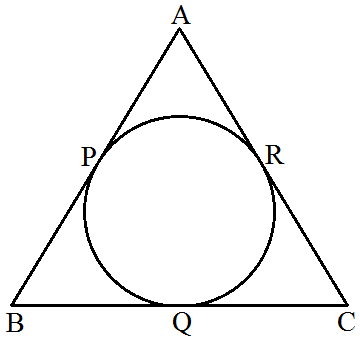
- A
$11\ cm$
- ✓
$10\ cm$
- C
$14\ cm$
- D
$15\ cm$
AnswerCorrect option: B. $10\ cm$
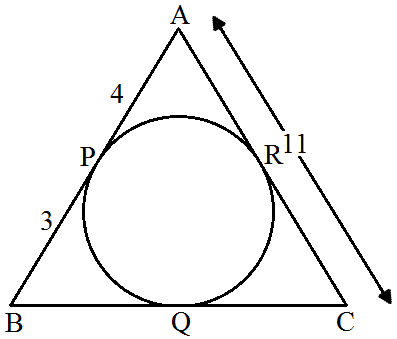
By property of tangent
$\ce{AP = AR = 4\ cm}($ tangent from $A) ...(i)$
$\ce{BP = BQ = 3\ cm}($tangent from $B) ...(ii)$
$\ce{RC = QC}($tangent from $C) ...(iii)$
$\ce{AC = 11\ cm}($ given$)$
Now, we have to find $\ce{BC}$
$\ce{BC = BQ + QC}$
$\Rightarrow \ce{BC = 3 + RC [from eq. (ii) and (iii)]}$
$\Rightarrow \ce{BC = 3 + (AC + AR) [from fig]}$
$\Rightarrow \ce{BC = 3 + (11 - 4) [from eq. (i)]}$
$\Rightarrow \ce{BC = 3 + 7}$
$\Rightarrow \ce{BC = 10\ cm}$ View full question & answer→MCQ 411 Mark
$PQ$ is a tangent drawn from a point $P$ to a circle with centre $O$ and $\ce{QOR}$ is a diameter of the circle such that $\angle\text{POR}=120^{\circ}$ then $\angle\text{OPQ}$ is:
- A
$60^\circ$
- B
$45^\circ$
- ✓
$30^\circ$
- D
$90^\circ$
AnswerCorrect option: C. $30^\circ$
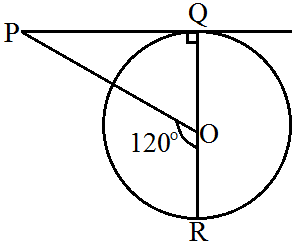
we know, radius always $\bot$ to tangent, then
$\angle\text{PQO}=90^{\circ}(\text{OQ}\bot\text{PQ})$
Given, $\angle\text{POR}=120^{\circ}$
then, $\angle\text{POQ}=\angle\text{QOR}-\angle\text{POR}$
$\Rightarrow\angle\text{POQ}=180^{\circ}-120^{\circ}$
$\Rightarrow\angle\text{POQ}=60^{\circ}$
Now, In $\triangle\text{OPQ}$
Sum of all angles are equal to $180^{\circ}$
then,
$\angle\text{OPQ}+\angle\text{POQ}+\angle\text{PQO}=180^{\circ}$
$\Rightarrow\angle\text{OPQ}+90^{\circ}+60^{\circ}=180^{\circ}$
$\Rightarrow\angle\text{OPQ}+150^{\circ}=180^{\circ}$
$\Rightarrow\angle\text{OPQ}=30^{\circ}$ View full question & answer→MCQ 421 Mark
$AP$ and $AQ$ are tangents drawn from a point $A$ to a circle with centre $O$ and radius 9cm. If $OA = 15\ cm$, then $AP + AQ =$
- A
$12\ cm$
- B
$18\ cm$
- ✓
$24\ cm$
- D
$36\ cm$
AnswerCorrect option: C. $24\ cm$
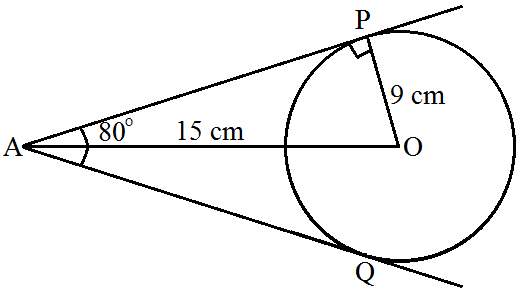
By the property of tangent
$AP = AQ ($tangent from $A)...(i)$
We know, radius always $\bot$ to tangent then $\triangle\text{OPQ}$ is right angle triangle the $\angle\text{OPA}=90^{\circ}$
Now, $AP^2 = OA^2 - OP^2$
$\Rightarrow AP^2 = 15^2 - 9^2$
$\Rightarrow AP^2 = 225 - 81$
$\Rightarrow AP =$ $\sqrt{144}$
$\Rightarrow AP = 12\ cm$
we have to find $AP + AQ = 12 + 12 = 24\ cm [$from$(i)]$ View full question & answer→MCQ 431 Mark
At one end $A$ of a diameter $AB$ of a circle of radius $5\ cm$, tangent $\text{XAY}$ is drawn to the circle. The length of the chord $CD$ parallel to $XY$ and at a distance $8 \ cm$ from $A$ is:
- A
$4\ cm$
- B
$5\ cm$
- C
$6\ cm$
- ✓
$8\ cm$
AnswerCorrect option: D. $8\ cm$
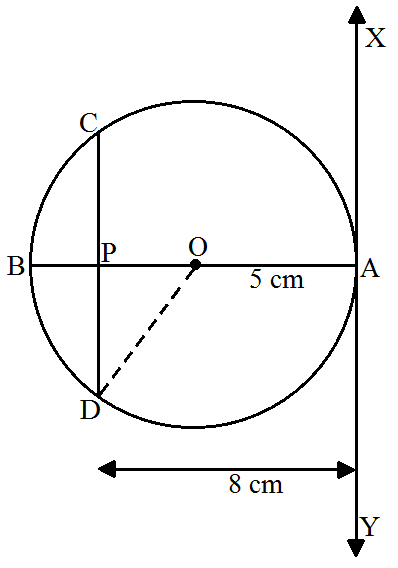
$XY$ is the tangent to the circle with centre $O $.
$C D$ is the chord.
$O A=O B=O D=5 \ cm \text { (radii) }$
$P A=8 \ cm$
$P O=3 \ cm$
$\text { In } \triangle P O D$
$\Rightarrow P D^2+P O^2=O D^2$
$\Rightarrow 3^2+P D^2=5^2$
$\Rightarrow P D^2=25-9=16$
$\Rightarrow P D=4 \ cm$
$\text { Hence, } C D=C P+P D=4+4=8 \ cm$ View full question & answer→MCQ 441 Mark
In the adjacent figure, if $AB = 12\ cm, BC = 8\ cm$ and $AC = 10\ cm,$ then $AD =$ 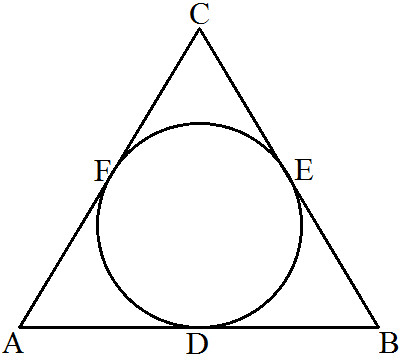
- A
$5\ cm$
- B
$4\ cm$
- C
$6\ cm$
- ✓
$7\ cm$
AnswerCorrect option: D. $7\ cm$
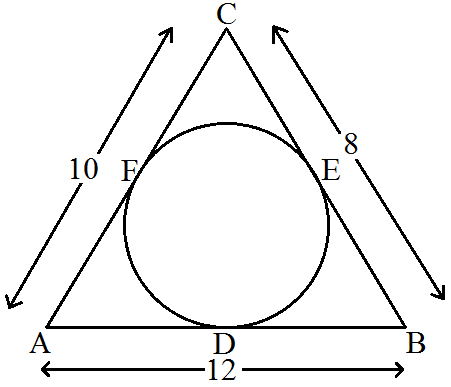
Given,
$\ce{AB = AD + DB} = 12\ cm...(i)$
$\ce{BC = BE + EC} = 8\ cm...(ii)$
$\ce{CA + CF + FA} = 10\ cm...(iii)$
from the property of tangent
$\ce{AD = AF} ($ tangent from $A ) ...(iv)$
$\ce{DB = BE} ($ tangent from $A ) ...(v)$
$\ce{CF = CE} ($ tangent from $A ) ...(vi)$
Now, we have to find $\ce{AD}$
By substracting eq.$(ii)$ from eq.$(i),$ then
$\Rightarrow \ce{AD + DB - (BE + EC) = 12 - 8}$
$\Rightarrow \ce{AD + BE - BE - CF = 4 [ from eq.(V) ]}$
$\Rightarrow \ce{AD - CF = 4}$
$\Rightarrow \ce{AD - (10 - AF) = 4 [ from eq,(iii) ]}$
$\Rightarrow \ce{AD - 10 + AF} = 4$
$\Rightarrow \ce{AD - 10 + AD} = 4$
$\Rightarrow \ce{2AD} = 14$
$\Rightarrow \ce{AD} = 7$ View full question & answer→MCQ 451 Mark
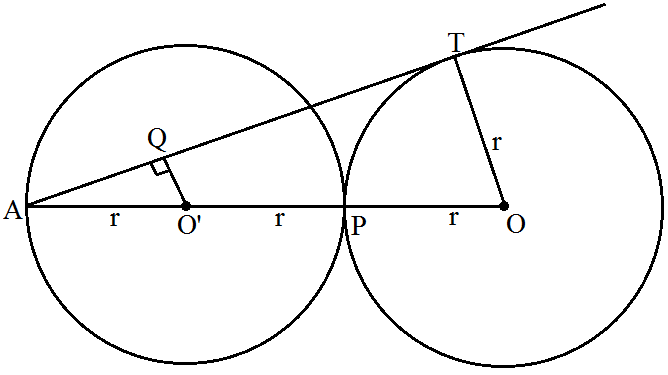
Two circles of same radii r and centres $O$ and $O'$ touch each other at $P$ as shown in. If $O O'$ is produced to meet the circle $C (O', r)$ at $A$ and $AT$ is a tangent to the
circle $C (O,r)$ such that $\ce{O'Q \perp AT.}$ Then $\ce{AO: AO'} =$
Answer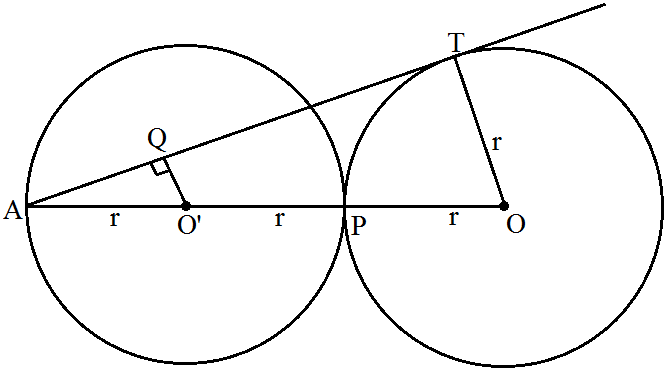
From the given figure we have,
$AO = r + r + r$
$AO = 3r$
$AO’ = r$
Therefore,
$\frac{\text{AO}}{\text{AO'}}=\frac{3\text{r}}{\text{r}}$
$\frac{\text{AO}}{\text{AO'}}=3$
Also as $\text{O'Q}\parallel\text{OT}$
therefore $\frac{\text{AT}}{\text{AQ}}=\frac{\text{AO}}{\text{AO'}}$ View full question & answer→MCQ 461 Mark
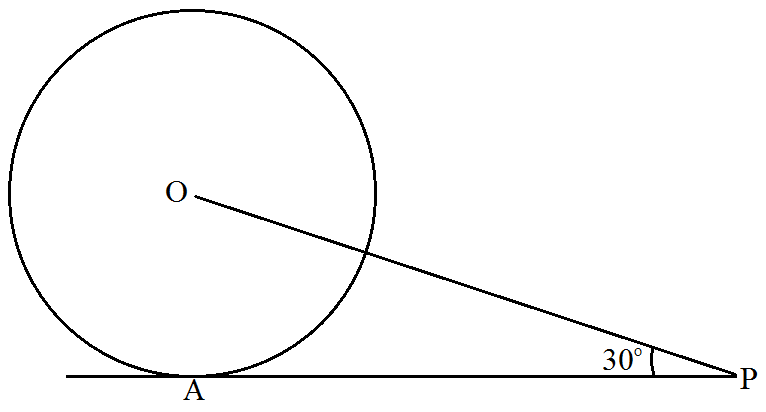
In the figure, $AP$ is a tangent to the circle with centre $O$ such that $OP = 4\ cm$ and $\angle\text{OPA}=30^{\circ}$. Then, $AP =$
- A
$2\sqrt{2}\text{cm}$
- B
$2\text{cm}$
- ✓
$2\sqrt{3}\text{cm}$
- D
$3\sqrt{2}\text{cm}$
AnswerCorrect option: C. $2\sqrt{3}\text{cm}$
In the figure, AP is the tangent to the circle with centre $O$ such that $OP = 4\ cm, \angle\text{OPA}=30^{\circ}$
Join $OA,$
let $AP = x$
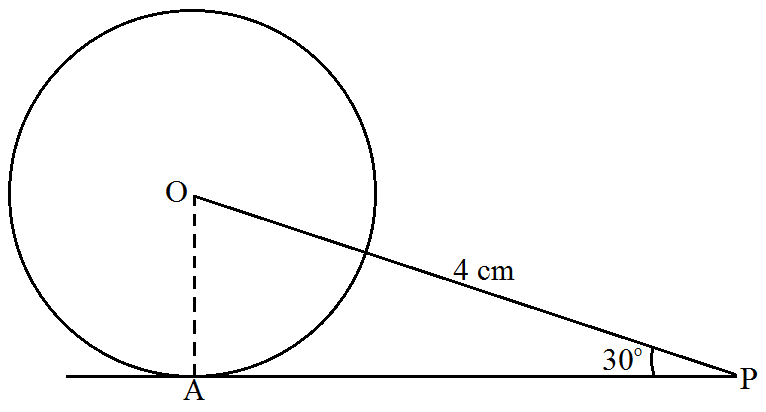
$\cos30^{\circ}=\frac{\text{AP}}{\text{OP}}$
$\Rightarrow\frac{\sqrt{3}}{2}=\frac{\text{x}}{4}$
$\Rightarrow\text{x}=\frac{4\times\sqrt{3}}{2}$
$=2\sqrt{3}\text{cm}$ View full question & answer→MCQ 471 Mark
In the figure, two equal circles touch each other at $T,$ if $\ce{QP} = 4.5\ cm,$ then $\ce{QR} =$ 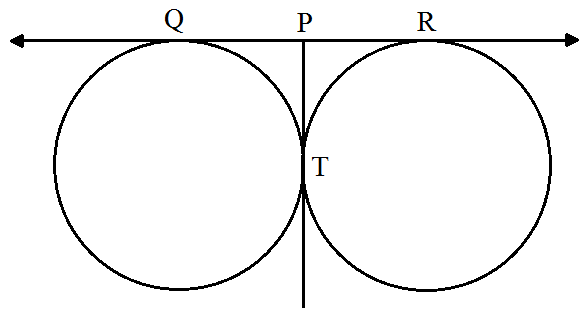
- ✓
$9\ cm$
- B
$18\ cm$
- C
$15\ cm$
- D
$13.5\ cm$
AnswerCorrect option: A. $9\ cm$
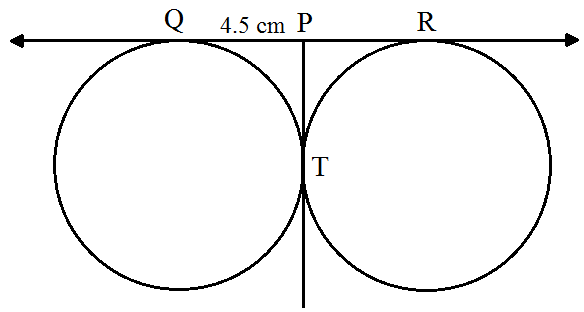
In the figure, two equal circles touch, each other externally at $T$
$\ce{QR}$ is the common tangent $\ce{QP = 4.5\ cm}$
$\ce{PQ = PT} ($ tangents from $P$ to the circle$)$
Similarly $\ce{PT = PR}$
$\ce{PQ = PT = PR}$
Now $\ce{QR = PQ + PR}$
$= 4.5 + 4.5$
$= 9\ cm$ View full question & answer→MCQ 481 Mark
$\text{ABC}$ is a right angled triangle, right angled at B such that $BC = 6\ cm$ and $AB = 8\ cm$. A circle with centre $O$ is inscribed in $\triangle ABC$. The radius of the circle is:
- A
$1\ cm$
- ✓
$2\ cm$
- C
$3\ cm$
- D
$4\ cm$
AnswerCorrect option: B. $2\ cm$
In a right $\triangle\text{ABC},$ $\angle\text{B}=90^{\circ}$
$BC = 6\ cm$, $AB = 8\ cm$
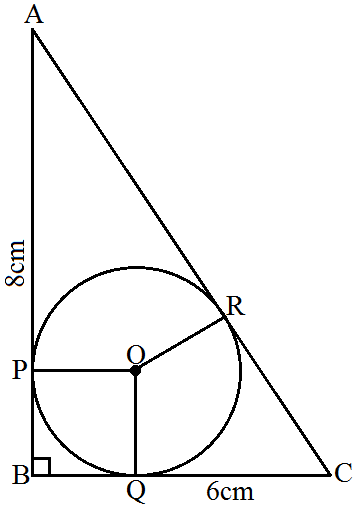
$AC^2=AB+BC^2 \text { (Pythagoras Theorem) }$
$=(8)^2+(6)^2=64+36=100=(10)^2$
$AC=10 cm$
An incircle is drawn with centre $0$ which touches the sides of the triangle $A B C$ at $P, Q$ and $\text{R O P, O Q}$ and $O R$ are radii and $\text{A B, B C}$ an $C A$ are the tangents to the circle.
$O P \perp A B, O Q \perp B C$ and $O R \perp C A$
$\text{OPBQ}$ is a square.
Let $r$ be the radius of the incircle.
$P B=B Q=r$
$A R=A P=8-r,$
$C Q=C R=6-r$
$A C=A R+C R$
$\Rightarrow 10=8-r+6-r$
$\Rightarrow 10=14-2 r$
$\Rightarrow 2 r=14-10=4$
$\Rightarrow r=2$
Radius of the incircle $=2 \ cm$.
View full question & answer→MCQ 491 Mark
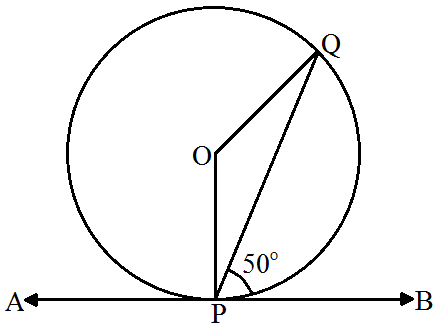
In the figure, $\ce{APB}$ is a tangent to a circle with centre $O$ at point $P.$ If $\angle\text{QPB}=50^\circ$ then the measure of $\angle\text{POQ}$ is:
- ✓
$100^\circ$
- B
$120^\circ$
- C
$140^\circ$
- D
$150^\circ$
AnswerCorrect option: A. $100^\circ$
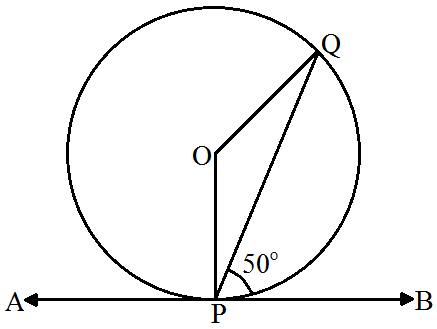
In the figure, $\ce{APB}$ is a tangent to the circle with centre $O.$
$\angle\text{QPB}=50^\circ$
$OP$ is radius and $\ce{APB}$ is a tangent.
$\ce{OP \perp AB}$
$\Rightarrow\text{OPB}=90^\circ$
$\Rightarrow\angle\text{OPQ}+\angle\text{QPB}=90^\circ$
$\angle\text{OPQ}+50^\circ=90^\circ$
$\Rightarrow\angle\text{OPQ}=90^\circ-50^\circ=40^{\circ}$
But $\ce{OP = OQ}$
$\angle\text{OPQ}=\angle\text{OQP}=40^{\circ}$
$\angle\text{POQ}=180^{\circ}-(40^{\circ}+40^{\circ})$
$=180^{\circ}-80^{\circ}$
$=100^{\circ}$ View full question & answer→MCQ 501 Mark
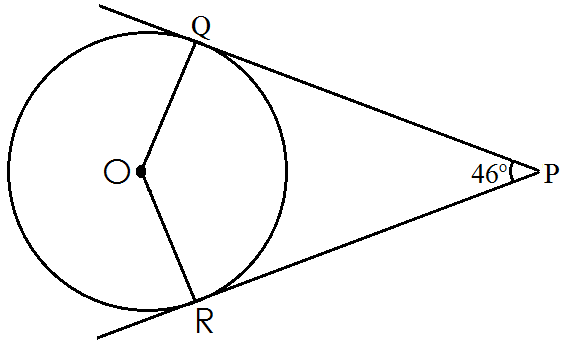
In the figure, $PQ$ and $PR$ are two tangents to a circle with centre $O.$ If $\angle\text{QPR}=46^\circ$ then $\angle\text{QOR}$ equals:
- A
$67^\circ$
- ✓
$134^\circ$
- C
$44^\circ$
- D
$46^\circ$
AnswerCorrect option: B. $134^\circ$
$\angle\text{OQP}=90^\circ [$Tangent is $\perp$ to the radius through the point of contact$]$
$\angle\text{ORP}=90^\circ$
$\angle\text{OQP}+\angle\text{QPR}+\angle\text{ORP}+\angle\text{QOR}=360^\circ [$Angle sum property of a quad.$]$
$90^\circ+46^\circ+90^\circ+\angle\text{QOR}=360^\circ$
$\angle\text{QOR}=360^\circ-90^\circ-46^\circ-90^\circ=134^\circ$
View full question & answer→