Question 14 Marks
Show that A (-4, -7),B (-1, 2), C (8, 5) and D (5, -4) are the vertices of a parallelogram.
AnswerIn a parallelogram, opposite sides are equal and parallel.
According to the distance formula, the distance 'd' between two points $( a , b )$ and $( c , d )$ is given by
$d=\sqrt[2]{(a-c)^2+(b-d)^2}$
Slope $m$ of a line passing through two points $A(a, b)$ and $B(c, d)$ ig given by
$m =\frac{ d - b }{ c - a }$
In the question,
$A B=\sqrt{(-4-(-1))^2+(2-(-7))^2}=\sqrt{90}$
$B C=\sqrt{(8-(-1))^2+(5-2)^2}=\sqrt{90}$
$C D=\sqrt{(8-5)^2+(5-(-4))^2}=\sqrt{90}$
$A D=\sqrt{(5-(-4))^2+(-7-(-4))^2}=\sqrt{90}$
Slope of $A B=\frac{2-(-7)}{-1-(-4)}=3$
Slope of $B C=\frac{5-2}{8-(-1)}=\frac{1}{3}$
Slope of $C D=\frac{-4-5}{5-8}=3$
Slope of $AD =\frac{-4-(-7)}{5-(-4)}=\frac{1}{3}$
As $A B=D C$ and $B C=A D$
And Slope $A B=$ Slope $C D$
Slope $B C=$ slope $A D$
Hence the given points form a parallelogram.
View full question & answer→Question 24 Marks
Find the slopes of the lines passing through the given points.
(1) A (2, 3), B (4, 7)
(2) P (-3, 1), Q (5, -2)
(3) C (5, -2), D (7, 3)
(4) L (-2, -3), M (-6, -8)
(5) E(-4, -2), F (6, 3)
(6) T (0, -3), S (0, 4)
AnswerSlope $m$ of a line passing through two points $A ( a , b )$ and $B ( c , d )$ ig given by $m=\frac{d-b}{c-a}$ 1. $A(2,3), B(4,7)$
$m=\frac{7-3}{4-2}=\frac{4}{2}=2$
2. $P(-3,1), Q(5,-2)$
$m=\frac{-2-1}{5-(-3)}=\frac{-3}{5+3}=\frac{-3}{8}$
3. $C(5,-2), D(7,3)$
$m=\frac{3-(-2)}{7-5}=\frac{3+2}{7-5}=\frac{5}{2}$
4. $L(-2,-3), M(-6,-8)$
$m=\frac{-8-(-3)}{-6-(-2)}=\frac{-8+3}{-6+2}=\frac{-5}{-4}=\frac{5}{4}$
5. $E(-4,-2), F(6,3)$
$m=\frac{3-(-2)}{6-(-4)}=\frac{3+2}{6+4}=\frac{5}{10}=\frac{1}{2}$
6. T $(0,-3), S(0,4)$
$m =\frac{4-(-3)}{0-0}$
As denominator is 0 ,
So, slope cannot be determined.
View full question & answer→Question 34 Marks
Find the possible pairs of coordinates of the fourth vertex D of the parallelogram,if three of its vertices are A(5,6), B(1,-2)and C(3,-2).
AnswerAccording to the distance formula, the distance ' $d$ ' between two points $(a, b)$ and $(c, d)$ is given by
$d=\sqrt[2]{(a-c)^2+(b-d)^2}$
Slope of a line between two points $(a, b)$ and $(c, d)$ is
$m =\frac{ d - b }{ c - a }$
In the given question, for it to be a parallelogram $A D=B C$ and slope $A D=$ Slope $B C$
And
$A B=D C$ and Slope $A B=$ Slope $C D$
Let $D$ be $(x, y)$
As $A D=B C$ we get
$\sqrt{(5-x)^2+(6-y)^2}=\sqrt{(1-3)^2+(-2+2)^2}=2 \ldots i$
As $AB = CD$ we get
$\sqrt{(3-x)^2+(y+2)^2}=\sqrt{(5-1)^2+(6+2)^2}=4 \sqrt{5} \ldots . . \text { ii }$
As slope $A D=$ Slope $B C$
$\frac{6-y}{5-x}=\frac{-2+2}{3-1}=0$
As slope $A B=$ Slope $D C$
$\frac{3-x}{-2-y}=\frac{-2-6}{1-5}=2 \ldots . . iv$
From iii we gey $y=6$
Putting $y=6$ in (i) we get
$x=3$
and putting $y=6$ in (ii) we get $x=7$
Hence the possible coordinates of the point D are $(7,6)$ and $(3,6)$.
View full question & answer→Question 44 Marks
If A (20, 10), B(0, 20) are given, find the coordinates of the points which divide segment AB into five congruent parts.
AnswerLet the points dividing AB be C,D,E,F
AC:CD:DE:EF:FB∷1:1:1:1:1
A point P(x,y) divides the line formed by points (a,b) and (c,d) in the ratio of m:n, then the coordinates of the point P is given by
$x =\frac{ an + cm }{ m + n } \text { and } y =\frac{ bn + dm }{ m + n }$
For C m:n :: 1:4
$x=\frac{(20) 4+(0) 1}{1+4}=16$
$y=\frac{10(4)+(20) 1}{1+4}=12$
For D m:n :: 2:3
$x=\frac{(20) 3+(0) 2}{2+3}=12$
$y=\frac{(10) 3+(20) 2}{2+3}=14$
For E m:n :: 3:2
$x=\frac{(20) 2+(0) 3}{2+3}=8$
$y=\frac{(10) 2+(20) 3}{2+3}=16$
For F m:n :: $4: 1$
$x =\frac{(20) 1+(0) 3}{1+4}=4$
$y =\frac{(10) 1+(20) 4}{1+4}=18$
View full question & answer→Question 54 Marks
Find the lengths of the medians of a triangle whose vertices are A(-1,1), B(5, -3) and C(3, 5).
AnswerAccording to the distance formula, the distance 'd' between two points $(a, b)$ and $(c, d)$ is given by
$d=\sqrt[2]{(a-c)^2+(b-d)^2}$
According to the mid point theorem the coordinates of the point $P(x, y)$ dividing the line formed by $A(a, b)$ and $B(c, d)$ is given by:
$x =\frac{ a + c }{2}$
$y =\frac{ b + d }{2}$
Mid point of $A B \times$ coordinate $=\frac{-1+5}{2}=2$
$Y \text { coordinate }=\frac{1-3}{2}=-1$
Mid point of $BC \times$ coordinate $=\frac{5+3}{2}=4$
$Y \text { coordinate }=\frac{-3+5}{2}=1$
Mid point of $AC \times$ coordinate $=\frac{-1+3}{2}=1$
$Y \text { coordinate }=\frac{5+1}{2}=3$
Length of median through $A$ is the distance between pt $A$ and the mid point of $B C$
$D_a=\sqrt{(-4-1)^2+(1-1)^2}=5$
Length of median through $B$ is the distance between $pt B$ and the mid point of $A C$
$D_b={\sqrt{(5-1)^2+(-3-3)}}^2=2 \sqrt{13}$
Length of median through C is the distance between pt C and the mid point of AB
$D_c=\sqrt{(3-2)^2+(-1-5)^2}=\sqrt{(37)}$
View full question & answer→Question 64 Marks
Show that the □PQRS formed by P(2,1), Q(-1,3), R(-5,-3) and S(-2,-5) is a rectangle.
AnswerAccording to the distance formula, the distance ' $d$ ' between two points $(a, b)$ and $(c, d)$ is given by
$d=\sqrt[2]{(a-c)^2+(b-d)^2} \ldots$
Slope of a line between two points $(a, b)$ and $(c, d)$ is
$m =\frac{ d - b }{ c - a }$
Note: If the Product of slopes of two lines = -1 then they are perpendicular to each other.
$PQ =\sqrt{(2+1)^2+(1-3)^2}=\sqrt{13}$
$QR =\sqrt{(-1+5)^2+(3+3)^2}=\sqrt{52}$
$RS =\sqrt{(-5+2)^2+(-3+5)^2}=\sqrt{13}$
$SP =\sqrt{(2+2)^2+(1+5)}=\sqrt{52}$
Slope $P Q=\frac{3-1}{-1-2}==\frac{2}{3}$
Slope $QR =\frac{-3-3}{-5+1}=\frac{2}{3}$
Slope RS $=\frac{-5+3}{-2+5}=-\frac{2}{3}$
Slope $SP =\frac{-5-1}{-2-1}=\frac{2}{3}$
As opposite sides are equal and parallel and perpendicular to each other, points form a rectangle.
View full question & answer→Question 74 Marks
Show that points P(1,-2), Q(5,2), R(3,-1), S(-1,-5) are the vertices of aparallelogram.
AnswerAccording to the distance formula, the distance ' d ' between two points $( a , b )$ and $( c , d )$ is given by
$d=\sqrt[2]{(a-c)^2+(b-d)^2}$
Slope of a line between two points $(a, b)$ and $(c, d)$ is
$m=\frac{d-b}{c-a}$
Distance $P Q=\sqrt{(1-5)^2+(-2-2)^2}=\sqrt{32}$
Distance $Q R=\sqrt{(5-3)^2+(-1-2)^2}=\sqrt{13}$
Distance RS $=\sqrt{(-1-3)^2+(-5+1)^2}=\sqrt{32}$
Distance SP $=\sqrt{(-1-1)^2+(-2+5)^2}=\sqrt{13}$
Slope $PQ =\frac{2+2}{5-1}=1$
Slope $Q R=\frac{-1-2}{3-5}=\frac{3}{2}$
Slope RS $=\frac{-5+1}{-1-3}=1$
Slope SP $=\frac{-5+2}{-1-1}=\frac{3}{2}$
As opposite sides are equal and parallel, the points from a parallelogram.
View full question & answer→Question 84 Marks
Determine whether the points are collinear.
(1) A(1, -3), B(2, -5), C(-4, 7)
(2) L(-2, 3), M(1, -3), N(5, 4)
(3) R(0, 3), D(2, 1), S(3, -1)
(4) P(-2, 3), Q(1, 2), R(4, 1)
AnswerIf Three points (a,b), (c,d), (e,f) are collinear then the area formed by the triangle by the three points is zero.Area of a triangle = $\frac{1}{2}| a ( d - f )+ c ( f - b )+ e ( b - d )|.........(1)$
1.
(a,b) = (1,-3)
(c,d) = (2,-5)
(e,f) = (-4,7)
Area $=\frac{1}{2}|1(-5-7)+2(7-(-3))+(-4)(-3-(-5))|$
Area $=\frac{1}{2}|-12+20-8|=0$
Hence the points are collinear.
2.
(a,b) = (-2,3)
(c,d) = (1,-3)
(e,f) = (5,4)
Area $\left.=\frac{1}{2} \right\rvert\,(-2)(-3-4)+1(4-3)+5(3-(-3) \mid$
Area $=\frac{1}{2}|14+1+30|=\frac{45}{2}$
Hence the points are not collinear.
3.
(a,b) = (0,3)
(c,d) = (2,1)
(e,f) = (3,-1)
Area $=\frac{1}{2}|0(1-(-1))+2(-1-3)+3(3-1)|$
Area $=\frac{1}{2}|0-8+6|=-1$
Hence the points are non collinear.
4.
(a,b) = (-2,3)
(c,d) = (1,2)
(e,f) = (4,1)
Area $=\frac{1}{2}|(-2)(2-1)+1(1-3)+4(3-2)|$
Area $=\frac{1}{2}|-2-2+4|=0$
Hence the points are collinear.
View full question & answer→Question 94 Marks
Find the distance between each of the following pairs of points.
(1) A(2, 3), B(4, 1)
(2) P(-5, 7), Q(-1, 3)
(3) R(0, -3), S(0, 5/2)
(4) L(5, -8), M(-7, -3)
(5) T(-3, 6), R(9, -10)
(6) $W \left(\frac{-7}{2}, 4\right),{x(11,4)}$
AnswerThe distance between points $A(x_1, y_1)$ and $B(x_2, y_2)$ is given by,
$d=\sqrt{\left(x_1-x_2\right)^2+\left(y_1-y_2\right)^2}$
1. Given Points: A(2, 3) and B(4, 1)
we can see that,
$x_1= 2$
$x_2= 4$
$y_1= 3$
$y_2= 1$
Putting the values in the distance formula we get,
$d=\sqrt{\left\{(2-4)^2+(3-1)^2\right\}}$
$\Rightarrow d=\sqrt[2]{4+4}$
⇒ d = √8
2. Given Points: P(-5, 7) and Q(-1, 3)
we can see that,
$x_1= -5$
$x_2= -1$
$y_1= 7$
$y_2= 3$
Putting these values in distance formula we get,
$d=\sqrt[2]{(-5-(-1))^2+(7-3)^2}$
d = √32
3. Given Points: R(0, -3), S(0, 5/2)
we can see that,
$x_1= 0$
$x_2= 0$
$y_1= -3$
$y_2= 5/2$
On putting these values in distance formula we get,
$d=\sqrt[2]{(0-0)^2+\left(-3-\frac{5}{2}\right)^2}$
$d=\sqrt{\left(-\frac{11}{2}\right)^2}$
$d=\sqrt{\frac{121}{4}}$
4. Given Points: L(5, -8), M(-7, -3)
we can see that,
$ x_1=5 $
$ x_2=-7 $
$ y_1=-8 $
$ y_2=-3 $
On putting these values in distance formula we get,
$d=\sqrt[2]{(5-(-7))^2+(-8-(-3))^2}$
$d=\sqrt[2]{144+25}$
d = √169 = 13
5. Given Points: T(-3, 6), R(9, -10)
we can see that,
$ x_1=-3 $
$ x_2=9 $
$ y_1=6 $
$ y_2=-10 $
On putting these values in distance formula we get,
$d=\sqrt[2]{(-3-9)^2+(6-(-10))^2}$
$d=\sqrt[2]{144+256}$
d = 20
6. Given Points: $W\left(-\frac{7}{2}, 4\right), x(11,4)$
we can see that,
$ x_1=-7 / 2 $
$ x_2=11 $
$ y_1=4 $
$ y_2=4 $
On putting these values in distance formula we get,
$d=\sqrt[2]{\left(-\frac{7}{2}-11\right)^2+(4-4)^2}$
$d=\sqrt[2]{\left(-\frac{29}{2}\right)^2+0}$
$d=\frac{29}{2}$
View full question & answer→Question 104 Marks
In the following examples, can the segment joining the given points form atriangle? If triangle is formed, state the type of the triangle considering sides ofthe triangle.
(1) L(6,4), M(-5,-3) , N(-6,8)
(2) P(-2,-6), Q(-4,-2), R(-5,0)
(3) $A (\sqrt{2}, \sqrt{2}), B (-\sqrt{2},-\sqrt{2}), C (-\sqrt{6}, \sqrt{6})$
AnswerAccording to the distance formula, the distance 'd' between two points $(a, b)$ and $(c, d)$ is given by
$d=\sqrt[2]{(a-c)^2+(b-d)^2} \ldots . .(1)$
$\text { 1. } LM =\sqrt{(6+5)^2+(4+3)^2}=\sqrt{170}$
$M N=\sqrt{(-6+5)^2+(8+3)^2}=\sqrt{122}$
$NL =\sqrt{(-6-6)^2+(8-4)^2}=\sqrt{160}$
As sum of any two sides are greater than the third side,
The following points form a scalene triangle.
$\text { 2. } P Q=\sqrt{(-4+2)^2+(-2+6)^2}=\sqrt{20}$
$Q R=\sqrt{(-5+4)^2+(0+2)^2}=\sqrt{5}$
$R P=\sqrt{(-5+2)^2+(0+6)^2}=\sqrt{45}$
As $P Q+Q R$ The following points donot form a triangle.
$\text { 3. } A B=\sqrt{\left.((-\sqrt{2})-(\sqrt{2}))^2+(-(\sqrt{2})-(\sqrt{2}))^2\right)}=4$
$B C==\sqrt{\left.((-\sqrt{6})-(-\sqrt{2}))^2+((\sqrt{6})-(-\sqrt{2}))^2\right)}=4$
$A C=\sqrt{\left.((-\sqrt{6})-(\sqrt{2}))^2+((\sqrt{6})-(\sqrt{2}))^2\right)}=4$
As $A B=B C=A C$
The following points form an equilateral triangle.
View full question & answer→Question 114 Marks
Find the co-ordinates of the points of trisection of the segment joining the points $\mathrm{A}(2,-2)$ and $\mathrm{B}(-7,4)$.(The two points that divide the line segment in three equal parts are called as points of trisection of the segment.)
AnswerLet points $\mathrm{P}$ and $\mathrm{Q}$ be the points of trisection of the line segment joining the points $\mathrm{A}$ and $\mathrm{B}$.
Point $\mathrm{P}$ and $\mathrm{Q}$ divide line segment $\mathrm{AB}$ into three parts.
$\mathrm{AP}=\mathrm{PQ}=\mathrm{QB}$
$\frac{\mathrm{AP}}{\mathrm{PB}}=\frac{\mathrm{AP}}{\mathrm{PQ}+\mathrm{QB}}=\frac{\mathrm{AP}}{\mathrm{AP}+\mathrm{AP}}=\frac{\mathrm{AP}}{2 \mathrm{AP}}=\frac{1}{2}$..............From (I)
Point $\mathrm{P}$ divides seg $\mathrm{AB}$ in the ratio 1:2.
$x$ co-ordinate of point $\mathrm{P}=\frac{1 \times(-7)+2 \times 2}{1+2}=\frac{-7+4}{3}=\frac{-3}{3}=-1$
$y$ co-ordinate of point $\mathrm{P}=\frac{1 \times 4+2 \times(-2)}{1+2}=\frac{4-4}{3}=\frac{0}{3}=0$
Point $Q$ divides seg $A B$ in the ratio 2:1. $\therefore \frac{A Q}{Q D}=\frac{2}{1}$
$x$ co-ordinate of point $\mathrm{Q}=\frac{2 \times(-7)+1 \times 2}{2+1}=\frac{-14+2}{3}=\frac{-12}{3}=-4$
$y$ co-ordinate of point $\mathrm{Q}=\frac{2 \times 4+1 \times-2}{2+1}=\frac{8-2}{3}=\frac{6}{3}=2$
$\therefore$ co-ordinates of points of trisection are $(-1,0)$ and $(-4,2)$.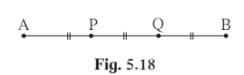
View full question & answer→Question 124 Marks
Show that points $\mathrm{A}(-3,2), \mathrm{B}(1,-2)$ and $\mathrm{C}(9,-10)$ are collinear.
AnswerIf the sum of any two distances out of $d(A, B), d(B, C)$ and $d(A, C)$ is equal to the third, then the three points $\mathrm{A}, \mathrm{B}$ and $\mathrm{C}$ are collinear.
$\therefore$ we will find $\mathrm{d}(\mathrm{A}, \mathrm{B}), \mathrm{d}(\mathrm{B}, \mathrm{C})$ and $\mathrm{d}(\mathrm{A}, \mathrm{C})$.
Co-ordinates of A Co-ordinates of B Distance formula
$ (-3,2)$
$(1,-2)$
$\mathrm{d}(\mathrm{A}, \mathrm{B})=\sqrt{\left(x_2-x_1\right)^2+\left(y_2-y_1\right)^2}$
$\left(x_1, y_1\right)$
$\left(x_2, y_2\right)$
$\therefore d(A, B)=\sqrt{[1-(-3)]^2+[(-2)-2]^2}$
$=\sqrt{(1+3)^2+(-4)^2}$
$=\sqrt{16+16}$
$=\sqrt{32}=4 \sqrt{2}$
$d(B, C)=\sqrt{(9-1)^2+(-10+2)^2}$
$=\sqrt{64+64}=8 \sqrt{2}$
$\text { and } d(A, C)=\sqrt{(9+3)^2+(-10-2)^2}$
$=\sqrt{144+144} \quad=12 \sqrt{2}$
$\therefore \text { from(I), (II) and (III) } 4 \sqrt{2}+8 \sqrt{2}=12 \sqrt{2}$
$\therefore \mathrm{d}(\mathrm{A}, \mathrm{B})+\mathrm{d}(\mathrm{B}, \mathrm{C})=\mathrm{d}(\mathrm{A}, \mathrm{C})$
$\therefore \text { Points A, B, C are collinear. }$
from distance formula
View full question & answer→Question 134 Marks
Show that $P(3,4), Q(7,-2), R(1,1)$ and $S(-3,7)$ are the vertices of a parallelogram.
View full question & answer→Question 144 Marks
Show that $\square ABCD$ is a parallelogram, if $A (-1,2)$, $B(-5,-6)$, $C(3,-2)$ and $D(7,6)$
View full question & answer→Question 154 Marks
Show that line joining $(4,-1)$ and $(6,0)$ is parallel to line joining $(7,-2)$ and $(5,-3)$.
View full question & answer→Question 164 Marks
$P(3,4), Q(7,2)$ and $R(-2,-1)$ are the vertices of PQR. Write down the slope of each side of the triangle.
Answer$-\frac{1}{2}, \frac{1}{3}, 1$
View full question & answer→Question 174 Marks
Find the coordinates of the points dividing the segment joining $A(-5,7)$ and $B(11,-1)$ into four equal parts.
View full question & answer→Question 184 Marks
The origin 'O' is the centroid of ABC in which $A(-4,3) B(3, k)$ and $C(h, 5)$. Find h and k.
View full question & answer→Question 194 Marks
If $A-P-Q-B$, point $P$ and $Q$ trisects seg $A B$ and $A(3,1), Q(-1,3)$, then find coordinates of points $B$ and $P$.
View full question & answer→Question 204 Marks
Find the coordinates of the points which divide segment $A B$ into four equal parts, if $A (5,7)$ and $B (-3,-1)$
View full question & answer→Question 214 Marks
Segments AB and CD bisects each other at point $M$. If $A(4,3), B(-2,5), C(-3,5)$, then find coordinates of D.
View full question & answer→Question 224 Marks
Show that the line segment joining the points $(5,7),(3,9)$ and $(8,6),(0,10)$ bisect each other.
View full question & answer→Question 234 Marks
Find the lengths of the median of $A B C$ whose vertices are $A(7,-3), B(5,3), C(3,-1) . \quad$
View full question & answer→Question 244 Marks
Show that points $A (1,-5), B (-4,-8), C (-1,-13)$ and $D(4,-10)$ are the vertices of a rhombus.
View full question & answer→Question 254 Marks
Show that $A (4,-1)$, $B(6,0)$, $C(7,-2)$ and $D(5,-3)$ are the vertices of a square.
View full question & answer→Question 264 Marks
Show that A (-4, -7),B (-1, 2), C (8, 5) and D (5, -4) are the vertices of a parallelogram.
Question 274 Marks
Find the slopes of the lines passing through the given points.
(1) A (2, 3), B (4, 7)
(2) P (-3, 1), Q (5, -2)
(3) C (5, -2), D (7, 3)
(4) L (-2, -3), M (-6, -8)
(5) E(-4, -2), F (6, 3)
(6) T (0, -3), S (0, 4)
Question 284 Marks
Find the possible pairs of coordinates of the fourth vertex D of the parallelogram,if three of its vertices are A(5,6), B(1,-2)and C(3,-2).
Question 294 Marks
If A (20, 10), B(0, 20) are given, find the coordinates of the points which divide segment AB into five congruent parts.
Question 304 Marks
Find the lengths of the medians of a triangle whose vertices are A(-1,1), B(5, -3) and C(3, 5).
Question 314 Marks
Show that the □PQRS formed by P(2,1), Q(-1,3), R(-5,-3) and S(-2,-5) is a rectangle.
Question 324 Marks
Show that points P(1,-2), Q(5,2), R(3,-1), S(-1,-5) are the vertices of aparallelogram.
Question 334 Marks
Determine whether the points are collinear.
(1) A(1, -3), B(2, -5), C(-4, 7)
(2) L(-2, 3), M(1, -3), N(5, 4)
(3) R(0, 3), D(2, 1), S(3, -1)
(4) P(-2, 3), Q(1, 2), R(4, 1)
Question 344 Marks
Find the distance between each of the following pairs of points.
(1) A(2, 3), B(4, 1)
(2) P(-5, 7), Q(-1, 3)
(3) R(0, -3), S(0, 5/2)
(4) L(5, -8), M(-7, -3)
(5) T(-3, 6), R(9, -10)
(6) $W \left(\frac{-7}{2}, 4\right), x (11,4)$ View full question & answer→Question 354 Marks
In the following examples, can the segment joining the given points form atriangle? If triangle is formed, state the type of the triangle considering sides ofthe triangle.
(1) L(6,4), M(-5,-3) , N(-6,8)
(2) P(-2,-6), Q(-4,-2), R(-5,0)
(3) $A (\sqrt{2}, \sqrt{2}), B (-\sqrt{2},-\sqrt{2}), C (-\sqrt{6}, \sqrt{6})$
View full question & answer→Question 364 Marks
Find the co-ordinates of the points of trisection of the segment joining the points $\mathrm{A}(2,-2)$ and $\mathrm{B}(-7,4)$.(The two points that divide the line segment in three equal parts are called as points of trisection of the segment.)
View full question & answer→Question 374 Marks
Show that points $\mathrm{A}(-3,2), \mathrm{B}(1,-2)$ and $\mathrm{C}(9,-10)$ are collinear.
View full question & answer→Question 384 Marks
The origin 'O' is the centroid of ABC in which $A(-4,3) B(3, k)$ and $C(h, 5)$. Find h and k.
View full question & answer→Question 394 Marks
Show that the line segment joining the points $(5,7),(3,9)$ and $(8,6),(0,10)$ bisect each other.
View full question & answer→Question 404 Marks
Show that $\square ABCD$ is a parallelogram, if $A (-1,2)$, $B(-5,-6)$, $C(3,-2)$ and $D(7,6)$
View full question & answer→Question 414 Marks
Show that points $A (1,-5), B (-4,-8), C (-1,-13)$ and $D(4,-10)$ are the vertices of a rhombus.
View full question & answer→Question 424 Marks
Show that $P(3,4), Q(7,-2), R(1,1)$ and $S(-3,7)$ are the vertices of a parallelogram.
View full question & answer→Question 434 Marks
Show that line joining $(4,-1)$ and $(6,0)$ is parallel to line joining $(7,-2)$ and $(5,-3)$.
View full question & answer→Question 444 Marks
Show that $A (4,-1)$, $B(6,0)$, $C(7,-2)$ and $D(5,-3)$ are the vertices of a square.
View full question & answer→Question 454 Marks
Segments AB and CD bisects each other at point $M$. If $A(4,3), B(-2,5), C(-3,5)$, then find coordinates of D.
View full question & answer→Question 464 Marks
$P(3,4), Q(7,2)$ and $R(-2,-1)$ are the vertices of PQR. Write down the slope of each side of the triangle.
View full question & answer→Question 474 Marks
If $A-P-Q-B$, point $P$ and $Q$ trisects seg $A B$ and $A(3,1), Q(-1,3)$, then find coordinates of points $B$ and $P$.
View full question & answer→Question 484 Marks
Find the lengths of the median of $A B C$ whose vertices are $A(7,-3), B(5,3), C(3,-1) . \quad$
View full question & answer→Question 494 Marks
Find the coordinates of the points which divide segment $A B$ into four equal parts, if $A (5,7)$ and $B (-3,-1)$
View full question & answer→Question 504 Marks
Find the coordinates of the points dividing the segment joining $A(-5,7)$ and $B(11,-1)$ into four equal parts.
View full question & answer→