Question
Show that $\square ABCD$ is a parallelogram, if $A (-1,2)$, $B(-5,-6)$, $C(3,-2)$ and $D(7,6)$
Answer

self

Need a full question paper?

Generate a complete, print-ready paper with questions like this in minutes — across 16+ boards, with answer keys.

Start Generating Free

Similar questions

Construct a triangle $PQR$ with sides $QR = 7\ cm, PQ = 6\ cm$ and $ \angle\text{PQR} = 60^\circ.$ Then construct another triangle whose sides are $\frac{3}{5}$ of the corresponiding sides of $\triangle\text{PQR}.$
Water is flowing at the rate of $6$km/hr through a pipe of diameter $14\ cm$ into a rectangular tank which is $60m$ long and $22m$ wide. Determine the time in which the level of water in the tank Will rise by $7\ cm.$
If $(m+1)^{\text {th }}$ term of an A.P is twice the $(n+1)^{\text {th }}$ term, prove that $(3 m+1)^{\text {th }}$ term is twice the $(m+n+1)^{\text {th }}$ term.
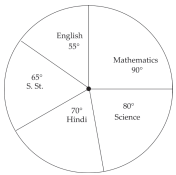
The following pie chart gives the marks scored in an examination by a student in various subjects. If the total marks obtained by the student were 360, answer the following questions
Image
(i) Find the marks obtained in each subject.
(ii) How many more marks he got in Mathematics than in Science?
(iii) Which subject he get the least marks?
Prove the following trigonometric identities.
$(1+\cot\text{A}+\tan\text{A})(\sin\text{A}-\cos\text{A})=\frac{\sec\text{A}}{\text{cosec}^2\text{A}}-\frac{\text{cosec A}}{\sec^2\text{A}}=\sin\text{A}\tan\text{A}-\cot\text{A}\cos\text{A}$
Two dice are rolled, write the sample space ‘S’ and number of sample points
n(S). Also write events and number of sample points in the event according to the
given condition.
(i) Sum of the digits on upper face is a prime number.
(ii) Sum of the digits on the upper face is multiple of 5.
(iii) Sum of the digits on the upper face is 25.
(iv) Digit on the upper face of the first die is less than the digit on the second die.
A farmer borrows ₹ 1000 and agrees to repay with a total interest of ₹ 140 in 12 installments, each installment being less than the preceding installment by ₹ 10 . What should be his first installment?
Solve graphically each of the following systems of linear equations. Also, find the coordinates of the points where the lines meet the axis of x in each system.
2x + y = 6,
x - 2y = -2.
In a cyclic quadrilateral ABCD $\angle\text{A}=(2\text{x}+4)^\circ,\angle\text{B}=(\text{y}+3)^\circ,$ $\angle\text{C}=(2\text{y}+10)^\circ,\angle\text{D}=(4\text{x}-5)^\circ.$ Find the four angles.
Find four consecutive terms in an A.P. whose sum is 12 and sum of 3rd and 4th term is 14.
(Assume the four consecutive terms in A.P. are a – d, a, a + d, a + 2d.)