Questions

3 Marks Question

Take a timed test

46 questions · self-marked practice — reveal the answer and mark yourself.

Question 13 Marks
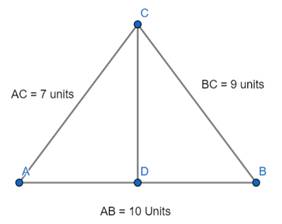
In ΔABC, AB = 10, AC = 7, BC = 9 then find the length of the median drawn from point C to side AB
Answer
The figure is given below:

According to Pythagoras theorem,
$\text { Median2 }=\frac{ AC ^2+ BC ^2}{2}-\frac{ AB ^2}{4} $
$ \Rightarrow \text { Median2 }=\frac{49+81}{2}-\frac{100}{4}$
⇒ Median2 = 40
Median = 2√10
Thus the median is 2√10
View full question & answer
Question 23 Marks
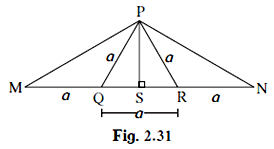
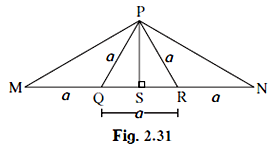
From the information given in the figure 2.31, prove that PM = PN = $\sqrt3 \times a$
Answer
In $\triangle P Q S$ and $\triangle P S R$, By Pythagoras theorem i.e. $(\text { Hypotenuse })^2=(\text { base })^2+(\text { Perpendicular })^2$
$\mathrm{PQ}^2=\mathrm{QS}^2+\mathrm{PS}^2[1]$
$\mathrm{PR}^2=\mathrm{SR}^2+\mathrm{PS}^2[2]$
Subtracting [2] from [1],
$P Q^2-P R^2=Q S^2-S R^2$
$\Rightarrow a^2-a^2=Q S^2-S R^2$
$\Rightarrow Q S^2=S R^2$
$\Rightarrow Q S=S R$
$\Rightarrow QS = SR =\frac{1}{2} QR =\frac{ a }{2}$
Also,
$M S=M Q+Q S $
$\Rightarrow M S=a+\frac{a}{2}=\frac{3 a}{2}$
And
$SN = SR + RN $
$\Rightarrow SN =\frac{ a }{2}+ a =\frac{3 a }{2}$
In $\triangle PSM$ and $\triangle PSN$, By Pythagoras theorem
$PM ^2= PS ^2+ MS ^2 $
$\Rightarrow PM ^2= PS ^2+\left(\frac{3 a }{2}\right)^2 $
$PN ^2= PS ^2+ SN ^2 $
$\Rightarrow PN ^2= PS ^2+\left(\frac{3 a }{2}\right)^2$
From $[3]$ and $[4]$
$PM ^2= PN ^2 $
$\Rightarrow PM = PN$
Hence Proved.
View full question & answer
Question 33 Marks
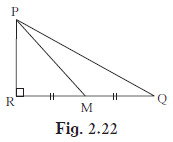
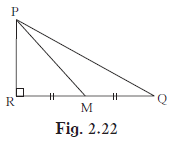
In the figure 2.22, M is themidpoint of QR. ∠PRQ = 90°. Prove that, $P Q^2=4 P M^2-3 P R^2$
Answer
$\text { In } \triangle P R Q \angle P R Q=90^{\circ}$
$P Q^2=P R^2+Q R^2--1$
In $\triangle \mathrm{PRM}, \angle \mathrm{PRM}=90^{\circ}$
$P M^2=P R^2+M R^2$
$\Rightarrow P M^2=P R^2+\left(\frac{Q R}{2}\right)^2[M$ is midpoint $]$
$\Rightarrow 4\left(P M^2-P R^2\right)=Q R^2---2$
1 And 2 implies
$P Q^2=P R^2+4\left(P M^2-P R^2\right)$
$\Rightarrow P Q^2=4 P M^2-3 P R^2$
PROVED.
View full question & answer
Question 43 Marks
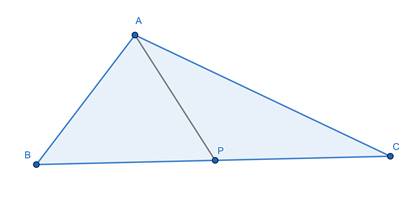
In $\triangle ABC$ seg AP is a median. If $B C=18, A B^2+A C^2=260$ Find AP.
Answer

We know, By Apollonius theorem
In $\triangle A B C$,
if $P$ is the midpoint of side $B C$, then $A B^2+A C^2=2 A P^2+2 B P^2$
Given that, $A P$ is median i.e. $P$ is the mid-point of $B C$
$B P=C P=\frac{1}{2} B C=9$
And $\mathrm{BC}=18 \mathrm{~cm}$
and $A B^2+A C^2=260$
$\Rightarrow 260=2 A P^2+2(9)^2$
$\Rightarrow 260=2 A P^2+162$
$\Rightarrow 98=2 A P^2$
$\Rightarrow A P^2=49$
$\Rightarrow A P=7 \text { units }$
 
View full question & answer
Question 53 Marks
Find the diagonal of a rectangle whose length is $16\ cm$ and area is $192\ sq.cm.$
 
Answer
Given,
Length of rectangle, $I =16 cm$
Breadth of rectangle $= b$
Area of rectangle $=$ length $\times$ breadth
$\Rightarrow 192=16 b$
$\Rightarrow b=12 cm$
Also, we know that
Length of diagonal $=\sqrt{ }\left(l^2+b^2\right)$
Where, $I =$ length and $b =$ breadth
$\Rightarrow$ length of diagonal $=\sqrt{ }\left(16^2+12^2\right)$
$=\sqrt{ }(256+144)=20 cm$
View full question & answer
Question 63 Marks
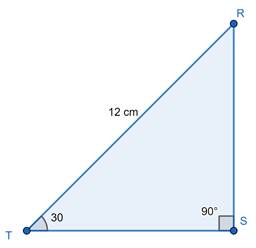
In $\triangle RAT , \angle S =90^{\circ}, \angle T =30^{\circ}, RT =12 cm$ then find RS and ST.
Answer


As, ∠S = 90°, and ∠T = 30° and RT = 12 cm is given.
Clearly, RTS is a 30°-60°-90° triangle.
We know, Property of 30°-60°-90° triangle i.e.
If acute angles of a right angled-triangle are 30° and 60°, then the side opposite
30° angle is half of the hypotenuse and the side opposite to 60° angle is $\frac{\sqrt3}{2}$ times of hypotenuse.
$\Rightarrow RS =\frac{1}{2} \times RT =\frac{1}{2}(12)=6 cm$
And
$ST =\frac{\sqrt{3}}{2} \times RT =\frac{\sqrt{3}}{2} \times 12=6 \sqrt{3} cm$
View full question & answer
Question 73 Marks
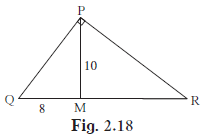
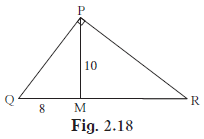
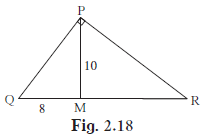
In figure 2.18, ∠QPR = 90°, seg PM ⊥ seg QR and Q – M – R,PM = 10, QM = 8, find QR.
Answer

$\text { In } \triangle \mathrm{PMQ} \angle \mathrm{PMQ}=90^{\circ}$
$\text { So } \mathrm{PM}^2+\mathrm{QM}^2=\mathrm{PQ}^2$
$\Rightarrow 10^2+8^2=P Q^2$
$\Rightarrow 100+64=\mathrm{PQ}^2$
$P Q^2=164 \ldots \text { (1) }$
$\text { In } \triangle P Q R, \angle R P Q=90^{\circ}$
$\text { So } P Q^2+P R^2=Q R^2$
$\Rightarrow 164+P R^2=Q R^2$
$\Rightarrow P R^2=Q R^2-164 \ldots(2)$
$\text { In } \triangle P M R, \angle P M R=90^{\circ}$
$\text { So } P M^2+M R^2=P R^2$
$\Rightarrow 10^2+(Q R-Q M)^2=Q R^2-164$
$\Rightarrow 100+(Q R-Q M)^2=Q R^2-164$
$\Rightarrow 100+\mathrm{QR}^2-2 \cdot \mathrm{QR} \cdot \mathrm{QM}+\mathrm{QM}^2=\mathrm{QR}^2-164$
$\Rightarrow 100-2 . Q R .8+64=-164$
$\Rightarrow 16 Q R=2 \times 164$
$\Rightarrow Q R=20.5$
$\text { Thus } Q R=20.5$
 
View full question & answer
Question 83 Marks
Solve the following examples.
A side of an isosceles right angled triangle is $x$. Find its hypotenuse.
 
Answer
In a right-angled triangle
By Pythagoras theorem
$(\text { Hypotenuse })^2=(\text { base })^2+(\text { Perpendicular })^2$
As, the triangle is isosceles
Base $=$ Perpendicular $= x$
[Hypotenuse can't be equal to any of the sides, because hypotenuse is the greatest side in a right-angled triangle and it must be greater than other two sides]
$\Rightarrow \text { (Hypotenuse }^2=x^2+x^2$
$\Rightarrow \text { (Hypotenuse }^2=2 x^2$
$\Rightarrow \text { Hypotenuse }^2 x \sqrt{2}$
View full question & answer
Question 93 Marks
Walls of two buildings on either side of a street are parellel to each other. A ladder $5.8\ m$ long is placed on the street such that its top just reaches the window of a building at the height of $4\ m$. On turning the ladder over to the other side of the street , its top touches the window of the other building at a height $4.2\ m$. Find the width of the street.
 
Answer
Let us consider a distance x m on the street from one building and a distance y m from the other one.
Now according to question,
In the $1^{st}$ case,
$5.8^2 = 4^2 + x^2$
$\Rightarrow x^2 = 17.64$
$\Rightarrow x = 4.2$
Similarly for the second building,
$5.8^2 = 4.2^2 + y^2$
$\Rightarrow y^2 = 16$
$\Rightarrow y = 4$
Total width $= x + y$
$= 4 + 4.2$
$= 8.2$
Thus the total width is $8.2m.$
View full question & answer
Question 103 Marks
Solve the following examples.
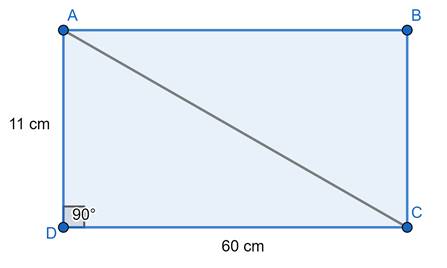
Find the length a diagonal of a rectangle having sides 11 cm and 60cm.
Answer

Let $A B C D$ be a rectangle, with
$A B=C D=60 \mathrm{~cm}$
$B C=D A=11 \mathrm{~cm}$
And $A C$ be a diagonal.
As, $\angle \mathrm{A}=90^{\circ}$
ADC is a right-angled triangle, By Pythagoras Theorem i.e.
$\text { (Hypotenuse }^2=(\text { base })^2+(\text { Perpendicular })^2$
$A C^2=(C D)^2+(D A)^2$
$\Rightarrow A C^2=60^2+11^2$
$\Rightarrow A C^2=3600+121$
$\Rightarrow A C^2=3721$
$\Rightarrow A C=61 \mathrm{~cm}$
 
View full question & answer
Question 123 Marks
prove the theorem : In a triangle if the square of one side is equal to the sum of the squares of the remaining two sides, then the triangle is a right angled triangle.
View full question & answer
Question 133 Marks
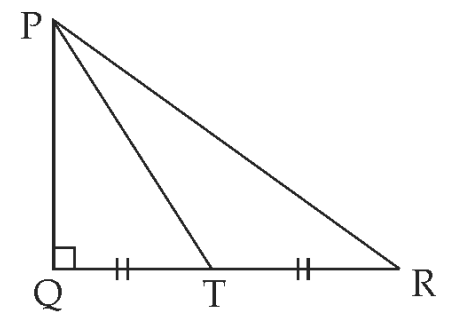
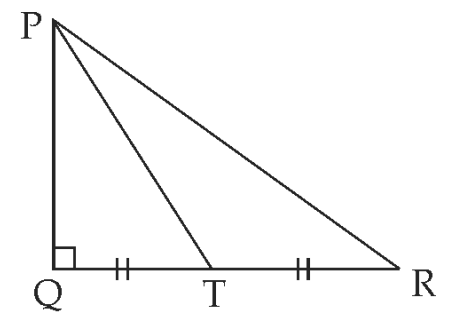
In the adjoining figure, $\angle$PQR = 90°. T is the midpoint of side QR. Prove that $PR ^2=4 PT ^2-3 PQ ^2$. 
Image
Answer
self
View full question & answer
Question 143 Marks
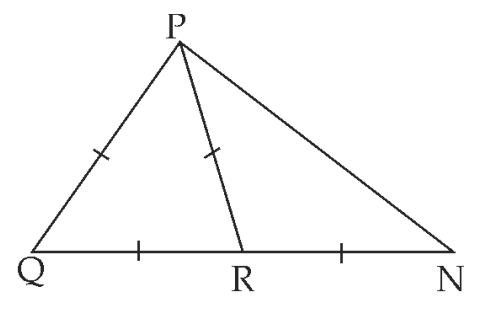
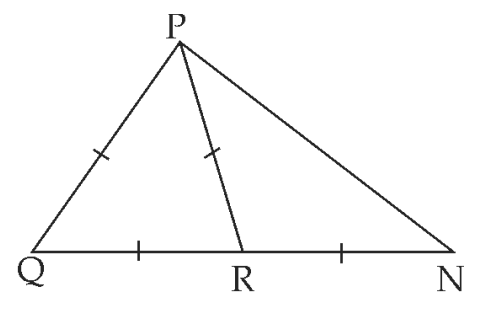
In the adjoining figure, $\Delta$PQR is an equilateral triangle. QR = RN. Prove that $P N ^2=3 P R ^2$
Image
Answer
self
View full question & answer
Question 153 Marks
If ' O' is any point in the interior of rectangle ABCD, then prove that : $OB ^2+ OD ^2= OA ^2+O C^2$
Answer
self
View full question & answer
Question 163 Marks
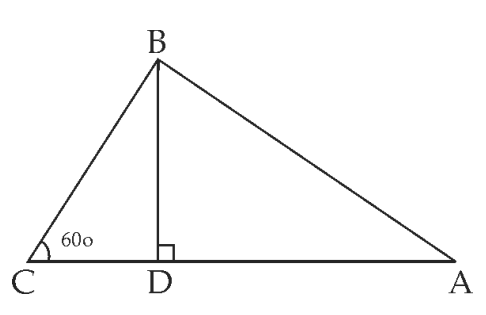
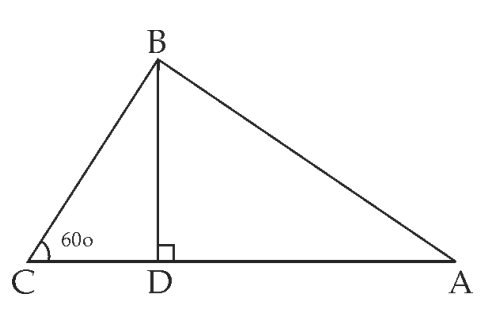
In the adjoining figure, seg BD$ \perp$ side AC, C-D-A. Prove that : $A B^2=B C^2+A C^2-B C . A C$
Image
Answer
self
View full question & answer
Question 173 Marks
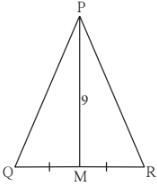
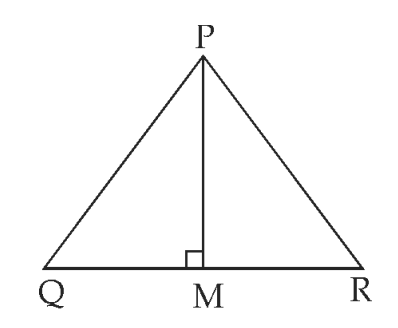
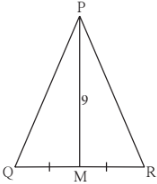
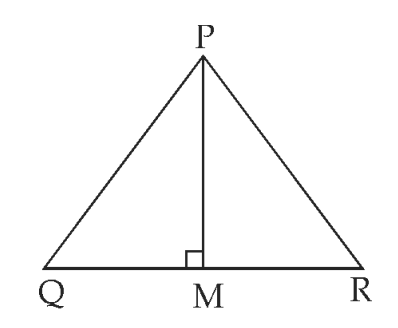
$\triangle PQR$ is an equilateral triangle, seg PM$ \perp$ side QR , Q-M-R. Prove that : $PQ ^2=4 QM ^2$
Image
Answer
self
View full question & answer
Question 183 Marks
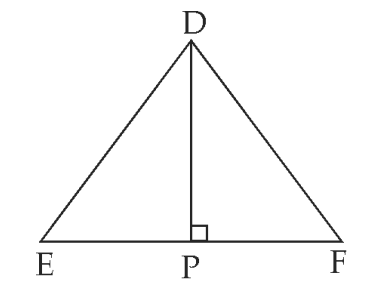
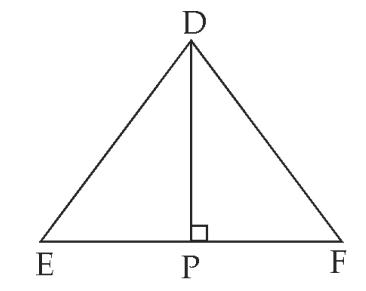
$\triangle DEF$ is an equilateral triangle. seg DP$ \perp$ side EF , E-P-F. Prove that : $DP ^2=3 EP ^2$
Image
Answer
self
View full question & answer
Question 193 Marks
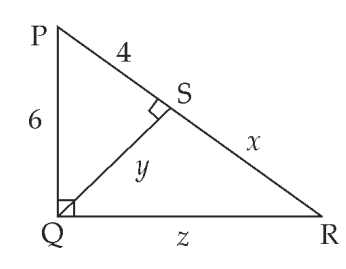
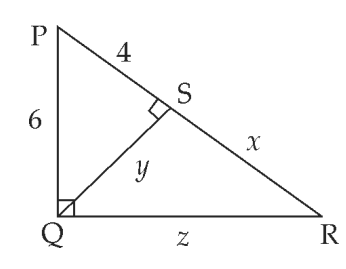
In the adjoining figure, $\angle PQR =90^{\circ}$ $\operatorname{seg} QS \perp$ side $PR , PS =4, PQ =6$. Find $x, y$ and $z$.
Image
Answer
$x=5, y=2 \sqrt{5}, z=3 \sqrt{5}$
View full question & answer
Question 203 Marks
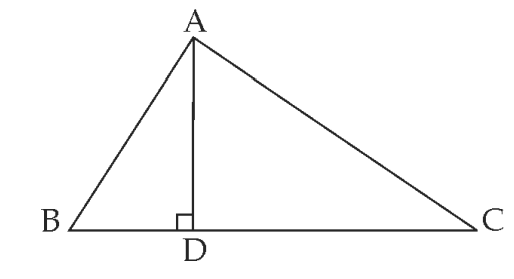
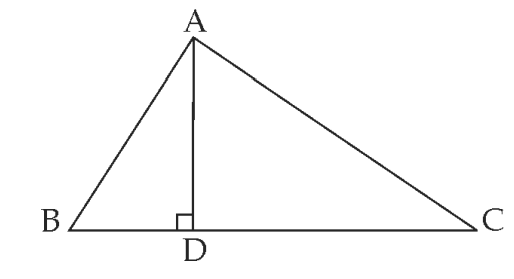
In adjoining figure, seg $AD \perp$ side BC , B -D-C. Prove that $A B ^2+ C D ^2= B D ^2+ A C ^2 \quad$ 
Image
Answer
self
View full question & answer
Question 213 Marks
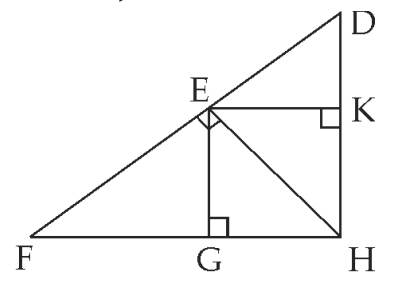
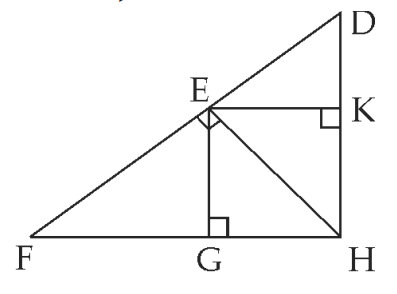
E is a point on hypotenuse DF of $\Delta$DFH, such that seg HE $\perp$ seg DF, seg EG $\perp$ seg FH and seg EK $\perp$ seg DH. Prove that, (i) $EG ^2= FG \times EK$
(ii) $E K^2= DK \times EG$
Image
Answer
self
View full question & answer
Question 223 Marks
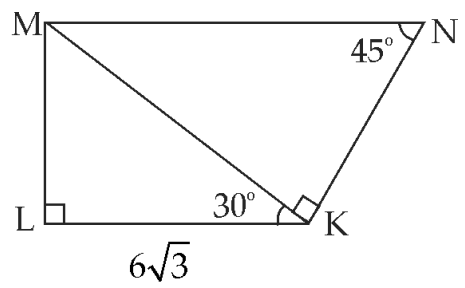
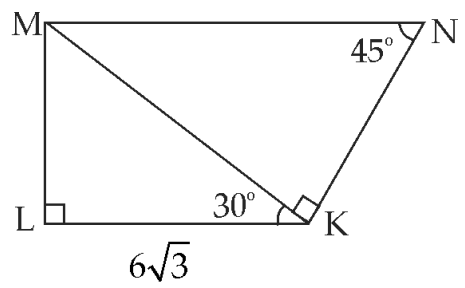
In the adjoining figure, $\angle$L = $\angle$MKN = 90°, $\angle$MKL = 30° and $\angle$MNK = 45°. If KL = $6 \sqrt{3}$, then find MK, ML, KN, MN and perimeter of $\square$MNKL.
Image
Answer
MK = 12, ML = 6, KN = 12, MN = $12 \sqrt{2}$, Perimeter of $\square$MNKL = $6(3+2 \sqrt{2}+\sqrt{3})$
View full question & answer
Question 233 Marks
In $\Delta$XYZ, $\angle$Y = 90°, $\angle$Z = a°, $\angle$X = (a + 30°). If XZ = 24, find XY and YZ.
Answer
$X Y=12, Y Z=12 \sqrt{3}$
View full question & answer
Question 323 Marks
Walls of two buildings on either side of a street are parellel to each other. A ladder 5.8 m long is placed on the street such that its top just reaches the window of a building at the height of 4 m. On turning the ladder over to the other side of the street , its top touches the window of the other building at a height 4.2 m. Find the width of the street.

View full question & answer
Question 353 Marks
prove the theorem : In a triangle if the square of one side is equal to the sum of the squares of the remaining two sides, then the triangle is a right angled triangle.
View full question & answer
Question 363 Marks
$\triangle PQR$ is an equilateral triangle, seg PM$ \perp$ side QR , Q-M-R. Prove that : $PQ ^2=4 QM ^2$
Image
View full question & answer
Question 373 Marks
$\triangle DEF$ is an equilateral triangle. seg DP$ \perp$ side EF , E-P-F. Prove that : $DP ^2=3 EP ^2$
Image
View full question & answer
Question 393 Marks
In the adjoining figure, $\Delta$PQR is an equilateral triangle. QR = RN. Prove that $P N ^2=3 P R ^2$
Image
View full question & answer
Question 403 Marks
In the adjoining figure, $\angle$PQR = 90°. T is the midpoint of side QR. Prove that $PR ^2=4 PT ^2-3 PQ ^2$. 
Image
View full question & answer
Question 413 Marks
In the adjoining figure, $\angle PQR =90^{\circ}$ $\operatorname{seg} QS \perp$ side $PR , PS =4, PQ =6$. Find $x, y$ and $z$.
Image
View full question & answer
Question 423 Marks
In the adjoining figure, $\angle$L = $\angle$MKN = 90°, $\angle$MKL = 30° and $\angle$MNK = 45°. If KL = $6 \sqrt{3}$, then find MK, ML, KN, MN and perimeter of $\square$MNKL.
Image
View full question & answer
Question 433 Marks
In $\Delta$XYZ, $\angle$Y = 90°, $\angle$Z = a°, $\angle$X = (a + 30°). If XZ = 24, find XY and YZ.
View full question & answer
Question 443 Marks
In adjoining figure, seg $AD \perp$ side BC , B -D-C. Prove that $A B ^2+ C D ^2= B D ^2+ A C ^2 \quad$ 
Image
View full question & answer
Question 463 Marks
E is a point on hypotenuse DF of $\Delta$DFH, such that seg HE $\perp$ seg DF, seg EG $\perp$ seg FH and seg EK $\perp$ seg DH. Prove that, (i) $EG ^2= FG \times EK$
(ii) $E K^2= DK \times EG$
Image
View full question & answer