Maharashtra BoardEnglish MediumSTD 10MathsP-2 Pythagoras Theorem3 Marks
Question
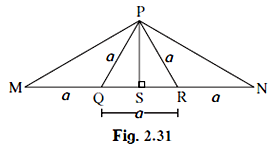
From the information given in the figure 2.31, prove that PM = PN = $\sqrt3 \times a$
✓
Answer
In $\triangle P Q S$ and $\triangle P S R$, By Pythagoras theorem i.e. $(\text { Hypotenuse })^2=(\text { base })^2+(\text { Perpendicular })^2$
$\mathrm{PQ}^2=\mathrm{QS}^2+\mathrm{PS}^2[1]$
$\mathrm{PR}^2=\mathrm{SR}^2+\mathrm{PS}^2[2]$
Subtracting [2] from [1],
$P Q^2-P R^2=Q S^2-S R^2$
$\Rightarrow a^2-a^2=Q S^2-S R^2$
$\Rightarrow Q S^2=S R^2$
$\Rightarrow Q S=S R$
$\Rightarrow QS = SR =\frac{1}{2} QR =\frac{ a }{2}$
Also,
$M S=M Q+Q S $
$\Rightarrow M S=a+\frac{a}{2}=\frac{3 a}{2}$
And
$SN = SR + RN $
$\Rightarrow SN =\frac{ a }{2}+ a =\frac{3 a }{2}$
In $\triangle PSM$ and $\triangle PSN$, By Pythagoras theorem
$PM ^2= PS ^2+ MS ^2 $
$\Rightarrow PM ^2= PS ^2+\left(\frac{3 a }{2}\right)^2 $
$PN ^2= PS ^2+ SN ^2 $
$\Rightarrow PN ^2= PS ^2+\left(\frac{3 a }{2}\right)^2$
From $[3]$ and $[4]$
$PM ^2= PN ^2 $
$\Rightarrow PM = PN$
Hence Proved.
Need a full question paper?
Generate a complete, print-ready paper with questions like this in minutes — across 16+ boards, with answer keys.