Questions

4 Marks Questions

Take a timed test

68 questions · self-marked practice — reveal the answer and mark yourself.

Question 14 Marks
On the world environment day tree plantation programme was arranged on a land which is triangular in shape. Trees are planted such that in the first row there is one tree, in the second row there are two trees, in the third row three trees and so on. Find the total number of trees in the 25 rows.
Answer
First term a = 1
Second term $\mathrm{t}_1=2$
Third term $\mathrm{t}_3=3$
Common difference $d=t_3-t_2=3-2=1$
We need to find total number of trees when $n=25$
Thus, By using sum of $n^{\text {th }}$ term of an A.P. we will find it's sum
$S_n=\frac{n}{2}[2 a+(n-1) d]$
Where, $n=$ no. of terms
$a=$ first term
$\mathrm{d}=$ common difference
$S_n=$ sum of $n$ terms
We need to find $\mathrm{S}_{25}$
Thus, on substituting the given value in formula we get,
$\Rightarrow S_{25}=\frac{25}{2}[2 \times 1+(25-1) \times 1] $
$ \Rightarrow S_{25}=\frac{25}{2}[2+24] $
$ \Rightarrow S_{25}=\frac{25}{2} \times 2 \times[1+12] $
$ \Rightarrow S_{25}=25 \times 13=325$
View full question & answer
Question 24 Marks
Kargil's temperature was recorded in a week from Monday to Saturday. All readings were in A.P. The sum of temperatures of Monday and Saturday was $5^{\circ} C$ more than sum of temperatures of Tuesday and Saturday. If temperature of Wednesday was $-30^{\circ}$ celsius then find the temperature on the other five days.
Answer
Let Monday be the first term i.e. $a=t_1$
Let Tuesday be the second term i.e $t _2$
Let Wednesday be the third term i.e $t _3$
Let Thursday be the fourth term i.e $t _4$
Let Friday be the fifth term i.e $t _5$
Let Saturday be the sixth term i.e $t _6$
$\text { Given: } t_1+t_6=5+\left(t_2+t_6\right)$
$\Rightarrow a=5+\left(t_2+t_6\right)-t_6$
$\Rightarrow a=5+t_2 \ldots \ldots(1)$
We know that,
Now, By using $n ^{\text {th }}$ term of an A.P. formula
$t_n=a+(n-1) d$
where $n=n o$. of terms
$a=\text { first term }$
$d=\text { common difference }$
$t_n=n^{\text {th }} \text { terms }$
Thus, $t _2= a +(2-1) d$
$\Rightarrow t_2=a+d$
Now substitute value of $t _2$ in (1) we get,
$\Rightarrow a=5+(a+d)$
$\Rightarrow d=a-5-a=-5$
Given: $t _3=-30^{\circ}$
$\text { Thus, } t_3=a+(3-1) \times(-5)$
$\Rightarrow-30=a+2 \times(-5)$
$\Rightarrow-30=a-10$
$\Rightarrow a=-30+10=-20^{\circ}$
Thus, Monday, $a=t_1=-20^{\circ}$
Using formula $t_{n+1}=t_n+d$
We can find the value of the other terms
Tuesday, $t _2= t _1+ d =-20-5=-25^{\circ}$
Wednesday, $t _3= t _2+ d =-25-5=-30^{\circ}$
Thursday, $t_4=t_3+d=-30-5=-35^{\circ}$
Friday, $t _5= t _4+ d =-35-5=40^{\circ}$
Saturday, $t_6=t_5+d=-40-5=-45^{\circ}$
Thus, we obtain an A.P.
$-20^{\circ},-25^{\circ},-30^{\circ},-35^{\circ},-40^{\circ},-45^{\circ}$
View full question & answer
Question 34 Marks
There is an auditorium with 27 rows of seats. There are 20 seats in the first row, 22 seats in the second row, 24 seats in the third row and so on. Find the number of seats in the 15th row and also find how many total seats are there in the auditorium?
Answer
Given: first term $\mathrm{a}=20$
Second term $t_1=22$
Third term $\mathrm{t}_2=24$
Common difference $d=t_2-t_1=24-22=2$
We need to find $t_{15}$ thus $n=15$
Now, By using $\mathrm{n}^{\text {th }}$ term of an A.P. formula
$t_n=a+(n-1) d$
where $n=$ no. of terms
$a=$ first term
$\mathrm{d}=$ common difference
$\mathrm{t}_{\mathrm{n}}=\mathrm{n}^{\text {th }} \text { terms }$
On substituting all value in $\mathrm{n}^{\text {th }}$ term of an A.P.
$\Rightarrow t_{15}=20+(15-1) \times 2$
$\Rightarrow t_{15}=20+14 \times 2$
$\Rightarrow t_{15}=20+28=48$
We have been given that, there are 27 rows in an auditorium
Thus, we need to find total seats in auditorium i.e. $\mathrm{S}_{27}$
Now, By using sum of $n^{\text {th }}$ term of an A.P. we will find it's sum
$S_n=\frac{n}{2}[2 a+(n-1) d]$
Where, $\mathrm{n}=$ no. of terms
$a=$ first term
$\mathrm{d}=$ common difference
$\mathrm{S}_{\mathrm{n}}=$ sum of $n$ terms
Thus, on substituting the given value in formula we get,
$\Rightarrow S_{27}=\frac{27}{2}[2 \times 20+(27-1) \times 2]$
$\Rightarrow S_{27}=\frac{27}{2} \times 2 \times[20+26]$
$\Rightarrow S_{27}=27 \times 46$
$\Rightarrow S_{27}=1242$
 
View full question & answer
Question 44 Marks
Sachin invested ina national saving certificate scheme. In the first year he invested ₹ 5000, in the second year ₹ 7000, in the third year ₹ 9000 and so on. Find the total amount that he invested in 12 years.
Answer
By given information we can form an A.P.
$5000,7000,9000, \ldots \ldots .$
Hence, the first term $a=5000$
Second term $\mathrm{t}_1=7000$
Third term $\mathrm{t}_2=9000$
Thus, common difference $d=t_2-t_1=9000-7000=2000$
Here, number of terms $\mathrm{n}=12$
We need to find $\mathrm{S}_{12}$
Now, By using sum of $\mathrm{n}^{\text {th }}$ term of an A.P. we will find it's sum
$S_n=\frac{n}{2}[2 a+(n-1) d]$
Where, $\mathrm{n}=$ no. of terms
$a=$ first term
$\mathrm{d}=$ common difference
$\mathrm{S}_{\mathrm{n}}=$ sum of n terms
Thus, on substituting the given value in formula we get,
$\Rightarrow S_{12}=\frac{12}{2}[2 \times 5000+(12-1) \times 2000]$
$\Rightarrow S_{12}=6 \times[10,000+11 \times 2000]$
$\Rightarrow S_{12}=6 \times[10,000+22,000]$
$\Rightarrow S_{12}=6 \times 32,000$
$\Rightarrow S_{12}=\text { Rs. } 192000$
 
View full question & answer
Question 54 Marks
A man borrows ₹ 8000 and agrees to repay with a total interest of ₹ 1360 in 12 monthly instalments. Each instalment being less than the preceding one by ₹ 40. Find the amount of the first and last instalment.
Answer
Given: A man borrows = Rs. 8000
Repay with total interest = Rs 1360
In 12 months, thus n = 12
Thus, $S_{12}$ = 8000 + 1360 = 9360
Each installment being less than preceding one
Thus, d = – 40
We need to find “a”
Now, By using sum of $n^{th}$ term of an A.P. we will find it’s sum
$S_n = \frac{n}{2} [2a+(n-1)]d$
Where, n = no. of terms
a = first term
d = common difference
$S _{ n }$ = sum of n terms
Thus, on substituting the given value in formula we get,
$\Rightarrow S_{12}=\frac{12}{2}[2 a+(12-1) \times(-40)]$
$\Rightarrow 9360=6[2 a-11 \times 40] $
$\Rightarrow \frac{9360}{6}=2 a-440 $
$\Rightarrow 1560=2 a-440 $
$\Rightarrow 1560+440=2 a $
$\Rightarrow 2 a=2000 $
$\Rightarrow a=\frac{2000}{2}=1000$
Thus, first installment $a=$ Rs. 1000
Now, By using sum of $n ^{\text {th }}$ term of an A.P. we will find it's sum
$S _{ n }=\frac{ n }{2}[\text { first term }+ \text { last term }]$
Where, $n=$ no. of terms
$S _{ n }=$ sum of n terms
Thus, on substituting the given value in formula we get,
Let $a=$ first term, $t_n=$ last term
$\Rightarrow S _{12}=\frac{12}{2}\left[ a + t _{ n }\right] $
$\Rightarrow 9360=6\left[1000+ t _{ n }\right] $
$\Rightarrow 1000+ t _{ n }=\frac{9360}{6}=1560 $
$\Rightarrow t _{ n }=1560-1000=560$
Thus, last installment $t _{ n }=560$
View full question & answer
Question 64 Marks
On $1^{st}$ Jan 2016, Sanika decides to save ₹ 10, ₹ 11 on second day, ₹ 12 on third day. If she decides to save like this, then on 31st Dec 2016 what would be her total saving?
Answer
By given information we can form an A.P.
$10,11,12,13, \ldots \ldots .$
Hence, the first term $a=10$
Second term $t_1=11$
Third term $\mathrm{t}_2=12$
Thus, common difference $d=t_2-t_1=12-11=1$
Here, number of terms from $1^{\text {st }}$ Jan 2016 to $31^{\text {st }}$ Dec 2016 is,
$\mathrm{n}=366$
We need to find $\mathrm{S}_{366}$
Now, By using sum of $\mathrm{n}^{\text {th }}$ term of an A.P. we will find it's sum
$S_n=\frac{n}{2}[2 a+(n-1) d]$
Where, $\mathrm{n}=$ no. of terms
$a=$ first term
$\mathrm{d}=$ common difference
$\mathrm{S}_{\mathrm{n}}=$ sum of n terms
Thus, on substituting the given value in formula we get,
$\Rightarrow S_{366}=\frac{366}{2}[2 \times 10+(366-1) \times 1]$
$\Rightarrow S_{366}=183[20+365]$
$\Rightarrow S_{366}=183 \times 385$
$\Rightarrow S_{366}=\operatorname{Rs} 70,455$
 
View full question & answer
Question 74 Marks
If the $9 \text {th}$ term of an A.P. is zero then show that the $29^{th}$ term is twice the $19^{th}$​​​​​​​ term.
Answer
Now, By using $n ^{\text {th }}$ term of an A.P. formula
$t_n=a+(n-1) d$
where $n=n o$. of terms
$a=$ first term
$d =$ common difference
$t _{ n }= n ^{\text {th }}$ terms
Given: $t_9=0$
$\Rightarrow t_9=a+(9-1) d$
$\Rightarrow 0=a+8 d$
$\Rightarrow a=-8 d$
To Show: $t _{29}=2 \times t _{19}$
Now,
$\Rightarrow t_{29}=a+(29-1) d$
$\Rightarrow t_{29}=a+28 d$
$\left.\Rightarrow t_{29}=-8 d+28 d=20 d \text { (since, } a=-8 d\right)$
$\Rightarrow t_{29}=20 d$
$\Rightarrow t_{29}=2 \times 10 d \ldots . .(1)$
Also,
$\Rightarrow t_{19}=a+(19-1) d$
$\Rightarrow t_{19}=a+18 d$
$\Rightarrow t_{19}=-8 d+18 d=10 d(\text { since, } a=-8 d)$
$\Rightarrow t_{19}=10 d \ldots . . .(2)$
From eq. (1) and eq. (2) we get,
$t_{29}=2 \times t_{19}$
View full question & answer
Question 84 Marks
Find four consecutive terms in an A.P. whose sum is 12 and sum of 3rd and 4th term is 14.
(Assume the four consecutive terms in A.P. are a – d, a, a + d, a + 2d.)
Answer
Let the first term be a – d
the second term be a
the third term be a + d
the fourth term be a + 2 d
Given: sum of consecutive four term is 12
⇒ (a – d) + a + (a + d) + (a + 2d) = 12
⇒ 4 a + 2d = 12
⇒ 2(2 a + d) = 12
$\Rightarrow 2a +d = \frac{12}{2} = 6$
⇒ 2a + d = 6 …..(1)
Also, sum of third and fourth term is 14
⇒ (a + d) + (a + 2d) = 14
⇒ 2a + 3d = 14 ……(2)
Subtracting eq. (1) from eq. (2) we get,
⇒(2a + 3d) – (2a + d) = 14 – 6
⇒2a + 3d – 2a – d = 8
⇒ 2d = 8
$\Rightarrow d = \frac{8}{2} = 4$
⇒ d = 4
Substituting value of “d” in eq. (1) we get,
⇒ 2a + 4 = 6
⇒ 2a = 6 – 4 = 2
$\Rightarrow a = \frac{2}{2} = 1$
⇒ a = 1
Thus, a = 1 and d = 4
Hence, first term a – d = 1 – 4 = – 3
the second term a = 1
the third term a + d = 1 + 4 = 5
the fourth term a + 2 d = 1 + 2×4 = 1 + 8 = 9
Thus, the A.P. is – 3, 1, 5, 9
View full question & answer
Question 94 Marks
In an A.P. sum of three consecutive terms is 27 and their product is 504 find the terms? (Assume that three consecutive terms in A.P. are a – d, a, a + d.)
Answer
Let the first term be $a-d$ the second term be a the third term be $a+d$
Given: sum of consecutive three term is 27
$\Rightarrow(a-d)+a+(a+d)=27$
$\Rightarrow 3 a=27$
$\Rightarrow a=\frac{27}{3}=9$
Also, Given product of three consecutive term is 504
$\Rightarrow(a-d) \times a \times(a+d)=504$
$\Rightarrow(9-d) \times 9 \times(9+d)=504(\text { since, } a=9)$
$\Rightarrow(9-d) \times(9+d)=\frac{504}{9}=56$
$\Rightarrow 9^2-d^2=56\left(\text { since, }(a-b)(a+b)=a^2-b^2\right)$
$\Rightarrow 81-d^2=56$
$\Rightarrow d^2=81-56=25$
$\Rightarrow d=\sqrt{ } 25= \pm 5$
Case 1:
Thus, if $a=9$ and $d=5$
Then the three terms are,
First term $a-d=9-5=4$
Second term $a=9$
Third term $a+d=9+5=14$
Thus, the A.P. is $4,9,14$
Case 2:
Thus, if $a=9$ and $d=-5$
Then the three terms are,
First term $a-d=9-(-5)=9+5=14$
Second term $a=9$
Third term $a+d=9+(-5)=9-5=4$
Thus, the A.P. is $14,9,4$
View full question & answer
Question 104 Marks
Sum of first 55 terms in an A.P. is 3300, find its 28th term.
Answer
Given: $S_{55}=3300$ where $n=55$
Now, By using sum of $n^{\text {th }}$ term of an A.P. we will find it's sum
$S_n=\frac{n}{2}[2 a+(n-1)] d$
Where, $\mathrm{n}=$ no. of terms
$a=$ first term
$\mathrm{d}=$ common difference
$\mathrm{S}_{\mathrm{n}}=$ sum of $n$ terms
Thus, on substituting the given value in formula we get,
$\Rightarrow S_{55}=\frac{55}{2}[2 a+(55-1) d]$
$\Rightarrow 3300=\frac{55}{2}[2 a+54 d]$
$\Rightarrow 3300=\frac{55}{2} \times 2 \times[a+27 d]$
$\Rightarrow 3300=55 \times[a+27 d]$
$\Rightarrow \frac{3300}{55}=a+27 d$
$\Rightarrow a+27 \mathrm{~d}=60 \ldots \ldots(1)$
We need to find value of $28^{\text {th }}$ term i.e $\mathrm{t}_{28}$
Now, By using $\mathrm{n}^{\text {th }}$ term of an A.P. formula
$t_n=a+(n-1) d$
where $n=$ no. of terms
$\mathrm{a}=$ first term
$\mathrm{d}=$ common difference
$\mathrm{t}_{\mathrm{n}}=\mathrm{n}^{\text {th }} \text { terms }$
we can find value of $t_{28}$ by substituting all the value in formula we get,
$\Rightarrow t_{28}=a+(28-1) d$
$\Rightarrow t_{28}=a+27 d$
From eq. (1) we get,
$\Rightarrow t_{28}=a+27 d=60$
$\Rightarrow t_{28}=60$
 
View full question & answer
Question 114 Marks
In an A.P. 19th term is 52 and 38th term is 128, find sum of first 56 terms.
Answer
Given: $\mathrm{t}_{19}=52$ and $\mathrm{t}_{38}=128$
To find: value of "a" and "d"
Using $n^{\text {th }}$ term of an A.P. formula
$t_n=a+(n-1) d$
$\text { where } n=\text { no. of terms }$
$a=\text { first term }$
$d=\text { common difference }$
$t_n=n^{\text {th }} \text { terms }$
we will find value of "a" and "d"
$\text { Let, } \mathrm{t}_{19}=a+(19-1) \mathrm{d}$
$\Rightarrow 52=a+18 d \ldots . .(1)$
$t_{38}=a+(38-1) d$
$\Rightarrow 128=a+37 d \ldots . .(2)$
Subtracting eq. (1) from eq. (2), we get,
$\Rightarrow 128-52=(a-a)+(37 d-18 d)$
$\Rightarrow 76=19 d$
$\Rightarrow d=\frac{76}{19}=4$
Substitute value of "d" in eq. (1) to get value of "a"
$\Rightarrow 52=a+18 \times 4$
$\Rightarrow 52=a+72$
$\Rightarrow a=52-72=-20$
Now, to find value of $S_{56}$ we will using formula of sum of $n$ terms
$S_n=\frac{n}{2}[2 a+(n-1)] d$
Where, $\mathrm{n}=$ no. of terms
$a=$ first term
$\mathrm{d}=$ common difference
$\mathrm{S}_{\mathrm{n}}=$ sum of $n$ terms
Thus, Substituting given value in formula we can find the value of $S_n$
$\Rightarrow S_{56}=\frac{56}{2}[2 \times(-20)+(56-1) \times 4]$
$\Rightarrow S_{56}=28 \times[-40+55 \times 4]$
$\Rightarrow S_{56}=28 \times[-40+220]$
$\Rightarrow S_{56}=28 \times 180=5040$
Thus, $\mathrm{S}_{56}=5040$
View full question & answer
Question 124 Marks
Find the sum of all even numbers from 1 to 350.
Answer
List of even natural number between 1 to 350 is $2,4,6, \ldots . . . .348$
Where first term $a=2$
Second term $\mathrm{t}_1=4$
Third term $\mathrm{t}_2=6$
Thus, common difference $d=t_2-t_1=6-4=2$
$t_n=348$ (As we have to find the sum of even numbers between 1 and 350 therefore excluding 350 )
Now, By using $n^{\text {th }}$ term of an A.P. formula
$t_n=a+(n-1) d$
where $\mathrm{n}=$ no. of terms
$a=$ first term
$\mathrm{d}=$ common difference
$\mathrm{t}_{\mathrm{n}}=\mathrm{n}^{\text {th }} \text { terms }$
we can find value of " n " by substituting all the value in formula we get,
$\Rightarrow 348=2+(\mathrm{n}-1) \times 2$
$\Rightarrow 348-2=2(\mathrm{n}-1)$
$\Rightarrow 346=2(\mathrm{n}-1)$
$\Rightarrow n-1=\frac{346}{2}=173$
$\Rightarrow \mathrm{n}=173+1=174$
Now, By using sum of $n^{\text {th }}$ term of an A.P. we will find it's sum
$S_n=\frac{n}{2}[2 a+(n-1)] d$
Where, $\mathrm{n}=$ no. of terms
$a=$ first term
$\mathrm{d}=$ common difference
$S_n=$ sum of $n$ terms
Thus, Substituting given value in formula we can find the value of $S_n$
$\Rightarrow S_{174}=\frac{174}{2}[2 \times 2+(174-1) \times 2]$
$\Rightarrow S_{174}=\frac{174}{2}[4+173 \times 2]$
$\Rightarrow S_{174}=\frac{174}{2}[4+346]$
$\Rightarrow S_{174}=\frac{174}{2} \times 350=174 \times 175=30,450$
Thus, $\mathrm{S}_{174}=30,450$
View full question & answer
Question 134 Marks
Find the sum of first 123 even natural numbers.
Answer
List of first 123 even natural number is
2,4,6,......
Where first term $a=2$
Second term $\mathrm{t}_1=4$
Third term $\mathrm{t}_2=6$
Thus, common difference $d=t_2-t_1=6-4=2$
$n=123$
By using sum of $\mathrm{n}^{\text {th }}$ term of an A.P. is
$S_n=\frac{n}{2}[2 a+(n-1) d]$
Where, $\mathrm{n}=$ no. of terms
$a=$ first term
$\mathrm{d}=$ common difference
$S_n=$ sum of $n$ terms
Thus, Substituting given value in formula we can find the value of $S_n$
$\Rightarrow S_n=\frac{123}{2}[2 \times 2+(123-1) \times 2] $
$ \Rightarrow S_n=\frac{123}{2}[4+122 \times 2]$
$ \Rightarrow S_n=\frac{123}{2}[4+244] $
$ \Rightarrow S_n=\frac{123}{2} \times 248=123 \times 122=15252$
Thus, $S_n$ = 15252
View full question & answer
Question 144 Marks
If the sum of first p terms of an A.P. is equal to the sum of first q terms then show that the sum of its first (p + q) terms is zero. (p ≠ q)
Answer
We know that, sum of $\mathrm{n}^{\text {th }}$ term of an A.P. we will find it's sum
$S_n=\frac{n}{2}[2 a+(n-1) d]$
Where, $n=$ no. of terms
$a=$ first term
$\mathrm{d}=$ common difference
$\mathrm{S}_{\mathrm{n}}=$ sum of n terms
Now, Sum of $p$ terms is
$S_p=\frac{p}{2}[2 a+(p-1) d]$
And, Sum of q terms is
$S_q=\frac{q}{2}[2 a+(q-1) d]$
Given: $S_p=S_q$
$\Rightarrow \frac{p}{2}[2 a+(p-1) d]=\frac{q}{2}[2 a+(q-1) d]$
Multiply by 2 on both sides, we get,
$\Rightarrow p[2 a+(p-1) d]=q[2 a+(q-1) d]$
$\Rightarrow 2 a p+p(p-1) d=2 a q+q(q-1) d$
$\Rightarrow 2 a p-2 a q+p(p-1) d-q(q-1) d=0$
$\Rightarrow 2 a(p-q)+d\left[p^2-p-q^2+q\right]=0$
$\Rightarrow 2 a(p-q)+d\left[\left(p^2-q^2\right)-p+q\right]=0$
$\Rightarrow 2 a(p-q)+d[(p-q)(p+q)-(p-q)]=0$
$\left(\text { since, }(a-b)(a+b)=a^2-b^2\right)$
$\Rightarrow 2 a(p-q)+d(p-q)[p+q-1]=0$
$\Rightarrow(p-q)[2 a+d(p+q-1)]=0$
Since, $p \neq q$
$\therefore p-q \neq 0$
$\Rightarrow 2 a+d(p+q-1)=0$
Multiply both side by $\frac{p+q}{2}$
$\Rightarrow \frac{p+q}{2}[2 a+d(p+q-1)]=0$
$\Rightarrow S_{p+q}=0$
Hence proved
View full question & answer
Question 154 Marks
If first term of an A.P. is a, second term is b and last term is c, then show that sum of all terms is $\frac{(a+c)(b+c-2 a)}{2(b-a)}$
Answer
Given first term = a
Second term $=b$
Last term $=\mathrm{c}$
Common difference $d=$ second term - first term $=b-a$
We will first find the number of terms
We use $\mathrm{n}^{\text {th }}$ term of an A.P. formula
$t_n=a+(n-1) d$
where $n=$ no. of terms
$a=$ first term
$\mathrm{d}=$ common difference
$\mathrm{t}_{\mathrm{n}}=\mathrm{n}^{\mathrm{th}} \text { terms }$
Thus, on substituting all values we get,
$\Rightarrow c=a+(n-1)(b-a)$
$\Rightarrow c=a+(b-a) n+a-b$
$\Rightarrow c=2 a-b+(b-a) n$
$\Rightarrow(b-a) n=c+b-2 a$
$\Rightarrow n =\frac{ c + b -2 a }{ b - a }$
Using Sum of n terms of an A.P. formula
$S _{ n }=\frac{ n }{2}[\text { first term }+ \text { last term }]$
where $n=$ no. of terms
$S_n=\text { sum of } n \text { terms} $
On substituting all the values we get,
$\Rightarrow S_n=\frac{c+b-2 a}{2(b-a)}[a+c] $
$\Rightarrow S_n=\frac{(a+c)(c+b-2 a)}{2(b-a)}$
Hence, proved
View full question & answer
Question 164 Marks
There are 37 terms in an A.P., the sum of three terms placed exactly at the middle is 225 and the sum of last three terms is 429. Write the A.P.
Answer
Let first term = a
Common difference $=\mathrm{d}$
Since, A.P. consist of 37 terms, therefor the middle most term is $\frac{37+1}{2}=\frac{38}{2}=19^{\text {th }}$ thrm,
Thus, three middle most term are $\mathrm{t}_{18}=18^{\text {th }}$ term, $\mathrm{t}_{19}=19^{\text {th }}$ term, $\mathrm{t}_{20}=20^{\text {th }}$ term
We use $\mathrm{n}^{\text {th }}$ term of an A.P. formula
$t_n=a+(n-1) d$
where $n=$ no. of terms
$a=\text { first term }$
$d=\text { common difference }$
$t_n=n^{\text {th }} \text { terms }$
Thus, on substituting all values we get,
$\text { Given, } \mathrm{t}_{18}+\mathrm{t}_{19}+\mathrm{t}_{20}=225$
$\Rightarrow[\mathrm{a}+(18-1) \mathrm{d}]+[\mathrm{a}+(19-1) \mathrm{d}]+[\mathrm{a}+(20-1) \mathrm{d}]=225$
$\Rightarrow[\mathrm{a}+17 \mathrm{~d}]+[\mathrm{a}+18 \mathrm{~d}]+[\mathrm{a}+19 \mathrm{~d}]=225$
$\Rightarrow 3 \mathrm{a}+54 \mathrm{~d}=225$
Dividing by 3
$\Rightarrow a+18 d=75 \ldots \ldots(1)$
Given, sum of last three term is 429
$\Rightarrow t_{35}+t_{36}+t_{37}=429$
$\Rightarrow[a+(35-1) d]+[a+(36-1) d]+[a+(37-1) d]=429$
$\Rightarrow[a+34 d]+[a+35 d]+[a+36 d]=429$
$\Rightarrow 3 a+105 d=429$
Dividing by 3
$\Rightarrow a+35 d=143 \ldots \ldots(2)$
Subtracting eq. (1) from eq. (2) we get,
$\Rightarrow[\mathrm{a}+35 \mathrm{~d}]-[\mathrm{a}+18 \mathrm{~d}]=143-75$
$\Rightarrow 17 \mathrm{~d}=68$
$\Rightarrow d=\frac{68}{17}=4$
Substituting value of 'd' in eq. (1) we get,
$\Rightarrow a+18 \times 4=75$
$\Rightarrow a+72=75$
$\Rightarrow a=75-72=3$
$\Rightarrow a=t_1=3$
We know that, $t_{n+1}=t_n+d$
$\mathrm{t}_2=\mathrm{t}_1+\mathrm{d}=3+4=7$
$\mathrm{t}_3=\mathrm{t}_2+\mathrm{d}=7+4=11$
$\mathrm{t}_4=\mathrm{t}_3+\mathrm{d}=11+4=15$
$\mathrm{t}_{37}=3+(37-1) \times 4$
$\mathrm{t}_{37}=3+36 \times 4$
$\mathrm{t}_{37}=3+144=147$
Thus, the A.P. is $3,7,11, \ldots, 147$
View full question & answer
Question 174 Marks
In an A.P. the first term is – 5 and last term is 45. If sum of all numbers in the A.P. is 120, then how many terms are there? What is the common difference?
Answer
Given, first term $a=-5$
Last term $t_n=45$
Sum of $n$ terms $S_n=120$
To find no of terms " n "
Using Sum of $n$ terms of an A.P. formula $S_n=\frac{n}{2}[$ first term + last term $]$
where $n=$ no. of terms
$S_n=\text { sum of } \mathrm{n} \text { terms }$
Now, on substituting given value in formula we get,
$\Rightarrow 120=\frac{n}{2}[-5+45]$
$\Rightarrow 120=\frac{n}{2} \times 40$
$\Rightarrow 120=20 n$
$\Rightarrow n=\frac{120}{20}=6$
To find the common difference ' $d$ '
We use $n^{\text {th }}$ term of an A.P. formula
$t_n=a+(n-1) d$
where $n=$ no. of terms
$a=$ first term
$d=$ common difference
$\mathrm{t}_{\mathrm{n}}=\mathrm{n}^{\text {th }} \text { terms }$
Thus, on substituting all values we get,
$\Rightarrow \mathrm{t}_6=-5+(6-1) \mathrm{d}$
$\Rightarrow 45=-5+5 \mathrm{~d}$
$\Rightarrow 5 \mathrm{~d}=45+5=50$
$\Rightarrow d=\frac{50}{5}=10$
Thus, common difference is 10
View full question & answer
Question 184 Marks
Two A.P.’s are given $9, 7, 5, . . .$  and $24, 21, 18, . . . .$ If nth term of both the progressions are equal then find the value of n and nth term.
Answer
Given A.P. is $9,7,5 \ldots$...
Whose first tern a $=9$
Second term $t _1=7$
Third term $t _3=5$
Common difference $d=t_3-t_2=5-7=-2$
Another A.P. is $24,21,18, \ldots$
Whose first tern a $=24$
Second term $t _1=21$
Third term $t _3=18$
Common difference $d=t_3-t_2=18-21=-3$
We have been given, $n ^{\text {th }}$ term of both the A.P. is same thus, by using $n ^{\text {th }}$ term of an A.P. formula
$t_n=a+(n-1) d$
where $n =$ no. of terms
$a=$ first term
$d =$ common difference
$t _{ n }= n ^{\text {th }}$ terms
Hence, by given condition we get,
$\Rightarrow 9+(n-1) \times(-2)=24+(n-1) \times(-3)$
$\Rightarrow 9-2 n+2=24-3 n+3$
$\Rightarrow 11-2 n=27-3 n$
$\Rightarrow 3 n-2 n=27-11$
$\Rightarrow n=16$
Thus, value of $n ^{\text {th }}$ term where $a=9, d=-2, n=16$ is
$\Rightarrow t_n=9+(16-1) \times(-2)$
$\Rightarrow t_n=9-15 \times 2$
$\Rightarrow t_n=9-30=-21$
View full question & answer
Question 204 Marks
Anvar saves some amount every month.In first three months he saves ₹ 200, ₹ 250 and ₹ 300 respectively. In which month will he save ₹ 1000?
View full question & answer
Question 214 Marks
Ajay sharma repays the borrowed amount of ₹ 3,25,000 by paying ₹ 30500 in the first month and then decreases the payment by ₹ 1500 every month. How long will it take to clear his amount?
View full question & answer
Question 224 Marks
A mixer manufacturing company manufactured $600$ mixers in $3^{rd}$^ year and in $7^{th}$​​​​​​​^ year they manufactured 700 mixers. If every year there is same growth in the production of mixers then find
(i) Production in the first year
(ii) Production in $10^{th}$​​​​​​​ year
(iii) Total production in first seven years.
View full question & answer
Question 234 Marks
The $10^{\text {th }}$ term and the $18^{\text {th }}$ term of an A.P. are $25$ and $41$ respectively then find $38^{\text {th }}$ term of that A.P., similarly if $n^{\text {th }}$ term is $99$ . Find the value of $n$.
View full question & answer
Question 244 Marks
Find the middle term of sequence formed by all three digit numbers which leave a remainder $3$ when divided by $4.$ Also find sum of all numbers on both sides of the middle term.
Answer
The sequence formed by the given numbers is $103, 107, 111, 115, .... , 999.$
This is an $A.P.$ with $a=103, d=107-103=4$ and
$t_{ n }=999$
$t_n=a+(n-1) d$
$\therefore 999=103+(n-1) 4$
$\therefore 896=4 n-4$
$\therefore 4 n=900$
$\therefore n=\frac{900}{4}$
$\therefore n=225$
$ \therefore \text { Middle term } =\left(\frac{n+1}{2}\right)^{ th } \text { term }$
$ =\left(\frac{225+1}{2}\right)^{ th } \text { term }$
$ =\frac{226}{2}$
$ =113^{ th } \text { term. }$
$t_n=a+(n-1) d$
$\therefore t_{113}=103+(113-1) 4$
$\therefore \quad=103+112 \times 4$
$=103+448$
$t_{113}=551$
Now, $t_{112}=551-4=547$
So, we have to find $S_{112}$ and $\left(S_{225}-S_{113}\right)$
$S _n=\frac{n}{2}\left[t_1+t_{ n }\right]$
$\therefore S _{112}=\frac{112}{2}[103+547]$
$\therefore \quad=\frac{112}{2} \times 650$
$\therefore S _{112}=36400$
Similarly,
$ S _{225}- S _{113} =\frac{225}{2}(103+999)-\frac{113}{2}(103+551)$
$ =(225 \times 551)-(113 \times 327)$
$ =123975-36951$
$ =87024$
$\therefore$ Sum of all members on $\text{LHS}$ of middle term is $36400$ and sum of all numbers on $\text{RHS}$ of the middle term is $87024 .$
View full question & answer
Question 254 Marks
Jinal saves $₹ 1600$ during the first year, $₹ 2100$ in the second year, $₹ 2600$ in the third year, If she continues her saving in this pattern, in how many years will she save $₹ 38,500 ?$
Answer
Pattern of her saving is $₹ 1600, ₹ 2100, ₹ 2600, ....$
It is an $A.P$. with $a=1600, d=2100-1600=500$
Also, $S_n=38500$
$S_n=\frac{n}{2}[2 a+(n-1) d]$
$\therefore 38500=\frac{n}{2}[2 \times 1600+(n-1) 500]$
$\therefore 77000=n[3200+500 n-500]$
$\therefore 77000=n[2700+500 n]$
$\therefore 77000=2700 n+500 n^2$
$\therefore 500 n^2+2700 n-77000=0$
$\therefore 5 n^2+27 n-770=0$ ...[Dividing both sides by 100]
$\therefore 5 n^2+77 n-50 n-770=0$
$\therefore n(5 n+77)-10(5 n+77)=0$
$\therefore \quad(n-10)(5 n+77)=0$
$\therefore n-10=0 \text { or } 5 n+77=0$
$\therefore n=10 \text { or } n=\frac{-77}{5}$
Now $n=\frac{-77}{5}$ (Not possible as $n$ is natural number)
$\therefore n=10$
$\therefore$ Jinal will save $₹ 38500$ in $10$ years.
View full question & answer
Question 264 Marks
If $p^{\text {th }}, q^{\text {th }}$ and $r^{\text {th }}$ terms of an $A. P$. are $l, m, n$ respectively, show that
$(q-r) l+(r-p) m+(p-q) n=0$
Answer
Given : $t_p=l, t_q=m, t_r=n$
Let the $1^{s t}$ term of given $A.P$. be $a$ and $d$ be the common difference.
$ t_n =a+(n-1) d$
$\therefore t_p =a+(p-1) d$
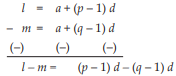
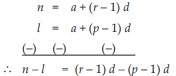
$\therefore l=a+(p-1) d ...(i)$
$\therefore t_q=a+(q-1) d$
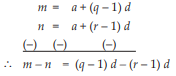
$\therefore m=a+(q-1) d ...(ii)$
$\therefore t_r=a+(r-1) d$
$\therefore n=a+(r-1) d ...(iii)$
Subtracting $(ii)$ from $(i),$ we get
Image
$\therefore l-m=(p-1-q+1) d$
$\therefore l-m=(p-q) d$
$\therefore \frac{l-m}{d}=(p-q) ...(iv)$
Subtracting $(iii)$ from $(ii),$ we get
Image
$\therefore m-n=(q-1-r+1) d$
$\therefore m-n=(q-r) d$
$\therefore \frac{m-n}{d}=(q-r) ...(v)$
Subtracting $(i)$ from $(iii),$ we get
Image
$\therefore n-l=(r-1-p+1) d$
$\therefore n-l=(r-p) d$
$\therefore \frac{n-l}{d}=(r-p) ...(vi)$
Now, $(q-r) l+(r-p) m+(p-q) n$
$=\left(\frac{m-n}{d}\right) l+\left(\frac{n-l}{d}\right) m+\left(\frac{l-m}{d}\right) n ...[$From $(iv), (v), (vi)]$
$=\frac{1}{d}[l m-\ln +m n-\operatorname{lm}+\ln -m n]$
$= 0$
Hence proved.
View full question & answer
Question 274 Marks
How many terms of the A.P. 16, 14, 12, ..... Are needed to given the sum 60? Explain why we get two answers.
Answer
For the A.P. 16, 14, 12, .....
a = 16, d = 14 – 16 = –2
Let $S_n=60$
$S_n=\frac{n}{2}[2 a+(n-1) d]$
$\therefore 60=\frac{n}{2}[2 \times 16+(n-1)(-2)]$
$\begin{array}{ll}\therefore 120=n[32-2 n+2] \\ \therefore 120=n[34-2 n] \\ \therefore 120=34 n-2 n^2 \\ \therefore 2 n^2-34 n+120=0\end{array}$
$\therefore \quad n^2-17 n+60=0$ ...[Dividing both sides by 2]
$\begin{array}{lr}\therefore n^2-12 n-5 n+60=0 \\ \therefore n(n-12)-5(n-12)=0 \\ \therefore (n-12)(n-5)=0 \\ \therefore n-12=0 \text { or } n-5=0 \\ \therefore n=12 \text { or } n=5\end{array}$
$\therefore$ The number of terms required to give a sum of 60 are 12 or 5 .
The reason for getting two answers is the common difference is –2 and the progression is towards the negative side.
The A. P. is as follows:
16, 14, 12, 10, 8, 6, 4, 2, 0, –2, –4, –6.....
$S_5=16+14+12+10+8=60$
$S_{12}=16+14+12+10+8+6+4+2+0-2$ $-4-6=60$
View full question & answer
Question 284 Marks
If sum of $m$ terms is $n$ and sum of $n$ terms is $m$, then show that the sum of $(m+n)$ terms is $-(m+n)$.
Answer
Given: $S_m=n, S_n=m$
To prove: $S_{m+n}=-(m+n)$
Proof:
$S_m=\frac{m}{2}[2 a+(m-1) d]$
$\therefore n=\frac{m}{2}[2 a+(m-1) d]...(i)$
$S_n=\frac{n}{2}[2 a+(n-1) d]$
$m=\frac{n}{2}[2 a+(n-1) d]...(ii)$
Subtracting $(ii)$ from $(i)$
$\therefore n-m=\frac{m}{2}[2 a+(m-1) d]-\frac{n}{2}[2 a+(n-1) d]$
$\therefore 2(n-m)=m[2 a+(m-1) d]-n[2 a+(n-1) d]$
$\therefore 2(n-m)=m[2 a+m d-d]-n[2 a+n d-d]$
$\therefore 2(n-m)=2 a m+m^2 d-m d-2 a n-n^2 d+n d$
$\therefore 2(n-m)=2 a m-2 a n+m^2 d-n^2 d-m d+n d$
$\therefore 2(n-m)=2 a(m-n)+d\left(m^2-n^2\right)-d(m-n)$
$\therefore \quad-2(m-n)=2 a(m-n)+d(m+n)(m-n)-d(m-n)$
Dividing throughout by $m – n,$
$\therefore \quad-2=2 a+d(m+n)-d$
$\therefore \quad-2=2 a+d(m+n-1) ...(iii)$
Now, $S_{m+n}=\frac{m+n}{2}[2 a+d(m+n-1)]$
$\therefore S_{m+n}=\frac{m+n}{2}[-2] ....[$From $(iii)]$
$\therefore S_{m+n}=m+n(-1)$
$\therefore S_{m+n}=-(m+n)$
View full question & answer
Question 294 Marks
$200$ logs of wood are stacked in the following manner: $20$ logs in the bottom row, $19$ in the next row, $18$ in the row next to it and so on. In how many rows $200$ logs are placed and how many logs are there in the top row?
Answer
The arrangement of logs $20,19,18, \ldots$. forms an $A.P.$ with $a=20, d=-1$
Let $200$ logs be arranged in n rows.
$S_n=200$
$S_n=\frac{n}{2}[2 a+(n-1) d]$
$\therefore 200=\frac{n}{2}[2 \times 20+(n-1)(-1)]$
$\therefore 400=n[40-n+1]$
$\therefore 400=n[41-n]$
$\therefore 400=41 n-n^2$
$\therefore n^2-41 n+400=0$
$\therefore n^2-25 n-16 n+400=0$
$\therefore n(n-25)-16(n-25)=0$
$\therefore \quad(n-25)(n-16)=0$
$\therefore n-25=0$ or $n-16=0$
$\therefore n=25$ or $n=16$
If $n=25$
$t_n=a+(n-1) d$
$\therefore t_{25}=20+(25-1)(-1)$
$=20+24(-1)$
$=20-24$
$t_{25}=-4$
No. of logs in the $25^{ th }$ row cannot be negative
$\therefore n \neq 25 \therefore n=16$
$t_n=a+(n-1) d$
$ \therefore t_{16} =20+(16-1)(-1)$
$=20+15(-1)$
$=20-15$
$t_{16} =5$
$\therefore 200$ logs are placed in $16$ rows and there are $5$ logs in the top row.
View full question & answer
Question 304 Marks
A farmer borrows ₹ 1000 and agrees to repay with a total interest of ₹ 140 in 12 installments, each installment being less than the preceding installment by ₹ 10 . What should be his first installment?
Answer
₹ 150
View full question & answer
Question 314 Marks
Mr. Shah borrows ₹ 4000 and agrees to repay with a total interest of ₹ 500 in 10 installments, each installment being less than the preceding installment by ₹ 10. What should be the first and the last installment?
Answer
₹ 495 , ₹ 405
View full question & answer
Question 324 Marks
Neeta saves in a 'Mahila Bachat Gat' ₹ 2 on the first day, ₹ 4 on the second day, ₹ 6 on the third day and so on. What will be her saving in the month of February 2010 ?
Answer
₹ 812
View full question & answer
Question 334 Marks
In winter, the temperature at a hill station from Monday to Friday is in A.P., The sum of the temperatures of Monday, Tuesday and Wednesday is zero and the sum of the temperature of Thursday and Friday is 15. Find the temperature of each of the five days.
Answer
$-3,0,3,6,9$
View full question & answer
Question 344 Marks
A meeting hall has 20 seats in the first row, 20 seats in the second, 28 seats in the third row and so on and has in all 30 rows. How many seats are there in the meeting hall?
Answer
2340
View full question & answer
Question 354 Marks
In an A.P. the first term is – 5 and last term is 45. If sum of all numbers in the A.P. is 120, then how many terms are there? What is the common difference?
Answer
Given, first term a = – 5
Last term tn = 45
Sum of n terms Sn = 120
To find no of terms “n”
Using Sum of n terms of an A.P. formula
$S _{ n }=\frac{ n }{2}[\text { first term }+ \text { last term }]$
where $n=$ no. of terms
$S_n=\text { sum of } n \text { terms }$
Now, on substituting given value in formula we get
$\begin{array}{l}
\Rightarrow 120=\frac{n}{2}[-5+45] \\
\Rightarrow 120=\frac{n}{2} \times 40 \\
\Rightarrow 120=20 n \\
\Rightarrow n=\frac{120}{20}=6
\end{array}$
To find the common difference ‘d’
We use nth term of an A.P. formula
tn = a + (n – 1)d
where n = no. of terms
a = first term
d = common difference
tn = nth terms
Thus, on substituting all values we get,
⇒ t6 = – 5 + (6 – 1)d
⇒ 45 = – 5 + 5d
⇒ 5d = 45 + 5 = 50
$\Rightarrow d=\frac{50}{5}=10$
Thus, common difference is 10
View full question & answer
Question 364 Marks
Two A.P.’s are given 9, 7, 5, . . . and 24, 21, 18, . . . . If nth term of both the progressions are equal then find the value of n and nth term.
Answer
Given A.P. is 9, 7, 5….Whose first tern a = 9
Second term t1 = 7
Third term t3 = 5
Common difference d = t3 – t2 = 5 – 7 = – 2
Another A.P. is 24, 21, 18, . . .
Whose first tern a = 24
Second term t1 = 21
Third term t3 = 18
Common difference d = t3 – t2 = 18 – 21 = – 3
We have been given, nth term of both the A.P. is same
thus, by using nth term of an A.P. formula
tn = a + (n – 1)d
where n = no. of terms
a = first term
d = common difference
tn = nth terms
Hence, by given condition we get,
⇒ 9 + (n – 1) × ( – 2) = 24 + (n – 1) × ( – 3)
⇒ 9 – 2n + 2 = 24 – 3n + 3
⇒ 11 – 2n = 27 – 3n
⇒ 3n – 2n = 27 – 11
⇒ n = 16
Thus, value of nth term where a = 9, d = – 2, n = 16 is
⇒ tn = 9 + (16 – 1) × ( – 2)
⇒ tn = 9 – 15 × 2
⇒ tn = 9 – 30 = – 21
View full question & answer
Question 374 Marks
If the sum of first p terms of an A.P. is equal to the sum of first q terms then show that the sum of its first (p + q) terms is zero. (p ≠ q)
Answer
We know that, sum of $n^{\text {th }}$ term of an A.P. we will find it's sum
$S _{ n }=\frac{ n }{2}[2 a +( n -1) d ]$
Where, $n =$ no. of terms
$a=\text { first term }$
$d =$ common difference
$S _{ n }=\text { sum of } n \text { terms }$
Now, Sum of $p$ terms is
$S _{ p }=\frac{ p }{2}[2 a +( p -1) d ]$
And, Sum of $q$ terms is
$S _{ q }=\frac{ q }{2}[2 a +( q -1) d ]$
Given: $S _{ p }= S _{ q }$
$\Rightarrow \frac{p}{2}[2 a+(p-1) d]=\frac{q}{2}[2 a+(q-1) d]$
Multiply by 2 on both sides, we get,
$\begin{array}{l}
\Rightarrow p[2 a+(p-1) d]=q[2 a+(q-1) d] \\
\Rightarrow 2 a p+p(p-1) d=2 a q+q(q-1) d \\
\Rightarrow 2 a p-2 a q+p(p-1) d-q(q-1) d=0 \\
\Rightarrow 2 a(p-q)+d\left[p^2-p-q^2+q\right]=0 \\
\Rightarrow 2 a(p-q)+d\left[\left(p^2-q^2\right)-p+q\right]=0 \\
\Rightarrow 2 a(p-q)+d[(p-q)(p+q)-(p-q)]=0 \\
\left(\operatorname{since},(a-b)(a+b)=a^2-b^2\right) \\
\Rightarrow 2 a(p-q)+d(p-q)[p+q-1]=0 \\
\Rightarrow(p-q)[2 a+d(p+q-1)]=0
\end{array}$
$\begin{array}{l}
\therefore p-q \neq 0 \\
\Rightarrow 2 a+d(p+q-1)=0
\end{array}$
Multiply both side by $\frac{p+q}{2}$
$\begin{array}{l}
\Rightarrow \frac{p+q}{2}[2 a+d(p+q-1)]=0 \\
\Rightarrow S_{p+q}=0
\end{array}$
Hence proved
View full question & answer
Question 384 Marks
If first term of an A.P. is a, second term is b and last term is c, then show that sum of all terms is $\frac{(a+c)(b+c-2 a)}{2(b-a)}$.
Answer
Given first term = a
Second term = b
Last term = c
Common difference d = second term – first term = b – a
We will first find the number of terms
We use nth term of an A.P. formula
tn = a + (n – 1)d
where n = no. of terms
a = first term
d = common difference
tn = nth terms
Thus, on substituting all values we get,
⇒ c = a + (n – 1)(b – a)
⇒ c = a + (b – a)n + a – b
⇒ c = 2a – b + (b – a)n
⇒ (b – a)n = c + b – 2a
$\Rightarrow n =\frac{ c + b -2 a }{ b - a }$
Using Sum of $n$ terms of an A.P. formula
$S _{ n }=\frac{ n }{2} \text { [ first term + last term] }$
where $n =$ no. of terms
$S_n=\text { sum of } n \text { terms }$
On substituting all the values we get,
$\begin{array}{l}
\Rightarrow S _{ n }=\frac{ c + b -2 a }{2( b - a )}[ a + c ] \\
\Rightarrow S _{ n }=\frac{( a + c )( c + b -2 a )}{2( b - a )}
\end{array}$
Hence, proved
View full question & answer
Question 394 Marks
There are 37 terms in an A.P., the sum of three terms placed exactly at the middle is 225 and the sum of last three terms is 429. Write the A.P.
Answer
Let first term = a
Common difference = d
Since, A.P. consist of 37 terms, therefor the middle most term is
$\frac{37+1}{2}=\frac{38}{2}=19$ th term
Thus, three middle most term are t18 = 18th term, t19 = 19th term,
t20 = 20th term
We use nth term of an A.P. formula
tn = a + (n – 1)d
where n = no. of terms
a = first term
d = common difference
tn = nth terms
Thus, on substituting all values we get,
Given, t18 + t19 + t20 = 225
⇒ [a + (18 – 1)d] + [a + (19 – 1)d] + [a + (20 – 1)d] = 225
⇒ [a + 17d] + [a + 18d] + [a + 19d] = 225
⇒ 3a + 54d = 225
Dividing by 3
⇒ a + 18d = 75 …….(1)
Given, sum of last three term is 429
⇒ t35 + t36 + t37 = 429
⇒ [a + (35 – 1)d] + [a + (36 – 1)d] + [a + (37 – 1)d] = 429
⇒ [a + 34d] + [a + 35d] + [a + 36d] = 429
⇒ 3a + 105d = 429
Dividing by 3
⇒ a + 35d = 143 …….(2)
Subtracting eq. (1) from eq. (2) we get,
⇒ [a + 35d] – [a + 18d] = 143 – 75
⇒ 17d = 68
$\Rightarrow d=\frac{68}{17}=4$
Substituting value of ‘d’ in eq. (1) we get,
⇒ a + 18 × 4 = 75
⇒ a + 72 = 75
⇒ a = 75 – 72 = 3
⇒ a = t1 = 3
We know that, tn + 1 = tn + d
t2 = t1 + d = 3 + 4 = 7
t3 = t2 + d = 7 + 4 = 11
t4 = t3 + d = 11 + 4 = 15
t37 = 3 + (37 – 1) × 4
t37 = 3 + 36 × 4
t37 = 3 + 144 = 147
Thus, the A.P. is 3, 7, 11, . . . . ., 147
View full question & answer
Question 404 Marks
Kargil’s temperature was recorded in a week from Monday to Saturday. All readings were in A.P. The sum of temperatures of Monday and Saturday was 5° C more than sum of temperatures of Tuesday and Saturday. If temperature of Wednesday was – 30° celsius then find the temperature on the other five days.
Answer
Let Monday be the first term i.e. a = t1Let Tuesday be the second term i.e t2
Let Wednesday be the third term i.e t3
Let Thursday be the fourth term i.e t4
Let Friday be the fifth term i.e t5
Let Saturday be the sixth term i.e t6
Given: t1 + t6 = 5 + (t2 + t6)
⇒ a = 5 + (t2 + t6) – t6
⇒ a = 5 + t2 …..(1)
We know that,
Now, By using nth term of an A.P. formula
tn = a + (n – 1)d
where n = no. of terms
a = first term
d = common difference
tn = nth terms
Thus, t2 = a + (2 – 1) d
⇒ t2 = a + d
Now substitute value of t2 in (1) we get,
⇒ a = 5 + (a + d)
⇒ d = a – 5 – a = – 5
Given: t3 = – 30°
Thus, t3 = a + (3 – 1) × ( – 5)
⇒ – 30 = a + 2 × ( – 5)
⇒ – 30 = a – 10
⇒ a = – 30 + 10 = – 20°
Thus, Monday, a = t1 = – 20°
Using formula tn + 1 = tn + d
We can find the value of the other terms
Tuesday, t2 = t1 + d = – 20 – 5 = – 25°
Wednesday, t3 = t2 + d = – 25 – 5 = – 30°
Thursday, t4 = t3 + d = – 30 – 5 = – 35°
Friday, t5 = t4 + d = – 35 – 5 = 40°
Saturday, t6 = t5 + d = – 40 – 5 = – 45°
Thus, we obtain an A.P.
– 20°, – 25°, – 30°, – 35°, – 40°, – 45°
View full question & answer
Question 414 Marks
There is an auditorium with 27 rows of seats. There are 20 seats in the first row, 22 seats in the second row, 24 seats in the third row and so on. Find the number of seats in the 15th row and also find how many total seats are there in the auditorium?
Answer
Given: first term a = 20
Second term t1 = 22
Third term t2 = 24
Common difference d = t2 – t1 = 24 – 22 = 2
We need to find t15 thus n = 15
Now, By using nth term of an A.P. formula
tn = a + (n – 1)d
where n = no. of terms
a = first term
d = common difference
tn = nth terms
On substituting all value in nth term of an A.P.
⇒ t15 = 20 + (15 – 1) × 2
⇒ t15 = 20 + 14 × 2
⇒ t15 = 20 + 28 = 48
We have been given that, there are 27 rows in an auditorium
Thus, we need to find total seats in auditorium i.e. S27
Now, By using sum of nth term of an A.P. we will find it’s sum
$S_n=\frac{n}{2}[2 a+(n-1) d]$
Where, $n=n o$. of terms
$\begin{array}{l}
a=\text { first term } \\
d=\text { common difference } \\
S_n=\text { sum of } n \text { terms }
\end{array}$
Thus, on substituting the given value in formula we get,
$\begin{array}{l}
\Rightarrow S_{27}=\frac{27}{2}[2 \times 20+(27-1) \times 2] \\
\Rightarrow S_{27}=\frac{27}{2} \times 2 \times[20+26] \\
\Rightarrow S_{27}=27 \times 46 \\
\Rightarrow S_{27}=1242
\end{array}$
View full question & answer
Question 424 Marks
Sachin invested ina national saving certificate scheme. In the first year he invested ₹ 5000, in the second year ₹ 7000, in the third year ₹ 9000 and so on. Find the total amount that he invested in 12 years.
Answer
By given information we can form an A.P.
5000, 7000,9000 , $\qquad$
Hence, the first term $a =5000$
Second term $t_1=7000$
Third term $t_2=9000$
Thus, common difference $d=t_2-t_1=9000-7000=2000$
Here, number of terms $n =12$
We need to find $S_{12}$
Now, By using sum of $n^{\text {th }}$ term of an A.P. we will find it's sum
$S_n=\frac{n}{2}[2 a+(n-1) d]$
Where, $n=$ no. of terms
$a=$ first term
$d=$ common difference
$S_n=$ sum of $n$ terms
Thus, on substituting the given value in formula we get,
$\begin{array}{l}\Rightarrow S_{12}=\frac{12}{2}[2 \times 5000+(12-1) \times 2000] \\ \Rightarrow S_{12}=6 \times[10,000+11 \times 2000] \\ \Rightarrow S_{12}=6 \times[10,000+22,000] \\ \Rightarrow S_{12}=6 \times 32,000 \\ \Rightarrow S_{12}=\text { Rs. } 192000\end{array}$
View full question & answer
Question 434 Marks
A man borrows ₹ 8000 and agrees to repay with a total interest of ₹ 1360 in 12 monthly instalments. Each instalment being less than the preceding one by ₹ 40. Find the amount of the first and last instalment.
Answer
Given: A man borrows $=$ Rs. 8000
Repay with total interest $=$ Rs 1360
In 12 months, thus $n =12$
Thus, $S_{12}=8000+1360=9360$
Each installment being less than preceding one
Thus, $d=-40$
We need to find "a"
Now, By using sum of $n^{\text {th }}$ term of an A.P. we will find it's sum
$S_n=\frac{n}{2}[2 a+(n-1) d]$
Where, $n=$ no. of terms
$a=\text { first term }$
$d=$ common difference
$S _n=$ sum of $n$ terms
Thus, on substituting the given value in formula we get,
$\Rightarrow S _{12}=\frac{12}{2}[2 a +(12-1) \times(-40)]$
$\begin{array}{l}
\Rightarrow 9360=6[2 a-11 \times 40] \\
\Rightarrow \frac{9360}{6}=2 a-440 \\
\Rightarrow 1560=2 a-440 \\
\Rightarrow 1560+440=2 a \\
\Rightarrow 2 a=2000 \\
\Rightarrow a=\frac{2000}{2}=1000
\end{array}$
Thus, first installment $a =$ Rs. 1000
Now, By using sum of $n^{\text {th }}$ term of an A.P. we will find it's sum
$S _{ n }=\frac{ n }{2}[\text { first term }+ \text { last term }]$
Where, $n=$ no. of terms
$S_n=\text { sum of } n \text { terms }$
Thus, on substituting the given value in formula we get,
Let $a=$ first term, $t_n=$ last term
$\Rightarrow S _{12}=\frac{12}{2}\left[ a + t _{ n }\right]$
$\begin{array}{l}
\Rightarrow 9360=6\left[1000+t_n\right] \\
\Rightarrow 1000+t_n=\frac{9360}{6}=1560 \\
\Rightarrow t_n=1560-1000=560
\end{array}$
Thus, last installment $t_n=560$
View full question & answer
Question 444 Marks
On 1st Jan 2016, Sanika decides to save ₹ 10, ₹ 11 on second day, ₹ 12 on third day. If she decides to save like this, then on 31st Dec 2016 what would be her total saving?
Answer
By given information we can form an A.P.
$10,11,12,13, \ldots \ldots$
Hence, the first term $a=10$
Second term $t _1=11$
Third term $t _2=12$
Thus, common difference $d=t_2-t_1=12-11=1$
Here, number of terms from $1^{\text {st }}$ Jan 2016 to $31^{\text {st }}$ Dec 2016 is, $n =366$
We need to find $S _{366}$
Now, By using sum of $n ^{\text {th }}$ term of an A.P. we will find it's sum
$S _{ n }=\frac{ n }{2}[2 a +( n -1) d ]$
Where, $n=$ no. of terms
$\begin{array}{l}
a=\text { first term } \\
d=\text { common difference } \\
S_n=\text { sum of } n \text { terms }
\end{array}$
Thus, on substituting the given value in formula we get,
$\begin{array}{l}
\Rightarrow S_{366}=\frac{366}{2}[2 \times 10+(366-1) \times 1] \\
\Rightarrow S_{366}=183[20+365] \\
\Rightarrow S_{366}=183 \times 385 \\
\Rightarrow S_{366}=\operatorname{Rs} 70,455
\end{array}$
View full question & answer
Question 454 Marks
On the world environment day tree plantation programme was arranged on a land which is triangular in shape. Trees are planted such that in the first row there is one tree, in the second row there are two trees, in the third row three trees and so on. Find the total number of trees in the 25 rows.
Answer
First term a = 1
Second term t1 = 2
Third term t3 = 3
Common difference d = t3 – t2 = 3 – 2 = 1
We need to find total number of trees when n = 25
Thus, By using sum of nth term of an A.P. we will find it’s sum
$S_n=\frac{n}{2}[2 a+(n-1) d]$
Where, $n=$ no. of terms
$\begin{array}{l}
a=\text { first term } \\
d=\text { common difference } \\
S_n=\text { sum of } n \text { terms }
\end{array}$
We need to find $S_{25}$
Thus, on substituting the given value in formula we get,
$\begin{array}{l}
\Rightarrow S_{25}=\frac{25}{2}[2 \times 1+(25-1) \times 1] \\
\Rightarrow S_{25}=\frac{25}{2}[2+24] \\
\Rightarrow S_{25}=\frac{25}{2} \times 2 \times[1+12] \\
\Rightarrow S_{25}=25 \times 13=325
\end{array}$
View full question & answer
Question 464 Marks
If the 9th term of an A.P. is zero then show that the 29th term is twice the 19th term.
Answer
Now, By using nth term of an A.P. formulatn = a + (n – 1)d
where n = no. of terms
a = first term
d = common difference
tn = nth terms
Given: t9 = 0
⇒ t9 = a + (9 – 1)d
⇒ 0 = a + 8d
⇒ a = – 8d
To Show: t29 = 2× t19
Now,
⇒ t29 = a + (29 – 1)d
⇒ t29 = a + 28d
⇒ t29 = – 8d + 28d = 20 d (since, a = – 8d )
⇒ t29 = 20 d
⇒ t29 = 2 × 10 d ….(1)
Also,
⇒ t19 = a + (19 – 1)d
⇒ t19 = a + 18d
⇒ t19 = – 8d + 18d = 10 d (since, a = – 8d )
⇒ t19 = 10 d …..(2)
From eq. (1) and eq. (2) we get,
t29 = 2× t19
View full question & answer
Question 474 Marks
Find four consecutive terms in an A.P. whose sum is 12 and sum of 3rd and 4th term is 14.
(Assume the four consecutive terms in A.P. are a – d, a, a + d, a + 2d.)
Answer

$\begin{array}{l}
\text { Let the first term be } a-d \\
\text { the second term be } a \\
\text { the third term be } a+d \\
\text { the fourth term be } a+2 d \\
\text { Given: sum of consecutive four term is } 12 \\
\Rightarrow(a-d)+a+(a+d)+(a+2 d)=12 \\
\Rightarrow 4 a+2 d=12 \\
\Rightarrow 2(2 a+d)=12 \\
\Rightarrow 2 a+d=\frac{12}{2}=6 \\
\Rightarrow 2 a+d=6 \ldots . .(1)
\end{array}$
Also, sum of third and fourth term is 14
$\begin{array}{l}
\Rightarrow(a+d)+(a+2 d)=14 \\
\Rightarrow 2 a+3 d=14 \ldots . .(2)
\end{array}$
Subtracting eq. (1) from eq. (2) we get,
$\begin{array}{l}
\Rightarrow(2 a+3 d)-(2 a+d)=14-6 \\
\Rightarrow 2 a+3 d-2 a-d=8
\end{array}$
$\begin{array}{l}
\Rightarrow 2 d=8 \\
\Rightarrow d=\frac{8}{2}=4 \\
\Rightarrow d=4
\end{array}$
Substituting value of "d" in eq. (1) we get,
$\begin{array}{l}
\Rightarrow 2 a+4=6 \\
\Rightarrow 2 a=6-4=2 \\
\Rightarrow a=\frac{2}{2}=1 \\
\Rightarrow a=1
\end{array}$
Thus, $a=1$ and $d=4$
Hence, first term $a-d=1-4=-3$
the second term $a=1$
the third term $a+d=1+4=5$
the fourth term $a +2 d =1+2 \times 4=1+8=9$
Thus, the A.P. is $-3,1,5,9$
View full question & answer
Question 484 Marks
In an A.P. sum of three consecutive terms is 27 and their product is 504 find the terms? (Assume that three consecutive terms in A.P. are a – d, a, a + d.)
Answer
Let the first term be a – d
the second term be a
the third term be a + d
Given: sum of consecutive three term is 27
⇒ (a – d) + a + (a + d) = 27
⇒ 3 a = 27
$\Rightarrow a =\frac{27}{3}=9$
Also, Given product of three consecutive term is 504
$\begin{array}{l}
\Rightarrow(a-d) \times a \times(a+d)=504 \\
\Rightarrow(9-d) \times 9 \times(9+d)=504(\text { since, } a=9) \\
\Rightarrow(9-d) \times(9+d)=\frac{504}{9}=56
\end{array}$
⇒ 92 – d2 = 56 (since, (a – b)(a + b) = a2 – b2)
⇒ 81 – d2 = 56
⇒ d2 = 81 – 56 = 25
⇒ d = √25 = ± 5
Case 1:
Thus, if a = 9 and d = 5
Then the three terms are,
First term a – d = 9 – 5 = 4
Second term a = 9
Third term a + d = 9 + 5 = 14
Thus, the A.P. is 4, 9, 14
Case 2:
Thus, if a = 9 and d = – 5
Then the three terms are,
First term a – d = 9 – ( – 5) = 9 + 5 = 14
Second term a = 9
Third term a + d = 9 + ( – 5) = 9 – 5 = 4
Thus, the A.P. is 14, 9, 4
View full question & answer
Question 494 Marks
Sum of first 55 terms in an A.P. is 3300, find its 28th term.
Answer
Given: $S_{55}=3300$ where $n=55$
Now, By using sum of $n^{\text {th }}$ term of an A.P. we will find it's sum
$S_n=\frac{n}{2}[2 a+(n-1) d]$
Where, $n=$ no. of terms
$a =$ first term
$d=$ common difference
$S _{ n }=$ sum of $n$ terms
Thus, on substituting the given value in formula we get,
$\begin{array}{l}
\Rightarrow S_{55}=\frac{55}{2}[2 a+(55-1) d] \\
\Rightarrow 3300=\frac{55}{2}[2 a+54 d] \\
\Rightarrow 3300=\frac{55}{2} \times 2 \times[a+27 d]
\end{array}$
$\begin{array}{l}
\Rightarrow 3300=55 \times[a+27 d] \\
\Rightarrow \frac{3300}{55}=a+27 d \\
\Rightarrow a+27 d=60 \ldots \ldots .(1)
\end{array}$
We need to find value of $28^{\text {th }}$ term i.e $t_{28}$
Now, By using $n^{\text {th }}$ term of an A.P. formula
$t_n=a+(n-1) d$
where $n=n o$. of terms
$\begin{array}{l}
a=\text { first term } \\
d=\text { common difference } \\
t_n=n^{\text {th }} \text { terms }
\end{array}$
we can find value of $t_{28}$ by substituting all the value in formula we get,
⇒ t28 = a + (28 – 1) d
⇒ t28 = a + 27 d
From eq. (1) we get,
⇒ t28 = a + 27 d = 60
⇒ t28 = 60
View full question & answer
Question 504 Marks
In an A.P. 19th term is 52 and 38th term is 128, find sum of first 56 terms.
Answer
Given: t19 = 52 and t38 = 128
To find: value of “a” and “d”
Using nth term of an A.P. formula
tn = a + (n – 1)d
where n = no. of terms
a = first term
d = common difference
tn = nth terms
we will find value of “a” and “d”
Let, t19 = a + (19 – 1) d
⇒ 52 = a + 18 d …..(1)
t38 = a + (38 – 1) d
⇒ 128 = a + 37 d …..(2)
Subtracting eq. (1) from eq. (2), we get,
⇒ 128 – 52 = (a – a) + (37 d – 18 d)
⇒ 76 = 19 d
$\Rightarrow d=\frac{76}{19}=4$
Substitute value of “d” in eq. (1) to get value of “a”
⇒ 52 = a + 18 ×4
⇒ 52 = a + 72
⇒ a = 52 – 72 = – 20
Now, to find value of S56 we will using formula of sum of n terms
$S_n=\frac{n}{2}[2 a+(n-1) d]$
Where, n = no. of terms
a = first term
d = common difference
Sn = sum of n terms
Thus, Substituting given value in formula we can find the value of Sn
$\Rightarrow S_{56}=\frac{56}{2}[2 \times(-20)+(56-1) \times 4]$
⇒S56 = 28 × [ – 40 + 55×4]
⇒S56 = 28 × [ – 40 + 220]
⇒S56 = 28 × 180 = 5040
Thus, S56 = 5040
View full question & answer
Question 514 Marks
Find the sum of all even numbers from 1 to 350.
Answer
List of even natural number between 1 to 350 is
2,4,6,…….348
Where first term a = 2
Second term t1 = 4
Third term t2 = 6
Thus, common difference d = t2 – t1 = 6 – 4 = 2
tn = 348 (As we have to find the sum of even numbers between 1 and 350 therefore excluding 350 )
Now, By using nth term of an A.P. formula
tn = a + (n – 1)d
where n = no. of terms
a = first term
d = common difference
tn = nth terms
we can find value of “n” by substituting all the value in formula we get,
⇒ 348 = 2 + (n – 1) × 2
⇒ 348 – 2 = 2(n – 1)
⇒ 346 = 2(n – 1)
$\Rightarrow n -1=\frac{346}{2}=173$
⇒ n = 173 + 1 = 174
Now, By using sum of nth term of an A.P. we will find it’s sum
$S_n=\frac{n}{2}[2 a+(n-1) d]$
Where, n = no. of terms
a = first term
d = common difference
Sn = sum of n terms
Thus, Substituting given value in formula we can find the value of Sn
$\begin{array}{l}\Rightarrow S_{174}=\frac{174}{2}[2 \times 2+(174-1) \times 2] \\ \Rightarrow S_{174}=\frac{174}{2}[4+173 \times 2] \\ \Rightarrow S_{174}=\frac{174}{2}[4+346] \\ \Rightarrow S_{174}=\frac{174}{2} \times 350=174 \times 175=30,450\end{array}$
Thus, S174 = 30,450
View full question & answer
Question 524 Marks
Find the sum of first 123 even natural numbers.
Answer
List of first 123 even natural number is
$2,4,6, \ldots \ldots$
Where first term $a =2$
Second term $t _1=4$
Third term $t _2=6$
Thus, common difference $d=t_2-t_1=6-4=2$
$n=123$
By using sum of $n^{\text {th }}$ term of an A.P. is
$S_n=\frac{n}{2}[2 a+(n-1) d]$
Where, $n=$ no. of terms
$a =$ first term
$d =$ common difference
$S_n=$ sum of $n$ terms
Thus, Substituting given value in formula we can find the value of $S_n$
$\begin{array}{l}
\Rightarrow S_n=\frac{123}{2}[2 \times 2+(123-1) \times 2] \\
\Rightarrow S_n=\frac{123}{2}[4+122 \times 2] \\
\Rightarrow S_n=\frac{123}{2}[4+244] \\
\Rightarrow S_n=\frac{123}{2} \times 248=123 \times 122=15252
\end{array}$
Thus, $S_n=15252$
View full question & answer
Question 534 Marks

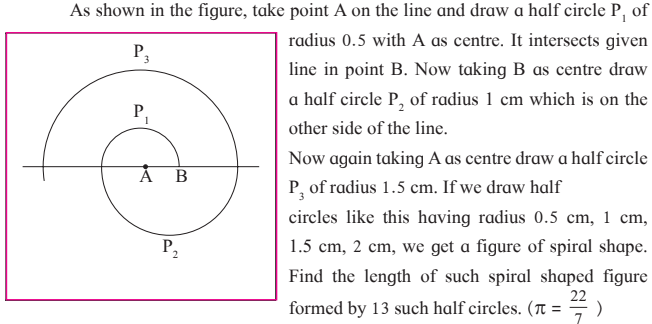
Image
Answer
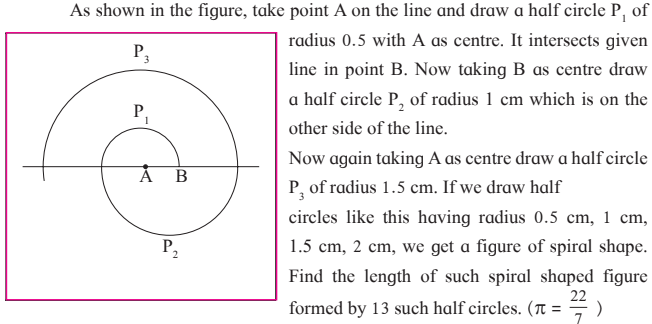
Semi circumferences $P _1, P _2, P _3, \ldots$ are drawn by taking centres $A , B , A$, $B , \ldots$ It is given that radius of the first circle is $0.5 cm$. The radius of the second circle is $1.0 cm , \ldots$ From this information we will find $P _1, P _2, P _3, \ldots P _3$.
Length of the first semi circumference $=P_1=\pi r_1=\pi \times \frac{1}{2}=\frac{\pi}{2}$
$\begin{array}{l}
P_2=\pi r_2=\pi \times 1=\pi \\
P_3=\pi r_3=\pi \times 1.5=\frac{3}{2} \pi
\end{array}$
The lengths are $P_1, P_2, P_3, \ldots$, and the numbers $\frac{1}{2} \pi, 1 \pi, \frac{3}{2} \pi, \ldots$ are in A.P. Here $a=\frac{1}{2} \pi, d=\frac{1}{2} \pi$, From this let's find $S _{13}$.
$\begin{aligned}
S _{ n } & =\frac{n}{2}[2 a+(n-1) d] \\
S _{13} & =\frac{13}{2}\left[2 \times \frac{\pi}{2}+(13-1) \times \frac{1}{2} \pi\right] \\
& =\frac{13}{2}[\pi+6 \pi] \\
& =\frac{13}{2} \times 7 \pi= \\
& =\frac{13}{2} \times 7 \times \frac{22}{7} \\
& =143 cm .
\end{aligned}$
$\therefore$ The total length of spiral shape formed by 13 semicircles is $143 cm$.
View full question & answer
Question 544 Marks
Anvar saves some amount every month.In first three months he saves ₹ 200, ₹ 250 and ₹ 300 respectively. In which month will he save ₹ 1000?
Answer
Saving in first month ₹ 200 ; Saving in second month $₹ 250 ; \ldots$. $200,250,300, \ldots$ this is an A.P.
Here $a=200, d=50$, Let's find $n$ using $t _{ n }$ formula and then find $S _{ n }$.
$\begin{aligned}
t _{ n } & =a+(n-1) d \\
& =200+(n-1) 50 \\
& =200+50 n-50 \\
1000 & =150+50 n \\
150+50 n & =1000 \\
50 n & =1000-150 \\
50 n & =850 \\
\therefore n & =17
\end{aligned}$
In the $17^{\text {th }}$ month he will save $₹ 1000$.
Let's find that in 17 months how much total amount is saved.
$\begin{aligned}
S _{ n } & =\frac{n}{2}[2 a+( n -1) d] \\
& =\frac{17}{2}[2 \times 200+(17-1) \times 50] \\
& =\frac{17}{2}[400+800] \\
& =\frac{17}{2}[1200] \\
& =17 \times 600 \\
& =10200
\end{aligned}$
In 17 months total saving is ₹ 10200 .
View full question & answer
Question 554 Marks
Ajay sharma repays the borrowed amount of ₹ 3,25,000 by paying ₹ 30500 in the first month and then decreases the payment by ₹ 1500 every month. How long will it take to clear his amount?
Answer
Let the time required to clear the amount be $n$ months. The monthly payment decreases by ₹ 1500 . Therefore the payments are in A.P.
$\begin{array}{l}
\text { First term }=a=30500, d=-1500 \\
\text { Amount }= S _{ n }=3,25,000 \\
S _{ n }=\frac{n}{2}[2 a+(n-1) d] \\
3,25,000=\frac{n}{2}[2 \times 30500+(n-1) d] \\
\quad=\frac{n}{2}[2 \times 30500-1500 n+1500] \\
3,25,000=30500 n-750 n^2+750 n \\
\therefore 750 n^2-31250 n+325000=0
\end{array}$
divide both sides by 250 .
$\begin{array}{l}
\therefore 3 n^2-125 n+1300=0 \\
\therefore 3 n^2-60 n-65 n+1300=0 \\
\therefore 3 n(n-20)-65(n-20)=0 \\
\therefore(n-20)(3 n-65)=0 \\
\therefore n-20=0,3 n-65=0 \\
\therefore n=20 \text { or } n=\frac{65}{3}=21 \frac{2}{3}
\end{array}$
In an A.P. $n$ is a natural number.
$\therefore n \neq \frac{65}{3} \quad \therefore \quad n=20$
(Or, after 20 months, $S _{20}=3,25,000$ then the total amount will be repaid. It is not required to think about further period of time.)
$\therefore$ To clear the amount 20 months are needed.
View full question & answer
Question 564 Marks
A mixer manufacturing company manufactured 600 mixers in 3rd year and in 7th year they manufactured 700 mixers. If every year there is same growth in the production of mixers then find (i) Production in the first year (ii) Production in 10th year (iii) Total production in first seven years.
View full question & answer
Question 574 Marks
The 10th term and the 18th term of an A.P. are 25 and 41 respectively then find 38th term of that A.P., similarly if nth term is 99. Find the value of n.
View full question & answer
Question 584 Marks
Neeta saves in a 'Mahila Bachat Gat' ₹ 2 on the first day, ₹ 4 on the second day, ₹ 6 on the third day and so on. What will be her saving in the month of February 2010 ?
View full question & answer
Question 594 Marks
Mr. Shah borrows ₹ 4000 and agrees to repay with a total interest of ₹ 500 in 10 installments, each installment being less than the preceding installment by ₹ 10. What should be the first and the last installment?
View full question & answer
Question 604 Marks
Jinal saves ₹ 1600 during the first year, ₹ 2100 in the second year, ₹ 2600 in the third year, If she continues her saving in this pattern, in how many years will she save ₹ 38,500 ?
View full question & answer
Question 614 Marks
In winter, the temperature at a hill station from Monday to Friday is in A.P., The sum of the temperatures of Monday, Tuesday and Wednesday is zero and the sum of the temperature of Thursday and Friday is 15. Find the temperature of each of the five days.
View full question & answer
Question 624 Marks
If sum of $m$ terms is $n$ and sum of $n$ terms is $m$, then show that the sum of $(m+n)$ terms is $-(m+n)$.
View full question & answer
Question 634 Marks
If $p^{\text {th }}, q^{\text {th }}$ and $r^{\text {th }}$ terms of an A. P. are $l, m, n$ respectively, show that
$(q-r) l+(r-p) m+(p-q) n=0$
View full question & answer
Question 644 Marks
How many terms of the A.P. 16, 14, 12, ..... Are needed to given the sum 60? Explain why we get two answers.
View full question & answer
Question 654 Marks
Find the middle term of sequence formed by all three digit numbers which leave a remainder 3 when divided by 4. Also find sum of all numbers on both sides of the middle term.
View full question & answer
Question 664 Marks
A meeting hall has 20 seats in the first row, 20 seats in the second, 28 seats in the third row and so on and has in all 30 rows. How many seats are there in the meeting hall?
View full question & answer
Question 674 Marks
A farmer borrows ₹ 1000 and agrees to repay with a total interest of ₹ 140 in 12 installments, each installment being less than the preceding installment by ₹ 10 . What should be his first installment?
Answer
₹ 150
View full question & answer
Question 684 Marks
200 logs of wood are stacked in the following manner: 20 logs in the bottom row, 19 in the next row, 18 in the row next to it and so on. In how many rows 200 logs are placed and how many logs are there in the top row?
Answer
The arrangement of logs $20,19,18, \ldots$. forms an A.P. with $a=20, d=-1$
Let 200 logs be arranged in n rows.
$S_n=200$
$S_n=\frac{n}{2}[2 a+(n-1) d]$
$\therefore \quad 200=\frac{n}{2}[2 \times 20+(n-1)(-1)]$
$\therefore \quad 400=n[40-n+1]$
$\therefore \quad 400=n[41-n]$
$\therefore \quad 400=41 n-n^2$
$\therefore \quad n^2-41 n+400=0$
$\therefore \quad n^2-25 n-16 n+400=0$
$\therefore n(n-25)-16(n-25)=0$
$\therefore \quad(n-25)(n-16)=0$
$\therefore n-25=0$ or $n-16=0$
$\therefore n=25$ or $n=16$
If $n=25$
$t_n=a+(n-1) d$
$\therefore \quad t_{25}=20+(25-1)(-1)$
$\begin{array}{l}=20+24(-1) \\ =20-24\end{array}$
$t_{25}=-4$
No. of logs in the $25^{ th }$ row cannot be negative
$\therefore n \neq 25 \quad \therefore n=16$
$t_n=a+(n-1) d$
$\begin{aligned} \therefore \quad t_{16} =20+(16-1)(-1) \\ =20+15(-1) \\ =20-15 \\ t_{16} =5\end{aligned}$
$\therefore$ 200 logs are placed in 16 rows and there are 5 logs in the top row.
View full question & answer