Questions

3 Marks Question

Take a timed test

58 questions · self-marked practice — reveal the answer and mark yourself.

Question 13 Marks
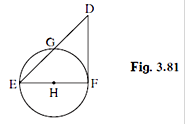
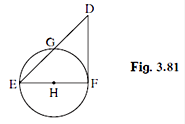
In figure 3.81, seg EF is a diameter and seg DF is a tangent segment. The radius of the circle is r. Prove that, $\mathrm{DE} \times \mathrm{GE}=4 \mathrm{r}^2$
Answer
In $\triangle \mathrm{DEF}$,
$\angle \mathrm{DFE}=90^{\circ}$ { Using tangent-radius theorem which states that a tangent at any point of a circle is perpendicular to the radius at the point of contact.}
Given: $E F=$ diameter of the circle.
$\mathrm{DE}^2=D F^2+\mathrm{EF}^2$ {Using Pythagoras theorem $\}$
$\Rightarrow D E^2=D F^2+(2 r)^2$
$\Rightarrow D E^2=D F^2+4 r^2$
$\Rightarrow D F^2=D E^2-4 r^2$
Also, $D E \times D G=D F^2$
This property is known as tangentsecant segments theorem.
$\Rightarrow D E \times D G=D E^2-4 r^2$
$\Rightarrow D E^2-D E \times D G=4 r^2$
$\Rightarrow D E(D E-D G)=4 r^2$
$\Rightarrow D E \times E G=4 r^2$
Hence, proved.
View full question & answer
Question 23 Marks
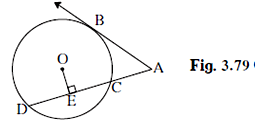
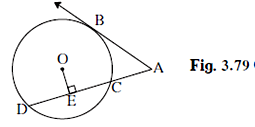
In figure 3.79, O is the centre of the circle and B is a point of contact. seg OE $\perp$ seg AD, AB = 12, AC = 8, find

(1) AD
(2) DC
(3) DE.
Answer
Given: OE $\perp$ AD, AB = 12, AC = 8
$\Rightarrow A D \times A C=A B^2$
This property is known as tangent secant segments theorem.
$\Rightarrow A D \times 8=12^2$
$\Rightarrow AD = \frac{144}{8} = 18$
(2)DC = AD – AC = 18 – 8 = 10
(3)As we know that a perpendicular from centre divides the chord in two equal parts. Here, OE $\perp$  AD.
⇒ DE = EC
⇒ DE + EC = DC
⇒2DE = DC
$\Rightarrow DE = \frac{1}{2}DC = 5$
View full question & answer
Question 33 Marks
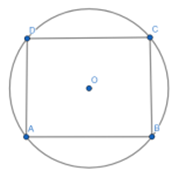
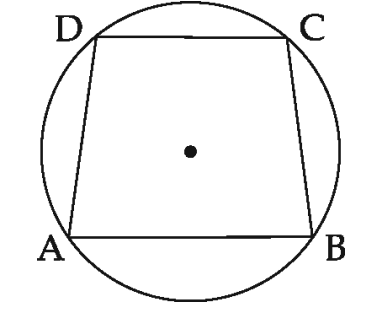
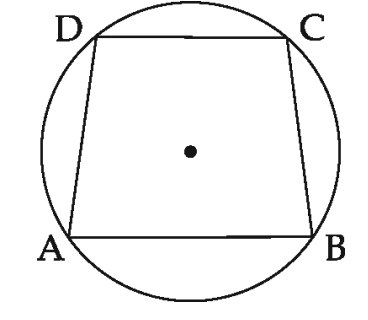
Prove that, any rectangle is a cyclic quadrilateral.
Answer


In ABCD,
∠A = 90°{∵ angle of a rectangle is 90°.}
∠C = 90° {opposite angles are equals}
⇒∠ A + ∠ C = 180°
If opposite angles are supplementary, the quadrilateral is cyclic.
∴ ABCD is cyclic.
View full question & answer
Question 43 Marks
$\square MRPN$ is cyclic, ∠R = (5x - 13)°, ∠N = (4x + 4)°. Find measures of $\angle R$ and $\angle N.$
Answer
Given MRPN is a cyclic quadrilateral.
⇒∠ R + ∠ N = 180° {Using Opposite angles of a cyclic quadrilateral are supplementary}
⇒ (5x - 13)° + (4x + 4)° = 180°
⇒9x - 9 = 180°
⇒ x – 1 = 20°
⇒ x = 21°
∠R = (5x - 13)° = 5 × 21 – 13 = 105 – 13 = 92°
∠N = (4x + 4)° = 4 × 21 + 4 = 84 + 4 = 88°
View full question & answer
Question 53 Marks
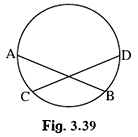
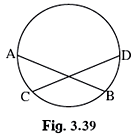
In fig 3.39 chord AB ≅ chord CD, Prove that, arc AC ≅ arc BD
Answer
∵ chord AB ≅ chord CD
∴ m(arc AB) = m(arc CD){Corresponding arcs of congruent chords of a circle (or congruent circles) are congruent}
Subtract m(arc CB) from above,
m(arc AB)– m(arc CB) = m(arc CD) – m(arc CB)
⇒m(arc AC) = m(arc BD)
⇒arc AC ≅ arc BD
Hence, proved.
View full question & answer
Question 63 Marks
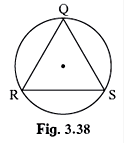
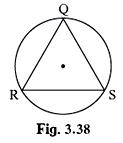
In fig 3.38 ∆ QRS is an equilateral triangle. Prove that,
(1) arc RS ≅ arc QS ≅ arc QR
(2) m(arc QRS) = 240°.
Answer
Two arcs are congruent if their measures and radii are equal.
∵∆ QRS is an equilateral triangle
∴ RS = QS = QR
⇒arc RS ≅ arc QS ≅ arc QR
(2) Let O be the centre of the circle.
m(arc QS) = ∠ QOS
∠ QOS + ∠ QOR + ∠ SOR = 360°
⇒ 3∠ QOS = 360° {∵ ∆QRS is an equilateral triangle}
⇒∠ QOS = 120°
m(arc QS) = 120°
m(arc QRS ) = 360° - 120° {∵Measure of a major arc = 360°- measure of its corresponding minor arc}
⇒m(arc QRS ) = 240°
View full question & answer
Question 73 Marks
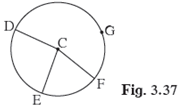
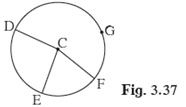
In figure 3.37, points G, D, E, F are concyclic points of a circle with centre C.
∠ ECF = 70°, m(arc DGF) = 200° find m(arc DE) and m(arc DEF).
Answer
Given ∠ECF = 70° and m(arc DGF) = 200°
We know that measure of major arc = 360° - measure of minor arc
m(arc DGF) = 360° - m(arc DF)
⇒ m(arc DF) = 360° - 200° = 160°
⇒∠ DCF = 160°
∵ The measure of a minor arc is the measure of its central angle.
∴m(arc DEF) = 160°
So, ∠DCE = ∠ DCF -∠ECF = 160° - 70°
⇒ ∠DCE = 90°
The measure of a minor arc is the measure of its central angle.
m(arc DE) = 90°
View full question & answer
Question 83 Marks
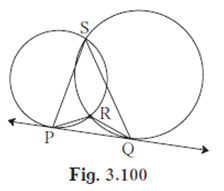
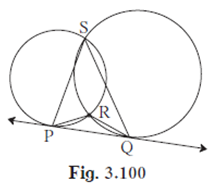
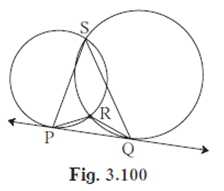
In figure 3.100, two circles intersect each other at points S and R. Their common tangent PQ touches the circle at points P, Q.
Prove that, ∠ PRQ + ∠ PSQ = 180°
Answer
We join R to S,

As PQ is the tangent at P, we have
∠RPQ = ∠PSR …………..(1)
As PQ is tangent at Q, we have
∠RQP = ∠RSQ …………………(2)
In ΔRPQ, we have
⇒ ∠RPQ + ∠RQP + ∠ PRQ = 180° (Sum of all angles of a triangle)
⇒ ∠PSR + ∠RSQ + ∠PRQ = 180° (From (1) and (2))
⇒ ∠PSQ + ∠PRQ = 180° (∠PSR + ∠RSQ = ∠PSQ)
Hence Proved.
View full question & answer
Question 93 Marks
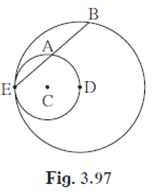
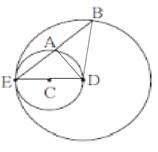
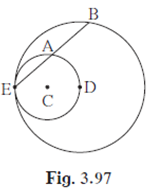
In figure 3.97, circles with centres C and D touch internally at point E. D lies on the inner circle. Chord EB of the outer circle intersects inner circle at point A. Prove that, seg EA ≅seg AB.
Answer

We see that the line joining D to E passes through C.
In the smaller circle,
A lies in the semicircle,
∴ ∠EAD = 90°
⇒ DA is perpendicular on the chord EB of the bigger circle.
We know that perpendicular from the center bisects the chord.
Therefore, EA = AB.
View full question & answer
Question 103 Marks
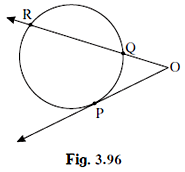
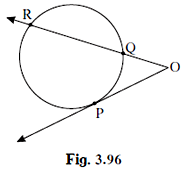
In figure 3.96 P is the point of contact.
(1) If m(arc PR) = 140°,∠ POR = 36°,find m(arc PQ)
(2) If OP = 7.2, OQ = 3.2,find OR and QR
(3) If OP = 7.2, OR = 16.2,find QR.
Answer
Given: $\mathrm{m}(\operatorname{arc} P R)=140^{\circ}, \angle \mathrm{POR}=36^{\circ}$
$\angle R O P$ is an external angle.
$\angle R O P=\frac{1}{2}[m(\operatorname{arcRP})-m(\operatorname{arcPQ})]$
$\Rightarrow \mathrm{m}(\operatorname{arc} P Q)=140^{\circ}-2 \times 36^{\circ}$
$\Rightarrow \mathrm{m}(\operatorname{arc} P Q)=68^{\circ}$
(2) Given: $\mathrm{OP}=7.2, \mathrm{OQ}=3.2$
$\text { Here, } R O \times O Q=O P^2$
$\Rightarrow R O \times 3.2=7.2 \times 7.2$
$\Rightarrow R O=16.2$
$Q R=R O-O Q=16.2-3.2=13$
(3) Given: $O P=7.2, \mathrm{OR}=16.2$
$\text { Here, } \mathrm{RO} \times \mathrm{OQ}=\mathrm{OP}^2$
$\Rightarrow 16.2 \times \mathrm{OQ}=7.2 \times 7.2$
$\Rightarrow \mathrm{OQ}=3.2$
$Q R=R O-O Q=16.2-3.2=13$
 
View full question & answer
Question 113 Marks
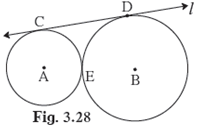
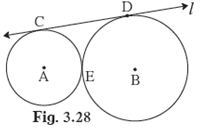
In fig 3.28 the circles with centres A and B touch each other at E. Line is a common tangent which touches the circles at C and D respectively. Find the length of seg CD if the radii Fig. 3.28 of the circles are 4 cm, 6 cm.
Answer

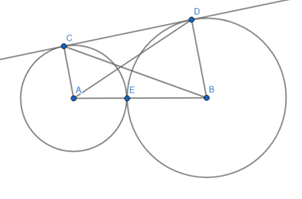
Given that two circles with centre A and B touch each other externally. We know that if the circles touch each other externally, distance between their centres is equal to the sum of their radii.
$\Rightarrow A B=(4+6) \mathrm{cm}=10 \mathrm{~cm}$
$\text { In } \triangle A B C \text { right-angles at } A \text {, }$
$B C^2=C A^2+A B^2\{\text { Using Pythagoras theorem }\}$
$\Rightarrow B C^2=4^2+10^2$
$\Rightarrow B C^2=16+100$
$\Rightarrow B C=\sqrt{116} \mathrm{~cm}$
$\text { In } \triangle D B C$
$\angle B D C=90^{\circ} \text { because } D \text { is the point of contact of tangent } C D \text { to circle centred } B$
$B C^2=C D^2+D B^2\{\text { Using Pythagoras theorem }\}$
$\Rightarrow C C^2=116-6^2$
$\Rightarrow C D^2=116-36$
$\Rightarrow C D=\sqrt{2} 0 \mathrm{~cm}=4 \sqrt{5}$
 
View full question & answer
Question 123 Marks
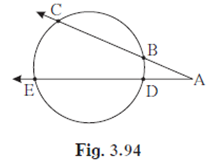
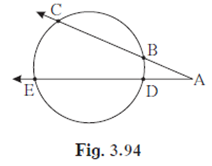
In figure 3.94,
(1) m(arc CE) = 54°,
m(arc BD) = 23°, find measure of ∠CAE.
(2) If AB = 4.2, BC = 5.4,
AE = 12.0, find AD
(3) If AB = 3.6, AC = 9.0,
AD = 5.4, find AE
Answer
Given: m(arc CE) = 54°,
m(arc BD) = 23°
∠ CAE is an external angle.
$\angle CAE =\frac{1}{2}[m(\operatorname{arcCE})- m (\operatorname{arcBD})] $
$\angle CAE =\frac{1}{2}\left[54^{\circ}-23^{\circ}\right]=15.5^{\circ}$
(2)Given: AB = 4.2, BC = 5.4,AE = 12.0
Here, AB × AC = AD × EA
⇒ AD × 12 = 4.2 × 5.4
⇒ AD = 3.36
(3) Given AB = 3.6, AC = 9.0,
AD = 5.4
Here, AB × AC = AD × EA
⇒ AE × 5.4 = 3.6 × 9
⇒ AE = 6
View full question & answer
Question 133 Marks
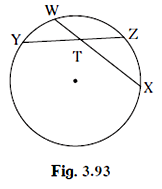
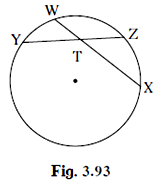
In figure 3.93, m(arc WY) = 44°,m(arc ZX) = 68°, then
(1) Find the measure of ∠ ZTX.
(2) If WT = 4.8, TX = 8.0,YT = 6.4, find TZ.
(3) If WX = 25, YT = 8,YZ = 26, find WT.
Answer
Given: m(arc WY) = 44°,m(arc ZX) = 68°
We know that
$\angle ZTX =\frac{1}{2}[m(\operatorname{arcZX})+ m (\operatorname{arcWX})] $
$ \Rightarrow \angle ZTX =\frac{1}{2}\left(44^{\circ}+68^{\circ}\right)=56^{\circ}$
(2)Given: WT = 4.8, TX = 8.0, YT = 6.4
We know that WT × TX = YT × TZ {Using secant-tangent theorem}
⇒ 6.4 × TZ = 4.8 × 8
⇒ TZ = 6
(3)Given: WX = 25, YT = 8,YZ = 26
Let WT = x and TX = 25-x
WT × TX = YT × TZ
⇒x(25-x) = 8 × 26
⇒ (x – 16)(x-9) = 0
⇒ WT = 16 or 9
View full question & answer
Question 143 Marks
If radii of two circles are 4 cm and 2.8 cm. Draw figure of these circles touching each other –
(i) externally
(ii) internally.

Answer
coming soon
View full question & answer
Question 153 Marks
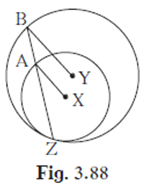
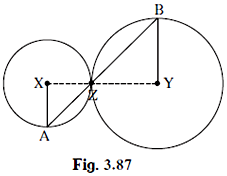
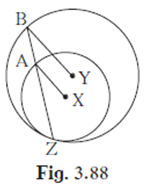
In figure 3.88, circles with centres X and Y touch internally at point Z. Seg BZ is a chord of bigger circle and intersects smaller circle at point A. Prove that, seg AX || seg BY.
Answer
XA and YB are the radii of the respective circles.
AZ and BZ are the chords of the circles.
In triangle XAZ,
AX = XZ {Radii of the same circle}
⇒ ∠ XAZ = ∠ XZA {angles opposite to equal sides are equal}
In triangle YBZ,
YB = YZ {Radii of the same circle}
⇒ ∠ YBZ = ∠ YZB {angles opposite to equal sides are equal}
⇒ ∠ XAZ = ∠ XZA = ∠ YBZ = ∠ YZB
∵ Corresponding angles are equal
⇒ XA||YB
View full question & answer
Question 163 Marks
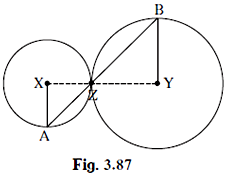
In the adjoining figure circles with centres X and Y touch each other at point Z. A secant passing through Z intersects the circles at points A and B respectively. Prove that, radius XA || radius YB. Fill in the blanks and complete the proof.

Construction: Draw segments XZ and ..YZ........ .
Proof: By theorem of touching circles, points X, Z, Y are ..concyclic........ .
$\therefore \angle XZA \cong \ldots \angle YZB \ldots \ldots \ldots$.....vertically opposite angles
Let $\angle XZA =\angle BZY = a \cdots( l )$
Now, seg XA $\cong \operatorname{seg} X Z$........ (...radius of the same circle......)
$\therefore \angle XAZ =\ldots . \angle XZA \ldots \ldots=$ a $\ldots \ldots \ldots$ (isosceles triangle theorem) (II)
similarly, seg $Y B \cong . Y Z . \ldots . \ldots \ldots .$. ........ (radius of the same circle........)
$\therefore \angle BZY =\angle Z B Y \ldots \ldots \ldots= a$ $\qquad$ (isosceles triangle theorem. $\qquad$
$\therefore$ from (I), (II), (III),
$\angle XAZ =. \angle ZBY \ldots \ldots \ldots$.
$\therefore$ radius $XA \|$ radius YB $\qquad$ (..since alternate interior angles are equal.......)
Answer
Construction: Draw segments $X Z$ and $Y Z$.
Proof: By theorem of touching circles, points $X, Z, Y$ are concyclic.
$\angle X Z A=\angle Y Z B$ \{vertically opposite angles\}
Let $\angle X Z A=\angle B Z Y=a(I)$
Now, seg $X A \cong s e g X Z$ (radius of the same circle)
$\because \angle X A Z=\angle X Z A=a$ (isosceles triangle theorem) (II)
Similarly, seg $Y B \cong Y Z$ (radius of the same circle)
$\therefore \angle \mathrm{BZY}=\angle Z B Y=\mathrm{a}$ (isosceles triangle theorem) (III)
$\therefore$ from (I), (II), (III),
$\angle \mathrm{XAZ}=\angle \mathrm{ZBY}$
$\therefore$ radius $\mathrm{XA} \|$ radius YB (since alternate interior angles are equal)
View full question & answer
Question 173 Marks
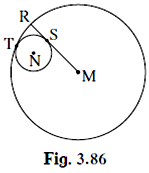
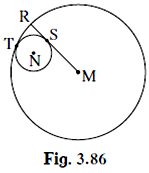
In figure 3.86, circle with centre M touches the circle with centre N at point T. Radius RM touches the smaller circle at S. Radii of circles are 9 cm and 2.5 cm. Find the answers to the following questions hence find the ratio MS:SR.
(1) Find the length of segment MT
(2) Find the length of seg MN
(3) Find the measure of ∠ NSM.
Answer
MT = radius of the big circle = 9 cm
(2)MN = MT – TN = 9 – 2.5 = 6.5 cm
(3)SM is the tangent to the circle with radius 2.5 cm with S being point of contact.
∠ NSM = 90° Using tangent-radius theorem which states that a tangent at any point of a circle is perpendicular to the radius at the point of contact.
In ∆MSN,
∠ MSN = 90°{∵ MS is the tangent to the small circle with point of contact S}
$\Rightarrow M N^2=M S^2+N S^2$
$M S^2=M N^2-N S^2$
$\Rightarrow M S^2=6.5^2-2.5^2$
$\Rightarrow M S^2=36$
$\Rightarrow M S=6 \mathrm{~cm}$
Now, SR = MR – MS = 9 – 6 = 3 cm
⇒ MS:SR = 6:3 = 2:1
View full question & answer
Question 183 Marks
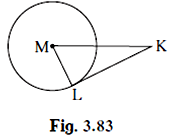
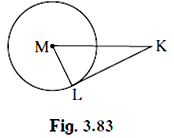
In figure 3.83, M is the centre of the circle and seg KL is a tangent segment.
If MK = 12, KL = $6\sqrt3$then find -
(1) Radius of the circle.
(2) Measures of ∠ K and ∠ M.
Answer
Here $L M$ is the radius of the circle
$\Rightarrow \angle \mathrm{KML}=90^{\circ}$ Using tangent-radius theorem which states that a tangent at any point of a circle is perpendicular to the radius at the point of contact.
In triangle MLK right-angled at L,
Given $M K=12, \mathrm{KL}=6 \sqrt{ } 3$,
$M K^2=L M^2+K L^2$ \{Using Pythagoras theorem $\}$
$\Rightarrow \mathrm{LM}^2=12^2-6 \sqrt{ } 3^2$
$\Rightarrow \mathrm{LM}^2=144-108$
$\Rightarrow \mathrm{LM}=\sqrt{ } 36$
$\Rightarrow \mathrm{LM}=6 \mathrm{~cm}$
$\text { (2) } \tan K=\frac{M L}{L K}$
$\Rightarrow \tan K=\frac{6}{6 \sqrt{3}}=\frac{1}{\sqrt{3}}=\tan 30^{\circ}$
$\Rightarrow \angle K=30^{\circ}$
$\angle \mathrm{M}+\angle \mathrm{K}+\angle \mathrm{L}=180^{\circ} \text { \{Angle sum property of the triangle\} }$
$\text { So, } \angle \mathrm{M}=180^{\circ}-\angle \mathrm{K}-\angle \mathrm{L}$
$\Rightarrow \angle \mathrm{M}=180^{\circ}-30^{\circ}-90^{\circ}=60^{\circ}$
 
View full question & answer
Question 193 Marks
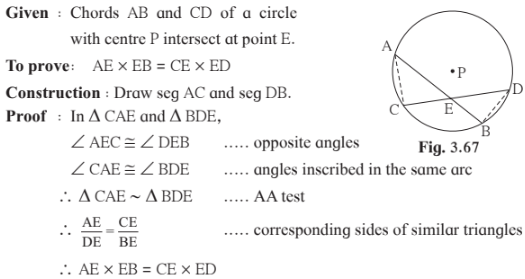
prove : Suppose two chords of a circle intersect each other in the interior of the circle, then the product of the lengths of the two segments of one chord is equal to the productof the lengths of the two segments of the other chord.
Answer
Solution is as follow:
Image
View full question & answer
Question 203 Marks
In the figure 3.36 a rectangle PQRS is inscribed in a circle with centre T.
Prove that, (i) arc PQ ≅ arc SR
(ii) arc SPQ ≅ arc PQR
Answer
(i)▭ PQRS in a rectangle.
∴ chord PQ ≅ chord SR ....... opposite sides
of a rectangle
∴ arc PQ ≅ arc SR ...... arcs corresponding
to congruent chords.
(ii) chord PS ≅ chord QR ..... Opposite sides of
a rectangle ∴ arc SP ≅ arc QR ..... arcs corresponding to congruent chords.
∴ measures of arcs SP and QR are equal
Now, m(arc SP) + m(arc PQ) = m(arc PQ) + m(arc QR)
∴ m(arc SPQ) = m(arc PQR)
∴ arc SPQ ≅ arc PQR
View full question & answer
Question 213 Marks
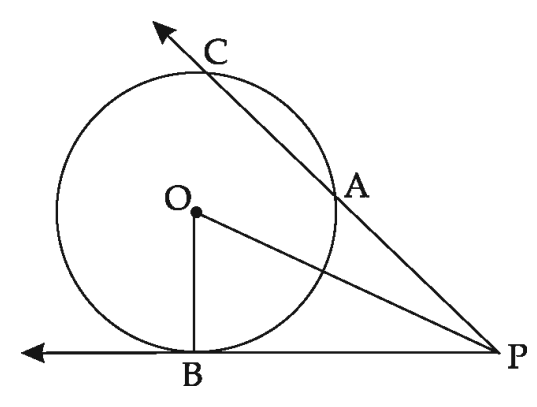
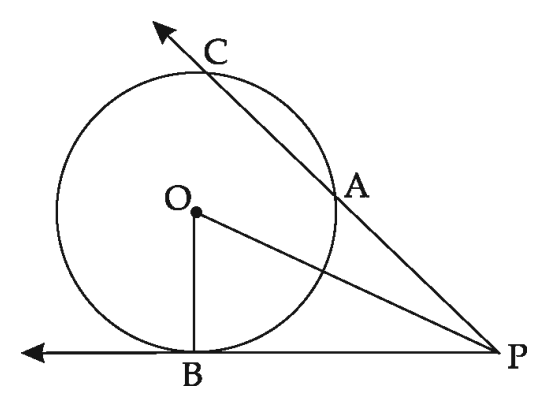
In the adjoining figure, point O is the centre of the circle. Line PB is a tangent and line PAC is a secant. Find PA × PC if OP = 25 and radius is 7.
Image
Answer
576 units
View full question & answer
Question 223 Marks
$\square$ABCD is a rectangle. Taking AD as a diameter, a semicircle AXD is drawn which intersects the diagonal BD at X. If AB = 12 cm, AD = 9 cm, then find values of BD and BX.
Answer
BD = 15, BX = 9.6
View full question & answer
Question 233 Marks
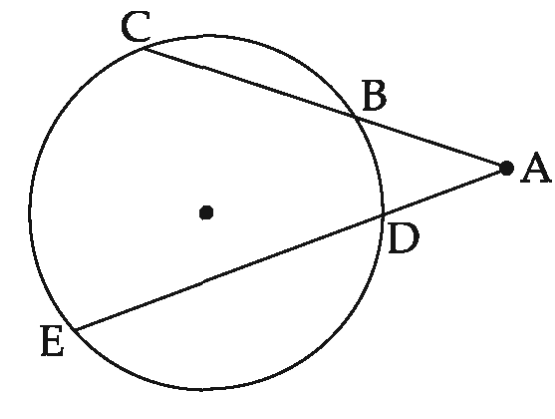
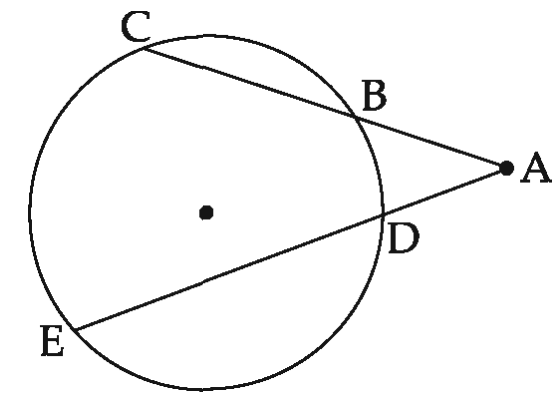
Secant AC and secant AE intersects in point A. Points of intersections of the circle and secants are B and D respectively. If CB = 5, AB = 7, EA = 20. Determine ED - AD.
Image
Answer
11.6 units
View full question & answer
Question 243 Marks
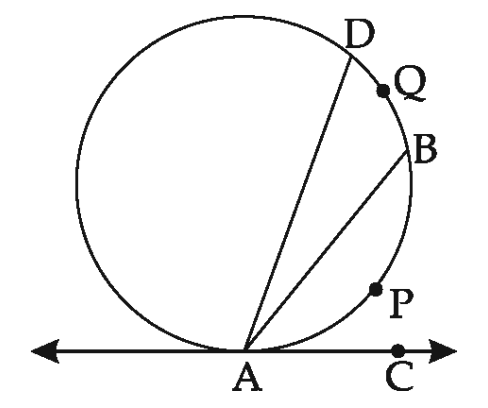
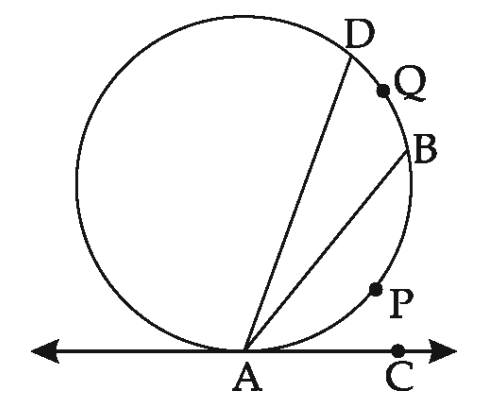
Seg AB and seg AD are the chords of the circle. C is a point on tangent of the circle at point A. If m(arc APB) 80° = and $\angle$BAD = 30°. Then find (i) $\angle$BAC (ii) m(arc BQD).
Image
Answer
(i) 40° (ii) 60°
View full question & answer
Question 253 Marks
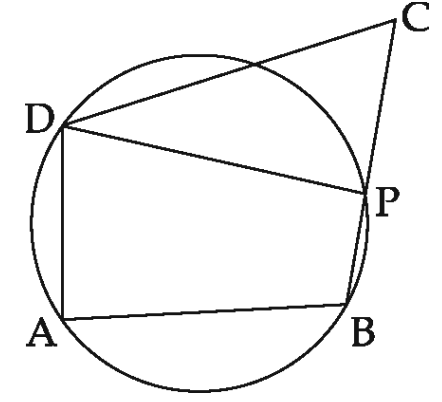
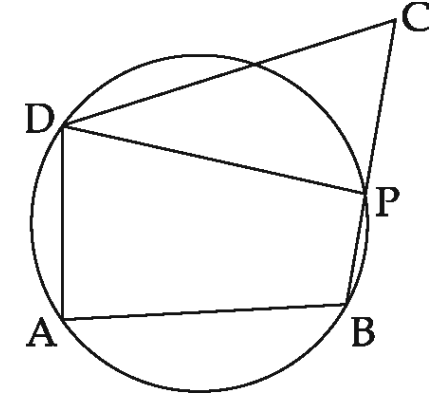
$\square$ABCD is a parallelogram. Side BC intersects circle at point P. Prove that DC = DP. 
Image
Answer
self
View full question & answer
Question 263 Marks
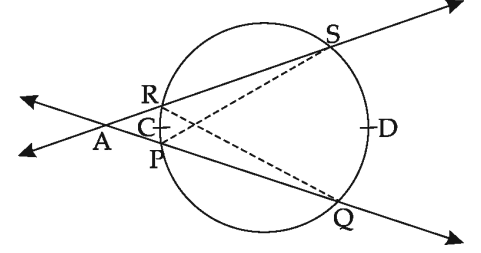
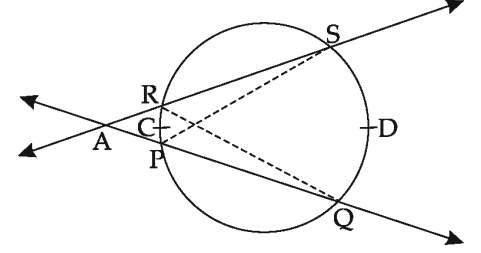
Secants containing chords RS and PQ of a circle intersect each other in point A in the exterior of a circle. If m(arc PCR) = 26° and m(arc QDS) = 48°, then find (1) $\angle$AQR (2) $\angle$SPQ (3) $\angle$RAQ.
Image
Answer
13°, 24°, 11°
View full question & answer
Question 273 Marks
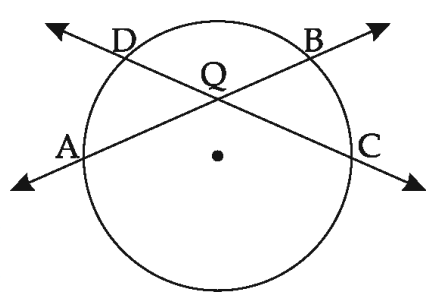
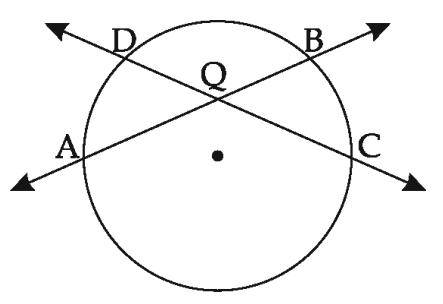
Chords AB and CD of a circle intersect in point Q in the interior of a circle of as shown in the figure. If m(arc AD) = 20°, and m(arc BC) = 36°, then find $\angle$BQC.
Image
Answer
30.5°
View full question & answer
Question 283 Marks
In the adjoining figure, chord AD $\cong$ chord BC. m(arc ADC) = 100°, m(arc CD) = 60°. Find m(arc AB) and m(arc BC).
Image
Answer
$m (\operatorname{arc} A D)= m (\operatorname{arc} B C)=100^{\circ}$
View full question & answer
Question 293 Marks
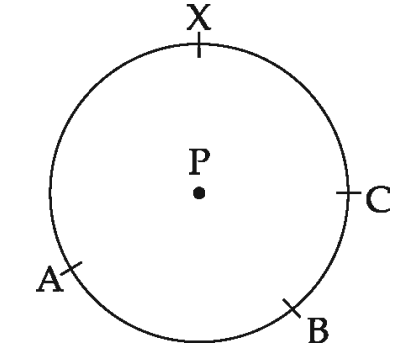
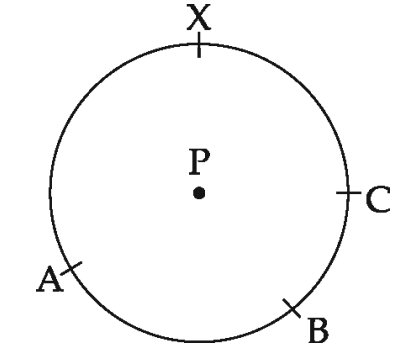
A circle with centre P. arc AB = arc BC and arc AXC = 2 arc AB. measure of arc AB, arc BC and arc AXC. Prove chord AB $\cong$ chord BC.
Image
Answer
$m (\operatorname{arc} A B)=90^{\circ}, m \left(\operatorname{arc} B C=90^{\circ} m (\operatorname{arcAXC})=180^{\circ}\right.$
View full question & answer
Question 303 Marks
In figure 3.81, seg EF is a diameter and seg DF is a tangent segment. The radius of the circle is r. Prove that, DE × GE = 4r2
Image
View full question & answer
Question 333 Marks
$\square MRPN$ is cyclic, $\angle R=(5 x-13)^{\circ}, \angle N=(4 x+4)^{\circ}$. Find measures of $\angle R$ and $\angle N$.
View full question & answer
Question 413 Marks
In figure 3.94,
(1) m(arc CE) = 54°,
m(arc BD) = 23°, find measure of ∠CAE.
(2) If AB = 4.2, BC = 5.4,
AE = 12.0, find AD
(3) If AB = 3.6, AC = 9.0,
AD = 5.4, find AE
Image
View full question & answer
Question 433 Marks
If radii of two circles are 4 cm and 2.8 cm. Draw figure of these circles touching each other –
(i) externally
(ii) internally.

View full question & answer
Question 453 Marks
View full question & answer
Question 483 Marks
prove : Suppose two chords of a circle intersect each other in the interior of the circle, then the product of the lengths of the two segments of one chord is equal to the productof the lengths of the two segments of the other chord.
View full question & answer
Question 493 Marks
In the figure 3.36 a rectangle PQRS is inscribed in a circle with centre T.
Prove that, (i) arc PQ ≅ arc SR
(ii) arc SPQ ≅ arc PQR
View full question & answer
Question 503 Marks
$\square$ABCD is a rectangle. Taking AD as a diameter, a semicircle AXD is drawn which intersects the diagonal BD at X. If AB = 12 cm, AD = 9 cm, then find values of BD and BX.
View full question & answer
Question 523 Marks
Seg AB and seg AD are the chords of the circle. C is a point on tangent of the circle at point A. If m(arc APB) 80° = and $\angle$BAD = 30°. Then find (i) $\angle$BAC (ii) m(arc BQD).
Image
View full question & answer
Question 533 Marks
Secants containing chords RS and PQ of a circle intersect each other in point A in the exterior of a circle. If m(arc PCR) = 26° and m(arc QDS) = 48°, then find (1) $\angle$AQR (2) $\angle$SPQ (3) $\angle$RAQ.
Image
View full question & answer
Question 543 Marks
Secant AC and secant AE intersects in point A. Points of intersections of the circle and secants are B and D respectively. If CB = 5, AB = 7, EA = 20. Determine ED - AD.
Image
View full question & answer
Question 553 Marks
In the adjoining figure, point O is the centre of the circle. Line PB is a tangent and line PAC is a secant. Find PA × PC if OP = 25 and radius is 7.
Image
View full question & answer
Question 563 Marks
In the adjoining figure, chord AD $\cong$ chord BC. m(arc ADC) = 100°, m(arc CD) = 60°. Find m(arc AB) and m(arc BC).
Image
View full question & answer
Question 573 Marks
Chords AB and CD of a circle intersect in point Q in the interior of a circle of as shown in the figure. If m(arc AD) = 20°, and m(arc BC) = 36°, then find $\angle$BQC.
Image
View full question & answer
Question 583 Marks
A circle with centre P. arc AB = arc BC and arc AXC = 2 arc AB. measure of arc AB, arc BC and arc AXC. Prove chord AB $\cong$ chord BC.
Image
View full question & answer