Questions

2 Marks Questions

Take a timed test

18 questions · self-marked practice — reveal the answer and mark yourself.

Question 12 Marks
A cylindrical bucket 28cm in diameter and 72cm high is full of water. The water is emptied into a rectangular tank 66cm long and 28cm wide. Find the height of the water level in the tank.
Answer
Let h be the height of rectangular tank = volume of cylindrical bucket
$66\times28\times\text{h}=\pi\Big(\frac{28}{2}\Big)^2\times72$
$66\times28\times\text{h}=\frac{22}{7}\times14\times14\times72$
$\text{h}=\frac{22\times2\times14\times72}{66\times28}$
$\text{h}=24\text{cm}$
$$Hence, the height of rectangular tank is 24cm.
View full question & answer
Question 22 Marks
A rectangular tank 15m long and 11m broad is required to receive entire liquid contents from a fully cylindrical tank of internal diameter 21m and length 5m. Find the least height of the tank that will serve the purpose.
Answer
Suppose height of the rectangular tank is equal to h.
Length of the tank = 15m
Breadth of the tank = 11m
Further,
length of cylindrical tank = 5m
Radius of cylindrical tank $=\frac{21}{2}\text{m}$
To find out the least height of the tank, equate the volumes of two tanks.
$15\times11\times\text{h}\times\pi\Big(\frac{21}{2}\Big)^2\times5$
$\Rightarrow\text{h}=\frac{22}{7}\times\frac{21}{2}\times\frac{21}{2}\times\frac{5}{15}\times\frac{1}{11}$
$\Rightarrow\text{h}=\frac{21}{2}$
$\Rightarrow\text{h}=10.5$
Hence, the least height of the tank is equal to 10.5
View full question & answer
Question 32 Marks
A spherical ball of iron has been melted and made into smaller balls. If the radius of each smaller ball is one-fourth of the radius of the original one, how many such balls can be made?
Answer
Let the radius of larger ball = r
Then volume $=\frac{4}{3}\pi\text{r}^3$
Now radius of one of the smaller balls $=\frac{\text{r}}{4}$
$\therefore$ Volume of each smaller balls $=\frac{4}{3}\pi\Big(\frac{\text{r}}{4}\Big)^3$
$=\frac{4}{3}\pi\frac{\text{r}^3}{64}=\frac{1}{64}\Big(\frac{4}{3}\pi\text{r}^3\Big)$
$\therefore$ Number of balls can be made
$=\frac{4}{3}\pi\text{r}^3\div\frac{1}{64}\Big(\frac{4}{3}\pi\text{r}^3\Big)$
$=1\div\frac{1}{64}=1\times\frac{64}{1}=64$
View full question & answer
Question 42 Marks
$25$ circular plates, each of radius $10.5\ cm$ and thickness $1.6\ cm$, are placed one above the other to form a solid circular cylinder. Find the curved surface area and
the volume of the cylinder so formed.
Answer
We have 25 circular plates, each with radius $= 10.5\ cm$ and thickness $= 1.6\ cm.$
These plates are stacked on top of one another.
So, the total height of the arrangement becomes $= 1.6 \times 25 = 40cm$
Volume of this arrangement $=\pi\text{r}^2\text{h}=\pi(10.5)^2\times40=13860\text{cm} ^2$
Curved surface area $=2\pi\text{rh}=2\pi\times10.5\times40=2640\text{cm}^2$
Hence, Volume $= 13860\ cm^3$ and C.S.A $= 2640\ cm^2​​​​​​​$​​​​​​​
View full question & answer
Question 52 Marks
A solid metallic sphere of radius 5.6cm is melted and solid cones each of radius 2.8cm and height 3.2cm are made. Find the number of such cones formed.
Answer
Let the number of such cones formed be n
Now, volume of solid metallic sphere = volume of n solid cones
$\Rightarrow\frac{4}{3}\times\frac{22}{7}\times(5.6)^3=\text{n}\times\frac{1}{3}\times\frac{22}{7}\times(2.8)^2\times3.2$
$\Rightarrow4\times(5.6)^3=\text{n}\times(2.8)^2\times3.2$
$\Rightarrow\text{n}=28$
View full question & answer
Question 62 Marks
A rectangular vessel of dimensions 20cm × 16cm × 11cm is full of water. This water is poured into a conical vessel. The top of the conical vessel has its radius 10cm. If the conical vessel is filled completely, determine its height.
Answer
Volume of cone $=\frac{1}{3}\pi\text{r}^2\text{h}$
$=\frac{1}{3}\pi\text{r}^2\text{h}=20\times16\times11$
Height of cone (h) $=\frac{3\times20\times16\times11\times7}{22\times100}$
$=33.6\text{cm}$
View full question & answer
Question 72 Marks
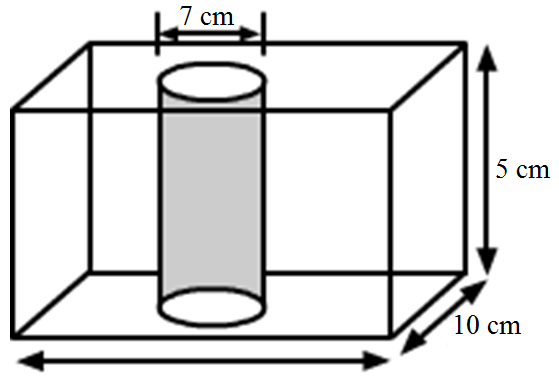
In the given figure, from a cuboidal solid metalic block, of dimensions 15cm × 10cm × 5cm, a cylindrical hole of diameter 7cm is drilled out. Find the surface area of the remaining block. $\Big(\text{use}\ \pi=\frac{22}{7}\Big)$
Answer
Surface area of the remaining block
= Total Surface area of cubic block + Curved Surface area of cylinder − 2(Area of circular base)
$=2(\text{lb}+\text{bh}+\text{lh})+2\pi\text{rh}-2\pi\text{r}^2$
$=2(15\times10\times+10\times5+15\times5)\\+2\times\frac{22}{7}\times\frac{7}{2}\times5-2\times\frac{22}{7}\times\Big(\frac{7}{2}\Big)^2$
$=2\times275+110-77$
$=583\text{cm}^2$
View full question & answer
Question 82 Marks
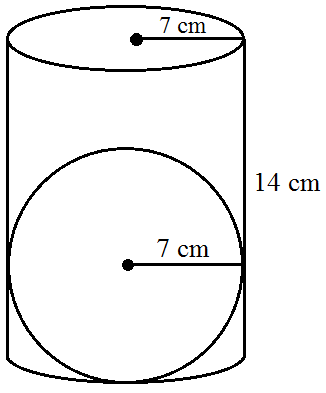
The largest sphere is to be curved out of a right circular cylinder of radius 7cm and height 14cm. Find the volume of the sphere.
Answer
Radius of cylinder (r) = 7cm
and height (h) = 14cm

The diameter of the largest sphere curved out of the given cylinder = diameter of the cylinder
= 2 x 7 = 14cm
= 2 x 7 = 14cm
$\therefore$ Radius = 7cm
$\therefore$ Volume $=\frac{4}{3}\pi\text{r}^3$
$=\frac{4}{3}\times\frac{22}{7}\times7\times7\times7\text{cm}^3$
$=1437.33=1437\text{cm}^3$
View full question & answer
Question 92 Marks
A vessel in the form of a hollow hemisphere mounted by a hollow cylinder. The diameter of the hemisphere is 14cm and the total height of the vessel is 13cm. Find the inner surface area of the vessel.
Answer
We have to find the inner surface area of a vessel which is in the form of a hemisphere mounted by a hollow cylinder.
Radius of hemisphere and cylinder (r) = 7cm
Total height of vessel (r + h) = 13cm
So, the inner surface area of a vessel,
$=2\pi\text{r}(\text{r}+\text{h})$
$=2\times\frac{22}{7}\times7\times13\text{ cm}^2$
$=572\text{cm}^2$
View full question & answer
Question 102 Marks
An wooden toy is made by scooping out a hemisphere of same radius from each end of a solid cylinder. If the height of the cylinder is 10cm, and its base is of radius 3.5cm, find the volume of wood in the toy.$\Big(\text{use}\ \pi=\frac{22}{7}\Big)$
Answer
Volume of wood in the toy = Volume of cylinder - 2(Volume of hemisphere)
$=\pi\text{r}^2\text{h}-2\times\frac{2}{3}\pi\text{r}^3$
$=\frac{22}{7}\times(3.5)^2\times10-2\times\frac{2}{3}\times(3.5)^3$
$=385-179.67$
$=205.33\text{cm}^3$
View full question & answer
Question 112 Marks
The radii of the ends of a bucket of height 24cm are 15cm and 5cm. Find its capacity. $(\text{Take}\ \pi=\frac{22}{7})$
Answer
Height of a bucket = 24cm
R = 15cm
r = 5cm
Therefore,
Capacity of the bucket
$=\frac{\pi\text{h}}{3}[\text{h}^2+\text{Rr}+\text{r}^2]$
$=\frac{22}{7}\times\frac{24}{3}\times\Big[(15)^2+15\times5+(5)^2\Big]$
$=8171.42\text{cm}^3$
View full question & answer
Question 122 Marks
The largest possible sphere is carved out of a wooden solid cube of side 7cm. Find the volume of the wood left.$(\text{use}\ \pi=\frac{22}{7})$
Answer
The radius of the largest possible sphere is carved out of a wooden solid cube is equal to the half of the side of the cube.
Radius of sphere $=\frac{7}{2}=3.5$
Volume of the wood left = Volume of cube - Volume of sphere
$=(\text{side})^3-\frac{4}{3}\pi\text{r}^3$
$=7^3-\frac{4}{3}\times\frac{22}{7}\times(3.5)^3$
$=343-179.67$
$=163.33\text{cm}^3$
View full question & answer
Question 132 Marks
The largest cone is curved out from one face of solid cube of side 21cm. Find the volume of the remaining solid.
Answer
The radius of the largest possible cone is carved out of a solid cube is equal to the half of the side of the cube.
Also, the height of the cone is equal to the side of the cube.
Radius of the cone $=\frac{21}{2}=10.5\text{cm}$
Volume of the remaining solid = Volume of cube - Volume of cone
$=(\text{Side})^3-\frac{1}{3}\pi\text{r}^2\text{h}$
$=(21)^3-\frac{1}{3}\times\frac{22}{7}\times(10.5)^2\times21$
$=9261-2425.5$
$=6835.5\text{cm}^3$
View full question & answer
Question 142 Marks
Find the number of coins, 1.5cm is diameter and 0.2cm thick, to be melted to form a right circular cylinder of height 10cm and diameter 4.5cm.
Answer
Volume of one coin $=\pi\times(1.5)^2\times\frac{0.2}{4}$
Volume of cylinder $=\pi\times(4.5)^2\times\frac{10}{4}$
So number of coins to be melted
$=\frac{\text{volume of cylinder}}{\text{volume of each coin}}$
$=\Big(\frac{4.5}{1.5}\Big)^2\times\frac{10}{0.2}$
$=9\times50$
$=450$
View full question & answer
Question 152 Marks
A bucket, made of metal sheet, is in the form of a cone whose height is 35cm and radii of circular ends are 30cm and 12cm. How many litres of milk it contains if it is full to the brim? If the milk is sold at Rs 40 per litre, find the amount received by the person.
Answer
Radii of the bucket in the form of frustum of cone = 30cm
and 12cm Depth of the bucket = 35cm
capacity of the bucket $=\frac{1}{3}\pi\text{h}(\text{r}_1^2+\text{r}^2_2+\text{r}_1\text{r}_2)$
$=\frac{1}{3}\times\frac{22}{7}\times35\big[(30)^2+(12)^2+(30\times12)\big]$
$=\frac{110}{3}[900+144+360]$
$=\frac{110}{3}\times1404=51480\text{cm}^2=51.48\ \text{liters}$
Price of milk per liter = 40
Total amount recieved by milkman = 41 × 51.48 = 2059.20
View full question & answer
Question 162 Marks
150 spherical marbles, each of diameter 1.4cm are dropped in a cylindrical vessel of diameter 7cm containing some water, which are completely immersed in water. Find the rise in the level of water in the vessel.
Answer
Let the rise in the level of water in the vessel be h cm.
Now, volume of 150 spherical maeble = volume of water displace in vessel
$\Rightarrow150\times\frac{4}{3}\times\frac{22}{7}\times(\frac{1.4}{2})^3=\frac{22}{7}\times(\frac{7}{2})^2\times\text{h}$
$\Rightarrow200\times(0.7)^3=(\frac{7}{2})^2\times\text{h}$
$\Rightarrow\text{h}=5.6\text{cm}$
View full question & answer
Question 172 Marks
Find the depth of a cylindrical tank of radius 28m, if its capacity is equal to that of a rectangular tank of size 28m × 16m × 11m.
Answer
Let x be the depth of cylindrical tank.
The radius of tank r = 28m.
Since,
The volume of cylindrical tank = volume of rectangular tank
$\pi\text{r}^2\text{x}=28\times16\times11$
$\Rightarrow\frac{22}{7}\times28\times28\times\text{x}=28\times16\times11$
$\text{x}=\frac{28\times16\times11\times7}{22\times28\times28}$
$\text{x}=\frac{16}{8}$
$\text{x}=2\text{m}$
Thus, the depth of cylindrical tank = 2m.
View full question & answer
Question 182 Marks
The radii of the ends of a frustum of a right circular cone are 5m and 8m and its lateral height is 5m. Find the lateral surface and volume of the frustum.
Answer
Lateral surface area of frustum
$=\pi(\text{r}+\text{R})\ \text{l}$
$=\pi(5+8)\times5$
$=204.28\text{m}^2$
Height of cone
$\text{h}=\sqrt{5^2=(\text{R}-\text{r}^2)}$
$=\sqrt{5^2-(8-5)^2}$
$=\sqrt{13}=4\text{cm}$
Volume $=\frac{\pi\times4}{3}(8^2+5^2+40)=540.56\text{cm}^3$
View full question & answer