Questions

2 Marks Questions

Take a timed test

16 questions · self-marked practice — reveal the answer and mark yourself.

Question 12 Marks
$\triangle\text{ABC}\sim\triangle\text{DEF}$ and their areas are respectively $64\ cm^2$ and $121\ cm^2$. If $EF = 15.4\ cm$, find $BC$.
Answer
It is given that $\triangle\text{ABC}\sim\triangle\text{DEF}$
Therefore, ratio of the areas of these triangles will be equal to the ratio of squares of their corresponding sides.
$\frac{\text{ar}(\triangle\text{ABC})}{\text{ar}(\triangle\text{DEF})}=\frac{\text{BC}^2}{\text{EF}^2}$
Let BC be x cm.
$\Rightarrow\frac{64}{121}=\frac{\text{x}^2}{(15.4)^2}$
$\Rightarrow\text{x}^2=\frac{64\times15.4\times15.4}{121}$
$\Rightarrow\text{x}=\sqrt{\frac{64\times15.4\times15.4}{121}}$
$=\frac{8\times15.4}{11}$
$=11.2$
Hence, $BC = 11.2\ cm$
View full question & answer
Question 22 Marks
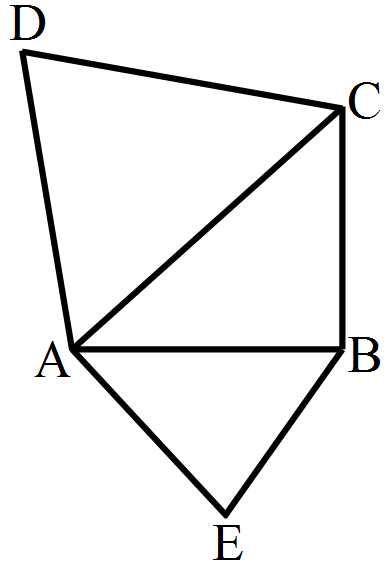
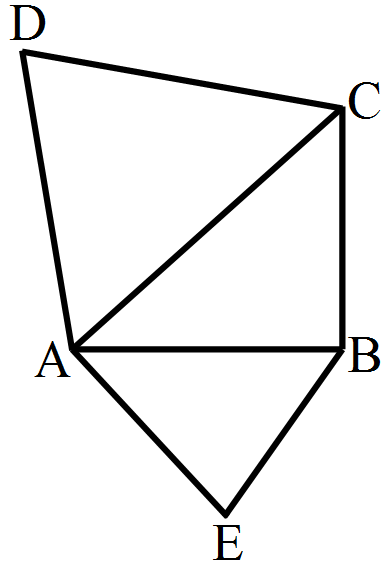
$ABC$ is an isosceles triangle, right-angled at $B$. Similar triangle $ACD$ and $ABE$ are constructed on sides $AC$ and $AB$. Find the ratio between the areas of $\triangle\text{ABE}$ and $\triangle\text{ACD}.$

Answer
ABC is an isosceles triangle right angled at $B$, Let $AB = BC = x\ cm$


By Pythagoras theorem, $AC^2 = AB^2 + BC^2 = x^2 + x^2 AC^2 = 2x^2$
$\text{AC}=\sqrt{2}\text{x}$ $\triangle\text{ACD}\approx\triangle\text{ABE}$(Given)
$\therefore\frac{\text{ar}\triangle\text{ABE}}{\text{ar}\triangle\text{ACD}}=\frac{\text{AB}^2}{\text{AC}^2}=\frac{\text{x}^2}{\big(\sqrt{2}\text{x}\big)^2}$
 $=\frac{\text{x}^2}{2\text{x}^2}=\frac{1}{2}=1:2$
View full question & answer
Question 32 Marks
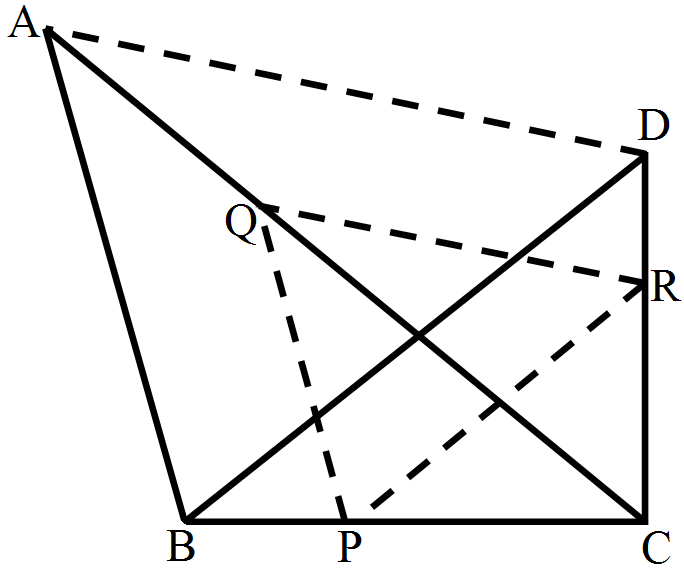
$\triangle\text{ABC}$ and $\triangle\text{DBC}$ lie on the same side of BC, as shown in the figure. From a point P on BC, PQ || AB and PR || BD are drawn, meeting AC at Q and CD at R respectively. Prove that QR || AD.
Answer
In $\triangle\text{CAB},\text{PQ }||\text{ AB}.$
Applying Thales' theorem, we get:
$\frac{\text{CP}}{\text{PB}}=\frac{\text{CQ}}{\text{QA}}\dots(1)$
Similarly, applying Thales' theorem $\triangle\text{BDC},$ where PR || BD, we get:
$\frac{\text{CP}}{\text{PB}}=\frac{\text{CR}}{\text{RD}}\dots(2)$
Hence, from (1) and (2), we have:
$\frac{\text{CQ}}{\text{QA}}=\frac{\text{CR}}{\text{RD}}$
Applying the converse of Thales' theorem, we conclude that QR || AD in $\triangle\text{ADC}.$
This completes the proof.
View full question & answer
Question 42 Marks
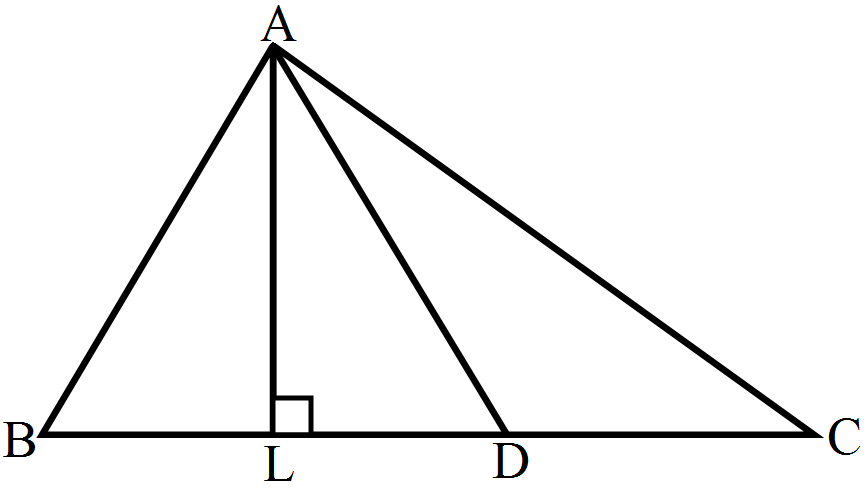
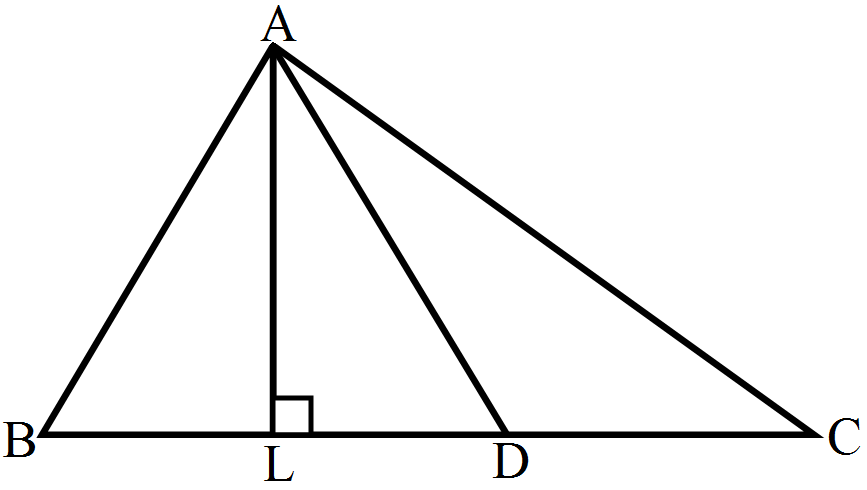
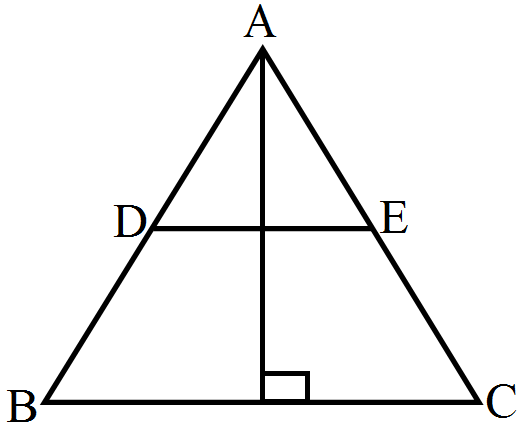
In a $\triangle\text{ABC},\text{AD}$ is a median and $\text{AL}\perp\text{BC}.$
Prove that:
  1. $\text{AC}^2=\text{AD}^2+\text{BC}.\text{DL}+\Big(\frac{\text{BC}}{2}\Big)^2$
  2. $\text{AB}^2=\text{AD}^2-\text{BC}.\text{DL}+\Big(\frac{\text{BC}}{2}\Big)^2$
  3. $\text{AC}^2+\text{AB}^2=2\text{AD}^2+\frac{\text{1}}{2}\text{BC}^2$
Answer


In right $\triangle\text{ALD},$
By Pythagoras theorem,
$AD^2 = AL^2 + DL^2$
$\Rightarrow AL^2 = AD^2 - DL^2 ....(i)$
In right $\triangle\text{ACL},$
By Pythagoras theorem,
$\text{AC}^2 =\text{ AL}^2 + \text{LC}^2$
$\Rightarrow \text{AC}^2 = (\text{AD}^2 -\text{ DL}^2) + (\text{DL} +\text{ DC)}^2\dots(\text{from (i))}$
$\Rightarrow\text{AC}^2=\text{AD}^2-\text{DL}^2+\Big(\text{DL}+\frac{\text{BC}}{2}\Big)^2$.....(Since AD is the median)
$\Rightarrow\text{AC}^2=\text{AD}^2-\text{DL}^2+\text{DL}^2+\Big(\frac{\text{BC}}{2}\Big)^2+\text{BC}.\text{DL}$
$\Rightarrow\text{AC}^2=\text{AD}^2+\text{BC}.\text{DL}+\Big(\frac{\text{BC}}{2}\Big)^2$
Hence proved.
View full question & answer
Question 52 Marks
The areas of two similar triangles ABC and PQR are in the ratio 9 : 16. If BC = 4.5cm, find the length of QR.
Answer
It is given that $\triangle\text{ABC}\sim\triangle\text{PQR}.$
Therefore, ratio of the areas of these triangles will be equal to the ratio of squares of their corresponding sides.
$\frac{\text{ar}(\triangle\text{ABC})}{\text{ar}(\triangle\text{PQR})}=\frac{\text{BC}^2}{\text{QR}^2}$
$\Rightarrow\frac{9}{16}=\frac{\text{4.5}^2}{\text{QR}^2}$
$\Rightarrow\text{QR}^2=\frac{4.5\times4.5\times16}{9}$
$\Rightarrow\text{QR}=\sqrt{\frac{4.5\times4.5\times16}{9}}$
$=\frac{4.5\times4}{3}$
$=6\text{cm}$
Hence, QR = 6cm
View full question & answer
Question 62 Marks
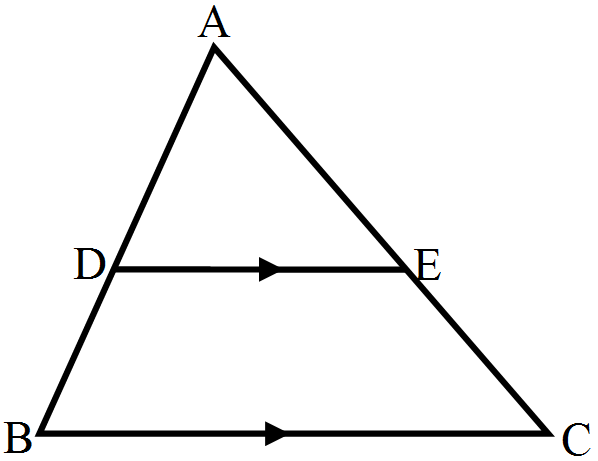
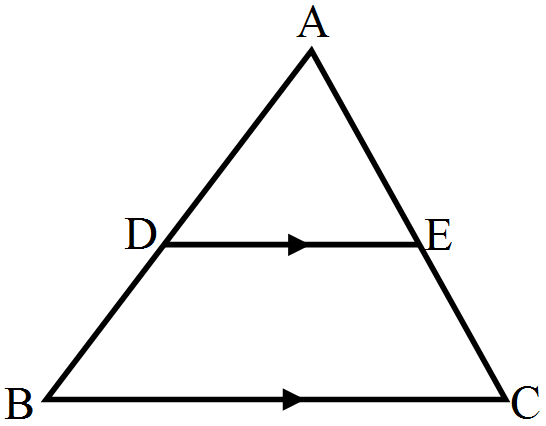
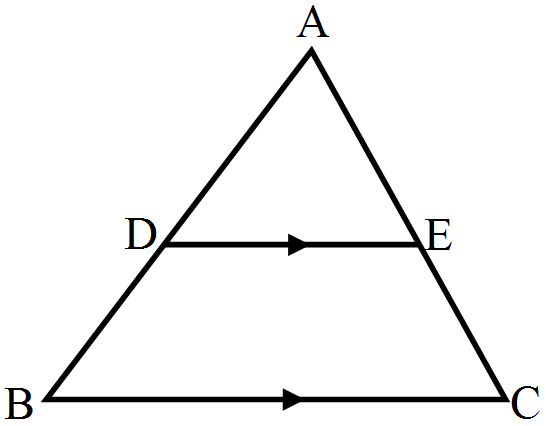
D and E are points on the sides AB and AC respectively of a $\triangle\text{ABC}$ such that DE || BC: If AB = 13.3cm, AC = 11.9cm and EC = 5.1cm, find AD.
Answer
In $\triangle\text{ABC},$ it is given that DE || BC.
Applying Thales' theorem, we get:
$\frac{\text{AD}}{\text{DB}}=\frac{\text{AE}}{\text{EC}}$
Adding 1 to both sides, we get:
$\frac{\text{AD}}{\text{DB}}+1=\frac{\text{AE}}{\text{EC}}+1$
$\Rightarrow\frac{\text{AB}}{\text{DB}}=\frac{\text{AC}}{\text{EC}}$
$\Rightarrow\frac{\text{13.3}}{\text{DB}}=\frac{\text{11.9}}{\text{5.1}}$
$\text{DB}=\frac{13.3\times5.1}{11.9}=5.7\text{cm}$
Therefore, $\text{AD}=\text{AB}-\text{BD}=13.5-5.7=7.6\text{cm}$
View full question & answer
Question 72 Marks
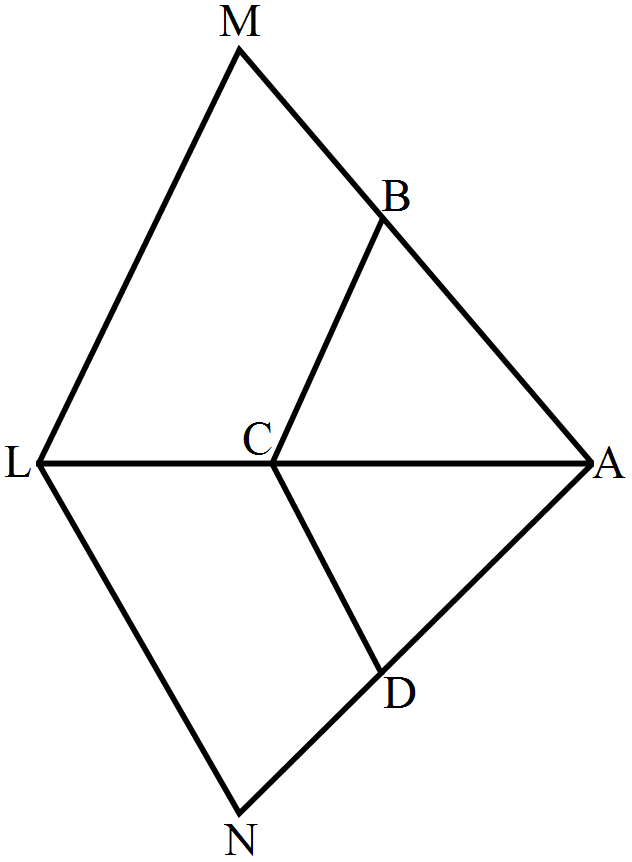
In the given figure, LM || CD.
Prove that $\frac{\text{AM}}{\text{AB}}=\frac{\text{AN}}{\text{AD}}.$
Answer
LM || CB and LN || CD
Therefore, Applying Thale's theorem, we have:
$\frac{\text{AB}}{\text{AM}}=\frac{\text{AC}}{\text{AL}}$ and $\frac{\text{AD}}{\text{AN}}=\frac{\text{AC}}{\text{AL}}$
$\Rightarrow\frac{\text{AB}}{\text{AM}}=\frac{\text{AD}}{\text{AN}}$
$\therefore\frac{\text{AM}}{\text{AB}}=\frac{\text{AN}}{\text{AD}}$
This completes the proof.
View full question & answer
Question 82 Marks
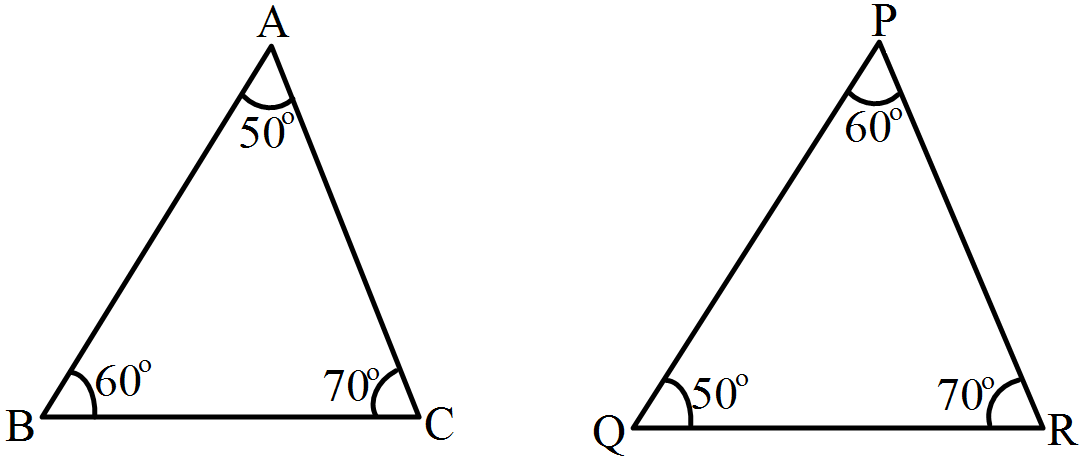
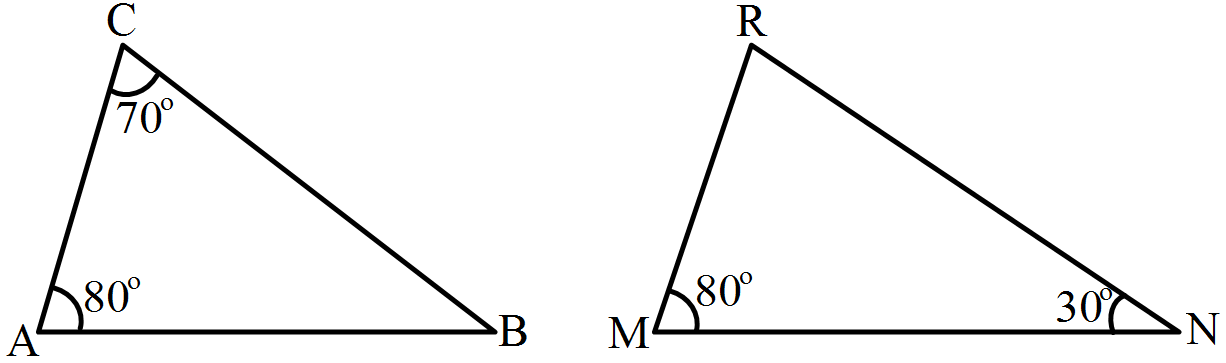
In the given pairs of triangles, find which pair of triangles are similar. State the similarity criterior and write the similarity relation in symbolic from.
Answer
In $\triangle\text{ABC}$ and $\triangle\text{PQR}$
$\angle\text{A}=\angle\text{Q}=50^\circ$
$\angle\text{B}=\angle\text{P}=60^\circ$
$\angle\text{C}=\angle\text{R}=70^\circ$
$\therefore\triangle\text{ABC}\sim\triangle\text{QPR}$ (by AAA similarity)
View full question & answer
Question 92 Marks
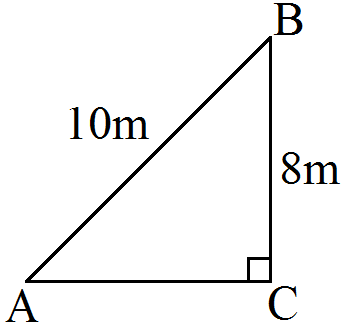
A ladder $10\ m$ long reaches the window of a house $8\ m$ above the ground. Find the distance of the foot of the ladder from the base of the wall.
Answer
Let the ladder be AB and BC be the height of the window from the ground.

We have:
$AB = 10\ m$ and $BC = 8\ m$
Applying Pythagoras theorem in right-angled triangle ACB, we have:
$AB^2= AC^2 + BC^2$
$\Rightarrow AC^2 = AB^2 - BC^2 = 10^2 - 8^2 = 100 - 64 = 36$
$\Rightarrow AC = 6\ m$
Hence, the foot of the ladder is 6m away from the base of the wall.
View full question & answer
Question 102 Marks
In the given pairs of triangles, find which pair of triangles are similar. State the similarity criterior and write the similarity relation in symbolic from.
Answer
In $\triangle\text{ABC}$
$\angle\text{A}+\angle\text{B}+\angle\text{C}=180^\circ$ (Angle Sum Property)
$\Rightarrow80^\circ+\angle\text{B}+70^\circ=180^\circ$
$\Rightarrow\angle\text{B}=30^\circ$
$\angle\text{A}=\angle\text{M}$ and $\angle\text{B}=\angle\text{N}$
Therefore, by AA similarity theorem, $\triangle\text{ABC}\sim\triangle\text{MNR}$
View full question & answer
Question 112 Marks
D and E are points on the sides AB and AC respectively of a $\triangle\text{ABC}$ such that DE || BC: AD = 4cm, DB = (x - 4)cm, AE = 8cm and EC = (3x - 19)cm.
Answer
In $\triangle\text{ABC},$ it is given that DE || BC.
Applying Thales' theorem, we get:
$\frac{\text{AD}}{\text{DB}}=\frac{\text{AE}}{\text{EC}}$
$\Rightarrow\frac{\text{4}}{\text{x}-4}=\frac{\text{8}}{3\text{x}-19}$
$\Rightarrow\text{4}(3\text{x}-19)=8(\text{x}-4)$
$\Rightarrow12\text{x}-76=8\text{x}-32$
$\Rightarrow4\text{x}=44$
$\Rightarrow\text{x}=11\text{cm}$
View full question & answer
Question 122 Marks
In the given figure, DE || BC such that AD = x cm, DB = (3x + 4)cm, AE = (x + 3)cm and EC = (3x + 19)cm. Find the value of x.
Answer
$\therefore\text{DE }||\text{ BC}$
$\therefore\frac{\text{AD}}{\text{DB}}=\frac{\text{AE}}{\text{EC}}$ (Basic proportionality theorem)
$\frac{\text{x}}{3\text{x}+4}=\frac{\text{x}+3}{3\text{x}+19}$
$\Rightarrow\text{x}(3\text{x}+19)=(\text{x}+3)(3\text{x}+4)$
$\Rightarrow3\text{x}^2+19\text{x}=3\text{x}^2+4\text{x}+9\text{x}+12$
$\Rightarrow19\text{x}-13\text{x}=12$
$\Rightarrow6\text{x}=12$
$\Rightarrow\text{x}=2$
View full question & answer
Question 132 Marks
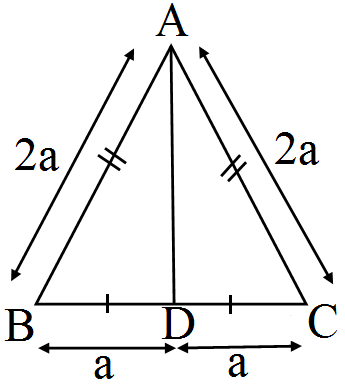
Find the length of the altitude of an equilateral triangle of side $2a\ cm.$
Answer
Let the triangle be $ABC$ with $AD$ as its altitude. Then, $D$ is the midpoint of $BC.$
In right-angled triangle ABD, we have:

$AB^2 = AD^2+ DB^2$
$\Rightarrow AD^2 = AB^2 - DB^2 = 4a^2- a^2 $$\big(\therefore\text{BD}=\frac{1}{2}\text{BC}\big)$
$= 3a^2$ 
$\text{AD}=\sqrt{3\text{a}}$
Hence, the length of the altitude of an equilateral triangle of side 2a cm is $\sqrt{3}\text{a}\text{ cm}.$
View full question & answer
Question 142 Marks
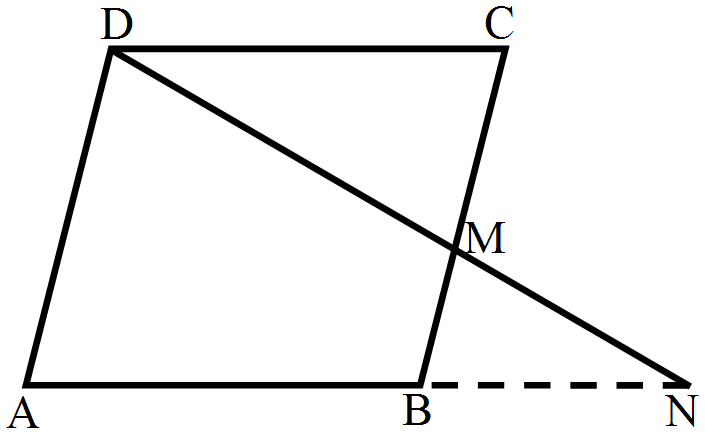
M is a point on the side BC of a parallelogram ABCD. DM when produced meet AB produced at N. Prove that.
  1. $\frac{\text{DM}}{\text{MN}}=\frac{\text{DC}}{\text{BN}}$
  2. $\frac{\text{DN}}{\text{DM}}=\frac{\text{AN}}{\text{DC}}$
Answer
Given: ABCD is a parallelogram
To prove:
  1. $\frac{\text{DM}}{\text{MN}}=\frac{\text{DC}}{\text{BN}}$
  2. $\frac{\text{DN}}{\text{DM}}=\frac{\text{AN}}{\text{DC}}$
Proof: In $\triangle\text{DMC}$ and $\triangle\text{NMB}$
$\angle\text{DMC}=\angle\text{NMB}$ (Vertically opposite angle)
$\angle\text{DCM}=\angle\text{NBM}$ (Altrnate angles)
By AAA-similarity
$\triangle\text{DMC}\sim\triangle\text{NMB}$
$\therefore\frac{\text{DM}}{\text{MN}}=\frac{\text{DC}}{\text{BN}}$
Now, $\frac{\text{MN}}{\text{DM}}=\frac{\text{BN}}{\text{DC}}$
Adding 1 to both sides, we get
$\frac{\text{MN}}{\text{DM}}+1=\frac{\text{BN}}{\text{DC}}+1$
$\Rightarrow\frac{\text{MN}+\text{DM}}{\text{DM}}=\frac{\text{BN}+\text{DC}}{\text{DC}}$
$\Rightarrow\frac{\text{MN}+\text{DM}}{\text{DM}}=\frac{\text{BN}+\text{AB}}{\text{DC}}$ $[\therefore\text{ABCD}$ is a parallelogram$]$
$\Rightarrow\frac{\text{DN}}{\text{DM}}=\frac{\text{AN}}{\text{DC}}$
View full question & answer
Question 152 Marks
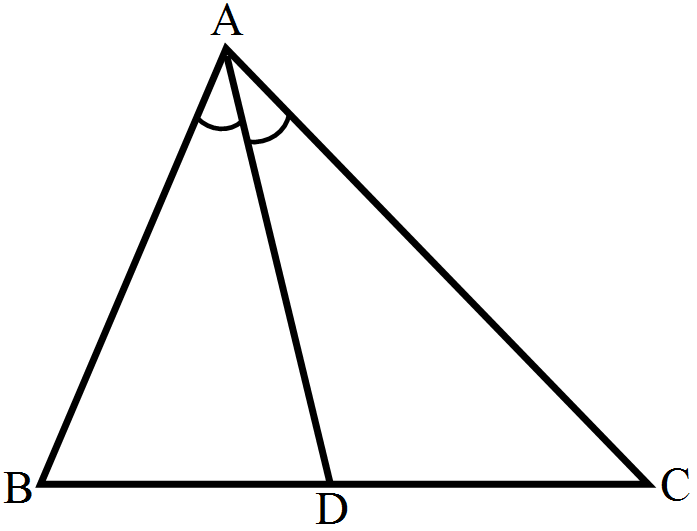
In a $\triangle\text{ABC},\text{AD}$ is the bisector of $\angle\text{A}.$
If AB = 6.4cm, AC = 8cm and BD = 5.6cm, find DC.
Answer
It is given that AD bisects $\angle\text{A}.$
Applying angle-bisector theorem in $\triangle\text{ABC},$ we get:
$\frac{\text{BD}}{\text{DC}}=\frac{\text{AB}}{\text{AC}}$
$\Rightarrow\frac{5.6}{\text{DC}}=\frac{6.4}{8}$
$\Rightarrow\text{DC}=\frac{8\times5.6}{6.4}=7\text{cm}$
View full question & answer
Question 162 Marks
D and E are points on the sides AB and AC respectively of a $\triangle\text{ABC}$ such that DE || BC:
AD = x cm, DB = (x - 2)cm, AE = (x + 2)cm and EC = (x - 1)cm.
Answer
In $\triangle\text{ABC},$ it is given that DE || BC.
Applying Thales' theorem, we get:
$\frac{\text{AD}}{\text{DB}}=\frac{\text{AE}}{\text{EC}}$
$\Rightarrow\frac{\text{x}}{\text{x}-2}=\frac{\text{x}+2}{\text{x}-1}$
$\Rightarrow\text{x}(\text{x}-1)=(\text{x}-2)(\text{x}+2)$
$\Rightarrow\text{x}^2-\text{x}=\text{x}^2-4$
$\Rightarrow\text{x}=4\text{cm}$
View full question & answer