Question 13 Marks
In the following, one of the six trigonometric ratios is given. Find the values of the other trigonometric ratios.
$\tan\theta=11$
AnswerGiven: $\tan\theta=\frac{11}{1}\ \dots(1)$
By definition $\tan{\theta}=\frac{\text{perpendicular}}{\text{Base}}\ \dots(2)$
By comparing (1) and (2)
We get
Base $= 1$ and
Perppendicular side $= 5$
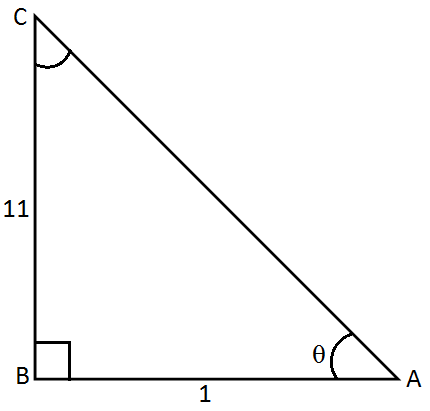
Therefore,
By Pythagoras theorem,
$AC^2 = AB^2 + BC^2$
Now we substitute the value of base side (AB) and the perpendicular side (BC) and get hypotenuse (AC)
$\text{AC}^2=1^2+11^2$
$\text{AC}^2=1+121$
$\text{AC}^2=122$
$\text{AC}=\sqrt{122}$
Hence, Hypotenuse $\sqrt{122}$
Now, $\sin{\theta}=\frac{\text{perpendicular}}{\text{Hypotenuse}}$
Therefore
$\sin\theta=\frac{11}{\sqrt{122}}$
Now, $\text{cosec }\theta=\frac{1}{\sin\theta}$
Therefore
$\text{cosec }\theta=\frac{\text{Hypotenuse}}{\text{perpendicullar}} $
$\text{cosec }\theta=\frac{\sqrt{122}}{11}$
Now, $\cos\theta=\frac{\text{Base}}{\text{Hypotenuse}}$
Therefore,
$\cos\theta=\frac{1}{\sqrt{122}}$
Now, $\sec\theta=\frac{1}{\cos\theta}$
Therefore,
$\sec\theta=\frac{\text{Hypotenuse}}{\text{Base}}$
$\sec\theta=\frac{\sqrt{122}}{1}$
$\sec\theta=\sqrt{122}$
Now, $\cot\theta=\frac{1}{\tan\theta}$
Therefore,
$\cot\theta=\frac{\text{Base}}{\text{Perpendicular}}$
$\cot\theta=\frac{1}{11}$ View full question & answer→Question 23 Marks
If $\sec\text{A}=\frac{17}{8},$ verify that $\frac{3-4\sin^2\text{A}}{4\cos^2\text{A}-3}=\frac{3-\tan^2\text{A}}{1-3\tan^2\text{A}}.$
AnswerGiven:
$\sec\text{A}=\frac {17}{8}\dots(1)$
To verify:
$\frac{3- 4\sin^2\text{A}}{4\cos^2\text{A}-3}=\frac{3-\tan^2\text{A}}{1-3\tan^2\text{A}}\dots(2)$
Now we know that $\sec\text{A}=\frac {1}{\cos\text{A}}$
Therefore $\cos\text{A}=\frac {1}{\sec\text{A}}$
Now, by substituting the value of sec A from equation (1)
We get,
$\cos\text{A}=\frac {1}{\frac{17}{8}}$
$=\frac{8}{17}$
Therefore,
$\cos\text{A}=\frac {8}{17}\dots(3)$
Now, we know the following trigonometric identity
$\cos^2\text{A}+ \sin^2\text{A}=1$
Therefore,
$\sin^2\text{A} =1-\cos^2\text{A}$
Now by substituting the value of cos A from equation (3)
We get,
$\sin^2\text{A}=1- \Big(\frac{8}{17}\Big)^2$
$=1-\frac{(8)^2} {(17)^2}$
$=1-\frac{64} {289}$
Now by taking L.C.M.
We get,
$\sin^2\text{A}= \frac{289-64}{289}$
$=\frac{225}{289}$
Now, by taking square root on both sides
We get,
$\sin\text{A}=\sqrt {\frac{225}{289}}$
$=\frac{\sqrt{225}} {\sqrt{289}}$
$=\frac{15}{17}$
Therefore,
$\sin\text{A}=\frac{15} {17}\dots(4)$
Now, we know that $\tan\text{A}=\frac{\sin\text{A}}{\cos\text{A}}$
Now by substituting the value of cos A and sin A from equation (3) and (4) respectively
We get,
$\tan\text{A}=\frac {\frac{15}{17}}{\frac{8}{17}}$
$=\frac{15} {17}\times\frac{17}{8}$
$=\frac{15}{8}$
Therefore
$\tan\text{A}=\frac {15}{8}\dots(5)$
Now from the expression of equation (2)
$\text{L}.\text{H}. \text{S}=\frac{3-4\sin^2\text{A}}{4\cos^2\text{A}-3}$
Now by substituting the value of cos A and sin A from equation (3) and (4)
We get,
$\text{L}.\text{H}.\text {S}=\frac{3-4\Big(\frac{15}{17}\Big)^2}{4\Big(\frac{8}{17}\Big)^2-3}$
Therefore,
$\text{L}.\text{H}. \text{S}=\frac{3-4\Big(\frac{225}{289}\Big)}{4\Big(\frac{64}{289}\Big)-3}$
$=\frac{3-\frac {900}{289}}{\frac{256}{289}-3}$
Now by taking L.C.M of both numerator and denominator
We get,
$\text{L}.\text{H}. \text{S}=\frac{\frac{3\times289}{1\times289}-\frac{900}{289}}{\frac{256}{289}-\frac{3\times289} {1\times289}}$
$=\frac{\frac{867} {289}-\frac{900}{289}}{\frac{256}{289}-\frac{867}{289}}$
$=\frac{\frac{867- 900}{289}}{\frac{256-867}{289}}$
$=\frac{\frac{-33} {289}}{\frac{-611}{289}}$
$=\frac{33}{611}$
Therefore,
$\frac{3- 4\sin^2\text{A}}{4\cos^2\text{A}-3}=\frac{33}{611}\dots(6)$
Now from the expression of equation (2)
$\text{R}.\text{H}. \text{S}=\frac{3-\tan^2\text{A}}{1-3\tan^2\text{A}}$
Now by substituting the value of tan A from equation (5)
We get,
$\text{R}.\text{H}. \text{S}=\frac{3-\Big(\frac{15}{8}\Big)^2}{1-3\Big(\frac{15}{8}\Big)^2}$
$=\frac{3-\frac{225}{64}}{1-\frac{3\times225}{64}}$
Now by taking L.C.M
We get,
$\text{R}.\text{H}. \text{S}=\frac{\frac{3\times64}{1\times64}-\frac{225}{64}}{\frac{64-675}{64}}$
$=\frac{\frac{192} {64}-\frac{225}{64}}{\frac{-611}{64}}$
$=\frac{\frac{192- 225}{64}}{\frac{-611}{64}}$
Therefore
$\text{R}.\text{H}. \text{S}=\frac{\frac{-33}{64}}{\frac{-611}{64}}$
$=\frac{-33} {64}\times\frac{64}{-611}$
$=\frac{33}{611}$
Therefore,
$\frac{3-\tan^2\text {A}}{1-3\tan^2\text{A}}=\frac{33}{611}\dots(7)$
Now by comparing equation (6) and (7)
We get,
$\frac{3- 4\sin^2\text{A}}{4\cos^2\text{A}-3}=\frac{3-\tan^2\text{A}}{1-3\tan^2\text{A}}$
View full question & answer→Question 33 Marks
Evaluate the following:
$\frac{\tan45^\circ}{\text{cosec}30^\circ}+\frac{\sec60^\circ}{\cot45^\circ}-\frac{5\sin90^\circ}{2\cos0^\circ}$
Answer$\frac{\tan45^\circ}{\text{cosec}30^\circ}+\frac{\sec60^\circ}{\cot45^\circ}-\frac{5\sin90^\circ}{2\cos0^\circ}\ \dots(\text{i})$
By trigonometric ration we have
$\tan45^\circ=1,\text{ cosec }30^\circ=2,\sec60^\circ=2,$ $\cot45^\circ=1,\sin90^\circ=1,\cos0^\circ=1$
By substituting above values in (i), we get
$\frac{1}{2}+\frac{2}{1}-5\cdot\frac{1}{2}$
$-\frac{4}{2}+2=-2+2=0$
View full question & answer→Question 43 Marks
If A = 30° and B = 60°, verify that.
$\sin(\text{A}+\text{B})=\sin\text{A}\cos\text{B}+\cos\text{A}\sin\text{B}$
AnswerGiven
$\text{A}=30^\circ$ and $\text{B}=60^\circ\dots(1)$
To verify:
$\sin(\text{A}+\text{B})=\sin\text{A}\cos\text{B}+\cos\text{A}\sin\text{B}\dots(2)$
Now consider LHS of the expression to be verified in equation (2)
Therefore,
$\sin(\text{A}+\text{B})=\sin(30+60)$
$=\sin90$
$=1$
Now consider RHS of the expression to be verified in equation (2)
Therefore
$\sin\text{A}\cos\text{B}+\cos\text{A}\sin\text{B}=\sin30^\circ\cos60^\circ+\cos30^\circ\sin60^\circ $
$=\frac{1}{2}\times\frac{1}{2}+\frac{\sqrt{3}}{2}\times\frac{\sqrt{3}}{2}$
$=\frac{1+3}{4}$
$=1$
Hence it is verified that,
$\sin(\text{A}+\text{B})=\sin\text{A}\cos\text{B}+\cos\text{A}\sin\text{B}$
View full question & answer→Question 53 Marks
If $\tan\theta=\frac{20}{21},$ show that $\frac{1-\sin\theta+\cos\theta}{1+\sin\theta+\cos\theta}=\frac{3}{7}.$
Answer$\tan\theta=\frac{20}{21}\text{ S.T }\frac{1-\sin\theta+\cos\theta}{1+\sin\theta+\cos\theta}=\frac{3}{7}$ $\tan\theta=\frac{\text{opposite side}}{\text{efficient side}}=\frac{20}{21}$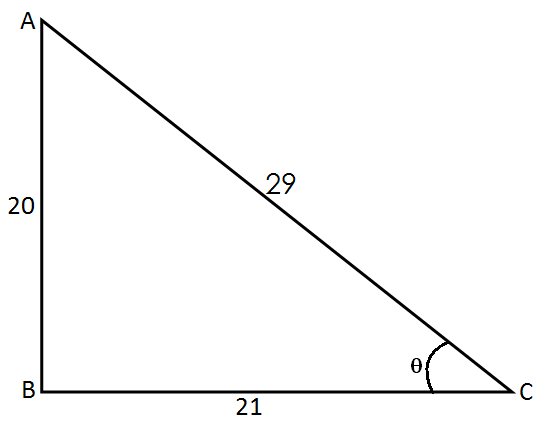
Let x be the hypotenuse By applying Pythagoras we get $\text{AC}^2+\text{AB}^2+\text{BC}^2$ $\text{x}^2=(20)^2+(21)^2$ $\text{x}^2=400+441$ $\text{x}^2=841\Rightarrow\text{x}=29$ $\sin\theta=\frac{\text{AB}}{\text{AC}}=\frac{20}{29}$ $\cos\theta=\frac{\text{BC}}{\text{AC}}=\frac{21}{29}$ Substitute $\sin\theta,\cos\theta$ in equation we get $\Rightarrow\frac{1-\sin\theta+\cos\theta}{1+\sin\theta+\cos\theta}$ $\Rightarrow\frac{1-\frac{20}{29}+\frac{21}{29}}{1+\frac{20}{29}+\frac{21}{29}}=\frac{\frac{29-20+21}{29}}{\frac{29+20+21}{29}}=\frac{30}{70}=\frac{3}{7}$ View full question & answer→Question 63 Marks
Prove that $(\sqrt{3}+1)(3-\cot30^\circ)=\tan^360^\circ-2\sin60^\circ.$
Answer$=\text{R.H.S}=\tan^360^\circ-2\sin60^\circ $
$=\big(\sqrt{3}\big)^3-2\frac {\sqrt{3}}{2}=3\sqrt{3}-\sqrt{3}=2\sqrt {3}$
$\text{L.H.S}=\big(\sqrt{3}+1\big)\big(3-\cot30^ \circ\big)$
$=\big(\sqrt{3}+1\big)\big(3- \sqrt{3}\big)$
$=\big(\sqrt{3}+1\big)\sqrt {3}\big(\sqrt{3}-1\big)$
$=\sqrt{3}\big[(\sqrt{3}) ^2-1\big]$
$=\sqrt{3}(3-1) =2\sqrt{3}$
$\text{L.H.S}=\text{R.H.S}$
$\Big [\because \tan60^\circ=\sqrt{3},\sin60^\circ=\frac {\sqrt{3}}{2}\text{ and }\cot30^\circ= \sqrt{3}\Big]$
Hence proved.
View full question & answer→Question 73 Marks
If $\cot\theta=\frac{3}{4},$ prove that $\sqrt{\frac{\sec\theta-\text{cosec }\theta}{\sec\theta+\text{cosec }\theta}}=\frac{1}{\sqrt{7}}.$
Answer
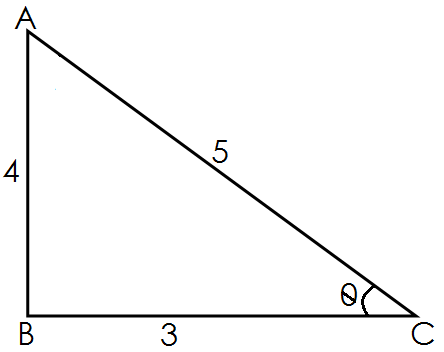 Given,
$\cos\theta=\frac{3}{4}$
base = 3, perpendicular = 4
by P.G.T.
$\text{h}=\sqrt{\text{P}^2+\text{b}^2}=\sqrt{4^2+3^2}$
$=\sqrt{16+9}=\sqrt{25}=5$
$\sec\theta=\frac{\text{h}}{\text{b}}=\frac{5}{3},\text{cosec}\theta=\frac{\text{h}}{\text{P}}=\frac{5}{4}$
Taking L.H.S. $\sqrt{\frac{\sec\theta-\text{cosec}\theta}{\sec+\text{cosec}\theta}}=\sqrt{\frac{\frac{5}{3}-\frac{5}{4}}{\frac{5}{3}+\frac{5}{4}}}$
$=\sqrt{\frac{\frac{20-15}{12}}{\frac{20+15}{12}}}=\sqrt{\frac{5}{35}}=\sqrt{\frac{1}{7}}\ =\text{R.H.S}$ View full question & answer→Question 83 Marks
If $\angle\text{A}$ and $\angle\text{B}$ are acute angles such that cos A = cos B, then show that $\angle\text{A}=\angle\text{B}.$
AnswerGiven:
$\cos\text{A}=\cos\text{B}\ \dots(1)$
To show: $\angle\text{A}=\angle\text{B}$
$\triangle\text{ABC}$ is as shown in figure below
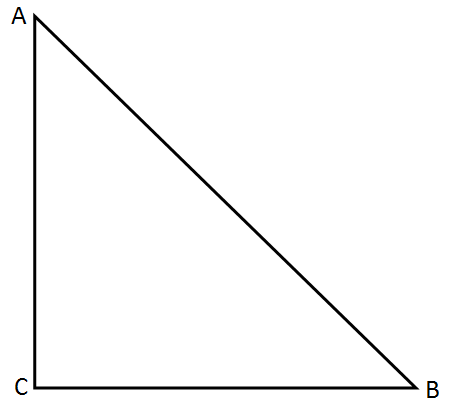
Now since cos A = cos B ...... from (1)
Therefore
$\frac{\text{AC}}{\text{AB}}=\frac{\text{BC}}{\text{AB}}$
Now observe that denominator of above equality is same that is AB
Hence $\frac{\text{AC}}{\text{AB}}=\frac{\text{BC}}{\text{AB}}$ only when AC = BC
Therefore AC = BC ..... (2)
We know that when two sides of a triangle are equal, then angle opposite to the sides are also equal.
Therefore from equation (2)
We can say that
Angle opposite to side AC = Angle opposite to side BC
Therefore,
$\angle\text{B}=\angle\text{A}$
Hence, $\angle\text{A}=\angle\text{B}$ View full question & answer→Question 93 Marks
In the following, one of the six trigonometric ratios is given. Find the values of the other trigonometric ratios.
$\cos\text{A}=\frac{4}{5}$
AnswerWe hawe, $\cos\text{A}=\frac{4}{5}=\frac{\text{Base}}{\text{Hypotuse}}$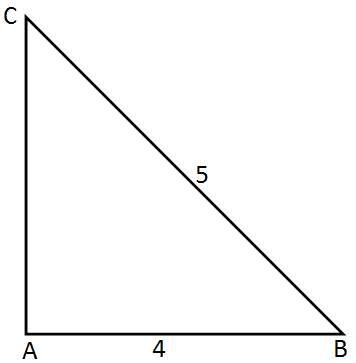
If $\triangle\text{ABC,}$ $\Rightarrow \text{BC}^2=\text{AB}^2+\text{AC}^2$ $\Rightarrow(5)^2=(4)^2+\text{AC}^2$ $\Rightarrow\text{AC}^2=25-16$ $\Rightarrow \text{AC}^2=9$ $\Rightarrow\text{AC}=3$ $\therefore\ \sin\text{A}=\frac{\text{perpendicular}}{\text{Hypotenuse}}=\frac{\text{AC}}{\text{BC}}=\frac{3}{5}$ $\tan\text{A}=\frac{\text{perpendicular}}{\text{Base}}=\frac{\text{AC}}{\text{BC}}=\frac{3}{4}$ $\cot\text{A}=\frac{1}{\tan{\text{A}}}=\frac{4}{3}$ $\sec{\text{A}}=\frac{1}{\cos\text{A}}=\frac{1}{\frac{4}{5}}=\frac{5}{4}$ $\text{cosec }\text{A}=\frac{1}{\sin\text{A}}=\frac{5}{3}$ View full question & answer→Question 103 Marks
If $\cot\theta=\frac{1}{\sqrt{3}},$ write the value of $\frac{1-\cos^2\theta}{2-\sin^2\theta}.$
AnswerWe have, $\cot\theta=\frac{1}{\sqrt{3}}$ In $\triangle\text{ABC},$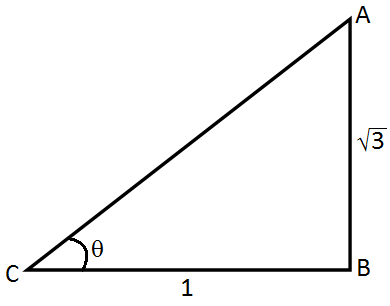
$\text{AC}^2=\text{AB}^2+\text{BC}^2$ $\Rightarrow\text{AC}^2=(\sqrt{3})^2+(1)^2$ $\Rightarrow\text{AC}^2=3+1$ $\Rightarrow\text{AC}^2=4$ $\Rightarrow\text{AC}^2=4$ $\therefore\cos\theta=\frac{\text{BC}}{\text{AC}}=\frac{1}{2}$ and $\sin\theta=\frac{\text{AB}}{\text{AC}}=\frac{\sqrt{3}}{2}$ Now, $\frac{1-\cos^2\theta}{2-\sin^2\theta}=\frac{1-\Big(\frac{1}{2}\Big)^2}{2-\Big(\frac{\sqrt{3}}{2}\Big)^2}$ $=\frac{1-\frac{1}{4}}{2-\frac{3}{4}}$ $=\frac{3}{5}$ View full question & answer→Question 113 Marks
If $\sin\theta=\frac{\text{a}}{\text{b}},$ find that $\sin\theta+\tan\theta$ in terms of a and b.
Answer
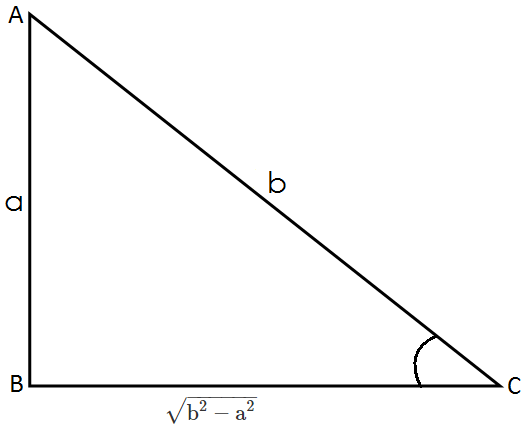 If $\sin\theta=\frac{\text{a}}{\text{b}}$
$\therefore\tan=\frac{\text{p}}{\text{b}}=\frac{\text{a}}{\sqrt{\text{b}^2-\text{a}^2}}$
Now, $\sin\theta+\tan\theta=\frac{\text{a}}{\text{b}}+\frac{\text{a}}{\sqrt{\text{b}^2-\text{a}^2}}$
$=\frac{\text{a}\sqrt{\text{b}^2-\text{a}^2}+\text{ab}}{\text{b}\sqrt{\text{b}^2-\text{a}^2}}$ View full question & answer→Question 123 Marks
In the following, one of the six trigonometric ratios is given. Find the values of the other trigonometric ratios.
$\sin\text{A} = \frac{2}{3}$
Answer$\sin\text{A} = \frac{2}{3}$
We know that $\sin \theta=\frac{\text{opposite side}}{\text{hypotenuse}}$
Let us consider a right angled $\triangle^{\text{le}}\text{ABC}$
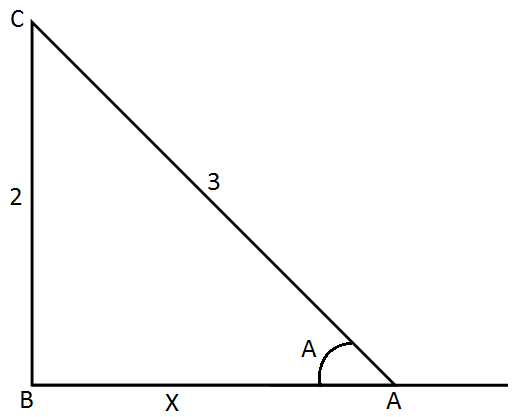
By applying pythagorean theorem we get
$\text{AC}^2=\text{AB}^2+\text{BC}^2$
$9=\text{x}^2+4$
$\text{x}^2=9-4$
$\text{x}=\sqrt{5}$
We know that $\cos=\frac{\text{adjacent side}}{\text{hypotenuse}}$ and
$\tan\theta=\frac{\text{opposite side}}{\text{adjacent side}}$
So, $\cos\theta=\frac{\sqrt{5}}{3};$
$\sec\theta =\frac{1}{\cos\theta}=\frac{3}{\sqrt{5}}$
$\tan\theta=\frac{2}{\sqrt{5}};$
$\cot\theta=\frac{1}{\tan\theta}=\frac{\sqrt{5}}{2}$
$\text{cosec }\theta =\frac{1}{\sin\theta}=\frac{3}{2}$ View full question & answer→Question 133 Marks
In the following, one of the six trigonometric ratios is given. Find the values of the other trigonometric ratios.
$\tan\theta=\frac{8}{15}$
AnswerWe have, $\tan\theta=\frac{8}{15}$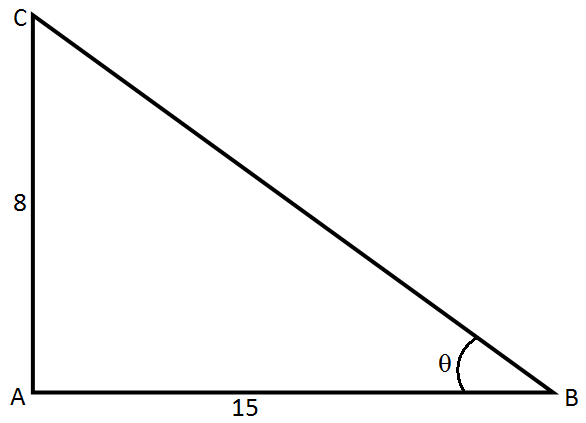
In $\triangle\text{ABC},$ $\Rightarrow\text{BC}^2=\text{AB}^2+\text{AC}^2$ $\Rightarrow\text{BC}^2=\text{(15)}^2+(8)^2$ $\Rightarrow\text{BC}^2=225+64$ $\Rightarrow\text{BC}^2=289$ $\Rightarrow\text{BC}=17$ $\therefore\sin \theta=\frac{\text{Perendicular}}{\text{Hypotnuse }}=\frac{8}{17}$ $\cos \theta=\frac{\text{Base}}{\text{Hypotnuse }}=\frac{15}{17}$ $\sec\theta=\frac{1}{\cos\theta}=\frac{17}{15}$ $\text{cosec }\theta =\frac{1}{\sin\theta}=\frac{17}{8}$ $\cot\theta=\frac{1}{\tan\theta}=\frac{15}{8}$ View full question & answer→Question 143 Marks
If $\tan\theta=\frac{\text{a}}{\text{b}},$ prove that $\frac{\text{a}\sin\theta+\text{b}\cos\theta}{\text{a}\sin\theta+\text{b}\cos\theta}=\frac{\text{a}^2-\text{b}^2}{\text{a}^2+\text{b}^2}.$
Answer$\tan\theta=\frac{\text{a}}{\text{b}}.$ $\text{PT }\frac{\text{a}\sin\theta-\text{b}\cos\theta}{\text{a}\sin\theta+\text{b}\cos\theta}=\frac{\text{a}^2-\text{b}^2}{\text{a}^2+\text{b}^2}.$
Let $\frac{\text{a}\sin\theta-\text{b}\cos\theta}{\text{a}\sin\theta+\text{b}\cos\theta}\ \dots(1)$
Divide both Nr and Dr with $\cos\theta$ of (a)
$=\frac{\frac{\text{a}\sin\theta-\text{b}\cos\theta}{\cos\theta}}{\frac{\text{a}\sin\theta+\text{b}\cos\theta}{\cos\theta}}$
$=\frac{\text{a}\tan\theta-\text{b}}{\text{a}\tan+\text{b}}$
$=\frac{\text{a}\times\Big(\frac{\text{a}}{\text{b}}\Big)-\text{b}}{\text{a}\times\Big(\frac{\text{a}}{\text{b}}\Big)+\text{b}}$
$=\frac{\text{a}^2-\text{b}^2}{\text{a}^2+\text{b}^2}$
View full question & answer→Question 153 Marks
In a right triangle ABC, right angled at C, if $\angle\text{B} = 60^\circ$ and AB = 15 units. Find the remaining angles and sides.
AnswerIn a $\triangle\text{le}$ sum of all angles = 180° $ \angle\text{A}+\angle\text{B}+\angle\text{C}=180^\circ$ $\Rightarrow90^\circ+60^\circ+\angle\text{A}=180^\circ$ $\angle\text{A}=180^\circ-150^\circ$ $\therefore \angle\text{A}=30^\circ$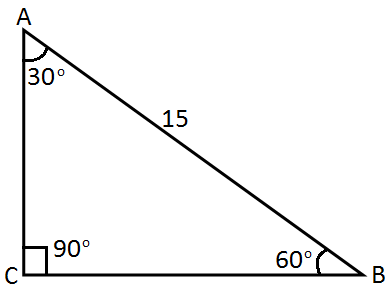
From above figure $\cos\text{B}=\frac{\text{BC}}{\text {AB}}$ $\cos60^\circ=\frac{\text{BC}}{ {15}}$ $\frac{1}{2}=\frac{\text{BC}}{15}$ $\text{BC}=\frac{15}{2}$ $\sin\text{B}=\frac{\text{AC}}{15}$ $\sin60^\circ=\frac{\text{AC}}{15}$ $\frac{\sqrt{3}}{2}=\frac{\text{AC}}{15}\Rightarrow\text{AC}=\frac{15\sqrt{3}}{2}$ View full question & answer→Question 163 Marks
If $\sin(\text{A}-\text{B})=\frac{1}{2}$ and $\cos(\text{A}+\text{B})=\frac{1}{2},0^\circ<\text{A}+\text{B}\geq90^\circ,\text{A}<\text{B}$ find A and B.
Answer$\sin(\text{A}-\text{B})=\sin30^\circ\ \cos(\text{A}+\text{B})=\cos60^\circ$$\text{A}-\text{B}=30^\circ\dots(\text{i})$
$\text{A}+\text{B}=60^\circ\dots(\text{ii})$
Add (i) & (ii) we get,
$2\text{A}=90^\circ,\text{A}=45^\circ$
$\text{A}-\text{B}=30^\circ$
$45-\text{B}=30^\circ\text{ B}=45-30^\circ$
$\text{B}=15^\circ$
View full question & answer→Question 173 Marks
Evaluate the following:
$\sin^230^\circ+\sin^245^\circ+\sin^260^\circ+\sin^260^\circ+\sin^290^\circ\dots(1)$
Answer$\sin^230^\circ+\sin^245^\circ+\sin^260^\circ+\sin^260^\circ+\sin^290^\circ\dots(1)$
By trigonometric ratios we have
$\sin30^\circ=\frac{1}{2}\ \ \ \ \sin45^\circ=\frac{1}{\sqrt2}$
$\sin60^\circ=\frac{\sqrt3}{2}\ \ \ \ \sin90^\circ=1$
By substituting above values in (i), we get
$=\Big[\frac{1}{2}\Big]^2+\Big[\frac{1}{\sqrt2}\Big]^2+\Big[\frac{\sqrt3}{2}\Big]^2+[1]^2$
$=\frac{1}{4}+\frac{1}{2}+\frac{3}{2}+1\Rightarrow\frac{1+3}{4}+\frac{1+2}{2}$
$\Rightarrow1+\frac{3}{2}=\frac{2+3}{2}=\frac{5}{2}$
View full question & answer→Question 183 Marks
Prove the following:
$\frac{\tan(90^\circ-\text{A})\cot\text{A}}{\text{cosec}^2\text{A}}-\cos^2\text{A}=0$
AnswerWe have to prove: $\frac{\tan(90^\circ-\text{A})\cot\text{A}}{\text{cosec}^2\text{A}}-\cos^2\text{A}=0$
Left hand side
$=\frac{\tan(90^\circ-\text{A})\cot\text{A}}{\text{cosec}^2\text{A}}-\cos^2\text{A}$
$=\frac{\cot\text{A}.\cot\text{A}}{\text{cosec}^2\text{A}}-\cos^2\text{A}$
$=\frac{\cot^2\text{A}}{\text{cosec}^2\text{A}}-\cos^2\text{A}$
$=\frac{\cos^2\text{A}.\sin^2\text{A}}{\sin^2\text{A}}-\cos^2\text{A}$
$=\cos^2\text{A}-\cos^2\text{A}$
$=0$
= Right hand side
Proved.
View full question & answer→Question 193 Marks
If $\theta$ is a positive acute such that $\sec \theta = \text{cosec } 60^\circ,$ find the value of $2\cos^2\theta-1.$
AnswerWe have: $\sec\theta=\text{cosec }60^\circ$ where $\theta$ is positive acute angle
$\Rightarrow\text{cosec}(90^\circ-\theta)=\text{cosec }60^\circ$
$ \Rightarrow90^\circ-\theta=60^\circ$
$\Rightarrow\theta=30^\circ$
Now we have to find $2\cos^2\theta-1$
Put $\theta=30^\circ$
$=2\times\cos^230^\circ-1$
$=2\times\Big(\frac{\sqrt3}{2}\Big)^2-1$
$=2\times\frac{3}{4}-1$
$=\frac{1}{2}$
Hence the value of $ 2\cos^2\theta-1$ is $\frac{1}{2}$
View full question & answer→Question 203 Marks
If $\cot\theta=\frac{7}{8},$ evaluate:
$\frac{(1+\sin\theta)(1-\sin\theta)}{(1+\cos\theta)(1-\cos\theta)}$
AnswerGiven, $\cot\theta=\frac{7}{8}$
Now, $\frac{(1+\sin\theta)(1-\sin\theta)}{(1+\cos\theta)(1-\cos\theta)}=\frac{1-\sin^2\theta}{1-\cos^2\theta}$ $\begin{cases}1-\sin^2\theta=\cos^2\theta\\1-\cos^2\theta=\sin^2\theta\end{cases}$
$=\frac{\cos^2\theta}{\sin^2\theta}$
$=\cot^2\theta$
$=(\cot\theta)^2$
$=\Big(\frac{7}{8}\Big)^2=\frac{49}{64}$
View full question & answer→Question 213 Marks
If $\sin\theta=\frac{3}{4},$ prove that $\sqrt{\frac{\text{cosec}^2\theta-\cot^2\theta}{\sec^2\theta-1}}=\frac{\sqrt{7}}{3}.$
AnswerWe have, $\sin\theta=\frac{3}{4}$ In $\triangle\text{ABC},$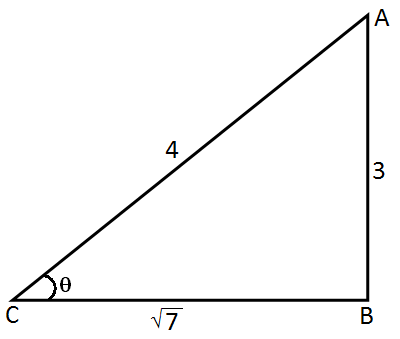
$\text{AC}^2=\text{AB}^2+\text{BC}^2$ $\Rightarrow(4)^2=(3)^2+\text{BC}^2$ $\Rightarrow\text{BC}^2=16-9$ $\Rightarrow\text{BC}^2=2$ $\Rightarrow\text{BC}=\sqrt{7}$ $\therefore\text{cosec }\theta=\frac{4}{3},\sec\theta=\frac{4}{\sqrt{7}}$ and $\cot\theta=\frac{\sqrt{7}}{3}$ Now, $\text{L}.\text{H}.\text{S}=\sqrt{\frac{\text{cosec}^2\theta-\cot^2\theta}{\sec^2\theta-1}}$ $=\sqrt{\frac{\Big(\frac{4}{3}\Big)^2-\Big(\frac{\sqrt{7}}{3}\Big)^2}{\Big(\frac{4}{\sqrt{7}}\Big)^2-1}}$ $=\sqrt{\frac{\frac{16}{9}-\frac{7}{9}}{\frac{16}{7}-1}}$ $=\sqrt{\frac{\frac{9}{9}}{\frac{16-7}{7}}}$ $=\sqrt{\frac{7}{9}}$ $=\frac{\sqrt{7}}{3}$ $= \text{R.H.S}$ View full question & answer→Question 223 Marks
Write the value of $\cos1^\circ\cos2^\circ\cos3^\circ\dots\cos179^\circ\cos180^\circ.$
AnswerGiven that: $\cos1^\circ\cos2^\circ\cos3^\circ\dots\cos179^\circ\cos180^\circ$
$=\cos1^\circ\cos2^\circ\cos3^\circ\dots\cos179^\circ\cos180^\circ$
$=\cos1^\circ\cos2^\circ\cos3^\circ\dots\cos89^\circ\cos90^\circ\cos91^\circ\dots\cos179^\circ$
$=\cos1^\circ\cos2^\circ\cos3^\circ\dots\cos89^\circ\times0\dots\cos179^\circ\cos180^\circ$
$=0$ $\big[\cos90^\circ=0\big]$
Hence the value of $\cos1^\circ\cos2^\circ\cos3^\circ\dots\cos179^\circ\cos180^\circ\text{ is }0$
View full question & answer→Question 233 Marks
In the following, one of the six trigonometric ratios is given. Find the values of the other trigonometric ratios.
$\text{cosec }\theta=\sqrt{10}$
AnswerWe have, $\text{cosec }\theta=\sqrt{10}=\frac{\text{Hypotenuse}}{\text{Pependicular}}$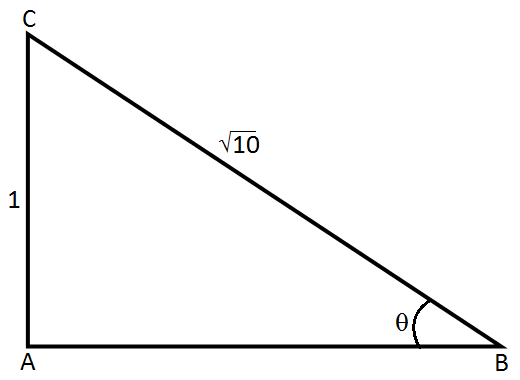
In $\triangle\text{ABC},$ $\Rightarrow\text{BC}^2=\text{AB}^2+\text{AC}^2$ $\Rightarrow(\sqrt{10})^2=\text{AB}^2+\text{(1)}^2$ $\Rightarrow\text{AB}^2=10-1$ $\Rightarrow\text{AB}^2=9$ $\Rightarrow\text{AB}=3$ $\therefore \sin \theta =\frac{1}{\text{cosec }\theta}=\frac{1}{\sqrt{10}}$ $\cos\theta=\frac{\text{Base}}{\text{Hypotenuse}}=\frac{3}{\sqrt{10}}$ $\tan\theta=\frac{\text{Perpendicular}}{\text{Base}}=\frac{1}{3}$ $\cot\theta= \frac{1}{\tan\theta}=3$ View full question & answer→Question 243 Marks
Evaluate the following:
$\sin^230^\circ\cos^245^\circ+4\tan^230^\circ+\frac{1}{2}\sin^290^\circ-2\cos^290^\circ+\frac{1}{24}\cos^20^\circ$
Answer$\sin^230^\circ\cos^245^\circ+4\tan^230^\circ+\frac{1}{2}\sin^290^\circ-2\cos^290^\circ+\frac{1}{24}\cos^20^\circ$
$=\Big(\frac{1}{2}\Big)^2\times\Big(\frac{1}{\sqrt{2}}\Big)^2+4\times\Big(\frac{1}{\sqrt{3}}\Big)^2+\frac{1}{2}\times(1)^2-2\times(0)^2+\frac{1}{24}(1)^2$
$=\frac{1}{4}\times\frac{1}{2}+4\times\frac{1}{3}+\frac{1}{2}-0+\frac{1}{24}$
$=\frac{1}{8} +\frac{4}{3}+\frac{1}{2}+\frac{1}{24}$
$=\frac{3+32+12+1}{24}$
$=\frac{48}{24}$
$=2$
View full question & answer→Question 253 Marks
If A = B = 60°, verify that.
$\cos(\text{A}-\text{B})=\cos\text{A}\cos\text{B}+\sin\text{A}\sin\text{B}$
AnswerGiven:
$\text{A}=\text{B}=60^\circ\ \dots(1)$
To verify:
$\cos(\text{A}-\text{B})=\cos\text{A}\cos\text{B}+\sin\text{A}\sin\text{B}\ \dots(2)$
Now consider left hand side of the expression to be verified in equation (2)
Therefore,
$\cos(\text{A}-\text{B})=\cos(60-60)$
$=\cos0$
$=1$
Now consider right hand side of the expression to be verified in equation (2)
Therefore,
$\cos\text{A}\cos\text{B}+\sin\text{A}\sin\text{B}=\cos\text{B}\cos\text{B}+\sin\text{B}\sin\text{B}$
$=\cos^2\text{B}+\sin^2\text{B}$
$=1$
Hence it is verified that,
$\cos(\text{A}-\text{B})=\cos\text{A}\cos\text{B}+\sin\text{A}\sin\text{B}$
View full question & answer→Question 263 Marks
If tan A $= 15$, find sin A - cos A.
AnswerGiven: $8\tan\text{A}=15$ Therefore, $\tan\text{A}=\frac{15}{8}\ \dots(1)$
To find: $\sin\text{A}-\cos\text{A}$
Now we know $\tan\theta$ is defined as follows
$\tan\text{A}=\frac{\text{Perpendicular side oppsite to }\angle\text{A}}{\text{Base side adjacement to }\angle\text{A}}\ \dots(2)$
Now by comparing equation $(1)$ and $(2)$ We get, Perpendicular side opposite to $\angle\text{A}=15$ Base side adjacement to $\angle\text{A}=8$ Therefore triangle representing angle A is as shown below
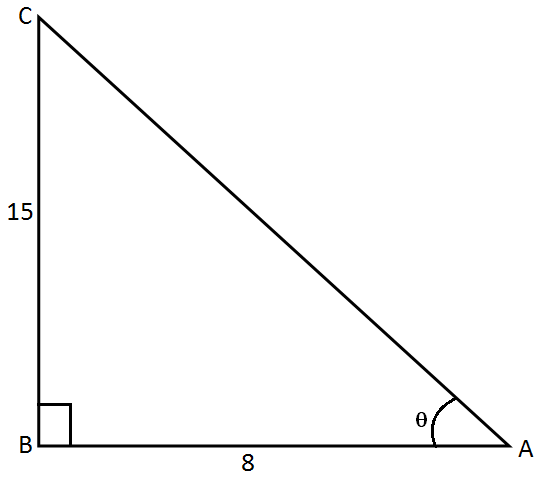
Side AC is unknown and can be found using Pythagoras theorem Therefore, $AC^2 = AB^2 + BC^2$
Now by substituting the value of known sides from figure (a) We get,
$AC^2 = 15^2 + 8^2 = 225 + 64 = 289$
Now by taking square root on both sides We get, $\text{AC}=\sqrt{289}$ $=17$ Therefore Hypotenuse side AC = 17 …… (3)
Now we know, sin A is defined as follows
$\sin\text{A}=\frac{\text{Peependicular side opposite to}\angle\text{A}}{\text{Hypotenuse}}$ Therefore from figure (a) and equation (3) We get, $\sin\text{A}=\frac{\text{BC}}{\text{AC}}$ $=\frac{15}{17}$ $\sin\text{A}=\frac{15}{17}\ \dots(4)$
Now we know, cos A is defined as follows
$\cos\text{A}=\frac{\text{Base side adjacement to}\angle\text{A}}{\text{Hypotenuse}}$
Therefore from figure (a) and equation (3) We get, $\cos\text{A}=\frac{\text{AB}}{\text{AC}}$
$=\frac{8}{17}$ $\cos\text{A}=\frac{8}{17}\ \dots(5)$
Now we need to find the value of expression $\sin\text{A}-\cos\text{A}$
Therefore by substituting the value of sin A and cos A from equation $(4)$ and $(5)$ respectively,
we get, $\sin\text{A}-\cos\text{A}=\frac{15}{17}-\frac{8}{17}$
$=\frac{15-8}{17}$
$=\frac{7}{17}$
Hence $\sin\text{A}-\cos\text{A}=\frac{7}{17}$ View full question & answer→Question 273 Marks
If A + B = 90° and $\cos\text{B}=\frac{3}{5},$ what is the value of sin A?
AnswerWe have: $\text{A}+\text{B}=90^\circ$ $\cos\text{B}=\frac{3}{5}$ $\text{A}+\text{B}=90^\circ$ $\Rightarrow\text{A}=90^\circ-\text{B}$ $\Rightarrow\sin\text{A}=\sin(90^\circ-\text{B})$ $\Rightarrow\sin\text{A}=\cos\text{B}$ $\Rightarrow\sin\text{A}=\frac{3}{5}\big[\sin(90^\circ-\text{B})=\cos\text{B}\big]$Hence the value of sin A is $\frac{3}{5}$
View full question & answer→Question 283 Marks
If $\tan\text{A}=\frac{5}{12},$ find the value of (sin A + cos A) sec A.
Answer$\tan\text{A}=\frac{5}{12}=\frac{\text{Perpendicular}}{\text{Base}}$
Draw a right $\triangle\text{ABC}$ in which
$\angle\text{B}=90^\circ\text{AB}=12,\text{BC}=5\text{ units}$
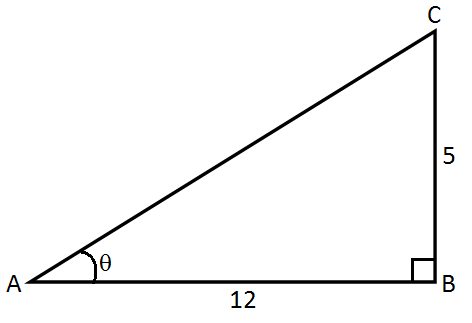
By Pythagoras Theorem,
$\text{AC}^2=\text{AB}^2+\text{BC}^2$
$=(12)^2+(5)^2=144+25$
$=169=(13)^2$
$\therefore\text{AC}=13\text{ units}$
Now, $\sin\text{A}=\frac{\text{Perpendicular}}{\text{Hypotenuse}}=\frac{\text{BC}}{\text{AC}}=\frac{5}{13}$
$\cos\text{A}=\frac{\text{Base}}{\text{Hypotenuse}}=\frac{\text{AB}}{\text{AC}}=\frac{12}{13}$
$\sec\text{A}=\frac{1}{\cos\text{A}}=\frac{13}{12}$
Now $(\sin\text{A}+\cos\text{A})\sec\text{A}$
$=\Big(\frac{5}{13}+\frac{12}{13}\Big)\times\frac{13}{12}$
$=\frac{17}{13}\times\frac{13}{12}=\frac{17}{12}$ View full question & answer→Question 293 Marks
Evaluate the following:
$\cot^230^\circ-2\cos^260^\circ-\frac{3}{4}\sec^245^\circ-4\sec^230^\circ$
AnswerWe have,
$\cot^230^\circ-2\cos^260^\circ-\frac{3}{4}\sec^245^\circ-4\sec^230^\circ\dots(1)$
Now,
$\cot30^\circ=\sqrt{3},\cos60^\circ=\frac{1}{2},\sec45^\circ=\sqrt{2},\sec30^\circ=\frac{2}{\sqrt{3}}$
So by substituting above values in equation (1)
We get,
$\cot^230^\circ-2\cos^260^\circ-\frac{3}{4}\sec^245^\circ-4\sec^230^\circ$
$=\big(\sqrt{3}\big)^2-2\Big(\frac{1}{2}\Big)^2-\frac{3}{4}\big(\sqrt{2}\big)^2-4\Big(\frac{2}{\sqrt{3}}\Big)^2$
$=3-2\times\frac{1^1}{2^2}-\frac{3}{4}\times2-4\times\frac{2^2}{\big(\sqrt{3}\big )^2}$
Now, in the third term 4 gets cancelled by 2 and 2 remains
Therefore,
$\cot^230^\circ-2\cos^260^\circ-\frac{3}{4}\sec^245^\circ-4\sec^230^\circ$
$=3-2\times\frac{1}{4}-\frac{3}{2}-4\times\frac{4}{3}$
Now in the second term, 4 gets cancelled by 2 and 2 remains
Therefore,
$\cot^230^\circ-2\cos^260^\circ-\frac{3}{4}\sec^245^\circ-4\sec^230^\circ$
$=3-2\times\frac{1}{4}-\frac{3}{2}-4\times\frac{4}{3}$
$=3-\frac{1}{2}-\frac{3}{2}-4\times\frac{4}{3}$
$=3-\frac{1}{2}-\frac{3}{2}-\frac{16}{3}$
Now, LCM of denominator in the above expression is 6
Therefore by taking LCM
We get,
$\cot^230^\circ-2\cos^260^\circ-\frac{3}{4}\sec^245^\circ-4\sec^230^\circ$
$=\frac{3\times6}{1\times6}-\frac{1\times3}{2\times3}-\frac{3\times3}{2\times3}-\frac{16\times2}{3\times2}$
$=\frac{18}{6}-\frac{3}{6}-\frac{9}{6}-\frac{32}{6}$
$=\frac{18-3-9-32}{6}$
$=\frac{18-12-32}{6}$
$=\frac{18-44}{6}$
$=\frac{-26}{6}$
Now in the above expression, $=\frac{-26}{6}$ gets reduced to $\frac{-13}{3}$
$\cot^230^\circ-2\cos^260^\circ-\frac{3}{4}\sec^245^\circ-4\sec^230^\circ=\frac{-13}{3}$
View full question & answer→Question 303 Marks
If $\cos\theta=\frac{1}{\sqrt{3}},$ show that $\frac{1-\cos^2\theta}{2-\sin^2\theta}=\frac{3}{5}.$
Answer$\cot\theta=\frac{1}{\sqrt{3}},$
Prove that $\frac{1-\cos^2\theta}{2-\sin^2\theta}=\frac{3}{5}$
$\cot\theta=\frac{\text{adjacent side}}{\text{opposite side}}=\frac{1}{\sqrt{3}}$
Let x be the hypotenuse
By appling Pythagoras
$\text{AC}^2=\text{AB}^2+\text{BC}^2$
$\text{x}^2=(\sqrt{3})^2+1$
$\text{x}^2=3+1$
$\text{x}^2=3+1 \Rightarrow\ \text{x}=2$
$\cos\theta=\frac{\text{BC}}{\text{AC}}=\frac{1}{2}$
$\sin\theta=\frac{\text{AB}}{\text{AC}}=\frac{\sqrt{3}}{2}$
$\frac{1-\cos^2\theta}{2-\sin^2\theta}\Rightarrow\frac{1-\Big(\frac{1}{2}\Big)^2}{2-\Big(\frac{\sqrt{3}}{2}\Big)^2}$
$\Rightarrow\frac{1-\frac{1}{4}}{2-\frac{3}{4}}\Rightarrow\frac{\frac{3}{4}}{\frac{5}{4}}$
$=\frac{3}{5}$
View full question & answer→Question 313 Marks
Find the value of x in the following:
$\tan\text{x}=\sin45^\circ\cos45^\circ+\sin30^\circ$
AnswerWe have,
$\tan\text{x}=\sin45^\circ\cos45^\circ+\sin30^\circ\dots(1) $
Now we know that
$\sin45^\circ=\cos45^\circ=\frac{1}{\sqrt{2}}$ and $\sin30^\circ=\frac{1}{2}$
Now by substituting above values in equation (1), we get
$\tan\text{x}=\sin45^\circ\cos45^\circ+\sin30^\circ$
$\tan\text{x}=\frac{1}{\sqrt{2}}\times\frac{1}{\sqrt{2}}+\frac{1}{2}$
$=\frac{1}{\sqrt{2}\times\sqrt{2}}+\frac{1}{2}$
$=\frac{1}{2}+\frac{1}{2}$
$=\frac{1+1}{2}$
$=\frac{2}{2}$
$=1$
Therefore,
$\tan\text{x}=1\ \dots(2)$
Since,
$=\tan45^\circ=1\ \dots(3)$
$\text{x}=45^\circ$
Therefore by comparing equation (2) and (3)
We get,
$\text{x}=45^\circ$
Therefore,
$\text{x}=45^\circ$
View full question & answer→Question 323 Marks
If $\theta=30^\circ,$ verify that.
$\sin2\theta=\frac{2\tan\theta}{1+\tan^2\theta}$
AnswerGiven:
$\theta=30^\circ\ \dots(1)$
To verify:
$\sin2\theta=\frac{2\tan\theta}{1+\tan^2\theta}\ \dots(2)$
$\sin2\theta=\sin2\times30$
$=\sin60$
$=\frac{\sqrt{3}}{2}$
Now consider right hand side
$\frac{2\tan\theta}{1+\tan^2\theta}=\frac{2\tan30}{1+\tan^230}$
$=\frac{2\times\frac{1}{\sqrt{3}}}{1+\Big(\frac{1}{\sqrt{3}}\Big)^2}$
$=\frac{\sqrt{3}}{2}$
Hence it is verified that,
$\sin2\theta=\frac{2\tan\theta}{1+\tan^2\theta}$
View full question & answer→Question 333 Marks
Find the value of x in the following:
$\sqrt{3}\tan2\text{x}=\cos60^\circ+\sin45^\circ\cos45^\circ$
Answer$\sqrt{3}\tan2\text{x}=\cos60^\circ+\sin45^\circ\cos45^\circ$
$\Rightarrow\sqrt{3}\tan2\text{x}=\frac{1}{2}+\frac{1}{\sqrt{2}}\times\frac{1}{\sqrt{2}}$
$\Rightarrow\sqrt{3}\tan2\text{x}=\frac{1}{2}+\frac{1}{2}$
$\Rightarrow\sqrt{3}\tan2\text{x}=1$
$\Rightarrow\tan2\text{x}=\frac{1}{\sqrt{3}}$
$\Rightarrow\tan2\text{x}=\tan30^\circ$
$\Rightarrow2\text{x}=30^\circ$
$\Rightarrow\text{x}=\frac{30^\circ}{2}$
$\Rightarrow\text{x}=15^\circ$
View full question & answer→Question 343 Marks
In a $\triangle\text{ABC},$ right angled at B, AB = 24cm, BC = 7cm. Determine:
$\sin \text{A}, \cos \text{A}$
Answer$\triangle\text{ABC}$ is right angled at B
AB = 24cm, BC = 7cm.
Let 'x' be the hypotenuse,
By applying Pythagoras
$\text{AC}^2=\text{AB}^2+\text{BC}^2$
$\text{x}^2=24^2+7^2$
$\text{x}^2=576+49$
$\text{x}^2=625$
$\text{x}=25$
$\sin\text{A},\cos\text{A}$
At $\angle\text{A,}$ opposite side = 7
adjacent side = 24
hypotenuse = 25
$\sin\text{A}=\frac{\text{opposite side}}{\text{hypotenuse}}=\frac{7}{25}$
$\cos\text{}A=\frac{\text{adjacent side}}{\text{hypotenuse}}=\frac{24}{25}$
View full question & answer→Question 353 Marks
State whether the following are true or false. Justify your answer.
$\sec\text{A}=\frac{12}{5}$ for some value of angle A.
Answer$\sec\text{A}=\frac{1}{\cos\text{A}}$
In sec A and $\cos\text{A},\angle\text{A}$ is acute angle
Therefore,
Minimum value $\angle\text{A}$ of is 0° and
Maximum value of $\angle\text{A}$ is 90°
We know that cos 0° = 1 and
cos 90° = 0
Now,
$\sec0^\circ=\frac{1}{\cos0^\circ}$
$=\frac{1}{1}$
Therefore minimum value of sec A is sec 0 ° …… (1)
Now,
$\sec90^\circ=\frac{1}{\cos90^\circ}$
$=\frac{1}{0}$
$=\infty$
Therefore maximum value of sec A is $\sec90^\circ=\infty\ \dots(2)$
Now consider the given value
$\sec\text{A}=\frac{12}{5}$
Here, $\frac{12}{5}=2.4$
This value 2.4 lies in between 1 and $\infty$
Now from equation (1) and (2), we can say that the value $\frac{12}{5}=2.4$ lies in between minimum value of sec A (that is 1) and maximum value of sec A (that is $\infty$)
Hence $\sec\text{A}=\frac{12}{5},$ for some value of angle A is true.
View full question & answer→Question 363 Marks
If $\sin\text{A}=\frac{9}{41},$ computer cos A and tan A.
Answer$\sin\text{A}=\frac{9}{41},$ $\sin\text{A}=\frac{\text{opposite side}}{\text{adjacent side}}=\frac{9}{41}$
Consider right angled triangle ABC,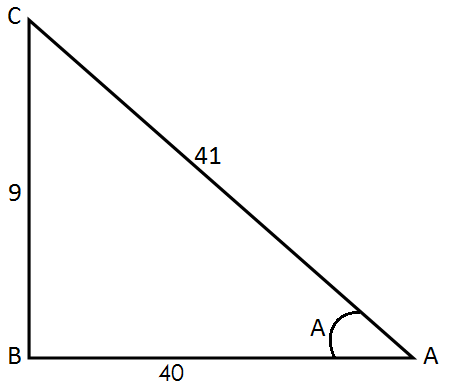
Let x be the adjacent side By applying Pythagoras $\text{AC}^2=\text{AB}^2+\text{BC}^2$ $(41)^2=(\text{AB})^2+9^2$ $1681-81=\text{AB}^2$ $\text{AB}=40$ $\cos\text{A}=\frac{\text{adjacent side}}{\text{hypotenuse}}=\frac{40}{41}$ $\tan\text{A}=\frac{\text{opposite side}}{\text{Hypotenuse side}}=\frac{9}{40}$ View full question & answer→Question 373 Marks
If $3\tan\theta=4,$ find the value of $\frac{4\cos\theta-\sin\theta}{2\cos\theta+\sin\theta}.$
AnswerWe have, $3\tan\theta=4\ \Rightarrow\tan\theta=\frac{4}{3}$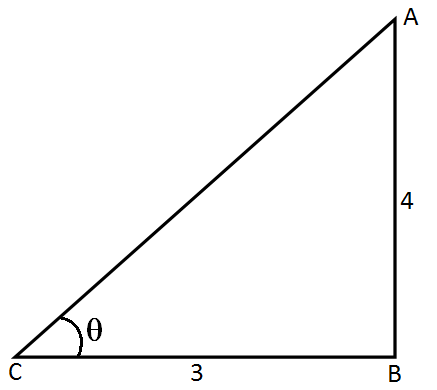
In $\triangle\text{ABC},$ $\text{AC}^2=\text{AB}^2+\text{BC}^2$ $\Rightarrow\text{AC}^2=(4)^2+(3)^2$ $\Rightarrow\text{AC}^2=16+9$ $\Rightarrow\text{AC}^2=25$ $\Rightarrow\text{AC}=5$ $\therefore\ \sin\theta=\frac{\text{AB}}{\text{AC}}=\frac{4}{5}$ and $\cos\theta=\frac{\text{BC}}{\text{AC}}=\frac{3}{5}$ Now, $\frac{4\cos\theta-\sin\theta}{2\cos\theta+\sin\theta}=\frac{4\times\frac{3}{5}-\frac{4}{5}}{2\times\frac{3}{5}+\frac{4}{5}}$ $=\frac{\frac{4}{5}(3-1)}{\frac{2}{5}(3+2)}$ $=\frac{2\times2}{5}$ $=\frac{4}{5}$ Hence, $\frac{4\cos\theta-\sin\theta}{2\cos\theta+\sin\theta}=\frac{4}{5}$ View full question & answer→Question 383 Marks
In the following, one of the six trigonometric ratios is given. Find the values of the other trigonometric ratios.
$\tan \alpha=\frac{5}{12}$
AnswerWe have, $ \tan \alpha= \frac{\text{perpendicular}}{\text{Base}}=\frac{5}{12}$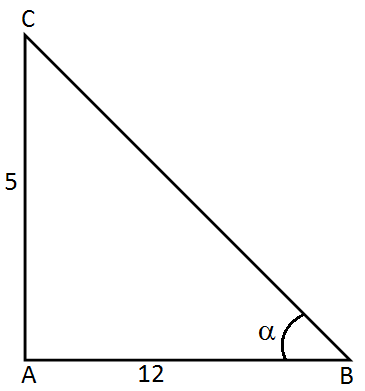
In $\triangle \text{ABC},$ $\Rightarrow\text{BC}^2 = \text{AB}^2 + \text{AC}^2$ $\Rightarrow\text{BC}^2 = (12)^2 + (5)^2$ $\Rightarrow\text{BC}^2 = 144+25$ $\Rightarrow\text{BC}^2 = 169$ $\Rightarrow\text{BC} = 13$ $\therefore\ \sin\alpha=\frac{\text{perpendicular}}{\text{Hypotinuse}}=\frac{5}{13}$ $\cos\alpha=\frac{\text{Base}}{\text{Hypotinuse}}=\frac{12}{13}$ $\cot\alpha=\frac{1}{\text{tan}\alpha}=\frac{12}{5}$ $\sec\alpha=\frac{1}{\cos\alpha}=\frac{13}{12}$ $\text{cosec }\alpha=\frac{1}{\sin\alpha}=\frac{13}{5}$ View full question & answer→Question 393 Marks
Evaluate the following:
$(\cos0^\circ+\sin45^\circ+\sin30^\circ)(\sin90^\circ-\cos45^\circ+\cos60^\circ)$
Answer$(\cos0^\circ+\sin45^\circ+\sin30^\circ)(\sin90^\circ-\cos45^\circ+\cos60^\circ)\dots(\text{i})$ By trigonometric ration we have $\cos0^\circ=1,\ \sin45^\circ=\frac{1}{\sqrt{2}},\ \sin30=\frac{1}{2},$$\sin90^\circ=1,\cos45^\circ=\frac{1}{\sqrt{2}}\cos60^\circ=\frac{1}{2}$
By substituting above values in (i), we get $\Big(1+\frac{1}{\sqrt{2}}+\frac{1}{2}\Big)\Big(1-\frac{1}{\sqrt{2}}+\frac{1}{2}\Big)$ $\Big[\frac{3}{2}+\frac{1}{\sqrt{2}}\Big]\Big[\frac{3}{2}-\frac{1}{\sqrt{2}}\Big]$ $\Rightarrow\Big[\frac{3}{2}\Big]^2-\Big[\frac{1}{\sqrt{2}}\Big]=\frac{9}{4}-\frac{1}{2}=\frac{7}{4}$
View full question & answer→Question 403 Marks
Evaluate the following:
$4\big(\sin^430^\circ+\cos^260^\circ\big)-3\big(\cos^245^\circ-\sin^290^\circ\big)-\sin^260^\circ$
Answer$4\big(\sin^430^\circ+\cos^260^\circ\big)-3\big(\cos^245^\circ-\sin^290^\circ\big)-\sin^260^\circ\ \dots(1)$
By trigonometric ration we have
$\sin30^\circ=\frac{1}{2},\cos60^\circ=\frac{1}{2},\cos45^\circ=\frac{1}{\sqrt{2}},$ $\sin90^\circ=1\sin60^\circ=\frac{\sqrt{3}}{2}$
By substituting above values in (i), we get
$4\bigg[\Big(\frac{1}{2}\Big)^4+\Big(\frac{1}{2}\Big)^2\bigg]-3\bigg[\Big[\frac{1}{\sqrt{2}}\Big]^2-1\bigg]\Big[\frac{\sqrt{3}}{2}\Big]^2$
$4\bigg[\frac{1}{16}+\frac{1}{4}\bigg]-3\bigg[\frac{1-[\sqrt{2}]}{(\sqrt{2})^2}\bigg]-\frac{3}{4}$
$\frac{1}{4}+1-3\bigg[\frac{1-[\sqrt{2}]}{[\sqrt{2}]}\bigg]^2-\frac{3}{4}$
$=\frac{1}{4}+1-\frac{3}{4}+\frac{3}{2}=2$
View full question & answer→Question 413 Marks
Prove the following:$\frac{\cos(90^\circ-\text{A})\sin(90^\circ-\text{A})}{\tan(90^\circ-\text{A})}-\sin^2\text{A}=0$
Answer$\cos(90^\circ-\text{A})=\sin\text{A}$ $\tan(90^\circ-\text{A})=\cot\text{A}$
$\sin(90^\circ-\text{A})=\cos\text{A}$
$\frac{\sin\text{A}.\cos\text{A}}{\cot\text{A}}-\sin^2\text{A}=0$
$\frac{\sin\text{A}.\cos\text{A}}{\cos\text{A}}\sin\text{A}-\sin^2\text{A}$
$\sin^2\text{A}-\sin^2\text{A}=0$
$\text{L.H.S = R.H.S}$
Hence Proved.
View full question & answer→Question 423 Marks
In a $\triangle\text{ABC}$ right angled at B, $\angle\text{A}=\angle\text{C.}$ Find the values of.
$\sin\text{A}\sin \text{B}+\cos\text{A}\cos\text{B}$
AnswerGiven: $\angle\text{A}=\angle\text{C}$ and $\angle\text{B}=90^\circ$ 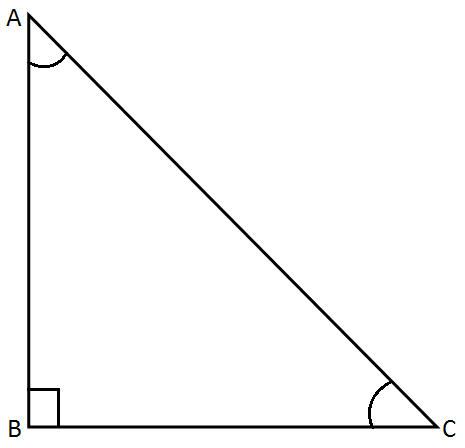 To find: $\sin\text{A}\sin\text{B}+\cos\text {A}\cos\text{B}\dots(1)$ Now we know that sum of all the angles of any triangle is 180°Therefore,
$\angle\text{A}+ \angle\text{B}+\angle\text{C}=180^\circ $
since $\angle\text{A}= \angle\text{C}$ and $\angle\text{B}=90^ \circ$Therefore,
$\angle\text{A}+90^ \circ+\angle\text{A}=180^\circ$ $\Rightarrow2\angle\text{A}+90^ \circ=180^\circ$ $\Rightarrow2\angle\text{A}=180^\circ- 90^\circ$ $\Rightarrow2\angle\text{A}=90^\circ$ $\Rightarrow\angle\text{A}=\frac{90^ \circ}{2}$ $\Rightarrow\angle\text{A}=45^\circ$ It is given that $\angle\text{A}=\angle\text{C}$ Therefore, $\angle\text{A}=\angle\text{C}=45^ \circ\dots(2)$ Now we have, $\sin\text{A}=\frac{\text{BC}}{\text {AC}},\ \sin\text{B}=\sin90^\circ=1$ $\cos\text{A}=\frac{\text{AB}}{\text {AC}},\ \cos\text{B}=\cos90^\circ=0$ Now by substituting the above values in equation (1) We get, $\sin\text{A}\sin\text{B}+\cos\text {A}\cos\text{B}=\sin45^\circ\times1+ \cos45^\circ\times0$ $= \sin45^\circ$ Since $\sin45^\circ=\frac {1}{\sqrt{2}}$Therefore $\sin\text{A}\sin \text{B}+\cos\text{A}\cos\text{B}=\frac {1}{\sqrt{2}}$ View full question & answer→Question 433 Marks
If $\cot\theta=\frac{3}{4},$ prove that $\sqrt{\frac{\sec\theta-\text{cosec }\theta}{\sec\theta+\text{cosec }\theta}}=\frac{1}{\sqrt{7}}.$
Answer$\cot\theta=\frac{3}{4}\ \text{P.T}\ \sqrt{\frac{\sec\theta-\text{cosec }\theta}{\sec\theta+\text{cosec }\theta}}=\frac{1}{\sqrt{7}}$ $\cot\theta=\frac{\text{adjacent side }}{\text{opposite side}}$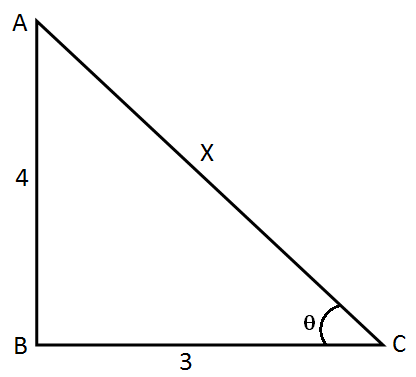
Let x be the hypotenuse by applying Pythagoras theorem. $\text{AC}^2=\text{AB}^2+\text{BC}^2$ $\text{x}^2=16+9$ $\text{x}^2=25\Rightarrow\text{x}=5$ $\sec\theta=\frac{\text{AC}}{\text{BC}}=\frac{5}{3}$$\text{cosec }\theta=\frac{\text{AC}}{\text{AB}}=\frac{5}{4}$
On substituting in equation we get $ \sqrt{\frac{\sec\theta-\text{cosec }\theta}{\sec\theta+\text{cosec }\theta}}=\sqrt{\frac{\frac{5}{3}-\frac{5}{4}}{\frac{5}{3}+\frac{5}{4}}}$ $=\sqrt{\frac{\frac{20-15}{12}}{\frac{20+15}{12}}}=\sqrt{\frac{5}{35}}=\frac{1}{\sqrt{7}}$ View full question & answer→Question 443 Marks
Prove the following:$\frac{\cos(90^\circ-\theta)\sec(90^\circ-\theta)\tan\theta}{\text{cosec}(90^\circ-\theta)\sin(90^\circ-\theta)\cot(90^\circ-\theta)}+\frac{\tan(90^\circ)-\theta}{\cot\theta}=2$
Answer$\cos(90^\circ-\theta)=\sin\text{A},\text{cosec }(90^\circ-\theta)=\sec\theta$
$\sec(90^\circ-\theta)=\text{cosec}\theta,\sin(90-\theta)=\cos\theta$
$\cot(90-\theta)=\tan\theta$
$\Rightarrow\frac{\sin\theta\text{ cosec }\theta\tan\theta}{\sec\theta.\cos\theta.\tan\theta}=\frac{\sin\theta\text{ cosec }\theta}{\sec\theta\cos\theta}$ $\big[\because\sin\theta\text{ cosec }\theta=1\big]$
$=1$ $[\sec\theta\cos\theta=1]$
$\frac{\tan(90^\circ-\theta)}{\cot\theta}=\frac{\cot\theta}{\cot\theta}=1$
$\Rightarrow1+1=2$
$\therefore\ \text{L.H.S} = \text{R.H.S}$
Hence proved.
View full question & answer→Question 453 Marks
If $\tan\theta=\frac{1}{\sqrt{7}},$ show that $\frac{\text{cosec}^2\theta-\sec^2\theta}{\text{cosec}^2\theta+\sec^2\theta}=\frac{3}{4}.$
AnswerWe have, $\tan\theta=\frac{1}{\sqrt{7}}$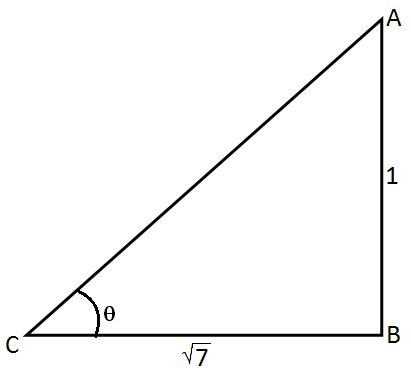
In $\triangle\text{ABC},$ $\text{AC}^2=\text{AB}^2+\text{BC}^2$ $\Rightarrow\text{AC}^2=(1)^2+(\sqrt{7})^2$ $\Rightarrow\text{AC}^2=8$ $\Rightarrow\text{AC}=2\sqrt{2}$ $\therefore\text{cosec }\theta=\frac{2\sqrt{2}}{1},$ and $\sec\theta=\frac{2\sqrt{2}}{\sqrt{7}}$ Now, $\frac{\text{cosec}^2\theta-\sec^2\theta}{\text{cosec}^2\theta+\sec^2\theta}=\frac{(2\sqrt{2})^2-\Big(\frac{2\sqrt{2}}{\sqrt{7}}\Big)^2}{(2\sqrt{2})^2+\Big(\frac{2\sqrt{2}}{\sqrt{7}}\Big)^2}$ $=\frac{8-\frac{8}{7}}{8+\frac{8}{7}}$ $=\frac{\big(\frac{56-8}{7}\big)}{\big(\frac{56+8}{7}\big)}$ $=\frac{48}{64}$ $=\frac{6}{8}=\frac{3}{4}$ View full question & answer→Question 463 Marks
If $3\cot\text{A}=4$ check whether $\frac{1+\tan^2\text{A}}{1+\tan^2\text{A}}=\cos^2\text{A}-\sin^2\text{A}$ or not.
AnswerWe have, $3\cot\text{A}=4\Rightarrow\cot\text{A}=\frac{4}{3}\Rightarrow\tan\text{A}=\frac{3}{4}$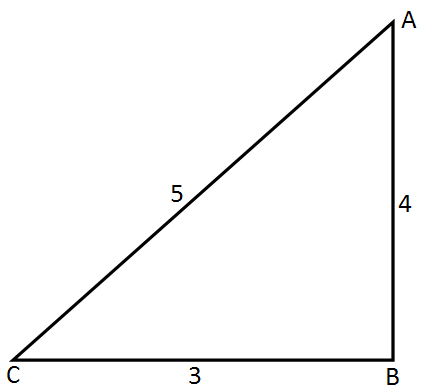
In $\triangle\text{ABC},$ $\Rightarrow\text{AC}^2=(3)^2+(4)^2$ $\Rightarrow\text{AC}^2=25$ $\Rightarrow\text{AC}=5$ Now, $\frac{1-\tan^2\text{A}}{1+\tan^2\text{A}}=\cos^2\text{A}-\sin^2\text{A}$ $\Rightarrow\frac{1-\Big(\frac{3}{4}\Big)^2}{1+\Big(\frac{3}{4}\Big)^2}=\Big(\frac{4}{5}\Big)^2-\Big(\frac{3}{5}\Big)^2$ $\Rightarrow\frac{1-\frac{9}{16}}{1+\frac{9}{16}}=\frac{16}{25}-\frac{9}{25}$ $\Rightarrow\frac{7}{25}\times\frac{16}{16}=\frac{7}{25}$ $\Rightarrow\text{L.H.S}=\text{R.H.S}$ View full question & answer→Question 473 Marks
Prove the following:$\sin(50^\circ+\theta)-\cos(40^\circ-\theta)+\tan1^\circ\tan10^\circ\tan70^\circ\tan80^\circ\tan89^\circ=1$
AnswerWe have to prove: $\sin(50^\circ+\theta)-\cos(40^\circ-\theta)+\tan1^\circ\tan10^\circ\tan70^\circ\tan80^\circ\tan89^\circ=1$
Left hand side
$=\sin(50^\circ+\theta)-\cos(40^\circ-\theta)+\tan1^\circ\tan10^\circ\tan20^\circ\tan70^\circ\tan80^\circ\tan89^\circ$
$=\cos\big[90^\circ-(50^\circ+\theta)\big]-\cos(40^\circ-\theta)+\tan(90^\circ-89^\circ)\tan(90^\circ-80^\circ)\tan(90^\circ-70^\circ)\tan70^\circ\tan80^\circ\tan89^\circ$
$=\cos(40^\circ-\theta)-\cos(40^\circ-\theta)+\cot89^\circ.\cot80^\circ.\cot70^\circ.\tan70^\circ.\tan80^\circ.\tan89^\circ$
$=0+(\tan89^\circ.\cot89^\circ)(\tan80^\circ.\cot80^\circ)(\tan70^\circ.\cot70^\circ)$
Since $\tan\theta.\cot\theta=1$.
So, $=1\times1\times1$
$=1$
= Right hand side
Proved.
View full question & answer→Question 483 Marks
If $\text{cosec A} = 2,$ find the value of $\frac{1}{\tan\text{A}}+\frac{\sin\text{A}}{1+\cos\text{A}}.$
AnswerWe have, $\text{cosec}\text{A}=2$ In $\triangle\text{ABC},$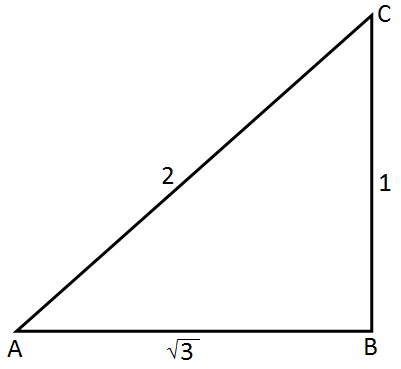
$\text{AC}^2=\text{AB}^2+\text{BC}^2$ $\Rightarrow(2)^2=(1)^2+\text{BC}^2$ $\Rightarrow\text{BC}^2=4-1$ $\Rightarrow\text{BC}^2=3$ $\Rightarrow\text{BC}=\sqrt{3}$ $\therefore\sin\text{A}=\frac{1}{2},\cos\text{A}=\frac{\sqrt{3}}{2}$ and $\tan\text{A}=\frac{1}{\sqrt{3}}$ Now, $\frac{1}{\tan\text{A}}+\frac{\sin\text{A}}{1+\cos\text{A}}=\frac{1}{\frac{1}{\sqrt{3}}}+\frac{\frac{1}{2}}{1+\frac{\sqrt{3}}{2}}$ $=\sqrt{3}+\frac{2}{2(2+\sqrt{3})}$ $=\frac{\sqrt{3}(2+\sqrt{3})+1}{(2+\sqrt{3})}$ $=\frac{2\sqrt{3}+3+1}{2+\sqrt{3}}$ $=\frac{2\sqrt{3}+4}{2+\sqrt{3}}$ $=\frac{2(\sqrt{3}+2)}{(2+\sqrt{3})}$ $=2$ View full question & answer→Question 493 Marks
In the following, one of the six trigonometric ratios is given. Find the values of the other trigonometric ratios.
$\sin \theta =\frac{\sqrt{3}}{2}$
AnswerGiven $\sin\theta=\frac{\sqrt{3}}{2}\ \dots(1)$
By definition $\sin\theta=\frac{\text{Perpendiular}}{\text{Hypotenuse}}\ \dots(2)$
By comparing (1) and (2) We get, Perpendicular side $=\sqrt{3}$ and Hypotenuse $= 2$
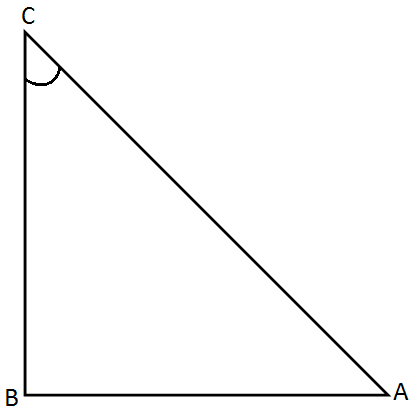
Therefore, By Pythagoras theorem, $AC^2 = AB^2 + BC^2$
Now we substitute the value of perpendicular side $(BC)$ and hypotenuse $(AC)$ and get the base side $(AB)$
$2^2=\text{AB}^2+\big(\sqrt{3}\big)^2$
$\text{AB}^2=2^2-\big(\sqrt{3}\big)^2$
$\text{AB}^2=4-3$ $\text{AB}^2=1$
$\text{AB}\sqrt{1}$
$\text{AB}=1$
Hence, Base = 1 Now, $\cos\theta=\frac{\text{Base}}{\text{Hypotenuse}}$
Therefore, $\cos\theta=\frac{1}{2}$ Now, $\text{cosec }\theta=\frac{1}{\sin \theta}$
Therefore, $\text{cosec }\theta=\frac{\text{Hypotenuse}}{\text{Perpendicular}}$
$\text{cosec }\theta=\frac{2}{\sqrt{3}}$
Now, $\sec\theta=\frac{\text{Hypotenuse}}{\text{Base}}$
Therefore, $\sec\theta=\frac{2}{1}$
Now, $\tan\theta=\frac{\text{Perpendicular}}{\text{Base}}$
Therefore, $\tan\theta=\frac{\sqrt{3}}{1}$
Now, $\cot\theta=\frac{\text{Base}}{\text{Perpendicular}}$
Therefore, $\cot\theta=\frac{1}{\sqrt{3}}$ View full question & answer→Question 503 Marks
Find acute angles A and B, if $\sin(\text{A + 2B})=\frac{\sqrt{3}}{2}$ and $\cos(\text{A + 4B})=0,\text{A}>\text{B}.$
AnswerWe have,
$\sin(\text{A}+2\text {B})=\frac{\sqrt {3}}{2}$ and $\cos(\text {A}+4\text{B})=0$
Now, $\sin(\text{A}+2\text {B})=\frac{\sqrt{3}}{2}$
$\Rightarrow\sin (\text{A}+2\text{B})=\sin60^\circ$
$\Rightarrow\text {A}+2\text{B}=60^ \circ\dots(1)$
And, $\cos(\text{A}+4\text {B})=0$
$\Rightarrow\cos (\text{A}+4\text{B})= \cos90^\circ$
$\Rightarrow\text {A}+4\text{B}=90^ \circ\dots(2)$
Substract (1) from (2), we get
$\Rightarrow2\text{B} =30^\circ$
$\Rightarrow\text{B}= \frac{30^\circ} {2}=15^\circ$
Put B = 15° in (1) we get -
$\Rightarrow\text {A}+2\times15=60^ \circ$
$\Rightarrow\text {A}+30^\circ=60^\circ $
$\Rightarrow\text{A} =60^\circ-30^\circ $
$\Rightarrow\text{A} =30^\circ$
Thus, A = 30° and B = 15°
View full question & answer→Question 513 Marks
If $\tan\theta=\frac{24}{7},$ find that $\sin\theta+\cos\theta.$
Answer$\tan\theta=\frac{24}{7}$ find $\sin\theta+\cos\theta$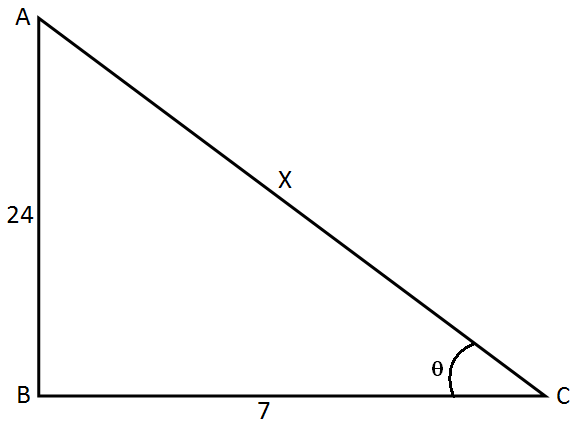
Let x - 1 be the hypotenuse By applying Pythagoras theorem we get
$\text{AC}^2=\text{AB}^2+\text{BC}^2$ $\text{x}^2=(24)^2+(7)^2$ $\text{x}^2=576+49=62.5$ $\text{x}=25$ $\sin\theta=\frac{\text{AB}}{\text{AC}}=\frac{24}{25}$ $\cos\theta=\frac{\text{BC}}{\text{AC}}=\frac{7}{25}$ $\sin\theta+\cos\theta=\frac{24}{25}+\frac{7}{25}$ $=\frac{31}{25}$ View full question & answer→Question 523 Marks
If A = 30° and B = 60°, verify that.
$\cos(\text{A}+\text{B})=\cos\text{A}\cos\text{B}-\sin\text{A}\sin\text{B}$
AnswerWe have,
$\sin(\text{A}-\text{B})=\frac{1}{2}$ and $\cos(\text{A}+\text{B})=\frac{1}{2}$
Now, $\sin(\text{A}-\text{B})=\frac{1}{2}$
$\Rightarrow\sin(\text{A}-\text{B})=\sin30^\circ$
$\Rightarrow(\text{A}-\text{B})=30^\circ\dots(1)$
And, $\cos(\text{A}+\text{B})=\frac{1}{2}$
$\Rightarrow\cos(\text{A}+\text{B})=\cos60^\circ$
$\Rightarrow(\text{A}+\text{B})=60^\circ\dots(2)$
Adding (1) and (2), we get,
$\Rightarrow2\text{A}=90^\circ$
$\Rightarrow\text{A}=\frac{90^\circ}{2}=45^\circ$
Put $\text{A}=45^\circ$ in (2), we get,
$\Rightarrow45^\circ+\text{B}=60^\circ$
$\Rightarrow\text{B}=60^\circ-45^\circ$
$\Rightarrow\text{B}=15^\circ$
Thus, $\text{A}=45^\circ$ and $\text{B}=15^\circ$
View full question & answer→Question 533 Marks
Evaluate the following:
$ \frac{\tan^260^\circ+4\cos^245^\circ+3\sec^230^\circ+5\cos^290^\circ}{\text{cosec30}^\circ+\sec60^\circ-\cot^230^\circ}$
Answer$ \frac{\tan^260^\circ+4\cos^245^\circ+3\sec^230^\circ+5\cos^290^\circ}{\text{cosec30}^\circ+\sec60^\circ-\cot^230^\circ}$$=\frac{(\sqrt{3})^2+4\big(\frac{1}{\sqrt{2}}\big)^2+3\big(\frac{2}{\sqrt{3}}\big)^2+5\times0}{2+2-(\sqrt{3})^2}$
$ =\frac{3+4\times\frac{1}{2}+3\times\frac{4}{3}+0}{4-3}$
$=3+2+4$
$=9$
View full question & answer→Question 543 Marks
Evaluate the following:
$\cos60^\circ\cos45^\circ-\sin60^\circ\sin45^\circ$
AnswerWe have to find the value of the following expression
$\cos60^\circ\cos45^\circ-\sin60^\circ\sin45^\circ\dots(1)$
$\sin45^\circ=\cos45^\circ=\frac{1}{\sqrt2},\sin60^\circ=\frac{\sqrt3}{2}\cos60^\circ=\frac{1}{2}$
Now
So by substituting above values in equation (1)
We get,
$\cos60^\circ\cos45^\circ-\sin60^\circ\sin45^\circ$
$=\frac{1}{2}\times\frac{1}{\sqrt2}-\frac{\sqrt3}{2}\times\frac{1}{\sqrt2}$
$=\frac{1}{2\sqrt2}-\frac{\sqrt3}{2\sqrt2}$
$=\frac{1-\sqrt3}{2\sqrt2}$
Therefore,
$\cos60^\circ\cos45^\circ-\sin60^\circ\sin45^\circ=\frac{1-\sqrt3}{2\sqrt2}$
View full question & answer→Question 553 Marks
Evaluate:
$\frac{2}{3}(\cos^430^\circ-\sin^445^\circ)-3(\sin^260^\circ-\sec^245^\circ)+\frac{1}{4}\cot^230^\circ$
Answer$\cos30^\circ=\frac{\sqrt{3}}{2},\sin60^\circ=\frac{\sqrt{3}}{2},\cot30^\circ=\sqrt{3},$ $\sin45^\circ=\frac{1}{\sqrt{2}},\sec45^\circ=\sqrt{2}$
Substituting above value in question,
$=\frac{2}{3}\bigg[\Big(\frac{\sqrt{3}}{2}\Big)^4-\Big(\frac{1}{\sqrt{2}}\Big)^4\bigg]-3\bigg[\Big(\frac{\sqrt{3}}{2}\Big)^2-\Big(\sqrt{2}\Big)^2\bigg]+\frac{1}{4}\Big(\sqrt{3}\Big)^2$
$=\frac{2}{3}\Big[\frac{9}{16}-\frac{1}{4}\Big]-3\Big[\frac{3}{4}-2\Big]+\frac{1}{4}\times3$
$=\frac{2}{3}\Big[\frac{5}{16}\Big]-3\Big[\frac{-5}{4}\Big]+\frac{3}{4}$
$=\frac{5}{24}+\frac{15}{4}+\frac{3}{4}$
$=\frac{5+90+18}{24}$
$=\frac{133}{24}$
View full question & answer→Question 563 Marks
In the following, one of the six trigonometric ratios is given. Find the values of the other trigonometric ratios.
$\sin\theta=\frac{11}{15}$
Answer$\sin\theta=\frac{11}{5}$
We know $ \sin{\theta}=\frac{\text{perpendicullar}}{\text{Hypotenuse}}=\frac{11}{15}$
Consider right angled $\triangle^\text{le}\text{ACB}.$
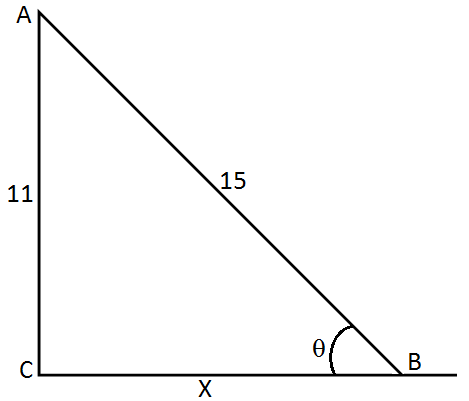
Let x = adjacent side
By applying Pythagoras
$\text{AB}^2=\text{AC}^2+\text{BC}^2$
$225=121-\text{x}^2$
$\text{x}^2=225-121$
$\text{x}^2=104$
$\text{x}=\sqrt{104}$
$\cos\theta=\frac{\text{adjacent side}}{\text{hypotenuse}}=\frac{\sqrt{104}}{15}$
$\tan\theta=\frac{\text{opposite side}}{\text{adjacent side}}=\frac{11}{\sqrt{104}}$
$\text{cosec }\theta=\frac{1}{\sin\theta}=\frac{15}{11}$
$\sec\theta=\frac{1}{\cos\theta}=\frac{15}{\sqrt{104}}$
$\cot\theta=\frac{1}{\tan\theta}=\frac{\sqrt{104}}{11}$ View full question & answer→Question 573 Marks
Evaluate the following:
$2\sin^230^\circ-3\cos^245^\circ+\tan^260^\circ$
Answer$2\sin^230^\circ-3\cos^245^\circ+\tan^260^\circ....(\text{i})$
By trigonometric ratios we have
$\sin30^\circ=\frac{1}{2},\ \cos45^\circ=\frac{1}{\sqrt{2}},\ \tan60^\circ=\sqrt{3}$
By substituing above values in (i) we get
$2\cdot\Big[\frac{1}{2}\Big]^2-3\Big[\frac{1}{\sqrt{2}}\Big]^2+\big[\sqrt{3}\big]^2$
$2\cdot\frac{1}{4}-3\cdot\frac{1}{2}+3$
$\frac{1}{2}-\frac{3}{2}+3\Rightarrow\frac{3}{2}+2=2$
View full question & answer→Question 583 Marks
Evaluate the following:
$\frac{\sin30^\circ}{\sin45^\circ}+\frac{\tan45^\circ}{\sec60^\circ}-\frac{\sin60^\circ}{\cot45^\circ}-\frac{\cos30^\circ}{\sin90^\circ}$
AnswerWe have
$\frac{\sin30^\circ}{\sin45^\circ}+\frac{\tan45^\circ}{\sec60^\circ}-\frac{\sin60^\circ}{\cot45^\circ}-\frac{\cos30^\circ}{\sin90^\circ}\ \dots(1)$
Now,
$\sin45^\circ=\frac{1}{\sqrt{2}},\ \sin30^\circ=\frac{1}{2},\ \sin90^\circ=1,$ $\tan45^\circ=\cot45^\circ=1,\ \sin60^\circ=\cos30^\circ=\frac{\sqrt{3}}{2}$
$\sec60^\circ=2$
So by substituting above values in equation (1)
We get,
$\frac{\sin30^\circ}{\sin45^\circ}+\frac{\tan45^\circ}{\sec60^\circ}-\frac{\sin60^\circ}{\cot45^\circ}-\frac{\cos30^\circ}{\sin90^\circ}$
$ =\frac{\frac{1}{2}}{\frac{1}{\sqrt{2}}}+\frac{1}{2}-\frac{\frac{\sqrt{3}}{2}}{1}-\frac{\frac{\sqrt{3}}{2}}{1}$
Now by further simplifying
We get,
$ \frac{\sin30^\circ}{\sin45^\circ}+\frac{\tan45^\circ}{\sec60^\circ}-\frac{\sin60^\circ}{\cot45^\circ}-\frac{\cos30^\circ}{\sin90^\circ} $
$ =\frac{1}{\sqrt{2}\times\sqrt{2}}\times\frac{\sqrt{2}}{1}+\frac{1}{2}-\frac{\sqrt{3}}{2}-\frac{\sqrt{3}}{2}$
Now, one $\sqrt{2}$ gets cancelled and
We get,
$\frac{\sin30^\circ}{\sin45^\circ}+\frac{\tan45^\circ}{\sec60^\circ}-\frac{\sin60^\circ}{\cot45^\circ}-\frac{\cos30^\circ}{\sin90^\circ}$
$ =\frac{1}{\sqrt{2}}+\frac{1}{2}-\frac{\sqrt{3}}{2}-\frac{\sqrt{3}}{2}$
Now, by taking LCM
We get,
$ \frac{\sin30^\circ}{\sin45^\circ}+\frac{\tan45^\circ}{\sec60^\circ}-\frac{\sin60^\circ}{\cot45^\circ}-\frac{\cos30^\circ}{\sin90^\circ}$
$=\frac{1\times\sqrt{2}}{\sqrt{2}\times\sqrt{2}}+\frac{1}{2}-\frac{\sqrt{3}}{2}-\frac{\sqrt{3}}{2}$
$=\frac{\sqrt{2}}{2}+\frac{1}{2}-\frac{\sqrt{3}}{2}-\frac{\sqrt{3}}{2}$
$ =\frac{\sqrt{2}+1-\sqrt{3}-\sqrt{3}}{2}$
$=\frac{\sqrt{2}+1-2\sqrt{3}}{2}$
Therefore,
$ \frac{\sin30^\circ}{\sin45^\circ}+\frac{\tan45^\circ}{\sec60^\circ}-\frac{\sin60^\circ}{\cot45^\circ}-\frac{\cos30^\circ}{\sin90^\circ}$ $=\frac{\sqrt{2}+1-2\sqrt{3}}{2}$
View full question & answer→Question 593 Marks
Given 15 cot A = 8, find sin A and sec A.
AnswerWe have, $15\cot\text{A}=8$ $\cot\text{A}=\frac{8}{15}=\frac{\text{Base}}{\text{Perpendicular}}$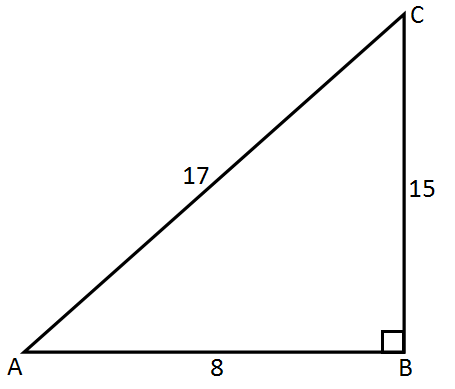
In $\triangle\text{ABC},$ $\text{AC}^2=\text{AB}^2+\text{BC}^2$ $\Rightarrow\text{AC}^2=(8)^2+(15)^2$ $\Rightarrow\text{AC}^2=64+225$ $\Rightarrow\text{AC}^2=289$ $\Rightarrow \text{AC}=17$ $\sin\text{A}=\frac{\text{perpendicular}}{\text{hypotenuse}}=\frac{\text{BC}}{\text{AC}}=\frac{15}{17}$ $\sec\text{A}=\frac{\text{Hypotenuse}}{\text{Base}}=\frac{17}{8}$ View full question & answer→Question 603 Marks
If $3\cot\theta=4,$ find the value of $\frac{4\cos\theta-\sin\theta}{2\cos+\sin\theta}.$
AnswerWe have, $3\cot\theta=4$ $\cot\theta=\frac{4}{3}$ In $\triangle\text{ABC},$ $\text{AC}^2=\text{AB}^2+\text{BC}^2$ $\Rightarrow\text{AC}^2=(3)^2+(4)^2$ $\Rightarrow\text{AC}^2=9+16$ $\Rightarrow\text{AC}^2=25$ $\Rightarrow\text{AC}=5$ $\therefore\cos\theta=\frac{\text{BC}}{\text{AC}}=\frac{4}{5}$ and $\sin\theta=\frac{\text{AB}}{\text{AC}}=\frac{3}{5}$ Now, $\frac{4\cos\theta-\sin\theta}{2\cos\theta+\sin\theta}=\frac{4\times\frac{4}{5}-\frac{3}{5}}{2\times\frac{4}{5}+\frac{3}{5}}$ $=\frac{\frac{16-3}{5}}{\frac{8+3}{5}}$ $=\frac{13}{5}\times\frac{5}{11}$ $=\frac{13}{11}$
View full question & answer→Question 613 Marks
Evaluate the following:
$\big(\text{cosesc}^245^\circ\sec^230^\circ\big)\big(\sin^230^\circ+4\cot^245^\circ-\sec^260^\circ\big)$
Answer$\big(\text{cosesc}^245^\circ\sec^230^\circ\big)\big(\sin^230^\circ+4\cot^245^\circ-\sec^260^\circ\big)\dots(\text{i})$
By trigonometric ration we have
$\text{cosec}45^\circ=\sqrt{2},\ \sec30^\circ=\frac{2}{\sqrt{3}},$ $\sin30^\circ=\frac{1}{2}\ \cot45^\circ=1\ \sec60^\circ=2$
By substituting above values in (i), we get
$\bigg[\Big(\sqrt{2}\Big)^2\cdot\Big(\frac{2}{\sqrt{3}}\Big)^2\bigg]\bigg[\Big(\frac{1}{2}\Big)^2+4(1)^2-(2)^2\bigg]$
$\Rightarrow\Big[2\cdot\frac{4}{3}\Big]\Big[\frac{1}{4}+4-4\Big]\Rightarrow2\cdot\frac{4}{3}\cdot\frac{1}{4}=\frac{2}{3}$
View full question & answer→Question 623 Marks
If $\sec\theta=\frac{13}{5},$ show that $\frac{\sin\theta-3\cos\theta}{4\sin\theta-9\cos\theta}=3.$
AnswerWe have, $\sec\theta=\frac{13}{5}$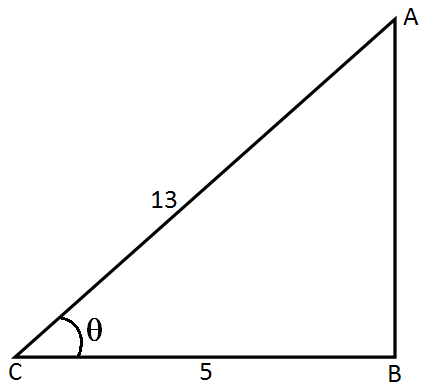
In $\triangle\text{ABC},$ $\text{AC}^2=\text{AB}^2+\text{BC}^2$ $\Rightarrow(13)^2=\text{AB}^2+(5^2)$ $\Rightarrow\text{AB}^2=169-25$ $\Rightarrow\text{AB}^2=144$ $\Rightarrow\text{AB}=12$ $\therefore\sin\theta=\frac{\text{AB}}{\text{AC}}=\frac{12}{13}$ and $\cos\theta=\frac{\text{BC}}{\text{AC}}=\frac{5}{13}$ Now, $\frac{2\sin\theta-3\cos\theta}{4\sin\theta-9\cos\theta}=\frac{2\times\frac{12}{13}-3\times\frac{5}{13}}{4\times\frac{12}{13}-9\times\frac{5}{13}}$ $=\frac{\frac{24-15}{13}}{\frac{48-45}{13}}$ $=\frac{9}{3}$ $=3$ View full question & answer→Question 633 Marks
Given $\tan\theta=\frac{1}{\sqrt{5}},$ what is the value of $\frac{\text{cosec}^2\theta-\sec^2\theta}{\text{cosec}^2\theta+\sec^2\theta}?$
Answer$\tan\theta=\frac{1}{\sqrt{5}}=\frac{\text{Perpendicular}}{\text{Base}}$ Draw a right $\triangle\text{ABC}$ in which $\angle\text{B}=90^\circ,\text{BC}=1,\text{AB}=\sqrt{5} \text{ units}$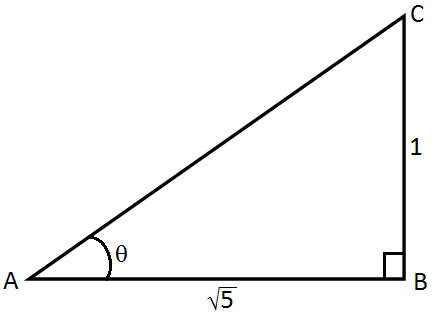
By Pythagoras Theorem $\text{AC}^2=\text{AB}^2+\text{BC}^2$ $=\big(\sqrt{5}\big)^2+(1)^2=5+1=6$ $\therefore\ \text{AC}=\sqrt{6}\text{ units }$ $\therefore\ \sec\theta=\frac{\text{Hypotenuse}}{\text{Base}}=\frac{\text{AC}}{\text{AB}}=\frac{\sqrt{6}}{\sqrt{5}}=\frac{\sqrt{6}}{\sqrt{5}}$ $\text{cosec }\theta=\frac{\text{Hypotenuse}}{\text{Perpendicular}}=\frac{\text{AC}}{\text{AB}}=\frac{\sqrt{6}}{1}=\sqrt{6}$ Now $\frac{\text{cosec }^2\theta-\sec^2\theta}{\text{cosec }^2\theta+\sec^2\theta}=\frac{\big(\sqrt{6}\big)^2-\Big(\sqrt{\frac{6}{5}}\Big)^2}{\big(\sqrt{6}\big)^2+\Big(\sqrt{\frac{6}{5}}\Big)^2}$ $=\frac{6-\frac{6}{5}}{6+\frac{6}{5}}=\frac{\frac{30-6}{5}}{\frac{30+6}{5}}=\frac{\frac{24}{5}}{\frac{36}{5}}$ $=\frac{24}{5}\times\frac{5}{36}=\frac{24}{36}=\frac{2}{3}$ View full question & answer→Question 643 Marks
If $\tan\theta=\frac{4}{5},$ find the value of $\frac{\cos\theta-\sin\theta}{\cos\theta+\sin\theta}.$
AnswerWe have, $\tan\theta=\frac{4}{5}$ In $\triangle\text{ABC},$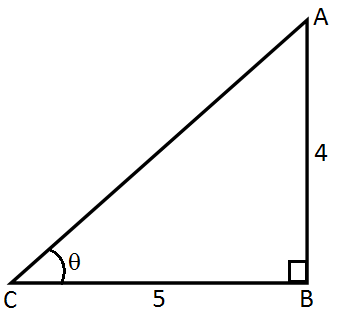
$\text{AC}^2=\text{AB}^2+\text{BC}^2$ $\Rightarrow\text{AC}^2=(4)^2+(5)^2$ $\Rightarrow\text{AC}^2=16+25$ $\Rightarrow\text{AC}^2=41$ $\Rightarrow\text{AC}=\sqrt{41}$ $\cos\theta=\frac{\text{BC}}{\text{AC}}=\frac{5}{\sqrt{14}}$ and $\sin\theta=\frac{\text{AB}}{\text{AC}}=\frac{4}{\sqrt{41}}$ Now, $\frac{\cos\theta-\sin\theta}{\cos\theta+\sin\theta}=\frac{\frac{5}{\sqrt{41}}-\frac{4}{\sqrt{41}}}{\frac{5}{\sqrt{41}}+\frac{4}{\sqrt{41}}}$ $=\frac{\frac{5-4}{\sqrt{41}}}{\frac{5+4}{\sqrt{41}}}$ $=\frac{1}{9}$ View full question & answer→Question 653 Marks
If $\theta=30^\circ,$ verify that.
$\cos2\theta=\frac{1-\tan^2\theta}{1+\tan^2\theta}$
Answer$\cos2\theta=\frac{1-\tan^2\theta}{1+\tan^2\theta}$
Substitutc $\theta=30^\circ$
$\text{L.H.S}=\cos2\theta,\ \text{R.H.S}=\frac{1-\tan^2\theta}{1+\tan^2\theta}$
$=\cos2(30^\circ)=\frac{1-\tan^230^\circ}{1+\tan^230^\circ}$
$=\cos60^\circ=\frac{1}{2}=\frac{1-\Big(\frac{1}{\sqrt{3}}\Big)^2}{1+\Big(\frac{1}{\sqrt{3}}\Big)^2}=\frac{1-\frac{1}{3}}{1+\frac{1}{3}}=\frac{\frac{2}{3}}{\frac{4}{3}}=\frac{1}{2}$
View full question & answer→Question 663 Marks
In $\triangle\text{PQR},$ right-angled at Q, PQ = 3cm and PR = 6cm. Determine $\angle\text{P}$ and $\angle\text{R}.$
Answer
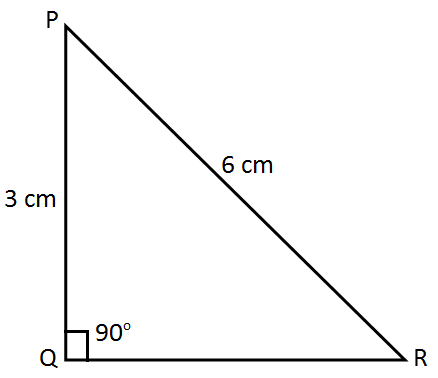 From above figure
$\sin\text{R}=\frac{\text{PQ}}{\text{PR}}$
$\sin\text{R}=\frac{3}{6}=\frac{1}{2}$
$\therefore\ \sin\text{R}=\sin30^\circ$
$\text{R}=\sin30^\circ$
We Know in $\triangle\text{le }\angle\text{P}+\angle\text{Q}+\angle\text{R}=180^\circ$
$\angle\text{P}+90^\circ+30^\circ=180^\circ$
$\angle\text{P}=60^\circ$ View full question & answer→Question 673 Marks
If $\tan\theta=\frac{12}{13},$ find the value of $\frac{2\sin\theta\cos\theta}{\cos^2\theta-\sin^2\theta}.$
Answer$\tan\theta=\frac{\text{opposite side}}{\text{adjacent side}}$
Let x be, the hypotenuse
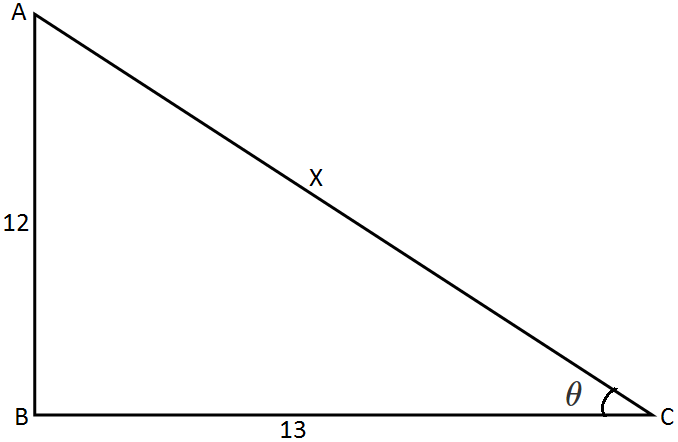
By pythagoras we get
$\text{AC}^2=\text{AB}^2+\text{BC}^2$
$\text{x}^2=144+169$
$\text{x}=\sqrt{313}$
$\sin\theta=\frac{\text{AB}}{\text{AC}}=\frac{12}{\sqrt{313}}$
$\cos\theta=\frac{\text{BC}}{\text{AC}}=\frac{13}{\sqrt{313}}$
Substitute, $\sin\theta,\cos\theta$ in equation we get
$\frac{2\sin\theta,\cos\theta}{\cos^2\theta-\sin\theta}=\frac{2\times\frac{12}{\sqrt{313}}\times\frac{13}{\sqrt{313}}}{\frac{169}{313}-\frac{144}{313}}$
$=\frac{\frac{312}{313}}{\frac{25}{313}}=\frac{312}{25}$ View full question & answer→Question 683 Marks
If $\triangle\text{ABC}$ is a right triangle such that $\angle\text{C} = 90^\circ,\angle\text{A}=45^\circ$ and BC = 7 units. Find $\angle\text{B}$ AB and AC.
AnswerWe have $\angle\text{C}=90^\circ,\angle\text{A}=45^\circ$ and $\text{BC}=7\text{ units}$ In $\triangle\text{ABC},$ $\angle\text{A}+\angle\text{B}+\angle\text{C}=180^\circ$ $\Rightarrow45^\circ+\angle\text{B}+90^\circ=180^\circ$ $\Rightarrow\angle\text{B}=180^\circ-135^\circ$ $\Rightarrow\angle\text{B}=45^\circ$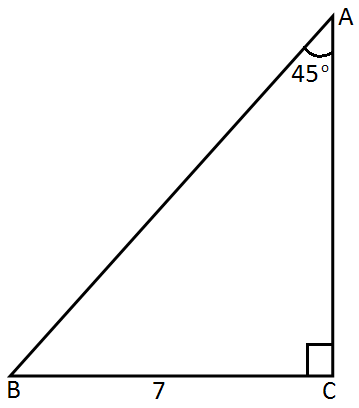
Now, $\tan\text{B}=\frac{\text{AC}}{\text{BC}}$ $\Rightarrow\tan45^\circ=\frac{\text{AC}}{7}$ $\Rightarrow\text{AC}=\frac{\text{BC}}{\tan45^\circ}$ $\Rightarrow\text{AC}=\frac{7}{1}$ $\Rightarrow\text{AC}=7\text{ units}$ And, $\cos\text{B}=\frac{\text{BC}}{\text{AB}}$ $\Rightarrow\text{AB}=\frac{\text{BC}}{\cos45^\circ}$ $\Rightarrow\text{AB}=\frac{7}{\frac{1}{\sqrt{2}}}$ $\Rightarrow\text{AB}=7\sqrt{2}\text{ units}$ View full question & answer→Question 693 Marks
If $\tan\theta=\frac{\text{a}}{\text{b}} ,$ find the value of $\frac{\cos\theta+\sin\theta}{\cos\theta-\sin\theta}.$
Answer$\tan\theta=\frac{\text{a}}{\text{b}}$ find $\frac{\cos\theta+\sin\theta}{\cos\theta-\sin\theta}$
Divide equation (i) with $\cos\theta,$ we get
$\Rightarrow\frac{\frac{\cos\theta+\sin\theta}{\cos\theta}}{\frac{\cos\theta-\sin\theta}{\cos\theta}}$
$\Rightarrow\frac{1+\frac{\sin\theta}{\cos\theta}}{ 1-\frac{\sin\theta}{\cos\theta}}$
$\Rightarrow\frac{1+\tan\theta}{1-\tan\theta}$
$=\frac{1+\frac{\text{a}}{\text{b}}}{1-\frac{\text{a}}{\text{b}}} $
$=\frac{\text{b}+\text{a}}{\text{b}-\text{a}}$
View full question & answer→Question 703 Marks
Evaluate the following:
$\sin 45^{\circ} \sin30^{\circ} +\cos 45^{\circ} \cos30^{\circ}$
Answer$\sin 45^{\circ} \sin30^{\circ} +\cos 45^{\circ} \cos30^{\circ}\ \dots(1)$ We know that by trigonometric ratios we have, $\sin45^\circ =\frac{1}{\sqrt2}\ \sin30^\circ=\frac{1}{\sqrt2}$ $\cos45^\circ=\frac{1}{\sqrt2}\ \cos30^\circ=\frac{\sqrt3}{2}$ Substituting the values in (i) we get $\frac{1}{\sqrt2}.\frac{1}{2}+\frac{1}{\sqrt2}.\frac{\sqrt3}{2}$$=\frac{1}{\sqrt2}.\frac{\sqrt3}{2\sqrt2}=\frac{\sqrt3+1}{2\sqrt2}$
View full question & answer→Question 713 Marks
In a $\triangle\text{ABC},$ right angled at A, if $\tan\text{C}=\sqrt{3},$ find the value of sin B cos C + cos B sin C.
AnswerIn a $\triangle^\text{le }\text{ABC}$ right angaled at A $\tan\text{C}=\sqrt{3}$ Find $\sin\text{B}\cos\text{C}+\cos\text{B}\sin\text{C}.$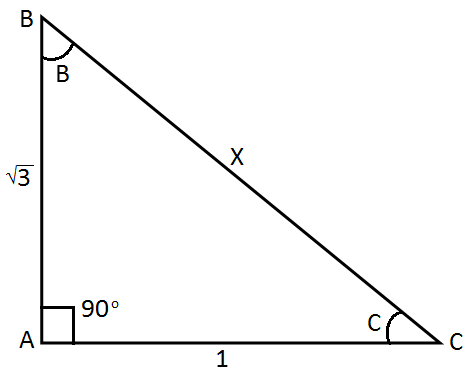
$\tan\text{c}=\sqrt{3}$ $\tan\text{C}=\frac{\text{opposite side}}{\text{adjacent side}}$ Let x be the hypotenuse By appying Pythagoras we get $\text{BC}^2=\text{BA}^2+\text{AC}^2$ $\text{x}^2=(\sqrt{3})^2+1^2$ $\text{x}^2=\triangle\Rightarrow\text{x}=2$ at $\angle\text{B},\sin\text{B}=\frac{\text{AC}}{\text{BC}}=\frac{1}{2}$ $\cos\text{B}=\frac{\sqrt{3}}{2}$ at $\angle\text{C},\sin=\frac{\sqrt{3}}{2}$ $\cos\text{c}=\frac{1}{2}$ On substitution we get $\Rightarrow\frac{1}{2}\times\frac{1}{2}+\frac{\sqrt{3}}{2}\times\frac{\sqrt{3}}{2}$ $\Rightarrow\frac{1}{4}+\frac{\sqrt{3}}{4}\times(\sqrt{3})$ $=\frac{\sqrt{3}\times\sqrt{3}+1}{4}=\frac{3+1}{4}=\frac{4}{4}=1$ View full question & answer→