Questions

Answer the following questions: [5 M]

Take a timed test

36 questions · self-marked practice — reveal the answer and mark yourself.

Question 15 Marks
When we touch a hot plate unknowingly, then this heat is sensed by a receptor P present in our fingers. The receptor triggers and impulse in neuron Q which transmits the message to an organ R which is a part of the central nervous system. Here the impulse is passed on to a neuron S which in turn passes it to a yet another neuron T. The neuron T passes the impulse to a tissue U in our arm. The tissue U then contracts and pulls our hand away from the hot plate.
  1. What is the name of (i) receptor P (ii) neuron Q, and (iii) organ R?
  2. What is (i) neuron S, and (ii) neuron T?
  3. Name the tissue U.
  4. What name is given to the phenomenon in which hand is pulled away quickly from the hot plate?
  5. Name the effector in this whole process.
Answer
  1.  
  1. ​​​​​​​P is a thermoreceptor.
  2. Q is a sensory neuron.
  3. R is the spinal cord.
  1.  
  1. S is a relay neuron. The impulse from the spinal cord is passed on to a relay neuron.
  2. T is a motor neuron. From the relay neuron, the impulse is passed on to a motor neuron.
  1. U is a muscle.
  2. Reflex action is the phenomenon in which the hand is pulled away quickly from a hot plate. It is performed automatically by an individual.
  3. The effector organ is the muscle of the arm.
View full question & answer
Question 25 Marks
A and B are two pairs of glands that are present in the human endocrine system. The pair A is found only in females, whereas B is present only in males. Glands A make and secrete two hormones C and D, whereas glands B make and secrete only one hormone E. In addition to hormones, Glands A make gametes F, whereas glands B make gametes G.
  1. What are the glands A?
  2. What are the hormones C and D?
  3. What are the glands B? Name the hormone E.
  4. What are the gametes F and G?
  5. Which event in the life of males and females is associated with the secretion of the hormones C, D and E?
Answer
  1. The glands A are the ovaries.
  2. The hormones C and D, secreted by the ovaries, are oestrogen and progesterone, respectively.
  3. The glands B are the testes. The hormone E, released by the testes, is testosterone.
  4.  
  1. The gametes F are ova or eggs. They are produced by the ovaries.
  2. The gametes G are sperms. Sperms are produced by the testes.
  1. The secretion of hormones C (oestrogen) and D (progesterone) in females and hormone E (testosterone) in males are associated with puberty.
View full question & answer
Question 35 Marks
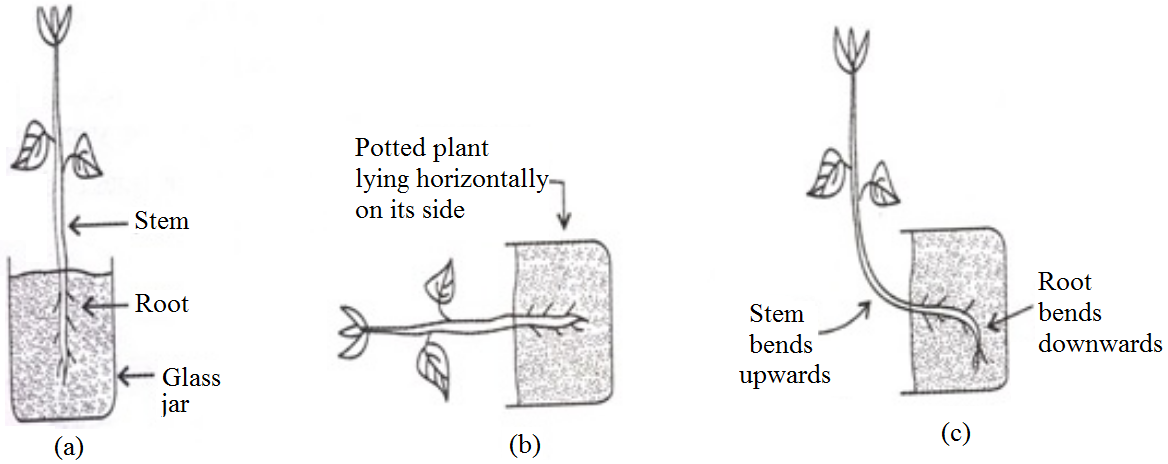
What is meant by ‘positive geotropism’ and ‘negative geotropism’? Give one example of each type. Draw a labelled diagram to illustrate your answer indicating the plant part which shows positive geotropism and the plant part which shows negative geotropism.
Answer
If the plant part moves towards the direction of gravity, it is called positive geotropism. Example – Roots. If the plant part moves against the direction of the gravity it is negative geotropism. Example – Stem
Experiment to show the response of a plant to gravity (geotropism).
View full question & answer
Question 45 Marks
Name the hormones secreted by the following endocrine glands:
  1. Thyroid gland.
  2. Parathyroid glands.
  3. Pancreas.
  4. Adrenal glands.
Answer
  1. Thyroxine.
  2. Parathromone.
  3. Insulin.
  4. Adrenaline.
View full question & answer
Question 55 Marks
A cylindrical structure P in our body begins in continuation with medulla and extends downwards. It is enclosed in a bony cage Q and surrounded by membranes R. As many as x pairs of nerves arise from the structure P. The structure P is involved in the reflex actions of our body and conduction of nerve impulses to and from another organ S of our body with which it forms CNS.
  1. Name the structure P.
  2. Name (i) bony cage Q, and (ii) membranes R.
  3. How much is x?
  4. Name the organs S.
  5. What are the reflexes involving structure P only known as?
Answer
  1. The structure P is the spinal cord. It is a cylindrical structure that begins in continuation with the medulla and extends downwards.
  2.  
  1. The bony cage Q is the vertebral column. The spinal cord is enclosed by the vertebral column.
  2. R represents the meninges. The spinal cord is surrounded by membranes called the meninges.
  1. X represents the number of pairs of spinal nerves. They are 31 in number.
  2. S is the brain. The central nervous system consists of the brain and the spinal cord.
  3. The reflex actions involving the spinal cord (P) are known as spinal reflexes.
View full question & answer
Question 65 Marks
While conducting experiments to study the effect of various stimuli on the plants, it was observed that the roots of a plant X grow and bend towards two stimuli A and B but bend away from a third stimulus C. The stem of the plant X, however, bends away from stimuli A and B but bends towards the stimulus C. The stimulus B is known to act on the roots due to too much weight of the earth. Keeping these points in mind, answer the following question:
  1. What could stimulus A be?
  2. Name the stimulus B.
  3. What could stimulus C be?
  4. The branches of a fallen tree in a forest grow straight up in response to two stimuli. What could be these two stimuli out of A, B and C? Also name these two stimuli.
Answer
  1. The stimulus A is water.
  2. The stimulus B is gravity.
  3. The stimulus C is light.
  4. The two stimuli responsible for the straight growth of the branches of a fallen tree are B and C, i.e., gravity and light, respectively.
View full question & answer
Question 75 Marks
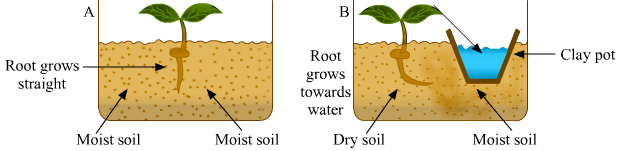
Define hydrotropism. Give one example of hydrotropism. State whether this example is of positive hydrotropism or negative hydrotropism. Illustrate your answer with the help of labelled diagram.
Answer
The movement of a plant part in response to water is called hydrotropism. Example: The roots of a plant always go towards water, this is positive hydrotropism.
Experiment to show the response of a plant to water (hydrotropism).
View full question & answer
Question 85 Marks
What is a plant hormone? Name four plant hormones. State one function of each.
Answer
The hormones that control and coordinate the activities in plants are called plant hormones. The four types of plant hormones are:
  1. Auxins – It promotes cell enlargement and cell differentiation in plants.
  2. Gibberellines – It helps in breaking the dormancy in seeds and buds.
  3. Cytokinins – It promotes cell division in plants.
  4. Abscisic acid – It promotes the dormancy in seeds and buds.
View full question & answer
Question 95 Marks
Write down the following activities in the correct order for a simple reflex arc:
  1. Impulse travels in the motor fibre.
  2. Impulse travels in the sensory fibre.
  3. Effector organ stimulated.
  4. Impulse crosses the synapse.
Answer
The pathway taken by nerve impulses in a reflex action is called a reflex arc. It is an automatic response to a stimulus. When a stimulus is given to a receptor, the receptors produce an impulse in the sensory fibre. The sensory fibre carries this message in the form of an electrical stimulus across the synapse. From the synapse, the impulse travels in the motor fibre and stimulates the effector organ to produce the desired response. The correct order for a simple reflex arc is:
(b) → (d) → (a) → (c).
View full question & answer
Question 105 Marks
There are two similar glands P which are located on top of two similar organs Q in the human body. P are often called the emergency glands and they secrete a hormone R into the blood stream. R is secreted in large amounts when a person is frightened. It brings about temporary changes in the body which allow a lot of substance S from the liver to go into the blood to provide a lot of energy in a very short time. This helps a person to fight back or run away from the frightening situation.
What are P, Q, R and S?
Answer
P is adrenal glands.
Q is kidneys.
R is adrenaline hormone.
S is glucose.
Humans have two adrenal glands, which are located on top of the kidneys. They are often called emergency glands. They secrete adrenaline into the bloodstream. It is secreted in large amounts when a person is frightened. Adrenal gland brings about temporary changes in the body which allow glucose from the liver to go into the bloodstream. This provides a lot of energy in a very short time.
View full question & answer
Question 115 Marks
The organ A which is located inside the skull of our body is protected by a bony shell B. It is surrounded by three layers membranes C. The spaces between these layers are filled with a liquid D which protects organ A from mechanical shocks. Organ A in combination with another organ E makes up the central nervous system.
  1. What is organ A?
  2. What are B, C and D?
  3. Name the organ E.
  4. While walking barefoot, if we happen to step on a sharp piece of stone, we immediately lift our foot up. Which of the two organs: A or E, is directly involved in this action?
  5. If we step out from a darkened room into bright sunlight, we close our eyes for a moment. Which of the two organs: A or E, is directly involved in this action?
Answer
  1. The organ A is the brain. The brain is located inside the skull of our body at the top of the spinal cord.
  1.  
  1. B is the cranium. The brain is protected by a bony box in the skull called the cranium.
  2. C are meninges. The brain is surrounded by three layers of membranes called the meninges.
  3. D is the cerebrospinal fluid. It is present in between the meninges and protects the brain from mechanical shocks.
  1. The organ E is the spinal cord. The brain (organ A) and the spinal cord (organ E) together make central nervous system.
  2. A person walking barefoot lifts his foot at once on stepping on to a sharp piece of stone. The spinal cord (E) is involved in this action. Those reflexes that involve only the spinal cord are called spinal reflexes.
  3. A person closes his eyes at once when he steps out from a darkened room to bright light. The brain (A) is involved in this action. Those reflexes that involve only the brain are known as cerebral reflexes.
View full question & answer
Question 125 Marks
A gland W is located just below the stomach in the human body. The gland W secretes a hormone X. The deficiency of hormone X in the body causes a disease Y in which the blood sugar level of a person rises too much. The person having high blood sugar is called Z.
  1. Name (i) gland W, and (ii) hormone X.
  2. What is the function of hormone X?
  3. Name (i) disease Y, and (ii) person Z.
  4. What advice would you like to give to a person who is suffering from disease Y due to faulty life - style?
Answer
  1.  
  1. W represents the pancreas. It is located just below the stomach in the human body.
  2. X represents insulin, which is secreted by the pancreas.
  1. The function of insulin (X) is to maintain the sugar level in blood.
  2.  
  1. Y represents diabetes, which is a disease caused by increased blood sugar level.
  2. The person Z is known to be diabetic.
  1. A person suffering from diabetes (Y) should control his/her diet, reduce his/ her weight and do regular physical exercises. He/ she should regularly take proper medication to control the sugar level in blood.
View full question & answer
Question 135 Marks
P and Q are two types of plants having weak stems which cannot stand upright on their own. The plants P and Q have organs R and S respectively which can grow towards any support which they happen to touch and wind around that support. It is observed that organ R originates from the leaves of the plant whereas organ S originates directly from the stem of the plant.
  1. What is (i) R, and (ii) S?
  2. What is the name of growth movement exhibited by the organs R and S?
  3. Name the stimulus involved in this case.
  4. State whether the behaviour of organs R and S is a tropic movement or a nastic movement.
  5. Name one plant like P and another plant like Q.
Answer
  1. (i) R is a leaf tendril and (ii) S is a stem tendril.
  2. The growth movement exhibited by R and S is thigmotropism.
  3. The stimulus involved is touch or contact with other objects.
  4. The behaviour of R and S is a tropic movement.
  5. Pea plant is an example of plant type P, whereas bitter gourd plant is an example of the type Q.
View full question & answer
Question 145 Marks
The gland A is attached to the wind pipe in the human body. The gland A makes and secretes a hormone B which controls the metabolism of carbohydrates, fats and proteins in the body. The non-metal element C is necessary for the formation of hormone B. The deficiency of C in the diet can cause a deficiency of hormone B in the body leading to a disease D in which the neck of a person appears to be swollen. People are advised to use salt E in cooking food so as to avoid disease D.
  1. Name (i) gland A, and (ii) hormone B.
  2. What is the element C?
  3. Name one type of food which can provide sufficient C in the diet of a person.
  4. Name (i) disease D, and (ii) salt E.
Answer
  1. (i)A represents the thyroid gland. It is attached to the wind pipe in the human body.
  2. (ii) B represents thyroxine. It regulates the metabolism of carbohydrates, fats and proteins in the body.
  3. The non-metal element C is iodine. It is essential for the synthesis of thyroxine hormone by the thyroid gland.
  4. Sea foods like fish provide sufficient amount of iodine in the diet of a person.
  5.  
  1. D represents the disease called goiter. It is characterised by abnormal enlargement of the thyroid gland in the neck.
  2. E represents iodised salt. It is advised to use iodine in cooking food in order to prevent goiter.
View full question & answer
Question 155 Marks
The gland X which is located just below the brain in the human head secretes a chemical substance Y which controls the development of ones and muscles in the body of a person. Secretion of too little of substance Y as well as the secretion of too much of substance Y by the gland X leads to abnormal development of the body of a person.
  1. Name the gland X.
  2. What is the chemical substance Y?
  3. What happens if too little of substance Y is secreted?
  4. What happens if too much of substance Y is secreted?
  5. Name the system of glands in the human body of which gland X is a part.
Answer
  1. X is the pituitary gland. It is located just below the brain.
  2. The chemical substance (Y) released from the pituitary gland is human growth hormone.
  3. Under-secretion of growth hormone leads to a condition known as dwarfism. In dwarfism, the person remains very short.
  4. Over-secretion of growth hormone causes a condition known as gigantism. In gigantism, the person grows very tall.
  5. The pituitary gland (X) is a part of the endocrine system.
View full question & answer
Question 165 Marks
P is a cell (or group of cells) in the human body which is sensitive to a particular type of stimulus and conveys the messages to CNS through nerves Q. On the other hand, R is a part of the human body which can respond to a stimulus according to the instructions sent from the CNS through nerves S.
  1. What is P? Name five organs which contain cells (or group of cells) like P.
  2. Name the nerves Q.
  3. What is R? Give two examples of R.
  4. Name nerves S.
  5. How do messages travel through the nerves Q and S?
Answer
  1. P is a receptor. The five organs which contain receptors are: Eyes, ears, nose, tongue and skin.
  2. Q represents sensory nerves. Sensory nerves bring impulses from sensory organs to the CNS.
  3. R is an effector organ. Effectors are part of the human body which can respond to a stimulus according to the instructions sent from the CNS though the motor nerves. Two examples of effector organs are the muscles and glands.
  4. S represents motor nerves. Motor nerves carry impulse from the CNS to the effector organs like the muscles or glands.
  5. Messages travel in the form of electrical impulses or nerve impulses through sensory nerves (Q) and motor nerves (S).
View full question & answer
Question 175 Marks
The human body contains a large number of cells A which are very long and branched, and look like electric wires. The longest branch of this cell is B whereas there are many small branches C. Any two A cells do not join to one another completely in the human body. There is a microscopic gap D between every pair of adjacent A cells through which electric impulses can pass by the release of a chemical substance.
  1. What are cells A?
  2. What is the name of (i) branch B, and (ii) branches C?
  3. What is the microscopic gap D known as?
  4. What is the function of cells like A in the human body?
  5. The cells A are of three types. name the three types.
Answer
  1. A represents neurons. Neurons are the largest cells in the human body, which look like electric wires.
  2.  
  1. B represents the axon.
  2. C represents the dendrites.
  1. The microscopic gap D is known as a synapse. A synapse is a functional junction between a pair of adjacent neurons over which nerve impulses can pass.
  2. A neuron transmits messages to and from the central nervous system. It is the structural and functional unit of the nervous system.
  3. The three types of neurons are sensory neurons, motor neurons and relay neurons.
View full question & answer
Question 185 Marks
The pancreas is made up of two parts A and B. The part A secretes insulin whereas part B secretes pancreatic juice.
  1. Which part is functioning as an endocrine gland? Why?
  2. What is insulin and what effect does it have in the body?
  3. Name the disease which can be treated by giving insulin injection.
  4. What does pancreatic juice contain? Where does pancreatic juice go?
  5. Name the life process in which pancreatic juice is made use of.
Answer
  1. The part A functions as an endocrine gland. The glands that secrete their secretions directly into the blood are called endocrine glands. Part A of the pancreas secretes insulin (a hormone) directly into the bloodstream.
  2. Insulin is a hormone which is secreted by the pancreas. It controls the blood sugar level.
  3. Deficiency of insulin in the body can lead to diabetes. Diabetes can be treated by giving injections of insulin.
  4. Pancreatic juice contains digestive enzymes like pancreatic amylase, trypsin and lipase. The pancreatic juice goes into the small intestine where complete digestion of food takes place.
  5. Digestion is the process where the enzymes present in the pancreatic juice are used to break down the food.
View full question & answer
Question 195 Marks
Explain the difference between each of the following pairs of terms:
  1. Receptor and effector.
  2. Cerebrum and cerebellum.
Answer
  1. Receptor A receptor is a cell (or a group of cells) in a sense organ which is sensitive to a particular type of stimulus (or a particular type of change in the environment). Example: Photoreceptors and Phonoreceptors. Effector An effector is the part of the body which can respond to the stimulus according to the instructions sent from the nervous system (spinal cord and brain). Example: Muscles and glands.
  2. Cerebrum:
  1. It is a part of forebrain.
  2. It is the main thinking part of the brain. All our thoughts, sensation, actions and movements are controlled by cerebrum.
Cerebellum:
  1. It is a part of hindbrain.
  2. It helps in maintaining posture and balance of the body. It enables us to make precise and accurate movements.
View full question & answer
Question 205 Marks
A and B are the two systems of control and coordination in the human body. The messages in system A are transmitted in the form of chemical substances C which travel comparatively slowly through the blood stream. The substances C are made in tissues D present in the head and trunk of human body. The messages in system b are transmitted very quickly in the form of electrical impulses through fibres E. The effect of messages transmitted by system b usually lasts for a much shorter time as compared to those transmitted by system A.
  1. Name the system A. What does system A consist of?
  2. Name the chemical substance C.
  3. What is tissue D? Name any five such tissues in the human body.
  4. Name the system B. What does system B consist of?
  5. Name the fibres E.
  6. State whether system A controls the working of system B or system B controls the working of system A.
Answer
  1. A represents the endocrine system. The endocrine system is composed of glands.
  2. C represents hormones. Hormones are the chemical messengers of the body and they travel slowly through the bloodstream.
  3. D represents endocrine glands that are made up of tissues. Hypothalamus, thyroid, thymus, pancreas and adrenalglands are some of the endocrine glands present in the human body.
  4. B represents the nervous system. It comprises the brain, spinal cord and nerves.
  5. E represents nerve fibres. They transmit messages very quickly in the form of electrical impulses.
  6. The nervous system (B) controls the working of the endocrine system (A).
View full question & answer
Question 215 Marks
A potted plant is growing in a transparent glass jar. In this plant, X and Y are the two growing parts having a lot of meristematic tissue. It is observed that the part X of this plant exhibits positive geotropism but negative phototropism. On the other hand, part Y of this plant exhibits negative geotropism but positive phototropism.
  1. Name the part X of plant.
  2. Name the part Y of plant.
  3. Which part of the plant, X or Y, will exhibit positive hydrotropism?
  4. Which part of the plant, X or Y, can have tendrils on it?
  5. Which phytohormone causes the part X to exhibit negative phototropism?
Answer
  1. The part X is the root.
  2. The part Y is the shoot.
  3. The part X (root) will exhibit positive hydrotropism.
  4. The part Y (shoot) could have tendrils on it.
  5. The phytohormone, auxin causes the root to exhibit negative phototropism.
View full question & answer
Question 225 Marks
The top part A of the flask-shaped reproductive organ X in the flower of a plant secrets a surgery substance into its lower part B which goes towards the bottom part C of the flask-shaped organ. When a tiny grain D coming from the top part E of another reproductive organ Y i the flower falls on part A, it grows a long tube F through the organ X i response to the sugary substance and reaches the bottom part C of flask-shaped organ to carry out fertilisation.
  1. Name parts (i) organ X, and (ii) organ Y, inside the flower?
  2. Name parts (i) A (ii) B, and (iii) C, of flask-shaped organ.
  3. Name (i) grain D, and (ii) part E of organ Y.
  4. Name the tube F.
  5. What is the phenomenon of growing a long tube in response to sugary substance in the process of fertilisation in a flower known as?
Answer
  1. (i) X is the carpel and (ii) Y is the stamen.
  2. (i) A is the stigma, (ii) B is the style and (iii) C is the ovary of the flask-shaped organ.
  3. (i) D is the pollen and (ii) E is the anther.
  4. F is the pollen tube.
  5. The phenomenon of growing a long tube in response to a sugary substance in the process of fertilisation in a flower is known as chemotropism.
View full question & answer
Question 235 Marks
Write the names of all the major endocrine glands present in the human body. Which of these glands also function as exocrine glands?
Answer
The endocrine gland present in the human body are:
  1. Pineal gland.
  2. Hypothalamus.
  3. Pituitary.
  4. Thyroid.
  5. Parathyroid.
  6. Thymus.
  7. Pancreas.
  8. Adrenal glands.
  9. Testes (in males).
  10. Ovaries (in females). Pancreas, testes and ovaries function as exocrine glands.
View full question & answer
Question 245 Marks
Write the names of five endocrine glands found in the human body. Name the hormones secreted by each gland.
Answer
  1. Pituitary – Growth.
  2. Thyroid – Thyroxine.
  3. Pancreas – Insulin.
  4. Adrenal – Adrenaline.
  5. Testes – Testosterone.
View full question & answer
Question 255 Marks
The chemical substance P is made and secreted by the meristematic tissue at the tip of stem (or shoot) of a plant. The chemical substance P is responsible for a phenomenon Q in plants in which the stem bends towards a source of light. The same chemical substance P has an opposite effect on the root of a plant. It causes the root of a plant to bend away from the source of light in a process called R.
  1. What is the chemical substance P?
  2. State whether P prefers to remains in the sunlit side of a stem or in shade.
  3. What is the effect of substance P on the rate of growth of (i) a root, and (ii) a stem?
  4. What is the name of process (i) Q, and (ii) R?
  5. What is the general name of chemical substances like P? Name another substance which belongs to this class of chemical substances.
Answer
  1. From the given question, the chemical substance P is Auxin which is produced at the shoot tip and can diffuse to other plant parts.
  2. Auxin moves to the darker side of the plant, causing the cells there to grow large.
  3. Auxin has adverse effect on growth rate of roots hence, it decrease the growth rate of roots. Unlike roots, the auxin has positive effect on growth rate of stem hence, it increases the growth rate of stem.
  4. Process Q is positive phototropism while process E is negative phototropism. Growth towards a light source is called positive phototropism, while growth away from light is called negative phototropism.
  5. Chemical substance like P is Auxin, aPhytohormone or plant hormone. Like Auxin, Gibberellin is also an example of phytohormone.
View full question & answer
Question 265 Marks
What are the scientific names for the following receptors in animals?
  1. Receptors for light.
  2. Receptors for heat.
  3. Receptors for sound.
  4. Receptors for smell.
  5. Receptors for taste.
Answer
  1. Photoreceptors.
  2. Thermoreceptors.
  3. Phonoreceptors.
  4. Olfactory receptors.
  5. Gustatory receptors.
View full question & answer
Question 275 Marks
What are the different types of tropisms? Define each type of tropism. Write the name of stimulus in each case.
Answer
Different types of tropisms are:
  1. Phototropism: The movement of a plant part in response to light is called phototropism. Its stimulus is light.
  2. Geotropism: The movement of a plant part in response to gravity is called geotropism. Its stimulus is gravity.
  3. Chemotropism: The movement of a plant part in response to a chemical stimulus is called chemotropism. Its stimulus is chemical.
  4. Hydrotropism: The movement of a plant part in response to a water stimulus is called hydrotropism. Its stimulus is water.
  5. Thigmotropism: The movement of a plant part in response to a touch stimulus is called thigmotropism. Its stimulus is touch.
View full question & answer
Question 285 Marks
State the functions of the following hormones:
  1. Thyroxine.
  2. Adrenaline.
  3. Growth hormone.
Answer
  1. Thyroxine? The function of this hormone is to control the rate of metabolism of carbohydrates, fats and proteins in the body.
  2. Adrenaline? Its function is to regulate heart rate, breathing rate, blood pressure and carbohydrate metabolism.
  3. Growth hormone? It controls the growth of the human body.
View full question & answer
Question 295 Marks
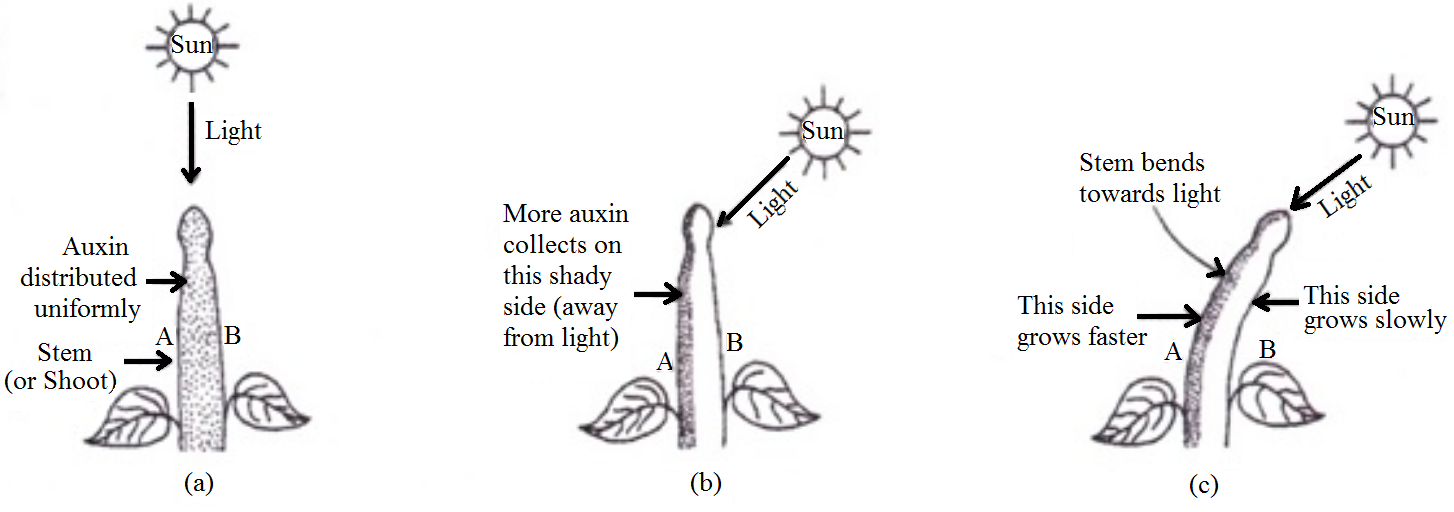
How does phototropism occur in a plant stem (or shoot)? Explain with the help of labelled diagrams.
Answer
Phototropism in a plant stem – The bending of a plant stem towards light is an example of phototropism. The plant stem responds to light and bends towards it due to the action of auxin hormone. The auxin hormone is present at the tip of the stem of the growing plant. Auxin prefers to stay in shade away from light so when sunlight falls on the stem from one side, it gets concentrated on the opposite side. Due to more auxin, the shady side of the stem grows to be longer than the side of stem which is facing light, and makes the stem bend towards light.
Diagrams to explain the bending of a plant stem (or shoot) towards light by the action of 'auxin' hormone.
View full question & answer
Question 305 Marks
Name five stimuli which act on plants. Name the type of tropism produced by each one of these stimuli.
Answer
  1. Light – Phototropism.
  2. Gravity – Geotropism.
  3. Chemical – Chemotropism.
  4. Water – Hydrotropism.
  5. Touch – Thigmotropism.
View full question & answer
Question 315 Marks
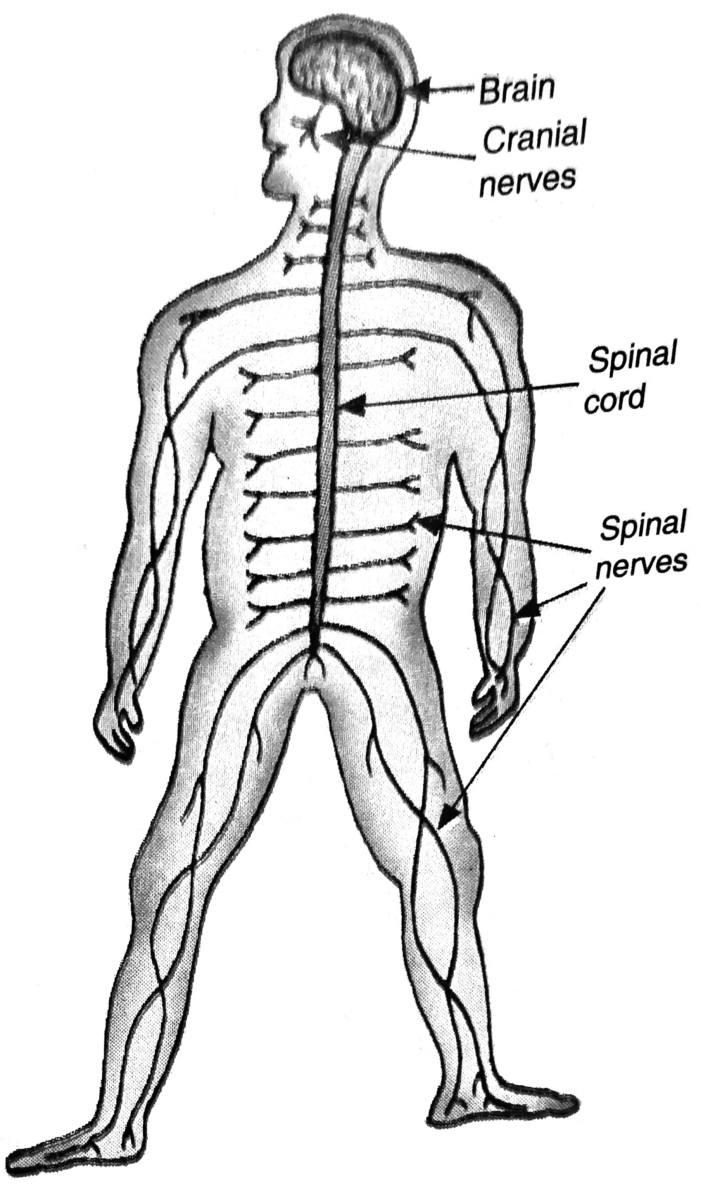
What are the main organs of the human nervous system? Draw a labelled diagram to show the main organs of the human nervous system.
Answer
The main organs of the nervous system are; brain, spinal cord and nerves.

The human nervous system.
View full question & answer
Question 325 Marks
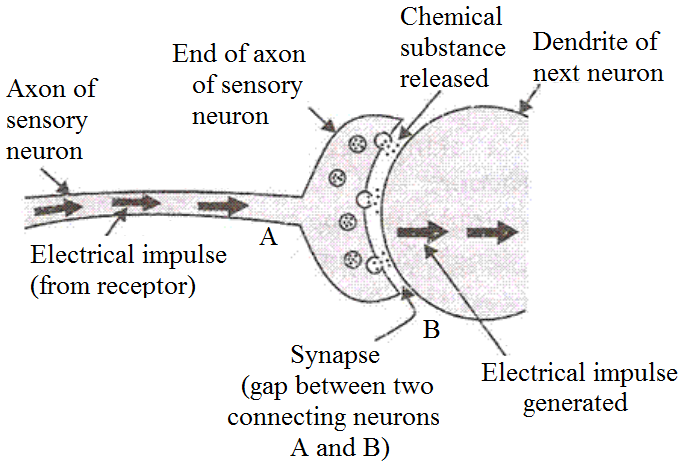
What is a synapse? What happens at the synapse between two neurons? How are the messages carried across a synapse? Explain with the help of a labelled diagram.
Answer
A microscopic gap between a pair of adjacent neurons over which nerve impulses pass when going from one neuron to the next is called a synapse. Synapse between two neurons acts as a one way valve which allows electrical impulses to pass in one direction only. This happens as follows: When an electrical impulse coming from the receptor reaches the end of the axon of sensory neuron, then the electrical impulse releases tiny amount of a chemical substance called neuro transmitter substance into the synapse between two adjacent neurons. This substance crosses the synapse and starts a similar electrical impulse in the dendrite of the next neuron. In this way, the electrical impulses passes from one neuron to the next across the synapse.
View full question & answer
Question 335 Marks
What does the central nervous system in humans consist of? What is the job of the central nervous system?
Answer
The central nervous system consists of the brain and spinal cord. The work of the CNS is to direct incoming messages to the motor neurons that are connected to the part of the body which will respond to a stimulus. It is involved in complicated responses where both (brain and spinal cord) work. It enables a person to give a more appropriate and more intelligent response to various situations.
View full question & answer
Question 345 Marks
There are three plants A, B and C. The flowers of plant A open their petals in bright light during the day but close them when it gets dark at night. On the other hand, the flowers of plant B open their petals at night but close them during the day when there is bright light. The leaves of plant C fold up and droop when touched with fingers or any other solid object.
  1. Name the phenomenon shown by the flowers of (i) plant A, and (ii) plant B.
  2. Name one flower each which behaves like the flower of (i) plant A, and (ii) plant B.
  3. Name the phenomenon exhibited by the leaves of plant C.
  4. Name a plant whose leaves behave like those of plant C.
  5. Which plant/ plants exhibit the phenomenon based on growth movements?
Answer
  1. The phenomenon shown by the flowers of plants A and B is photonasty.
  2. A flower which behaves like the flower of (i) plant A is dandelion and (ii) plant B is moonflower.
  3. The leaves of plant C exhibit thigmonasty.
  4. A plant whose leaves behave like those of plant C is Mimosa pudica.
  5. The plants A and B exhibit the phenomenon based on growth movements.
View full question & answer
Question 355 Marks
Give the various functions of brain.
Answer
  1. The brain receives information carrying nerve impulses from all the sensory organs of the body.
  2. It responds to the impulses brought in by sensory organs by sending its own instructions through motor nerves to the muscles and glands causing them to function accordingly.
  3. It correlates the various stimuli from different sense organs and produces the most appropriate and intelligent response.
  4. It coordinates the body activities so that the mechanisms and chemical reactions of the body work together efficiently.
  5. It stores information so that behavior can be modified according to the past experience.
View full question & answer
Question 365 Marks
What is the stimulus in:
  1. Phototropism?
  2. Geotropism?
  3. Chemotropism?
  4. Hydrotropism?
  5. Thigmotropism?
Answer
  1. Light.
  2. Gravity.
  3. Chemical.
  4. Water.
  5. Touch.
View full question & answer