MCQ 11 Mark
The unit for expressing electric power is:
AnswerWatt is the unit of electric power.
View full question & answer→MCQ 21 Mark
When a $4 \Omega $ resistor is connected across the terminals of a $12V$ battery, the number of coulombs passing through the resistor per second is:
AnswerThe number of coulombs passing through the resistor is the current passing through it.
$\text{Current}=\frac{\text{Voltage}}{\text{Resistance}}$
$\text{I}=\frac{\text{V}}{\text{R}}$
$\text{I}=\frac{12}{4}$
$\text{I}={3\text{A}}$
Thus, when a $4 \Omega $ resistor is connected across the terminals of a $12V$ battery,
the number of coulombs passing through the resistor per second will be $3$.
View full question & answer→MCQ 31 Mark
In the circuit shown below:
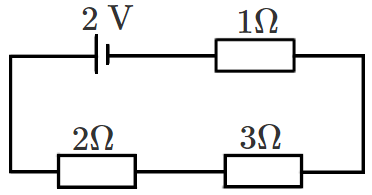
The potential difference across the $3 \Omega $ resistor is: - A
$\frac{1}{9}\text{V}$
- B
$\frac{1}{2}\text{V}$
- ✓
$1V$
- D
$2V$
AnswerThe resistors of $1 \Omega , 2 \Omega $ and $3 \Omega $ are connected in series.
Therefore, the net resistance,
$\text{R} = \text{R}_1 + \text{R}_2 +\text{R}_3$
$\text{R}=1\Omega+2\Omega+3\Omega=6\Omega$
Current in the circuit will be,
$\text{I}=\frac{\text{V}}{\text{R}}$
or $\text{I}=\frac{2}{6}=\frac{1}{3}\text{A}$
Current $=\frac{1}{3}\text{A}$
Therefore, the voltage across the $3I$ resistor,
$V = IR$
or $\text{V}=\frac{1}{3}\times3=1\text{V}$
View full question & answer→MCQ 41 Mark
The current passing through an electric kettle has been doubled. The heat produced will become:
AnswerCorrect option: D. One$-$fourth.
Heat produced is directly proportional to the square of the current.
View full question & answer→MCQ 51 Mark
A battery and three lamps are connected as shown? Which of the following statements about the currents at $X, Y$ and $Z$ is correct?
- A
The current at $Z$ is greater than that at $Y.$
- ✓
The current at $Y$ is greater than that at $Z.$
- C
The current at $X$ equals the current at $Y.$
- D
The current at $X$ equals the current at $Z.$
AnswerCorrect option: B. The current at $Y$ is greater than that at $Z.$
This is so because $Y$ alone will offer less resistance.
View full question & answer→MCQ 61 Mark
Which of the following characteristic is not suitable for a fuse wire?
- A
- ✓
- C
- D
Higher resistance than rest of wiring.
AnswerThis is so because in this case, the resistance of the wire will be low.
View full question & answer→MCQ 71 Mark
The lamps in a house hold circuit are connected in parallel because:
- A
This way they required less current.
- ✓
If one lamp fails the others remain lit.
- C
This way they require less power.
- D
If one lamp fails the other also fail.
AnswerCorrect option: B. If one lamp fails the others remain lit.
This is so because in a parallel circuit, if one device fails, it does not affect the working of the other devices.
View full question & answer→MCQ 81 Mark
Keeping the $p.d.$ constant, the resistance of a circuit is halved. The current will become:
AnswerAs we know from Ohm’s law:
Voltage $=$ Current $\times$ Resistance
$V = IR$
If the voltage is constant, the resistance of the circuit is halved.
That is, it becomes $\frac{\text{R}}{2}$
Current, $\text{I}=\frac{\text{V}}{\text{R}}$
$\text{I}=\frac{\text{V}}{\text{R}}$
$\text{I}=\frac{\frac{\text{V}}{\text{R}}}{2}=2\text{I}$
Thus by keeping the $p.d.$ constant, the resistance of a circuit is halved and the current is doubled.
View full question & answer→MCQ 91 Mark
Which of the following statements correctly defines a volt?
- A
A volt is a joule per ampere.
- ✓
A volt is a joule per coulomb.
- C
$A$ and $B$ both
- D
AnswerCorrect option: B. A volt is a joule per coulomb.
A volt is a joule per coulomb.
View full question & answer→MCQ 101 Mark
When the diameter of a wire is doubled, its resistance becomes:
- A
- B
- C
One$-$half.
- ✓
One$-$fourth.
AnswerCorrect option: D. One$-$fourth.
$\text{R}=\rho\frac{\text{I}}{\text{A}}$
When the diameter is doubled, $d = 2d$
Radius, $r\ ' = 2r$
Area of cross section, $\text{A}'=\pi\text{r}'^2=\pi(2\text{r})=4\pi\text{r}^2=4\text{A}$
The area of cross$-$section will increase by four times.
Then the new resistance, $\text{R}'=\frac{\rho\text{I}}{\text{A}'}$
$\text{R}'=\frac{\rho\text{I}}{4\text{A}}$
$\text{R}'=\frac{\text{R}}{4}$
Thus, the resistance will get reduced by four times.
View full question & answer→MCQ 111 Mark
Which of the following is likely to be the correct wattage for an electric iron used in our homes?
- A
$60W.$
- B
$250W.$
- ✓
$850W.$
- D
$2000W.$
AnswerCorrect option: C. $850W.$
An electric iron may use a power of $850$ watts.
View full question & answer→MCQ 121 Mark
A car headlight bulb working on a $12V$ car battery draws a current of $0.5A.$ The resistance of the light bulb is:
- A
$0.5\Omega $
- B
$6\Omega $
- C
$12\Omega $
- ✓
$24\Omega $
AnswerCorrect option: D. $24\Omega $
Voltage, $V = 12V$
Current, $I = 0.5A$
Resistance, $\text{R}=\frac{\text{Voltage}}{\text{Current}}$
$\text{R}=\frac{12}{0.5}$
$\text{R} = 24\Omega $
Thus, if a car's headlight bulb working on a $12V$ car battery draws a current of $0.5A,$
the resistance of the light bulb will be $ 24\Omega $
View full question & answer→MCQ 131 Mark
The commercial unit of energy is:
- A
- B
Watt$-$hour.
- ✓
Kilowatt$-$hour.
- D
Kilo$-$joule.
AnswerCorrect option: C. Kilowatt$-$hour.
Kilowatt$-$hour is the commercial unit of electrical energy.
View full question & answer→MCQ 141 Mark
One coulomb charge is equivalent to the charge contained in:
- A
$2.6 \times 10^{19}$ electrons.
- B
$6.2 \times 10^{19}$ electrons.
- C
$2.65 \times 10^{18}$ electrons.
- ✓
$6.25 \times 10^{18}$ electrons.
AnswerCorrect option: D. $6.25 \times 10^{18}$ electrons.
The coulomb is the $SI$ unit of electric charge.
It is the charge transported by a constant current of one ampere in one second.
It is equivalent to the charge of approximately $6.25 \times 10^{18}$ protons or electrons.
View full question & answer→MCQ 151 Mark
A wire of resistance $R_1$ is cut into five equal pieces. These five pieces of wire are then connected in parallel. If the resultant resistance of this combination be $R_2$, then the ratio $\frac{\text{R}_1}{\text{R}_2}$ is:
- A
$\frac{1}{25}$
- B
$\frac{1}{5}$
- C
$5$
- ✓
$25$
AnswerIf the resistance wire is cut into five pieces, the resistance of each wire is $\frac{\text{R}}{5}.$
If we connected the pieces in parallel,
we will get the net resistance as $\frac{\text{R}}{25}$
Therefore, the ratio will be $25.$
View full question & answer→MCQ 161 Mark
The resistivity of copper metal depends on only one of the following factors. This factor is:
- A
- B
- ✓
- D
Area of cross$-$section.
AnswerThe resistivity of copper depends only on temperature.
View full question & answer→MCQ 171 Mark
If two resistors of $25 \Omega $ and $15 \Omega $ are joined together in series and then placed in parallel with a $15 \Omega $ resistor, the effective resistance of the combination is:
- A
$0.1\Omega$
- B
$10\Omega$
- ✓
$20\Omega$
- D
$40\Omega$
AnswerCorrect option: C. $20\Omega$
When $25 \Omega $ and $15 \Omega $ are connected in series, then:
Total resistance, $R = 25 + 15 = 40I$
This $40I$ is connected in parallel with the $40I$ resistor.
Therefore, the net resistance $=\frac{40}{2}=20\text{I}$
View full question & answer→MCQ 181 Mark
The $SI$ unit of energy is:
AnswerJoule is the $SI$ unit of energy.
View full question & answer→MCQ 191 Mark
At a given time, a house is supplied with $100A$ at $220V.$ How many $75W, 220V$ light bulb could be switched on in the house at the same time $($if they are all connected in parallel$)?$
Answer$El$ Total power provided in the house, $P = VI = 100A \times 220V = 22000W$
This is the maximum power that can be drawn in the house.
Total power drawn by $x$ bulbs $= 75 \times W$
Maximum power $x$ bulbs can draw $= 22000W.$
$\Rightarrow75\text{x}=22000$
$\Rightarrow \text{x}=\frac{22000}{75}\approx293$
View full question & answer→MCQ 201 Mark
Ohm's law gives a relationship between:
- A
- B
Resistance and potential difference.
- C
Potential difference and electric charge.
- ✓
Current and potential difference.
AnswerCorrect option: D. Current and potential difference.
Ohm's law gives the relationship between current and potential difference.
View full question & answer→MCQ 211 Mark
Keeping the potential difference constant, the resistance of a circuit is doubled. The current will become:
AnswerAs we know from Ohm’s law:
Voltage $=$ Current $\times$ Resistance
$V = IR$
If the voltage is constant, the resistance is doubled and the current becomes half.
View full question & answer→Question 221 Mark
$V _1, V_2$ and $V _3$ are the p.ds. across the $1 \Omega, 2 \Omega$ and $3 \Omega$ resistors in the following diagram, and the current is 5 A .
| |
$V_1$ |
$V_2$ |
$V_3$ |
| (a) |
1.0 |
2.0 |
3.0 |
| (b) |
5.0 |
10.0 |
15 |
| (c) |
5.0 |
2.5 |
1.6 |
| (d) |
4.0 |
3.0 |
2.0 |
Answer$V_1=5, V_2=10$ and $V_3=15$
Because V = IR, the net voltage can be obtained by multiplying current with resistance.
View full question & answer→MCQ 231 Mark
The $p.d.$ across a $ 3\Omega $ resistor is $6V.$ The current flowing in the resistor will be:
- A
$\frac{1}{2}\text{A}$
- B
$1A.$
- ✓
$2A.$
- D
$6A.$
AnswerIf the $p.d.$ across a $3\Omega$ resistor is $6V,$ the current flowing in the resistor will be $2A$ as current $(I)$ is given by the equation, $\text{I}=\frac{\text{V} (\text{Voltage})}{\text{R}(\text{Resistance})}.$
or $\text{I}=\frac{\text{V}}{\text{R}}$
$\text{I}=6\ \frac{\text{V}}{3}\ \Omega $
$\text{I} = 2\text{A.}$
View full question & answer→MCQ 241 Mark
An electrical appliance has a resistance of $25 \Omega .$ When this electrical appliance is connected to a $230V$ supply line, the current passing through it will be:
- A
$0.92A.$
- B
$2.9A.$
- ✓
$9.2A.$
- D
$92A.$
AnswerCorrect option: C. $9.2A.$
Resistance $=25\Omega $
Voltage $= 230V$
$\text{Current}=\frac{\text{Voltage}}{\text{Resistance}}$
$\text{I}=\frac{\text{V}}{\text{R}}$
$\text{I}=\frac{230}{25}$
$\text{I}=9.2\text{A}$
Thus, if an electrical appliance has a resistance of $25\Omega $ and when that electrical appliance is connected to a $230V$ supply line, the current passing through it will be $9.2A.$
View full question & answer→MCQ 251 Mark
The $SI$ unit of energy is:
AnswerJoule is the $SI$ unit of energy.
View full question & answer→MCQ 261 Mark
The device used for measuring potential difference is known as:
AnswerA voltage meter is an instrument used for measuring the potential difference, or voltage, between two points in an electrical or electronic circuit.
View full question & answer→MCQ 271 Mark
An electric heater is rated at $2 \ \ce{KW}.$ Electrical energy costs $Rs. 4$ per $\ce{KWh}.$ What is the cost of using the heater for $3$ hours?
- A
$Rs. 12.$
- ✓
$Rs. 24.$
- C
$Rs. 36.$
- D
$Rs. 48.$
AnswerCorrect option: B. $Rs. 24.$
Electrical energy consumed in three hours $= P \times t = 2 \times 3 = 6$
Unit cost $= Rs. 4 =$ per
Therefore, the cost of energy used for three hours $= 4 \times 6 = Rs. 24$
View full question & answer→MCQ 281 Mark
If the current flowing through a fixed resistor is halved, the heat produced in it will become:
- A
- B
One$-$half.
- ✓
One$-$fourth.
- D
AnswerCorrect option: C. One$-$fourth.
This is so because heat produced is directly proportional to the square of the current passing through the resistor.
View full question & answer→MCQ 291 Mark
If the area of cross$-$section of a resistance wire is halved, then its resistance becomes:
- A
One$-$half.
- ✓
$2$ times.
- C
One$-$fourth.
- D
$4$ times.
AnswerCorrect option: B. $2$ times.
The resistance of a conductor is inversely proportional to its area of cross$-$section, i.e. $R \ \alpha \ 1/ A.$
So, when the area of cross$-$section of a resistance wire is halved, its resistance will increase by two times.
View full question & answer→MCQ 301 Mark
The figure given below shows three resistors? Their combined resistance is:
- A
$1\frac{5}{7}\Omega$
- B
$14\Omega$
- C
$6\frac{2}{3}\Omega$
- ✓
$7\frac{1}{2}\Omega$
AnswerCorrect option: D. $7\frac{1}{2}\Omega$
The resistors of $6I$ and $2I$ are connected in parallel.
$\therefore\frac{1}{\text{R}}=\frac{1}{\text{R}_1}+\frac{1}{\text{R}_2}$ Here,
$\text{R}_1=6\Omega$
$\text{R}_2=2\Omega\ \frac{1}{\ \text{R}}=\frac{1}{6}+\frac{1}{2}\frac{1}{\text{R}}=\frac{4}{6}\ \text{R}=\frac{6}{4}$
This arrangement is further connected in series with the $6I$ resistor.
$\therefore$ Net resistance $=\frac{6}{4}+6=7\frac{1}{2}\Omega$
View full question & answer→MCQ 311 Mark
If the potential difference between the ends of a fixed resistor is halved, the electric power will become:
AnswerCorrect option: D. One$-$fourth.
Since $\text{P}=\frac{\text{V}^2}{\text{R}}, $ when the potential difference is halved, the power becomes one$-$fourth.
View full question & answer→MCQ 321 Mark
The substance having infinitely high electrical resistance is called:
AnswerA substance having infinitely high electrical resistance is called an insulator.
View full question & answer→MCQ 331 Mark
When the area of cross$-$section of a conductor is doubled, its resistance becomes:
AnswerWe know that the resistance of a conductor is given by:
$\text{R}=\rho\frac{\text{I}}{\text{A}}$
where $\rho=\text{resistivity}$
$l =$ length of the conductor
$A =$ area of the cross$-$section of the conductor
Let the new resistance be $R\ '$ when the area of cross$-$section of the conductor is doubled
$\text{R}'=\rho\frac{\text{I}}{2\text{A}}$
View full question & answer→MCQ 341 Mark
An electric fuse works on the:
- A
Chemical effect of current.
- B
Magnetic effect of current.
- C
Lighting effect of current.
- ✓
Heating effect of current.
AnswerCorrect option: D. Heating effect of current.
An electric fuse works on the heating effect of current.
View full question & answer→MCQ 351 Mark
The heat produced by passing an electric current through a fixed resistor is proportional to the square of:
- A
Magnitude of resistance of the resistor.
- B
Temperature of the resistor.
- ✓
- D
Time for which current is passed.
AnswerWe know that:
$H = I^2Rt$
It shows that the heat produced is proportional to the square of the current.
View full question & answer→MCQ 361 Mark
How much energy does a $100W$ electric bulb transfer in $1$ minute?
- A
$100J.$
- ✓
$600J.$
- C
$3600J.$
- D
$6000J.$
AnswerCorrect option: B. $600J.$
Energy transferred, $E =$ power $\times$ time $= 100W \times 60s = 6000J$
View full question & answer→MCQ 371 Mark
The other name of potential difference is:
AnswerThe term voltage came from volt, which is the $SI$ unit of potential difference.
View full question & answer→MCQ 381 Mark
Which of the following is the most likely temperature of the filament of an electric light bulb when it is working on the normal $220V$ supply line?
- A
$500^\circ C$
- B
$1500^\circ C$
- ✓
$2500^\circ C$
- D
$4500^\circ C $
AnswerCorrect option: C. $2500^\circ C$
It is the temperature of an electric bulb filament when it glows.
View full question & answer→MCQ 391 Mark
The resistivity of a certain material is $0.6 \Omega \ \text{m}. $ The material is most likely to be:
AnswerThe resistivity of a certain material is $0.6 \Omega \ \text{m}. $ The material is most likely to be a semiconductor because it has moderate resistivity.
View full question & answer→MCQ 401 Mark
The diagram below shows part of a circuit:
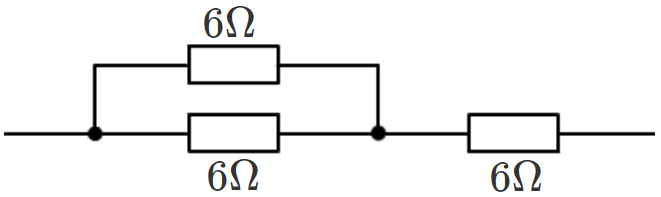
If this arrangement of three resistors was to be replaced by a single resistor, its resistance should be:
- ✓
$9\Omega$
- B
$4\Omega$
- C
$6\Omega$
- D
$18\Omega$
AnswerCorrect option: A. $9\Omega$
The two resistors of $6I$ are connected in parallel with each other.
So, their net resistance $3I$ is connected in series with a resistance of $6I.$
So, the net resistance of the complete arrangement is $9 \Omega .$
View full question & answer→MCQ 411 Mark
In a filament type light bulb, most of the electric power consumed appears as:
AnswerCorrect option: B. Infra$-$red$-$rays.
This is so because of the heat produced when a filament type light bulb glows.
View full question & answer→MCQ 421 Mark
When an electric lamp is connected to $12V$ battery, it draws a current of $0.5A.$ The Power of the lamp is:
- A
$0.5W.$
- ✓
$6W.$
- C
$12W.$
- D
$24W.$
AnswerPower, $P = VI = 12V \times 0.5A = 6W$
View full question & answer→MCQ 431 Mark
Which statement$/$ statement is$/$ are correct?
$1.$ An ammeter is connected in series in a circuit and a voltmeter is connected in parallel.
$2.$ An ammeter has a high resistance.
$3.$ A voltmeter has a low resistance.
- A
$1, 2, 3$
- B
$1, 2$
- C
$2, 3.$
- ✓
$1.$
AnswerAn ammeter is connected in series in a circuit and voltmeter is connected in parallel.
View full question & answer→MCQ 441 Mark
The unit for measuring potential difference is:
- A
- B
$\ce{Ohm}.$
- ✓
- D
$\ce{KWh}.$
AnswerIt is the $SI$ unit of potential difference.
View full question & answer→MCQ 451 Mark
If the current through a floodlamp is $5A,$ what charge passed in $10$ seconds?
- A
$0.5C.$
- B
$2C.$
- C
$5C.$
- ✓
$50C.$
AnswerCorrect option: D. $50C.$
Here, current, $I = 5A$
Time, $t = 10s$
So, using the relation, $\text{I} =\frac{\text{Q}}{\text{t}}$
$Q = I \times t$
Charge, $Q = 5 \times 10 = 50C$
Thus, a charge of $50C$ is passed in $10s.$
View full question & answer→MCQ 461 Mark
The work done in moving a unit charge across two points in an electric circuit is a measure of:
AnswerThe difference in potential between two points that represents the work involved or the energy released in the transfer of a unit quantity of electricity from one point to the other.
View full question & answer→MCQ 471 Mark
An electric kettle for use on a $230V$ supply is rated $3000W.$ For safe working, the cable connected to it should be able to carry at least:
- A
$2A.$
- B
$5A.$
- C
$10A.$
- ✓
$15A.$
AnswerCorrect option: D. $15A.$
Current drawn by the kettle, $\text{I}=\frac{\text{P}}{\text{V}}=\frac{3000}{230}=13\text{A}$
So the cable should be able to carry more current than this and hence the answer is $15A.$
View full question & answer→MCQ 481 Mark
The unit of electrical resistance is:
AnswerCorrect option: D. $\ce{Ohm}.$
The unit of electrical resistance is $\ce{Ohm}.$
View full question & answer→MCQ 491 Mark
The elements of electrical heating devices are usually made of:
AnswerNichrome has a high resistance.
View full question & answer→MCQ 501 Mark
If the diameter of a resistance wire is halved, then its resistance becomes:
AnswerCorrect option: C. One$-$fourth.
Resistance of the wire is given by:
$\text{R}=\rho\frac{\text{I}}{\text{A}}$
When the diameter is halved:
$\text{d}'=\frac{\text{d }}{2}$
Radius:
$\text{r}'=\frac{\text{r}}{2}$
Area of cross$-$section:
$\text{A}'=\pi\text{r}'^2=\pi\Big(\frac{\text{r}}{2}\Big)^2=\frac{\pi\text{r}}{4}=\frac{\text{A}}{4}$
Area of cross$-$section will get reduced by four times.
Then the new resistance:
$\text{R}'=\frac{\rho\text{I}}{\text{A}}$
$\text{R}'=\frac{4\rho\text{I}}{\text{A}}$
$\text{R}'=4\text{R}$
Thus, the resistance will increase by four times.
View full question & answer→MCQ 511 Mark
Which of the following units could be used to measure electric charge?
AnswerThe coulomb $($symbol$: C)$ is the International System of Units $(SI)$ unit of electric charge. It is the charge $($symbol$: Q$ or $q)$ transported by a constant current of one ampere in one second.
View full question & answer→MCQ 521 Mark
Which unit could be used to measure current?
AnswerIt is the $SI$ unit of electric current.
View full question & answer→MCQ 531 Mark
The resistance of a wire of length $300m$ and cross$-$section area $1.0\ mm^2$ made of material of resistivity $1.0\times10−7 Ω\ \text{m}$ is:
- A
$2 Ω$
- B
$3 Ω$
- C
$20 Ω$
- ✓
$30 Ω$
AnswerCorrect option: D. $30 Ω$
Resistance, $\text{R}=\frac{\rho\text{I}}{\text{A}}$
Length, $I = 300m$
Cross section area,$A = 1.0mm^2 = 10^{-6} m^2$
Resistivity, $\rho=1.0\times10^{-7}\Omega\ \text{m}$
Resistance, $\text{R}=\frac{10^{-7}\times300}{10^{-6}}$
$\text{R}=30\Omega$
View full question & answer→MCQ 541 Mark
How many joules of electrical energy are transferred per second by a $6V; 0.5A$ lamp?
- ✓
$30\ \ce{J/s}$
- B
$12\ \ce{J/s}$
- C
$0.83\ \ce{J/s}$
- D
$3\ \ce{J/s}$
AnswerCorrect option: A. $30\ \ce{J/s}$
Electrical energy transferred per second, $E = V \times I \times t = 6V \times 0.5A \times 1s \ 6V \times 0.5A \times 1s = 3\ \ce{J/s}$
View full question & answer→MCQ 551 Mark
If the resistance of a certain copper wire is $1 \Omega ,$ then the resistance of a similar nichrome wire will be about:
- A
$25 \Omega $
- B
$30 \Omega $
- ✓
$60 \Omega $
- D
$45 \Omega $
AnswerCorrect option: C. $60 \Omega $
If the resistance of a certain copper wire is $1 \Omega ,$ the resistance of a similar nichrome wire will be about $60 \Omega $ because the resistivity of nichrome is $60$ times the resistivity of copper.
View full question & answer→MCQ 561 Mark
$f$ the amount of electric charge passing through a conductor in $10 $ minutes is $300C,$ the current flowing is:
- A
$30A.$
- B
$0.3A.$
- ✓
$0.5A.$
- D
$5A.$
AnswerCorrect option: C. $0.5A.$
Here, charge, $Q = 300C$
Time, $t = 10$ minutes $= (10 \times 60)s = 600s$
Then, current, $\text{I}=\frac{\text{Q}}{\text{t}}$
$=\frac{300}{600}=0.5\text{A}.$
View full question & answer→MCQ 571 Mark
The heat produced in a wire of resistance $'x\ '$ when a current $'y\ '$ flows through it in time $'z\ '$ is given by:
- A
$x^2 \times y \times z.$
- ✓
$x \times z \times y^2.$
- C
$y \times z^2 \times x.$
- D
$y \times z \times x.$
AnswerCorrect option: B. $x \times z \times y^2.$
This is so because heat, $H = I^2Rt.$
View full question & answer→