Question types

Electricity question types

334 questions across 7 question groups — pick any mix to generate a Science paper with step-by-step answer keys.

334
Questions
7
Question groups
5
Question types
Sample Questions

Electricity questions

One sample from each question group in this chapter. Select any group above to see the full set with answer keys.

Q 2M.C.Q1 Mark
When a $4 \Omega $ resistor is connected across the terminals of a $12V$ battery, the number of coulombs passing through the resistor per second is:
  • A
    $0.3$
  • $3$
  • C
    $4$
  • D
    $12$

Answer: B.

View full solution
Q 3M.C.Q1 Mark
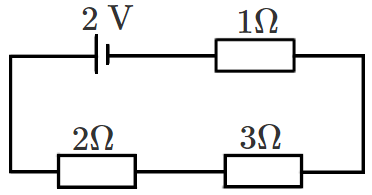
In the circuit shown below:

The potential difference across the $3 \Omega $ resistor is:
  • A
    $\frac{1}{9}\text{V}$
  • B
    $\frac{1}{2}\text{V}$
  • $1V$
  • D
    $2V$

Answer: C.

View full solution
Q 4M.C.Q1 Mark
The current passing through an electric kettle has been doubled. The heat produced will become:
  • A
    Half.
  • B
    Double.
  • C
    Four time.
  • One$-$fourth.

Answer: D.

View full solution
Q 5M.C.Q1 Mark
A battery and three lamps are connected as shown? Which of the following statements about the currents at $X, Y$ and $Z$ is correct?
  • A
    The current at $Z$ is greater than that at $Y.$
  • The current at $Y$ is greater than that at $Z.$
  • C
    The current at $X$ equals the current at $Y.$
  • D
    The current at $X$ equals the current at $Z.$

Answer: B.

View full solution
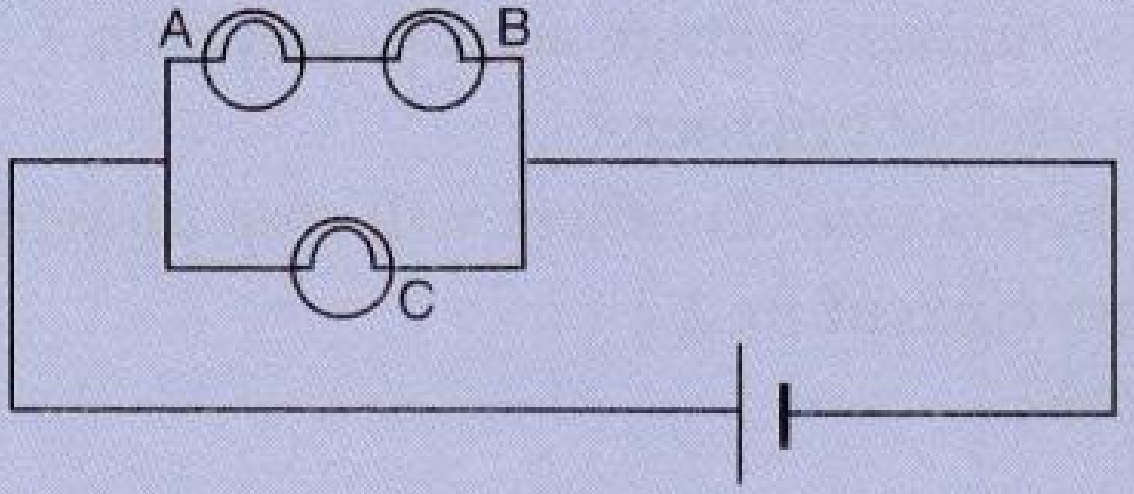
Consider the circuit given below where A, B and C are three identical light bulbs of constant resistance.
  1. List the bulbs in order of increasing brightness.
  2. If C burns out, what will be the brightness of A now compared with before?
  3. If B burns out instead, what will be the brightness of A and C compared with before?
View full solution
The electrical resistivities of four materials P, Q, R and S are given below:
$\begin{matrix}\text{P}&6.84\times10^{-8}\Omega\text{m}\\\text{Q}&1.70\times10^{-8}\Omega\text{m}\\\text{R}&1.0\times10^{15}\Omega\text{m}\\\text{S}&11.0\times10^{-7}\Omega\text{m}\end{matrix}$
Which material will you use for making:
  1. Heating element of electric iron.
  2. Connecting wires of electric iron.
  3. Covering of connecting wires?
Give reason for your choice in each case.
View full solution
A 5V battery is connected to two $20 Ω$ resistors which are joined together in series.
  1. Draw a circuit diagram to represent this. Add an arrow to indicate the direction of conventional current flow in the circuit.
  2. What is the effective resistance of the two resistors?
  3. Calculate the current that flows from the battery.
  4. What is the p.d. across each resistor?
View full solution
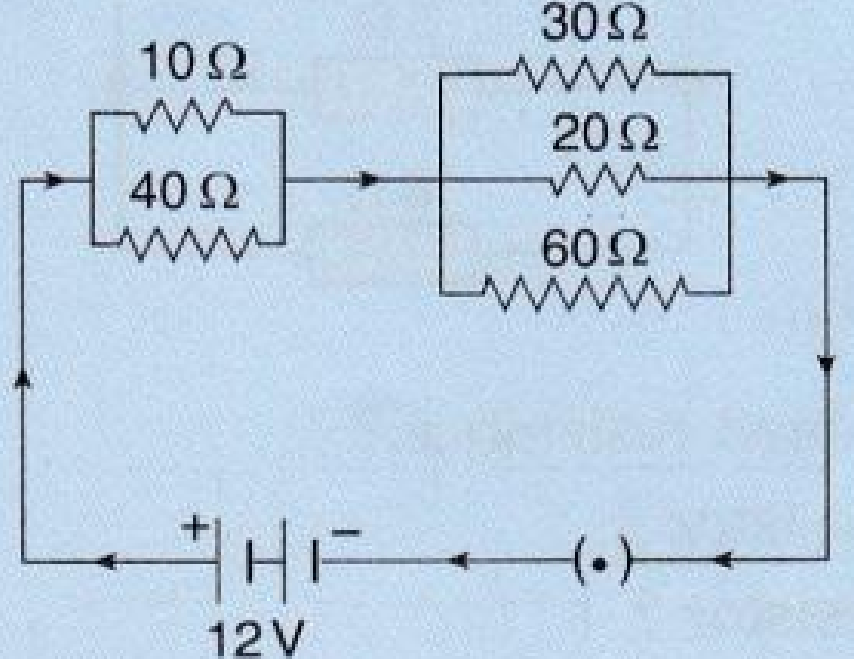
In the circuit diagram given below five resistances of $10 Ω, 40 Ω, 30 Ω, 20 Ω\ \text{and}\ 60 Ω$ are connected as shown to a $12V$ battery.

Calculate:
  1. Total resistance in the circuit.
  2. Total current flowing in the circuit.
View full solution
With the help of a circuit diagram, deduce the equivalent resistance of two resistances connected in series. Two resistances are connected in series as shown in the diagram:
  1. What is the current through the $5$ ohm resistance$?$
  2. What is the current through $R?$
  3. What is the value of $R?$
  4. What is the value of $ V?$
View full solution
Fill in the following blanks with suitable words:
Potential difference is measured in __________ by using a __________ placed in __________ across a component.
View full solution
Q 31Case study.4 Marks
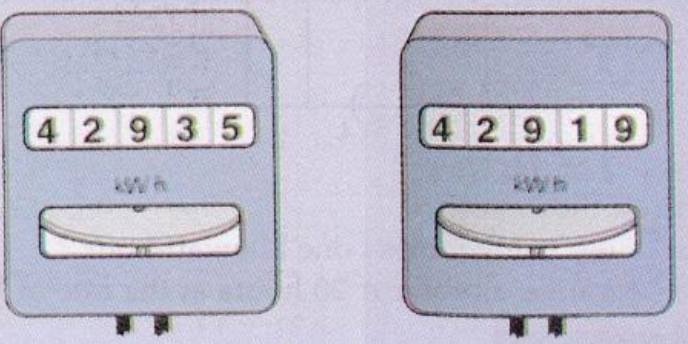
A boy noted the readings on his home’s electricity meter on Sunday at 8AM and again on Monday at 8AM (see figure below).
  1. What was the meter reading on Sunday?
  2. What was the meter reading on Monday?
  3. How many units of electricity have been used?
  4. In how much time these units have been used?
  5. If the rate is Rs. 5 per unit, what is the cost of electricity used during this time?
View full solution
Q 32Case study.4 Marks
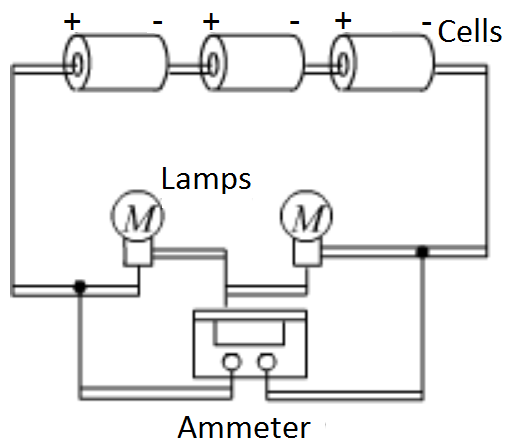
A student made an electric circuit shown here to measure the current through two lamps.
  1. Are the lamps in series or parallel?
  2. The student has made a mistake in this circuit. What is the mistake?
  3. Draw a circuit diagram to show the correct way to connect the circuit. Use the proper circuit symbols in your diagram.
View full solution
Q 33Case study.4 Marks
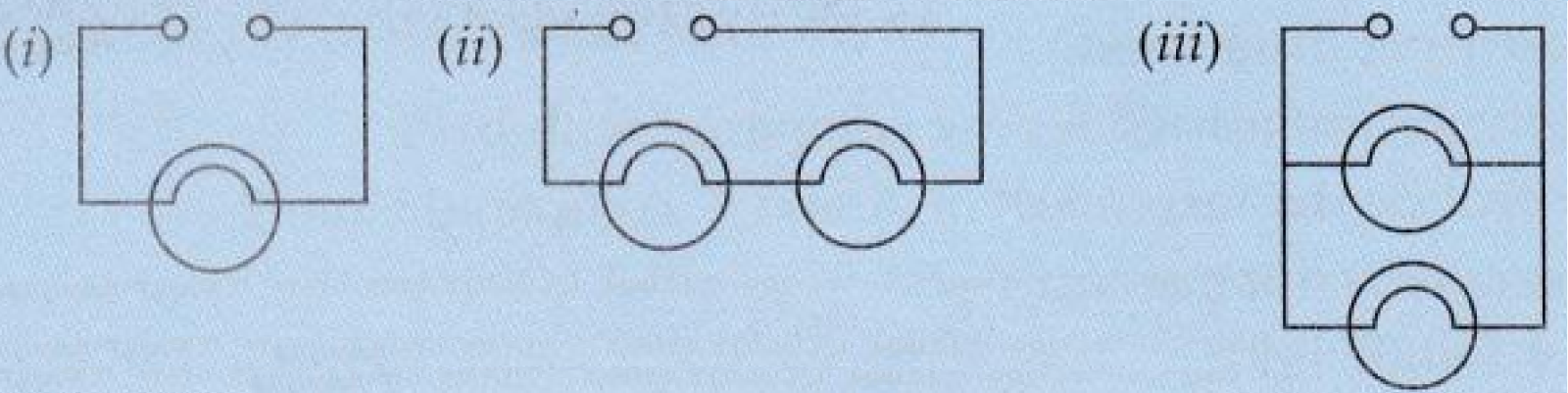
Consider the circuits given below:
  1. In which circuit are the lamps dimmest?
  2. In which circuit or circuits are the lamps of equal brightness to the lamps in circuit?
  3. Which circuit gives out the maximum light?
View full solution
Q 34Case study.4 Marks
The table below shows the current in three different electrical appliances when connected to the 240V mains supply:
Appliance Current
Kettle 8.5A
Lamp 0.4A
Toaster 4.8A
  1. Which appliance has the greatest electrical resistance? How does the data show this?
  2. The lamp is connected to the mains supply by using a thin, twin-cored cable consisting of live and neutral wires. State two reasons why this cable should not be used for connecting the kettle to the mains supply.
  3. Calculate the power rating of the kettle when it is operated from the 240V mains supply.
  4. A man takes the kettle abroad where the mains supply is 120V. What is the current in the kettle when it is operated from the 120V supply?
View full solution
Q 35Case study.4 Marks
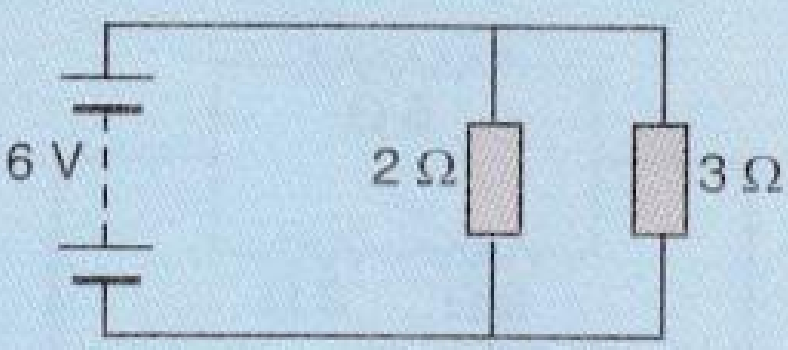
The figure given below shows an electric circuit in which current flows from a $6V$ battery through two resistors.
  1. Are the resistors connected in series with each other or in parallel?
  2. For each resistor, state the p.d. across it.
  3. The current flowing from the battery is shared between the two resistors. Which resistor will have bigger share of the current?
  4. Calculate the effective resistance of the two resistors.
  5. Calculate the current that flows from the battery.
View full solution

Generate a Electricity paper free

Pick question groups from the list above, set marks and difficulty, and export a branded PDF with step-by-step answer keys. First 3 chapters free — no signup.

Download App