| A | B | C |
| (1) Widespread volcanic eruption | (1) Zone V | (1) I to XII |
| (2) Andaman and Nicobar Islands | (2) Fissure eruption | (2) Block Mountain |
| (3) Mercalli scale | (3) Intensity | (3) Very high seismic vulnerability |
| (4) Slow movements | (4) Faulting | (4) Deccan Trap |
Question types
Earth Movements question types
94 questions across 15 question groups — pick any mix to generate a Geography paper with step-by-step answer keys.
94
Questions
15
Question groups
5
Question types
01
Complete the chain and rewrite in your answer paper
2 Q→02Answer the following questions in short
7 Q→03Choose the correct option by identifying the correct co-relation in the given statements.
16 Q→04identify the correct correlation
7 Q→05Give geographical reason
10 Q→06Distinguish between
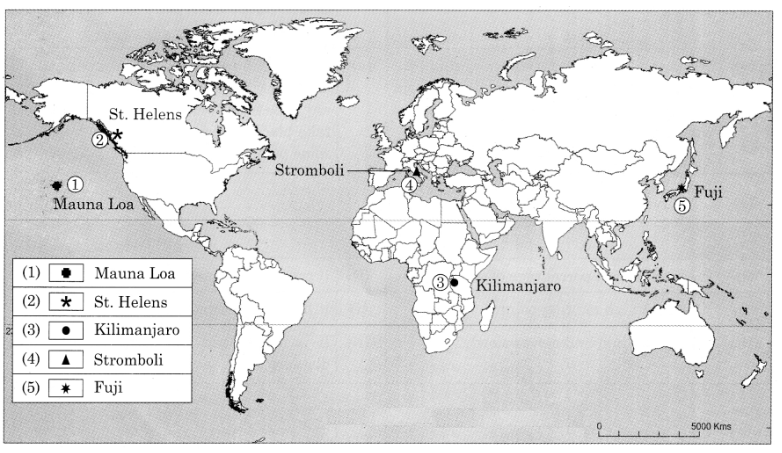
8 Q→07Mark and name the following on the outline map of the world with suitable index.
1 Q→08Observe the following graph , chart or map and answer the question given below.
4 Q→09Read the given passage and answer the following questions:
3 Q→10Answer the following question in detail
8 Q→11identify the correct group
3 Q→12Draw a neat and labelled diagram.
7 Q→13Answer the following question in detail.
3 Q→14Write short note
7 Q→15identfy the incorrect factor
8 Q→Sample Questions
Earth Movements questions
One sample from each question group in this chapter. Select any group above to see the full set with answer keys.
| A | B | C |
| (1) P-waves | (1) Ring of Fire | (1) Indonesia |
| (2) Volcanic eruption | (2) Shadow zone | (2) Italy |
| (3) Cinder cone | (3) Smoke | (3) Cauliflower cloud |
| (4) Tectonic movements | (4) Mt. Nuovo | (4) Cotopaxi |
| (5) Circum pacific belt | (5) Convergent and divergent margin | (5) Between 105° and 140° |
Find out examples of active, dormant and extinct volcanoes.
Why has the shadow zone for L-waves not been shown in fig 1.10?
Look at fig.1.10 and answer following questions. During an earthquake, do you think the seismic waves reach entire portion of the earth. Is there any region on the earth’s surface where a given earthquake will not be reported?
Can folds form into block mountains? Find the reason and discuss.
When can faults form is fold mountains?
A – South-East Asia, Japan and islands in the Pacific Ocean are most vulnerable to earthquakes and volcanic eruptions.
R – They are located in ‘Ring of Fire’.
R – They are located in ‘Ring of Fire’.
- AOnly A is correct.
- BOnly R is correct.
- ✓Both A and R are correct and R is the correct explanation of A.
- DBoth A and R are correct but R is not the correct explanation of A.
Answer: C.
View full solution →A – Intensity of an earthquake is a measurement of the energy released during an earthquake.
R – Mercallis scale is used to measure intensity of an earthquake.
R – Mercallis scale is used to measure intensity of an earthquake.
- AOnly A is correct.
- BOnly R is correct.
- ✓Both A and R are correct and R is the correct explanation of A.
- DBoth A and R are correct but R is not the correct explanation of A.
Answer: C.
View full solution →A – Faulting leads to development of fold mountains.
R – Faulting occurs when tensional forces move away from each other.
R – Faulting occurs when tensional forces move away from each other.
- AOnly A is correct.
- ✓Only R is correct.
- CBoth A and R are correct and R is the correct explanation of A.
- DBoth A and R are correct but R is not the correct explanation of A.
Answer: B.
View full solution →Earthquakes are recorded with the help of ………………. instrument.
- Aseismogram
- ✓seismograph
- CRichter scale
- DMercalli scale
Answer: B.
View full solution →The …………….. are symmetrical in shape.
- Acinder cone
- Blava domes
- Cvolcanic plateau
- ✓composite cone
Answer: D.
View full solution →A – South-East Asia, Japan and islands in the Pacific Ocean are most vulnerable to earthquakes and volcanic eruptions.
R – They are located in ‘Ring of Fire’.
R – They are located in ‘Ring of Fire’.
- AOnly A is correct.
- BOnly R is correct.
- ✓Both A and R are correct and R is the correct explanation of A.
- DBoth A and R are correct but R is not the correct explanation of A.
Answer: C.
View full solution →A – Intensity of an earthquake is a measurement of the energy released during an earthquake.
R – Mercallis scale is used to measure intensity of an earthquake.
R – Mercallis scale is used to measure intensity of an earthquake.
- AOnly A is correct.
- BOnly R is correct.
- ✓Both A and R are correct and R is the correct explanation of A.
- DBoth A and R are correct but R is not the correct explanation of A.
Answer: C.
View full solution →A – Faulting leads to development of fold mountains.
R – Faulting occurs when tensional forces move away from each other.
R – Faulting occurs when tensional forces move away from each other.
- AOnly A is correct.
- ✓Only R is correct.
- CBoth A and R are correct and R is the correct explanation of A.
- DBoth A and R are correct but R is not the correct explanation of A.
Answer: B.
View full solution →A – Basic lava contains less percentage of silica.
R – It has high melting point.
R – It has high melting point.
- ✓Only A is correct.
- BOnly R is correct.
- CBoth A and R are correct and R is the correct explanation of A.
- DBoth A and R are correct but R is not the correct explanation of A.
Answer: A.
View full solution →A – Volcanic activity coincides with seismic activity of the world.
R – The seismic cone coincides with plate boundaries.
R – The seismic cone coincides with plate boundaries.
- AOnly A is correct.
- BOnly R is correct.
- CBoth A and R are correct and R is the correct explanation of A.
- ✓Both A and R are correct but R is not the correct explanation of A.
Answer: D.
View full solution →Folds depend on the strength of rocks and intensity of forces.
Soft rocks form folds while hard rocks form faults.
L-waves do not have a shadow zone.
People living in the Himalayas are more vulnerable to earthquakes.
Extinct conical volcanoes often form crater lakes.
Slow movements and Sudden movements.
Mercalli scale and Richter scale.
Asymmetrical fold and Symmetrical fold.
Syncline and Anticline.
Normal fault and Reverse fault.
(1) Ring of Fire<br>(2) Indo-Australian plate<br>(3) Eurasian Plate<br>(4) Pacific Plate<br>(5) Mt. Cotopaxi
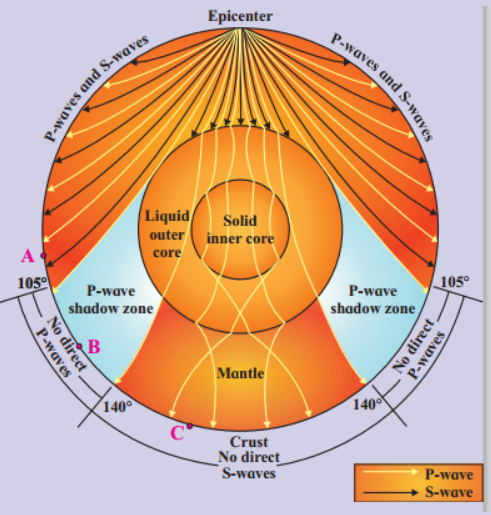
In fig 1.10 textbook page 6 A, B, C are three points on the earth’s surface. Analyse their location with respect to epicentre and shadow zones
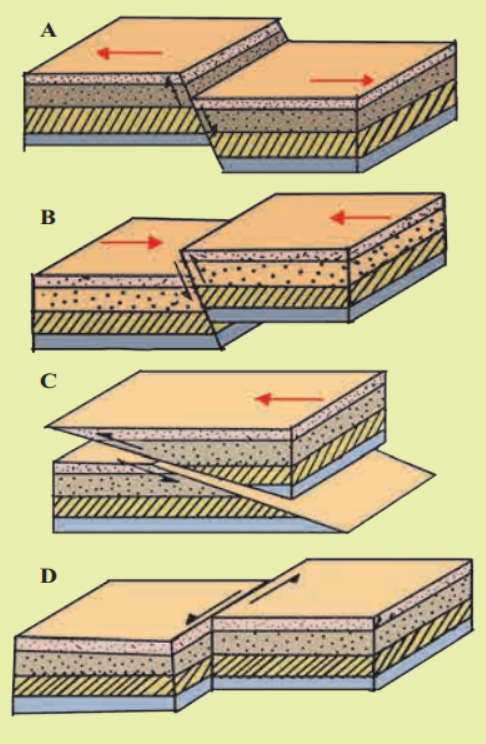
Observe the diagram in fig. 1.6 and read the explanation regarding the characteristics of various faults given. Identify the faults and match each of them with their characteristics.
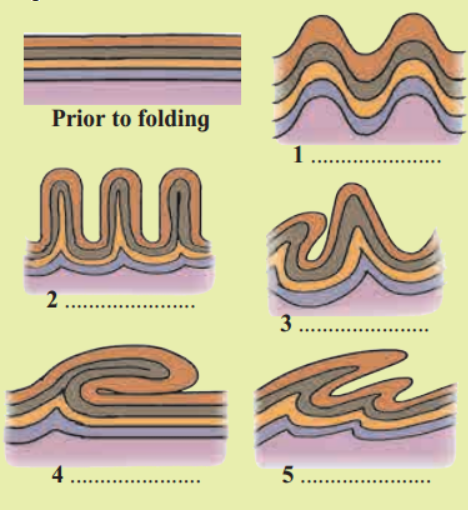
Observe the diagrams in fig. 1.5. Try to understand the different types of fold shown in the diagram. Write the name of the fold.
There is an island known as Krakatoa between the islands of Java and Su matra in Indonesia. There were frequent volcanic eruptions here. From May 1883, massive explosions began. The eruption that took place at about 10 in the morning on 28 August 1883 was the largest ever recorded explosion. As a result of this explosion, the entire island disappeared. During this eruption, rock particles and dust thrown up in the atmosphere was about 25 km³. The column of this dust-ash rose as high as 80 km.
The discharge of Krakatoa threw into the air nearly 21 km3 of rock fragments, and large quantities of ash fell over an area of some 800,000 km². Near the volcano, masses of floating pumice, were so thick that ships had to halt. The surrounding region was plunged into darkness for two and a half days because of ash in the air. For some years after this, cloud kept moving round the earth. About 36,000 people died in these eruptions and the tsunami waves created by it.
In 1927, volcanic eruptions began at the same place and a new island rose in place of the Krakatoa island that had vanished. It was named Anak Krakatoa’ or ‘Child Krakatoa’. The volcano here constantly emits ash and steam. This new island has now become a laboratory for geologists and biologists.
(1)Make a list of materials that came out during eruptions.
(2)Classify them into liquid, solid and gaseous forms.
2. On 19th August, 2018, around 300 people died in Indonesia. Many buildings collapsed. Many roads broke apart. A tsunami was generated. (Textbook Page No. 6)
(1)What was the cause behind these events?
(2)What actually happened during this natural event?
(3)Name the energy waves involved in this natural event.
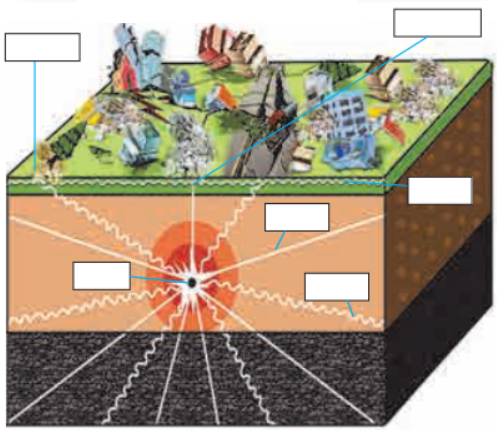
(4)Observe the diagram in fig. 1.9 and label the boxes.
(1)What was the cause behind these events?
(2)What actually happened during this natural event?
(3)Name the energy waves involved in this natural event.
(4)Observe the diagram in fig. 1.9 and label the boxes.
1. Observe the following pictures in fig 1.1 and discuss the questions.
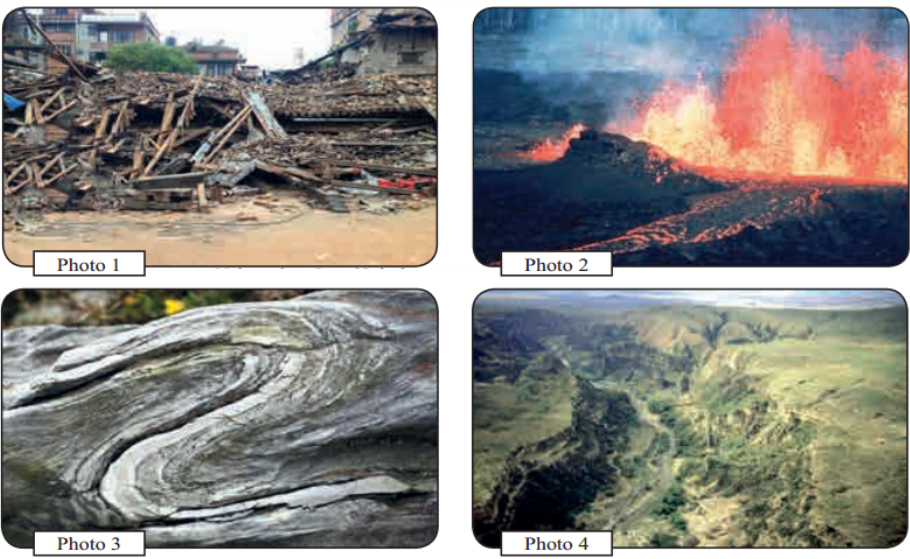
(1)What might be the reasons behind buildings collapsing in photo 1?
(2)Which event in depicted in photo 2? What impact does it bring about in the surroundings?
(3)In photo 3, what could be the reason behind the bend in the rock strata?
(4)What could be the reason behind the difference in altitudes of the land and the steepness of the slope in photo 4?
(5)Classify the events in the photos into sudden and slow movements.
(6)Example of which of these movements is not likely to be found in the mainland of Indian sub- continent?
Take the given hypothetical data in the table. The data shows the time of arrival of P-waves and S-waves at 3 seismograph stations. Assume the scale of the map as 1 cm : 18 km. See fig. 1.11.
| Recording Station | P-wave arrival time (IST) | S-wave arrival time |
| Jalana | 11 : 06 : 06 | 11 : 06 : 19 |
| Washim | 11 : 06 : 46 | 11 : 07 : 03 |
| Aurangabad | 11 : 07 : 06 | 11 : 07 : 24 |
Write a note on volcanic materials.
Explain the concept of shadow zone.
Explain with examples, different types of landforms produced by volcanic eruption.
Explain different types of faults.
| A | B | C | D |
| (1) Symmetrical Fold | (1) Black Forest | (1) Narmada Valley | (1) Caldera |
| (2) Isoclinal Fold | (2) Vosges | (2) African Valley | (2) Crater Lake |
| (3) Overturned Fold | (3) Himalayas | (3) Tapi Valley | (3) Cinder Cone |
| (4) Recumbent Fault | (4) Satpuras | (4) Rhine Valley | (4) Lava Plateau |
| A | B | C | D |
| (1) Asymmetrical Fold | (1) Normal Fault | (1) Zone I – Very high intensity | (1) Limb |
| (2) Overturned Fold | (2) Thrust Fault | (2) Zone II – High intensity | (2) Anticline |
| (3) Isoseismal Lines | (3) Reverse Fault | (3) Zone III – Moderate intensity | (3) Syncline |
| (4) Symmetrical Folds | (4) Tear Fault | (4) Zone IV – Low intensity | (4) Trough |
| A | B | C | D |
| (1) Mt. Fujiyama | (1) Normal Fault | (1) Rock Fragments | (1) Crater Lake |
| (2) Mt. St. Helens | (2) Reverse Fault | (2) Volcanic Dust | (2) Caldera |
| (3) Pinatubo | (3) Tear Fault | (3) Inflammable gases | (3) Volcanic Plug |
| (4) Mayon | (4) Overturned fold | (4) Biotic Material | (4) Volcanic Plateau |
Volcanic landforms
Shadow zone
Types of Faults
Types of folds
Rift Valley
Explain different types of slow movements.
Explain different types of folds.
Give the distribution of earthquakes and volcanic belts in the world.
Shadow Cone
Volcanic Materials
Volcanic landforms
Types of folds
Types of faults
Examples of block mountain are-
- ABlack Forest Mountains in Germany
- BSatpuras in Maharashtra
- CVosges in France
- ✓Himalayas in India
Answer: D.
View full solution →Three types of seismic waves are-
- AP-waves
- BS-waves
- ✓F-waves
- Dlongitudinal waves
Answer: C.
View full solution →Three major belts of earthquake and volcanoes are-
- AMid-Atlantic belt
- BMid-continental belt
- CCircum-Pacific belt
- ✓Indian Ocean belt
Answer: D.
View full solution →The material thrown out in formation of cinder cone are-
- Aash
- Bcinder
- Cbreccias
- ✓Dust
Answer: D.
View full solution →The solid material thro wn out of volcano consists of$-$
- ✓soil
- Bvolcanic bomb
- Cbreccias
- DAsh
Answer: A.
View full solution →Generate a Earth Movements paper free
Pick question groups from the list above, set marks and difficulty, and export a branded PDF with step-by-step answer keys. First 3 chapters free — no signup.