Questions

Answer the following questions.

Take a timed test

7 questions · self-marked practice — reveal the answer and mark yourself.

Question 14 Marks
Compare TLC and Paper Chromatography techniques.
Answer
Chromatography techniqueTLCPaper chromatography
PrincipleIt is based on the principle of differential adsorption. Different solutes are adsorbed on an adsorbent to different extent.It is based on continuous differential partitioning of components of a mixture between stationary and mobile phases.
Stationary phaseSolid (adsorbent like silica gel or alumina over a glass plate)Liquid (water trapped in the fibres of a Paper)
Mobile phaseLiquid (single solvent/mixture of solvents)Liquid (single solvent/mixture of solvents)
Visualization of components of a mixtureSimilar to TLC the coloured components are visible as coloured spots and the colourless components are observed under UV light or using a spraying agent.
View full question & answer
Question 24 Marks

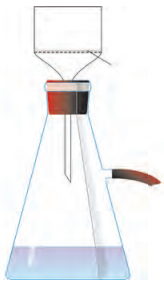
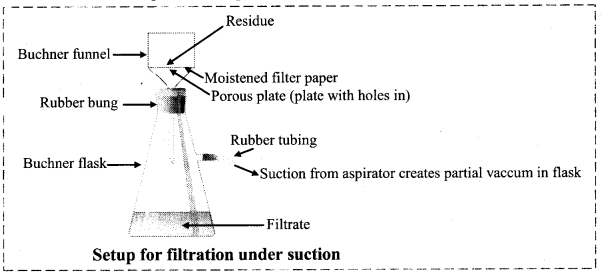
Label the diagram and explain the process in your words.
Image
Answer
When filtration is carried out using a vacuum pump it is called filtration under suction. It is a faster and more efficient technique than simple filtration. The diagram is as follows:Image
ii. Procedure:
  • The assembly for filtration under suction consists of a thick wall conical flask with a sidearm (Buchner flask).
  • The flask is connected to a safety bottle by rubber tube through the side arm.
  • Buchner funnel (a special porcelain funnel with a porous circular bottom) is fitted on the conical flask with the help of a rubber cork.
  • A circular filter paper of correct size is placed on the circular porous bottom of the Buchner funnel and the funnel is placed on the flask.
  • Filter paper is moistened with a few drops of water or solvent.
  • Suction is created by starting the pump and filtration is carried out.
iii. Crystals are collected on the filter paper and filtrate in the flask.
View full question & answer
Question 34 Marks
Image
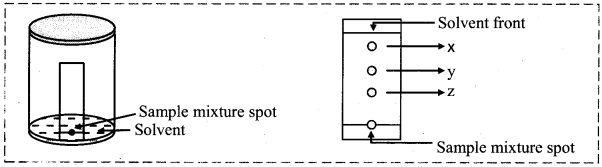
Based on the above diagram, answer the following questions:
$i.$ Name the chromatographic technique involved.
$ii.$ From the developed chromatogram, state which has the highest and which has the lowest $R_f$ value?
$iii.$ Based on the $\text{TLC,}$ which component would elute out at the end of a column chromatography?
$iv.$ Mention two applications of $\text{TLC}$ method.
Answer
$i.$ Thin layer chromatography
$ii.$ Based on the developed chromatogram, spot $‘x \ ’$ has the highest Rf value while spot $‘z \ ’$ the lowest $R_f$ value.
$iii.$ Based on the $\text{TLC,}$ spot $‘z \ ’$ being strongly adsorbed will elute at the end of a column chromatography.
$iv.$ Applications of $\text{TLC}$ are:
Separation of plant pigments from its mixture.
Separation of impurities from a given organic compound.
Separation of different amino acid.
View full question & answer
Question 44 Marks
Write a short note on Rf value.
Answer
i. In chromatography, migration of the solute relative to the solvent front gives an idea about the relative retention of the solutes (or components of t the mixture) on the stationary phase.
ii. The relative adsorption of solutes is expressed in terms of its Rf value.
The symbol Rf stands for Retardation Factor.
$\therefore \quad \mathrm{R}_{\mathrm{f}}=\frac{\text { Distance travelled by the solute from the base line }}{\text { Distance travelled by the solvent from the base line }}$
View full question & answer
Question 54 Marks
Describe the process of paper chromatography.
Answer
Process of paper chromatography:
  • The mixture of the compound to be analysed is dissolved in a suitable solvent and spotted on the chromatography paper about 2 cm from one end of the paper using a glass capillary.
  • The paper is then suspended in a chamber containing the mobile phase.
  • The mobile phase rises up the paper and flows over the spot, due to capillary action.
  • Different solutes are retained differently on the paper depending on their selective partitioning between the two phases. The paper strip so developed, is known as chromatogram.
View full question & answer
Question 64 Marks
State the principle involved and describe the process to separate acetone and water from their mixture.
Answer
i. Acetone and water can be separated from their mixture by simple distillation.

ii. Principle: Acetone and water are two miscible liquids having an appreciable difference (more than 30 K) in their boiling points. Acetone boils at 56 °C while boiling point of water is 100 °C. When the mixture of acetone and water is heated and temperature of the mixture reaches 56 °C acetone will distil out first. Once all acetone distils out, and when the temperature rises to 100 °C water will distil out.

iii. Process to separate acetone and water from their mixture:
  • Take the mixture of water and acetone in the distillation flask.
  • Heat the flask on a water bath carefully. At 56 °C acetone will distil out, collect it in receiver.
  • After all acetone distilled, change the receiver. Discard a few mL of the liquid. As the temperature reaches 100 °C water will begin to distil. Collect this in another receiver.
View full question & answer
Question 74 Marks
Match the following:
ProcessUsed in the purification/separation of
i.Crystallizationa.Acetone and benzene
ii.Simple distillationb.Benzoic acid and water
iii.Fractional distillationc.Impure copper sulphate
iv.Solvent extractiond.Acetone and water
Answer
i – c,
ii – d,
iii – a,
iv – b
View full question & answer