Questions

Answer the following questions:

Take a timed test

27 questions · self-marked practice — reveal the answer and mark yourself.
Question 11 Mark
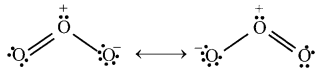
What are these two Lewis structures called?
Answer
These two Lewis structures are called as resonating or contributing or canonical structures.
View full question & answer
Question 21 Mark
How are these two Lewis structures related to each other?
Answer
In these two Lewis structures, the position of the atoms is same but the position of pair of electrons (or formal charge) is different. These two Lewis structures are considered equivalent to each other.
View full question & answer
Question 31 Mark
Represent the above polar covalent bond between $Q$ and R using fractional charges $\delta^{+}$and $\delta^{-}$.
Answer
R epresent the above polar covalent bond between Q and R using fractional charges $\delta^{+}$and $\delta^{-}$.
View full question & answer
Question 41 Mark
Consider two covalently bonded atoms Q and R where R is more electronegative than Q. Will these atoms share the electron pair equally between them?
Answer
A covalent bond is formed between $Q$ and $R$ having different electronegativities, that is, $R$ is more electronegative than $Q$. In such a case, the atom $R$ with a higher value of electronegativity pulls the shared pair of electrons to a greater extent towards itself as compared to the atom $Q$ with lower value of electronegativity. As a result of this, the shared pair of electrons will get shifted towards atom $R$. Thus, both the atoms $Q$ and $R$ will not share the electron pair equally between them.
View full question & answer
Question 51 Mark
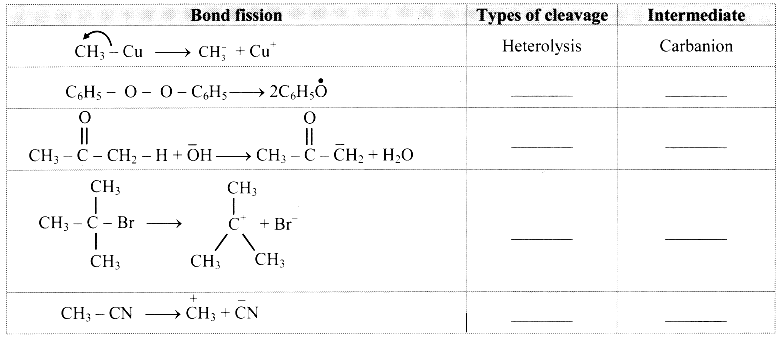
Some bond fissions are described in the following table. For each of them, show the movement of electron/s using curved arrow notation. Classify them as homolysis or heterolysis and identify the intermediate species produced as carbocation, carbanion or free radical.

Image

View full question & answer
Question 61 Mark
Consider the following reaction:
$2 CH_3-CH_2-CH_2-OH+2 Na \rightarrow 2 CH_3-CH_2-CH_2-ONa+H_2$
Compare the structure of the substrate propanol with that of the product sodium propoxide. Which part of the substrate, the carbon skeleton or the OH group has undergone a change during the reaction?
Answer
In above reaction, the -OH group of the substrate molecule has undergone a change. The H -atom of hydroxyl group $(- OH )$ is replaced by sodium forming the product.
View full question & answer
Question 81 Mark
How is covalent bond formed between two atoms?
Answer
A covalent bond is formed between two atoms by mutual sharing of electrons so as to complete their octets or duplets (in case of elements having only one shell).
View full question & answer
Question 91 Mark
Which classes of organic compounds are often used in our daily diet?
Answer
Carbohydrates (sugars), proteins (pulses), fats (edible plant and animal oil) and vitamins are the major classes of organic compounds often used in our daily diet.
View full question & answer
Question 101 Mark
Which is the essential element in all organic compounds?
Answer
Carbon is the essential element in all organic compounds.
View full question & answer
Question 111 Mark
Write true or false. Correct the false stament
Aniline is heterocyclic compound.
Answer
FALSE - Aniline is a homocyclic aromatic compound.
View full question & answer
Question 121 Mark
Write true or false. Correct the false stament
Free radicals are negatively charged species
Answer
FALSE - Free radicals are electrically neutral/uncharged species.
View full question & answer
Question 131 Mark
Write true or false. Correct the false stament
Heterolytic fission results in the formation of free radicals.
Answer
FALSE - Heterolytic fission results in the formation of charged ions like cation and anion.
View full question & answer
Question 141 Mark
Write true or false. Correct the false stament
Homolytic fission involves unsymmetrical breaking of a covalent bond.
Answer
FALSE - Homolytic fission involves symmetrical breaking of a covalent bond.
View full question & answer
Question 151 Mark
Define: Resonance effect.
Answer
The polarity produced in the molecule by the interaction between conjugated n bonds (or that between n bond and p orbital on attached atom) is called the resonance effect or mesomeric effect.
View full question & answer
Question 161 Mark
What do you understand by the term conjugated system of π bonds?
Answer
When Lewis structure of a compound has two or more multiple bonds alternating with single bonds, it is called a conjugated system of π bonds.
e.g. Benzene molecule
View full question & answer
Question 171 Mark
Which of the $CH_3 – CHCl_2 $ and $CH_3CH_2Cl$ is expected to have stronger $-I$ effect?
Answer
The group exerting $-I$ effect is $-Cl$. In $CH3CH2Cl,$ there is only one $-Cl$ atom while in $CH3 – CHCl2$ there are two $-Cl $ atoms. Therefore, $CH3 – CHCl2$ is expected to have strong $-I$ effect.
View full question & answer
Question 181 Mark
Define: Inductive effect
Answer
Inductive effect: When an organic molecule has a polar covalent bond in its structure, polarity is induced in adjacent carbon-carbon single bonds too. This effect is called as inductive effect.
View full question & answer
Question 191 Mark
What conditions favour homolytic cleavage?
Answer
Homolytic cleavage is favoured in the presence of $UV$ radiation or in presence of catalyst such as peroxides $(H_2O_2)$ or at high temperatures.
View full question & answer
Question 201 Mark
What are the different ways in which a covalent bond fission can takes place?
Answer
The covalent bond fission/cleavage takes place in two ways:
  1. Homolytic fission
  2. Heterolytic fission
View full question & answer
Question 211 Mark
Define: Stereoisomerism
Answer
When different compounds have the same structural formula but different relative arrangement of groups/atoms in space, that is, different spatial arrangement of groups/atoms, it is called as stereoisomerism.
View full question & answer
Question 221 Mark
Define: Structural isomerism
Answer
Structural isomerism: When two or more compounds have same molecular formula but different structural formulae, they are said to be structural isomers of each other and the phenomenon is known as structural isomerism.
View full question & answer
Question 241 Mark
Write names of following groups.
$i. C_6H_5–$
$ii. (CH_3)_3C-$
Answer
$i.$ Phenyl group
$ii.$ tert$-$Butyl group
View full question & answer
Question 251 Mark
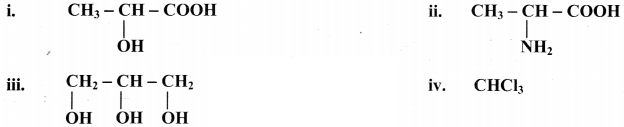
Give common name/trivial name of the following compounds.


Image
Answer
i. Lactic acid
ii. Glycine
iii. Glycerol
iv. Chloroform
View full question & answer
Question 261 Mark
Write the general formula of homologous series of alcohols.
Answer
General formula of homologous series of alcohols can be represented as, $C_nH_{2n+1}OH$ (where $n = 1, 2, 3, …).$
View full question & answer
Question 271 Mark
Match the following:
  Column $– I$   Column $– II$
$i.$ $C_{19}H_{40}$ $a.$ Undecane
$ii.$ $C_{12}H_{26}$ $b.$ Nonadecane
$iii.$ $C_{11}H_{24}$ $c.$ Dodecane
    $d.$ Nonane
Answer
$(i – b),(ii – c),(iii – a)$
View full question & answer