Questions

Answer the following in brief.

Take a timed test

17 questions · self-marked practice — reveal the answer and mark yourself.

Question 13 Marks
Which type of hybridization is present in ammonia molecule? Write the geometry and bond angle present in ammonia.
Answer
The type of hybridization present in ammonia ($NH_3$​​​​​​​) molecule is $sp^3.$
Geometry of ammonia molecule is pyramidal or distorted tetrahedral.
Bond angle in ammonia molecule is $107^\circ 18′$
View full question & answer
Question 23 Marks
In case of bond formation in Acetylene molecule :
a. How many covalend bonds are formed ?
b. State number of sigma and pi bonds formed.
c. Name the type of Hybridisation.
Answer
a. In acetylene molecule, there are five covalent bonds.
b. In acetylene molecule, there are three sigma bonds and two pi bonds.
c. In acetylene molecule, each carbon atom undergoes sp hybridization.
View full question & answer
Question 33 Marks

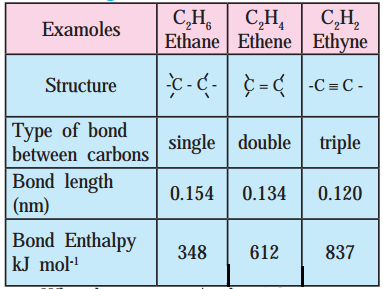
Image
a. What happens to the bond length when unsaturation increases?
b. Which is the most stable compound?
c. Indicate the relation between bond strength and Bond enthalpy.
d. Comment on overall relation between Bond length, Bond Enthalpy and Bond strength and stability.
Answer
a. When unsaturation increases, the bond length decreases.
b. The stable compound is ethyne $(C_2H_2).$
c. Bond strength ∝ Bond enthalpy
Larger the bond enthalpy, stronger is the bond.
d. As bond length decreases, bond enthalpy, bond strength and stability increase.
View full question & answer
Question 43 Marks
$F-Be-F$ is a liner molecule but $H-O-H$ is angular. Explain.
Answer
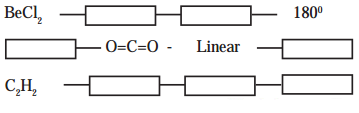
i. In the $BeF _2$ molecule, the central beryllium atom undergoes sp hybridization giving rise to two sp hybridized orbitals placed diagonally opposite with an angle of $180^{\circ}$. Thus, $F - Be - F$ is a linear molecule.ii. In the $H _2 O$ molecule, the central oxygen atom undergoes $sp ^3$ hybridization giving rise to four $sp ^3$ hybridized orbitals directed towards four comers of a tetrahedron. There are two lone pairs of electrons in two of the $sp ^3$ hybrid orbitals of oxygen. The lone pair-lone pair repulsion distorts the structure. Hence, $H - O - H$ is angular or V -shaped.
View full question & answer
Question 83 Marks
Explain $O_3$ molecule is the resonance hybrid.
Answer
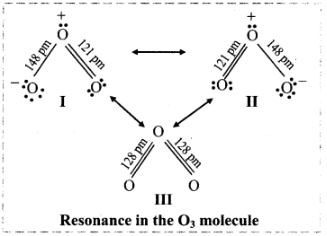
Ozone is a resonance hybrid of structures $I \ and \ II.$ The structures $I \ and \ II$ are canonical forms while structure $III$ is a resonance hybrid. The energy of structure $III$ is less than that of $I \ and \ II.$
Image ​​​​​​​
View full question & answer
Question 93 Marks
Define and explain the term dipole moment.
Answer
$i.$ Dipole moment $(\mu )$ is the product of the magnitude of charge and distance between the centres of $+ve \ and \ -$ve charges.
$ii.$ It is given by $, µ = Q \times r$
where, $Q =$ charge$, r =$ distance of separation.
$iii.$ Unit of dipole moment is Debye $(D).$
$iv.$ Dipole moment being a vector quantity is represented by a small arrow with the tail on the positive centre and head pointing towards the negative centre.
Image
Note: $1 D = 3.33564 \times 10^{-30} \ C m$
where $C$ is coulomb and $m$ is meter.
View full question & answer
Question 103 Marks
Write a short note on bond length.
Answer
Bond length:
  • Bond length is defined as the equilibrium distance between the nuclei of two covalently bonded atoms in a molecule.
  • Each atom of the bonded pair contributes to the bond length.
  • Bond length depends upon the size of atoms and multiplicity of bonds. It increases with increase in size of atom and decreases with increase in multiplicity of bond.
    e.g. C – C single bond is longer than C ≡ C triple bond.
  • Bond lengths are measured by X-ray and electron diffraction techniques.
View full question & answer
Question 113 Marks
Explain briefly the information provided by the electronic configuration of molecules.
Answer
The electronic configuration of molecules provides the following information:
Stability of molecules: If the number of electrons in bonding $MOs$ is greater than the number in antibonding $MOs$ the molecule is stable.
Magnetic nature of molecules: If all $MOs$ in a molecule are completely filled with two electrons each, the molecule is diamagnetic (i.e., repelled) by magnetic field. However, if at least one $MO$ is half$-$filled with one electron, the molecule is paramagnetic $($i. e., attracted by magnetic field$).$
Bond order of molecule: The bond order of the molecule can be calculated from the number of electrons in bonding $MOs (N_b)$ and antibonding $MOs (N_a).$
View full question & answer
Question 123 Marks
What are the limitations of valence bond theory?
Answer
Limitations of valence bond theory:
Valence Bond theory explains only the formation of covalent bond in which a shared pair of electrons comes from two bonding atoms. However, it offers no explanation for the formation of a coordinate covalent bond in which both the electrons are contributed by one of the bonded atoms.
Oxygen molecule is expected to be diamagnetic according to this theory. The two atoms in oxygen molecule should have completely filled electronic shells which give no unpaired electrons to the molecule making it diamagnetic. However, experimentally the molecule is found to be paramagnetic having two unpaired electrons. Thus, this theory fails to explain paramagnetism of oxygen molecule.
Valence bond theory does not explain the bonding in electron deficient molecules like $B_2H_6$ in which the central atom possesses a smaller number of electrons than required for an octet of electron.
View full question & answer
Question 133 Marks
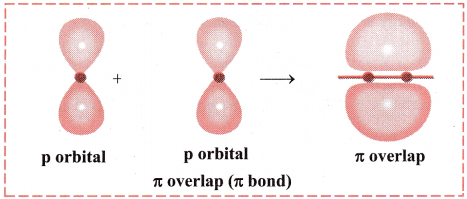
Explain the formation of π bond with diagram.###Explain π overlap with diagram.
Answer
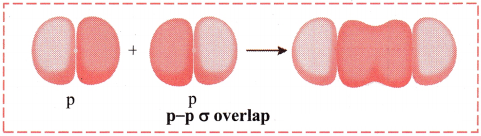
  • When two half-filled p orbitals of two atoms overlap side-ways (laterally), it is called π overlap and the bond formed is called π bond.
  • π bond is perpendicular to the intemuclear axis.
Diagram:
Image
View full question & answer
Question 143 Marks
Explain the formation of covalent bond in $Cl_2$ molecule.
Answer
Formation of $Cl_2$ molecule:
$i.$ The electronic configuration of $Cl$  atom  is  $[Ne] 3s^2 3p^5.$
$ii.$ It needs one more electron to complete its valence shell.
$iii.$ When two chlorine atoms approach each other at a certain internuclear distance, they share their valence electrons. In the process, both the atoms attain the valence shell of octet of nearest noble gas, argon.
$iv.$ The shared pair of electrons belongs equally to both the chlorine atoms. The two atoms are said to be linked by a single covalent bond and a $Cl_2$ molecule is formed.
Image
View full question & answer
Question 153 Marks
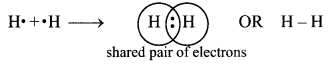
Explain the formation of covalent bond in $H_2$ molecule.
Answer
Formation of $H_2$ molecule:
$i.$ The electronic configuration of $H$ atom is $1s^1.$
$ii.$ It needs one more electron to complete its valence shell.
$iii.$ When two hydrogen atoms approach each other at a certain internuclear distance, they share their valence electrons.
$iv.$ The shared pair of electrons belongs equally to both the hydrogen atoms. The two atoms are said to be linked by a single covalent bond and a $H_2$ molecule is formed.
Image
View full question & answer
Question 163 Marks
Define lattice enthalpy.
Answer
Lattice enthalpy of an ionic solid is defined as the energy required to completely separate one mole of solid ionic compound into the gaseous components.
Note: Lattice enthalpy values of some ionic compounds:
Compound Lattice enthalpy $kJ \ mol^{-1}$
$LiCl$ $853$
$NaCl$ $788$
$BeF_2$ $3020$
$CaCl_2$ $2258$
$AlCl_3$ $5492$
View full question & answer
Question 173 Marks
Give the significance of octet rule. Explain why this rule is not valid for $H$ and $Li$ atoms.
Answer
$i.$ Significance: Octet rule is found to be very useful:
in explaining the normal valence of elements
in the study of the chemical combination of atoms leading to the formation of molecule.
$ii.$ Octet rule is not valid for $H$ and $Li$ atoms. According to octet rule, during the formation of a chemical bond, each atom loses, gains or shares electrons so that it achieves stable octet $($eight electrons in the valence shell$).$ However, $H$ and $Li$ atoms tend to have only two electrons in their valence shell similar to that of Helium $(1s^2),$ which called duplet. Hence, octet rule is not valid for $H$ and $Li$ atoms.
View full question & answer