Question
$F-Be-F$ is a liner molecule but $H-O-H$ is angular. Explain.

Answer

i. In the $BeF _2$ molecule, the central beryllium atom undergoes sp hybridization giving rise to two sp hybridized orbitals placed diagonally opposite with an angle of $180^{\circ}$. Thus, $F - Be - F$ is a linear molecule.ii. In the $H _2 O$ molecule, the central oxygen atom undergoes $sp ^3$ hybridization giving rise to four $sp ^3$ hybridized orbitals directed towards four comers of a tetrahedron. There are two lone pairs of electrons in two of the $sp ^3$ hybrid orbitals of oxygen. The lone pair-lone pair repulsion distorts the structure. Hence, $H - O - H$ is angular or V -shaped.

Need a full question paper?

Generate a complete, print-ready paper with questions like this in minutes — across 16+ boards, with answer keys.
Start Generating Free

Similar questions

Distinguish between the following : Adsorption and absorption. Give one example.
Nuclear fission of $^{235}U$ is a chain process. Justify.
Write the structural formulae for the following names and also write correct IUPAC names for them.
a. 5-ethyl-3-methylheptane
b. 2,4,5-trimethylthexane
c. 2,2,3-trimethylpentan-4-01
What are general oxidation states of group $13$ elements? Explain.
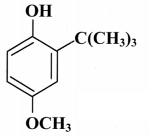
Compound $“X”$ having the following structure is used as synthetic antioxidant to increase the shelf life of packed foods.
Image
$i.$ What is the molecular formula of compound $“X”$?
$ii.$ Identify the structural unit responsible for antioxidant activity of $“X”.$
$iii.$ Give one example of a compound with structure, similar to compound $“X”,$ which is commonly used as synthetic antioxidant.
$iv.$ Give the $\text{IUPAC}$ name of compound $“X”.$
Discuss the reactivity of group $15$ elements with halogens.
Dissolve 4 g cobalt chloride in 40 mL water. It forms a reddish pink solution. Add 60 mL concentrated HCl to this. It will turn blue. Take 5 mL of this solution in a test tube and place it in a beaker containing ice water mixture. The colour of solution will become pink. Place the same test tube in a beaker containing water at 90 °C. The colour of the solution turns blue.
Yellow light emitted from a lamp has a wavelength of 580 nm. Find the frequency and wavenumber of this light.
The two natural isotopes of chlorine viz. ${ }_{17}^{35} \mathrm{Cl}$ and ${ }_{17}^{37} \mathrm{Cl}$ exist in relative abundance of $3: 1$. Find out the average atomic mass of chlorine.
How do you visualize colourless compounds after separation in TLC and Paper Chromatography?