Questions

Solve the Following Question.(5 Marks)

Take a timed test

13 questions · self-marked practice — reveal the answer and mark yourself.

Question 15 Marks
Show that the product of the lengths of its perpendicular segments drawn from the foci to

any tangent line to the ellipse $\frac{x^2}{25}+\frac{y^2}{16}=1$ is equal to 16 .

Answer
Given equation of the ellipse is $\frac{x^2}{25}+\frac{y^2}{16}=1$

Comparing this equation with $\frac{x^2}{a^2}+\frac{y^2}{b^2}=1$, we get

$\begin{aligned} & \therefore a^2=25, b^2=16 \\ & \therefore a=5, b=4\end{aligned}$

We know that $e =\frac{\sqrt{a^2-b^2}}{a}$

$\begin{aligned} & \therefore e=\frac{\sqrt{25-16}}{5}=\frac{3}{5} \\ & a e=5\left(\frac{3}{5}\right)=3\end{aligned}$

Co-ordinates of foci are S(ae, 0) and S'(-ae, 0),

i.e., S(3, 0) and S'(-3, 0)

Equations of tangents to the ellipse $\frac{x^2}{a^2}+\frac{y^2}{b^2}=1$ having slope $m$ are

$y=m x \pm \sqrt{a^2 m^2+b^2}$

Equation of one of the tangents to the ellipse is

$\begin{aligned} & y=m x+\sqrt{25 m^2+16} \\ & \therefore m x-y+\sqrt{25 m^2+16}=0\end{aligned}$

p1 = length of perpendicular segment from S(3, 0) to the tangent (i)

$\begin{aligned} & =\left|\frac{ m (3)-0+\sqrt{25 m ^2+16}}{\sqrt{ m ^2+1}}\right| \\ & \therefore p _1=\left|\frac{3 m +\sqrt{25 m ^2+16}}{\sqrt{ m ^2+1}}\right|\end{aligned}$

p2 = length of perpendicular segment from S'(-3, 0) to the tangent (i)

$\begin{aligned} & =\left|\frac{ m (-3)-0+\sqrt{25 m^2+16}}{\sqrt{m^2+1}}\right| \\ & \therefore p_2=\left|\frac{-3 m+\sqrt{25 m^2+16}}{\sqrt{m^2+1}}\right|\end{aligned}$

$\begin{aligned} & \therefore p_1 p_2=\left|\frac{3 m+\sqrt{25 m^2+16}}{\sqrt{m^2+1}}\right|\left|\frac{-3 m+\sqrt{25 m^2+16}}{\sqrt{m^2+1}}\right| \\ & =\frac{\left(25 m^2+16\right)-9 m^2}{m^2+1} \\ & =\frac{16\left(m^2+1\right)}{m^2+1} \\ & =16\end{aligned}$
View full question & answer
Question 25 Marks
Two tangents to the parabola $y ^2=8 x$ meet the tangents at the vertex in $P$ and $Q$. If $PQ =4$,prove that the locus of the point of intersection of the two tangents is $y^2=8(x+2)$.
Answer
Given parabola is $y^2=8 x$Comparing with $y ^2=4 ax$, we get,
4a = 8
⇒ a = 2
Let $M\left(t_1\right)$ and $N\left(t_2\right)$ be any two points on the parabola.
The equations of tangents at M and N are
$ yt _1= x +2 t _1^2 \ldots . .(1)$
$yt _2= x +2 t _2^2 \ldots(2) \ldots[\because a =2]$
Let tangent at M meet the tangent at the vertex in P.
But tangent at the vertex is Y-axis whose equation is x = 0.
⇒ to find P, put x = 0 in (1)
$\Rightarrow yt _1=2 t _1^2$
$\Rightarrow y =2 t _1 \ldots . .\left( t _1 \neq 0 \text { otherwise tangent at } M \text { will be } x =0\right)$
$\Rightarrow P =\left(0,2 t _1\right)$
Similarly, $Q =\left(0,2 t _2\right)$
It is given that PQ = 4
$\therefore\left|2 t _1-2 t _2\right|=4$
$\therefore\left| t _1- t _2\right|=2 \ldots . .$
$\therefore\left|2 t _1-2 t _2\right|=4$
$\therefore\left| t _1- t _2\right|=2 \ldots . .$
Let R = (x1, y1) be any point on the required locus.
Then R is the point of intersection of tangents at M and N.
To find R, we solve (1) and (2).
Subtracting (2) from (1), we get
$y\left( t _1- t _2\right)=2 t _1^2-2 t _2^2$
$y \left( t _1- t _2\right)=2\left( t _1- t _2\right)\left( t _1+ t _2\right)$
$\therefore y =2\left( t _1+ t _2\right) \ldots . \ldots\left[\because M , N \text { are distinct } \therefore t _1 \neq t _2\right]$
$\text { i.e., } y _1=2\left( t _1+ t _2\right) \ldots . .(4)$
$\therefore from ^2(1) \text {, we get }$
$2 t _1\left( t _1+ t _2\right)= x +2 t _1^2$
$\therefore 2 t _1 t _2= x \text { i.e. } x _1=2 t _1 t _2 \ldots . .(5)$
To find the equation of locus of R(x1, y1),
we eliminate t1 and t2 from the equations (3), (4) and (5).
We know that,
$\left( t _1+ t _2\right)^2=\left( t _1+ t _2\right)^2+4 t _1 t _2$
$\Rightarrow\left(\frac{y_1}{2}\right)^2=4+4\left(\frac{x_1}{2}\right) \ldots[ By (3),(4) \text { and (5)] }$
$\Rightarrow y_1^2=16+8 x _1=8\left( x _1+2\right)$
Replacing $x_1$ by $x_{\text {and }} y_1$ by $y_{\text {, }}$
the equation of required locus is $y^2=8(x+2)$.
View full question & answer
Question 35 Marks
Find the coordinates of the foci, the vertices, the length of major axis, the eccentricity and the length of the latus rectum of the ellipse : $4 x^2+9 y^2-16 x+54 y+61=0$
Answer
Self
View full question & answer
Question 45 Marks
Find the coordinates of the foci, the vertices, the length of major axis, the eccentricity and the length of the latus rectum of the ellipse : $3 x^2+4 y^2=1$
Answer
Self
View full question & answer
Question 55 Marks
Find the coordinates of the foci, the vertices, the length of major axis, the eccentricity and the length of the latus rectum of the ellipse : $4 x^2+3 y^2=1$
Answer
Self
View full question & answer
Question 65 Marks
Find the coordinates of the foci, the vertices, the length of major axis, the eccentricity and the length of the latus rectum of the ellipse : $\frac{x^2}{16}+\frac{y^2}{9}=1$
Answer
Given equation of an ellipse is $\frac{x^2}{16}+\frac{y^2}{9}=1$
Comparing with standard equation $\frac{x^2}{a^2}+\frac{y^2}{b^2}=1$
$a^2=16 ; b^2=9$
$a=4 ; \mathrm{b}=3(a>b)$
$\mathrm{X}$-axis $(y=0)$ is the major axis and $y$-axis $(x=0)$ the minor axis.
Centre $O(0,0)$
Vertices $\mathrm{A}( \pm a, 0) \equiv( \pm 4,0), \mathrm{B}(0, \pm b) \equiv(0, \pm 3)$
Length of major axis $(2 a)=2(4)=9$
Length of minor axis $(2 b)=2(3)=6$
By relation between $a, \mathrm{~b}$ and $\mathrm{e}$.
$
\begin{aligned}
& b^2=a^2\left(1-\mathrm{e}^2\right) \\
& 9=16\left(1-\mathrm{e}^2\right) \\
& \frac{9}{16}=1-\mathrm{e}^2 \\
& \mathrm{e}^2=1-\frac{9}{16} \\
& \mathrm{e}^2=\frac{7}{16} \text { that is } \mathrm{e}= \pm \frac{\sqrt{7}}{4} \\
& \text { but } 0<\mathrm{e}<1 \text { therefore } e=\frac{\sqrt{7}}{4} \\
& \text { Foci } \mathrm{S}(a \mathrm{e}, 0) \equiv\left(4 \cdot \frac{\sqrt{7}}{4}, 0\right)=(\sqrt{7}, 0) \\
& \mathrm{S}^{\prime}(-a \mathrm{e}, 0)=\left(-4 \cdot \frac{\sqrt{7}}{4}, 0\right)=(-\sqrt{7}, 0)
\end{aligned}
$
$\mathrm{e}^2=\frac{7}{16}$ that is $\mathrm{e}= \pm \frac{\sqrt{7}}{4}$
but $0<\mathrm{e}<1$ therefore $e=\frac{\sqrt{7}}{4}$
Foci $\mathrm{S}(a \mathrm{e}, 0) \equiv\left(4 \cdot \frac{\sqrt{7}}{4}, 0\right)=(\sqrt{7}, 0)$
$\mathrm{S}^{\prime}(-a \mathrm{e}, 0)=\left(-4 \cdot \frac{\sqrt{7}}{4}, 0\right)=(-\sqrt{7}, 0)$
Distance between foc $=2$ ae $=2 \sqrt{7}$,
Equation of directrix $x= \pm \frac{a}{e}$
$x= \pm \frac{4}{\frac{\sqrt{7}}{4}}$ that is $x= \pm \frac{16}{\sqrt{7}}$
distance between directrix $=2 \frac{a}{e}=2\left(\frac{16}{\sqrt{7}}\right)=\frac{32}{\sqrt{7}}$
End coordinates of latus rectum
$\mathrm{L}\left(a e, \frac{b^2}{a}\right)=\left(\sqrt{7}, \frac{9}{4}\right)$
$L^{\prime}\left(a e, \frac{-b^2}{a}\right)=\left(\sqrt{7},-\frac{9}{4}\right)$
Length of latus rectum $=\frac{2 b^2}{a}=2\left(\frac{9}{4}\right)=\frac{9}{2}$

Parametric form x = a cosθ , y = b sinθ That is x = 4 cosθ , y = 3 sinθ

View full question & answer
Question 75 Marks
The eccentric angles of two points $P$ and $Q$ of the ellipse $4 x^2+y^2=4$ differ by $\frac{2 \pi}{3}$. Showthat the locus of the point of intersection of the tangents at $P$ and $Q$ is the ellipse $4 x^2+y^2$
$= 16.$
Answer
Given equation of the ellipse is $4 x^2+y^2=4$$\frac{x^2}{1}+\frac{y^2}{4}=1$
Let $P\left(\theta_1\right)$ and $Q\left(\theta_2\right)$ be any two points on the given ellipse such that
$\theta_1-\theta_2=\frac{2 \pi}{3}$
The equation of the tangent at point $P\left(\theta_1\right)$ is
$\underline{x \cos \theta_1}+\underline{y \sin \theta_1}=1 \ldots \ldots$ (i)
The equation of the tangent at point $Q\left(\theta_2\right)$ is
$\frac{x \cos \theta_2}{1}+\frac{y \sin \theta_2}{2}=1$
Multiplying equation (i) by $\cos \theta_2$ and equation (ii) by $\cos \theta_1$ and subtracting, we get
$\frac{y}{2}\left(\sin \theta_1 \cos \theta_2-\sin \theta_2 \cos \theta_1\right)=\cos \theta_2-\cos \theta_1$
$\frac{y}{2}\left[\sin \left(\theta_1-\theta_2\right)\right]=\cos \theta_2-\cos \theta_1$
$\frac{y}{2}\left[\sin \left(\frac{2 \pi}{3}\right)\right]=\cos \theta_2-\cos \theta_1$
$\frac{y}{2} \sin \left(\pi-\frac{\pi}{3}\right)=\cos \theta_2-\cos \theta_1$
$\frac{y}{2} \sin \left(\frac{\pi}{3}\right)=\cos \theta_2-\cos \theta_1$
$\frac{y}{2}\left(\frac{\sqrt{3}}{2}\right)=\cos \theta_2-\cos \theta_1$
$\frac{\sqrt{3} y}{4}=\cos \theta_2-\cos \theta_1$
$\ldots$..(iii)
Multiplying equation (i) by $\sin \theta_2$ and
equation (ii) by $\sin \theta_1$ and subtracting, we get
$x\left(\sin \theta_2 \cos \theta_1-\cos \theta_2 \sin \theta_1\right)=\sin \theta_2-\sin \theta_1$
$-x \sin \left(\theta_1-\theta_2\right)=\sin \theta_2-\sin \theta_1$
$-x \sin \left(\frac{2 \pi}{3}\right)=\sin \theta_2-\sin \theta_1$
$-x \sin \left(\pi-\frac{\pi}{3}\right)=\sin \theta_2-\sin \theta_1$
$-x \sin \frac{\pi}{3}=\sin \theta_2-\sin \theta_1$
$-\frac{\sqrt{3}}{2} x=\sin \theta_2-\sin \theta_1$
...(iv)
Squaring (iii) and (iv) and adding, we get
$\frac{3 x^2}{4}+\frac{3 y^2}{16}=\sin ^2 \theta_2-2 \sin \theta_2 \sin \theta_1+\sin ^2 \theta_1$
$\begin{aligned} & +\cos ^2 \theta_2-2 \cos \theta_2 \cos \theta_1+\cos ^2 \theta_1 \\ = & \left(\cos ^2 \theta_2+\sin ^2 \theta_2\right)+\left(\cos ^2 \theta_1+\sin ^2 \theta_1\right)\end{aligned}$
$-2 \cos \theta_2 \cos \theta_1-2 \sin \theta_2 \sin \theta_1$
$=1+1-2\left(\cos \theta_2 \cos \theta_1+\sin \theta_2 \sin \theta_1\right)$
$=2-2\left[\cos \left(\theta_1-\theta_2\right)\right]$
$=2-2 \cos \left(\frac{2 \pi}{3}\right)$
$=2-2\left(\frac{-1}{2}\right)$
$=2+1$
$\frac{3 x^2}{4}+\frac{3 y^2}{16}=3$
$\frac{x^2}{4}+\frac{y^2}{16}=1$
$4 x^2+y^2=16$,
which is the required equation of locus.
View full question & answer
Question 85 Marks
Show that the product of the lengths of the perpendicular segments drawn from the foci

to any tangent line to the ellipse $\frac{x^2}{25}+\frac{y^2}{16}=1$ is equal to 16 .

Answer
Given equation of the ellipse is $\frac{x^2}{25}+\frac{y^2}{16}=1$.

Comparing this equation with $\frac{x^2}{3^2}+\frac{y^2}{h^2}=1$, we get

$a^2=25, b^2=16$

a = 5, b = 4

We know that $\mathrm{e}=\frac{\sqrt{\mathrm{a}^2-\mathrm{b}^2}}{\mathrm{a}}$

$e=\frac{\sqrt{25-16}}{5}=\frac{\sqrt{9}}{5}=\frac{3}{5}$

ae $=5\left(\frac{3}{5}\right)=3$

Co-ordinates of foci are $S(a e, 0)$ and $S^{\prime}(-\mathrm{ae}, 0)$,

i.e. $S(3,0)$ and $S^{\prime}(-3,0)$

Equations of tangents to the ellipse

$\frac{x^2}{\mathrm{a}^2}+\frac{y^2}{\mathrm{~b}^2}=1$ having slope $\mathrm{m}$ are

$y=m x \pm \sqrt{a^2 m^2+b^2}$

Equation of one of the tangents to the ellipse is

$\begin{aligned} & y=m x+\sqrt{25 m^2+16} \\ & m x-y+\sqrt{25 m^2+16}=0\end{aligned}$

$\ldots$...(i)

$\mathrm{p}_1=$ length of perpendicular segment from

$S(3,0)$ to the tangent (i)

$\begin{aligned} & =\left|\frac{m(3)-0+\sqrt{25 m^2+16}}{\sqrt{m^2+1}}\right| \\ & p_1=\left|\frac{3 m+\sqrt{25 m^2+16}}{\sqrt{m^2+1}}\right|\end{aligned}$

$\mathbf{p}_2=$ length of perpendicular segment from

$S^{\prime}(-3,0)$ to the tangent (i)

$=\left|\frac{m(-3)-0+\sqrt{25 m^2+16}}{\sqrt{m^2+1}}\right|$

$p_2=\frac{-3 m+\sqrt{25 m^2}+16}{\sqrt{m^2+1}}$

$\begin{aligned} p_1 p_2= & \left|\frac{3 m+\sqrt{25 m^2+16}}{\sqrt{m^2+1}}\right|\left|\frac{-3 m+\sqrt{25 m^2+16}}{\sqrt{m^2+1}}\right| \\ & =\frac{\left(25 m^2+16\right)-9 m^2}{m^2+1}=\frac{16\left(m^2+1\right)}{m^2+1}=16\end{aligned}$

View full question & answer
Question 95 Marks
$3 x^2+4 y^2=1$
Answer
Given equation of the ellipse is $3 x^2+4 y=1$.

$\frac{x^2}{\frac{1}{3}}+\frac{y^2}{\frac{1}{4}}=1$

Comparing this equation with $\frac{x^2}{\mathrm{a}^2}+\frac{y^2}{\mathrm{~b}^2}=1$, we get

$\begin{aligned} & a^2=\frac{1}{3} \text { and } b^2=\frac{1}{4} \\ & a=\frac{1}{\sqrt{3}} \text { and } b=\frac{1}{2}\end{aligned}$

Since a > b,

X-axis is the major axis and Y-axis is the minor axis.

(i) Length of major axis $=2 a=2\left(\frac{1}{\sqrt{3}}\right)=\frac{2}{\sqrt{3}}$

Length of minor axis $=2 b=2\left(\frac{1}{2}\right)=1$

Lengths of the principal axes are $\frac{2}{\sqrt{3}}$ and 1 .

(ii) We know that $\mathrm{e}=\frac{\sqrt{a^2-b^2}}{a}$

$e=\frac{\sqrt{\frac{1}{3}-\frac{1}{4}}}{\frac{1}{\sqrt{3}}}=\frac{\sqrt{\frac{1}{12}}}{\frac{1}{\sqrt{3}}}=\sqrt{\frac{3}{12}}=\sqrt{\frac{1}{4}}=\frac{1}{2}$

Co-ordinates of the foci are S(ae, 0) and S'(-ae, 0),

$\begin{aligned} & \text { i.e. } S\left(\frac{1}{\sqrt{3}}\left(\frac{1}{2}\right), 0\right) \text { and } S^{\prime}\left(-\frac{1}{\sqrt{3}}\left(\frac{1}{2}\right), 0\right) \\ & \text { i.e., } S\left(\frac{1}{2 \sqrt{3}}, 0\right) \text { and } S^{\prime}\left(-\frac{1}{2 \sqrt{3}}, 0\right)\end{aligned}$

(iii) Equations of the directrices are $x= \pm \frac{a}{e}$,

$\begin{aligned} & = \pm \frac{\frac{1}{\sqrt{3}}}{\frac{1}{2}} \\ & = \pm \frac{2}{\sqrt{3}}\end{aligned}$

(iv) Length of latus rectum $=\frac{2 b^2}{a}$

$\begin{aligned} & =\frac{2\left(\frac{1}{2}\right)^2}{\frac{1}{\sqrt{3}}} \\ & =\frac{\sqrt{3}}{2}\end{aligned}$

$\begin{aligned} & =2\left(\frac{1}{\sqrt{3}}\right)\left(\frac{1}{2}\right) \\ & =\frac{1}{\sqrt{3}}\end{aligned}$

(v) Distance between foci = 2ae

$\begin{aligned} & =2\left(\frac{1}{\sqrt{3}}\right)\left(\frac{1}{2}\right) \\ & =\frac{1}{\sqrt{3}}\end{aligned}$

(vi) Distance between directrices $=\frac{2 a}{e}$

$\begin{aligned} & =\frac{2\left(\frac{1}{\sqrt{3}}\right)}{\frac{1}{2}} \\ & =\frac{4}{\sqrt{3}}\end{aligned}$

View full question & answer
Question 105 Marks
$2 x^2+6 y^2=6$
Answer
Given equation of the ellipse is $2 x^2+6 y^2=6$

$\frac{x^2}{3}+\frac{y^2}{1}=1$

Comparing this equation with $\frac{x^2}{\mathrm{a}^2}+\frac{y^2}{\mathrm{~b}^2}=1$, we get

$\begin{aligned} & a^2=3 \text { and } b^2=1 \\ & a=\sqrt{3} \text { and } b=1\end{aligned}$

Since a > b,

X-axis is the major axis and Y-axis is the minor axis.

(i) Length of major axis = 2a = 2√3

Length of minor axis = 2b = 2(1) = 2

Lengths of the principal axes are 2√3 and 2.

(ii) We know that e $=\frac{\sqrt{a^2-b^2}}{a}$

$\begin{aligned} & =\frac{\sqrt{3-1}}{\sqrt{3}} \\ & =\frac{\sqrt{2}}{\sqrt{3}}\end{aligned}$

Co-ordinates of the foci are S(ae, 0) and S'(-ae, 0),

i.e., $S\left(\sqrt{ } 3\left(\frac{\sqrt{2}}{\sqrt{3}}\right), 0\right)$ and $S^{\prime}\left(-\sqrt{ } 3\left(\frac{\sqrt{2}}{\sqrt{3}}\right), 0\right)$

i.e., S(√2, 0) and S'(-√2, 0)

(iii) Equations of the directrices are $x= \pm \frac{a}{e}$,

$\begin{aligned} & = \pm \frac{\sqrt{3}}{\frac{\sqrt{2}}{\sqrt{3}}} \\ & = \pm \frac{3}{\sqrt{2}}\end{aligned}$

(iv) Length of latus rectum $=\frac{2 b^2}{a}=\frac{2(1)^2}{\sqrt{3}}=\frac{2}{\sqrt{3}}$

(v) Distance between foci = 2ae

$\begin{aligned} & =2(\sqrt{3})\left(\frac{\sqrt{2}}{\sqrt{3}}\right) \\ & =2 \sqrt{2}\end{aligned}$

(vi) Distance between directrices $=\frac{2 \mathrm{a}}{\mathrm{e}}$

$\begin{aligned} & =\frac{2 \sqrt{3}}{\frac{\sqrt{2}}{\sqrt{3}}} \\ & =\frac{2 \times 3}{\sqrt{2}} \\ & =3 \sqrt{2}\end{aligned}$

View full question & answer
Question 115 Marks
$3 x^2+4 y^2=12$
Answer
Given equation of the ellipse is $3 x^2+4 y^2=12$

$\frac{x^2}{4}+\frac{y^2}{3}=1$

Comparing this equation with $\frac{x^2}{a^2}+\frac{y^2}{h^2}=1$, we get

$a^2=4$ and $b^2=3$

a = 2 and b = √3

Since a > b,

X-axis is the major axis and Y-axis is the minor axis.

(i) Length of major axis = 2a = 2(2) = 4

Length of minor axis = 2b = 2√3

Lengths of the principal axes are 4 and 2√3.

(ii) We know that $\mathrm{e}=\frac{\sqrt{a^2-b^2}}{a}$

$\begin{aligned} & =\frac{\sqrt{4-3}}{2} \\ & =\frac{1}{2}\end{aligned}$

Co-ordinates of the foci are S(ae, 0) and S'(-ae, 0),

i.e., $S\left(2\left(\frac{1}{2}\right), 0\right)$ and $S^{\prime}\left(-2\left(\frac{1}{2}\right), 0\right)$

i.e., S(1, 0) and S'(-1, 0)

(iii) Equations of the directrices are $x= \pm \frac{\mathrm{a}}{\mathrm{e}}$

$\begin{aligned} & = \pm \frac{2}{\frac{1}{2}} \\ & = \pm 4\end{aligned}$

(iv) Length of latus rectum $=\frac{2 b^2}{a}=\frac{2(\sqrt{3})^2}{2}=3$

(v) Distance between foci $=2 a e=2(2)\left(\frac{1}{2}\right)=2$

$\begin{aligned} & =\frac{2(2)}{\frac{1}{2}} \\ & =8\end{aligned}$

View full question & answer
Question 125 Marks
Find the (i) lengths of the principal axes (ii) co-ordinates of the foci (iii) equations of directrices (iv) length of the latus rectum (v) distance between foci (vi) distance between directrices of the ellipse:

(a) $\frac{x^2}{25}+\frac{y^2}{9}=1$

Answer
a)Given equation of the ellipse is $\frac{x^2}{25}+\frac{y^2}{9}=1$

Comparing this equation with $\frac{x^2}{a^2}+\frac{y^2}{b^2}=1$, we get

$\begin{aligned} & a^2=25 \text { and } b^2=9 \\ & a=5 \text { and } b=3\end{aligned}$

Since a > b, X-axis is the major axis and Y-axis is the minor axis.

(i) Length of major axis = 2a = 2(5) = 10 Length of minor axis = 2b = 2(3) = 6 Lengths of the principal axes are 10 and 6.

(ii) We know that $\mathrm{e}=\frac{\sqrt{a^2-b^2}}{a}$

$\begin{aligned} & =\frac{\sqrt{25-9}}{5} \\ & =\frac{\sqrt{16}}{5} \\ & =\frac{4}{5}\end{aligned}$

Co-ordinates of the foci are S(ae, 0) and S'(-ae, 0),

i.e., $S\left(5\left(\frac{4}{5}\right), 0\right)$ and $S^{\prime}\left(-5\left(\frac{4}{5}\right), 0\right)$

i.e., S(4, 0) and S'(-4, 0)

(iii) Equations of the directrices are $x= \pm \frac{a}{e}$

$\begin{aligned} & = \pm \frac{5}{\frac{4}{5}} \\ & = \pm \frac{25}{4}\end{aligned}$

(iv) Length of latus rectum $=\frac{2 b^2}{a}=\frac{2(3)^2}{5}=\frac{18}{5}$

(v) Distance between foci = 2ae

$\begin{aligned} & =2(5)\left(\frac{4}{5}\right) \\ & =8\end{aligned}$

(vi) Distance between directrices $=\frac{2 \mathrm{a}}{\mathrm{e}}$

$\begin{aligned} & =\frac{2(5)}{\frac{4}{5}} \\ & =\frac{25}{2}\end{aligned}$

View full question & answer
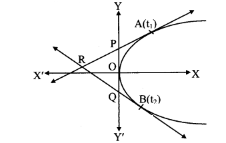
Question 135 Marks
Two tangents to the parabola $y^2=8 x$ meet the tangents at the vertex in the points $P$ and

Q. If PQ = 4, prove that the equation of the locus of the point of intersection of two

tangents is $y^2=8(x+2)$.

Answer
Given equation of the parabola is $y^2=8 x$

Comparing this equation with $y^2=4 a x$, we get

⇒ 4a = 8 ⇒ a = 2

Equation of tangent to given parabola at $A\left(t_1\right)$ is $y$

$t_1=x+2 t_1^2 \ldots \ldots$ (i)

Equation of tangent to given parabola at $B\left(t_2\right)$ is $y$

$t_2=x+2 t_2^2 \ldots$ (ii)

Image

A tangent at the vertex is Y-axis whose equation is x = 0.

x-coordinate of points P and Q is 0.

Let P be(0, k1) and Q be (0, k2).

Then, from (i) and (ii), we get

$\begin{aligned} & \mathrm{k}_1 \mathrm{t}_1=0+2 \mathrm{t}_1{ }^2 \text { and } \mathrm{k}_2 \mathrm{t}_2=0+2 \mathrm{t}_2{ }^2 \\ & \mathrm{k}_1=2 \mathrm{t}_1 \text { and } \mathrm{k}_2=2 t_2 \\ & \mathrm{P} \text { is }\left(0,2 \mathrm{t}_1\right) \text { and } \mathrm{Q} \text { is }\left(0,2 \mathrm{t}_2\right) \\ & \mathrm{PQ}=2\left|\mathrm{t}_1-\mathrm{t}_2\right|\end{aligned}$

But $P Q$ is given to be 4 .

$\begin{aligned} & 2\left|t_1-t_2\right|=4 \\ & \left(t_1-t_2\right)^2=4\end{aligned}$

...(iii)

Let $\mathrm{R}\left(x_1, y_1\right)$ be point of intersection of (i) and (ii).

$\begin{aligned} & y_1 t_1=x_1+2 t_1^2 \\ & \text { and } y_1 t_2=x_1+2 t_2^2\end{aligned}$

$\ldots$ (iv)

Subtracting, we get

$\begin{aligned} & y_1 t_1-y_1 t_2=2 t_1^2-2 t_2^2 \\ & y_1\left(t_1-t_2\right)=2\left(t_1+t_2\right)\left(t_1-t_2\right) \\ & y_1=2\left(t_1+t_2\right) \quad \ldots(v)\left[\because t_1 \neq t_2\right]\end{aligned}$

$\ldots(v)\left[\because t_1 \neq t_2\right]$

$\begin{aligned} & y_1 t_1=2\left(\mathrm{t}_1+\mathrm{t}_2\right) \mathrm{t}_1 \\ & x_1+2 t_1^2=2 t_1^2+2 t_1 t_2 \\ & \text {... From (iv)] } \\ & x_1=2 \mathrm{t}_1 \mathrm{t}_2 \\ & \end{aligned}$

To find the equation of locus of $\mathrm{R}\left(x_1, y_1\right)$,

eliminate $t_1$ and $t_2$ from the equations (iii), (v)

and (vi).

Squaring (v), we get

$\begin{aligned} y_1^2 & =4\left(\mathrm{t}_1+\mathrm{t}_2\right)^2 \\ & =4\left[\left(\mathrm{t}_1-\mathrm{t}_2\right)^2+4 \mathrm{t}_1 \mathrm{t}_2\right] \\ & =4\left[4+2 x_1\right] \quad \ldots[\text { From (iii) and (vi) }] . \\ y_1^2 & =8\left(x_1+2\right)\end{aligned}$

$\therefore$ Equation of locus of $R$ is $y^2=8(x+2)$.

View full question & answer
Solve the Following Question.(5 Marks) - Maths STD 11 Science Questions - Vidyadip