Question
$3 x^2+4 y^2=12$

Answer

Given equation of the ellipse is $3 x^2+4 y^2=12$

$\frac{x^2}{4}+\frac{y^2}{3}=1$

Comparing this equation with $\frac{x^2}{a^2}+\frac{y^2}{h^2}=1$, we get

$a^2=4$ and $b^2=3$

a = 2 and b = √3

Since a > b,

X-axis is the major axis and Y-axis is the minor axis.

(i) Length of major axis = 2a = 2(2) = 4

Length of minor axis = 2b = 2√3

Lengths of the principal axes are 4 and 2√3.

(ii) We know that $\mathrm{e}=\frac{\sqrt{a^2-b^2}}{a}$

$\begin{aligned} & =\frac{\sqrt{4-3}}{2} \\ & =\frac{1}{2}\end{aligned}$

Co-ordinates of the foci are S(ae, 0) and S'(-ae, 0),

i.e., $S\left(2\left(\frac{1}{2}\right), 0\right)$ and $S^{\prime}\left(-2\left(\frac{1}{2}\right), 0\right)$

i.e., S(1, 0) and S'(-1, 0)

(iii) Equations of the directrices are $x= \pm \frac{\mathrm{a}}{\mathrm{e}}$

$\begin{aligned} & = \pm \frac{2}{\frac{1}{2}} \\ & = \pm 4\end{aligned}$

(iv) Length of latus rectum $=\frac{2 b^2}{a}=\frac{2(\sqrt{3})^2}{2}=3$

(v) Distance between foci $=2 a e=2(2)\left(\frac{1}{2}\right)=2$

$\begin{aligned} & =\frac{2(2)}{\frac{1}{2}} \\ & =8\end{aligned}$

Need a full question paper?

Generate a complete, print-ready paper with questions like this in minutes — across 16+ boards, with answer keys.
Start Generating Free

Similar questions

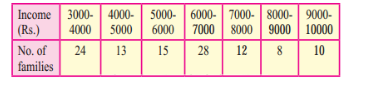
Calculate the coefficient of variation for the data given below:

Image

Differentiate the following from first principle$\tan\text{2x}$
Find the equation of the circle concentric with the circle $x^2 + y^2 - 6x + 12y + 15 = 0$ and double of its area.
$\begin{aligned}
& \cos A+\operatorname{Cos} B+C \cos C=4 \cos \frac{A}{2} \cos \frac{B}{2} \cos \frac{C}{2} \\
& =2 \cdot \cos \left(\frac{A+B}{2}\right) \cdot \cos \left(\frac{A-B}{2}\right)-\left(1-2 \sin ^2 \frac{C}{2}\right)
\end{aligned}$
A bag contains 6 red, 4 white and 8 blue balls. if three balls are drewn at random, find the probability that:
(i) One is red and two are white
(ii) Two are blue and one is red
(iii) One is red.
$\cos \frac{2 \pi}{15} \cos \frac{4 \pi}{15} \cos \frac{8 \pi}{15} \cos \frac{16 \pi}{15}=\frac{1}{16}$
Evaluate the following limit:
$\lim\limits_{\text{x}\rightarrow{\frac{\pi}{4}}}\frac{\cos\text{x}-\sin\text{x}}{\big(\frac\pi4-\text{x}\big)(\cos\text{x}+\sin\text{x})}$
If $A=\left[\begin{array}{cc}2 & -3 \\ 5 & -4 \\ -6 & 1\end{array}\right], B=\left[\begin{array}{cc}-1 & 2 \\ 2 & 2 \\ 0 & 3\end{array}\right]$ and $C=\left[\begin{array}{cc}4 & 3 \\ -1 & 4 \\ -2 & 1\end{array}\right]$

Show that

i. A+B=B+A

ii. (A + B) + C = A + (B + C)
Prove that $\left|\begin{array}{lll}1 & a & b c \\ 1 & b & c a \\ 1 & c & a b\end{array}\right|=\left|\begin{array}{lll}1 & a & a^2 \\ 1 & b & b^2 \\ 1 & c & c^2\end{array}\right|$
Find the co-ordinates of the circumcentre of the triangle whose vertices are A(- 2, 3), B(6, -1), C(4,3),e