Questions

Solve the Following Question.(5 Marks)

Take a timed test

20 questions · self-marked practice — reveal the answer and mark yourself.

Question 15 Marks
Prove The Theorem : The necessary condition for the equation $a_1 x+b_1 y+c_1=0, a_z x+b_y y+c_2=0$, $a_y x+b_y y+c_3=0$ to be consistent is
$
\left|\begin{array}{lll}
a_1 & b_1 & c_1 \\
a_2 & b_2 & c_2 \\
a_3 & b_3 & c_3
\end{array}\right|=0
$
View full question & answer
Question 25 Marks
Prove that $\left|\begin{array}{lll}1 & a & b c \\ 1 & b & c a \\ 1 & c & a b\end{array}\right|=\left|\begin{array}{lll}1 & a & a^2 \\ 1 & b & b^2 \\ 1 & c & c^2\end{array}\right|$
Answer
$
\begin{array}{r}
\text { L.H.S. }=\left|\begin{array}{lll}
1 & a & b c \\
1 & b & c a \\
1 & c & a b
\end{array}\right| \\
\mathrm{R}_1 \rightarrow \mathrm{aR}_1
\end{array}
$

$
\begin{gathered}
=\frac{1}{a}\left|\begin{array}{lll}
a & a^2 & a b c \\
1 & b & c a \\
1 & c & a b
\end{array}\right| \\
\mathrm{R}_2 \rightarrow \mathrm{bR}_2
\end{gathered}
$
$=\frac{1}{a} \times \frac{1}{b}\left|\begin{array}{lll}a & a^2 & a b c \\ b & b^2 & a b c \\ 1 & c & a b\end{array}\right|$
$
\mathrm{R}_3 \rightarrow \mathrm{cR}_3
$
$=\frac{1}{a} \times \frac{1}{b} \times \frac{1}{c}\left|\begin{array}{lll}a & a^2 & a b c \\ b & b^2 & a b c \\ c & c^2 & a b c\end{array}\right|$
$=\frac{1}{a b c} \times a b c\left|\begin{array}{lll}a & a^2 & 1 \\ b & b^2 & 1 \\ c & c^2 & 1\end{array}\right|$
(taking abc common from $\mathrm{C}_3$ )
$
\begin{aligned}
& =\left|\begin{array}{lll}
a & a^2 & 1 \\
b & b^2 & 1 \\
c & c^2 & 1
\end{array}\right| \\
& \mathrm{C}_1 \leftrightarrow \mathrm{C}_3 \\
& =(-1)\left|\begin{array}{lll}
1 & a^2 & a \\
1 & b^2 & b \\
1 & c^2 & c
\end{array}\right| \\
& \mathrm{C}_2 \leftrightarrow \mathrm{C}_3 \\
&
\end{aligned}
$
$
\begin{gathered}
=(-1)\left|\begin{array}{lll}
1 & a^2 & a \\
1 & b^2 & b \\
1 & c^2 & c
\end{array}\right| \\
\mathrm{C}_2 \leftrightarrow \mathrm{C}_3
\end{gathered}
$
$=(-1)(-1)\left|\begin{array}{lll}1 & a & a^2 \\ 1 & b & b^2 \\ 1 & c & c^2\end{array}\right|$
$
=\left|\begin{array}{lll}
1 & a & a^2 \\
1 & b & b^2 \\
1 & c & c^2
\end{array}\right|=\text { R.H.S. }
$

View full question & answer
Question 35 Marks
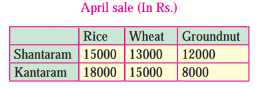
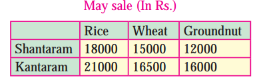
Two farmers Shantaram and Kantaram cultivate three crops rice, wheat, and groundnut. The sale (in Rupees) of these crops by both the farmers for the month of April and may 2008 is given below,

Image

Image

Find

(i) the total sale in rupees for two months of each farmer for each crop.

(ii) the increase in sales from April to May for every crop of each farmer.

Answer
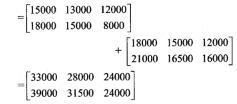
1. Total sale for Shantaram: For rice = 15000 + 18000 = ₹ 33000. For wheat = 13000 + 15000 = ₹ 28000. For groundnut = 12000 + 12000 = ₹ 24000. Total sale for Kantaram: For rice = 18000 + 21000 = ₹ 39000 For wheat = 15000 + 16500 = ₹ 31500 For groundnut = 8000 + 16000 = ₹ 24000 Alternate method: Matrix form

Image

∴ The total sale of April and May of Shantaram in ₹ is ₹ 33000 (rice), ₹ 28000 (wheat), ₹ 24000 (groundnut), and that of Kantaram in ₹ is ₹ 39000(rice), ₹ 31500(wheat), and ₹ 24000 (groundnut).

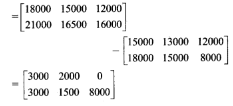
2. Increase in sale from April to May for Shantaram: For rice = 18000 – 15000 = ₹ 3000 For wheat = 15000 – 13000 = ₹ 2000 For groundnut = 12000 – 12000 = ₹ 0 Increase in sale from April to May for Kantaram: For rice = 21000 – 18000 = ₹ 3000 For wheat = 16500 – 15000 = ₹ 1500 For groundnut = 16000 – 8000 = ₹ 8000

Alternate method: Matrix form

Image

∴ The increase in sales for Shantaram from April to May in each crop is ₹ 3000 (rice), ₹ 2000(wheat), 0 (groundnut), and that for Kantaram is ₹ 3000 (rice), ₹ 1500 (wheat), and ₹ 8000 (groundnut)

View full question & answer
Question 45 Marks
If $A=\left[\begin{array}{cc}\cos \theta & \sin \theta \\ -\sin \theta & \cos \theta\end{array}\right]$, prove that $\mathrm{A}^n=\left[\begin{array}{cc}\cos n \theta & \sin n \theta \\ -\sin n \theta & \cos n \theta\end{array}\right]$, for all $n \in \mathbb{N}$.
Answer
$A=\left[\begin{array}{cc}\cos \theta & \sin \theta \\ -\sin \theta & \cos \theta\end{array}\right]$

Let $P(n)=A^{\mathbb{n}}=\left[\begin{array}{cc}\cos n \theta & \sin n \theta \\ -\sin n \theta & \cos n \theta\end{array}\right]$, for all $n \in N$.

Step 1: Put $n=1$

$\therefore \quad$ R.H.S. $=\left[\begin{array}{cc}\cos \theta & \sin \theta \\ \sin \theta & \cos \theta\end{array}\right]=\mathbf{A}=$ L.H.S.

$\therefore \quad P(n)$ is true for $n=1$.

Step 2: Let us consider that $\mathrm{P}(\mathrm{n})$ is true for $\mathrm{n}=\mathrm{k}$.

$\therefore \quad A^k=\left[\begin{array}{cc}\cos k \theta & \sin k \theta \\ -\sin k \theta & \cos k \theta\end{array}\right]$

...(i)

Step 3: We have to prove that $P(n)$ is true for

$\mathrm{n}=\mathrm{k}+\mathrm{l}$

i.e., to prove that

$\begin{aligned} & A^{k+1}=\left[\begin{array}{cc}\cos (k+1) \theta & \sin (k+1) \theta \\ -\sin (k+1) \theta & \cos (k+1) \theta\end{array}\right] \\ & \text { R.H.S. }=\left[\begin{array}{cc}\cos (k+1) \theta & \sin (k+1) \theta \\ -\sin (k+1) \theta & \cos (k+1) \theta\end{array}\right] \\ & \text { L.H.S. }=A^{k+1}=A^k \cdot A\end{aligned}$

$\begin{aligned} & =\left[\begin{array}{cc}\cos k \theta & \sin k \theta \\ -\sin k \theta & \cos k \theta\end{array}\right]\left[\begin{array}{cc}\cos \theta & \sin \theta \\ -\sin \theta & \cos \theta\end{array}\right] \quad \ldots[\text { From (i)] } \\ & =\left[\begin{array}{cc}\cos k \theta \cos \theta-\sin k \theta \sin \theta & \cos k \theta \sin \theta+\sin k \theta \cos \theta \\ -\sin k \theta \cos \theta-\cos k \theta \sin \theta & -\sin k \theta \sin \theta+\cos k \theta \cos \theta\end{array}\right] \\ & =\left[\begin{array}{cc}\cos k \theta \cos \theta-\sin k \theta \sin \theta & \sin k \theta \cos \theta+\cos k \theta \sin \theta \\ -(\sin k \theta \cos \theta+\cos k \theta \sin \theta) & \cos k \theta \cos \theta-\sin k \theta \sin \theta\end{array}\right]\end{aligned}$

$\begin{aligned} & =\left[\begin{array}{cc}\cos (k \theta+\theta) & \sin (k \theta+\theta) \\ -\sin (k \theta+\theta) & \cos (k \theta+\theta)\end{array}\right] \\ & =\left[\begin{array}{cc}\cos (k+1) \theta & \sin (k+1) \theta \\ -\sin (k+1) \theta & \cos (k+1) \theta\end{array}\right]\end{aligned}$

$=$ R.H.S.

$\therefore \quad P(n)$ is true for $n=k+1$.

Step 4: From all steps above, by the principle of

Mathematical induction, $P(n)$ is true for all

$\mathrm{n} \in \mathrm{N}$.

$\therefore \quad A^n=\left[\begin{array}{cc}\cos n \theta & \sin n \theta \\ -\sin n \theta & \cos n \theta\end{array}\right]$ for all $n \in N$.
View full question & answer
Question 55 Marks
If $A=\left[\begin{array}{ll}3 & -4 \\ 1 & -1\end{array}\right]$, prove that $A^n=\left[\begin{array}{cc}1+2 n & -4 n \\ n & 1-2 n\end{array}\right]$, for all $n \in \mathbf{N}$.
Answer
$A=\left[\begin{array}{ll}3 & -4 \\ 1 & -1\end{array}\right]$

Let $P(n) \equiv A^n=\left[\begin{array}{cc}1+2 n & -4 n \\ n & 1-2 n\end{array}\right]$, for all $n \in N$.

Step 1: Put n $=1$

$\begin{aligned} \text { R.H.S. } & =\left[\begin{array}{cc}1+2(1) & -4(1) \\ 1 & 1-2(1)\end{array}\right] \\ & =\left[\begin{array}{ll}3 & -4 \\ 1 & -1\end{array}\right] \\ & =\mathrm{A}=\text { L.H.S. }\end{aligned}$

$\therefore \quad \mathrm{P}(\mathrm{n})$ is true for $\mathrm{n}=1$.

Step 2: Let us consider that $P(n)$ is true for $n=k$.

$\therefore \quad A^k=\left[\begin{array}{cc}1+2 k & -4 k \\ k & 1-2 k\end{array}\right]$

...(i)

Step 3: We have to prove that $P(n)$ is true for

$\mathrm{n}=\mathrm{k}+1$

i.e., to prove that

$\begin{aligned} \mathrm{A}^{\mathrm{k}+1} & =\left[\begin{array}{cc}1+2(k+1) & -4(k+1) \\ k+1 & 1-2(k+1)\end{array}\right] \\ \text { R.H.S. } & =\left[\begin{array}{cc}1+2(k+1) & -4(k+1) \\ k+1 & 1-2(k+1)\end{array}\right] \\ & =\left[\begin{array}{cc}1+2 k+2 & -4 k-4 \\ k+1 & 1-2 k-2\end{array}\right] \\ & =\left[\begin{array}{cc}3+2 k & -4 k-4 \\ k+1 & -2 k-1\end{array}\right]\end{aligned}$

$\begin{aligned} \text { L.H.S. } & =A^{k+1} \\ & =A^k \cdot A\end{aligned}$

$\begin{aligned} & =\left[\begin{array}{cc}1+2 k & -4 k \\ k & 1-2 k\end{array}\right]\left[\begin{array}{cc}3 & -4 \\ 1 & -1\end{array}\right] \ldots[\text { From (i)] } \\ & =\left[\begin{array}{cc}3+6 k-4 k & -4-8 k+4 k \\ 3 k+1-2 k & -4 k-1+2 k\end{array}\right] \\ & =\left[\begin{array}{cc}3+2 k & -4 k-4 \\ k+1 & -2 k-1\end{array}\right]=\text { R.H.S. }\end{aligned}$

$\therefore \quad P(n)$ is true for $n=k+1$.

Step 4: From all steps above, by the principle of

Mathematical induction $P(n)$ is true for all

$\mathbf{n} \in \mathbf{N}$.

$\therefore \quad A^n=\left[\begin{array}{cc}1+2 n & -4 n \\ n & 1-2 n\end{array}\right]$ for all $n \in N$.
View full question & answer
Question 65 Marks
An amount of ₹ 5000 is put into three investments at the rate of interest of 6%, 7%, and 8% per annum respectively. The total annual income is ₹ 350. If the combined income from the first two investments is ₹ 70 more than the income from the third, find the amount of each investment.
Answer
Let the amount of each investment be ₹ $x, ₹ y$ and $₹ \mathrm{z}$. According to the given conditions,
$
\begin{aligned}
& x+y+z=5000 \text {, } \\
& 6 \% x+7 \% y+8 \% z=350 \\
& \therefore \quad \frac{6}{100} x+\frac{7}{100} y=\frac{8}{100} \mathrm{z}+70 \\
& \therefore \quad 6 x+7 y=8 z+7000 \\
& \therefore \quad 6 x+7 y-8 z=7000 \\
& \therefore \quad \mathrm{D}=\left|\begin{array}{ccc}
1 & 1 & 1 \\
6 & 7 & 8 \\
6 & 7 & -8
\end{array}\right| \\
& =1(-56-56)-1(-48-48)+1(42-42) \\
& =-112+96+0 \\
& =-16 \neq 0 \\
& \mathrm{D}_x=\left|\begin{array}{ccc}
5000 & 1 & 1 \\
35000 & 7 & 8 \\
7000 & 7 & -8
\end{array}\right| \\
&
\end{aligned}
$
Taking 1000 common from $C_1$, we get
$
\mathrm{D}_x=1000\left|\begin{array}{ccc}
5 & 1 & 1 \\
35 & 7 & 8 \\
7 & 7 & -8
\end{array}\right|
$
Applying $\mathrm{C}_1 \rightarrow \mathrm{C}_1-5 \mathrm{C}_3$ and $\mathrm{C}_2 \rightarrow \mathrm{C}_2-\mathrm{C}_3$, we get
$
\begin{aligned}
\mathrm{D}_x & =1000\left|\begin{array}{ccc}
0 & 0 & 1 \\
-5 & -1 & 8 \\
47 & 15 & -8
\end{array}\right| \\
& =1000[0-0+1(-75+47)] \\
& =1000 \times(-28) \\
& =-28000
\end{aligned}
$
$
\mathrm{D}_y=\left|\begin{array}{ccc}
1 & 5000 & 1 \\
6 & 35000 & 8 \\
6 & 7000 & -8
\end{array}\right|
$
Taking 1000 common from $C_2$, we get
$
\mathrm{D}_y=1000\left|\begin{array}{ccc}
1 & 5 & 1 \\
6 & 35 & 8 \\
6 & 7 & -8
\end{array}\right|
$
Applying $\mathrm{C}_1 \rightarrow \mathrm{C}_1-\mathrm{C}_3$ and $\mathrm{C}_2 \rightarrow \mathrm{C}_2-5 \mathrm{C}_3$, we get
$
\begin{aligned}
D_y & =1000\left|\begin{array}{ccc}
0 & 0 & 1 \\
-2 & -5 & 8 \\
14 & 47 & -8
\end{array}\right| \\
& =1000[0-0+1(-94+70) \\
& =1000(-24) \\
& =-24000
\end{aligned}
$
$
\mathrm{D}_{\mathrm{z}}=\left|\begin{array}{rrr}
1 & 1 & 5000 \\
6 & 7 & 35000 \\
6 & 7 & 7000
\end{array}\right|
$
Taking 1000 common from $C_3$, we get
$
D_z=1000\left|\begin{array}{ccc}
1 & 1 & 5 \\
6 & 7 & 35 \\
6 & 7 & 7
\end{array}\right|
$
Applying $\mathrm{C}_1 \rightarrow \mathrm{C}_1-\mathrm{C}_2$ and $\mathrm{C}_3 \rightarrow \mathrm{C}_3-5 \mathrm{C}_2$, we get
$
\begin{aligned}
\mathrm{D}_{\mathrm{z}} & =1000\left|\begin{array}{ccc}
0 & 1 & 0 \\
-1 & 7 & 0 \\
-1 & 7 & -28
\end{array}\right| \\
& =1000[0-1(28-0)+0] \\
& =1000 \times(-28) \\
& =-28000
\end{aligned}
$
By Cramer's Rule,
$
\begin{aligned}
& x=\frac{\mathrm{D}_x}{\mathrm{D}}=\frac{-28000}{-16}=1750, \\
& y=\frac{\mathrm{D}_y}{\mathrm{D}}=\frac{-24000}{-16}=1500, \\
& \mathrm{z}=\frac{\mathrm{D}_{\mathrm{Z}}}{\mathrm{D}}=\frac{-28000}{-16}=1750,
\end{aligned}
$
$\therefore$ The amounts of investments are ₹ 1750, ₹ 1500, and ₹ 1750.
View full question & answer
Question 75 Marks
If $\mathrm{A}=\left[\begin{array}{ll}a & 0 \\ 0 & b\end{array}\right]$, prove that $A^n=\left[\begin{array}{cc}a^n & 0 \\ 0 & b^n\end{array}\right]$ for all $n \in N$.
Answer
Given $\mathrm{A}=\left[\begin{array}{ll}a & 0 \\ 0 & b\end{array}\right]$
We prove $A^n=\left[\begin{array}{cc}a^n & 0 \\ 0 & b^n\end{array}\right]$ for all $\mathrm{n} \in \mathrm{N}$ using mathematical induction
Let $\mathrm{P}(\mathrm{n})$ be $=\left[\begin{array}{cc}a^n & 0 \\ 0 & b^n\end{array}\right]$ for $\mathrm{n} \in \mathrm{N}$.
To prove that $\mathrm{P}(\mathrm{n})$ is true for $\mathrm{n}=1$
$\mathrm{P}(1)$ is $A^1=\mathrm{A}=\left[\begin{array}{ll}a & 0 \\ 0 & b\end{array}\right] \quad \therefore \mathrm{P}(1)$ is true.
Assume that $\mathrm{P}(\mathrm{K})$ is true for some $\mathrm{K} \in \mathrm{N}$
That is $\mathrm{P}(\mathrm{K})$ is $A^k=\left[\begin{array}{cc}a^K & 0 \\ 0 & b^K\end{array}\right]$
To prove that $\mathrm{P}(\mathrm{K}) \rightarrow \mathrm{P}(\mathrm{K}+1)$ is true consider L.H.S. of $\mathrm{P}(\mathrm{K}+1)$
That is $A^{k+1}$
$
\begin{aligned}
& =A^k \cdot \mathrm{A} \\
& =\left[\begin{array}{cc}
a^K & 0 \\
0 & b^K
\end{array}\right]\left[\begin{array}{ll}
a & 0 \\
0 & b
\end{array}\right]=\left[\begin{array}{cc}
a^{K+1}+0 & 0+0 \\
0+0 & b^{K+1}+0
\end{array}\right] \\
& =\left[\begin{array}{cc}
a^{K+1} & 0 \\
0 & b^{K+1}
\end{array}\right]=\text { R.H.S of } \mathrm{P}(\mathrm{K}+1)
\end{aligned}
$
Hence $\mathrm{P}(\mathrm{K}+1)$ is true.
$\therefore \mathrm{P}(\mathrm{K}) \Rightarrow \mathrm{P}(\mathrm{K}+1)$ for all $\mathrm{K} \in \mathrm{N}$
Hence by principle of mathematical induction, the statement $P(n)$ is true for all $n \in N$.

That is $\mathrm{P}(\mathrm{n})$ is true $\rightarrow \mathrm{P}(2)$ is true $\rightarrow \mathrm{P}(3)$ is true and so on $\rightarrow P(n)$ is true, $n \in N$.
$\therefore=\mathrm{A}^n\left[\begin{array}{cc}a^n & 0 \\ 0 & b^n\end{array}\right] \quad$ for all $\mathrm{n} \in \mathrm{N}$.

View full question & answer
Question 85 Marks
The cost of $2$ books, $6$ notebooks and $3$ pens is $Rs.120.$ The cost of $3$ books, $4$ notebooks and $2$ pens is $Rs. 105.$ while the cost of $5$ books, $7$ notebooks and $4$ pens is $Rs. 183.$ Using this information find the cost of $1$ book, $1$ notebook and $1$ pen.
Answer
Let $Rs.x , Rs.  y$ and $Rs. z$ be the cost of one book, one notebook and one pen respectively. Then by given information
we have,
$D=\left|\begin{array}{lll}2 & 6 & 3 \\ 3 & 4 & 2 \\ 5 & 7 & 4\end{array}\right|$
$ =2(16-14)-6(12-10)+3(21-20)$
$ =2(2)-6(2)+3(1)$
$ =4-12+3$
$ =7-12$
$ =-5$
$\mathrm{D} x=\left|\begin{array}{lll}120 & 6 & 3 \\ 105 & 4 & 2 \\ 183 & 7 & 4\end{array}\right|=3\left|\begin{array}{lll}40 & 6 & 3 \\ 35 & 4 & 2 \\ 61 & 7 & 4\end{array}\right|$
$ =3[40(16-14)-6(140-122)+3(245-244)]$
$ =3[40(2)-6(18)+3(1)]$
$ =3[80-108+3]$
$ =3[83-108]$
$ =3[-25]$
$=-75$
$\mathrm{D} y=\left|\begin{array}{lll}2 & 120 & 3 \\ 3 & 105 & 2 \\ 5 & 183 & 4\end{array}\right|=3\left|\begin{array}{lll}2 & 40 & 3 \\ 3 & 35 & 2 \\ 5 & 61 & 4\end{array}\right|$
$ =3[2(140-122)-40(12-10)+3(183-175)]$
$ =3[2(18)-40(2)+3(8)]$
$ =3[36-80+24]$
$ =3[60-80]$
$ =3[-20]$
$ =-60$
$\mathrm{Dz}=\left|\begin{array}{ccc}2 & 6 & 40 \\ 3 & 4 & 35 \\ 5 & 7 & 61\end{array}\right|=3\left|\begin{array}{ccc}2 & 6 & 120 \\ 3 & 4 & 105 \\ 5 & 7 & 183\end{array}\right|$
$ =3[2(244-245)-6(183-175)+40(21-20)]$
$ =3[2(-1)-6(8)+40(1)]$
$ =3[-2-48+40]$
$ =3[-50+40]$
$ =3[-10]$
$ =-30$
$\therefore x=\frac{D x}{D}=\frac{-75}{-5}=15, y=\frac{D y}{D}=\frac{-60}{-5}=12$
$ \mathrm{z}=\frac{D z}{D}=\frac{-30}{-5}=6$
$\therefore Rs. 15 , Rs. 12 , Rs. 6$ are the costs of one book, one notebook and one pen respectively.
View full question & answer
Question 95 Marks
Solve the following equations by using determinant
$\frac{1}{x}+\frac{1}{y}+\frac{1}{z}=-2, \frac{1}{x}-\frac{2}{y}+\frac{1}{z}=3, \frac{2}{x}-\frac{1}{y}+\frac{3}{2}=-1$
Answer
$\text { Put } \frac{1}{x}=p \quad \frac{1}{y}=q \quad \frac{1}{z}=r$
$\therefore$ Equations are
$
\begin{aligned}
& \mathrm{p}+\mathrm{q}+\mathrm{r}=-2 \\
& \mathrm{p}-2 \mathrm{q}+\mathrm{r}=3 \\
& 2 p-q+3 r=-1 \\
& D=\left|\begin{array}{rrr}
1 & 1 & 1 \\
1 & -2 & 1 \\
2 & -1 & 3
\end{array}\right| \\
& =1(-6+1)-1(3-2)+1(-1+4) \\
& =-5-1+3 \\
& =-3 \\
& D p=\left|\begin{array}{lll}
-2 & 1 & 1 \\
3 & -2 & 1 \\
-1 & -1 & 3
\end{array}\right| \\
& =-2(-6+1)-1(9+1)+1(-3-2) \\
& =10-10-5 \\
& =-5 \\
& \mathrm{Dq}=\left|\begin{array}{rrr}
1 & -2 & 1 \\
1 & 3 & 1 \\
2 & -1 & 3
\end{array}\right| \\
& =1(9+1)+2(3-2)+1(-1-6) \\
& =10+2-7 \\
& =5 \\
& \operatorname{Dr}=\left|\begin{array}{rrr}
1 & 1 & -2 \\
1 & -2 & 3 \\
2 & -1 & -1
\end{array}\right| \\
& =1(2+3)-1(-1-6)-2(-1+4) \\
& =5+7-6 \\
& =6 \\
\end{aligned}
$$
\begin{aligned}
& \therefore \quad p=\frac{D p}{D}=\frac{-5}{-3}=\frac{5}{3}, \\
& q=\frac{D q}{q}=\frac{5}{-3}=\frac{-5}{3} \text {, } \\
& r=\frac{D r}{D}=\frac{6}{-3}=-2 \\
& \therefore \frac{1}{x}=p=\frac{5}{3} \quad \therefore x=\frac{3}{5} \text {, } \\
& \therefore \frac{1}{y}=q=\frac{-5}{3} \therefore y=\frac{-3}{5} \text {, } \\
& \therefore \frac{1}{z}=r=-2 \therefore z=\frac{-1}{2} \\
&
\end{aligned}
$
$\therefore x=\frac{3}{5}, y=\frac{-3}{5}, z=\frac{-1}{2}$ are the solutions of the equations.
View full question & answer
Question 105 Marks
By using Cramer's rule solve the following linear equations.
$x+y-z=1,8 x+3 y-6 z=1,-4 x-y+3 z=1$
Answer
Given equations are
$
\begin{aligned}
& x+y-z=1 \\
& 8 x+3 y-6 z=1 \\
& -4 x-y+3 z=1
\end{aligned}
$
$
\begin{aligned}
\mathrm{D} & =\left|\begin{array}{lrr}
1 & 1 & -1 \\
8 & 3 & -6 \\
-4 & 1 & 3
\end{array}\right| \\
& =1(9-6)-1(24-24)-1(-8+12) \\
& =3+0-4 \\
& =-1
\end{aligned}
$
$
\begin{aligned}
\text { Dx } & =\left|\begin{array}{rrr}
1 & 1 & -1 \\
1 & 3 & -6 \\
1 & -1 & 3
\end{array}\right| \\
& =1(9-6)-1(3+6)-1(-1-3) \\
& =3-9+4 \\
& =-2
\end{aligned}
$
$
\begin{aligned}
\text { Dy } & =\left|\begin{array}{lrr}
1 & 1 & -1 \\
8 & 3 & -6 \\
-4 & 1 & 3
\end{array}\right| \\
& =1(3+6)-1(24-24)-1(8+4) \\
& =9-0-12 \\
& =-3
\end{aligned}
$
$
\begin{aligned}
\mathrm{Dz} & =\left|\begin{array}{lrr}
1 & 1 & 1 \\
8 & 3 & 1 \\
-4 & -1 & 1
\end{array}\right| \\
& =1(3+1)-1(8+4)+1(-8+12) \\
& =4-12+4 \\
& =8-12 \\
& =-4
\end{aligned}
$
$\therefore x=\frac{D x}{D}=\frac{-2}{-1}=2, y=\frac{D y}{D}=\frac{-3}{-1}=3$ and $\therefore z=\frac{D z}{D}=\frac{-4}{-1}=4$
$\therefore x=2, y=3, z=4$ are the solutions of the given equations.
View full question & answer
Question 115 Marks
If $A=\left[\begin{array}{cc}2 & -1 \\ 3 & -2 \\ 4 & 1\end{array}\right]$ and $B=\left[\begin{array}{ccc}0 & 3 & -4 \\ 2 & -1 & 1\end{array}\right]$, verify thati. $(A B)^{\top}=B^{\top} A^{\top}$
ii. $(BA)^T = A^TB^T$
Answer
$A=\left[\begin{array}{cc}2 & -1 \\ 3 & -2 \\ 4 & 1\end{array}\right]$ and $B=\left[\begin{array}{ccc}0 & 3 & -4 \\ 2 & -1 & 1\end{array}\right]$$\therefore \quad A^{\top}=\left[\begin{array}{ccc}2 & 3 & 4 \\ -1 & -2 & 1\end{array}\right]$ and $B^{\mathrm{T}}=\left[\begin{array}{cc}0 & 2 \\ 3 & -1 \\ -4 & 1\end{array}\right]$
i. $\mathrm{AB}=\left[\begin{array}{cc}2 & -1 \\ 3 & -2 \\ 4 & 1\end{array}\right]\left[\begin{array}{ccc}0 & 3 & -4 \\ 2 & -1 & 1\end{array}\right]$
$=\left[\begin{array}{ccc}0-2 & 6+1 & -8-1 \\ 0-4 & 9+2 & -12-2 \\ 0+2 & 12-1 & -16+1\end{array}\right]$
$=\left[\begin{array}{ccc}-2 & 7 & -9 \\ -4 & 11 & -14 \\ 2 & 11 & -15\end{array}\right]$
$\therefore \quad(\mathrm{AB})^{\mathrm{T}}=\left[\begin{array}{ccc}-2 & -4 & 2 \\ 7 & 11 & 11 \\ -9 & -14 & -15\end{array}\right]$
$\ldots$..i)
$\mathbf{B}^{\mathrm{T}} \mathbf{A}^{\mathrm{T}}=\left[\begin{array}{cc}0 & 2 \\ 3 & -1 \\ -4 & 1\end{array}\right]\left[\begin{array}{ccc}2 & 3 & 4 \\ -1 & -2 & 1\end{array}\right]$
$=\left[\begin{array}{ccc}0-2 & 0-4 & 0+2 \\ 6+1 & 9+2 & 12-1 \\ -8-1 & -12-2 & -16+1\end{array}\right]$
$=\left[\begin{array}{ccc}-2 & -4 & 2 \\ 7 & 11 & 11 \\ -9 & -14 & -15\end{array}\right]$
...(ii)
From (i) and (ii), we get
$(A B)^{\top}=B^{\top} A^{\top}$
ii.
$
\begin{aligned}
\mathrm{BA} & =\left[\begin{array}{ccc}
0 & 3 & -4 \\
2 & -1 & 1
\end{array}\right]\left[\begin{array}{cc}
2 & -1 \\
3 & -2 \\
4 & 1
\end{array}\right] \\
& =\left[\begin{array}{cc}
0+9-16 & 0-6-4 \\
4-3+4 & -2+2+1
\end{array}\right]
\end{aligned}
$
$
\therefore \quad \mathrm{BA}=\left[\begin{array}{cc}
-7 & -10 \\
5 & 1
\end{array}\right]
$
$
\therefore \quad(\mathrm{BA})^{\mathrm{T}}=\left[\begin{array}{cc}
-7 & 5 \\
-10 & 1
\end{array}\right]
$
$
\begin{aligned}
A^{\mathrm{T}} B^{\mathrm{T}} & =\left[\begin{array}{ccc}
2 & 3 & 4 \\
-1 & -2 & 1
\end{array}\right]\left[\begin{array}{cc}
0 & 2 \\
3 & -1 \\
-4 & 1
\end{array}\right] \\
& =\left[\begin{array}{cc}
0+9-16 & 4-3+4 \\
0-6-4 & -2+2+1
\end{array}\right] \\
& =\left[\begin{array}{cc}
-7 & 5 \\
-10 & 1
\end{array}\right] .
\end{aligned}
$
From (i) and (ii) we get
$
(B A)^{\top}=A^{\top} B^{\top}
$
View full question & answer
Question 125 Marks
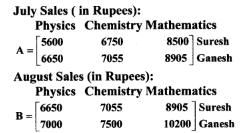
There are two book shops owned by Suresh and Ganesh. Their sales (in Rupees) for books in three subjects – Physics, Chemistry and Mathematics for two months, July and August 2017 are given by two matrices A and B.

Image

i. Find the increase in sales in Rupees from July to August 2017.

ii. If both book shops got 10% profit in the month of August 2017, find the profit for each bookseller in each subject in that month.

Answer
Increase in sales in rupees from July to August 2017 For Suresh: Increase in sales for Physics books = 6650 – 5600= ₹ 1050 Increase in sales for Chemistry books = 7055 – 6750 = ₹ 305 Increase in sales of Mathematics books = 8905 – 8500 = ₹ 405 For Ganesh: Increase in sales for Physics books = 7000 – 6650 = ₹ 350 Increase in sales for Chemistry books = 7500 – 7055 = ₹ 445 Increase in sales for Mathematics books = 10200 – 8905 = ₹ 1295 [Note: Answers given in the textbook are 1760, 2090. However, as per our calculation, they are 1050, 305, 405, 350, 445, 1295.]

2.Both book shops got 10% profit in the month of August 2017.For Suresh:

Profit for Physics books $=\frac{6650 \times 10}{100}=₹ 665$

Profit for Chemistry books $=\frac{7055 \times 10}{100}=₹ 705.50$

Profit for Mathematics books $=\frac{8905 \times 10}{100}=₹ 890.50$

For Ganesh:

Profit for Physics books $=\frac{7000 \times 10}{100}=₹ 700$

Profit for Chemistry books $=\frac{7500 \times 10}{100}=₹ 750$

Profit for Mathematics books $=\frac{10200 \times 10}{100}=₹ 1020$

[Note: Answers given in the textbook for Suresh’s profit in Chemistry and Mathematics books are ? 675 and ?850 respectively. However, as per our calculation profit amounts are ₹ 705.50 and ₹ 890.50 respectively.]

View full question & answer
Question 135 Marks
If $A=\left[\begin{array}{cc}2 & -3 \\ 5 & -4 \\ -6 & 1\end{array}\right], B=\left[\begin{array}{cc}-1 & 2 \\ 2 & 2 \\ 0 & 3\end{array}\right]$ and $C=\left[\begin{array}{cc}4 & 3 \\ -1 & 4 \\ -2 & 1\end{array}\right]$

Show that

i. A+B=B+A

ii. (A + B) + C = A + (B + C)
Answer
$A+B=\left[\begin{array}{cc}2 & -3 \\ 5 & -4 \\ -6 & 1\end{array}\right]+\left[\begin{array}{cc}-1 & 2 \\ 2 & 2 \\ 0 & 3\end{array}\right]$

$=\left[\begin{array}{cc}2-1 & -3+2 \\ 5+2 & -4+2 \\ -6+0 & 1+3\end{array}\right]$

$\therefore \quad A+B=\left[\begin{array}{cc}1 & -1 \\ 7 & -2 \\ -6 & 4\end{array}\right]$

....(i)

$B+A=\left[\begin{array}{cc}-1 & 2 \\ 2 & 2 \\ 0 & 3\end{array}\right]+\left[\begin{array}{cc}2 & -3 \\ 5 & -4 \\ -6 & 1\end{array}\right]$

$=\left[\begin{array}{cc}-1+2 & 2-3 \\ 2+5 & 2-4 \\ 0-6 & 3+1\end{array}\right]$

$\therefore \quad B+A=\left[\begin{array}{cc}1 & -1 \\ 7 & -2 \\ -6 & 4\end{array}\right]$

From (i) and (ii), we get A + B = B + A

$(A+B)+C=\left\{\left[\begin{array}{cc}2 & -3 \\ 5 & -4 \\ -6 & 1\end{array}\right]+\left[\begin{array}{cc}-1 & 2 \\ 2 & 2 \\ 0 & 3\end{array}\right]\right\}+\left[\begin{array}{cc}4 & 3 \\ -1 & 4 \\ -2 & 1\end{array}\right]$

$=\left[\begin{array}{cc}2-1 & -3+2 \\ 5+2 & -4+2 \\ -6+0 & 1+3\end{array}\right]+\left[\begin{array}{cc}4 & 3 \\ -1 & 4 \\ -2 & 1\end{array}\right]$

$=\left[\begin{array}{cc}1 & -1 \\ 7 & -2 \\ -6 & 4\end{array}\right]+\left[\begin{array}{cc}4 & 3 \\ -1 & 4 \\ -2 & 1\end{array}\right]$

$=\left[\begin{array}{cc}1+4 & -1+3 \\ 7-1 & -2+4 \\ -6-2 & 4+1\end{array}\right]$

$\therefore \quad(\mathrm{A}+\mathrm{B})+\mathrm{C}=\left[\begin{array}{cc}5 & 2 \\ 6 & 2 \\ -8 & 5\end{array}\right]$

$\ldots$...(i)

$\begin{aligned} A+(B+C) & =\left[\begin{array}{cc}2 & -3 \\ 5 & -4 \\ -6 & 1\end{array}\right]+\left\{\left[\begin{array}{cc}-1 & 2 \\ 2 & 2 \\ 0 & 3\end{array}\right]+\left[\begin{array}{cc}4 & 3 \\ -1 & 4 \\ -2 & 1\end{array}\right]\right\} \\ & =\left[\begin{array}{cc}2 & -3 \\ 5 & -4 \\ -6 & 1\end{array}\right]+\left[\begin{array}{cc}-1+4 & 2+3 \\ 2-1 & 2+4 \\ 0-2 & 3+1\end{array}\right] \\ & =\left[\begin{array}{cc}2 & -3 \\ 5 & -4 \\ -6 & 1\end{array}\right]+\left[\begin{array}{cc}3 & 5 \\ 1 & 6 \\ -2 & 4\end{array}\right]\end{aligned}$

$=\left[\begin{array}{cc}2+3 & -3+5 \\ 5+1 & -4+6 \\ -6-2 & 1+4\end{array}\right]$

$=\left[\begin{array}{cc}5 & 2 \\ 6 & 2 \\ -8 & 5\end{array}\right]$

..(ii)

$(A+B)+C=A+(B+C)$

View full question & answer
Question 145 Marks
The sum of three numbers is 15. If the second number is subtracted from the sum of first and third numbers, then we get 5. When the third number is subtracted from the sum of twice the first number and the second number, we get 4. Find the three numbers.
Answer
Let the three numbers be x, y and z. According to the given conditions, x + y + z = 15, x + z-y = 5, i.e., x – y + z = 5, 2x + y – z = 4.

$D=\left|\begin{array}{ccc}1 & 1 & 1 \\ 1 & -1 & 1 \\ 2 & 1 & -1\end{array}\right|$

= 1(1 – 1) – 1(-1 – 2) + 1(1 + 2) = 1(0) – 1(-3) + 1(3) = 0 + 3 + 3 = 6 ≠ 0

$D_x=\left|\begin{array}{ccc}15 & 1 & 1 \\ 5 & -1 & 1 \\ 4 & 1 & -1\end{array}\right|$

$\begin{aligned} & =15(1-1)-1(-5-4)+1(5+4) \\ & =15(0)-1(-9)+1(9) \\ & =0+9+9 \\ & =18\end{aligned}$

$D_y=\left|\begin{array}{ccc}1 & 15 & 1 \\ 1 & 5 & 1 \\ 2 & 4 & -1\end{array}\right|$

= 1(-5 – 4) – 15(-1 – 2) + 1(4 – 10) = 1(-9) – 15(-3) + 1(-6) = -9 + 45 – 6 = 30

$D_z=\left|\begin{array}{ccc}1 & 1 & 15 \\ 1 & -1 & 5 \\ 2 & 1 & 4\end{array}\right|$

= 1(-4 – 5) – 1(4 – 10) + 15(1 + 2) = 1(-9) – 1(-6) + 15(3) = -9 + 6 + 45 = 42

By Cramer’s Rule,

$x=\frac{\mathrm{D}_x}{\mathrm{D}}=\frac{18}{6}=3, y=\frac{\mathrm{D}_y}{\mathrm{D}}=\frac{30}{6}=5$

$z=\frac{D_z}{D}=\frac{42}{6}=7$

∴ The three numbers are 3, 5 and 7.

View full question & answer
Question 155 Marks
Solve the following linear equations by using Cramer’s Rule : $\frac{-2}{x}-\frac{1}{y}-\frac{3}{z}=3, \frac{2}{x}-\frac{3}{y}+\frac{1}{z}=-13$ and $\frac{2}{x}-\frac{3}{z}=-11$
Answer
Put $\frac{1}{x}=p_1, \frac{1}{y}=\mathrm{q}, \frac{1}{z}=\mathrm{r}$.
Then the given equations become,
$
\begin{aligned}
& -2 p-q-3 r=3 \\
& 2 p-3 q+r=-13 \\
& 2 p-3 r=-11 \\
& \therefore D=\left|\begin{array}{ccc}
-2 & -1 & -3 \\
2 & -3 & 1 \\
2 & 0 & -3
\end{array}\right| \\
& =-2(9-0)+1(-6-2)-3(0+6) \\
& =-18-8-18 \\
& =-44 \neq 0 \\
& D_p=\left|\begin{array}{ccc}
3 & -1 & -3 \\
-13 & -3 & 1 \\
-11 & 0 & -3
\end{array}\right| \\
& =3(9-0)+1(39+11)-3(0-33) \\
& =27+50+99 \\
& =176 \\
& D_q=\left|\begin{array}{ccc}
-2 & 3 & -3 \\
2 & -13 & 1 \\
2 & -11 & -3
\end{array}\right| \\
& =-2(39+11)-3(-6-2)-3(-22+26) \\
& =-100+24-12 \\
& =-88 \\
& D_r=\left|\begin{array}{ccc}
-2 & -1 & 3 \\
2 & -3 & -13 \\
2 & 0 & -11
\end{array}\right| \\
& =-2(33+0)+1(-22+26)+3(0+6) \\
& =-66+4+18 \\
& =-44 \\
&
\end{aligned}
$
$\therefore$ by Cramer's rule,
$
\begin{aligned}
& p=\frac{D_p}{D}=\frac{176}{-44}=-4 \\
& q=\frac{D_q}{D}=\frac{-88}{-44}=2 \\
& r=\frac{D_1}{D}=\frac{-44}{-44}=1 \\
& \therefore p=\frac{1}{x}=-4, q=\frac{1}{y}=2, r=\frac{1}{z}=1 \\
& \therefore x=-\frac{1}{4}, y=\frac{1}{2}, z=1 .
\end{aligned}
$
View full question & answer
Question 165 Marks
Solve the following linear equations by using Cramer’s Rule : x + z = 1, y + z = 1, x + y = 4
Answer
Given equations are
$
\begin{aligned}
& x+z=1 \text {, i.e. } x+0 y+z=1 \text {, } \\
& y+z=1 \text {, i.e., } 0 x+y+z=1 \text {, } \\
& x+y=4 \text {, i.e., } x+y+0 z=4 \text {. } \\
& D=\left|\begin{array}{lll}
1 & 0 & 1 \\
0 & 1 & 1 \\
1 & 1 & 0
\end{array}\right| \\
& =1(0-1)-0+1(0-1) \\
& =1(-1)+1(-1) \\
& =-1-1 \\
& =-2=0 \\
& D_x=\left|\begin{array}{lll}
1 & 0 & 1 \\
1 & 1 & 1 \\
4 & 1 & 0
\end{array}\right| \\
& =1(0-1)-0+1(1-4) \\
& =1(-1)+1(-3) \\
& =-1-3 \\
& =-4 \\
& D_y=\left|\begin{array}{lll}
1 & 1 & 1 \\
0 & 1 & 1 \\
1 & 4 & 0
\end{array}\right| \\
& =1(0-4)-1(0-1)+1(0-1) \\
& =1(-4)-1(-1)+1(-1) \\
& =-4+1-1 \\
& =-4 \\
& D_2=\left|\begin{array}{lll}
1 & 0 & 1 \\
0 & 1 & 1 \\
1 & 1 & 4
\end{array}\right| \\
& =1(4-1)-0+1(0-1) \\
& =1(3)+1(-1) \\
& =3-1 \\
& =2 \\
&
\end{aligned}
$
By Cramer's Rule,
$
\begin{aligned}
& x=\frac{D_x}{D}=\frac{-4}{-2}=2, y=\frac{D_y}{D}=\frac{-4}{-2}=2 \\
& z=\frac{D_x}{D}=\frac{2}{-2}=-1 \\
& \therefore x=2, y=2 \text { and } z=-1 \text { are the solutions of the given equations. }
\end{aligned}
$
$\therefore x=2, y=2$ and $z=-1$ are the solutions of the given equations.
View full question & answer
Question 175 Marks
Solve the following linear equations by using Cramer’s Rule : x + y – 2z = -10, 2x +y – 3z = -19, 4x + 6y + z = 2
Answer
The given equations are
$
\begin{aligned}
& x+y-2 z=-10 \\
& 2 x+y-3 z=-19 \\
& 4 x+6 y+z=2 \\
& \therefore D=\left|\begin{array}{ccc}
1 & 1 & -2 \\
2 & 1 & -3 \\
4 & 6 & 1
\end{array}\right| \\
& =1(1+18)-1(2+12)-2(12-4) \\
& =19-14-16 \\
& =-11 \neq 0 \\
& D_x=\left|\begin{array}{ccc}
-10 & 1 & -2 \\
-19 & 1 & -3 \\
2 & 6 & 1
\end{array}\right| \\
& =-10(1+18)-1(-19+6)-2(-114-2) \\
& =-190+13+232 \\
& =55 \\
& D_y=\left|\begin{array}{ccc}
1 & -10 & -2 \\
2 & -19 & -3 \\
4 & 2 & 1
\end{array}\right| \\
& =1(-19+6)+10(2+12)-2(4+76) \\
& =-13+140-160 \\
& =-33 \\
& D_2=\left|\begin{array}{ccc}
1 & 1 & -10 \\
2 & 1 & -19 \\
4 & 6 & 2
\end{array}\right| \\
& =1(2+114)-1(4-76)-10(12-4) \\
& =116-80-80 \\
& =-44 \\
& \therefore \text { by Cramer's rule } \\
& x=\frac{D_x}{D}=\frac{55}{-11}=-5 \\
& y=\frac{D_y}{D}=\frac{-33}{-11}=3 \\
& z=\frac{D_x}{D}=\frac{-44}{-11}=4 \\
& \therefore x=-5, y=3, z=4 \text {. } \\
&
\end{aligned}
$
View full question & answer
Question 185 Marks
Solve the following linear equations by using Cramer’s Rule : x+y + z = 6, x – y + z = 2,.x + 2y – z = 2
Answer
Given equations are
$
\begin{aligned}
& x+y+z=6 \text {. } \\
& x-y+z=2 \\
& x+2 y-z=2 \\
& D=\left|\begin{array}{ccc}
1 & 1 & 1 \\
1 & -1 & 1 \\
1 & 2 & -1
\end{array}\right| \\
& =1(1-2)-1(-1-1)+1(2+1) \\
& =1(-1)-1(-2)+1(3) \\
& =-1+2+3 \\
& =4 \neq 0 \\
& D_x=\left|\begin{array}{ccc}
6 & 1 & 1 \\
2 & -1 & 1 \\
2 & 2 & -1
\end{array}\right| \\
& =6(1-2)-1(-2-2)+1(4-2) \\
& =6(-1)-1(-4)+1(6) \\
& =-6+4+6 \\
& =4 \\
& D_y=\left|\begin{array}{ccc}
1 & 6 & 1 \\
1 & 2 & 1 \\
1 & 2 & -1
\end{array}\right| \\
& =1(-2-2)-6(-1-1)+1(2-2) \\
& =1(-4)-6(-2)+1(0) \\
& =-4+12+0 \\
& =8 \\
& D_2=\left|\begin{array}{ccc}
1 & 1 & 6 \\
1 & -1 & 2 \\
1 & 2 & 2
\end{array}\right| \\
& =1(-2-4)-1(2-2)+6(2+1) \\
& =1(-6)-1(0)+6(3) \\
& =-6+0+18 \\
& =12 \\
&
\end{aligned}
$
By Cramer's Rule,
$
\begin{aligned}
& x=\frac{D_x}{D}=\frac{4}{4}=1, y=\frac{D_y}{D}=\frac{8}{4}=2 \text { and } \\
& z=\frac{D_x}{D}=\frac{12}{4}=3
\end{aligned}
$
$\therefore x=1, y=2$ and $z=3$ are the solutions of the given equations.
View full question & answer
Question 195 Marks
Evaluate $\left|\begin{array}{ccc}2 & -3 & 5 \\ 6 & 0 & 4 \\ 1 & 5 & -7\end{array}\right|$ and cofactors of elements in the $2^{nd}$ determinant and verify:
$i. -a_{21} \cdot M_{21}+a_{22} \cdot M_{22}-a_{23} \cdot M_{23}=$ value of $A a_{21} \cdot C_{21}+a_{22} \cdot C_{22}+a_{23} \cdot C_{23}-$ value of $A$ where $M_{21}, M_{22}, M_{23}$ are minors of $a_{21}, a_{22}, a_{23}$ and $C_{21}, C_{22}, C_{23}$ are cofactors of $a_{21}, a_{22}, a_{23}$.
Answer
$\begin{aligned} & A=\left|\begin{array}{ccc}2 & -3 & 5 \\ 6 & 0 & 4 \\ 1 & 5 & -7\end{array}\right| \end{aligned} $
$ =2\left|\begin{array}{cc}0 & 4 \\ 5 & -7\end{array}\right|-(-3)\left|\begin{array}{cc}6 & 4 \\ 1 & -7\end{array}\right|+5\left|\begin{array}{cc}6 & 0 \\ 1 & 5\end{array}\right|$
$ =2(0-20)+3(-42-4)+5(30-0)=2(-20)+3(-46)+5(30)$
$ =2(0-20)+3(-42-4)+5(30-0)=2(-20)+3(-46)+5(30)$
$ =-40-138+150$
$=-28$
Here, $\left|\begin{array}{lll}a_{11} & a_{12} & a_{13} \\ a_{21} & a_{22} & a_{23} \\ a_{31} & a_{32} & a_{33}\end{array}\right|=\left|\begin{array}{ccc}2 & -3 & 5 \\ 6 & 0 & 4 \\ 1 & 5 & -7\end{array}\right|$
$\begin{aligned} & \mathrm{M}_{21}=\left|\begin{array}{cc}-3 & 5 \\ 5 & -7\end{array}\right|=21-25=-4 \end{aligned} $
$ \mathrm{C}_{21}=(-1)^{2+1} \mathrm{M}_{21}=(-1)(-4)=4  $
$ \mathrm{M}_{22}=\left|\begin{array}{cc}2 & 5 \\ 1 & -7\end{array}\right|=-14-5=-19  $
$ \mathrm{C}_{22}=(-1)^{2+2} \mathrm{M}_{22}=(1)(-19)=-19  $
$ \mathrm{M}_{23}=\left|\begin{array}{cc}2 & -3 \\ 1 & 5\end{array}\right|=10+3=13$
$ \mathrm{C}_{23}=(-1)^{2+3} \mathrm{M}_{23}=(-1)(13)=-13$
$ -\mathrm{a}_{21} \cdot M_{21}+\mathrm{a}_{22} \cdot M_{22}-\mathrm{a}_{23} \cdot M_{23}$
$ =-(6)(-4)+(0)(-19)-(4)(13)$
$ =24+0-52$
$ =-28$
$ -a_{21} \cdot M_{21}+a_{22} \cdot M_{22}-a_{23} \cdot M_{23}=$ value of $A$
$ \text { ii. } a_{21} \cdot C_{21}+a_{22} \cdot C_{22}+a_{23} \cdot C_{23}$
$ =(6)(4)+(0)(-19)+(4)(-13)$
$ =24+0-52 .$
$ =-28$
$ a_{21} \cdot C_{21}+a_{22} \cdot C_{22}+a_{23} \cdot C_{23}=$ value of $A$
View full question & answer
Question 205 Marks
Find the minors and cofactors of elements of the determinant $D=\left|\begin{array}{ccc}2 & -1 & 3 \\ 1 & 2 & -1 \\ 5 & 7 & 2\end{array}\right|$
Answer
Here, $\left|\begin{array}{lll}a_{11} & a_{12} & a_{13} \\ a_{21} & a_{22} & a_{23} \\ a_{31} & a_{32} & a_{33}\end{array}\right|=\left|\begin{array}{ccc}2 & -1 & 3 \\ 1 & 2 & -1 \\ 5 & 7 & 2\end{array}\right|$
$\begin{aligned} & M_{11}=\left|\begin{array}{cc}2 & -1 \\ 7 & 2\end{array}\right|=4+7=11 \end{aligned} $
$ C_{11}=(-1)^{1+1} M_{11}=(1)(11)=11  $
$ M_{12}=\left|\begin{array}{cc}1 & -1 \\ 5 & 2\end{array}\right|=2+5=7  $
$ C_{12}=(-1)^{1+2} M_{12}=(-1)(7)=11  $
$ M_{13}=\left|\begin{array}{ll}1 & 2 \\ 5 & 7\end{array}\right|=7-10=-3  $
$ C_{13}=(-1)^{1+3} M_{13}=(1)(-3)=-3  $
$ M_{21}=\left|\begin{array}{cc}-1 & 3 \\ 7 & 2\end{array}\right|=-2-21=23  $
$ C_{21}=(-1)^{2+1} M_{21}=(-1)(-23)=23  $
$ M_{22}=\left|\begin{array}{ll}2 & 3 \\ 5 & 2\end{array}\right|=4-15=-11$
$C_{22}=(-1)^{2+2} M_{22}=(1)(-11)=-11 $
$M_{31}=\left|\begin{array}{cc}-1 & 3 \\ 1 & -1\end{array}\right|=1-6=-5$
$M_{23}=\left|\begin{array}{cc}2 & -1 \\ 5 & 7\end{array}\right|=14+5=19  $
$ C_{31}=(-1)^{3+1} M_{31}=(1)(-5)=-5$
$\begin{aligned} & C_{23}=(-1)^{1+1} M_{23}=(1)(11)=11 \end{aligned} $
$ M_{32}=\left|\begin{array}{cc}2 & 3 \\ 1 & -1\end{array}\right|=-2-3=-5 $
$ C_{32}=(-1)^{3+2} M_{32}=(-1)(-5)=5  $
$ M_{33}=\left|\begin{array}{cc}2 & -1 \\ 1 & 2\end{array}\right|=4+1=5  $
$ C_{33}=(-1)^{3+3} M_{33}=(1)(5)=5$
View full question & answer