MCQ 1012 Marks
A straight line moves so that the sum of the reciprocals of its intercepts on two perpendicular lines is constant, then the line passes through
Answer(A)
Take two perpendicular lines as the coordinate axes. If a , b be the intercepts made by the moving line on the coordinate axes, then the equation of the line is
$\frac{x}{a}+\frac{y}{b}=1$ ...(i)
Let $\frac{1}{a}+\frac{1}{b}=\frac{1}{k}$
i.e., $\quad \frac{k}{a}+\frac{k}{b}=1$ ...(ii)
The result (ii) shows that the straight line (i) passes through a fixed point (k , k ).
View full question & answer→MCQ 1022 Marks
The intercept of a line between the coordinate axes is divided by the point (-5, 4) in the ratio 1: 2 . The equation of the line will be
Answer(B)
Let the line intersects coordinate axes at $A ( a , 0)$ and $B(0, b)$, but the point $(-5,4)$ divides the line AB in the ratio of $1: 2$.
$\therefore \quad-5=\frac{2( a )+1(0)}{2+1}$ and $4=\frac{2(0)+1(b)}{2+1}$
$\therefore \quad A \equiv\left(\frac{-15}{2}, 0\right)$ and $B \equiv(0,12)$.
$\therefore \quad$ Required equation is $8 x-5 y+60=0$.
View full question & answer→MCQ 1032 Marks
The point P(a, b) lies on the straight line 3x + 2y = 13 and the point Q(b, a) lies on the straight line 4x - y = 5, then the equation of line PQ is
Answer(B)
Point $P ( a , b )$ is on $3 x+2 y=13$
So, $3 a+2 b=13$ ...(i)
Point $Q ( b , a )$ is on $4 x-y=5$
So, $4 b-a-5$ ...(ii)
By solving (i) and (ii), we get
$a=3, b=2$
Now, equation of PQ is
$y-y_1=\frac{y_2-y_1}{x_2-x_1}\left(x-x_1\right)$
$\Rightarrow y-2=\frac{3-2}{2-3}(x-3) \Rightarrow y-2=-(x-3)$
$\Rightarrow x+y=5$
View full question & answer→MCQ 1042 Marks
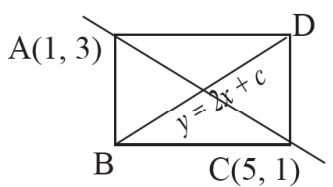
The points (1, 3) and (5, 1) are the opposite vertices of a rectangle. The other two vertices lie on the line y = 2x + c, then the value of c will be
MCQ 1052 Marks
A line AB makes zero intercepts on X - axis and Y - axis and it is perpendicular to another line CD, 3x + 4y + 6 = 0. The equation of line AB is
Answer(C)
Given, line AB makes 0 intercepts on X - axis and Y - axis so, $\left(x_1, y_1\right)=(0,0)$
Slope of perpendicular $=\frac{4}{3}$
Equation is $y-0=\frac{4}{3}(x-0)$
$\Rightarrow 4 x-3 y=0$
View full question & answer→MCQ 1062 Marks
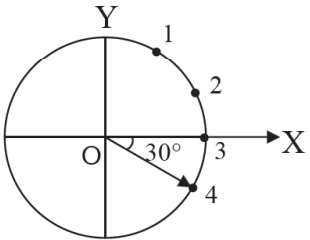
Equation of the hour hand at 4 O' clock is
- A
$x-\sqrt{3} y=0$
- B
$\sqrt{3} x-y=0$
- C
$x+\sqrt{3} y=0$
- D
$\sqrt{3} x+y=0$
View full question & answer→MCQ 1072 Marks
The equation of the straight line passing through the point $\left(a \cos ^3 \theta, a \sin ^3 \theta\right)$ and perpendicular to the line $x \sec \theta+y \operatorname{cosec} \theta=a$ is
- ✓
$x \cos \theta-y \sin \theta= a \cos 2 \theta$
- B
$x \cos \theta+y \sin \theta= a \cos 2 \theta$
- C
$x \sin \theta+v \cos \theta=a \cos 2 \theta$
- D
AnswerCorrect option: A. $x \cos \theta-y \sin \theta= a \cos 2 \theta$
(A)
$x \cos \theta-y \sin \theta=a\left(\cos ^4 \theta-\sin ^4 \theta\right)=a \cos 2 \theta$
View full question & answer→MCQ 1082 Marks
A(- 1, 1) B(5, 3) are opposite vertices of a square in xy-plane. The equation of the other diagonal not passing through (A, B) of the square is given by
Answer(C)
The required diagonal passes through the nidpoint of AB and is perpendicular to AB . So, its equation is $y-2=-3(x-2)$ or $y+3 x-8=0$.
View full question & answer→MCQ 1092 Marks
The opposite vertices of a square are (1, 2) and (3, 8), then the equation of a diagonal of the square passing through the point (1, 2), is
Answer(A)
$\text { Slope }=\frac{8-2}{3-1}=3$
The diagonal is $y-2=3(x-1)$
$\Rightarrow 3 x-y-1=0$
View full question & answer→MCQ 1102 Marks
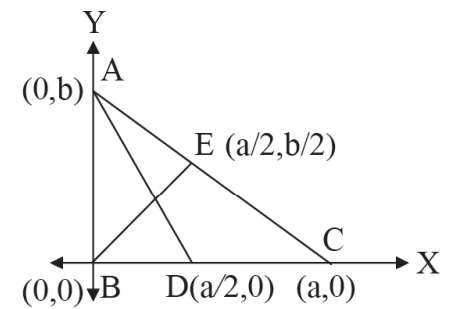
The medians AD and BE of a triangle with vertices A(0, b) B(0, 0) and C(a,0) are perpendicular to each other, if
- A
$a=\sqrt{2} b$
- B
$a=-\sqrt{2} b$
- C
- D
View full question & answer→MCQ 1112 Marks
Let PS be the median of the triangle with vertices P(2, 2) Q(6, - 1) and R(7, 3) The equation of the line passing through (1, -1) and parallel to PS is
Answer(D)
$S =$ midpoint of $QR =\left(\frac{6+7}{2}, \frac{-1+3}{2}\right)=\left(\frac{13}{2}, 1\right)$
∴ Slope of $PS =\frac{2-1}{2-\frac{13}{2}}=-\frac{2}{9}$
∴ The required equation is $y+1=\frac{-2}{9}(x-1)$
i.e., $2 x+9 y+7=0$
View full question & answer→MCQ 1122 Marks
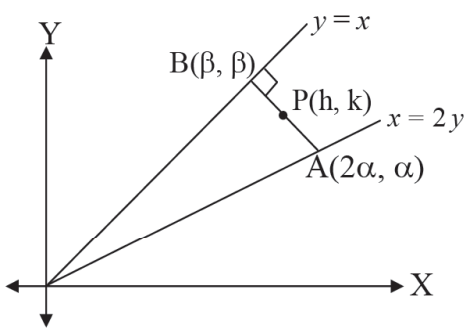
The locus of the mid-points of the perpendiculars drawn from points on the line, x = 2y to the line x = y is
MCQ 1132 Marks
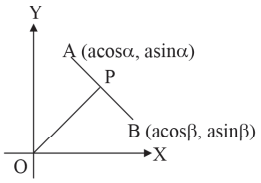
A straight line through origin bisects the line passing through the given points $(a \cos \alpha, a \sin \alpha)$ and (a $\cos \beta$, a $\sin \beta)$, then the lines are
View full question & answer→MCQ 1142 Marks
If the line passing through (4, 3) and (2, k) is perpendicular to y = 2x + 3 then k =
Answer(D)
$\begin{array}{l}m_1 m_2=-1 \\ \Rightarrow\left(\frac{k-3}{2-4}\right)(2)=-1 \Rightarrow 2 k-6=2 \Rightarrow k=4\end{array}$
View full question & answer→MCQ 1152 Marks
The inclination of the straight line passing through the point (-3, 6) and the midpoint of the line joining the points (4, -5) and (-2, 9) is
- A
$\frac{\pi}{4}$
- B
$\frac{\pi}{6}$
- C
$\frac{\pi}{3}$
- ✓
$\frac{3 \pi}{4}$
AnswerCorrect option: D. $\frac{3 \pi}{4}$
(D)
Midpoint of the line joining the points $(4,-5)$ and $(-2,9)$ is $\left(\frac{4-2}{2}, \frac{-5+9}{2}\right)$ i.e., $(1,2)$
∴ Inclination of straight line passing through point $(-3,6)$ and midpoint (1,2) is
$\begin{array}{l}m=\frac{2-6}{1+3} \Rightarrow \tan \theta=-1 \\\Rightarrow \theta=\frac{3 \pi}{4}\end{array}$
View full question & answer→MCQ 1162 Marks
By shifting the origin to a point to reduce the equation $2 x^2-y^2-4 x+4 y-3=0$ to the form $\frac{ X ^2}{ a ^2}-\frac{ Y ^2}{b^2}=1( a >0, b>0)$, the value of a and b will be
- ✓
$a=\frac{1}{\sqrt{2}}, b=1$
- B
$a=\frac{1}{\sqrt{2}}, b=\frac{1}{\sqrt{2}}$
- C
$a=\sqrt{2}, b=1$
- D
$a=1, b=1$
AnswerCorrect option: A. $a=\frac{1}{\sqrt{2}}, b=1$
(A)
$2 x^2-y^2-4 x+4 y-3=0$
can be expressed as
$2\left(x^2-2 x\right)-\left(y^2-4 y\right)-3=0$
$\Rightarrow 2\left(x^2-2 x+1-1\right)-\left(y^2-4 y+4-4\right)-3=0$
$\Rightarrow 2(x-1)^2-(y-2)^2=1$
$\Rightarrow \frac{(x-1)^2}{\left(\frac{1}{2}\right)}-\frac{(y-2)^2}{1}=1$
Comparing it with $\frac{ X ^2}{ a ^2}-\frac{ Y ^2}{b^2}=1$, we get
$a ^2=\frac{1}{2}$ and $b ^2=1$
$\therefore \quad a=\frac{1}{\sqrt{2}}, b=1$ ...$[\because a>0, b>0]$
View full question & answer→MCQ 1172 Marks
Transforming to parallel axes through a point (p, q), the equation
$x^2+3 x y+4 y^2+x+18 y+25=0$ becomes $2 x^2+3 x y+4 y^2=0$, then
Answer(B)
$2 x^2+3 x y+4 y^2=0$
i.e. $2 X^2+3 X Y+4 Y^2=0$
Replacing X by $x- p$ and Y by $y- q$, we get
$2(x- p )^2+3(x- p )(y- q )+4(y- q )^2=0$
$\Rightarrow 2\left(x^2-2 x p + p ^2\right)+3(x y-x q - p y+ pq )$$+4\left(y^2-2 q y+ q ^2\right)=0$
$\Rightarrow 2 x^2+3 x y+4 y^2-x(4 p +3 q )-y(3 p +8 q )$$+2 p^2+3 p q+4 q^2=0$
Comparing the above equation with
$2 x^2+3 x y+4 y^2+x+18 y+25=0$, we get
$4 p+3 q=-1$ ...(i)
$3 p+8 q=-18$ ...(ii)
On solving (i) and (ii), we get
$p =2, q =-3$
View full question & answer→MCQ 1182 Marks
If the origin is shifted to the point $\left(\frac{a b}{a-b}, 0\right)$, the new equation of the locus whose old equation $( a - b )\left(x^2+y^2\right)-2 ab x=0$, is
- A
$(a+b)\left(X^2+Y^2\right)-a^2 b^2=0$
- ✓
$(a-b)^2\left(X^2+Y^2\right)-a^2 b^2=0$
- C
$(a-b)\left(X^2+Y^2\right)+a^2 b^2=0$
- D
$(a+b)^2\left(X^2+Y^2\right)+a^2 b^2=0$
AnswerCorrect option: B. $(a-b)^2\left(X^2+Y^2\right)-a^2 b^2=0$
(B)
Given, $h =\frac{ ab }{ a - b }, k =0$
∴ Substituting $x= X +\frac{ ab }{ a - b }$ and $y= Y$
in the equation $(a-b)\left(x^2+y^2\right)-2 a b x-0$, we get
$(a-b)\left[\left(X+\frac{a b}{a-b}\right)^2+Y^2\right]-2 a b\left[X+\frac{a b}{a-b}\right]=0$
By solving, we get
$(a-b)^2\left(X^2+Y^2\right)-a^2 b^2=0$
View full question & answer→MCQ 1192 Marks
If the origin is shifted to the point (-3, 8), axes remaining parallel, (4, q) lies on the new X-axis and (p, 5) lies on the new Y-axis, then the values of p and q are
Answer(A)
Given, $(h, k) \equiv(-3,8)$
$(-4, q)$ lies on new $X$-axis.
∴ $(x, y)=(-4, q )$ and $Y =0$
But, $y= Y + k$
$q =0+8$
$\Rightarrow q=8$
Also, ( $p , 5$ ) lies on new Y -axis.
$(x, y)=(p, 5) \text { and } X=0$
But, $x= X + h$
$p=0-3$
$\Rightarrow p=-3$
View full question & answer→MCQ 1202 Marks
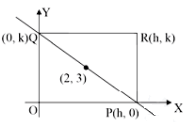
A straight line through a fixed point (2, 3) intersects the coordinate axes at distinct points P and Q. If O is the origin and the rectangle OPRQ is completed, then the locus of R is
MCQ 1212 Marks
A is a point on the X-axis and B is a point on the Y-axis such that 2. OA =3.OB. The equation of a locus of the point P which divides seg AB externally in the ratio 4:3 is
Answer(C)
A is a point on X -axis and B is a point on Y-axis.
Let A be $( a , 0)$ and B be $(0, b)$
Let $P (x, y)$ be any point on the locus.
Then, P divides seg AB externally in the ratio $4: 3$
$\therefore \quad x=\frac{4(0)-3( a )}{4-3}=-3 a , y=\frac{4(b)-3(0)}{4-3}=4 b$
$\therefore \quad a =\frac{-x}{3}, \quad b=\frac{y}{4}$
Now, $2.0 A=3.0 B$
$\Rightarrow 2 \sqrt{(a-0)^2}=3 \sqrt{(b-0)^2}$
$\Rightarrow 2 a=3 b$ ...(i)
Substituting value of a and b in equation (i), we get
$2\left(\frac{-x}{3}\right)=3\left(\frac{y}{4}\right)$
$\Rightarrow-8 x=9 y \Rightarrow 8 x+9 y=0$
View full question & answer→MCQ 1222 Marks
A(- 5, 2) and B is the point on the locus of equation $x^2+y^2-2 x+4 y+8=0$. If point P divides AB in the 2:1 , then equation of locus of P will be
- ✓
$x^2+y^2-14 x+12 y+97=0$
- B
$x^2-y^2-7 x+14 y+42=0$
- C
$x^2+y^2-3 x-5 y+87=0$
- D
$x^2+y^2-5 x+8 y-87=0$
AnswerCorrect option: A. $x^2+y^2-14 x+12 y+97=0$
(A)
Let $B \equiv(h, k)$
Since, point 'B' lies on the locus
$x^2+y^2-2 x+4 y+8=0$
$\therefore\ h^2+k^2-2 h+4 k+8=0$ ...(i)
Also, P(x, v) divides AB externally in the ratio 2:1
$\therefore \quad x=\frac{2 h-1(-5)}{2-1}, y=\frac{2 k -1(2)}{2-1}$
$\therefore \quad h =\frac{x-5}{2}, \quad k =\frac{y+2}{2}$
Putting values of h and k in (i), we get
$\left(\frac{x-5}{2}\right)^2+\left(\frac{y+2}{2}\right)^2-2\left(\frac{x-5}{2}\right)+4\left(\frac{y+2}{2}\right)+8=0$
$\begin{aligned} \Rightarrow x^2-10 x+ & 25+y^2+4 y \\ & +4-4 x+20+8 y+16+32=0\end{aligned}$
$\Rightarrow x^2+y^2-14 x+12 y+97=0$
View full question & answer→MCQ 1232 Marks
P and Q are two points on co-ordinate axes such that PQ = 7 If R divide PQ internally in the ratio 4:3 , then equation of locus of R is
- A
$x^2+y^2=16$
- B
$\frac{x^2}{16}+\frac{y^2}{9}=1$
- C
$\frac{x^2}{9}+\frac{y^2}{25}=1$
- ✓
$\frac{x^2}{9}+\frac{y^2}{16}=1$
AnswerCorrect option: D. $\frac{x^2}{9}+\frac{y^2}{16}=1$
(D)
Let $P \equiv( a , 0)$ and $Q \equiv(0, b)$
Since, $PQ =7$
$\therefore \quad \sqrt{a^2+b^2}=7$
$\therefore \quad a^2+b^2=49$ ...(i)
Let $R (x, y)$ divide PQ in ratio $4: 3$
$\therefore \quad x=\frac{4 \times 0+3 \times a }{4+3}, y=\frac{4 \times b +3 \times 0}{4+3}$
$\therefore \quad x=\frac{3 a }{7}, y=\frac{4 b}{7}$
$\therefore \quad a =\frac{7 x}{3}, b=\frac{7 y}{4}$
Putting $a$ and $b$ in equation (i), we get
$\left(\frac{7 x}{3}\right)^2+\left(\frac{7 y}{4}\right)^2=49$
$\therefore \quad \frac{49 x^2}{9}+\frac{49 y^2}{16}=49$
$\therefore \quad \frac{x^2}{9}+\frac{y^2}{16}=1$
View full question & answer→MCQ 1242 Marks
The locus of the mid-point of the portion intercepted between the axes of the variable line $x \cos \alpha+y \sin \alpha= p$, where p is a constant, is
- A
$x^2+y^2=4 p ^2$
- ✓
$\frac{1}{x^2}+\frac{1}{y^2}=\frac{4}{ p ^2}$
- C
$x^2+y^2=\frac{4}{ p ^2}$
- D
$\frac{1}{x^2}+\frac{1}{y^2}=\frac{2}{ p ^2}$
AnswerCorrect option: B. $\frac{1}{x^2}+\frac{1}{y^2}=\frac{4}{ p ^2}$
(B)
The straight line $x \cos \alpha+y \sin \alpha= p$ meets the X -axis at the point $A \left(\frac{ p }{\cos\alpha}, 0\right)$ and the Y -axis at the point $B \left(0, \frac{ p }{\sin \alpha}\right)$.
Let ($h , k$) be the co-ordinates of the middle point of the line segment AB .
Then, $h =\frac{ p }{2 \cos \alpha}$ and $k =\frac{ p }{2 \sin \alpha}$
$\Rightarrow \cos \alpha=\frac{ p }{2 h}$ and $\sin \alpha=\frac{ p }{2 k }$
$\cos ^2 \alpha+\sin ^2 \alpha=\frac{ p ^2}{4 h^2}+\frac{ p ^2}{4 k ^2}$
$\Rightarrow 1=\frac{p^2}{4}\left(\frac{1}{h^2}+\frac{1}{ k ^2}\right)$
$\Rightarrow \frac{1}{h^2}+\frac{1}{ k ^2}=\frac{4}{ p ^2}$
Hence, locus of the point $( h , k )$ is
$\frac{1}{x^2}+\frac{1}{y^2}=\frac{4}{ p ^2}$.
View full question & answer→MCQ 1252 Marks
Let P be (1, 0) and Q be a point on the locus $y^2=8 x$ The locus of mid-point of PQ isThe locus of mid-point of PQ isThe locus of mid-point of PQ isThe locus of mid-point of PQ isThe locus of mid-point of PQ is
- A
$x^2+4 y+2=0$
- B
$x^2-4 y+2=0$
- ✓
$y^2-4 x+2=0$
- D
$y^2+4 x+2=0$
AnswerCorrect option: C. $y^2-4 x+2=0$
(C)
Let $M (x, y)$ be the mid-point of PQ and $Q ( h , k )$ Since, $Q ( h , k )$ is the point on the locus
$k^2=8 h$
Also, $M (x, y)$ is the mid point of PQ$x=\frac{1+ h }{2}$, and $y=\frac{0+ k }{2}$$h =2 x-1$, and $k =2 y$
Substituting value of $h$ and $k$ in equation (i), we get
$(2 y)^2=8(2 x-1)$
$\Rightarrow 4 y^2-16 x+8=0$
$\therefore$ locus of $M (x, y)$ is $y^2-4 x+2=0$
View full question & answer→MCQ 1262 Marks
Equation of the locus of the centroid of the triangle whose vertices are (a cos k, a sin k), (b sin k, - b cos k) and (1, 0), where k is a parameter, is
- ✓
$(1-3 x)^2+9 y^2=a^2+b^2$
- B
$(3 x-1)^2+9 y^2=2 a^2+2 b^2$
- C
$(3 x+1)^2+(3 y)^2=a^2+b^2$
- D
$(3 x+1)^2+(3 y)^2=3 a^2+3 b^2$
AnswerCorrect option: A. $(1-3 x)^2+9 y^2=a^2+b^2$
(A)
Let $P (x, y)$ be the centroid of the triangle.
$\therefore \quad x=\frac{ a \cos k + b \sin k +1}{3}$
$\Rightarrow 3 x-1=a \cos k+b \sin k \ldots$ (i)
$y=\frac{ a \sin k - b \cos k +0}{3}$
$\Rightarrow 3 y=a \sin k-b \cos k$... (ii)
Squaring (i) and (ii) and adding, we get
$(3 x-1)^2+9 y^2=a^2+b^2$
i.e., $(1-3 x)^2+9 y^2=a^2+b^2$
View full question & answer→MCQ 1272 Marks
The locus of a point so that sum of its distance from two given perpendicular lines is equal to 2 unit in first quadrant, is
Answer(B)
We take the coordinate axes as two perpendicular lines.
Let $P \left(x_1, y_1\right)$ be any point on the locus.
From $P \left(x_1, y_1\right)$, we draw PM and PN perpendicular to OX and OY respectively.
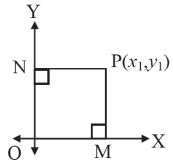
Given, $PM + PN =2$ ...(i)
But, $PM =y_1, PN =x_1$$y_1+x_1=2$...[From (i)]
Thus, locus of $\left(x_1, y_1\right)$ is $x+y=2$
View full question & answer→MCQ 1282 Marks
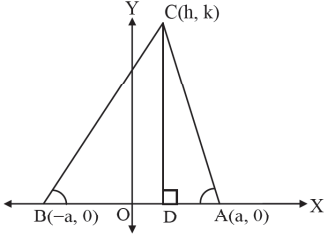
A(a, 0) and B(- a, 0) are two fixed points of triangle ABC. The vertex C moves in such a way that cot A + cot B = $\lambda$, where $\lambda$ is a constant. Then the locus of the point C is
- A
$y \lambda=2 a$
- B
$y a =2 \lambda$
- C
$y=\lambda a$
- D
View full question & answer→MCQ 1292 Marks
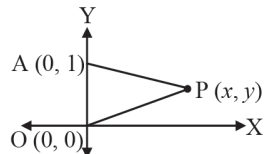
Let O (0, 0) and A(0, 1) be two fixed points. Then the locus of a point P such that the perimeter of $\triangle AOP$ is 4, is
- A
$8 x^2-9 y^2+9 y=18$
- B
$9 x^2-8 y^2+8 y=16$
- C
$9 x^2+8 y^2-8 y=16$
- D
$8 x^2+9 y^2-9 y=18$
View full question & answer→MCQ 1302 Marks
Given the points A(0, 4) and B(0, - 4). Then the equation of the locus of the point P(x, y) such that |AP - BP| = 6, is
- A
$\frac{x^2}{7}+\frac{y^2}{9}=1$
- B
$\frac{x^2}{9}+\frac{y^2}{7}=1$
- C
$\frac{x^2}{7}-\frac{y^2}{9}=1$
- ✓
$\frac{y^2}{9}-\frac{x^2}{7}=1$
AnswerCorrect option: D. $\frac{y^2}{9}-\frac{x^2}{7}=1$
(D)
We have, $| AP - BP |=6$
$\Rightarrow\left|\sqrt{(x-0)^2+(y-4)^2}-\sqrt{(x-0)^2+(y+4)^2}\right|=6$
$\Rightarrow\left|\sqrt{x^2+y^2-8 y+16}-\sqrt{x^2+y^2+8 y+16}\right|=6$
Squaring on both sides, we get
$2 x^2+2 y^2-4$
$=2\left(\sqrt{x^2+y^2-8 y+16}\right)\left(\sqrt{x^2+y^2+8 y+16}\right)$
$\Rightarrow x^2+y^2-2$
$=\left(\sqrt{x^2+y^2-8 y+16}\right)\left(\sqrt{x^2+y^2+8 y+16}\right)$
Again, squaring on both sides, we get
$\left(x^2+y^2-2\right)^2=\left(x^2+y^2+16\right)^2-(8 y)^2$
$x^4+y^4+4+2 x^2 y^2-4 y^2-4 x^2$
$=x^4+y^4+256+2 x^2 y^2+32 y^2+32 x^2-64 y^2$
$\Rightarrow 28 y^2-36 x^2=252$
$\Rightarrow \frac{y^2}{9}-\frac{x^2}{7}=1$
View full question & answer→MCQ 1312 Marks
A point P moves such that sum of the distances from point (c, 0) and (c, 0) is 2a, then equation of locus of P such that $b^2=a^2-c^2$, is
- A
$\frac{x^2}{b^2}+\frac{y^2}{a^2}=1$
- B
$a x^2+b y^2=a b$
- ✓
$\frac{x^2}{a^2}+\frac{y^2}{b^2}=1$
- D
$\frac{x^2}{ a ^2}-\frac{y^2}{b^2}=1$
AnswerCorrect option: C. $\frac{x^2}{a^2}+\frac{y^2}{b^2}=1$
(C)
Let $P (x, y)$ be any point on the locus then
$PA + PB =2 a$
$\therefore \quad \sqrt{(x- c )^2+y^2}=2 a -\sqrt{(x+ c )^2+y^2}$
Squaring both sides, we get
$(x- c )^2+y^2=4 a ^2-4 a \sqrt{(x+ c )^2+y^2}+(x+ c )^2+y^2$
$\Rightarrow-2 c x=4 a ^2-4 a \sqrt{(x+ c )^2+y^2}+2 c x$
$\Rightarrow a \sqrt{(x+ c )^2+y^2}= a ^2+ c x$
$\Rightarrow a ^2 x^2+2 a ^2 c x+ a ^2 c ^2+ a ^2 y^2= a ^4+2 a ^2 c x+ c ^2 x^2$
$\Rightarrow\left( a ^2- c ^2\right) x^2+ a ^2 y^2= a ^2\left( a ^2- c ^2\right)$
Dividing both sides by $a ^2\left( a ^2- c ^2\right)$, we get
$\frac{x^2}{ a ^2}+\frac{y^2}{ a ^2- c ^2}=1$
But, $a ^2- c ^2= b ^2$....[Given]
$\therefore \quad \frac{x^2}{ a ^2}+\frac{y^2}{b^2}-1$
View full question & answer→MCQ 1322 Marks
Equation of locus of a point, so that the segment joining the points (3, 2) and (-5, 1) subtends a right angle at that point, is
- A
$x^2+y^2-2 x-3 y+13=0$
- B
$x^2-y^2+2 x-3 y+12=0$
- ✓
$x^2+y^2+2 x-3 y-13=0$
- D
$x^2+y^2-2 x-2 y+13=0$
AnswerCorrect option: C. $x^2+y^2+2 x-3 y-13=0$
(C) Let $P (x, y)$ be any point on the locus and $A \equiv(3,2)$ and $B \equiv(-5,1)$, then $\angle APB =90^{\circ}$
∴ By Pythagoras theorem,
$AP ^2+ BP ^2= AB ^2$
$\begin{aligned} \Rightarrow(x-3)^2+(y-2)^2+(x & +5)^2+(y-1)^2 \\ & =(-5-3)^2+(1-2)^2\end{aligned}$
$\Rightarrow 2 x^2+2 y^2+4 x-6 y-26=0$
$\Rightarrow x^2+y^2+2 x-3 y-13=0$
View full question & answer→MCQ 1332 Marks
The equation of locus of a point, such that sum of its distance from points (2, 0) and (-2, 0) is 6, is
- A
$\frac{x^2}{5}+\frac{y^2}{9}=1$
- B
$\frac{x^2}{9}-\frac{y^2}{5}=1$
- C
$x^2+y^2=45$
- ✓
$\frac{x^2}{9}+\frac{y^2}{5}=1$
AnswerCorrect option: D. $\frac{x^2}{9}+\frac{y^2}{5}=1$
(D) Let $P (x, y)$ be any point on the locus and
$A \equiv(2,0), B \equiv(-2,0)$
We have, $PA + PB =6$
$\Rightarrow( PA )^2=(6- PB )^2$
$\Rightarrow(x-2)^2+(y-0)^2$
$=36-12 \sqrt{(x+2)^2+(y-0)^2}+(x+2)^2+(y-0)^2$
$\Rightarrow 2 x+9=3 \sqrt{x^2+y^2+4 x+4}$
Squaring both sides, we get
$4 x^2+36 x+81=9 x^2+9 y^2+36 x+36$
$\Rightarrow 5 x^2+9 y^2=45 \Rightarrow \frac{x^2}{9}+\frac{y^2}{5}=1$
View full question & answer→MCQ 1342 Marks
The locus of the moving point P such that 2PA = 3PB where A is (0, 0) and B is (4, -3), is
- A
$5 x^2-5 y^2-72 x+54 y+225=0$
- B
$5 x^2-5 y^2+72 x+54 y+225=0$
- C
$5 x^2+5 y^2+72 x+54 y+225=0$
- ✓
$5 x^2+5 y^2-72 x+54 y+225=0$
AnswerCorrect option: D. $5 x^2+5 y^2-72 x+54 y+225=0$
(D)
Let the point P be (h, k).
Given, 2PA = 3PB
$\Rightarrow 4 PA ^2=9 PB^2$
$\Rightarrow 4\left(h^2+ k ^2\right)=9\left[(h-4)^2+( k +3)^2\right]$
$\Rightarrow 4 h^2+4 k ^2=9 h^2-72 h+144+9 k ^2+54 k +81$
$\Rightarrow 5 h^2+5 k ^2-72 h+54 k +225=0$
Hence, the locus of point P is
$\Rightarrow 5 h^2+5 k ^2-72 h+54 k +225=0$
View full question & answer→MCQ 1352 Marks
The point A is (3, 0) and abscissa of the point B is -3. A variable point P is such that ordinates of P and B are equal, then equation of locus of P such that AP = PB is
- A
$x^2=12 y$
- ✓
$y^2=12 x$
- C
$x^2-y^2=12$
- D
$x^2+y^2=12$
AnswerCorrect option: B. $y^2=12 x$
(B)
Let $B \equiv(-3, y)$ and $P \equiv(x, y)$
Given, $AP = PB$
$\Rightarrow(x-3)^2+(y-0)^2=(x+3)^2+(y-y)^2$
$\Rightarrow x^2-6 x+9+y^2=x^2+6 x+9$
$\Rightarrow y^2=12 x$
View full question & answer→MCQ 1362 Marks
The equation of locus of a point, such that the difference of the square of its distance from points (5, 0) and (2 , 3) is 10, is
Answer(B)
Let $P (x, y)$ be any point on the locue.
Let $A (5,0)$ and $B (2,3)$ be the given points.
$\begin{array}{ll}\therefore & PA ^2- PB ^2=10 \\ \therefore & {\left[(x-5)^2+(y-0)^2\right]-\left[(x-2)^2+(y-3)^2\right]=10} \\ & \Rightarrow 3 x-3 y-1=0\end{array}$
View full question & answer→MCQ 1372 Marks
Equation of locus of a point, such that sum of its distance from co-ordinate axes is thrice its distance from origin, is
- ✓
$4 x^2+4 y^2-x y=0$
- B
$4 x^2-8 y^2+x y=0$
- C
$x^2+y^2-3 x y=0$
- D
$4 x^2+8 y^2-x y=0$
AnswerCorrect option: A. $4 x^2+4 y^2-x y=0$
(A)
According to the given condition,
$y+x=3 \sqrt{x^2+y^2}$
Squaring both sides, we get
$(x+y)^2=9\left(x^2+y^2\right) \Rightarrow 4 x^2+4 y^2-x y=0$
View full question & answer→MCQ 1382 Marks
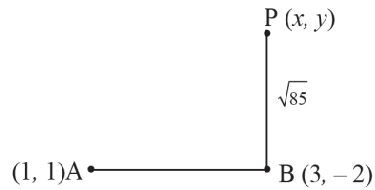
Two points A and B have co-ordinates (1, 1) and (3, -2) respectively. The co-ordinates of a point distant $\sqrt{85}$ from B on the line through B perpendicular to AB are
View full question & answer→MCQ 1392 Marks
A straight line passes through the points (5, 0) and (0, 3). The length of perpendicular from the point (4, 4) on the line is
- A
$\frac{15}{\sqrt{34}}$
- B
$\frac{\sqrt{17}}{2}$
- C
$\frac{17}{2}$
- ✓
$\sqrt{\frac{17}{2}}$
AnswerCorrect option: D. $\sqrt{\frac{17}{2}}$
(D)
Equation of line is
$y-0=\left(\frac{3-0}{-5}\right)(x-5)$
$\Rightarrow 3 x+5 y-15=0$
$\therefore \quad d=\left|\frac{3(4)+5(4)-15}{\sqrt{3^2+5^2}}\right|=\frac{17}{\sqrt{34}}=\sqrt{\frac{17}{2}}$
View full question & answer→MCQ 1402 Marks
The length of perpendicular drawn from origin on the line joining ( $x^{\prime}, y^{\prime}$ ) and ( $x^{\prime \prime}, y^{\prime \prime}$ ), is
- A
$\left|\frac{x^{\prime} y^{\prime \prime}+x^{\prime \prime} y^{\prime}}{\sqrt{\left(x^{\prime \prime}-x^{\prime}\right)^2+\left(y^{\prime \prime}-y^{\prime}\right)^2}}\right|$
- B
$\left|\frac{x^{\prime} y^{\prime \prime}-x^{\prime \prime} y^{\prime}}{\sqrt{\left(x^{\prime \prime}-x^{\prime}\right)^2+\left(y^{\prime \prime}-y^{\prime}\right)^2}}\right|$
- C
$\left|\frac{x^{\prime} x^{\prime \prime}+y^{\prime} y^{\prime \prime}}{\sqrt{\left(x^{\prime \prime}+x^{\prime}\right)^2+\left(y^{\prime \prime}+y^{\prime}\right)^2}}\right|$
- D
$\left|\frac{x^{\prime} x^{\prime \prime}+y^{\prime} y^{\prime \prime}}{\sqrt{\left(x^{\prime \prime}-x^{\prime}\right)^2+\left(y^{\prime \prime}-y^{\prime}\right)^2}}\right|$
Answer$) is
\begin{array}{l}y-y^{\prime}=\frac{y^{\prime \prime}-y^{\prime}}{x^{\prime \prime}-x^{\prime}}\left(x-x^{\prime}\right) \\\Rightarrow x\left(y^{\prime \prime}-y^{\prime}\right)-y\left(x^{\prime \prime}-x^{\prime}\right) \\\quad-x^{\prime}\left(y^{\prime \prime}-y^{\prime}\right)+y^{\prime}\left(x^{\prime \prime}-x^{\prime}\right)=0\end{array}
∴ Length of perpendicular
$\begin{array}{l}=\left|\frac{-x^{\prime}\left(y^{\prime \prime}-y^{\prime}\right)+y^{\prime}\left(x^{\prime \prime}-x^{\prime}\right)}{\sqrt{\left(y^{\prime \prime}-y^{\prime}\right)^2+\left(x^{\prime \prime}-x^{\prime}\right)^2}}\right| \\=\left|\frac{x^{\prime} y^{\prime \prime}-y^{\prime} x^{\prime \prime}}{\sqrt{\left(x^{\prime \prime}x^{\prime}\right)^2+\left(y^{\prime \prime}-y^{\prime}\right)^2}}\right|\end{array}$
View full question & answer→MCQ 1412 Marks
The length of perpendicular from the point (a cos $\alpha$, a sin $\alpha$) upon the straight line $y=x \tan \alpha+ c , c >0$ is
- ✓
$c \cos \alpha$
- B
$c \sin ^2 \alpha$
- C
$c \sec ^2 \alpha$
- D
$c \cos ^2 \alpha$
AnswerCorrect option: A. $c \cos \alpha$
(A)
Here, equation of line is $y=x \tan \alpha+ c , c >0$ Length of the perpendicular drawn on line from point (a $\cos \alpha, a \sin \alpha$ ) is
$p=\left|\frac{a \cos \alpha \tan \alpha-a \sin \alpha+c}{\sqrt{1+\tan ^2 \alpha}}\right|=\frac{c}{\sec \alpha}=c \cos \alpha$
View full question & answer→MCQ 1422 Marks
The length of the perpendicular from the point (b, a) to the line $\frac{x}{a}-\frac{y}{b}=1$ is
- A
$\left|\frac{a^2-a b+b^2}{\sqrt{a^2+b^2}}\right|$
- ✓
$\left|\frac{b^2-a b-a^2}{\sqrt{a^2+b^2}}\right|$
- C
$\left|\frac{a^2-b^2}{\sqrt{a^2+b^2}}\right|$
- D
$\left|\frac{a^2+a b+b^2}{\sqrt{a^2+b^2}}\right|$
AnswerCorrect option: B. $\left|\frac{b^2-a b-a^2}{\sqrt{a^2+b^2}}\right|$
(B)
Length of perpendicular is
$\left|\frac{\frac{b}{a}-\frac{a}{b}-1}{\sqrt{\left(\frac{1}{a}\right)^2+\left(-\frac{1}{b}\right)^2}}\right|=\left|\frac{b^2-a^2-ab}{\sqrt{a^2+b^2}}\right|$
View full question & answer→MCQ 1432 Marks
If the length of the perpendicular drawn from the origin to the line whose intercepts on the axes are a and b be p, then
- A
$a^2+b^2=p^2$
- B
$a ^2+ b ^2=\frac{1}{ p ^2}$
- C
$\frac{1}{ a ^2}+\frac{1}{b^2}=\frac{2}{ p ^2}$
- ✓
$\frac{1}{ a ^2}+\frac{1}{b^2}=\frac{1}{ p ^2}$
AnswerCorrect option: D. $\frac{1}{ a ^2}+\frac{1}{b^2}=\frac{1}{ p ^2}$
(D)
Let the equation of the line be
$\frac{x}{a}+\frac{y}{b}=1$
According to the given condition,
$\begin{array}{l}p=\left|\frac{ab}{\sqrt{a^2+b^2}}\right| \\\Rightarrow \frac{a^2+b^2}{a^2 b^2}\frac{1}{p^2} \\\Rightarrow \frac{1}{a^2}+\frac{1}{b^2}=\frac{1}{p^2}\end{array}$
View full question & answer→MCQ 1442 Marks
The length of the perpendicular from the origin on the line $\frac{x \sin \alpha}{b}-\frac{y \cos \alpha}{ a }-1=0$ is
- A
$\frac{|a b|}{\sqrt{a^2 \cos ^2 \alpha-b^2 \sin ^2 \alpha}}$
- B
$\frac{|a b|}{\sqrt{a^2 \cos ^2 \alpha+b^2 \sin ^2 \alpha}}$
- C
$\frac{|a b|}{\sqrt{a^2 \sin ^2 \alpha-b^2 \cos ^2 \alpha}}$
- ✓
$\frac{|a b|}{\sqrt{a^2 \sin ^2 \alpha+b^2 \cos ^2 \alpha}}$
AnswerCorrect option: D. $\frac{|a b|}{\sqrt{a^2 \sin ^2 \alpha+b^2 \cos ^2 \alpha}}$
(D)
Given, equation of line is$\frac{x \sin \alpha}{b}-\frac{y \cos \alpha}{a}-1=0$
∴ perpendicular distance from origin$=\left|\frac{0 \cdot \frac{\sin \alpha}{b}-\frac{0 \cdot \cos \alpha}{a}-1}{\sqrt{\frac{\sin ^2 \alpha}{b^2}+\frac{\cos ^2 \alpha}{a^2}}}\right|=\frac{|ab|}{\sqrt{a^2 \sin ^2 \alpha+b^2 \cos ^2 \alpha}}$
View full question & answer→MCQ 1452 Marks
If the perpendicular distance between the point (1,1) and the line 3x + 4y + c = 0 is 7, then the possible values of c are
Answer(D)
Distance of $(1,1)$ from $3 x+4 y+ c =0$ is
$\begin{array}{l}d=\left|\frac{3(1)+4(1)+c}{\sqrt{9+16}}\right| \\\Rightarrow \pm 7=\frac{7+c}{5} \\\Rightarrow c=-42,28\end{array}$
View full question & answer→MCQ 1462 Marks
Distance between the lines 5x + 3y - 7 = 0 an 15x + 9y + 14 = 0 is
- A
$\frac{35}{\sqrt{34}}$
- B
$\frac{1}{3 \sqrt{34}}$
- ✓
$\frac{35}{3 \sqrt{34}}$
- D
$\frac{35}{2 \sqrt{34}}$
AnswerCorrect option: C. $\frac{35}{3 \sqrt{34}}$
(C)
Given lines are $5 x+3 y-7=0$....(i)
and $15 x+9 y+14=0$ or$5 x+3 y+\frac{14}{3}=0$...(ii)
Lines (i) and (ii) are parallel.
$\therefore \quad$ Required distance $=\left|\frac{c_1-c_2}{\sqrt{a^2+b^2}}\right|$
$=\left|\frac{-7-\frac{14}{3}}{\sqrt{5^2+3^2}}\right|$
$=\left|\frac{-35}{3 \sqrt{34}}\right|=\frac{35}{3 \sqrt{34}}$
View full question & answer→MCQ 1472 Marks
The distance between the parallel line y = x + a y = x + b is
- ✓
$\frac{|a-b|}{\sqrt{2}}$
- B
$|a-b|$
- C
$| a + b |$
- D
$\frac{|a+b|}{\sqrt{2}}$
AnswerCorrect option: A. $\frac{|a-b|}{\sqrt{2}}$
(A)
Given equation of parallel lines are
$x-y+ a =0, x-y+ b =0$
$\therefore \quad$ Required distance $=\left|\frac{ a - b }{\sqrt{(1)^2+(-1)^2}}\right|=\frac{| a - b |}{\sqrt{2}}$
View full question & answer→MCQ 1482 Marks
The distance of the point (-2, 3) from the line x - y = 5 is
- ✓
$5 \sqrt{2}$
- B
$2 \sqrt{5}$
- C
$3 \sqrt{5}$
- D
$5 \sqrt{3}$
AnswerCorrect option: A. $5 \sqrt{2}$
(A)
Required distance $=\left|\frac{-2-3-5}{\sqrt{1+1}}\right|=\frac{10}{\sqrt{2}}=5 \sqrt{2}$
View full question & answer→MCQ 1492 Marks
The distance of the point (3, -5) from the line 3x - 4y - 26 = 0 is
- A
$\frac{3}{7}$
- B
$\frac{2}{5}$
- C
$\frac{7}{5}$
- ✓
$\frac{3}{5}$
AnswerCorrect option: D. $\frac{3}{5}$
(D)
Required distance $=\left|\frac{3(3)-4(-5)-26}{\sqrt{9+16}}\right|=\frac{3}{5}$
View full question & answer→MCQ 1502 Marks
If $u = a _1 x+ b _1 y+ c _1=0, v = a _2 x+ b _2 y+ c _2=0$ and $\frac{a_1}{a_2}=\frac{b_1}{b_2}=\frac{c_1}{c_2}$, then the curve $u + kv =0$ is
Answer(A)
$\begin{array}{l} u = a _1 x+ b _1 y+ c _1=0, v = a _2 x+ b _2 y+ c _2=0 \\ \text { Let } \frac{ a _1}{ a _2}=\frac{ b _1}{b_2}=\frac{ c _1}{ c _2}= c \\ \Rightarrow a _2=\frac{ a _1}{ c }, b _2=\frac{ b _1}{ c }, c _2=\frac{ c _1}{ c }\end{array}$ $\begin{array}{l}\text { Given that, } u + kv =0 \\ \Rightarrow a _1 x+ b _1 y+ c _1+ k \left( a _2 x+ b _2 y+ c _2\right)=0 \\ \Rightarrow a _1 x+ b _1 y+ c _1+ k \left(\frac{ a _1}{ c }\right) x+ k \left(\frac{ b _1}{ c }\right) y+ k \left(\frac{ c _1}{ c }\right)=0 \\ \Rightarrow a _1 x\left(1+\frac{ k }{ c }\right)+ b _1 y\left(1+\frac{ k }{ c }\right)+ c _1\left(1+\frac{ k }{ c }\right)=0 \\ \Rightarrow a _1 x+ b _1 y+ c _1=0= u \end{array}$
View full question & answer→