MCQ 1512 Marks
The lines 15x - 18y + 1 = 0 12x + 10y - 3 = 0 and 6x + 66y - 11 = 0 are
Answer(C)
Consider $\left|\begin{array}{ccc}15 & -18 & 1 \\ 12 & 10 & -3 \\ 6 & 66 & -11\end{array}\right|$
$\begin{aligned}=15(-110+198)+18(-132+ & 18) \\ +0 & +1(792-60)\end{aligned}$
$=0$
View full question & answer→MCQ 1522 Marks
If the lines x + 3y - 9 = 0 , 4x + by - 2 = 0 and 2x - y - 4 = 0 are concurrent, then the equation of the line passing through the point (b,0) and concurrent with the given lines, is
Answer(D)Since, lines $x+3 y-9=0,4 x+ b y-2=0$, and $2 x-y-4=0$ are concurrent
$\left|\begin{array}{ccc}1 & 3 & -9 \\ 4 & b & -2 \\ 2 & -1 & -4\end{array}\right|=0$
$\therefore \quad 1(-4 b-2)-3(-16+4)-9(-4-2 b)=0$
$\Rightarrow b =-5$
$\therefore $ the required line passes through $(-5,0)$
Now, consider option (D) and $x+3 y-9=0$,
4x - 5y - 2 = 0
$\therefore\left|\begin{array}{ccc}1 & 3 & -9 \\ 4 & -5 & -2 \\ 1 & -4 & 5\end{array}\right|=0$
$\therefore$ option (D) is correct
View full question & answer→MCQ 1532 Marks
If the lines ax + by + c = 0 bx + cy + a = 0 and cx + ay + b = 0 be concurrent, then
- A
$a^3+b^3+c^3+3 a b c=0$
- B
$a^3+b^3+c^3-a b c=0$
- ✓
$a^3+b^3+c^3-3 a b c=0$
- D
AnswerCorrect option: C. $a^3+b^3+c^3-3 a b c=0$
(C)Here, the given lines are
$\begin{array}{l}a x+b y+c=0 \\b x+c y+a=0 \\c x+a y+b=0\end{array}$
The lines will be concurrent, if $\left|\begin{array}{lll} a & b & c \\ b & c & a \\ c & a & b \end{array}\right|=0$
$\Rightarrow a^3+b^3+c^3-3 abc=0$
View full question & answer→MCQ 1542 Marks
If the lines 4 + 3y = 1 ,x - y = - 5 and 5y + bx = 3 are concurrent, then b equals
Answer(C)Lines are concurrent, if $\left|\begin{array}{ccc}4 & 3 & -1 \\ 1 & -1 & 5 \\ b & 5 & -3\end{array}\right|=0$
$\Rightarrow 4(3-25)-3(-3-5 b)-1(5+b)=0$
$\Rightarrow-88+9+15 b-5-b=0$
$\Rightarrow-84+14 b=0$
$\Rightarrow b =6$
View full question & answer→MCQ 1552 Marks
If the lines $y= m _1 x+ c _1, y= m _2 x+ c _2$ and $y=m_3 x+c_3$, are concurrent, then
- ✓
$m_1\left(c_2-c_3\right)+m_2\left(c_3-c_1\right)+m_3\left(c_1-c_2\right)=0$
- B
$m_1\left(c_2-c_1\right)+m_2\left(c_3-c_2\right)+m_3\left(c_1-c_3\right)=0$
- C
$\begin{aligned} c_1\left(m_2-m_3\right)+c_2\left(m_3-m_1\right) & \\ & +c_3\left(m_1-m_2\right)=0\end{aligned}$
- D
$\begin{aligned} c_1\left(m_1-m_2\right)+c_2\left(m_2-\right. & \left.m_3\right) \\ & +c_3\left(m_3-m_1\right)=0\end{aligned}$
AnswerCorrect option: A. $m_1\left(c_2-c_3\right)+m_2\left(c_3-c_1\right)+m_3\left(c_1-c_2\right)=0$
(A)
$\begin{array}{l}\left|\begin{array}{ccc} m _1 & -1 & c _1 \\ m_2 & -1 & c _2 \\ m_3 & -1 & c _3\end{array}\right|=0 \\ \Rightarrow\left|\begin{array}{ccc} m _1 & m_2 & m_3 \\ -1 & -1 & -1 \\ c _1 & c _2 & c _3\end{array}\right|=0 \\ \Rightarrow m_1\left( c _2- c _3\right)+ m _2\left( c _3- c _1\right)+ m _3\left( c _1- c _2\right)=0\end{array}$
View full question & answer→MCQ 1562 Marks
The equation of the line which passes through the point $(3, -2)$ and are inclined at $60^{\circ}$ to the line $\sqrt{3} x+y=1$, is
- ✓
$y+2=0, \sqrt{3} x-y-2-3 \sqrt{3}=0$
- B
$x-2=0, \sqrt{3} x-y+2+3 \sqrt{3}=0$
- C
$\sqrt{3} x-y-2-3 \sqrt{3}=0$
- D
$x-\sqrt{3 y}+2+3 \sqrt{3}=0$
AnswerCorrect option: A. $y+2=0, \sqrt{3} x-y-2-3 \sqrt{3}=0$
(A)The equation of a straight line passing through $(3,-2)$ is
$y+2=m(x-3)$
The slope of the line $\sqrt{3} x+y=1$ is $-\sqrt{3}$
So, $\tan 60^{\circ}= \pm \frac{m-(-\sqrt{3})}{1+m(-\sqrt{3})} \Rightarrow \sqrt{3}= \pm \frac{m+\sqrt{3}}{1-\sqrt{3} m}$
On solving, we get
$m=0 \text { or } \sqrt{3}$
Putting the values of m in (i), the required equation of lines are $y+2=0$ and $\sqrt{3} x-y-2-3 \sqrt{3}=0$
View full question & answer→MCQ 1572 Marks
For the lines 2x + 5y = 7 and 2x - 5y = 9 which of the following statement is true?
Answer(C)
Let $L _1 \equiv 2 x+5 y-7=0$ and $L _2 \equiv 2 x-5 y-9=0$, so that$m_1=\frac{2}{5},m_2=\frac{2}{5}$
Lines are neither parallel nor perpendicular, also not coincident.
Hence, the lines are intersecting.
View full question & answer→MCQ 1582 Marks
The angle between the lines $a _1 x+ b _1 y+ c _1=0$ and $a _2 x+ b _2 y+ c _2=0$, is
- A
$\tan ^{-1} \frac{a_1 b_2+a_2 b_1}{a_1 a_2-b_1 b_2}$
- ✓
$\cot ^{-1} \frac{a_1 a_2+b_1 b_2}{a_1 b_2-a_2 b_1}$
- C
$\cot ^{-1} \frac{a_1 b_1-a_2 b_2}{a_1 a_2+b_1 b_2}$
- D
$\tan ^{-1} \frac{a_1 b_1-a_2 b_2}{a_1 a_2+b_1 b_2}$
AnswerCorrect option: B. $\cot ^{-1} \frac{a_1 a_2+b_1 b_2}{a_1 b_2-a_2 b_1}$
(B)
Here, $m _1=\frac{- a _1}{b_1}$ and $m _2=\frac{- a _2}{b_2}$
$\begin{array}{l}\tan \theta=\left|\frac{-\frac{a_1}{b_1}+\frac{a_2}{b_2}}{1+\frac{a_1}{b_1} \times \frac{a_2}{b_2}}\right| \\\Rightarrow \tan \theta=\left|\frac{(-1)\left(\frac{a_1}{b_1}\frac{a_2}{b_2}\right)}{1+\frac{a_1 a_1}{b_1 b_2}}\right| \\\Rightarrow \theta=\tan ^{-1}\left(\frac{a_1 b_2-a_2 b_1}{b_1 b_2+a_1 a_2}\right) \\\Rightarrow \theta=\cot ^{-1}\left(\frac{a_1 a_2+b_1 b_2}{a_1 b_2-a_2 b_1}\right)
\end{array}$
View full question & answer→MCQ 1592 Marks
The angle between the lines whose intercepts on the axes are (a, -b) and (b, -a) respectively, is
- A
$\tan ^{-1} \frac{a^2+b^2}{a b}$
- B
$\tan ^{-1} \frac{b^2-a^2}{2}$
- ✓
$\tan ^{-1} \frac{b^2-a^2}{2 a b}$
- D
$\tan ^{-1} \frac{b^2-a^2}{a b}$
AnswerCorrect option: C. $\tan ^{-1} \frac{b^2-a^2}{2 a b}$
(C)Equation of lines are $\frac{x}{ a }-\frac{y}{b}=1$ and $\frac{x}{b}-\frac{y}{ a }=1$
$\Rightarrow m _1=\frac{ b }{ a }$ and $m _2=\frac{ a }{ b }$
$\therefore \quad \theta=\tan ^{-1}\left|\frac{\frac{b}{a}-\frac{a}{b}}{1+\frac{b}{a} \cdot \frac{a}{b}}\right|=\tan ^{-1} \frac{b^2-a^2}{2 a b}$
View full question & answer→MCQ 1602 Marks
The acute angle between the lines y = 3 and $y=\sqrt{3} x+9$ is
- A
$30^{\circ}$
- ✓
$60^{\circ}$
- C
$45^{\circ}$
- D
$90^{\circ}$
AnswerCorrect option: B. $60^{\circ}$
(B)
$\begin{array}{l} m _1=\sqrt{3}, m_2=0 \\ \tan \theta=\left|\frac{\sqrt{3}-0}{1+0}\right| \\ \Rightarrow \tan \theta=\sqrt{3} \\ \Rightarrow \theta=60^{\circ}\end{array}$
View full question & answer→MCQ 1612 Marks
The angle between the lines $y=(2-\sqrt{3}) x+5$ and $y=(2+\sqrt{3}) x-7$ is
- A
$30^{\circ}$
- ✓
$60^{\circ}$
- C
$45^{\circ}$
- D
$90^{\circ}$
AnswerCorrect option: B. $60^{\circ}$
(B)
$\begin{array}{l}\theta=\tan ^{-1}\left|\frac{2-\sqrt{3}-2-\sqrt{3}}{1+4-3}\right|=\tan ^{-1}(\sqrt{3}) \\ \Rightarrow \theta=60^{\circ}\end{array}$
View full question & answer→MCQ 1622 Marks
The angle between the lines 2x - y + 3 = 0 and x + 2y + 3 = 0 is x + 2y + 3 = 0 is
- ✓
$90^{\circ}$
- B
$60^{\circ}$
- C
$45^{\circ}$
- D
$30^{\circ}$
AnswerCorrect option: A. $90^{\circ}$
(A)
The slopes of the lines are $m_1=\frac{-1}{2}, m_2=2$
$\therefore \quad m_1 m_2=-1$
So, the lines are perpendicular i.e., $\theta=90^{\circ}$
View full question & answer→MCQ 1632 Marks
Which pair of points lie on the same side of 3x - 8y - 7 = 0 ?
Answer (D)
$L_{(-1,-1)}=3(-1)-8(-1)-7<0$
and $L _{(3,7)}=3 \times 3-8 \times 7-7<0$
Hence, $(-1,-1)$ and $(3,7)$ lie on the same side of line.
View full question & answer→MCQ 1642 Marks
The position of the points (3, 4) and (2, -6) with respect to the line 3x - 4y = 8 are
- A
on the same side of the line
- ✓
on opposite side of the line
- C
one point on the line and the other outside the line
- D
AnswerCorrect option: B. on opposite side of the line
(B)
$\begin{array}{l}L \equiv 3 x-4 y-8=0 \\L_{(3,4)}=9-16-8<0 \text { and } \\L_{(2,-6)}=6+24-8>0\end{array}$
Hence, the points lie on opposite side of the line.
View full question & answer→MCQ 1652 Marks
The equation of the line perpendicular to the line $\frac{x}{a}-\frac{y}{b}=1$ and passing through the point at which it cuts X-axis, is
- A
$\frac{x}{a}+\frac{y}{b}+\frac{a}{b}=0$
- B
$\frac{x}{b}+\frac{y}{a}=\frac{b}{a}$
- C
$\frac{x}{b}+\frac{y}{a}=0$
- ✓
$\frac{x}{b}+\frac{y}{ a }=\frac{ a }{ b }$
AnswerCorrect option: D. $\frac{x}{b}+\frac{y}{ a }=\frac{ a }{ b }$
(D)
The given line is $b x-a y=a b$....(i)
It cuts X -axis at $( a , 0)$.
The equation of a line perpendicular to (i) is $a x+ b y= k$.
Since, the line passes through $( a , 0) \Rightarrow k = a ^2$
Hence, required equation of line is $a x+b y=a^2$
i.e., $\frac{x}{b}+\frac{y}{ a }=\frac{ a }{ b }$
View full question & answer→MCQ 1662 Marks
A line passes through (2, 2) and is perpendicular to the line 3x + y = 3 Its y - intercept is
- ✓
$\frac{4}{3}$
- B
$\frac{1}{3}$
- C
- D
$\frac{2}{3}$
AnswerCorrect option: A. $\frac{4}{3}$
(A)
The equation of a line passing through $(2,2)$ and perpendicular to $3 x+y=3$ is
$\begin{array}{l}y-2=\frac{1}{3}(x-2) \\\Rightarrow x-3 y+4=0 .\end{array}$
Putting $x=0$ in this equation, we get
$y-\text { intercept }=\frac{4}{3}$
View full question & answer→MCQ 1672 Marks
The equation of the line passing through (a, b) and parallel to the line $\frac{x}{a}+\frac{y}{b}=1$ is
- A
$\frac{x}{a}+\frac{y}{b}=3$
- ✓
$\frac{x}{a}+\frac{y}{b}=2$
- C
$\frac{x}{a}+\frac{y}{b}=0$
- D
$\frac{x}{a}+\frac{y}{b}+2=0$
AnswerCorrect option: B. $\frac{x}{a}+\frac{y}{b}=2$
(B)
Required equation of line is $\frac{x}{a}+\frac{y}{b}=c$
As it passes through the point ( $a , b$ ), we get $c =2$
The required equation is $\frac{x}{a}+\frac{y}{b}=2$
View full question & answer→MCQ 1682 Marks
The intercept cut off from Y-axis is twice that from X-axis by the line and line passes through (1, 2), then its equation is
Answer(A)Let the intercepts be a and 2 a , then the equation of line is $\frac{x}{a}+\frac{y}{2 a}=1$, but it also passes through $(1,2)$, therefore $a =2$.
Hence, the required equation is $2 x+y=4$
View full question & answer→MCQ 1692 Marks
The equations of the straight line passing through the point (4, 3) and making intercepts on the co-ordinate axes whose sum is - 1, is
- ✓
$\frac{x}{2}-\frac{y}{3}=1$ and $\frac{x}{-2}+\frac{y}{1}=1$
- B
$\frac{x}{2}-\frac{y}{3}=-1$ and $\frac{x}{-2}+\frac{y}{1}=-1$
- C
$\frac{x}{2}-\frac{y}{3}=1$ and $\frac{x}{2}+\frac{y}{1}=1$
- D
$\frac{x}{2}+\frac{y}{1}=1$ and $\frac{x}{-2}+\frac{y}{1}=-1$
AnswerCorrect option: A. $\frac{x}{2}-\frac{y}{3}=1$ and $\frac{x}{-2}+\frac{y}{1}=1$
(A)
Here, $a + b =-1$
required line is $\frac{x}{a}-\frac{y}{1+a}=1$
Since, line (i) passes through $(4,3)$.
$\therefore \quad \frac{4}{a}-\frac{3}{1+a}=1$
$\Rightarrow 4+4 a-3 a=a+a^2$
$\Rightarrow a^2-4$
$\Rightarrow a= \pm 2$
$\therefore \quad$ The required lines are $\frac{x}{2}-\frac{y}{3}=1$ and $\frac{x}{-2}+\frac{y}{1}=1$.
View full question & answer→MCQ 1702 Marks
The equation of a straight line passing through (-3, 2) and cutting an intercept equal in magnitude but opposite in sign from the axes is given by
Answer(A)
Let the equation be $\frac{x}{a}+\frac{y}{-a}=1$.
$\Rightarrow x-y=a$
But, it passes through $(-3,2)$$a=-3-2=-5$
Putting the value of a in (i), we get
$x-y+5=0$
View full question & answer→MCQ 1712 Marks
Equation of the straight line making equal intercepts on the axes and passing through the point (2, 4) is
Answer(C)
Let the equation of the line be $\frac{x}{a}+\frac{y}{b}=1$.
Given, $a = b$
So, equation of line is $x+y=a$
Since, this line passes through $(2,4)$.
$\begin{array}{c}2+4=a \\\Rightarrow a=6\end{array}$
The required equation of line is $x+y=6$
i.e.. $x+y-6=0$
View full question & answer→MCQ 1722 Marks
Slope of a line which cuts intercepts of equal lengths on the axes is
Answer(A)
The equation of line is $\frac{x}{a}+\frac{y}{a}=1$.
$\Rightarrow x+y- a =0$
$\therefore \quad$ Slope $=-\frac{\text { coefficient of } x}{\text { coefficient of } y}=-1$
View full question & answer→MCQ 1732 Marks
If the line $\frac{x}{a}+\frac{y}{b}=1$ passes through the points (2, -3) and (4, -5), then (a, b) =
Answer(D)
Since, the given line passes through $(2,-3)$ and $(4,-5)$.
$\therefore \quad \frac{2}{a}-\frac{3}{b}=1$ and $\frac{4}{a}-\frac{5}{b}=1$
$\Rightarrow b =-1, a =-1$
View full question & answer→MCQ 1742 Marks
If the three points A(1, 6) B(3, - 4) and C(x,y) are collinear, then the equation justified by x and y is
Answer(A)
Since, the required line will be a line passing through A and B .
$\therefore \quad \frac{y-6}{6-(-4)}=\frac{x-1}{1-3}$
$\Rightarrow 10 x-10=-2 y+12 \Rightarrow 5 x+y-11=0$
View full question & answer→MCQ 1752 Marks
The equation of line whose midpoint (x1, y1) is in between the axes, is
- ✓
$\frac{x}{x_1}+\frac{y}{y_1}=2$
- B
$\frac{x}{x_1}+\frac{y}{y_1}=\frac{1}{2}$
- C
$\frac{x}{x_1}+\frac{y}{y_1}=1$
- D
AnswerCorrect option: A. $\frac{x}{x_1}+\frac{y}{y_1}=2$
(A)
Intersection point on X -axis is $\left(2 x_1, 0\right)$ and on Y -axis is $\left(0,2 y_1\right)$. Thus, equation of line passing through these points is $\frac{x}{x_1}+\frac{y}{y_1}-2$.
View full question & answer→MCQ 1762 Marks
The equation of the line which cuts off intercepts 2a sec $ \theta $ and 2a cosec $ \theta $ on X-axis and Y-axis respectively is
- A
$x \sin \theta+y \cos \theta-2 a =0$
- ✓
$x \cos \theta+y \sin \theta-2 a =0$
- C
$x \sec \theta+y \operatorname{cosec} \theta-2 a =0$
- D
$x \operatorname{cosec} \theta+y \sec \theta-2 a=0$
AnswerCorrect option: B. $x \cos \theta+y \sin \theta-2 a =0$
(B)
Using double intercept form, we get
$\frac{x}{2 a \sec \theta}+\frac{y}{2 a \operatorname{cosec} \theta}=1$
$\therefore \quad a+b=\frac{r}{p}-\frac{r}{q}=r\left(\frac{q-p}{p q}\right)$
View full question & answer→MCQ 1772 Marks
If the line px - qy = r intersects the co-ordinate axes at (a, 0,) and (0 , b), then the value of a + b is equal to
- A
$r\left(\frac{q+p}{p q}\right)$
- ✓
$r\left(\frac{q-p}{p q}\right)$
- C
$r\left(\frac{p-q}{p q}\right)$
- D
$r\left(\frac{p+q}{p-q}\right)$
AnswerCorrect option: B. $r\left(\frac{q-p}{p q}\right)$
(B)
Since, $p x- q y= r$ intersects at X -axis and Y -axis.
$\begin{array}{ll}\therefore & a=\frac{r}{p} \text { and } b=-\frac{r}{q} \\
\therefore & a+b=\frac{r}{p}-\frac{r}{q}=r\left(\frac{q-p}{p q}\right)\end{array}$
View full question & answer→MCQ 1782 Marks
A line cuts off equal intercepts on the co-ordinate axes. The angle made by this line with the positive direction of X-axis is
- A
$90^{\circ}$
- ✓
$135^{\circ}$
- C
$45^{\circ}$
- D
$120^{\circ}$
AnswerCorrect option: B. $135^{\circ}$
(B)
Let the equation of line be $\frac{x}{ a }+\frac{y}{ a }=1$
$\Rightarrow x+y= a \Rightarrow y=-x+ a$
Comparing with $y= m x+ c$, we get
$m =-1$
$\Rightarrow \tan \theta=-1 \Rightarrow \theta=135^{\circ}$
View full question & answer→MCQ 1792 Marks
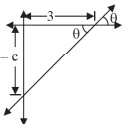
The equation of the line whose slope is 3 and which cuts off an intercept 3 from the positive X - axis is
MCQ 1802 Marks
A straight line makes an angle of $135^{\circ}$ with the X-axis and cuts Y-axis at -5. The equation of the line is
Answer(C)
$\begin{array}{l}\text { Equation of line is } y=m x+c \\ \Rightarrow y=\left(\tan 135^{\circ}\right) x-5 \Rightarrow y=-x-5 \\ \Rightarrow x+y+5=0\end{array}$
View full question & answer→MCQ 1812 Marks
The equation of a line through the intersection of lines x = 0 and y = 0 and through the point (2, 2) is
Answer(C)
The point of intersection is $(0,0)$
Thus, the equation of line passing through the points $(0,0)$ and $(2,2)$ is $y=x$.
View full question & answer→MCQ 1822 Marks
The equation of a straight line passing through the points (-5, -6) and ( 3, 10) is
Answer(B)
Equation of a line passing through the given points is $\frac{y-(-6)}{-6-10}=\frac{x-(-5)}{-5-3}$
$\Rightarrow \frac{y+6}{-16}=\frac{x+5}{-8} \Rightarrow 2 x-y+4=0$
View full question & answer→MCQ 1832 Marks
The point (-4, 5) is the vertex of a square and one of its diagonals is 7x - y + 8 = 0 The equation of the other diagonal is
Answer(C)
Since, the point $(-4,5)$ does not lie on the diagonal $7 x-y+8=0$, this point will lie on the other diagonal.
Also, diagonals are perpendicular.
∴ Slope of other diagonal $=\frac{-1}{7}$
∴ Equation of the other diagonal is
$y-5=-\frac{1}{7}(x+4)$
$\Rightarrow 7 y+x=31$
View full question & answer→MCQ 1842 Marks
The equation of the line passing through the point (x', y') and perpendicular to the line yy' = 2a(x + x') is
- A
$x y^{\prime}+2 a y+2 a y^{\prime}-x^{\prime} y^{\prime}=0$
- ✓
$x y^{\prime}+2 a y-2 a y^{\prime}-x^{\prime} y^{\prime}=0$
- C
$x y^{\prime}+2 a y+2 a y^{\prime}+x^{\prime} y^{\prime}=0$
- D
$x y^{\prime}+2 a y-2 a y^{\prime}+x^{\prime} y^{\prime}=0$
AnswerCorrect option: B. $x y^{\prime}+2 a y-2 a y^{\prime}-x^{\prime} y^{\prime}=0$
(B)
Slope of perpendicular $=\frac{-y^{\prime}}{2 a }$
The required equation is $y-y^{\prime}=-\frac{y^{\prime}}{2 a }\left(x-x^{\prime}\right)$
$\Rightarrow x y^{\prime}+2 a y-2 a y^{\prime}-x^{\prime} y^{\prime}=0$
View full question & answer→MCQ 1852 Marks
Equation of line passing through the point (1, 2) and perpendicular to the line y = 3x - 1 is
Answer(A)
Slope of $y=3 x-1$ is 3
Slope of line perpendicular to the above line is $m =\frac{-1}{3}$
Equation of line passing through $(1,2)$ and having slope $(m)=\frac{-1}{3}$ is
$\begin{array}{l}(y-2)=\frac{-1}{3}(x-1) \\\Rightarrow 3 y-6=-x+1 \\\Rightarrow x+3 y-7=0\end{array}$
View full question & answer→MCQ 1862 Marks
The equation of a line passing through (c, d) and parallel to ax + by + c = 0 is
Answer(C)
The required equation of the line which passes through $(c, d)$ and its gradient $=-\frac{a}{b}$, is
$\begin{array}{l}y-d=-\frac{a}{b}(x-c)
\\\Rightarrow a(x-c)+b(y-d)=0\end{array}$
View full question & answer→MCQ 1872 Marks
Equation of a line through the origin and perpendicular to the line joining (a, 0) and (-a, 0) is
Answer(B)
Note that: the line joining $(a, 0)$ and $(-a, 0)$ is X -axis.
∴ The required line is Y -axis.
$\Rightarrow$ The required equation is $x=0$
View full question & answer→MCQ 1882 Marks
The equation of the line bisecting the line segment joining the points (a, b) and (a', b') at right angle, is
- ✓
$2\left( a - a ^{\prime}\right) x+2\left(b- b ^{\prime}\right) y= a ^2+ b ^2- a ^{\prime 2}- b ^{\prime 2}$
- B
$\left( a - a ^{\prime}\right) x+\left( b - b ^{\prime}\right) y= a ^2+ b ^2- a ^{\prime 2}- b ^{\prime 2}$
- C
$2( a - b ) x+2\left(b- b ^{\prime}\right) y= a ^{\prime 2}+ b ^{\prime 2}- a ^{\prime 2}- b ^{\prime 2}$
- D
AnswerCorrect option: A. $2\left( a - a ^{\prime}\right) x+2\left(b- b ^{\prime}\right) y= a ^2+ b ^2- a ^{\prime 2}- b ^{\prime 2}$
(A)
$m =\frac{- l }{\frac{ b ^{\prime}- b }{ a ^{\prime}- a }}=\frac{ a ^{\prime}- a }{ b - b ^{\prime}}$
Midpoint is $\left(\frac{ a + a ^{\prime}}{2}, \frac{b+ b ^{\prime}}{2}\right)$
$\therefore \quad$ The required equation is
$y-\left(\frac{ b + b ^{\prime}}{2}\right)=\frac{ a ^{\prime}- a }{ b - b ^{\prime}}\left[x-\left(\frac{ a + a ^{\prime}}{2}\right)\right]$
$\Rightarrow 2\left(b- b ^{\prime}\right) y+2\left( a - a ^{\prime}\right) x= b ^2- b ^{\prime 2}+ a ^2- a ^{\prime 2}$
View full question & answer→MCQ 1892 Marks
If the co-ordinates of A and B are (1, 1) and (5, 7), then the equation of the perpendicular bisector of the line segment AB is
Answer(A)
Midpoint is $(3,4)$ and slope of $AB =\frac{6}{4}=\frac{3}{2}$
∴ Slope of perpendicular $=\frac{-1}{3 / 2}=\frac{-2}{3}$
∴ The required equation is $y-4=\frac{-2}{3}(x-3)$
$\Rightarrow 2 x+3 y=18$
View full question & answer→MCQ 1902 Marks
The equation of a line passing through (4, -6) and making an angle $45^{\circ}$ with positive X-axis, is
Answer(A)
The required equation is
$\begin{array}{l}y+6=\tan 45^{\circ}(x-4)
\\\Rightarrow x-y-10=0\end{array}$
View full question & answer→MCQ 1912 Marks
Two lines represented by equations x + y = 1 and x + ky = 0 are mutually orthogonal if k is
Answer(B)
Here, $m _1=-1, m_2=-\frac{1}{ k }$.
For orthogonal lines,
$m_1 m_2=-1 \Rightarrow \frac{1}{k}=-1 \Rightarrow k=-1$
View full question & answer→MCQ 1922 Marks
The lines $a _1 x+ b _1 y+ c _1=0$ and $a _2 x+ b _2 y+ c _2=0$ are perpendicular to each other, if
- A
$a_1 b_2-b_1 a_2=0$
- ✓
$a_1 a_2+b_1 b_2=0$
- C
$a_1^2 b_2+b_1^2 a_2=0$
- D
$a_1 b_1+a_2 b_2=0$
AnswerCorrect option: B. $a_1 a_2+b_1 b_2=0$
View full question & answer→MCQ 1932 Marks
The line passing through the points (3, -4) and ( -2, 6) and a line passing through ( -3, 6) and (9, -18)
Answer(B)
$m_1=\frac{6+4}{-2-3}=\frac{10}{-5}=-2 \text { and } m_2=\frac{-18-6}{9-(-3)}=-2$
Hence, the lines are parallel.
View full question & answer→MCQ 1942 Marks
The line passing through (1, 0) and (- 2, $\sqrt{3}$) makes an angle of _________ with X-axis
- A
$60^{\circ}$
- B
$120^{\circ}$
- ✓
$150^{\circ}$
- D
$135^{\circ}$
AnswerCorrect option: C. $150^{\circ}$
(C)
Gradient of the line which passes through
$(1,0)$ and $(-2, \sqrt{3})$ is $m =\frac{\sqrt{3}-0}{-21}=\frac{1}{\sqrt{3}}$
$\begin{array}{l}\Rightarrow \tan \theta=-\frac{1}{\sqrt{3}} \\\Rightarrow \theta=\tan ^{-1}\left(-\frac{1}{\sqrt{3}}\right)=150^{\circ}\end{array}$
View full question & answer→MCQ 1952 Marks
The slope of a straight line which does not intersect X-axis is equal to
- A
$\frac{1}{2}$
- B
$\frac{1}{\sqrt{2}}$
- C
$\sqrt{3}$
- ✓
$0$
Answer(D)
Here, the straight line is parallel to X -axis. So, the slope of such a line $=0$.
View full question & answer→MCQ 1962 Marks
The number of straight lines which are equally inclined to both the axes is
Answer(B)
Using [Shortcuts : 1] Slope of the line equally inclined with the axis is 1 or -1, we get that the required lines are $y=x$ and $y=-x$.
View full question & answer→MCQ 1972 Marks
The slope of a line that makes an angle of measure $30^{\circ}$ with Y-axis is
- A
$\sqrt{3}$
- B
$-\sqrt{3}$
- ✓
$\pm \sqrt{3}$
- D
$\pm \frac{1}{\sqrt{3}}$
AnswerCorrect option: C. $\pm \sqrt{3}$
(C)
Since, the line makes an angle of measure $30^{\circ}$ with Y -axis. Therefore, the line will make an angle of measure $60^{\circ}$ or $-60^{\circ}$ with X -axis.
$\therefore \quad$ Slope of line $=\tan 60^{\circ}$ or $\tan \left(-60^{\circ}\right)$
$=\sqrt{3}$ or $-\sqrt{3}$
$= \pm \sqrt{3}$
View full question & answer→MCQ 1982 Marks
If the origin is shifted to the point (-1, 2), the new equation of locus is $X^2+5 X Y+3 Y^2=0$ then the original equation of locus when axes remaining parallel is
- ✓
$x^2+5 x y+3 y^2-8 x-7 y+3=0$
- B
$x^2+y^2+2 x y-8 x-7 y+3=0$
- C
$x^2-5 x y+3 y^2+8 x+7 y+3=0$
- D
$2 x^2-5 x y+3 y^2-8 x-7 y+3=0$
AnswerCorrect option: A. $x^2+5 x y+3 y^2-8 x-7 y+3=0$
(A)
Putting, $X =x+1$ and $Y =y-2$ in the equation $X ^2+5 XY +3 Y ^2=0$, we get$\begin{array}{l}(x+1)^2+5(x+1)(y-2)+3(y-2)^2=0 \\\Rightarrow x^2+2 x+1+5 x y-10 x \\\quad+5 y-10+3 y^2-12 y+12=0 \\\Rightarrow x^2+5 x y+3 y^2-8 x-7 y+3=0\end{array}$
View full question & answer→MCQ 1992 Marks
Without changing the direction of the axes, the origin is transferred to the point (2, 3). Then the equation $x^2+y^2-4 x-6 y+9=0$ changes to
- A
$x^2+y^2+4=0$
- ✓
$x^2+y^2=4$
- C
$x^2+y^2-8 x-12 y+48=0$
- D
$x^2+y^2=9$
AnswerCorrect option: B. $x^2+y^2=4$
(B)
By shifting the origin to the point $(2,3)$,
we have $x= X +2, y= Y +3$
Substituting these values in
$\begin{array}{l}x^2+y^2-4 x-6 y+9=0, \text { we get } \$X+2)^2+(Y+3)^2-4(X+2)-6(Y+3)+9=0 \\
\Rightarrow X^2+Y^2-4=0 \\
\Rightarrow X^2+Y^2=4\end{array}$
View full question & answer→MCQ 2002 Marks
If the origin is shifted to the point (1, 1), axes remaining parallel, then the new equation of the locus $x^2-y^2-2 x+2 y=0$ will be
AnswerCorrect option: B. $X^2-Y^2=0$
(B)
Let $h =1, k =1$
$\therefore \quad x= X +1$ and $y= Y +1$
∴ Equation of locus is
$( X +1)^2-( Y +1)^2-2( X +1)+2( Y +1)=0$
$\Rightarrow X^2+2 X+1-Y^2-2 Y-1-2 X-2+2 Y+2=0$
$\Rightarrow X ^2- Y ^2=0$
View full question & answer→