MCQ 11 Mark
The binding energy of a satellite revolving around planet in a circular orbit is $3 \times 109 J$. Its kinetic energy is _________
- A
$6 \times 10^9 J$
- B
$-3 \times 10^9 J$
- C
$-6 \times 10^{+9} J$
- ✓
$3 \times 10^{+9} J$
AnswerCorrect option: D. $3 \times 10^{+9} J$
$3 \times 10^{+9} J$
View full question & answer→MCQ 21 Mark
The gravitational potential due to the Earth is minimum at
- ✓
- B
the surface of the Earth.
- C
a points inside the Earth but not at its centre.
- D
View full question & answer→MCQ 31 Mark
The weight of a particle at the centre of the Earth is _________
- A
- ✓
- C
same as that at other places.
- D
greater than at the poles.
View full question & answer→MCQ 41 Mark
The value of acceleration due to gravity is maximum at
- A
the equator of the Earth .
- B
- ✓
- D
slightly above the surface of the Earth.
View full question & answer→MCQ 51 Mark
Consider a planet whose density is same as that of the earth but whose radius is three times the radius ' $R$ ' of the earth. The acceleration due to gravity ' $g_n$ ' on the surface of planet is $g_n=x . g$ where $g$ is acceleration due to gravity on surface of earth. The value of ' $x$ ' is
- A
- B
- C
$\frac{1}{3}$
- D
$\frac{1}{9}$
View full question & answer→MCQ 61 Mark
Periodic time of a satellite revolving above the earth's surface at a height equal to radius of the earth ' $R$ ' is $[g=$ acceleration due to gravity]
- A
$2 \pi \sqrt{\frac{2 R}{g}}$
- B
$4 \pi \sqrt{\frac{2 R}{g}}$
- C
$2 \pi \sqrt{\frac{R}{g}}$
- D
$8 \pi \sqrt{\frac{R}{g}}$
View full question & answer→MCQ 71 Mark
A body weighs $300 N$ on the surface of the earth. How much will it weigh at a distance $\frac{R}{2}$ below the surface of earth? $(R \rightarrow$ Radius of earth)
- A
$300 N$
- B
$250 N$
- C
$200 N$
- D
$150 N$
View full question & answer→MCQ 81 Mark
A thin rod of length ' $L$ ' is bent in the form of a circle. Its mass is ' $M$ '. What force will act on mass ' $m$ ' placed at the centre of this circle? ( $G=$ constant of gravitation)
Answer(a): The gravitational field at the centre is zero, so net force on the mass m placed at centre will be zero.
View full question & answer→MCQ 91 Mark
Earth is assumed to be a sphere of radius $R$. If ' $g$ i' is value of effective acceleration due to gravity at latitude $30^{\circ}$ and ' $g$ ' is the value at equator, then the value of $\left.\mid g-g_1\right)$ is ( $\omega$ is angular velocity of rotation of earth, $\cos 30^{\circ}=\frac{\sqrt{3}}{2}$ )
- A
$\frac{1}{4} \omega^2 R$
- B
$\frac{3}{4} \omega^2 R$
- C
$\omega^2 R$
- D
$\frac{1}{2} \omega^2 R$
View full question & answer→MCQ 101 Mark
A body (mass $m$ ) starts its motion from rest from a point distant $R_0\left(R_0>R\right)$ from the centre of the earth. The velocity acquired by the body when it reaches the surface of earth will be ( $G=$ universal constant of gravitation, $M=$ mass of earth. $R=$ radius of earth)
- A
$2 G M\left(\frac{1}{R}-\frac{1}{R_0}\right)$
- ✓
$\left[2 G M\left(\frac{1}{R}-\frac{1}{R_0}\right)\right]^{\frac{1}{2}}$
- C
$G M\left(\frac{1}{R}-\frac{1}{R_0}\right)$
- D
AnswerCorrect option: B. $\left[2 G M\left(\frac{1}{R}-\frac{1}{R_0}\right)\right]^{\frac{1}{2}}$
(b) :$\begin{aligned} & \text { 25. }: \text { As, } g^{\prime}=g-R \omega^2 \cos ^2 \lambda \\ & g_{30}=g-R \omega^2\left(\cos ^2 30^{\circ}\right)=g-R \omega^2 \times \frac{3}{4} \\ & g-g_{30}=\frac{3}{4} \omega^2 R\end{aligned}$
View full question & answer→MCQ 111 Mark
The value of acceleration due to gravity at a depth ' $d$ ' from the surface of earth and at an altitude ' $h$ ' from the surface of earth are in the ratio
View full question & answer→MCQ 121 Mark
Considering earth to be a sphere of radius ' $R$ ' having uniform density ' $\rho$ ', then value of acceleration due to gravity ' $g$ ' in terms of $R, \rho$ and $G$ is
- A
$g=\sqrt{\frac{3 \pi R}{\rho G}}$
- B
$g=\sqrt{\frac{4}{3} \pi \rho G R}$
- C
$g=\frac{4}{3} \pi \rho G R$
- D
$g=\frac{G M}{g R^2}$
View full question & answer→MCQ 131 Mark
The difference in the acceleration due togravity at the pole and equator is $(g=$ acceleration due to gravity, $R=$ radius of earth, $\theta=$ latitude, $\omega=$ angular velocity, $\cos 0^{\circ}=1, \cos 90^{\circ}=0 )$
AnswerCorrect option: C. $R \omega^2$
$ g_p-g_e=g_0-g_0+R \omega^2$
$g_p-g_e=R \omega^2 $
View full question & answer→MCQ 141 Mark
The acceleration due to gravity on moon is $\frac{1^{\text {th }}}{6}$ times the acceleration due to gravity on earth. If the ratio of the density of earth ' $\rho_e$ ' to the density of moon ' $\rho_m{ }^{\prime}$ is $\frac{5}{3}$, then the radius of moon ' $R_m$ ' in terms of the radius of earth ' $R_e^{\prime}$ is
- A
$\left(\frac{3}{18}\right) R_e$
- B
$\left(\frac{7}{6}\right) R_e$
- ✓
$\left(\frac{5}{18}\right) R_e$
- D
$\left(\frac{1}{2 \sqrt{3}}\right) R_e$
AnswerCorrect option: C. $\left(\frac{5}{18}\right) R_e$
(c) :Given, $g_m=\frac{1}{6} g_e$
Also $g=\frac{G M}{R^2}=\frac{G \cdot \frac{4}{3} \pi R^3 \cdot \rho}{R^2}=4 \pi G \rho R$
For moon, $g_m=4 \pi \cdot G \rho_m R_m$
For earth, $g_e=4 \pi \cdot G \rho_e R_e$
$\Rightarrow \frac{g_m}{g_e}=\frac{\rho_m R_m}{\rho_e R_e}=\frac{1}{6}$
Also, $\frac{3 R_m}{5 R_e}=\frac{1}{6} \Rightarrow \frac{R_m}{R_e}=\frac{5}{18} \Rightarrow R_m=\left(\frac{5}{18}\right) R_e$
View full question & answer→MCQ 151 Mark
The escape velocity of a body from the surface of the earth is $11.2 km / s$. The escape velocity of a body from a planet having same mean density as the earth but twice the radius of earth is
- A
$11.2 km / s$
- B
$33.6 km / s$
- C
$5.5 km / s$
- ✓
$22.4 km / s$
AnswerCorrect option: D. $22.4 km / s$
(d) :Escape velocity, $v_e=\sqrt{\frac{2 G M_e}{R_e}}$
$
=\sqrt{\frac{2 G \cdot \rho \times \frac{4}{3} \pi R_e^3}{R_e}}=\sqrt{\frac{8}{3} \rho R_e^2 \cdot G} \Rightarrow v_e \alpha \sqrt{R_e^2} \Rightarrow v_e \propto R_e
$
Now, as radius of planet is twice that of earth then,
$
R=2 R_e
$
So escape velocity of body from planet,
$
v^{\prime}=2 R_e=2 \times 11.2 km / s =22.4 km / s
$
View full question & answer→MCQ 161 Mark
The time period ' $T$ ' of a satellite is related to the density $(\rho)$ of the planet which is orbiting close around the planet as
AnswerCorrect option: A. $T \propto \rho^{-1 / 2}$
(a) :time period of satellite is given by,
$
T=2 \pi \sqrt{\frac{r^3}{G M}}
$
Where ' $r$ ' is the radius of the orbit and ' $M$ ' is the mass of the planet,
As the satellite is revolving very close to the planet, so $r=R$.
Also,
$
\begin{aligned}
& M=\rho \times V=\rho \times \frac{4}{3} \pi R^3 \\
& T=2 \pi \sqrt{\frac{R^3}{G \times \frac{4 \pi}{3} \rho R^3}}=\sqrt{\frac{3 \pi}{\rho G}}
\end{aligned}
$
i.e. $T \propto \rho^{-\frac{1}{2}}$
View full question & answer→MCQ 171 Mark
The escape velocity of a planet having mass 6 times and radius 2 times as those of the earth is
- ✓
$\sqrt{3} v_e$
- B
$3 v_e$
- C
$\sqrt{2} v_e$
- D
$2 v_e$
AnswerCorrect option: A. $\sqrt{3} v_e$
(a) :Escape velocity is given by,
$
\begin{aligned}
& v_e=\sqrt{\frac{2 G M e}{R_e}} \\
& \frac{v}{v_e}=\frac{\sqrt{\frac{2 G\left(6 M_e\right)}{2 R_e}}}{\sqrt{\frac{2 G M e}{R_e}}}=\sqrt{3} \\
& v=\sqrt{3} v_e
\end{aligned}
$

View full question & answer→MCQ 181 Mark
Two satellites $A$ and $B$ go around the earth in circular orbits at heights of $R_A$ and $R_B$ respectively from the surface of the earth. Assuming earth to be a uniform sphere of radius $R_\theta$ the ratio of the magnitudes of their orbital velocities is
- A
$\sqrt{\frac{R_{ H }}{R_A}}$
- B
$\frac{R_B+R_e}{R_A+R_e}$
- ✓
$\sqrt{\frac{R_B+R_e}{R_A+R_e}}$
- D
$\frac{R_A}{R_B}$
AnswerCorrect option: C. $\sqrt{\frac{R_B+R_e}{R_A+R_e}}$
(c) :Since orbital velocity is inversely proportional to the square root of the radius of the orbit,
$
\therefore \frac{v_A}{v_B}=\sqrt{\frac{R_B+R_e}{R_A+R_e}}
$
View full question & answer→MCQ 191 Mark
The mass of a spaceship is $800 \ kg$. It is to be launched from the earth's surface out into free space. The value of $g$ and $R ($radius of earth$)$ are $10 m / s ^2$ and $6400 \ km$ respectively. The required energy for this work will be
AnswerCorrect option: C. $5.12 \times 10^{10}$ Joule
Energy required $=\frac{G M m}{R}$
$=g R^2 \times \frac{m}{R} \quad\left(\because g=\frac{G M}{R^2}\right)$
$=m g R=800 \times 10 \times 6400 \times 10^3$
$=5.12 \times 10^{10} J $
View full question & answer→MCQ 201 Mark
What is the minimum energy required to launch a satellite of mass $m$ from the surface of the earth of mass $M$ and radius $R$ at an altitude $2 R$ ?
- A
$\frac{G M m}{2 R}$
- ✓
$\frac{2 G M m}{3 R}$
- C
$\frac{G M m}{3 R}$
- D
$\frac{5 G M m}{6 R}$
AnswerCorrect option: B. $\frac{2 G M m}{3 R}$
(b) :At the surface of Earth potential energy of the satellite is $-\frac{G M m}{R}$ and let the minimum energy required to launch it be $E_{\min }$ which is equal to its kinetic energy. Now, from conservation of energy we can write that
$
-\frac{G M m}{R}+E_{\min }=-\frac{G M m}{R+H}
$
Now, at $H=2 R$, we get
$
\begin{aligned}
& -\frac{G M m}{R}+E_{\min }=-\frac{G M m}{3 R} \Rightarrow E_{\min }=\frac{2 G M m}{3 R} \\
& \Rightarrow h=(\sqrt{2}-1) R=(1.41-1) \times 6.4 \times 10^6=2.624 \times 10^6 m
\end{aligned}
$
View full question & answer→MCQ 211 Mark
A body is projected vertically from the surface of the earth of radius ' $R$ ' with velocity equal to half of the escape velocity. The maximum height reached by the body is
- A
$\frac{R}{5}$
- ✓
$\frac{R}{3}$
- C
$\frac{R}{2}$
- D
$\frac{R}{4}$
AnswerCorrect option: B. $\frac{R}{3}$
(b) :Let the body be projected up from the surface of the earth with velocity $v$ and it reaches a maximum height $h$.
Given velocity, $v=\frac{v_e}{2}$ where $v_e$ is the escape velocity.
Applying law of conservation of energy, total energy of body (K.E + P.E) on the earth's surface $=$ Total energy of the body at a height $h$
$
\begin{aligned}
& \frac{1}{2} m v^2+\left(\frac{-G M m}{R}\right)=\frac{-G M m}{R+h}+\frac{1}{2} m(0)^2 \\
& \frac{1}{2} m\left(\frac{v_e}{2}\right)^2+\left(\frac{-G M m}{R}\right)=\frac{-G M m}{R+h} \quad(\because \text { Final velocity }=0) \\
& \frac{1}{2} m \times \frac{2 g R}{4}=\frac{G M m}{R}-\frac{G M m}{R+h} \quad\left(\because v=\frac{v_e}{2}\right)
\end{aligned}
$
$\begin{aligned} & \frac{m g R}{4}=G M m\left(\frac{1}{R}-\frac{1}{R+h}\right) \\ & m \cdot \frac{G M}{R^2} \cdot \frac{R}{4}=G M m\left[\frac{R+h-R}{R(R+h)}\right] \quad\left(\because g=\frac{G M}{R^2}\right) \\ & \frac{1}{4 R}=\frac{h}{R(R+h)} \Rightarrow R+h=4 h \text { or } h=\frac{R}{3}\end{aligned}$
View full question & answer→MCQ 221 Mark
The kinetic energy of a revolving satellite (mass $m$ ) at a height equal to thrice the radius of the earth (R) is
- ✓
$\frac{m g R}{8}$
- B
$\frac{m g R}{16}$
- C
$\frac{m g R}{2}$
- D
$\frac{m g R}{4}$
AnswerCorrect option: A. $\frac{m g R}{8}$
(a) :The kinetic energy of a satellite of mass $m$ at a height $h$ is, $K=\frac{1}{2} \frac{G M m}{(R+h)}$
where $M$ and $R$ are the mass and radius of the earth respectively, and $G$ is the gravitational constant.
Now, the kinetic energy of the satellite at a height thrice the radius of earth, i.e., $h=3 R$
$
\begin{aligned}
& K=\frac{1}{2} \frac{G M m}{(R+3 R)} \quad \text { (Using eqn. (i)) } \\
& \text { or } K=\frac{1}{2} \frac{G M m}{4 R} \text { or } K=\frac{m g R}{8} \quad\left(\because g=\frac{G M}{R^2}\right)
\end{aligned}
$
where $g$ is the acceleration due to gravity.
View full question & answer→MCQ 231 Mark
The radius of the Earth and the radius of orbit around the Sun are $6371 km$ and $149 \times 10^6 km$ respectively. The order of magnitude of the diameter of the orbit is greater than that of Earth by
- A
$10^3$
- B
$10^2$
- ✓
$10^4$
- D
$10^5$
AnswerCorrect option: C. $10^4$
(c) :Radius of the Earth $=6371 km$
$\therefore$ Magnitude of diameter
$
\begin{aligned}
\text { of the Earth } & =2 \times 6371 \\
& =12742 km \\
(\because \text { Diameter } & =2 \times \text { Radius) }
\end{aligned}
$
Now, radius of Earth's orbit around the Sun
$
=149 \times 10^6 km
$
$\therefore$ Magnitude of the diameter of the earth's orbit around the Sun $=298 \times 10^6 km =29800 \times 10^4 km$
The order of magnitude of the diameter of the Earth's orbit around the Sun is $10^4$ times greater than the magnitude of diameter of the Earth.
View full question & answer→MCQ 241 Mark
A satellite is revolving in a circular orbit at a height ' $h$ ' above the surface of the earth of radius ' $R$ '. The speed of the satellite in its orbit is one-fourth. The escape velocity fron the surface of the earth. The ows. relation between ' $h$ ' and ' $R$ ' is
- A
$h=2 R$
- B
$h=3 R$
- C
$h=5 R$
- ✓
$h=7 R$
AnswerCorrect option: D. $h=7 R$
(d) :Given that $v_0=\frac{1}{4} v_e$
$
\begin{aligned}
& \sqrt{\frac{G M}{(R+h)}}=\frac{1}{4} \sqrt{\frac{2 G M}{R}} \Rightarrow \frac{G M}{(R+h)}=\frac{1}{16} \times \frac{2 G M}{R} \\
& R+h=8(R) \Rightarrow h=7 R
\end{aligned}
$
View full question & answer→MCQ 251 Mark
A body is thrown from the surface of the earth with velocity ' $u$ ' $m / s$. The maximum height in $m$ above the surface of the earth upto which it will reach is $(R=$ radius of earth, $g=$ acceleration due to gravity)
- ✓
$\frac{u^2 R}{2 g R-u^2}$
- B
$\frac{2 u^2 R}{g R-u^2}$
- C
$\frac{u^2 R^2}{2 g R^2-u^2}$
- D
$\frac{u^2 R}{g R-u^2}$
AnswerCorrect option: A. $\frac{u^2 R}{2 g R-u^2}$
(a) :Applying conservation of energy
$
\begin{aligned}
& \frac{-G M m}{R}+\frac{1}{2} m u^2=0-\frac{G M m}{(R+h)} \\
& \Rightarrow \frac{G M}{R+h}=\frac{G M}{R}-\frac{u^2}{2} \Rightarrow \frac{G M}{(R+h)}=\frac{2 G M-R u^2}{2 R} \\
& \Rightarrow \frac{R+h}{G M}=\frac{2 R}{2 G M-R u^2} \Rightarrow h=\frac{2 G M R}{2 G M-R u^2}-R \\
& =\frac{2 G M R-2 G M R+R^2 u^2}{2 G M-R u^2}=\frac{R^2 u^2}{2 G M-R u^2}=\frac{R u^2}{2 g R-u^2}
\end{aligned}
$
View full question & answer→MCQ 261 Mark
The depth $d$ at which the value of acceleration due to gravity become $\frac{1}{n}$ times the value at the earth's surface is $(R=$ radius of earth)
- A
$d=R\left(\frac{n}{n-1}\right)$
- B
$d=R\left(\frac{n-1}{2 n}\right)$
- ✓
$d=R\left(\frac{n-1}{n}\right)$
- D
$d=R^2\left(\frac{n-1}{n}\right)$
AnswerCorrect option: C. $d=R\left(\frac{n-1}{n}\right)$
(c) :The acceleration due to gravity at the depth $d$ is
$
\begin{aligned}
g^{\prime} & =g\left(1-\frac{d}{R}\right) \\
\text { Given } g^{\prime} \frac{g}{n} & =g\left(1-\frac{d}{R}\right) \\
\frac{1}{n} & =1-\frac{d}{R} \text { or } \frac{d}{R}=1-\frac{1}{n}=\frac{n-1}{n} \Rightarrow d=R\left(\frac{n-1}{n}\right)
\end{aligned}
$
View full question & answer→MCQ 271 Mark
The ratio of binding energy of a satellite at rest on earth's surface to the binding energy of a satellite of same mass revolving around the earth at a height $h$ above the earth's surface is ( $R=$ radius of the earth)
- ✓
$\frac{2(R+h)}{R}$
- B
$\frac{R+h}{2 R}$
- C
$\frac{R+h}{R}$
- D
$\frac{R}{R+h}$
AnswerCorrect option: A. $\frac{2(R+h)}{R}$
(a) :Binding energy of a satellite at rest on earth's surface
Total energy $=K . E,+P$. .
K.E. of rotation $=0$
$
\text { P.E. }=-\frac{G M m}{R}
$
$\therefore \quad$ Binding energy $=$ Energy necessary to free the body from the gravitation field
$
B . E_1=\frac{G m M}{R}=-(P . E .)
$
Binding energy of a satellite revolving around the earth at a height $h$
$
\begin{aligned}
& K . E .=\frac{G m M}{2(R+h)} ; P . E=-\frac{G m M}{(R+h)} \\
& \text { Total energy }=\text { K.E. }+P \cdot E=-\frac{G m M}{2(R+h)} \\
& \therefore \quad B \cdot E_2=-(\text { Total energy })=-\frac{G m M}{2(R+h)} \\
& \text { or } \frac{B_{.} \cdot E_1}{B \cdot E_2}=\frac{2(R+h)}{R}
\end{aligned}
$
View full question & answer→MCQ 281 Mark
The value of gravitational acceleration $g$ at a height $h$ above the earth's surface is $\frac{g}{4}$ then $(R=$ radius of earth)
- ✓
$h=R$
- B
$h=\frac{R}{2}$
- C
$h=\frac{R}{3}$
- D
$h=\frac{R}{4}$
Answer(a) :Acceleration due to gravity at a height $h$ above the earth's surface is
$
g_h=g\left(\frac{R}{R+h}\right)^2 \text { but } g_h=\frac{g}{4} \text { (given) }
$
$
\therefore \quad \frac{g}{4}=g\left(\frac{R}{R+h}\right)^2 \text { or } \frac{1}{4}=\left(\frac{R}{R+h}\right)^2
$
or $\frac{R}{R+h}=\frac{1}{2}$ or $R+h=2 R$ or $h=R$
View full question & answer→MCQ 291 Mark
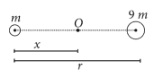
Two particles of masses $m$ and $9 m$ are separated by a distance $r$. At a point on the line joining them the gravitational field is zero. The gravitational potential at that point is ( $G=$ Universal constant of gravitation)
- A
$-\frac{4 G m}{r}$
- B
$-\frac{8 G m}{r}$
- C
$-\frac{16 G m}{r}$
- D
$-\frac{32 G m}{r}$
View full question & answer→MCQ 301 Mark
Let ' $g_h$ ' and ' $g_d$ ' be the accelerations due to gravity at height ' $h$ ' above the earth's surface and at depth ' $d$ ' below the earth's surface respectively. If $g_h=g_d$ then the relation between ' $h$ ' and ' $d$ ' is
- A
$d=h$
- B
$d=\frac{h}{2}$
- C
$d=\frac{h}{4}$
- ✓
$d=2 h$
AnswerCorrect option: D. $d=2 h$
(d) :$g_h=g\left[1-\frac{2 h}{R}\right]$ and $g_d=\left[1-\frac{d}{R}\right]$
View full question & answer→MCQ 311 Mark
A satellite of mass ' $m$ ' is revolving in a circular orbit of radius ' $r$ ' round the earth. Its angular momentum w.r.t. the centre of its orbit is $(M=$ mass of earth, $G=$ universal gravitational constant)
- A
$(G M m r)^{1 / 2}$
- ✓
$\left(G M m^2 r\right)^{1 / 2}$
- C
$\left(G M m^2 r^2\right)^{1 / 2}$
- D
$\left(G M^2 m^2 r\right)^{1 / 2}$
AnswerCorrect option: B. $\left(G M m^2 r\right)^{1 / 2}$
(b) :For a satellite of mass $m$, revolving around the earth in a circular orbit of radius $r$
$
\begin{gathered}
\frac{G M m}{r^2}=\frac{m v^2}{r} \\
\frac{G M m^2}{r}=m^2 v^2 \\
\text { or, } m v=p=\left(\frac{G M m^2}{r}\right)^{1 / 2}
\end{gathered}
$
Angular momentum of the satellite w.r.t. the centre of its orbit,
$
\begin{aligned}
& \vec{L}=\vec{r} \times \vec{p}=r p \sin 90^{\circ} \hat{n} \\
& L=r p=\left(G M m^2 r\right)^{1 / 2}
\end{aligned}
$
[Using eqn (i)]
View full question & answer→MCQ 321 Mark
A body of mass $m$ is raised to a height $10 R$ from the surface of earth, where $R$ is the radius of earth. The increase in potential energy is ( $G=$ universal constant of gravitation, $M=$ mass of earth and $g=$ acceleration due to gravity)
- A
$\frac{G M m}{11 R}$
- B
$\frac{G M m}{10 R}$
- C
$\frac{m g R}{11 G}$
- ✓
$\frac{10 GMm }{11 R }$
AnswerCorrect option: D. $\frac{10 GMm }{11 R }$
(d) :Potential energy of the body of mass $m$ on the surface of the earth is
$
U_i=-\frac{G M m}{R}
$
Potential energy of the same body at a height $h(=10 R)$ from the surface of earth is
$
\begin{aligned}
& U_f=-\frac{G M m}{R+h}=-\frac{G M m}{R+10 R}=-\frac{G M m}{11 R} \\
& \therefore \text { Increase in potential energy; } \\
& \Delta U=U_f-U_i=-\frac{G M m}{11 R}-\left(-\frac{G M m}{R}\right) \\
& =-\frac{G M m}{11 R}+\frac{G M m}{R} \\
& =\frac{G M m}{R}\left[1-\frac{1}{11}\right]=\frac{10 G M m}{11 R} \\
&
\end{aligned}
$
View full question & answer→MCQ 331 Mark
Calculate angular velocity of earth so that acceleration due to gravity at $60^{\circ}$ latitude becomes zero. (Radius of earth $=6400 km$, gravitational acceleration at poles $=10 m / s ^2, \cos 60^{\circ}=0.5$ )
- A
$7.8 \times 10^{-2} rad / s$
- B
$0.5 \times 10^{-3} rad / s$
- C
$1 \times 10^{-3} rad / s$
- ✓
$2.5 \times 10^{-3} rad / s$
AnswerCorrect option: D. $2.5 \times 10^{-3} rad / s$
(d) :Acceleration due to gravity at latitude $\lambda$ is
$
g_{\text {p }}=g-R \omega^2 \cos ^2 \lambda
$
where $R$ is the radius and $\omega$ is the angular velocity of earth.
At poles, $\lambda=90^{\circ}$
$
\therefore \quad g_p=g-R \omega^2 \cos ^2 90^{\circ}=g\left(\because \cos 90^{\circ}=0\right)
$
At latitude $\lambda=60^{\circ}$
$
\begin{aligned}
g_{600} & =g-R \omega^2 \cos ^2 60^{\circ} \\
& =g_p-\frac{1}{4} R \omega^2
\end{aligned}
$
$\begin{aligned} & \text { As per question, } g_{60^{\prime}}=\text { zero } \\ & \therefore \quad \frac{1}{4} R \omega^2=g_p \\ & \omega=\sqrt{\frac{4 g_p}{R}}=\sqrt{\frac{4 \times 10 m / s ^2}{6400 \times 10^3 m }}=\frac{1}{4} \times 10^{-2} rad / s \\ & =2.5 \times 10^{-3} rad / s \end{aligned}$
View full question & answer→MCQ 341 Mark
Two astronauts are floating in gravitational free space after having lost contact with their spaceship. The two will:
- A
keep floating at the same distance between them.
- ✓
- C
move away from each other.
- D
View full question & answer→MCQ 351 Mark
A satellite is revolving in a circular orbit at a height $h$ above the surface of the Earth of radius $R.$ The speed of the satellite in its orbit is one$-$fourth the escape velocity from the surface of the Earth. The relation between $h$ and $R$ is
- A
$h = 2R$
- B
$h = 3R$
- C
$h = 5R$
- ✓
$h = 7R$
AnswerCorrect option: D. $h = 7R$
$ V _{ c }=\sqrt{\frac{ GM }{ R + h }}$
$V _{ e }=\sqrt{\frac{2 GM }{ R }}$
But, $4 V _{ c }= V _{ e } \ \ \ ....($given$)$
$ 4 \times \sqrt{\frac{G M}{R+h}}=\sqrt{\frac{2 G M}{R}}$
$ \frac{16 GM }{ R + h }=\frac{2 GM }{ R }$
$\therefore 8 R = R + h$
$\therefore h =7 R $
View full question & answer→MCQ 361 Mark
A body is thrown from the surface of the Earth with velocity $'u\ ’ m/s.$ The maximum height in m above the surface of the Earth upto which it will reach is $(R =$ radius of Earth, $g =$ acceleration due to gravity$)$
- ✓
$\frac{ u ^2 R }{2 gR - u ^2}$
- B
$\frac{2 u^2 R}{g R-u^2}$
- C
$\frac{u^2 R^2}{2 g R^2-u^2}$
- D
$\frac{u^2 R}{g R-u^2}$
AnswerCorrect option: A. $\frac{ u ^2 R }{2 gR - u ^2}$
$(T.E.)$ on surface $= (T.E.)$ at height $'h\ ’$
$ \therefore(\text { K.E. })_1+(\text { P.E. })_1=(\text { K.E. })_2+(\text { P.E. })_2$
$\therefore \frac{1}{2} mu ^2+\left(-\frac{ GMm }{ R }\right)=0+\left(-\frac{ GMm }{ R + h }\right)$
$\frac{1}{2} mu ^2=\left(-\frac{ GMm }{ R + h }\right)-\left(-\frac{ GMm }{ R }\right)$
$=\frac{ GMm }{ R }-\frac{ GMm }{ R + h }$
$= GMm \left[\frac{1}{ R }-\frac{1}{ R + h }\right]$
$ \therefore u ^2 =2 GM \left[\frac{1}{ R }-\frac{1}{ R + h }\right]$
$u ^2 =2 gR ^2\left[\frac{ R + h - R }{ R ( R + h )}\right] \ldots\left(\because GM = gR ^2\right)$
$u^2=2 g R\left[\frac{h}{R+h}\right]$
$\therefore \frac{u^2}{2 g R}=\left[\frac{h}{R+h}\right]$
$\therefore \frac{ R + h }{ h }=\frac{2 g R}{u^2}$
$ \frac{ R }{ h }+1=\frac{2 g R}{u^2}$
$\therefore \frac{ R }{ h }=\frac{2 g R}{ u ^2}-1$
$ \frac{ R }{ h }=\frac{2 g R- u ^2}{ u ^2}$
$\therefore h =\frac{ u ^2 R }{2 gR - u ^2}$
View full question & answer→MCQ 371 Mark
According to Kepler’s Law, the areal velocity of the radius vector drawn from the Sun to any planet always
- A
- B
first increases and then decreases.
- ✓
- D
View full question & answer→MCQ 381 Mark
A body mass $‘m \ ’$ is dropped from height , from Earth’s surface, where $‘R \ ’$ is the radius of Earth. Its speed when it will hit the Earth’s surface is $(v_e =$ escape velocity from Earth’s surface$)$
AnswerCorrect option: B. $\frac{V_e}{\sqrt{3}}$
$ g_h =g\left(\frac{R}{R+\frac{R}{2}}\right)^2$
$ =g\left(\frac{2 R}{3 R}\right)^2$
$g_h =\frac{4 g}{9}\ \ \ \ .....(i)$
$\left(v_c\right)_h =\sqrt{g_h R_h}$
$ =\sqrt{\frac{4 g}{9} \times \frac{R}{2}} \ldots .[\text { From (i) }]$
$ =\frac{1}{\sqrt{3}} \sqrt{2 g R} \ldots .\left(V_e=\sqrt{2 g R}\right)$
$\left( V _{ c }\right)_{ h }=\frac{1}{\sqrt{3}} V _{ e }$
View full question & answer→MCQ 391 Mark
Assuming that the gravitational potential energy of an object at infinity is zero, the change in potential energy (final – initial) of an object of mass m, when taken to a height h from the surface of Earth (of radius R), is given by,
- A
$\frac{ GMm }{R+h}$
- B
$-\frac{ GMm }{R+h}$
- C
$\frac{ GMmh }{R(R+h)}$
- D
Answer$\frac{ GMmh }{R(R+h)}$
Hint:
Potential energy of object of mass m on the surface of Earth,
$P . E=\frac{-G M m}{R}$
Potential energy of object of mass m at a height h from the surface of the Earth,
$\text { P.E.' }=\frac{- GMm }{ R + h }$
$\therefore$ Change in potential energy
= P.E.' - P.E.
$=\frac{- GMm }{ R + h }+\left(\frac{- GMm }{ R }\right)$
$=\frac{ GMmh }{ R ( R + h )}$
View full question & answer→MCQ 401 Mark
The time period of a geostationary satellite is $24 h,$ at a height $6R_E (R_E$ is radius of Earth$)$ from surface of Earth. The time period of another satellite whose height is $2.5 R_E$ from surface will be,
- A
$\frac{12}{2.5} h$
- ✓
$6 \sqrt{2} h$
- C
$12 \sqrt{2} h$
- D
$\frac{24}{2.5} h$
AnswerCorrect option: B. $6 \sqrt{2} h$
By Kepler’s third law,
$ T ^2 \propto r ^3$
$\therefore T ^2 \propto\left( R _{ E }+ h \right)^3$
$\therefore \frac{ T _2}{T_1}=\left(\frac{ R _{ E }+ h _2}{ R _{ E }+ h _1}\right)^{\frac{3}{2}}$
$\therefore \frac{ T _2}{T_1}=\left(\frac{ R _{ E }+2.5 R _{ E }}{ R _{ E }+2 R _{ E }}\right)^{\frac{3}{2}}$
$\therefore \frac{ T _2}{24}=\frac{1}{2 \sqrt{2}}$
$\therefore T _2=6 \sqrt{2} h$
View full question & answer→MCQ 411 Mark
The work done to raise a mass $m$ from the surface of the Earth to a height $h,$ which is equal to the radius of the Earth, is:
- ✓
$\frac{1}{2} mgR$
- B
$\frac{3}{2} mgR$
- C
$mgR$
- D
$2mgR$
AnswerCorrect option: A. $\frac{1}{2} mgR$
Initial potential energy on Earth’s surface,
$U_i=\frac{- GMm }{ R }$
Final potential energy at height $h=R$
$U_f=\frac{-G M m}{2 R}$
Work done, $W=U_f-U_i$
$=\frac{- GMm }{2 R }-\left(\frac{- GMm }{ R }\right)$
$=\frac{ GMm }{ R }-\frac{ GMm }{2 R }$
$=\frac{G M m}{2 R}$
$=\frac{\left( gR ^2\right) m }{2 R }$
$\therefore W =\frac{1}{2} mgR$
View full question & answer→MCQ 421 Mark
A body weighs $200 N$ on the surface of the Earth. How much will it weigh half way down to the centre of the Earth?
- A
$250 N$
- ✓
$100 N$
- C
$150 N$
- D
$200 N$
AnswerCorrect option: B. $100 N$
Acceleration due to gravity at depth $d,$
$g_d=g\left(1-\frac{d}{R}\right)$
$=g\left(1-\frac{1}{2}\right) \ldots\left(\because d=\frac{1}{2}\right)$
$\therefore g_d=\frac{g}{2}$
Weight of the body at depth $d = R/2,$
$ W _{ d }= mg _{ d }$
$= m \times g / 2$
$=\frac{1}{2} \times 200$
$\therefore W _{ d }=100 N$
View full question & answer→MCQ 431 Mark
If the kinetic energy of a satellite is $2 \times 10^4 J,$ then its potential energy will be
- A
$– 2 \times 10^4 J$
- B
$4 \times 10^4 J$
- ✓
$-4 \times 10^4 J$
- D
$-10^4 J$
AnswerCorrect option: C. $-4 \times 10^4 J$
$-4 \times 10^4 J$
View full question & answer→MCQ 441 Mark
If $v_e$ and $v_o$ represent the escape velocity and orbital velocity of a satellite corresponding to a circular orbit of radius $R$ respectively, then
- A
$V_{ e }= V _{ o }$
- ✓
$\sqrt{2} V _{ o }= V _{ e }$
- C
$V _{ e }=\frac{1}{\sqrt{2}} V_{ O }$
- D
$V_e$ and $V_0$ are not related
AnswerCorrect option: B. $\sqrt{2} V _{ o }= V _{ e }$
$\sqrt{2} V _{ o }= V_{ e }$
View full question & answer→MCQ 451 Mark
If gravitational force of Earth disappears, what will happen to the satellite revolving round the Earth?
- A
Satellite will come back to Earth.
- B
Satellite will continue to revolve.
- ✓
Satellite will escape in tangential path.
- D
Satellite will start falling towards centre.
AnswerCorrect option: C. Satellite will escape in tangential path.
Satellite will escape in tangential path.
View full question & answer→MCQ 461 Mark
Potential energy of a body in the gravitational field of planet is zero. The body must be
- A
- B
on the surface of planet.
- ✓
- D
at distance equal to radius of Earth.
View full question & answer→MCQ 471 Mark
If the escape velocity of a body on Earth is 11.2 km/s, the escape velocity of the body thrown at an angle 45° with the horizontal will be
MCQ 481 Mark
Escape velocity on a planet is $ve.$ If radius of the planet remains same and mass becomes $4$ times, the escape velocity becomes
- A
$4v_e$
- ✓
$2v_e$
- C
$v_e$
- D
$0.5 v_e$
AnswerCorrect option: B. $2v_e$
$2v_e$
View full question & answer→MCQ 491 Mark
How does the escape velocity of a particle depend on its mass?
- A
$m^2$
- B
$m$
- ✓
$m^0$
- D
$m^{-1}$
View full question & answer→MCQ 501 Mark
A satellite is orbiting around a planet at a constant height in a circular orbit. If the mass of the planet is reduced to half, the satellite would
- A
- B
go to an orbit of smaller radius.
- C
go to an orbit of higher radius,
- ✓
View full question & answer→MCQ 511 Mark
The gravitational potential energy per unit mass at a point gives ________ at that point.
- A
- ✓
- C
gravitational potential energy
- D
View full question & answer→MCQ 521 Mark
Calculate angular velocity of Earth so that acceleration due to gravity at $60^\circ$ latitude becomes zero. $($Radius of Earth $= 6400 \ km,$ gravitational acceleration at poles $= 10 \ m/s^2, cos60^\circ = 0.5)$
- A
$7.8 \times 10^{-2} \ rad/s$
- B
$0.5 \times 10^{-3} \ radis$
- C
$1 \times 10^{-3} \ radis$
- ✓
$2.5 \times 10^{-3} \ rad/s$
AnswerCorrect option: D. $2.5 \times 10^{-3} \ rad/s$
$2.5 \times 10^{-3} \ rad/s$
View full question & answer→MCQ 531 Mark
Which of the following statements is not correct for the decrease in the value of acceleration due to gravity?
- A
As we go down from the surtce of the Earth towards its centre.
- B
As we go up from the surface of the Earth.
- ✓
As we go from equator to the poles on the surface on the Earth.
- D
As the rotational velocity of the Earth is increased.
AnswerCorrect option: C. As we go from equator to the poles on the surface on the Earth.
As we go from equator to the poles on the surface on the Earth.
View full question & answer→MCQ 541 Mark
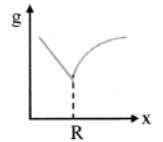
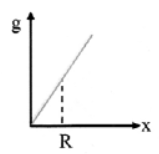
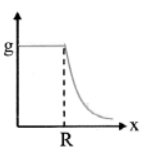
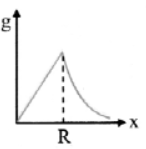
Variation of acceleration due to gravity (g) with distance x from the centre of the Earth is best represented by (R → Radius of the Earth)
MCQ 551 Mark
If R is the radius of the Earth and g is the acceleration due to gravity on the Earth’s surface, the mean density of the Earth is
- A
$\frac{4 g}{3 \pi RG }$
- B
$\frac{4 \pi RG }{3 g}$
- C
$\frac{\pi Rg }{12 g}$
- ✓
$\frac{3 g}{4 \pi RG }$
AnswerCorrect option: D. $\frac{3 g}{4 \pi RG }$
$\frac{3 g}{4 \pi RG }$
View full question & answer→MCQ 561 Mark
Acceleration due to gravity above the Earth’s surface at a height equal to the radius of the Earth is $.............$
- ✓
$2.5 \ m/s^2$
- B
$5 \ m/s^2$
- C
$9.8 \ m/s^2$
- D
$10 \ m/s^2$
AnswerCorrect option: A. $2.5 \ m/s^2$
$2.5 \ m/s^2$
View full question & answer→MCQ 571 Mark
The gravitational constant $G$ is equal to $6.67 \times 10^{-11} N m^2/kg^2$ in vacuum. Its value in a dense matter of density $10^{10} g/cm^3$ will be
- A
$6.67 \times 10^{-1} N m ^2 / kg ^2$
- ✓
$6.67 \times 10^{-11} N m ^2 / kg ^2$
- C
$6.67 \times 10^{-10} N m ^2 / kg ^2$
- D
$6.67 \times 10^{-21} N m ^2 / kg ^2$
AnswerCorrect option: B. $6.67 \times 10^{-11} N m ^2 / kg ^2$
$6.67 \times 10^{-11} N m ^2 / kg ^2$
View full question & answer→MCQ 581 Mark
If the distance between Sun and Earth is made two third times of the present value, then gravitational force between them will become
- A
$\frac{4}{9}$ times
- B
$\frac{2}{3}$ times
- C
$\frac{1}{3}$ times
- ✓
$\frac{9}{4}$ times
AnswerCorrect option: D. $\frac{9}{4}$ times
$\frac{9}{4}$ times
View full question & answer→MCQ 591 Mark
Which of the following is not a property of gravitational force?
- A
It is an attractive force.
- B
It acts along the line joining the two bodies.
- C
The forces exerted by two bodies on each other form an action-reaction pair.
- ✓
It has a very finite range of action.
AnswerCorrect option: D. It has a very finite range of action.
It has a very finite range of action.
View full question & answer→MCQ 601 Mark
Mass of a particle at the centre of the Earth is
- A
- B
- ✓
- D
greater than at the poles.
View full question & answer→MCQ 611 Mark
The gravitational force between two bodies is ______
- A
attractive at large distance only
- B
attractive at small distance only
- C
repulsive at small distance only
- ✓
attractive at all distances large or small
AnswerCorrect option: D. attractive at all distances large or small
attractive at all distances large or small
View full question & answer→MCQ 621 Mark
Which of the following statements about the gravitational constant is true?
- A
- B
It has same value in all systems of units.
- C
- ✓
It does not depend upon the nature of medium in which the bodies lie.
AnswerCorrect option: D. It does not depend upon the nature of medium in which the bodies lie.
It does not depend upon the nature of medium in which the bodies lie.
View full question & answer→MCQ 631 Mark
If the mass of a body is M on the surface of the Earth, the mass of the same body on the surface of the moon is M
MCQ 641 Mark
Newton’s law of gravitation is called universal law because
- A
force is always attractive.
- B
it is applicable to lighter and heavier bodies.
- C
it is applicable at all times,
- ✓
it is applicable at all places of universe for all distances between all particles.
AnswerCorrect option: D. it is applicable at all places of universe for all distances between all particles.
it is applicable at all places of universe for all distances between all particles.
View full question & answer→MCQ 651 Mark
Time period of revolution of a satellite around a planet of radius R is T. Period of revolution around another planet whose radius is 3R is
AnswerCorrect option: D. $3 \sqrt{3} T$
$3 \sqrt{3} T$
View full question & answer→MCQ 661 Mark
A planet is revolving around a star in a circular orbit of radius $R$ with a period $T.$ If the gravitational force between the planet and the star is proportional to $R^{-3/2},$ then
- ✓
$T^2 \propto R^{5 / 2}$
- B
$T^2 \propto R^{-7 / 2}$
- C
$T^2 \propto R^{3 / 2}$
- D
$T^2 \propto R^4$
AnswerCorrect option: A. $T^2 \propto R^{5 / 2}$
$T^2 \propto R^{5 / 2}$
View full question & answer→MCQ 671 Mark
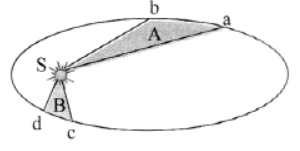
The figure shows the motion of a planet satellite in terms of mean density of Earth. around the Sun in an elliptical orbit with Sun at the focus. The shaded areas $A$ and $B$ are also shown in the figure which can be assumed to be equal. If $t_1$ and $t_2$ represent the time for the planet to move from $a$ to $b$ and $d$ to $c$ respectively, then
- A
$t_1 < t_2$
- B
$t_1>t_2$
- ✓
$t_1=t_2$
- D
$t_1 \leq t_2$
AnswerCorrect option: C. $t_1=t_2$
$t_1=t_2$
View full question & answer→MCQ 681 Mark
Amongst given statements, choose the correct statement.
(I) Kepler derived the laws of planetary motion.
(II) Newton provided the reason behind the laws of planetary motion.
- A
- ✓
- C
Both (I) and (II) are correct.
- D
Neither (I) nor (II) is correct.
View full question & answer→MCQ 691 Mark
Kepler’s law of equal areas is an outcome of
- A
- B
conservation of linear momentum
- ✓
conservation of angular momentum
- D
AnswerCorrect option: C. conservation of angular momentum
conservation of angular momentum
View full question & answer→