Questions

Answer the following in one or two sentences.

Take a timed test

22 questions · self-marked practice — reveal the answer and mark yourself.

Question 12 Marks
Define the terms: Inhibition
Answer
Inhibition:
The phenomenon in which the rate of chemical reaction is reduced by an inhibitor is called inhibition.
View full question & answer
Question 22 Marks
Define the terms: Catalysis.
Answer
Catalysis:
The phenomenon of increasing the rate of a chemical reaction with the help of a catalyst is known as catalysis.
View full question & answer
Question 32 Marks
Define the terms : Electrophoresis
Answer
Electrophoresis:
The movement of colloidal particles under an applied electric potential is called electrophoresis.
View full question & answer
Question 72 Marks
Dip a chalk in ink. What do you observe?
Answer
When a chalk is dipped in ink, it is observed that the ink molecules are adsorbed at the surface of chalk and the surface becomes coloured, while the solvent of the ink goes deeper into the chalk due to absorption.
View full question & answer
Question 82 Marks
What is adsorption?
Answer
Adsorption is the phenomenon of accumulation of higher concentration of one substance on the surface of another (in bulk) due to unbalanced/unsatisfied attractive forces on the surface.
View full question & answer
Question 102 Marks
In drinking water treatment, often alum is added for the complete removal of suspended impurities. On complete dissolution, alum produces positive charge which neutralizes the charge on the suspended particles and thus, impurities are easily removed.
i. Name and define the process involved due to which charge on particles get neutralized.
ii. What is the role of alum in the above mentioned process?
Answer
i. a. Charge on particles get neutralized due to coagulation.
b. The precipitation of colloids by removal of charge associated with colloidal particles is called coagulation.
ii. Alum acts as a reagent that helps in coagulation of the suspended particles by the removal of the charge associated with these particles.
View full question & answer
Question 112 Marks
How can we bring about precipitation of lyophobic colloids?
Answer
  • The charge on the colloidal particles is due to the preferential adsorption of ions on their surface.
  • Hence, lyophobic colloids can be precipitated out by removing the charge on the colloidal particles (dispersed phase).
View full question & answer
Question 122 Marks
Explain the term electroosmosis.
Answer
  • Movement of dispersed particles can be prevented by suitable means such as use of membrane.
  • On doing so, it is observed that the dispersion medium begins to move in an electric field. This is known as electroosmosis.

View full question & answer
Question 132 Marks
What are the general properties exhibited by colloidal dispersions?
Answer
General properties exhibited by colloidal dispersions:
  • Colloidal system is heterogeneous and consists of two phases, dispersed phase and dispersion medium.
  • The dispersed phase particles pass slowly through parchment paper or animal membrane, but readily pass through ordinary filter paper.
  • Colloidal particles are usually not detectable by powerful microscope.
View full question & answer
Question 142 Marks
Why is it necessary to purify colloidal solutions?
Answer
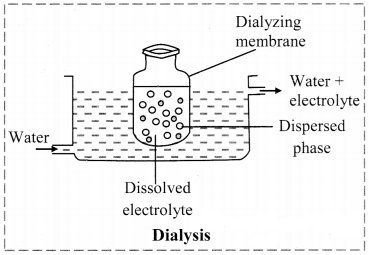
  • Colloidal solution generally contains excessive amount of electrolytes and some other soluble impurities.
  • A small quantity of an electrolyte is necessary for the stability of colloidal solution, however, a large quantity of electrolyte may result in coagulation.
  • It is also necessary to reduce soluble impurities.
Hence, it is necessary to purify colloidal solutions.
View full question & answer
Question 152 Marks
Describe the process involved in peptization?
Answer
  • During peptization a precipitate is converted into colloidal sol by shaking with dispersion medium in the presence of a small amount of an electrolyte. The electrolyte used is known as peptizing agent.
  • During the process, the precipitate adsorbs one of the ions of the electrolyte on its surface and as a result, positive or negative charge is developed on the precipitate which finally breaks up into small particles of colloidal size.
View full question & answer
Question 172 Marks
State the differences between colloids and solutions.
Answer
Colloids:
  1. Colloids contain particles of dispersed phase with diameters in the range of 2 to 500 nm.
  2. They are translucent to light.
  3. e.g. Milk, fog, etc.
Solutions:
  1. Solutions contain solute particles with diameters in the range of 0.1 to 2 nm.
  2. They are transparent or may be coloured.
  3. e.g. NaCl solution
View full question & answer
Question 182 Marks
Write decomposition reaction of hydrogen peroxide. Suggest how this decomposition can be prevented.
Answer
i. Hydrogen peroxide decomposes as,
$\underset{\substack{\text { Hydrogen } \\ \text { peroxide }}}{2 H _2 O _{2(h)}} \longrightarrow \underset{\text { Water }}{2 H _2 O _{(l)}}+\underset{\text { }}{ O _{2(g)}}$
ii. The reaction can be inhibited by addition of dilute acid or glycerol as they act as inhibitors.
View full question & answer
Question 192 Marks
Image
$i.$ State whether the given reaction is an example of heterogeneous or homogeneous catalysis.
$ii.$ What is the role of $Fe, K_2O$ and $Al_2O_3$ in this reaction?
Answer
$i.$ This reaction is an example of heterogeneous catalysis.
$ii.$ Fe is used as a catalyst while $K_2O$ and $Al_2O_3$ are promoters of the Fe catalyst. $Al_2O_3$ is used to prevent the fusion of $Fe$ particles while $K_2O$ causes chemisorption of nitrogen atoms.
View full question & answer
Question 202 Marks
Explain the importance of catalysts in chemical industries.
Answer
  • A large number of the chemicals manufactured in industries make use of catalysts to obtain specific products.
  • The use of catalyst lowers the reaction temperature as well as energy costs significantly.
    Due to these advantages, catalysts are of great importance in chemical industry.
View full question & answer
Question 212 Marks
Explain how high vacuum can be obtained by adsorption.
Answer
  • Lowering of temperature at a given pressure, increases the rate of adsorption of gases on charcoal powder. By using this principle, high vacuum can be attained by adsorption.
  • A vessel evacuated by vacuum pump is connected to another vessel containing coconut charcoal cooled by liquid air. The charcoal adsorbs the remaining traces of air or moisture to create a high vacuum.
View full question & answer
Question 222 Marks
Define sorption.
Answer
When both adsorption and absorption occur simultaneously, it is known as sorption.
e.g. When a chalk is dipped in ink, the ink molecules are adsorbed at the surface of the chalk while the solvent of the ink goes deeper into the chalk due to absorption.
View full question & answer