Questions

Solve the Following Question.(3 Marks)

Take a timed test

13 questions · self-marked practice — reveal the answer and mark yourself.

Question 13 Marks
Find the equations of the tangents to the circle $x^2+y^2=16$ with slope -2 .
Answer
Given equation of the circle is $x^2+y^2=16$

Comparing this equation with $x^2+y^2=a^2$, we get

$a^2=16$

Equations of the tangents to the circle $x^2+y^2=a^2$ with slope $m$ are

$y=m x \pm \sqrt{a^2\left(1+m^2\right)}$

Here, $m=-2, a^2=16$

the required equations of the tangents are

$\begin{aligned} & y=-2 x \pm \sqrt{16\left[1+(-2)^2\right]} \\ & \Rightarrow y=-2 x \pm \sqrt{16(5)} \\ & \Rightarrow y=-2 x \pm 4 \sqrt{ } 5 \\ & \Rightarrow 2 x+y \pm 4 \sqrt{ } 5=0\end{aligned}$
View full question & answer
Question 23 Marks
If the tangent at $(3,-4)$ to the circle $x^2+y^2=25$ touches the circle $x^2+y^2+8 x-4 y+c=$

0, find c.

Answer
The equation of a tangent to the circle

$x^2+y^2=r^2$ at $\left(x_1, y_1\right)$ is $x x_1+y y_1=r^2$

Equation of the tangent at (3, -4) is

x(3) + y(-4) = 25

⇒ 3x – 4y – 25 = 0 ……(i)

Given equation of circle is $x^2+y^2+8 x-4 y+c=0$

Comparing this equation with $x^2+y^2+2 g x+2 f y+c=0$, we get

2g = 8, 2f = -4

⇒ g = 4, f = -2

$\therefore C=(-4,2)$ and $r=\sqrt{4^2+(-2)^2-c}=\sqrt{20-c}$

Since line (i) is a tangent to this circle also, the perpendicular distance from C(-4, 2) to line (i) is equal to radius r.

$\begin{aligned} & \left|\frac{3(-4)+(-4)(2)-25}{\sqrt{3^2+4^2}}\right|=\sqrt{20-c} \\ & \left|\frac{-45}{\sqrt{25}}\right|=\sqrt{20-c} \\ & \left|\frac{-45}{5}\right|=\sqrt{20-c}\end{aligned}$

$\begin{aligned} & |-9|=\sqrt{20-c} \\ & 81=20-c \\ & c=-61\end{aligned}$

...[Squaring both the sides]

View full question & answer
Question 33 Marks
Find the equation of the circle concentric with $x^2+y^2-4 x+6 y=1$ and having radius 4

units.

Answer
Given equation of circle is

$x^2+y^2-4 x+6 y=1$ i.e, $x^2+y^2-4 x+6 y-1=0$

Comparing this equation with $x^2+y^2+2 g x+2 f y+c=0$, we get

2g = -4, 2f = 6

⇒ g = -2, f = 3

Centre of the circle = (-g, -f) = (2, -3)

Given circle is concentric with the required circle.

∴ They have same centre.

∴ Centre of the required circle = (2, -3)

The equation of a circle with centre at $(h, k)$ and radius $r$ is $(x-h)^2+(y-k)^2=r^2$

Here, h = 2, k = -3 and r = 4

∴ the required equation of the circle is

$\begin{aligned} & (x-2)^2+[y-(-3)]^2=4^2 \\ & \Rightarrow(x-2)^2+(y+3)^2=16 \\ & \Rightarrow x^2-4 x+4+y^2+6 y+9-16=0 \\ & \Rightarrow x^2+y^2-4 x+6 y-3=0\end{aligned}$

View full question & answer
Question 43 Marks
Find the equation of locus of the point of intersection of perpendicular tangents drawn to the circle x = 5 cos θ and y = 5 sin θ.
Answer
The locus of the point of intersection of perpendicular tangents is the director circle of the given circle.

x = 5 cos θ and y = 5 sin θ

$\begin{aligned} & \Rightarrow x^2+y^2=25 \cos ^2 \theta+25 \sin ^2 \theta \\ & \Rightarrow x^2+y^2=25\left(\cos ^2 \theta+\sin ^2 \theta\right) \\ & \Rightarrow x^2+y^2=25(1)=25\end{aligned}$

The equation of the director circle of the circle $x^2+y^2=a^2$ is $x^2+y^2=2 a^2$.

Here, a = 5

∴ the required equation is

$\begin{aligned} & x^2+y^2=2(5)^2=2(25) \\ & \therefore x^2+y^2=50\end{aligned}$

View full question & answer
Question 53 Marks
Show that $x=-1$ is a tangent to circle $x^2+y^2-4 x-2 y-4=0$ at $(-1,1)$.
Answer
Given equation of circle is $x^2+y^2-4 x-2 y-4=0$.

Comparing this equation with $x^2+y^2+2 g x+2 f y+c=0$, we get

2g = -4, 2f = -2, c = -4

⇒ g = -2, f = -1, c = -4

The equation of a tangent to the circle

$x^2+y^2+2 g x+2 f y+c=0$ at $\left(x_1, y_1\right)$ is $x x_1+y y_1+g\left(x+x_1\right)+f\left(y+y_1\right)+c=0$

the equation of the tangent at (-1, 1) is

⇒ x(-1) + y(1) – 2(x – 1) – 1(y + 1) – 4 = 0

⇒ -3x – 3 = 0

⇒ -x – 1 = 0

⇒ x = -1

∴ x = -1 is the tangent to the given circle at (-1, 1).

View full question & answer
Question 63 Marks
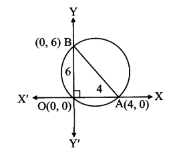
Find the equation of the circle which passes through the origin and cuts off chords of lengths 4 and 6 on the positive side of the X-axis and Y-axis respectively.
Answer

Image

Let the circle cut the chord of length 4 on X-axis at point A and the chord of length 6 on

the Y-axis at point B.

∴ the co-ordinates of point A are (4, 0) and co-ordinates of point B are (0, 6).

Since ∠BOA is a right angle.

AB represents the diameter of the circle.

The equation of a circle having $\left(x_1, y_1\right)$ and $\left(x_2, y_2\right)$ as endpoints of diameter is given by

$\begin{aligned} & \left(x-x_1\right)\left(x-x_2\right)+\left(y-y_1\right)\left(y-y_2\right)=0 \\ & \text { Here, } x_1=4_2 y_1=0, x_2=0, y_2=6\end{aligned}$

∴ the required equation of the circle is ⇒ (x – 4) (x – 0) + (y – 0) (y – 6) = 0

$\begin{aligned} & \Rightarrow x^2-4 x+y^2-6 y=0 \\ & \Rightarrow x^2+y^2-4 x-6 y=0\end{aligned}$

View full question & answer
Question 73 Marks
Show that the line $3 x-4 y+15=0$ is a tangent to the circle $x^2+y^2=9$. Find the point of contact.
Answer
The equation of circle is $x^2+y^2=9$
The equation of line is $3 x-4 y+15=0$
$\therefore y=\frac{1}{4}(3 x+15)$, substitute value of $y$ in equation (1)
$
x^2+\frac{1}{16}(3 x+15)^2=9
$
$
\begin{aligned}
& \therefore 16 x^2+9 x^2+90 x+225=144 \\
& \therefore 25 x^2+90 x+81=0 \\
& \therefore \quad(5 x+9)^2=0
\end{aligned}
$
$x=\frac{-9}{5}$; The roots of equation are equal.
$\therefore$ line (2) is tangent to given circle (1)
$
\begin{aligned}
\therefore & y=\frac{1}{4}(3 x+15) \\
& =\frac{1}{4}\left(3\left(-\frac{9}{5}\right)+12\right) \\
& =\frac{12}{5}
\end{aligned}
$
$\left(-\frac{9}{3}, \frac{12}{5}\right)$ is the only point of intersection of the line and circle.
$\therefore$ The line $3 x-4 y+15=0$ touches the circle at $\left(-\frac{9}{3}, \frac{12}{5}\right)$
$
\therefore \text { point of contact }=\left(-\frac{9}{3}, \frac{12}{5}\right)
$
View full question & answer
Question 83 Marks
Find the equation of tangent to the circle $x^2+y^2-4 x+3 y+2=0$ at the point $(4,-2)$.
Answer
Given equation of the circle is $x^2+y^2-4 x+3 y+2=0$
Comparing this equation with $x^2+y^2+2 g x+2 f y+c=0$, we get
$2g = -4, 2f = 3, c = 2$
$g=-2, f=\frac{3}{2}, c=2$
The equation of a tangent to the circle $x^2+y^2+2 g x+2 f y+c=0$ at $\left(x_1, y_1\right)$ is
$x x_1+y y_1+g\left(x+x_1\right)+f\left(y+y_1\right)+c=0$
The equation of the tangent at $(4, -2)$ is
$x(4)+y(-2)-2(x+4)+\frac{3}{2}(y-2)+2=0$
$\Rightarrow 4 x-2 y-2 x-8+\frac{3}{2} y-3+2=0$
$\Rightarrow 2 x-\frac{1}{2} y-9=0$
$\Rightarrow 4 x-y-18=0$
View full question & answer
Question 93 Marks
Show that the line $/ x-3 y-1=0$ touches the circle $x^2+y^2+5 x-1 y+4=0$ at point $(1,2).$
Answer
Given equation of the circle is $x^2+y^2+5 x-7 y+4=0$
Comparing this equation with $x^2+y^2+2 g x+2 f y+c=0$, we get
$2g = 5, 2f = -7, c = 4$
$\Rightarrow g=\frac{5}{2}, f=\frac{-7}{2}, c=4$
The equation of a tangent to the circle $x^2+y^2+2 g x+2 f y+c=0$ at $\left(x_1, y_1\right)$ is
$x x_1+y y_1+g\left(x+x_1\right)+f\left(y+y_1\right)+c=0$
The equation of the tangent at (1, 2) is
$x(1)+y(2)+\frac{5}{2}(x+1)-\frac{7}{2}(y+2)+4=0$
$x+2 y+\frac{5}{2} x+\frac{5}{2}-\frac{7}{2} y-7+4=0$
$\frac{7}{2} x-\frac{3}{2} y-\frac{1}{2}=0$
$7x – 3y – 1 = 0,$ which is same as the given line.
The line $7x – 3y – 1 = 0$ touches the given circle at $(1, 2).$
View full question & answer
Question 103 Marks
Find the equation of a tangent to the circle $x^2+y^2-3 x+2 y=0$ at the origin.
Answer
Given equation of the circle is $x^2+y^2-3 x+2 y=0$Comparing this equation with $x^2+y^2+2 g x+2 f y+c=0$, we get
$2g = -3, 2f = 2, c = 0$
$\Rightarrow \mathrm{g}=-\frac{5}{2}, \mathrm{f}=1, \mathrm{c}=0$
The equation of a tangent to the circle
$x^2+y^2+2 g x+2 f y+c=0$ at $\left(x_1, y_1\right)$ is $x x_1+y y_1+g\left(x+x_1\right)+f\left(y+y_1\right)+c=0$
The equation of the tangent at (0, 0) is
$x(0)+y(0)+\left(-\frac{3}{2}\right)(x+0)+1(y+0)+0=0$
$\Rightarrow-\frac{3}{2} x+y=0 $
$ \Rightarrow 3 x-2 y=0$
View full question & answer
Question 113 Marks
Find the parametric representation of the circle $3 x^2+3 y^2-4 x+6 y-4=0$.
Answer
Given equation of the circle is $3 x^2+3 y^2-4 x+6 y-4=0$
Dividing throughout by $3,$ we get
$x^2+y^2-\frac{4}{3} x+2 y-\frac{4}{3}=0$
$x^2-\frac{4}{3} x+y^2+2 y-\frac{4}{3}=0$
$x^2-\frac{4}{3} x+\frac{4}{9}-\frac{4}{9}+y^2+2 y+1-1-\frac{4}{3}=0$
$\left(x^2-\frac{4}{3} x+\frac{4}{9}\right)+\left(y^2+2 y+1\right)-\frac{25}{9}=0$
$\left(x-\frac{2}{3}\right)^2+(y+1)^2=\frac{25}{9}$
$\left(x-\frac{2}{3}\right)^2+[y-(-1)]^2=\left(\frac{5}{3}\right)^2$
Comparing this equation with $(x-h)^2+(y-k)^2=r^2$, we get
$\mathrm{h}=\frac{2}{3}, \mathrm{k}=-1$ and $r=\frac{5}{3}$
The parametric representation of the circle in terms of $\theta$ are
$x = h + r \cos \theta$ and $y = k + r \sin \theta$
$\Rightarrow x=\frac{2}{3}+\frac{5}{3} \cos \theta$ and $y=-1+\frac{5}{3} \sin \theta$
View full question & answer
Question 123 Marks
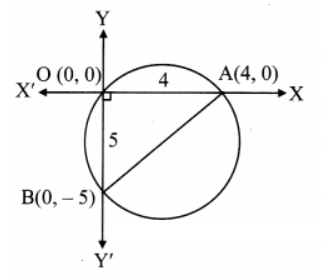
Find the equation of the circle passing through the origin and having intercepts $4$ and $-5$ on the co-ordinate axes.
Answer
Let the circle intersect X-axis at point A and intersect Y-axis at point $B.$ the co-ordinates of point $A$ are $(4, 0)$ and the co-ordinates of point $B$ are $(0, -5).$
Image
Since $\angle AOB$ is a right angle,
AB represents the diameter of the circle.
The equation of a circle having $\left(x_1, y_1\right)$ and $\left(x_2, y_2\right)$ as end points of diameter is given by
$\left(x-x_1\right)\left(x-x_2\right)+\left(y-y_1\right)\left(y-y_2\right)=0$
$\text { Here, } x_1=4, y_1=0, x_2=0, y_2=-5$
The required equation of the circle is
$\Rightarrow(x – 4) (x – 0) + (y – 0) [y – (-5)] = 0$
$\Rightarrow x(x – 4) + y(y + 5) = 0$
$\Rightarrow x^2-4 x+y^2+5 y=0$
$\Rightarrow x^2+y^2-4 x+5 y=0$
View full question & answer
Question 133 Marks
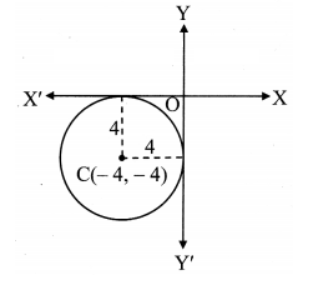
Find the equation of a circle with a radius of 4 units and touch both the co-ordinate axes having centre in the third quadrant.
Answer
The radius of the circle $= 4$ unitsSince the circle touches both the co-ordinate axes and its centre is in the third quadrant,
the centre of the circle is $C(-4, -4).$
Image
The equation of a circle with centre at $(h, k)$ and radius $r$ is given by $(x-h)^2+(y-k)^2=r^2$
Here, $h = -4, k = -4, r = 4$
the required equation of the circle is
$\Rightarrow[x-(-4)]^2+[y-(-4)]^2=4^2$
$\Rightarrow(x+4)^2+(y+4)^2=16$
$\Rightarrow x^2+8 x+16+y^2+8 y+16-16=0$
$\Rightarrow x^2+y^2+8 x+8 y+16=0$
View full question & answer